
Creating a Campaign to Build Students Habits of
Creating a Campaign to Build Students’ Habits of Mind Bryan Reece Steve Clifford Cerritos College Strengthening Student Success Conference, October 2009
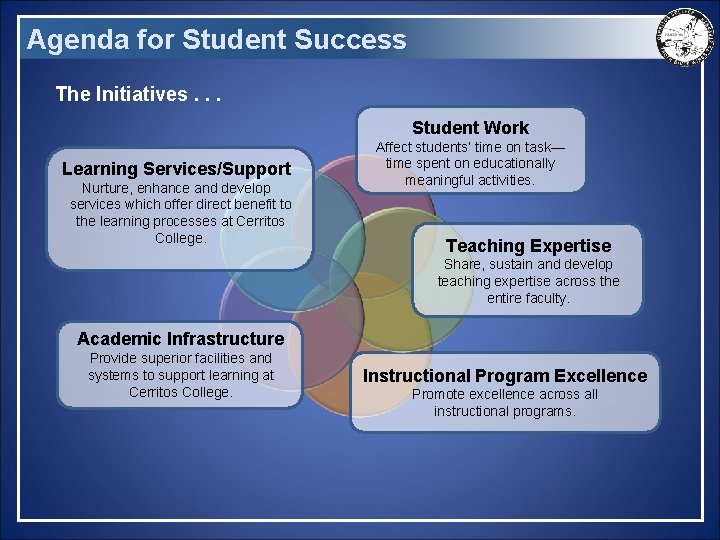
Agenda for Student Success The Initiatives. . . Student Work Learning Services/Support Nurture, enhance and develop services which offer direct benefit to the learning processes at Cerritos College. Affect students’ time on task— time spent on educationally meaningful activities. Teaching Expertise Share, sustain and develop teaching expertise across the entire faculty. Academic Infrastructure Provide superior facilities and systems to support learning at Cerritos College. Instructional Program Excellence Promote excellence across all instructional programs.
Habits of Mind (Overview) Student Work Initiative • Affect students’ time on task—time spent on educationally meaningful activities. • Habits of Mind is one of the projects under this initiative. Habits of Mind • Students need effective Habits of Mind to succeed. • The Habits of Mind campaign is one of the ways we propose to teach these skills to students.
Habits of Mind (Overview) The Need • Many Cerritos College students struggle academically because they do not have the practices, behaviors, or skills that are needed for a successful college experience. • Most of Cerritos College’s students possess at least one of the characteristics that put them most “at-risk” for dropping out of college or otherwise failing to achieve their educational goals: • 75% first-generation • 60% are low-income (receive some form of financial aid) • 93% require some form of remediation in math, reading, or both • 42% are second-language learners. • Many students are unaware of the practices that lead to successful learning because they are first-generation-students.
Goals and Objectives Primary Goals of Campaign • Raise awareness of the habits of mind across the entire student body (all 24, 000 students) • Increase the number of students that incorporate practices which lead to academic success. Objectives of Campaign • Introduce students to practices, behaviors, and attitudes that lead to success. • Invite students to join the academic community. • Prompt students to succeed with specific and proven approaches. • Assimilate students into a lifestyle centered around learning.
Breakout Session 1 What are “habits of mind”? • Carol Nancarrow, “Profile of a Quality Learner”: “Quality learners exhibit definable behaviors that optimize learning and predict successful performance. These behaviors can be classified and assessed. By recognizing these behaviors, learners and instructors can work towards ideal behaviors, and instructors can design instruction to foster grown-in learning behaviors. ” What academic habits do you most want your students to practice? • Academic habits are distinct from discipline-specific habits and apply across the curriculum • Take 10 minutes and create a list of 15 academic habits that your students need to learn or to reinforce • When possible, note specific examples of those habits as they benefit the student (or the effect when students fail to practice them)
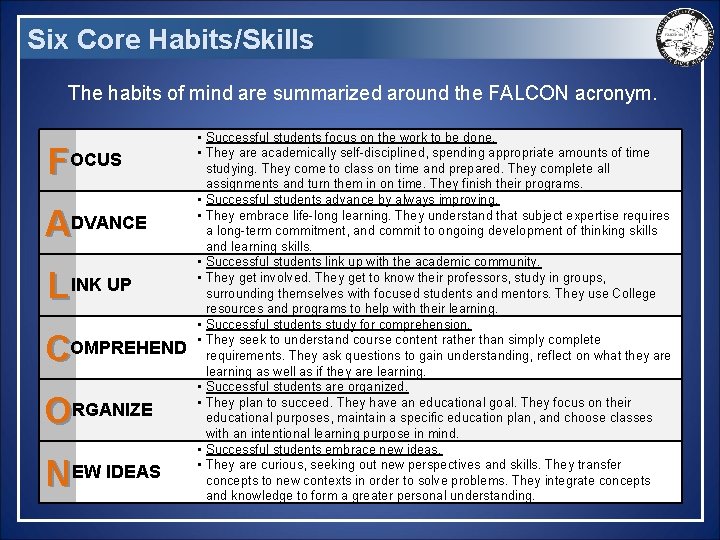
Six Core Habits/Skills The habits of mind are summarized around the FALCON acronym. FOCUS ADVANCE L INK UP COMPREHEND ORGANIZE NEW IDEAS • Successful students focus on the work to be done. • They are academically self-disciplined, spending appropriate amounts of time studying. They come to class on time and prepared. They complete all assignments and turn them in on time. They finish their programs. • Successful students advance by always improving. • They embrace life-long learning. They understand that subject expertise requires a long-term commitment, and commit to ongoing development of thinking skills and learning skills. • Successful students link up with the academic community. • They get involved. They get to know their professors, study in groups, surrounding themselves with focused students and mentors. They use College resources and programs to help with their learning. • Successful students study for comprehension. • They seek to understand course content rather than simply complete requirements. They ask questions to gain understanding, reflect on what they are learning as well as if they are learning. • Successful students are organized. • They plan to succeed. They have an educational goal. They focus on their educational purposes, maintain a specific education plan, and choose classes with an intentional learning purpose in mind. • Successful students embrace new ideas. • They are curious, seeking out new perspectives and skills. They transfer concepts to new contexts in order to solve problems. They integrate concepts and knowledge to form a greater personal understanding.
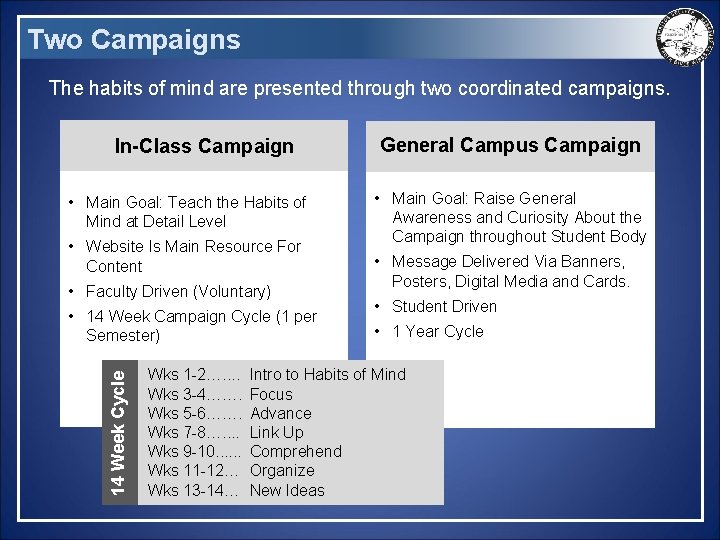
Two Campaigns The habits of mind are presented through two coordinated campaigns. In-Class Campaign • Main Goal: Teach the Habits of Mind at Detail Level • Website Is Main Resource For Content • Faculty Driven (Voluntary) 14 Week Cycle • 14 Week Campaign Cycle (1 per Semester) General Campus Campaign • Main Goal: Raise General Awareness and Curiosity About the Campaign throughout Student Body • Message Delivered Via Banners, Posters, Digital Media and Cards. • Student Driven • 1 Year Cycle Wks 1 -2…. . …… Intro to Habits of Mind Wks 3 -4………. . Focus Wks 5 -6………. Advance Wks 7 -8…. . . . Link Up Wks 9 -10. . . . Comprehend Wks 11 -12……. . Organize Wks 13 -14……. . New Ideas

Campaign Slogan and Logo Slogan/Hook • Do you falcon? i. Falcon. • Treats “falcon” as a verb. • “To falcon” is to practice the habits of mind. Logo i. Falcon Do you falcon? . com
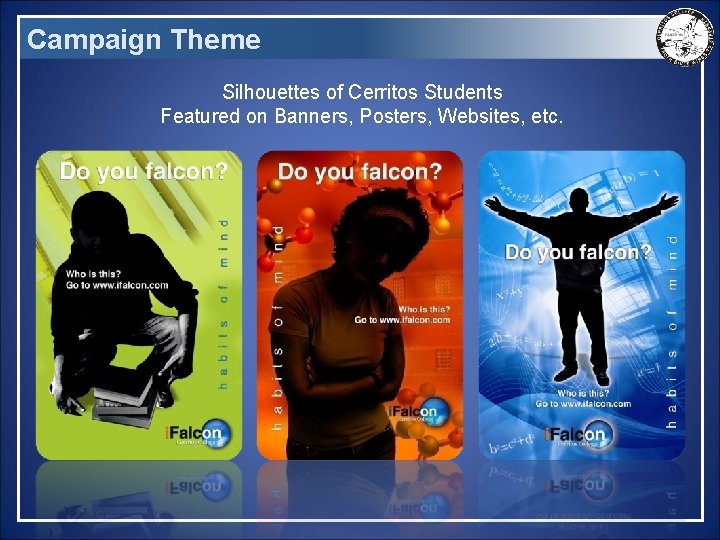
Campaign Theme Silhouettes of Cerritos Students Featured on Banners, Posters, Websites, etc.
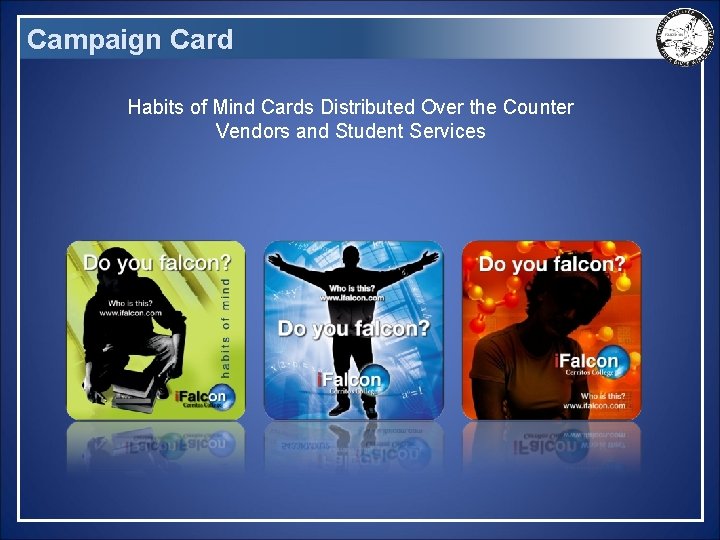
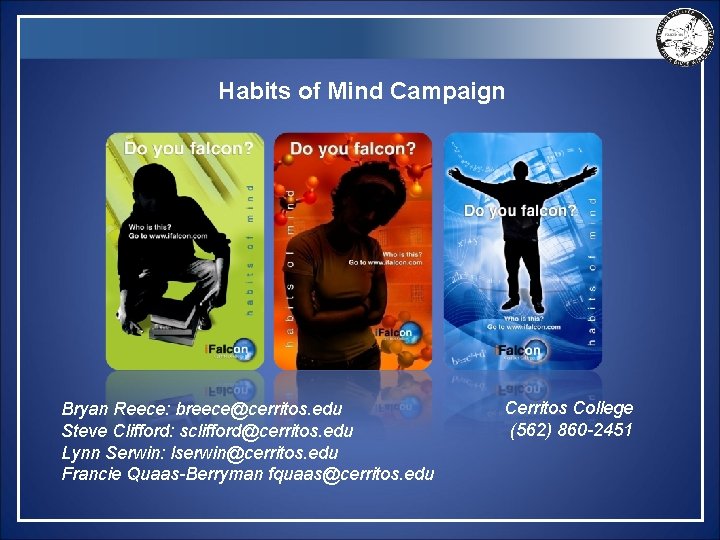
Campaign Card Habits of Mind Cards Distributed Over the Counter Vendors and Student Services
i. FALCON Website http: //www. cerritos. edu/ifalcon
Breakout Session 2 How Can You Implement a Habits of Mind Campaign? • Which habits of mind are most important for student success? • How will you “package” those habits of mind for ease of concept? • School mascot • Success-oriented language • Community-based symbol or imagery • Popular cultural allusions Practice: Define Your Habits of Mind • Take 10 minutes and create a list of academic habits that you want your students to learn or to reinforce • Manipulate the language of the academic skills to best fit your model • e. g. , “Focus” in FALCON becomes “Attention” in ANGELS or “Directed” in WILDCATS. • Take notes and be prepared to share your results
Making it Happen on Faculty • When you teach study skills, use the FALCON frame • Work FALCON into your courses and syllabi • Start teaching the Habits of Mind in the spring semester • Help develop content for i. Falcon website • Encourage colleagues to support this campaign on Students • Help develop campaign materials • Help promote the campaign • Encourage other students to adopt the Habits of Mind • Help recruit other students for videos and silhouette photos • Help identify and secure resources to launch and sustain the campaign
Making it Happen on Staff • If you come in contact with students, work this campaign into your routine—simple message • Encourage colleagues to support this effort • Develop a “counter” strategy for distributing cards • Contribute to the i. Falcon website content on Managers • Keep this on your agenda. Discuss it at meetings. • Contribute to the web content • Encourage your colleagues and programs to incorporate this effort • Help find resources to launch and sustain the program • Work the campaign into your exchanges with students
Making it Happen on Administration and Board • Encourage the entire college to support this effort • Contribute to the i. Falcon website content • Work the campaign into your exchanges with students • Keep this effort at the forefront of the College agenda • Help find resources to launch and sustain the program
Habits of Mind Campaign Bryan Reece: breece@cerritos. edu Steve Clifford: sclifford@cerritos. edu Lynn Serwin: lserwin@cerritos. edu Francie Quaas-Berryman fquaas@cerritos. edu Cerritos College (562) 860 -2451
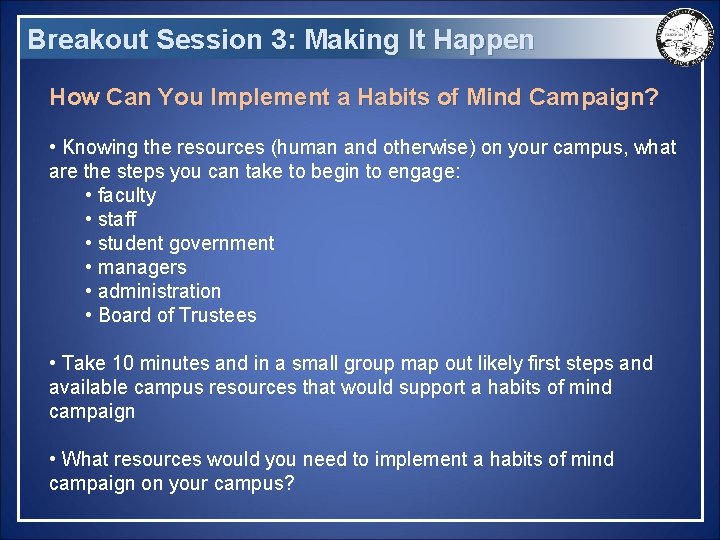
Breakout Session 3: Making It Happen How Can You Implement a Habits of Mind Campaign? • Knowing the resources (human and otherwise) on your campus, what are the steps you can take to begin to engage: • faculty • staff • student government • managers • administration • Board of Trustees • Take 10 minutes and in a small group map out likely first steps and available campus resources that would support a habits of mind campaign • What resources would you need to implement a habits of mind campaign on your campus?
- Slides: 18