
Creating a Balance Professionalism Communication and Students with
Creating a Balance: Professionalism, Communication, and Students with Disabilities Neera R. Jain, MS, CRC University of California, San Francisco Lisa M. Meeks, Ph. D UCSF School of Medicine Dr. Maxine A. Papadakis, MD UCSF School of Medicine Elisa Laird Metke, JD Samuel Merritt University (Moderator)
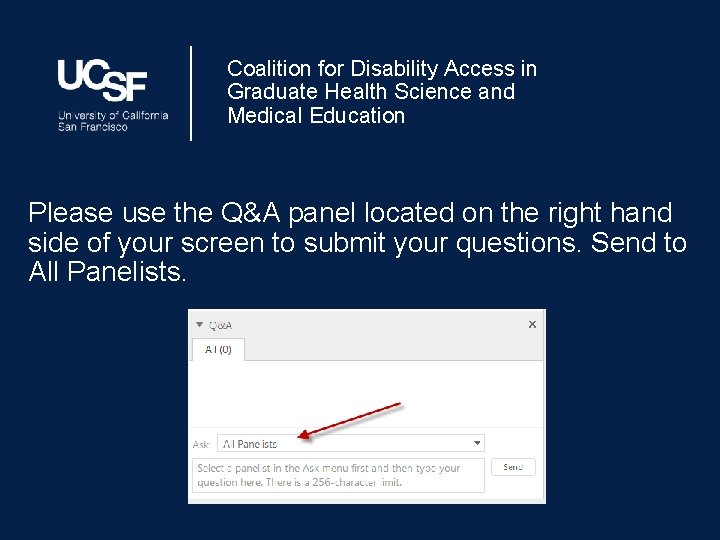
Coalition for Disability Access in Graduate Health Science and Medical Education Please use the Q&A panel located on the right hand side of your screen to submit your questions. Send to All Panelists.
Coalition for Disability Access in Graduate Health Science and Medical Education The Coalition wishes to thank the AAMC and for their generous support in developing this webinar series.
Overview §What is Professionalism? §Importance of professional communication §Using the communication guide §Shaping student communication §Supporting faculty communication §Guiding principles §Questions? 3/3/2021
Professionalism “Medical professionalism is a belief system about how best to organize and deliver health care, which calls on group members to jointly declare (“profess”) what the public and individual patients can expect regarding shared competency standards and ethical values, and to implement trustworthy means to ensure that all medical professionals live up to these promises. ” Wynia MK, Papadakis MA et al. More than a list of values and desired behaviors: a foundational understanding of medical professionalism. Acad Med. 2014 5 3/3/2021

Professionalism in Medicine § Forming relationships with patients, health care team members based on respect, integrity, and responsiveness to others needs § Applying ethical standards to professional practice § Professionalism lapses in medical students and residents are predictive of lapses in future professional behavior 1 § Students who were “irresponsible” in medical school were more likely to be disciplined as doctors 1 1 Papadakis MA et al. , 2005; Papadakis MA et al. , 2008. 6 3/3/2021
How is medical school unique? § Expectation of high self-direction and -advocacy in behavior and learning § Language and communication are part of core “professionalism” competency § Communication is a critical part of patient care and patient safety § Expectations of communication and behavior in the clinic are often not clearly articulated § Students must navigate unspoken rules and hierarchies of the clinical environment § Faculty and students will soon become part of one professional network § Environment can trigger “role confusion” § Performance expectations are greater than in previous settings 7 3/3/2021
Disability & Professionalism § A student’s professionalism, especially regarding communication skills, is critical to making an effective transition into medical school § University personnel have added responsibilities to ensure students understand What, Where, When and How to communicate their disability-related needs. § Students with disabilities have added responsibilities in the educational environment, they must: • Disclose their disability to the university designee • Request accommodations • Engage with DS providers and multiple stakeholders • Work with faculty/staff to access approved accommodations 8 3/3/2021
Common pitfalls in communication: Students § Late notification of a need for accommodations § Sending overly brief or excessively lengthy and detailed communication § Taking an overly defensive, emotional, or aggressive stance in communication § Failure to request assistance § Lack of clarity on who to notify (See Webinar #5) § Delicate balance of disclosing disability to those who evaluate them. 9 3/3/2021
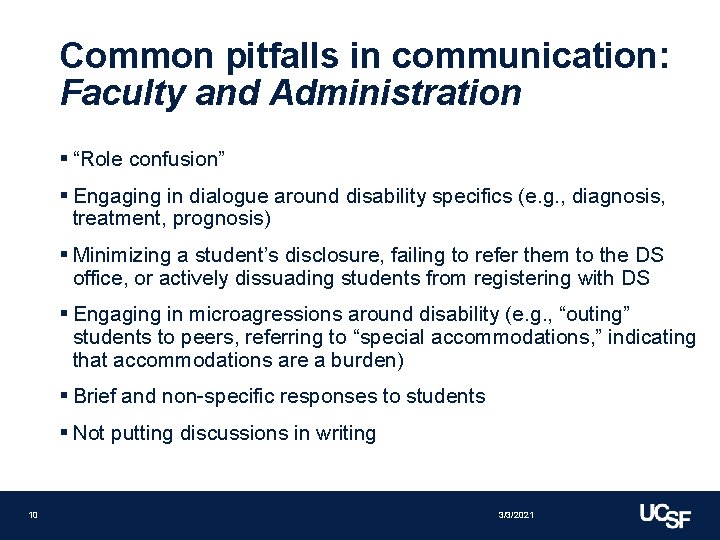
Common pitfalls in communication: Faculty and Administration § “Role confusion” § Engaging in dialogue around disability specifics (e. g. , diagnosis, treatment, prognosis) § Minimizing a student’s disclosure, failing to refer them to the DS office, or actively dissuading students from registering with DS § Engaging in microagressions around disability (e. g. , “outing” students to peers, referring to “special accommodations, ” indicating that accommodations are a burden) § Brief and non-specific responses to students § Not putting discussions in writing 10 3/3/2021
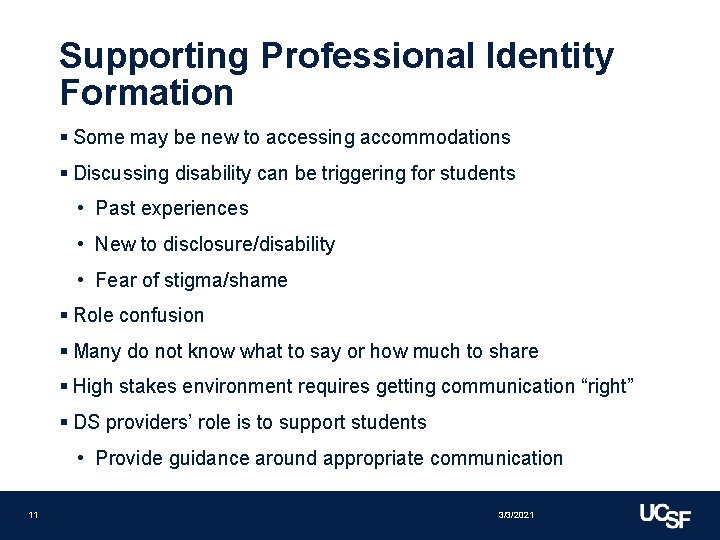
Supporting Professional Identity Formation § Some may be new to accessing accommodations § Discussing disability can be triggering for students • Past experiences • New to disclosure/disability • Fear of stigma/shame § Role confusion § Many do not know what to say or how much to share § High stakes environment requires getting communication “right” § DS providers’ role is to support students • Provide guidance around appropriate communication 11 3/3/2021
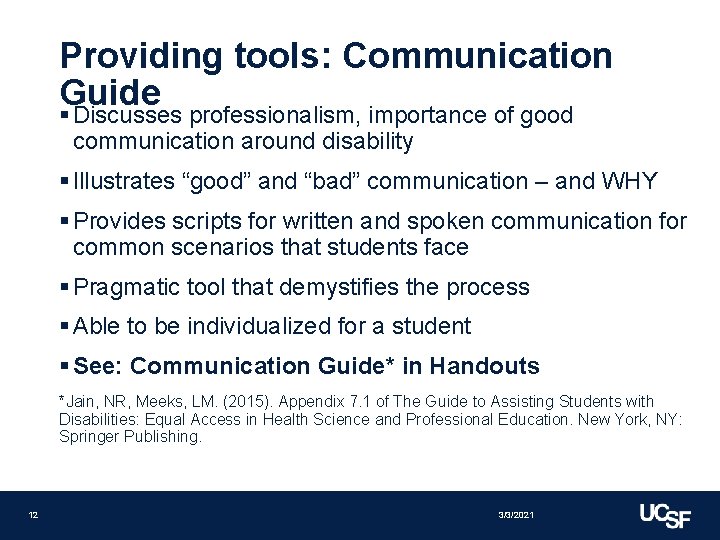
Providing tools: Communication Guide § Discusses professionalism, importance of good communication around disability § Illustrates “good” and “bad” communication – and WHY § Provides scripts for written and spoken communication for common scenarios that students face § Pragmatic tool that demystifies the process § Able to be individualized for a student § See: Communication Guide* in Handouts *Jain, NR, Meeks, LM. (2015). Appendix 7. 1 of The Guide to Assisting Students with Disabilities: Equal Access in Health Science and Professional Education. New York, NY: Springer Publishing. 12 3/3/2021
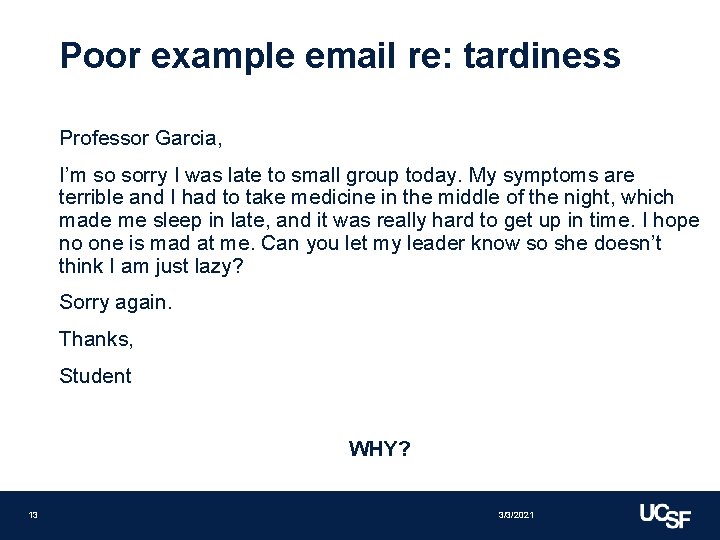
Poor example email re: tardiness Professor Garcia, I’m so sorry I was late to small group today. My symptoms are terrible and I had to take medicine in the middle of the night, which made me sleep in late, and it was really hard to get up in time. I hope no one is mad at me. Can you let my leader know so she doesn’t think I am just lazy? Sorry again. Thanks, Student WHY? 13 3/3/2021
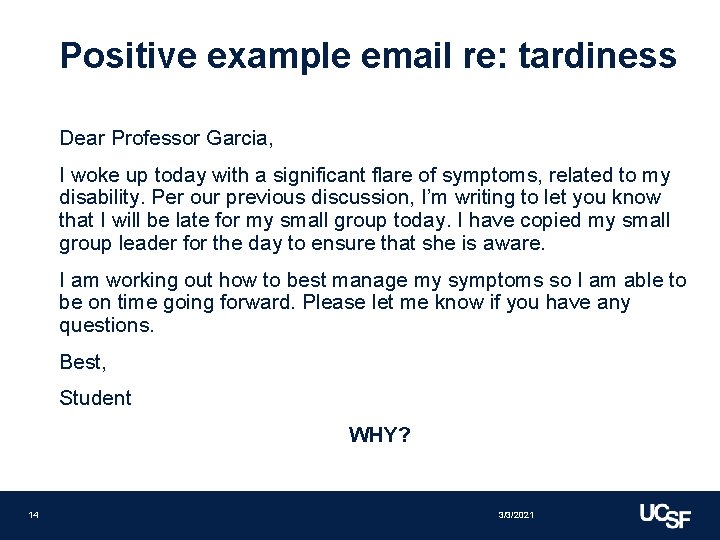
Positive example email re: tardiness Dear Professor Garcia, I woke up today with a significant flare of symptoms, related to my disability. Per our previous discussion, I’m writing to let you know that I will be late for my small group today. I have copied my small group leader for the day to ensure that she is aware. I am working out how to best manage my symptoms so I am able to be on time going forward. Please let me know if you have any questions. Best, Student WHY? 14 3/3/2021
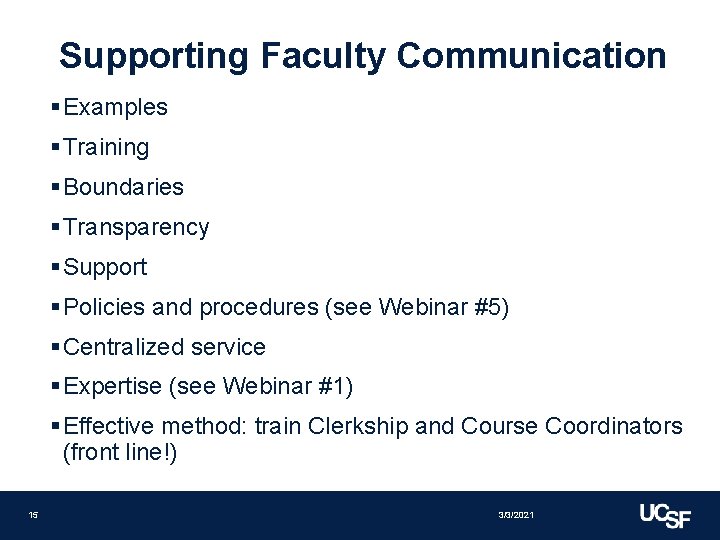
Supporting Faculty Communication § Examples § Training § Boundaries § Transparency § Support § Policies and procedures (see Webinar #5) § Centralized service § Expertise (see Webinar #1) § Effective method: train Clerkship and Course Coordinators (front line!) 15 3/3/2021
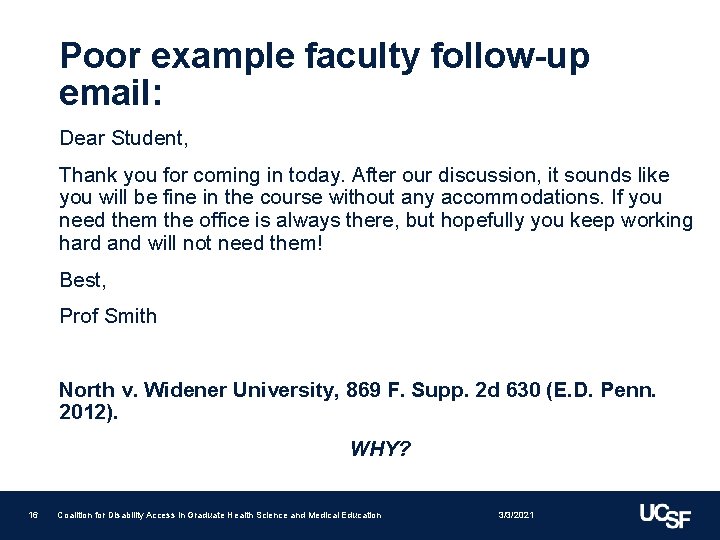
Poor example faculty follow-up email: Dear Student, Thank you for coming in today. After our discussion, it sounds like you will be fine in the course without any accommodations. If you need them the office is always there, but hopefully you keep working hard and will not need them! Best, Prof Smith North v. Widener University, 869 F. Supp. 2 d 630 (E. D. Penn. 2012). WHY? 16 Coalition for Disability Access in Graduate Health Science and Medical Education 3/3/2021
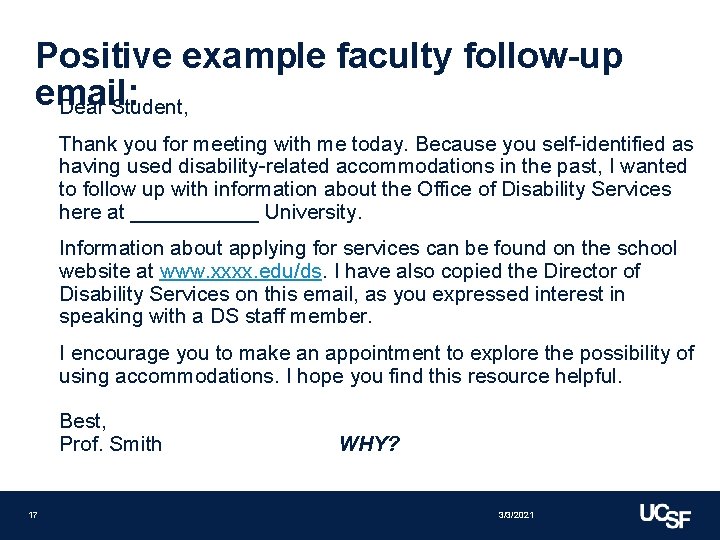
Positive example faculty follow-up email: Dear Student, Thank you for meeting with me today. Because you self-identified as having used disability-related accommodations in the past, I wanted to follow up with information about the Office of Disability Services here at ______ University. Information about applying for services can be found on the school website at www. xxxx. edu/ds. I have also copied the Director of Disability Services on this email, as you expressed interest in speaking with a DS staff member. I encourage you to make an appointment to explore the possibility of using accommodations. I hope you find this resource helpful. Best, Prof. Smith WHY? 17 3/3/2021
Guiding Principles for Communication § Be clear and concise. § Communicate and follow up in a timely manner. § Ensure that faculty are aware of the expected processes for accessing and providing accommodations § When difficulty arises: involve DS immediately to avoid any delay or disruption to services. § Take responsibility for following up. § Students are not obligated to disclose personal information unrelated to arranging accommodations to faculty or administrators. § Give students the tools to communicate effectively 18 3/3/2021
Questions? 19 3/3/2021
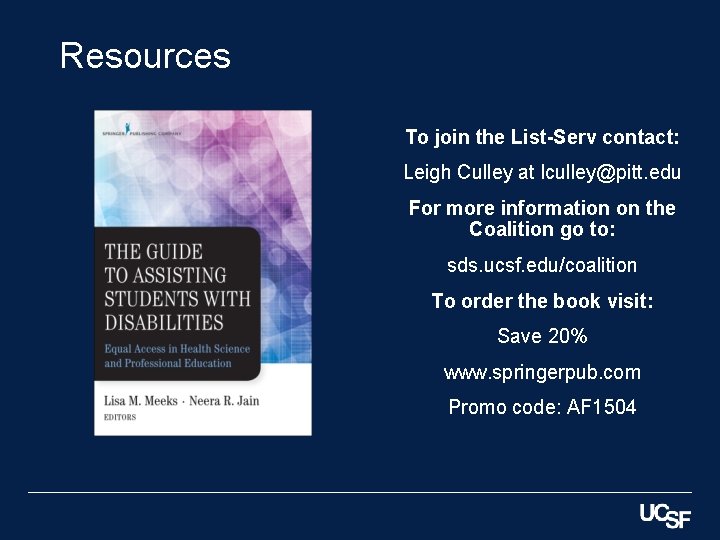
Resources To join the List-Serv contact: Leigh Culley at lculley@pitt. edu For more information on the Coalition go to: sds. ucsf. edu/coalition To order the book visit: Save 20% www. springerpub. com Promo code: AF 1504
Be sure to register for the next webinar “Q & A” (10/21/15) Details and Registration can be found: www. aamc. org/gsa
- Slides: 21