
CREATED AND PRESENTED BY SIMRAN THAKKAR WHAT IS
CREATED AND PRESENTED BY: SIMRAN THAKKAR
WHAT IS CROWDFUNDING? • Crowdfunding unites individuals who are willing to invest in creative people to launch their products or services. • It is combination of crowdsourcing and microfinance. • It is a new way businesses and companies raise money to fund projects. • Being at its start, the evaluation given by Massolution’s Global Crowdfunding report states it will soon be a $300 billion industry.
PRIMARY CATEGORIES OF CROWDFUNDING • Reward based crowdfunding: People can pledge money to boost a creative art project, a novel or a music album. The reward can be anything like a sample product or a thank you note. • Peer-to-Peer Lending: Similar to lending money to a friend, it has some risks but this platform is perfect for such risk takers. There are organizations like Leading. Club or Prosper who find such loan portfolios and fund individuals or companies.
PRIMARY CATEGORIES OF CROWDFUNDING • Donation Based Crowdfunding: Helping small scale entrepreneurs to survive by either direct funding some amount or providing monthly inventory or paying of bills. Companies such as Kiva. org and Go. Fund. Me have being doing such donations since over a decade. • Equity Crowdfunding: Being the smallest part of the crowdfunding family, it helps in providing real investments in private companies. Like funding a start up and these donations can be as little as $1000. • Real Estate and Human Capital: A secluded part where people can invest in live properties or fund property models. Under human capital funding, people can fund sports stars and even support youngsters who need help with their education fees.
HOW DO THEY DO IT? • Popular websites like Go. Fund. Me, Indiegogo and Kickstarter help people all around the world to accomplish their dreams by helping them build a profile and share their story. Investors, also addressed as backers, help by recognizing such campaigns and start funding. • Every individual who is willing to make an anonymous donations can sign up and see all the active campaigns, their funding status, their pledge amount and can decide to fund it.
HOW DO THEY MAKE MONEY? • Companies such as Kickstarter, Go. Fund. Me, and Indiegogo make money by the following means: 1. Kickstarter keeps 5% of the total money funded. 2. Go. Fund. Me charges a processing fees of 2. 9%+ $0. 30 on each donation made. 3. Indiegogo keeps 4% of the total money funded. All these websites also earn money via online advertisements.
DIFFERENTIATING: Advantages • Cheapest way to raise capital. Disadvantages • No collateral or credit check required. • Donations from individual and collecting large capital can be difficult. • You hold on all the equity and control of your organization. • If goal not reached, penalty can be applied. • Helps in raising brand awareness and customer base • Theft of ideas and business models.
SUCCESSFUL CAMPAIGNS ON KICKSTARTER: • Launched in 2009, Kickstarter has had more than 12 million donations and still counting. • Not every campaign is successful but 116, 462 such campaigns have got a chance try existing and growing in the economy. • With the help of Kickstarter, the first smart watch was introduced the market called, “ The Pebble Smart Watch”.
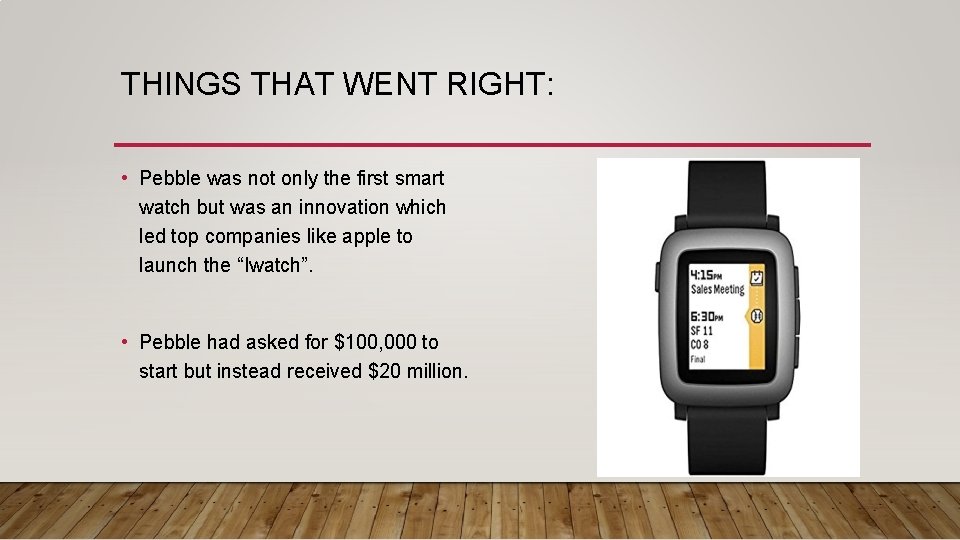
THINGS THAT WENT RIGHT: • Pebble was not only the first smart watch but was an innovation which led top companies like apple to launch the “Iwatch”. • Pebble had asked for $100, 000 to start but instead received $20 million.
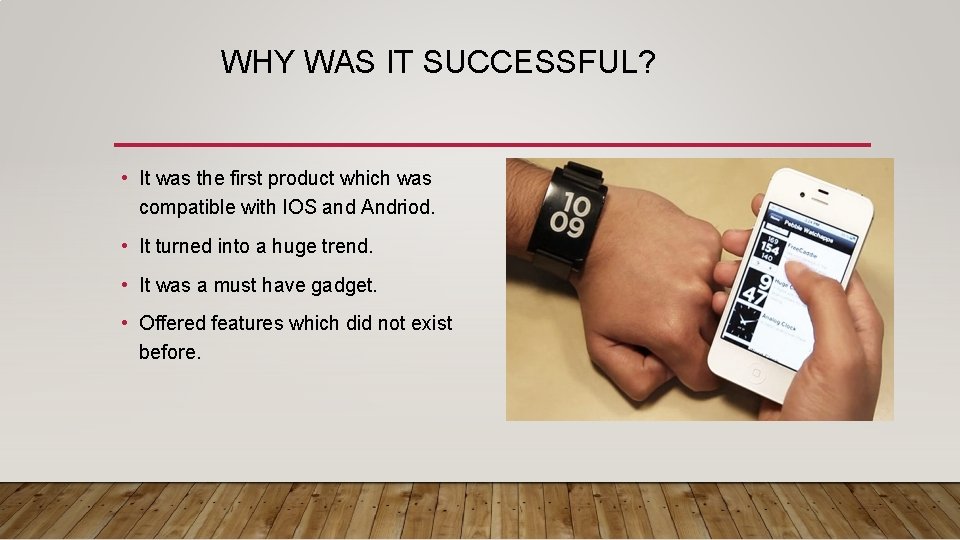
WHY WAS IT SUCCESSFUL? • It was the first product which was compatible with IOS and Andriod. • It turned into a huge trend. • It was a must have gadget. • Offered features which did not exist before.
HOW DID CROWDFUNDING HELP PEBBLE? • The CEO of Pebble, “Eric Migicovsky” explains that the idea was a boost for both Pebble and Kickstarter. • Being a backer, Pebble tried to post a campaign with the plans to find investors. • Within a month, Pebble was recognized as the most advance technology available and gathered attention. • This was beneficial for both as, Pebble successfully raised $20 million and the concept of crowdfunding was introduced to millions of people.
TIPS ON SUCCESSFUL CAMPAIGNS: • Be the face of your campaign. Be involved in anything and everything if its about your product. • Give investors a reason to help. • Don’t be afraid to present or advertise your product. • Send exciting rewards to investors. • Quality matters over quantity.
HERE ARE SOME CAMPAIGNS THAT FAILED: • ZANO: This organization introduced a drone to clicked high quality images but the product failed because Zano failed to deliver their products to customers. • Little Eatz: Introduced cookies which were meant to be edible for humans and dogs. This campaign raised only $250. • FND Films: A group of comedians from Chicago planned to produce a movie and raised $75, 000. The production did not take place for 3 years and raised suspicion.
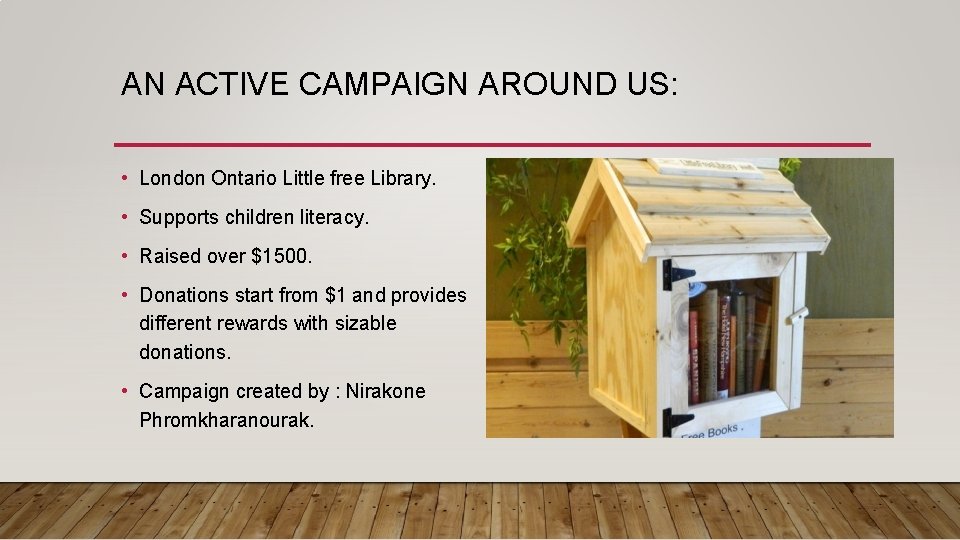
AN ACTIVE CAMPAIGN AROUND US: • London Ontario Little free Library. • Supports children literacy. • Raised over $1500. • Donations start from $1 and provides different rewards with sizable donations. • Campaign created by : Nirakone Phromkharanourak.
REFERENCES: • What is crowdfunding? https: //www. thebalance. com/a-guide-what-iscrowdfunding-985100 • How it works: https: //www. nerdwallet. com/blog/small-business/rewardcrowdfunding/ • Kickstater: https: //www. kickstarter. com/help/stats? ref=about_subnav • Gofundme: https: //www. gofundme. com/tour

- Slides: 16