
Create Great Group Discussions A Step by Step
Create Great Group Discussions! A Step by Step Guide & Practice for Group Discussion Facilitators Janice L. Benson, MD U of Chicago/North. Shore University Health System Alicia Vazquez, MD Cook County-Loyola-Provident Family Residency Program Eve Pinsker, PHD UIC School of Public Health The Cook County Family Medicine Faculty Development Program
Disclosures • Presenters have no disclosures • Thanks to HRSA title 7 D 55 HP 20647 – funding support for 2010 -2015.
Objectives/Agenda • Review one program’s recent 5 -year experience in teaching group discussion skills • Review good principles for Group Discussion • Apply step-by-step guide • Participate and assess an impromptu group discussion • Debrief large group, share/compare experiences, roles.
Introduction • Who we are – Public hospital-based FM faculty development program – 1984 -present—over 30 years of training grads – Comprehensive 5 -year grant to improve teaching skills and curriculum design skills in yearlong program – Micro skill method-program’s success and reputation • Trainees/fellows ALWAYS have 2 session skill lessons – Group discussion skills one of the 3 key teaching skills • Grads to date, 5 years 2010 -2015 • Evaluations show trainees and fellows improved in their group discussion skills

Introduction • What we do: – Yearlong traineeship & fellowship – 5 daylong teaching skills workshops – Participants-senior residents & fellows – Teaching skills=Lecture, group discussion, 1: 1 clinical precepting skills – Design one interactive session- lecture and group discussion elements – all complete one small group discussion
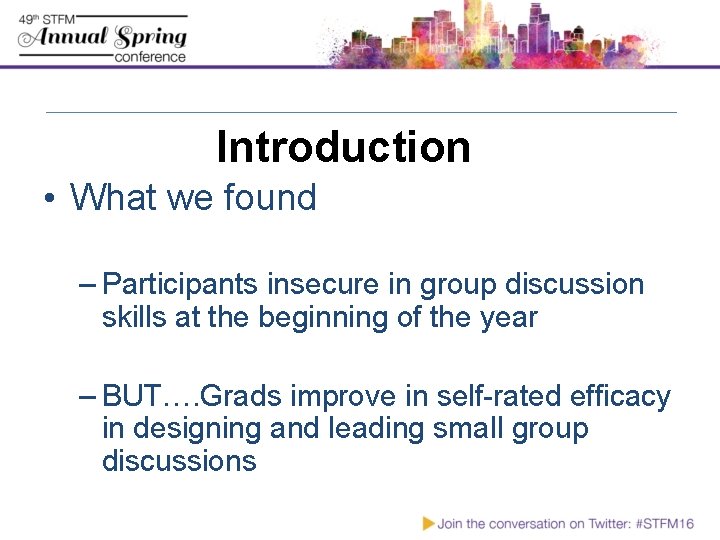
Introduction • What we found – Participants insecure in group discussion skills at the beginning of the year – BUT…. Grads improve in self-rated efficacy in designing and leading small group discussions
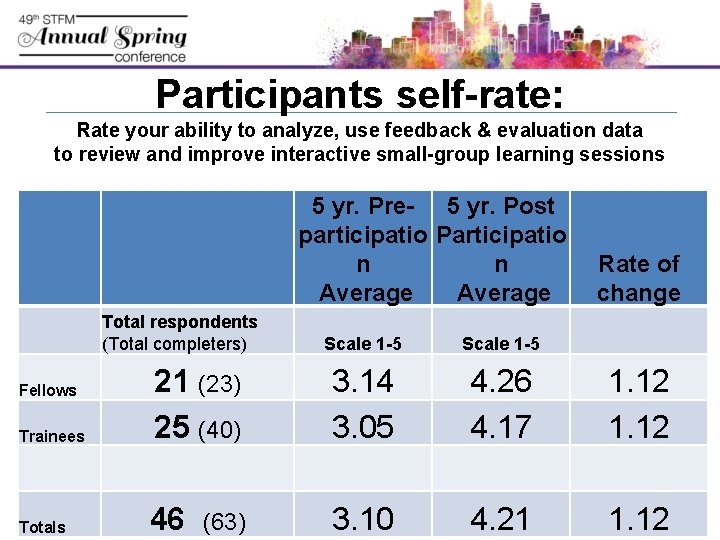
Participants self-rate: Rate your ability to analyze, use feedback & evaluation data to review and improve interactive small-group learning sessions 5 yr. Pre- 5 yr. Post participatio Participatio n n Average Total respondents (Total completers) Rate of change Scale 1 -5 Trainees 21 (23) 25 (40) 3. 14 3. 05 4. 26 4. 17 1. 12 Totals 46 3. 10 4. 21 1. 12 Fellows (63)
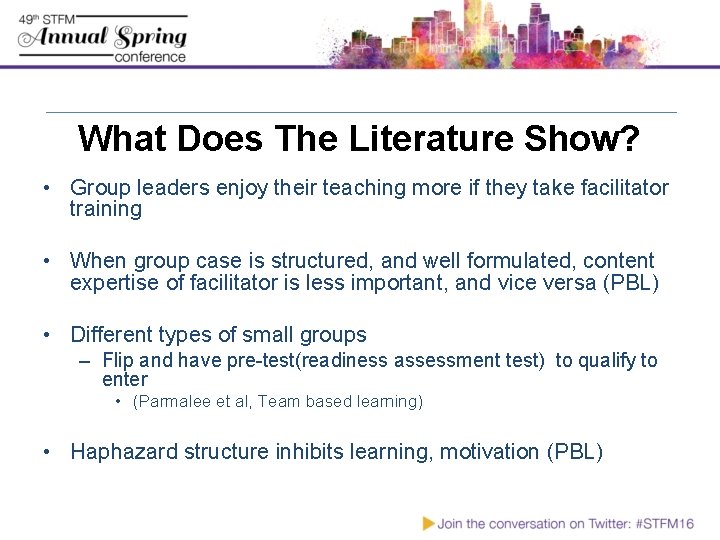
What Does The Literature Show? • Group leaders enjoy their teaching more if they take facilitator training • When group case is structured, and well formulated, content expertise of facilitator is less important, and vice versa (PBL) • Different types of small groups – Flip and have pre-test(readiness assessment test) to qualify to enter • (Parmalee et al, Team based learning) • Haphazard structure inhibits learning, motivation (PBL)

Small Groups Work Well For: � Small Group Reflection exercise – “Best Teacher”, ‘best lecturer” attributes � Role plays – Used to practice skills, e. g. precepting � Small group ‘Fish bowl” exercise – Used to reinforce knowledge, e. g. PCV vaccines � “Design Studio”- Work in session – Create interactive sessions and curriculum product � Other didactic forms – Board review and journal club sessions
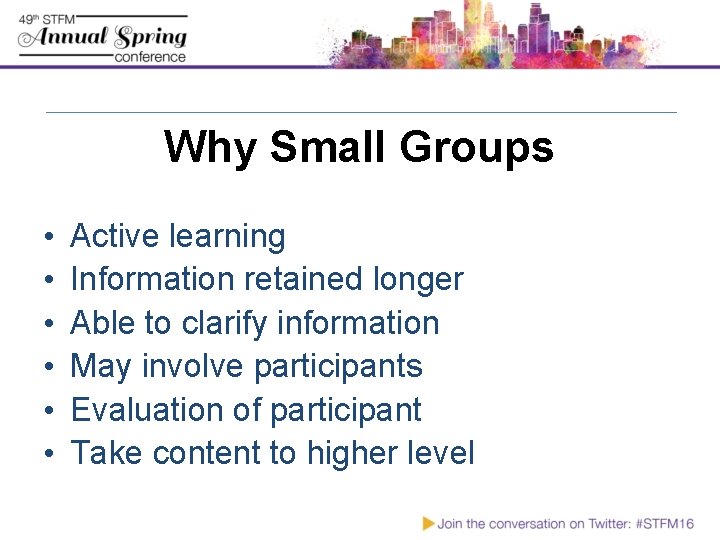
Why Small Groups • • • Active learning Information retained longer Able to clarify information May involve participants Evaluation of participant Take content to higher level
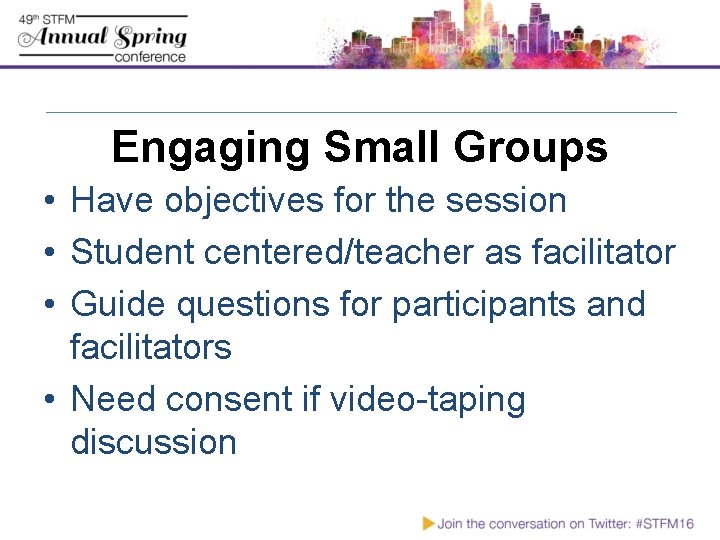
Engaging Small Groups • Have objectives for the session • Student centered/teacher as facilitator • Guide questions for participants and facilitators • Need consent if video-taping discussion
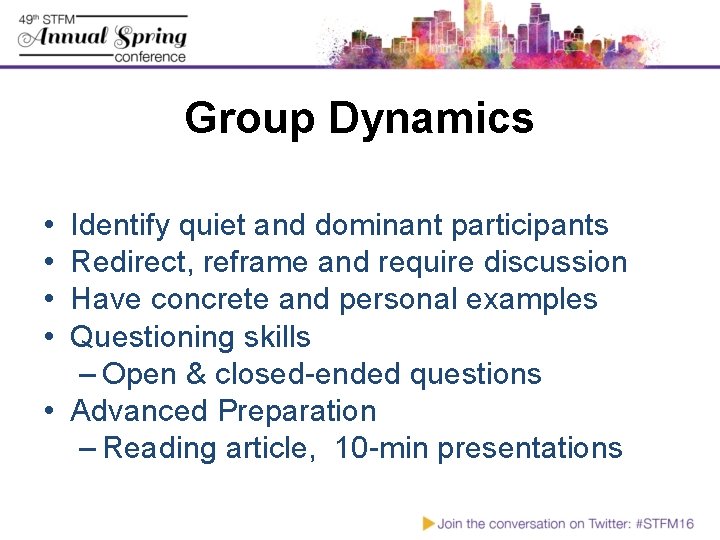
Group Dynamics • • Identify quiet and dominant participants Redirect, reframe and require discussion Have concrete and personal examples Questioning skills – Open & closed-ended questions • Advanced Preparation – Reading article, 10 -min presentations
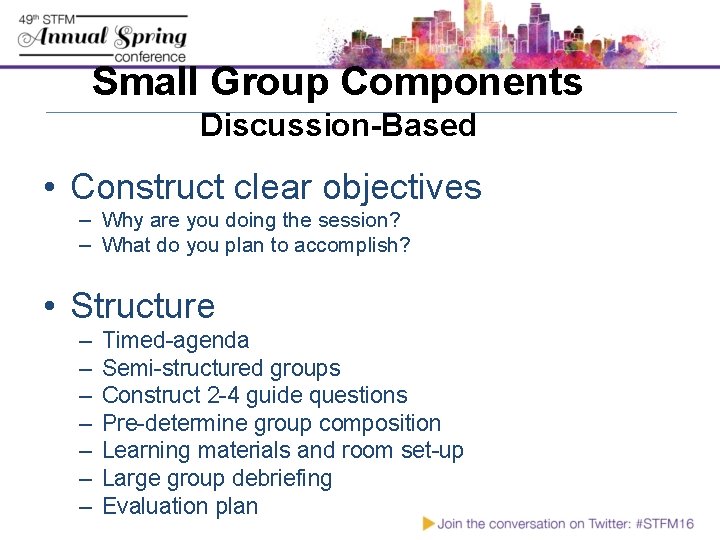
Small Group Components Discussion-Based • Construct clear objectives – Why are you doing the session? – What do you plan to accomplish? • Structure – – – – Timed-agenda Semi-structured groups Construct 2 -4 guide questions Pre-determine group composition Learning materials and room set-up Large group debriefing Evaluation plan
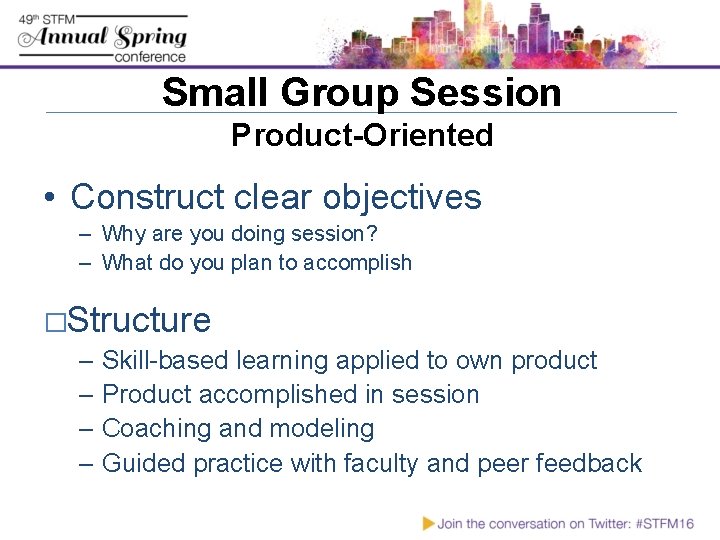
Small Group Session Product-Oriented • Construct clear objectives – Why are you doing session? – What do you plan to accomplish �Structure – Skill-based learning applied to own product – Product accomplished in session – Coaching and modeling – Guided practice with faculty and peer feedback
Construct S. M. A. R. T. Objectives • • • Specific Measurable Attainable/achievable Realistic Timely Behavioral Objectives • Behavior of learner-use action verbs • Condition-what is the context • Evaluation-how will you know objective has been achieved
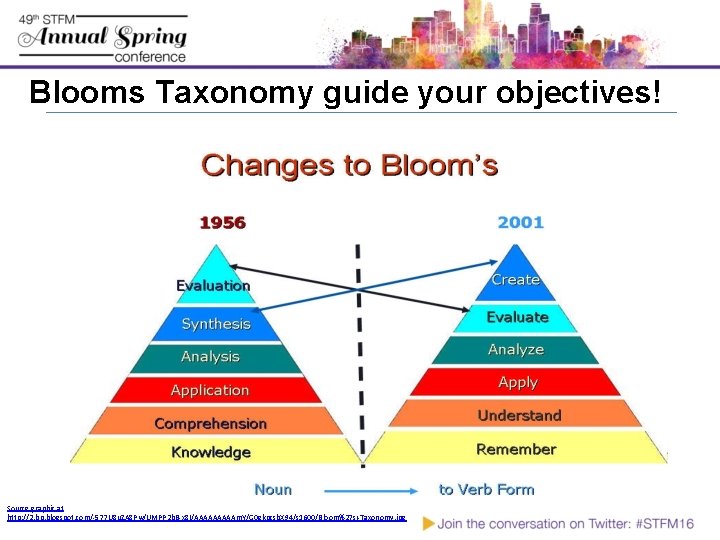
Blooms Taxonomy guide your objectives! Source graphic at http: //2. bp. blogspot. com/-577 U 8 u. ZA 8 Pw/UMPP 2 b. B-x 8 I/AAAAAm. Y/G 0 gkpcsb. X 94/s 1600/Bloom%27 s+Taxonomy. jpg
Design your own small group (instructions) • • Topic (case, reflection, journal article) SMART objectives Timed agenda Guide questions Instructions to facilitator Room prep & AV prep notes Large group wrap-up Evaluation
Small Group Activity • FISHBOWL-about 10 minutes – Inner group • Need 4 -5 volunteers for inner group, facilitated by one presenter – Outside group • • • Active observation of inner group Take notes, using quotes Watch facilitator, group dynamics Study communication- verbal/nonverbal Optional, take notes on content that you hear
Guide Questions 1. Share GREAT group experiences you have had. -as a participant -as a facilitator 2. What “BAD” group experiences have you had? -as a participant? -as a facilitator? 3. Do you have any resources, advise or tips to others to create group discussions? 4. If time permits: (Share your newly created draft plan)
Summary • Reviewed Group Discussion principles • Practiced with step-by-step planning guide • Participated, assessed impromptu group discussion • Debriefed in large group, shared/compared experiences, roles. • Reviewed resources to use back home.
Please evaluate this presentation using the conference mobile app! Simply click on the "clipboard" icon on the presentation page.
- Slides: 21