
Creams An introduction it is not 1 KAUSAR
- Slides: 19
Creams An introduction it is not 1 KAUSAR AHMAD KULLIYYAH OF PHARMACY, IIUM http: //staff. iium. edu. my/akausar PHM 4153 Dosage Design 2 2010/11
Contents 2 �Types of creams �Mode of action �Factors influencing efficacy PHM 4153 Dosage Design 2 2010/11
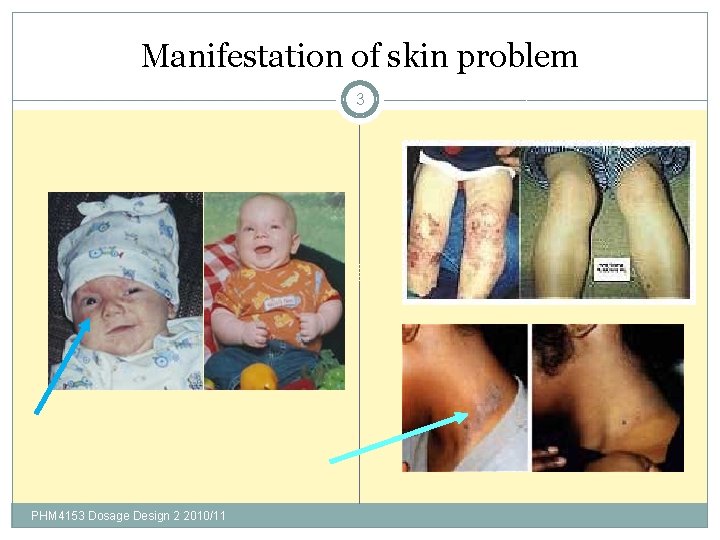
Manifestation of skin problem 3 PHM 4153 Dosage Design 2 2010/11
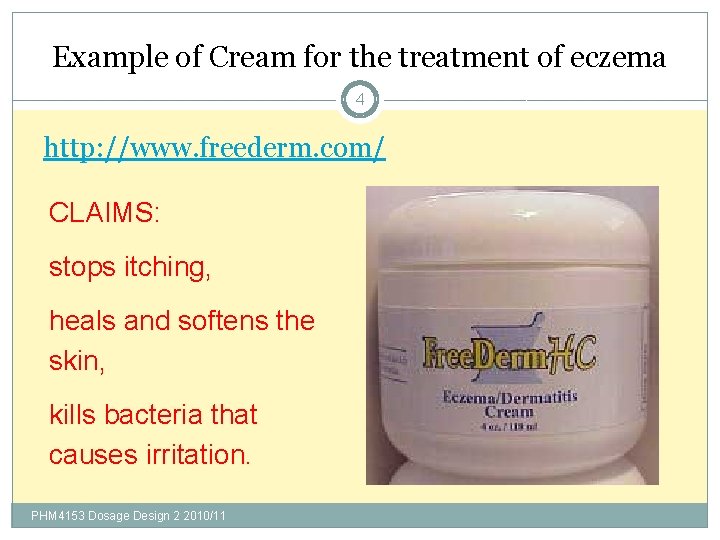
Example of Cream for the treatment of eczema 4 http: //www. freederm. com/ CLAIMS: stops itching, heals and softens the skin, kills bacteria that causes irritation. PHM 4153 Dosage Design 2 2010/11
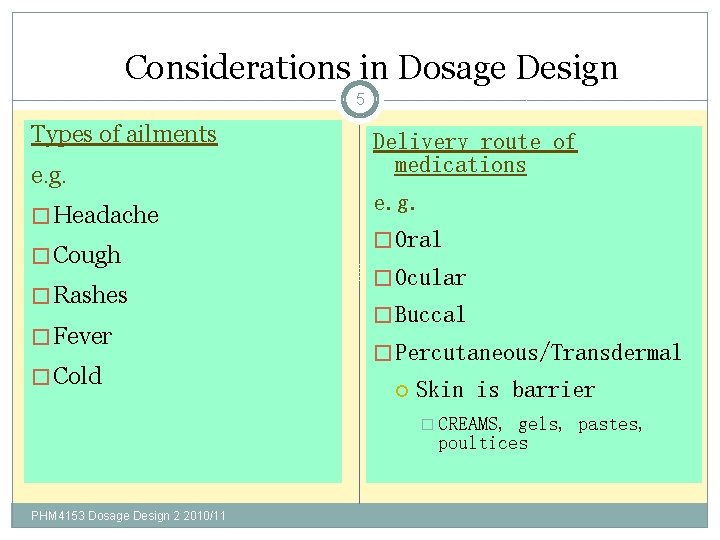
Considerations in Dosage Design 5 Types of ailments e. g. � Headache � Cough � Rashes � Fever � Cold Delivery route of medications e. g. � Oral � Ocular � Buccal � Percutaneous/Transdermal Skin is barrier � CREAMS, gels, pastes, poultices PHM 4153 Dosage Design 2 2010/11
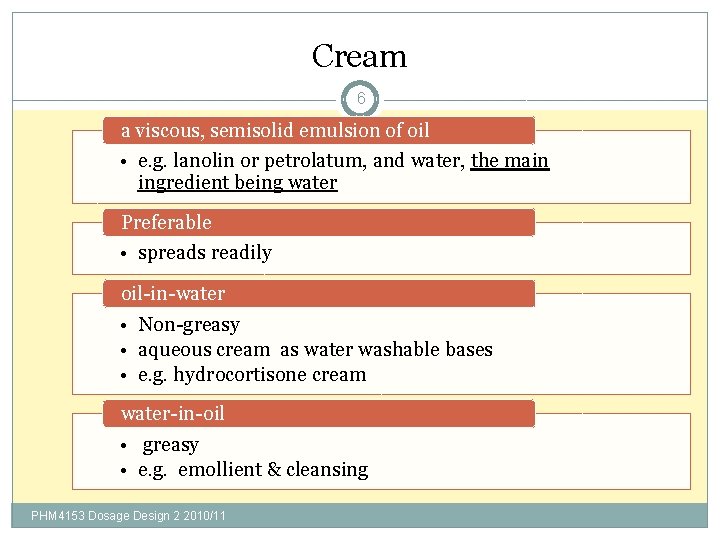
Cream 6 a viscous, semisolid emulsion of oil • e. g. lanolin or petrolatum, and water, the main ingredient being water Preferable • spreads readily oil-in-water • Non-greasy • aqueous cream as water washable bases • e. g. hydrocortisone cream water-in-oil • greasy • e. g. emollient & cleansing PHM 4153 Dosage Design 2 2010/11
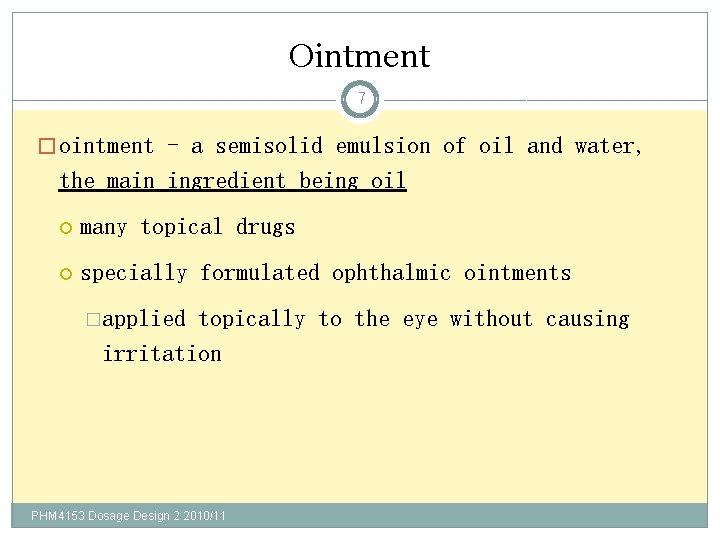
Ointment 7 � ointment - a semisolid emulsion of oil and water, the main ingredient being oil many topical drugs specially formulated ophthalmic ointments �applied topically to the eye without causing irritation PHM 4153 Dosage Design 2 2010/11
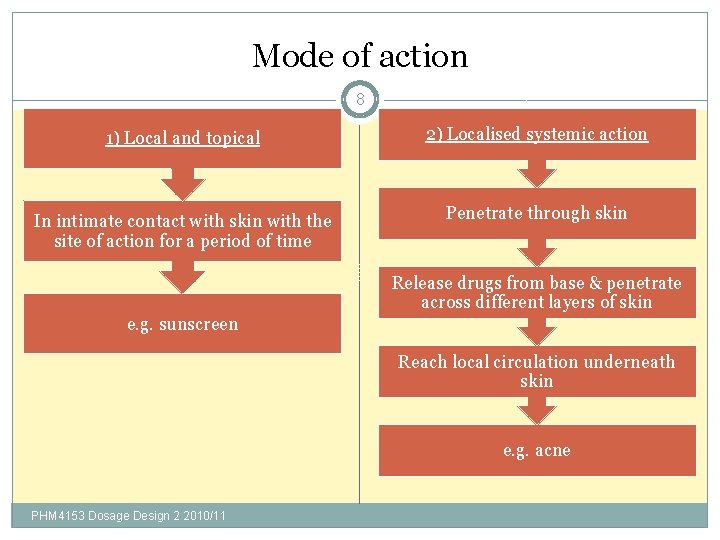
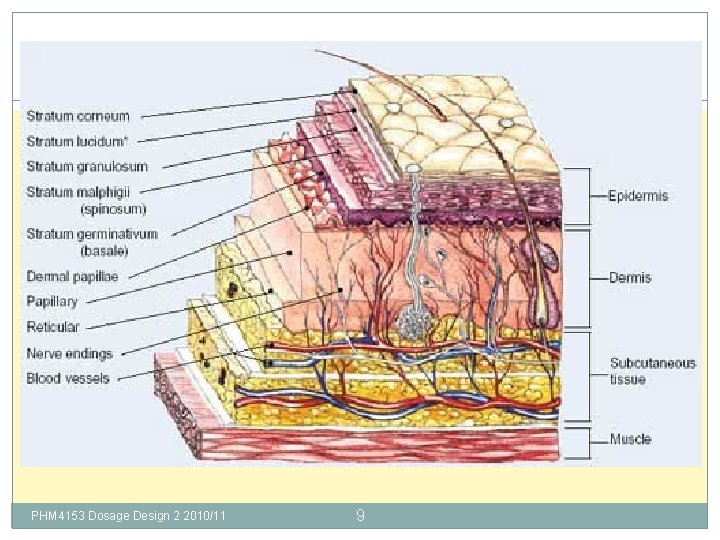
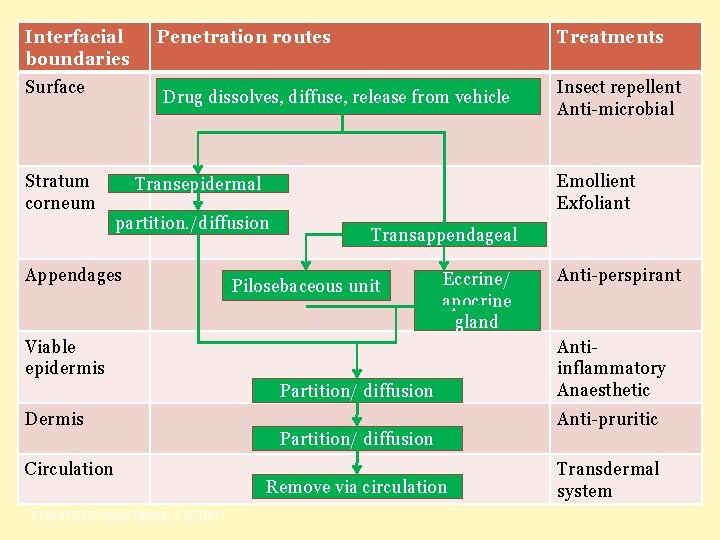
Mode of action 8 1) Local and topical 2) Localised systemic action In intimate contact with skin with the site of action for a period of time Penetrate through skin Release drugs from base & penetrate across different layers of skin e. g. sunscreen Reach local circulation underneath skin e. g. acne PHM 4153 Dosage Design 2 2010/11
PHM 4153 Dosage Design 2 2010/11 9
Interfacial boundaries Surface Stratum corneum Penetration routes Treatments Drug dissolves, diffuse, release from vehicle 10 Emollient Exfoliant Transepidermal partition. /diffusion Appendages Transappendageal Pilosebaceous unit Eccrine/ apocrine gland Viable epidermis Partition/ diffusion Dermis Circulation PHM 4153 Dosage Design 2 2010/11 Insect repellent Anti-microbial Partition/ diffusion Remove via circulation Anti-perspirant Antiinflammatory Anaesthetic Anti-pruritic Transdermal system
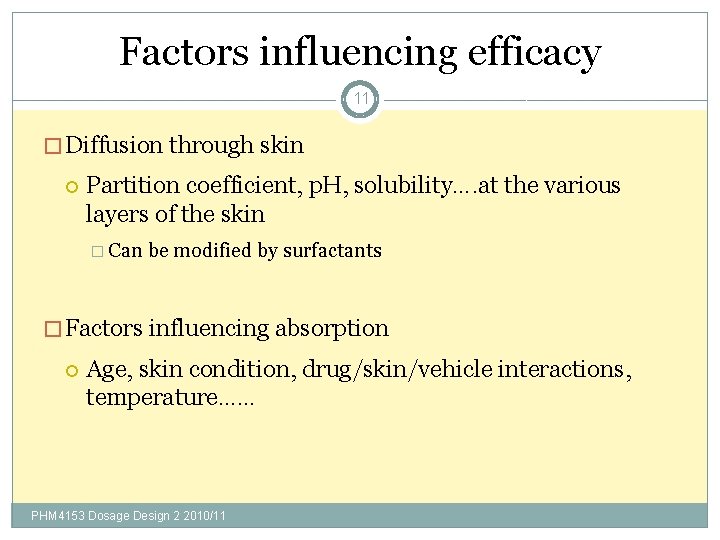
Factors influencing efficacy 11 � Diffusion through skin Partition coefficient, p. H, solubility…. at the various layers of the skin � Can be modified by surfactants � Factors influencing absorption Age, skin condition, drug/skin/vehicle interactions, temperature…… PHM 4153 Dosage Design 2 2010/11
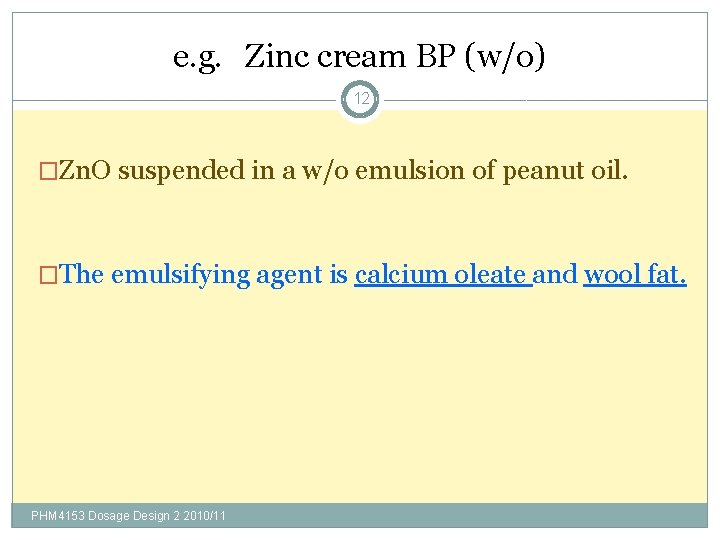
e. g. Zinc cream BP (w/o) 12 �Zn. O suspended in a w/o emulsion of peanut oil. �The emulsifying agent is calcium oleate and wool fat. PHM 4153 Dosage Design 2 2010/11
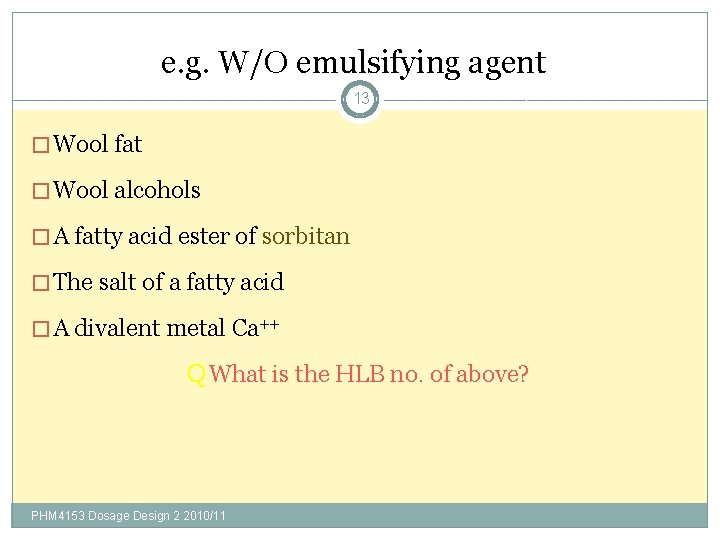
e. g. W/O emulsifying agent 13 � Wool fat � Wool alcohols � A fatty acid ester of sorbitan � The salt of a fatty acid � A divalent metal Ca++ Q What is the HLB no. of above? PHM 4153 Dosage Design 2 2010/11
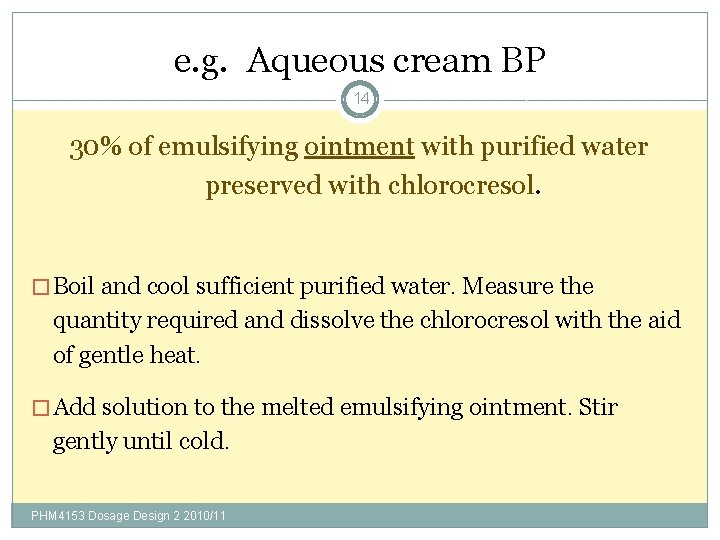
e. g. Aqueous cream BP 14 30% of emulsifying ointment with purified water preserved with chlorocresol. � Boil and cool sufficient purified water. Measure the quantity required and dissolve the chlorocresol with the aid of gentle heat. � Add solution to the melted emulsifying ointment. Stir gently until cold. PHM 4153 Dosage Design 2 2010/11
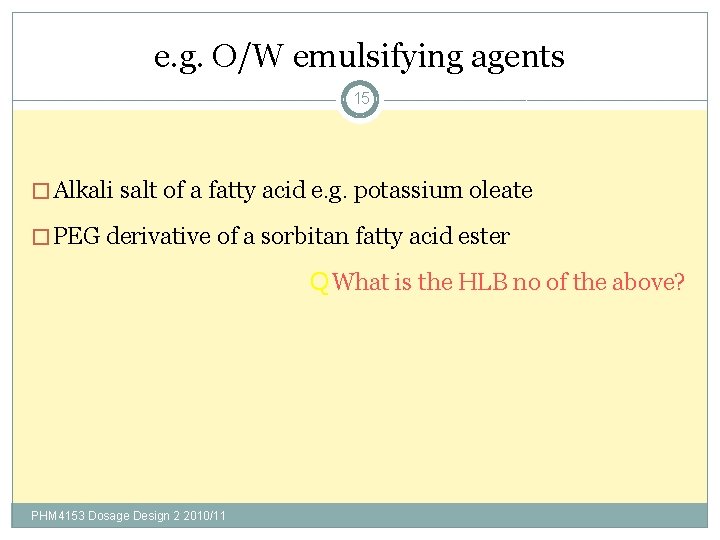
e. g. O/W emulsifying agents 15 � Alkali salt of a fatty acid e. g. potassium oleate � PEG derivative of a sorbitan fatty acid ester Q What is the HLB no of the above? PHM 4153 Dosage Design 2 2010/11
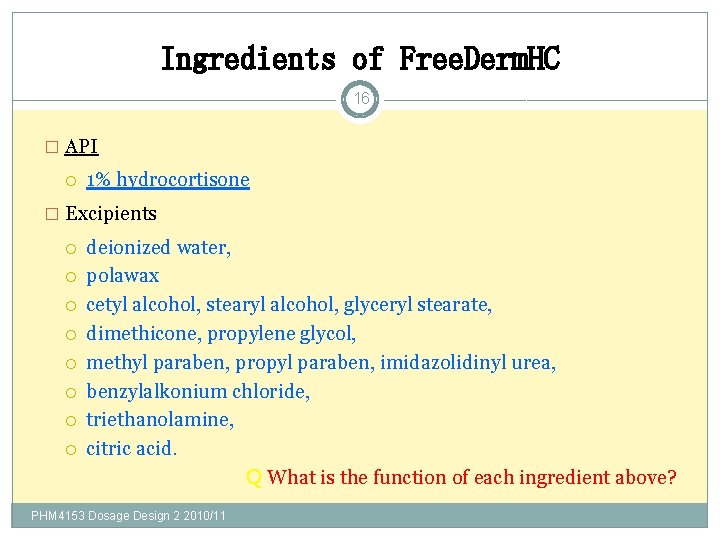
Ingredients of Free. Derm. HC 16 � API 1% hydrocortisone � Excipients deionized water, polawax cetyl alcohol, stearyl alcohol, glyceryl stearate, dimethicone, propylene glycol, methyl paraben, propyl paraben, imidazolidinyl urea, benzylalkonium chloride, triethanolamine, citric acid. Q What is the function of each ingredient above? PHM 4153 Dosage Design 2 2010/11
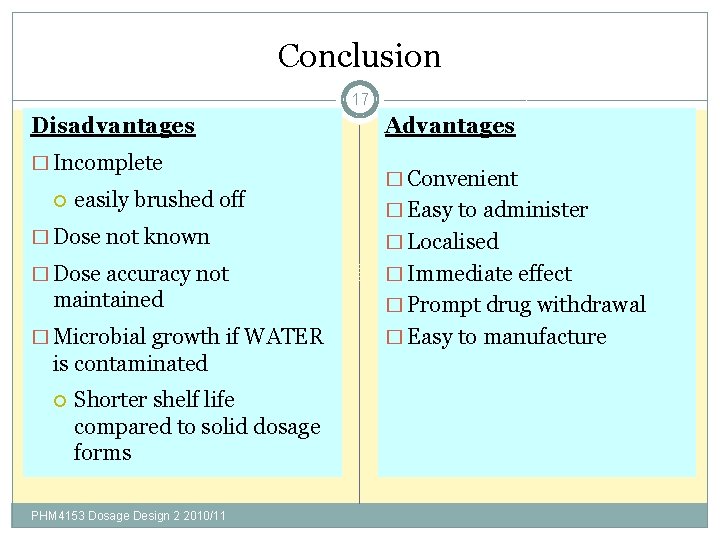
Conclusion 17 Disadvantages � Incomplete easily brushed off Advantages � Convenient � Easy to administer � Dose not known � Localised � Dose accuracy not � Immediate effect maintained � Microbial growth if WATER is contaminated Shorter shelf life compared to solid dosage forms PHM 4153 Dosage Design 2 2010/11 � Prompt drug withdrawal � Easy to manufacture
Exercise 18 Describe the function of the following creams and identify the active ingredients: � Ellgy � Mecdema � Sun Sense � Fucidin � Elomet PHM 4153 Dosage Design 2 2010/11
References 19 Gennaro, A. R. (2000). Remington: The Science and Practice of Pharmacy 20 th Ed. Philadelphia: Lippincott Williams and Wilkins. p 836 -857 Ansel, H. C. , Allen, V. & Poovich, N. G. (1999). Pharmaceutical dosage forms and drug delivery systems 7 th Ed. Philadelphia: Lippincott Williams and Wilkins. p 244 -262 Weiner, M. L. & Kotkoskie, L. A. (2000). Excipient Toxicity and Safety. New York: Marcel Dekker. Chapter 7 (Library: RS 201) Magdassi , S. & Touitou, E. (1999). Novel Cosmetic Delivery Systems. New York: Marcel Dekker. Chap 9 (Librray: TP 983. 3) PHM 4153 Dosage Design 2 2010/11