
CREA Conflict Resolution with Equitative Algorithms Dr Marco
- Slides: 1
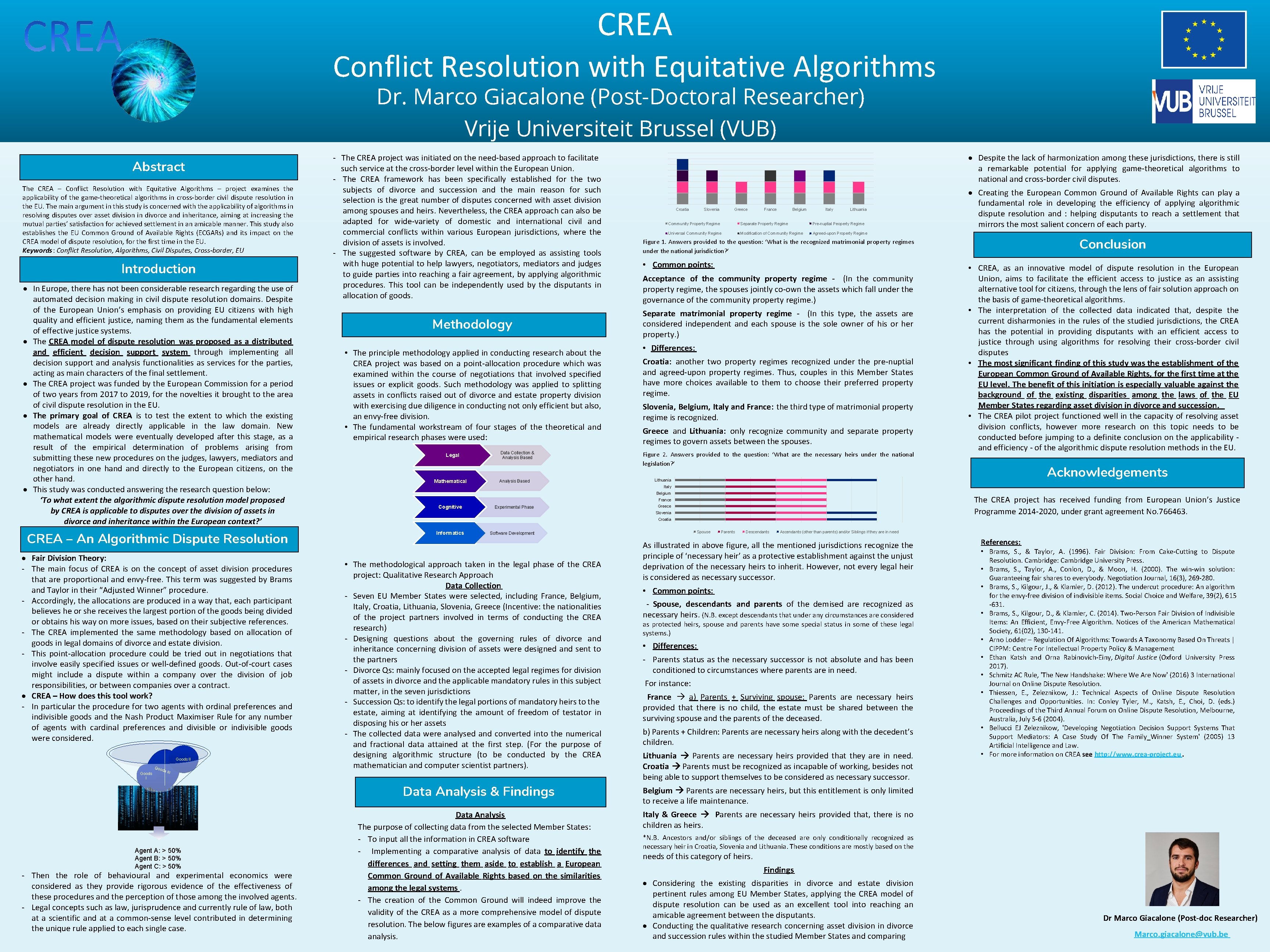
CREA Conflict Resolution with Equitative Algorithms Dr. Marco Giacalone (Post-Doctoral Researcher) Vrije Universiteit Brussel (VUB) Abstract The CREA – Conflict Resolution with Equitative Algorithms – project examines the applicability of the game-theoretical algorithms in cross-border civil dispute resolution in the EU. The main argument in this study is concerned with the applicability of algorithms in resolving disputes over asset division in divorce and inheritance, aiming at increasing the mutual parties’ satisfaction for achieved settlement in an amicable manner. This study also establishes the EU Common Ground of Available Rights (ECGARs) and its impact on the CREA model of dispute resolution, for the first time in the EU. Keywords: Conflict Resolution, Algorithms, Civil Disputes, Cross-border, EU Introduction In Europe, there has not been considerable research regarding the use of automated decision making in civil dispute resolution domains. Despite of the European Union’s emphasis on providing EU citizens with high quality and efficient justice, naming them as the fundamental elements of effective justice systems. The CREA model of dispute resolution was proposed as a distributed and efficient decision support system through implementing all decision support and analysis functionalities as services for the parties, acting as main characters of the final settlement. The CREA project was funded by the European Commission for a period of two years from 2017 to 2019, for the novelties it brought to the area of civil dispute resolution in the EU. The primary goal of CREA is to test the extent to which the existing models are already directly applicable in the law domain. New mathematical models were eventually developed after this stage, as a result of the empirical determination of problems arising from submitting these new procedures on the judges, lawyers, mediators and negotiators in one hand directly to the European citizens, on the other hand. This study was conducted answering the research question below: ‘To what extent the algorithmic dispute resolution model proposed by CREA is applicable to disputes over the division of assets in divorce and inheritance within the European context? ’ CREA – An Algorithmic Dispute Resolution Fair Division Theory: - The main focus of CREA is on the concept of asset division procedures that are proportional and envy-free. This term was suggested by Brams and Taylor in their “Adjusted Winner” procedure. - Accordingly, the allocations are produced in a way that, each participant believes he or she receives the largest portion of the goods being divided or obtains his way on more issues, based on their subjective references. - The CREA implemented the same methodology based on allocation of goods in legal domains of divorce and estate division. - This point-allocation procedure could be tried out in negotiations that involve easily specified issues or well-defined goods. Out-of-court cases might include a dispute within a company over the division of job responsibilities, or between companies over a contract. CREA – How does this tool work? - In particular the procedure for two agents with ordinal preferences and indivisible goods and the Nash Product Maximiser Rule for any number of agents with cardinal preferences and divisible or indivisible goods were considered. Goods II Goods I Goo ds I II - The CREA project was initiated on the need-based approach to facilitate such service at the cross-border level within the European Union. - The CREA framework has been specifically established for the two subjects of divorce and succession and the main reason for such selection is the great number of disputes concerned with asset division among spouses and heirs. Nevertheless, the CREA approach can also be adapted for wide-variety of domestic and international civil and commercial conflicts within various European jurisdictions, where the division of assets is involved. - The suggested software by CREA, can be employed as assisting tools with huge potential to help lawyers, negotiators, mediators and judges to guide parties into reaching a fair agreement, by applying algorithmic procedures. This tool can be independently used by the disputants in allocation of goods. Methodology • The principle methodology applied in conducting research about the CREA project was based on a point-allocation procedure which was examined within the course of negotiations that involved specified issues or explicit goods. Such methodology was applied to splitting assets in conflicts raised out of divorce and estate property division with exercising due diligence in conducting not only efficient but also, an envy-free division. • The fundamental workstream of four stages of theoretical and empirical research phases were used: Legal Mathematical Data Collection & Analysis Based - Then the role of behavioural and experimental economics were considered as they provide rigorous evidence of the effectiveness of these procedures and the perception of those among the involved agents. - Legal concepts such as law, jurisprudence and currently rule of law, both at a scientific and at a common-sense level contributed in determining the unique rule applied to each single case. Croatia Slovenia Greece France Belgium Italy Lithuania Community Property Regime Separate Property Regime Pre-nuptial Peoperty Regime Universal Community Regime Modification of Community Regime Agreed-upon Property Regime Creating the European Common Ground of Available Rights can play a fundamental role in developing the efficiency of applying algorithmic dispute resolution and : helping disputants to reach a settlement that mirrors the most salient concern of each party. Conclusion Figure 1. Answers provided to the question: ‘What is the recognized matrimonial property regimes under the national jurisdiction? ’ • Common points: Acceptance of the community property regime - (In the community property regime, the spouses jointly co-own the assets which fall under the governance of the community property regime. ) Separate matrimonial property regime - (In this type, the assets are considered independent and each spouse is the sole owner of his or her property. ) • Differences: Croatia: another two property regimes recognized under the pre-nuptial and agreed-upon property regimes. Thus, couples in this Member States have more choices available to them to choose their preferred property regime. Slovenia, Belgium, Italy and France: the third type of matrimonial property regime is recognized. Greece and Lithuania: only recognize community and separate property regimes to govern assets between the spouses. Figure 2. Answers provided to the question: ‘What are the necessary heirs under the national legislation? ’ • CREA, as an innovative model of dispute resolution in the European Union, aims to facilitate the efficient access to justice as an assisting alternative tool for citizens, through the lens of fair solution approach on the basis of game-theoretical algorithms. • The interpretation of the collected data indicated that, despite the current disharmonies in the rules of the studied jurisdictions, the CREA has the potential in providing disputants with an efficient access to justice through using algorithms for resolving their cross-border civil disputes • The most significant finding of this study was the establishment of the European Common Ground of Available Rights, for the first time at the EU level. The benefit of this initiation is especially valuable against the background of the existing disparities among the laws of the EU Member States regarding asset division in divorce and succession. • The CREA pilot project functioned well in the capacity of resolving asset division conflicts, however more research on this topic needs to be conducted before jumping to a definite conclusion on the applicability and efficiency - of the algorithmic dispute resolution methods in the EU. Acknowledgements Lithuania Italy Belgium The CREA project has received funding from European Union’s Justice Programme 2014 -2020, under grant agreement No. 766463. France Cognitive Experimental Phase Greece Slovenia Croatia Informatics Spouse Software Development • The methodological approach taken in the legal phase of the CREA project: Qualitative Research Approach Data Collection - Seven EU Member States were selected, including France, Belgium, Italy, Croatia, Lithuania, Slovenia, Greece (Incentive: the nationalities of the project partners involved in terms of conducting the CREA research) - Designing questions about the governing rules of divorce and inheritance concerning division of assets were designed and sent to the partners - Divorce Qs: mainly focused on the accepted legal regimes for division of assets in divorce and the applicable mandatory rules in this subject matter, in the seven jurisdictions - Succession Qs: to identify the legal portions of mandatory heirs to the estate, aiming at identifying the amount of freedom of testator in disposing his or her assets - The collected data were analysed and converted into the numerical and fractional data attained at the first step. (For the purpose of designing algorithmic structure (to be conducted by the CREA mathematician and computer scientist partners). Data Analysis & Findings Agent A: > 50% Agent B: > 50% Agent C: > 50% Despite the lack of harmonization among these jurisdictions, there is still a remarkable potential for applying game-theoretical algorithms to national and cross-border civil disputes. Data Analysis The purpose of collecting data from the selected Member States: - To input all the information in CREA software - Implementing a comparative analysis of data to identify the differences and setting them aside to establish a European Common Ground of Available Rights based on the similarities among the legal systems. - The creation of the Common Ground will indeed improve the validity of the CREA as a more comprehensive model of dispute resolution. The below figures are examples of a comparative data analysis. Parents Descendants Ascendants (other than parents) and/or Siblings if they are in need As illustrated in above figure, all the mentioned jurisdictions recognize the principle of ‘necessary heir’ as a protective establishment against the unjust deprivation of the necessary heirs to inherit. However, not every legal heir is considered as necessary successor. • Common points: - Spouse, descendants and parents of the demised are recognized as necessary heirs. (N. B. except descendants that under any circumstances are considered as protected heirs, spouse and parents have some special status in some of these legal systems. ) • Differences: - Parents status as the necessary successor is not absolute and has been conditioned to circumstances where parents are in need. For instance: France a) Parents + Surviving spouse: Parents are necessary heirs provided that there is no child, the estate must be shared between the surviving spouse and the parents of the deceased. b) Parents + Children: Parents are necessary heirs along with the decedent’s children. Lithuania Parents are necessary heirs provided that they are in need. Croatia Parents must be recognized as incapable of working, besides not being able to support themselves to be considered as necessary successor. References: • Brams, S. , & Taylor, A. (1996). Fair Division: From Cake-Cutting to Dispute Resolution. Cambridge: Cambridge University Press. • Brams, S. , Taylor, A. , Conlon, D. , & Moon, H. (2000). The win-win solution: Guaranteeing fair shares to everybody. Negotiation Journal, 16(3), 269 -280. • Brams, S. , Kilgour, J. , & Klamler, D. (2012). The undercut procedure: An algorithm for the envy-free division of indivisible items. Social Choice and Welfare, 39(2), 615 -631. • Brams, S. , Kilgour, D. , & Klamler, C. (2014). Two-Person Fair Division of Indivisible Items: An Efficient, Envy-Free Algorithm. Notices of the American Mathematical Society, 61(02), 130 -141. • Arno Lodder – Regulation Of Algorithms: Towards A Taxonomy Based On Threats | CIPPM: Centre For Intellectual Property Policy & Management • Ethan Katsh and Orna Rabinovich-Einy, Digital Justice (Oxford University Press 2017). • Schmitz AC Rule, 'The New Handshake: Where We Are Now' (2016) 3 International Journal on Online Dispute Resolution. • Thiessen, E. , Zeleznikow, J. : Technical Aspects of Online Dispute Resolution Challenges and Opportunities. In: Conley Tyler, M. , Katsh, E. , Choi, D. (eds. ) Proceedings of the Third Annual Forum on Online Dispute Resolution, Melbourne, Australia, July 5 -6 (2004). • Bellucci EJ Zeleznikow, 'Developing Negotiation Decision Support Systems That Support Mediators: A Case Study Of The Family_Winner System' (2005) 13 Artificial Intelligence and Law. • For more information on CREA see http: //www. crea-project. eu. Belgium Parents are necessary heirs, but this entitlement is only limited to receive a life maintenance. Italy & Greece Parents are necessary heirs provided that, there is no children as heirs. *N. B. Ancestors and/or siblings of the deceased are only conditionally recognized as necessary heir in Croatia, Slovenia and Lithuania. These conditions are mostly based on the needs of this category of heirs. Findings Considering the existing disparities in divorce and estate division pertinent rules among EU Member States, applying the CREA model of dispute resolution can be used as an excellent tool into reaching an amicable agreement between the disputants. Conducting the qualitative research concerning asset division in divorce and succession rules within the studied Member States and comparing Dr Marco Giacalone (Post-doc Researcher) Marco. giacalone@vub. be