
Crawling Slides adapted from Information Retrieval and Web
Crawling Slides adapted from –Information Retrieval and Web Search, Stanford University, Christopher Manning and Prabhakar Raghavan 1
Basic crawler operation Sec. 20. 2 • Begin with known “seed” URLs • Fetch and parse them –Extract URLs they point to –Place the extracted URLs on a queue • Fetch each URL on the queue and repeat 2
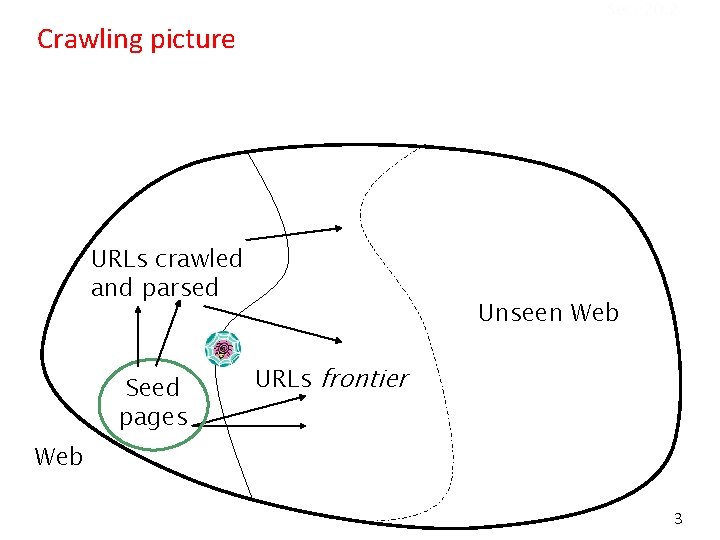
Sec. 20. 2 Crawling picture URLs crawled and parsed Seed pages Unseen Web URLs frontier Web 3
Simple picture – complications Sec. 20. 1. 1 • Web crawling isn’t feasible with one machine – All of the above steps distributed • Malicious pages – Spam pages – Spider traps – incl dynamically generated • Even non-malicious pages pose challenges – Latency/bandwidth to remote servers vary – Webmasters’ stipulations – How “deep” should you crawl a site’s URL hierarchy? – Site mirrors and duplicate pages • Politeness – don’t hit a server too often 4
What any crawler must do Sec. 20. 1. 1 • Be Polite: Respect implicit and explicit politeness considerations – Explicit politeness: Respect robots. txt, specifications from webmasters on what portions of site can be crawled – Implicit politeness: even with no specification, avoid hitting any site too often • Be Robust: Be immune to spider traps and other malicious behavior from web servers – indefinitely deep directory structures like http: //foo. com/bar/foo/bar/foo/bar/. . . – dynamic pages like calendars that produce an infinite number of pages. – pages filled with a large number of characters, crashing the lexical analyzer parsing the page. 5
What any crawler should do Sec. 20. 1. 1 • Be capable of distributed operation: designed to run on multiple distributed machines • Be scalable: designed to increase the crawl rate by adding more machines • Performance/efficiency: permit full use of available processing and network resources • Fetch pages of “higher quality” first • Continuous operation: Continue fetching fresh copies of a previously fetched page • Extensible: Adapt to new data formats, protocols 6
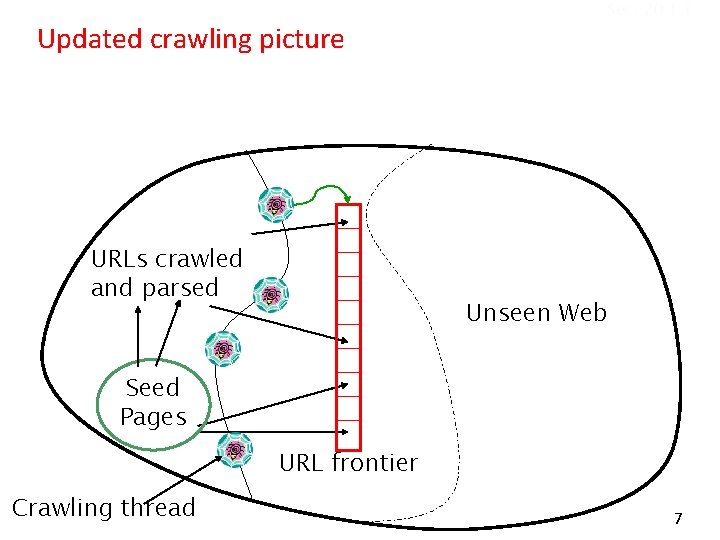
Updated crawling picture URLs crawled and parsed Sec. 20. 1. 1 Unseen Web Seed Pages URL frontier Crawling thread 7
URL frontier Sec. 20. 2 • Can include multiple pages from the same host • Must avoid trying to fetch them all at the same time • Must try to keep all crawling threads busy 8
Robots. txt Sec. 20. 2. 1 • Protocol for giving spiders (“robots”) limited access to a website, originally from 1994 – www. robotstxt. org/wc/norobots. html • Website announces its request on what can(not) be crawled – For a URL, create a file URL/robots. txt – This file specifies access restrictions 9
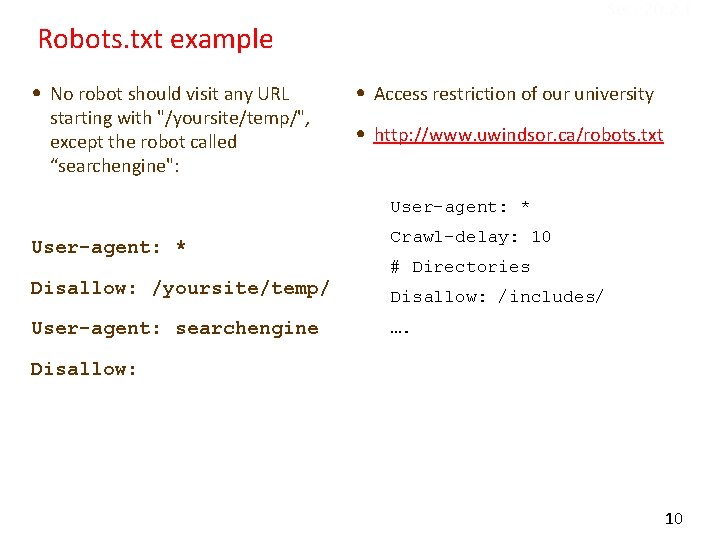
Sec. 20. 2. 1 Robots. txt example • No robot should visit any URL starting with "/yoursite/temp/", except the robot called “searchengine": • Access restriction of our university • http: //www. uwindsor. ca/robots. txt User-agent: * Disallow: /yoursite/temp/ User-agent: searchengine Crawl-delay: 10 # Directories Disallow: /includes/ …. Disallow: 10
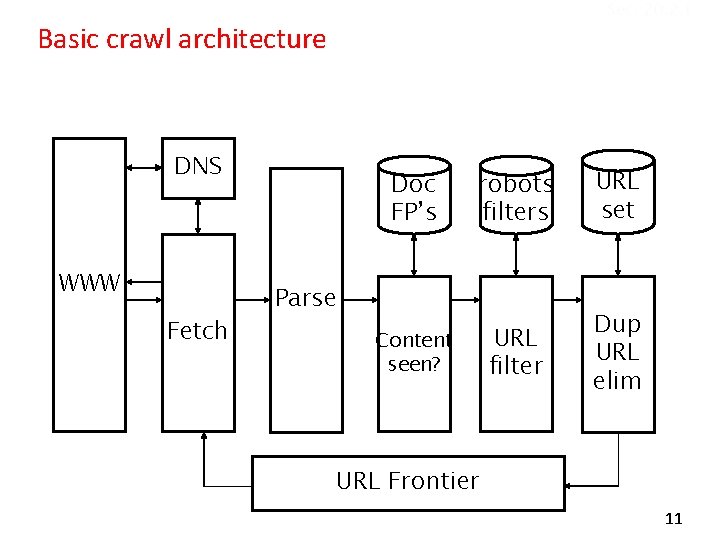
Sec. 20. 2. 1 Basic crawl architecture DNS WWW Fetch Doc FP’s robots filters URL set URL filter Dup URL elim Parse Content seen? URL Frontier 11
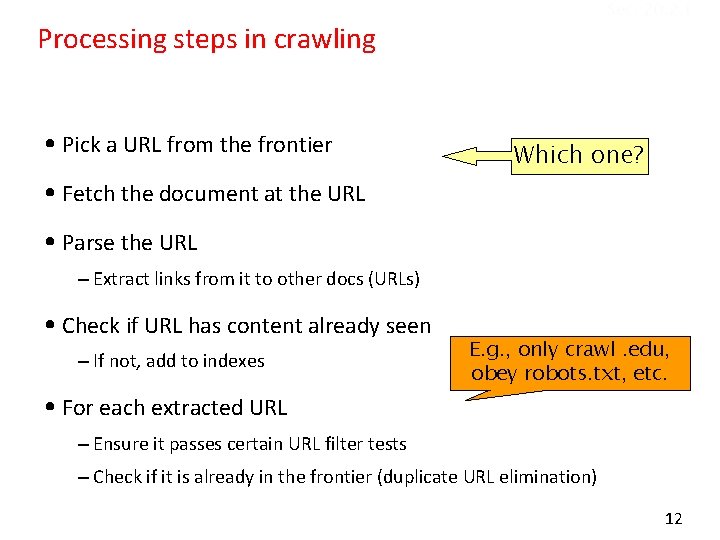
Sec. 20. 2. 1 Processing steps in crawling • Pick a URL from the frontier Which one? • Fetch the document at the URL • Parse the URL – Extract links from it to other docs (URLs) • Check if URL has content already seen – If not, add to indexes • For each extracted URL E. g. , only crawl. edu, obey robots. txt, etc. – Ensure it passes certain URL filter tests – Check if it is already in the frontier (duplicate URL elimination) 12
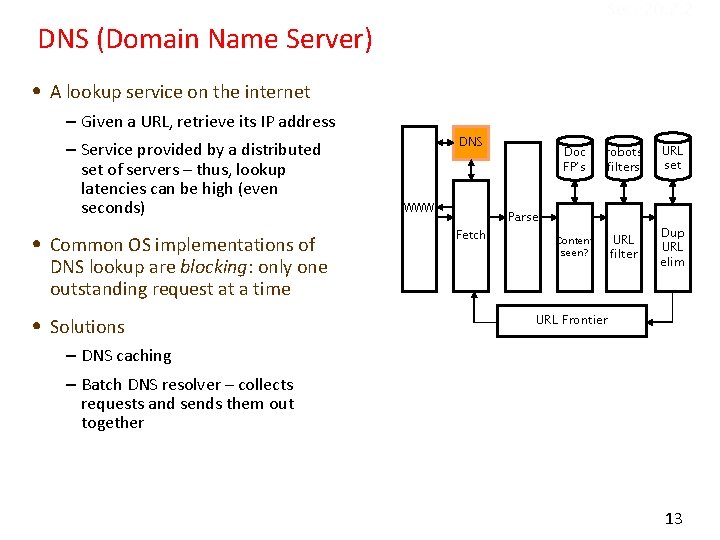
Sec. 20. 2. 2 DNS (Domain Name Server) • A lookup service on the internet – Given a URL, retrieve its IP address – Service provided by a distributed set of servers – thus, lookup latencies can be high (even seconds) • Common OS implementations of DNS lookup are blocking: only one outstanding request at a time • Solutions DNS WWW Doc FP’s robots filters URL set Content seen? URL filter Dup URL elim Parse Fetch URL Frontier – DNS caching – Batch DNS resolver – collects requests and sends them out together 13
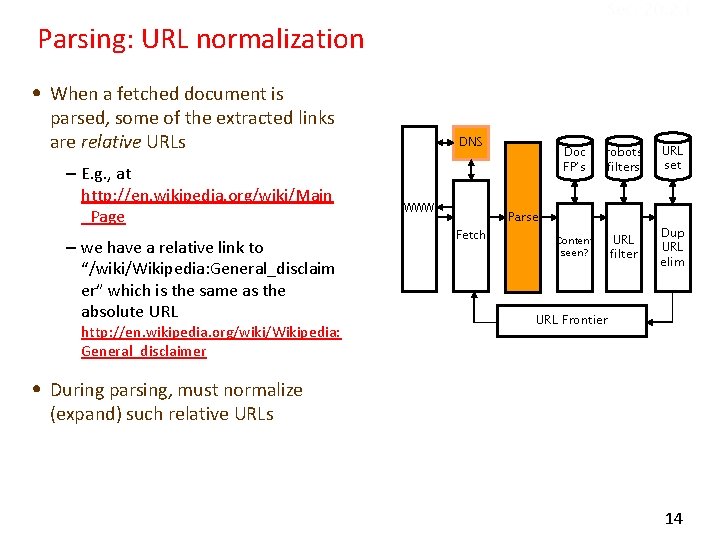
Sec. 20. 2. 1 Parsing: URL normalization • When a fetched document is parsed, some of the extracted links are relative URLs – E. g. , at http: //en. wikipedia. org/wiki/Main _Page – we have a relative link to “/wiki/Wikipedia: General_disclaim er” which is the same as the absolute URL http: //en. wikipedia. org/wiki/Wikipedia: General_disclaimer DNS WWW Doc FP’s robots filters URL set Content seen? URL filter Dup URL elim Parse Fetch URL Frontier • During parsing, must normalize (expand) such relative URLs 14
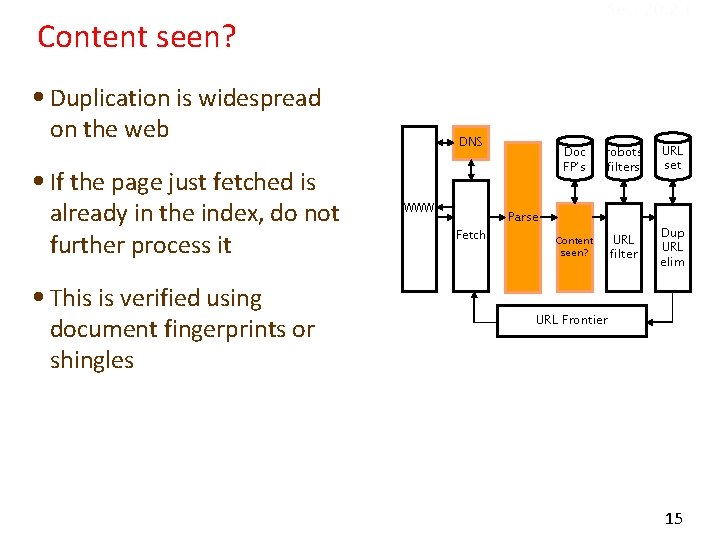
Sec. 20. 2. 1 Content seen? • Duplication is widespread on the web DNS • If the page just fetched is already in the index, do not further process it • This is verified using document fingerprints or shingles WWW Doc FP’s robots filters URL set Content seen? URL filter Dup URL elim Parse Fetch URL Frontier 15
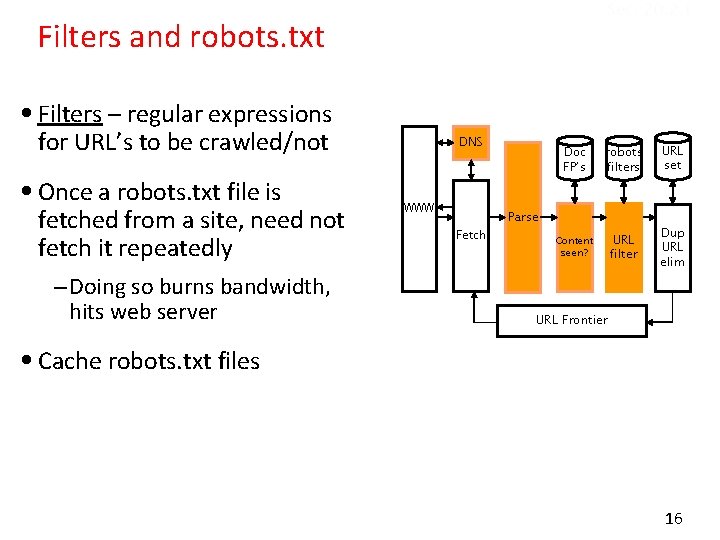
Sec. 20. 2. 1 Filters and robots. txt • Filters – regular expressions for URL’s to be crawled/not • Once a robots. txt file is fetched from a site, need not fetch it repeatedly – Doing so burns bandwidth, hits web server DNS WWW Doc FP’s robots filters URL set Content seen? URL filter Dup URL elim Parse Fetch URL Frontier • Cache robots. txt files 16
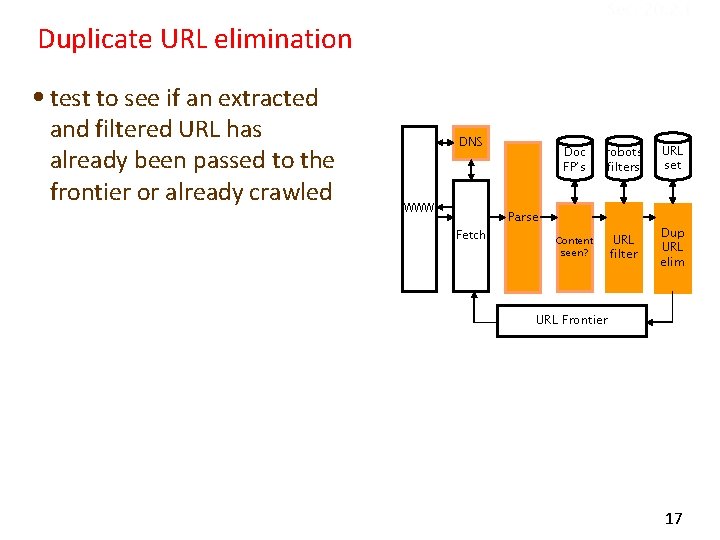
Sec. 20. 2. 1 Duplicate URL elimination • test to see if an extracted and filtered URL has already been passed to the frontier or already crawled DNS WWW Doc FP’s robots filters URL set Content seen? URL filter Dup URL elim Parse Fetch URL Frontier 17
Distributing the crawler Sec. 20. 2. 1 • Run multiple crawl threads, under different processes – potentially at different nodes – Geographically distributed nodes • Partition hosts being crawled into nodes – Hash used for partition • How do these nodes communicate? 18
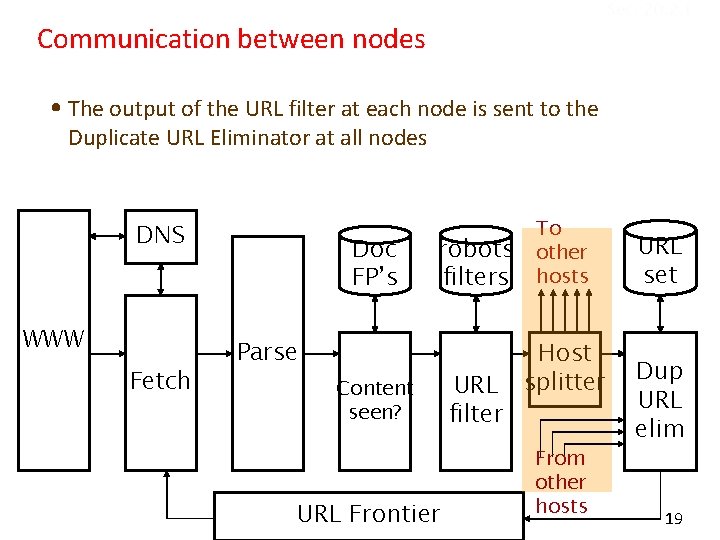
Sec. 20. 2. 1 Communication between nodes • The output of the URL filter at each node is sent to the Duplicate URL Eliminator at all nodes DNS WWW Fetch Doc FP’s robots filters Parse Content seen? URL Frontier URL filter To other hosts Host splitter From other hosts URL set Dup URL elim 19
Sec. 20. 2. 3 URL frontier: two main considerations • Politeness: do not hit a web server too frequently • Freshness: crawl some pages more often than others – E. g. , pages (such as News sites) whose content changes often • These goals may conflict each other – E. g. , simple priority queue fails – many links out of a page go to its own site, creating a burst of accesses to that site. 20
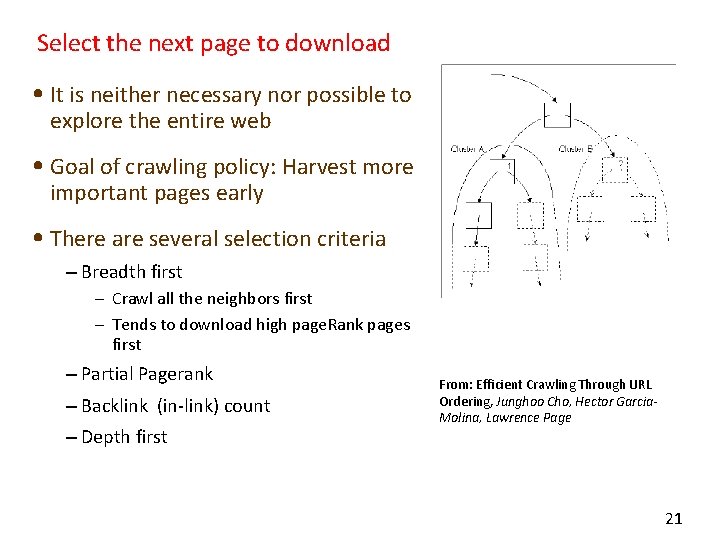
Select the next page to download • It is neither necessary nor possible to explore the entire web • Goal of crawling policy: Harvest more important pages early • There are several selection criteria – Breadth first – Crawl all the neighbors first – Tends to download high page. Rank pages first – Partial Pagerank – Backlink (in-link) count – Depth first From: Efficient Crawling Through URL Ordering, Junghoo Cho, Hector Garcia. Molina, Lawrence Page 21
Other issues in crawling • Focused crawling – Download pages that are similar to each other – Challenge: predict the similarity of the page to a query before downloading it – Prediction can be based on anchor text, pages already downloaded • Deep web 22
- Slides: 22