
Craters and impacts in the solar system starlight
- Slides: 11
Craters and impacts in the solar system starlight team
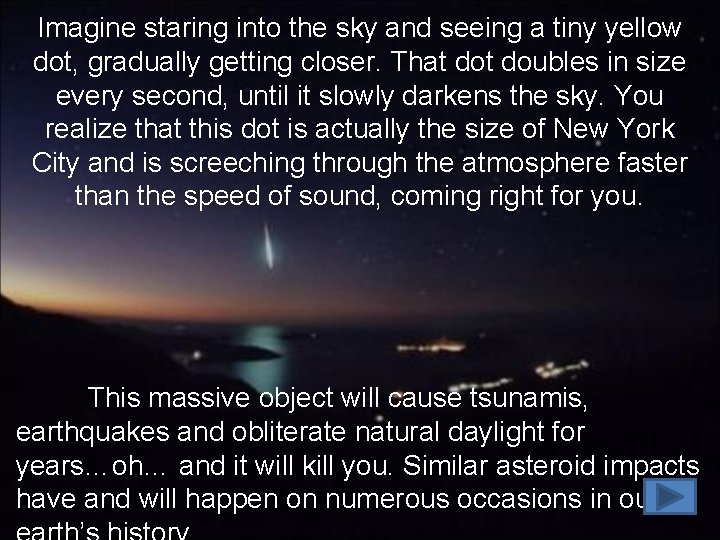
Imagine staring into the sky and seeing a tiny yellow dot, gradually getting closer. That doubles in size every second, until it slowly darkens the sky. You realize that this dot is actually the size of New York City and is screeching through the atmosphere faster than the speed of sound, coming right for you. This massive object will cause tsunamis, earthquakes and obliterate natural daylight for years…oh… and it will kill you. Similar asteroid impacts have and will happen on numerous occasions in our
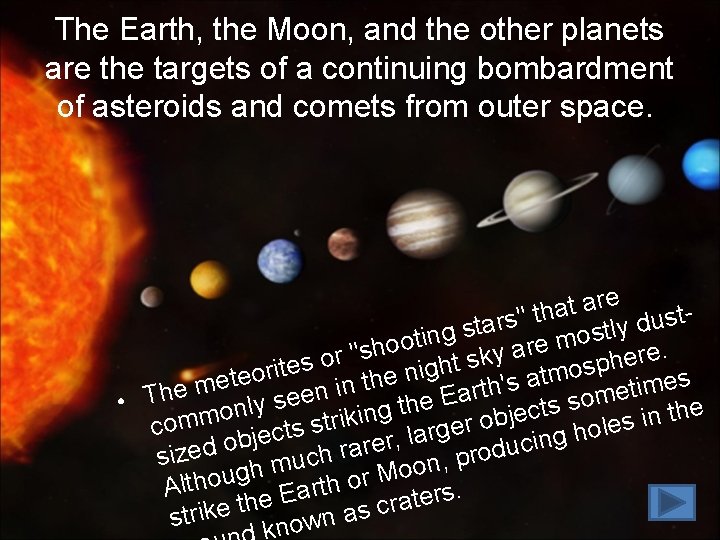
The Earth, the Moon, and the other planets are the targets of a continuing bombardment of asteroids and comets from outer space. . e r a th t " s s u r d a t s tly s g o n i t m o e r ho a. s " e y r r k e o s h t h sp tes g i i o r n o m t e e t s a h e e t s ' m m n h i i t t e r e a en m E e o s e • Th s h y t l s n ct g he o t e n j i m n k b i i r o m t s s le co er s o g t r h c a l e g j , ob er cin r u d a d r e o z i r h s c p u , n m o h o g M u r o o h t l h t A r. a s r E e t e a h r t strike known as c
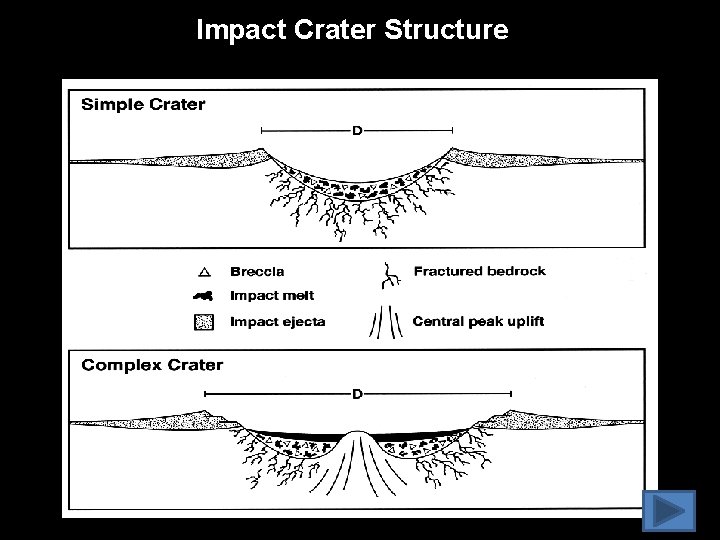
Impact Crater Structure
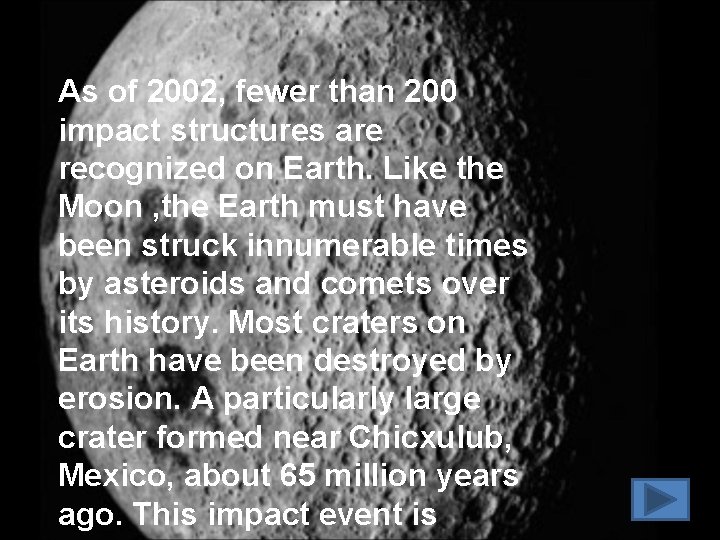
As of 2002, fewer than 200 impact structures are recognized on Earth. Like the Moon , the Earth must have been struck innumerable times by asteroids and comets over its history. Most craters on Earth have been destroyed by erosion. A particularly large crater formed near Chicxulub, Mexico, about 65 million years ago. This impact event is
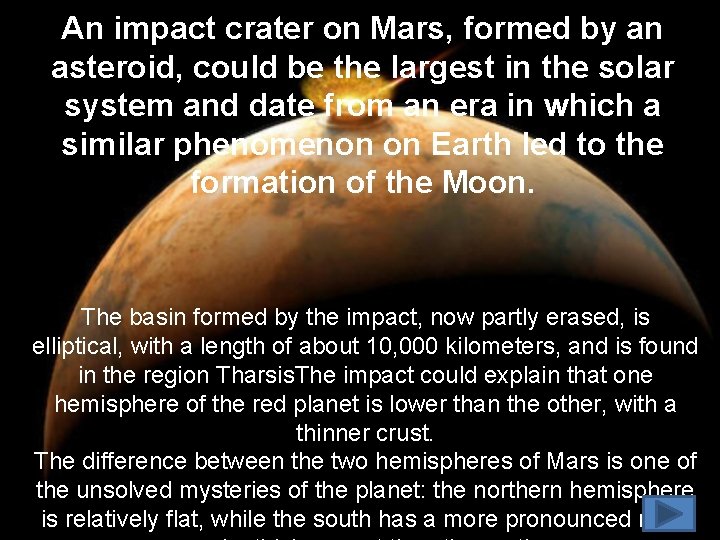
An impact crater on Mars, formed by an asteroid, could be the largest in the solar system and date from an era in which a similar phenomenon on Earth led to the formation of the Moon. The basin formed by the impact, now partly erased, is elliptical, with a length of about 10, 000 kilometers, and is found in the region Tharsis. The impact could explain that one hemisphere of the red planet is lower than the other, with a thinner crust. The difference between the two hemispheres of Mars is one of the unsolved mysteries of the planet: the northern hemisphere is relatively flat, while the south has a more pronounced relief
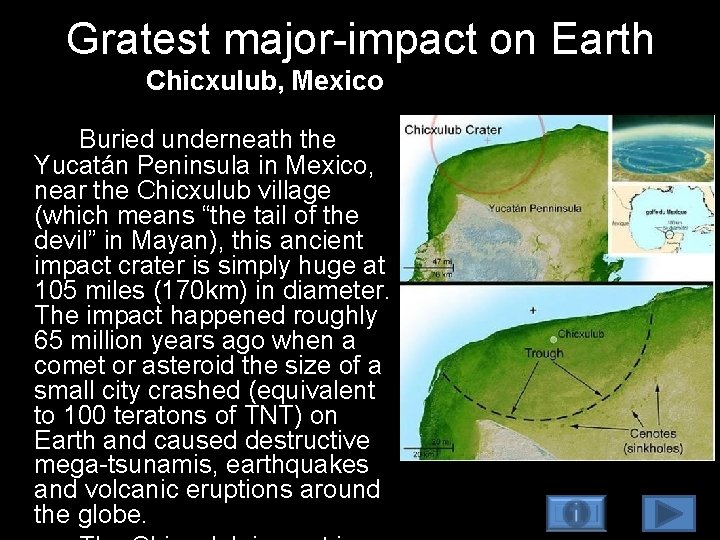
Gratest major-impact on Earth Chicxulub, Mexico • Buried underneath the Yucatán Peninsula in Mexico, near the Chicxulub village (which means “the tail of the devil” in Mayan), this ancient impact crater is simply huge at 105 miles (170 km) in diameter. The impact happened roughly 65 million years ago when a comet or asteroid the size of a small city crashed (equivalent to 100 teratons of TNT) on Earth and caused destructive mega-tsunamis, earthquakes and volcanic eruptions around the globe.
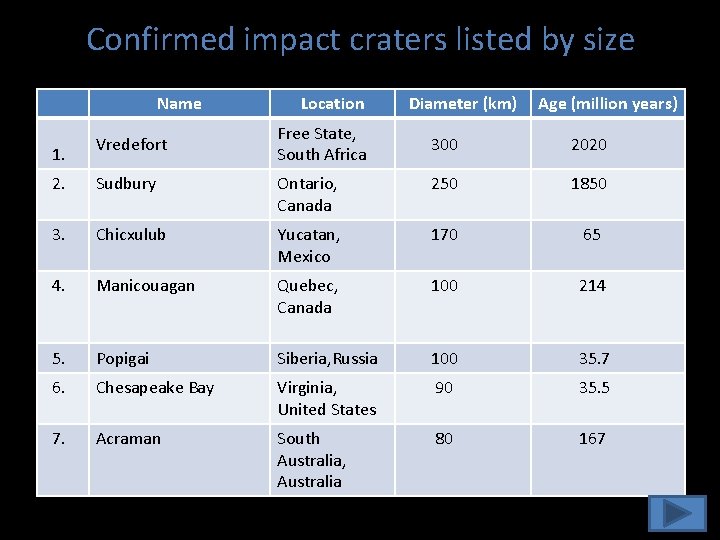
Confirmed impact craters listed by size Name 1. Vredefort Location Free State, South Africa Diameter (km) Age (million years) 300 2020 2. Sudbury Ontario, Canada 250 1850 3. Chicxulub Yucatan, Mexico 170 65 4. Manicouagan Quebec, Canada 100 214 5. Popigai Siberia, Russia 100 35. 7 6. Chesapeake Bay Virginia, United States 90 35. 5 7. Acraman South Australia, Australia 80 167
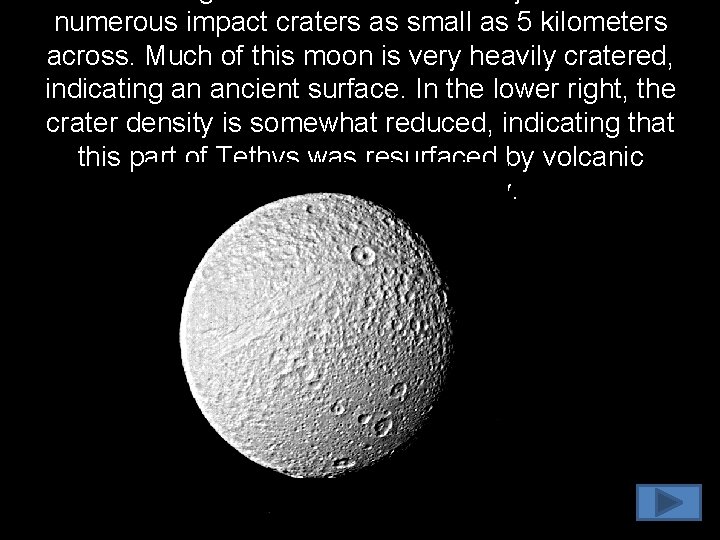
numerous impact craters as small as 5 kilometers across. Much of this moon is very heavily cratered, indicating an ancient surface. In the lower right, the crater density is somewhat reduced, indicating that this part of Tethys was resurfaced by volcanic activity early in its history.
Fotea Isabela cl. a X-a B