
CRASH INVESTIGATION AND RECONSTRUCTION TECHNOLOGIES AND BEST PRACTICES
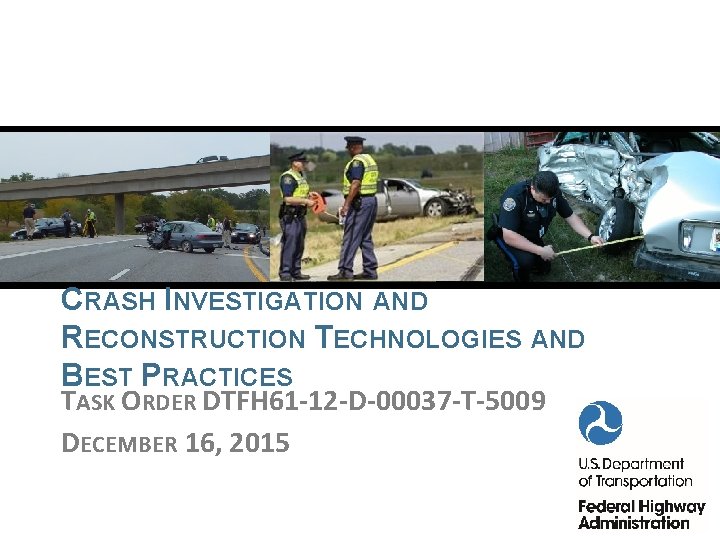
CRASH INVESTIGATION AND RECONSTRUCTION TECHNOLOGIES AND BEST PRACTICES TASK ORDER DTFH 61 -12 -D-00037 -T-5009 DECEMBER 16, 2015 1
Project Background and Purpose • Crash Investigation and Reconstruction Technologies and Best Practices are evolving – Support for Traffic Incident Management (TIM): Quick Clearance – Safer environment for investigators and responders: Positioning of personnel away from traffic while investigating – Court acceptance: Accuracy, reliability, and detail of crash data collected • Project collected analyzed crash investigation and reconstruction technologies and best practices – Assist agencies in identification of technologies and best practices • Address crash investigation and reconstruction needs • Support safe investigation and reconstruction activities • Support TIM 2
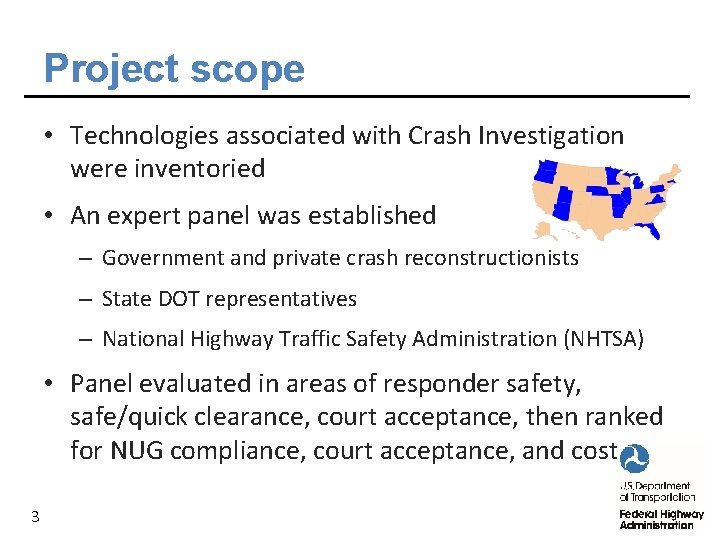
Project scope • Technologies associated with Crash Investigation were inventoried • An expert panel was established – Government and private crash reconstructionists – State DOT representatives – National Highway Traffic Safety Administration (NHTSA) • Panel evaluated in areas of responder safety, safe/quick clearance, court acceptance, then ranked for NUG compliance, court acceptance, and cost 3
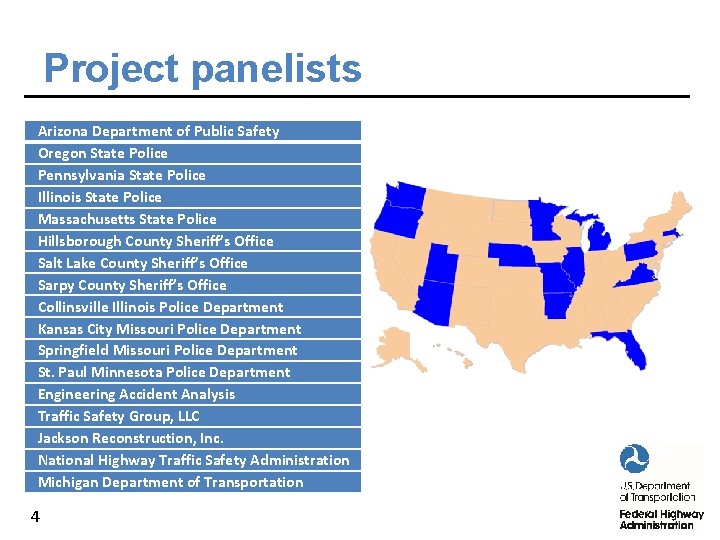
Project panelists Arizona Department of Public Safety Oregon State Police Pennsylvania State Police Illinois State Police Massachusetts State Police Hillsborough County Sheriff’s Office Salt Lake County Sheriff’s Office Sarpy County Sheriff’s Office Collinsville Illinois Police Department Kansas City Missouri Police Department Springfield Missouri Police Department St. Paul Minnesota Police Department Engineering Accident Analysis Traffic Safety Group, LLC Jackson Reconstruction, Inc. National Highway Traffic Safety Administration Michigan Department of Transportation 4
Report Contents • Chapter 1: Introduction • Chapter 2: Input from Experienced Crash Reconstruction Professionals • Chapter 3: Research Methodology • Chapter 4: Research Results • Chapter 5: Technology Overview • Chapter 6: Virtual Demonstrations • Chapter 7: Conclusions 5
Investigator Information Processing • • Do I have the technology tools I need, and are they in working order? How has traffic been affected? How is traffic affecting the scene? Will I encounter delays in ingress to the scene? Will the scene be intact or altered by the time I get there? Has evidence been preserved? What do I need to tell those on scene to do until I get there? When I arrive, what can I do to minimize the effects on traffic while still protecting responders and motorists? • Is the technology that I have the best for this investigation or do I need to call for assistance? • Can the evidence at the crash scene be marked and the mapping completed at a safer, more convenient time? 6 IT IS NOT JUST STOPPING TRAFFIC AND GATHERING DATA
Need for Research • Provide a safer environment for responders, a safer environment for motorists, and to minimize the effect that traffic crashes have on traffic flow. • The manner in which the technology is applied is just as important as the technology itself. • The most advanced technology available is no more valuable if it is not used in an efficient manner to minimize the exposure of personnel to the dangers of traffic in the roadway. 7
RESEARCH OF PRACTICES AND TECHNOLOGIES • Traffic crash reconstruction professionals were surveyed • Focus on current traffic crash reconstruction technologies • Then on the existing practices being employed • Some of the practices and methods have been used for many years and are still very accurate. • Some practices and technology are less efficient for crashes on the highway since they prolong roadway closures. 8
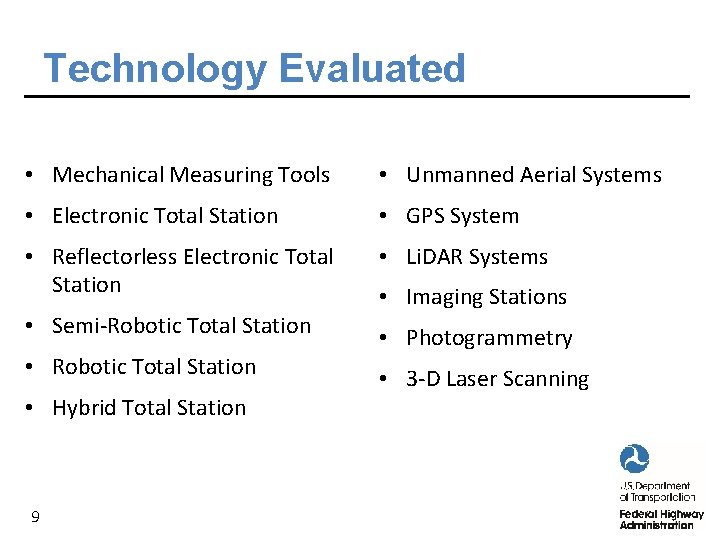
Technology Evaluated • Mechanical Measuring Tools • Unmanned Aerial Systems • Electronic Total Station • GPS System • Reflectorless Electronic Total Station • Li. DAR Systems • Semi-Robotic Total Station • Photogrammetry • Robotic Total Station • Hybrid Total Station 9 • Imaging Stations • 3 -D Laser Scanning
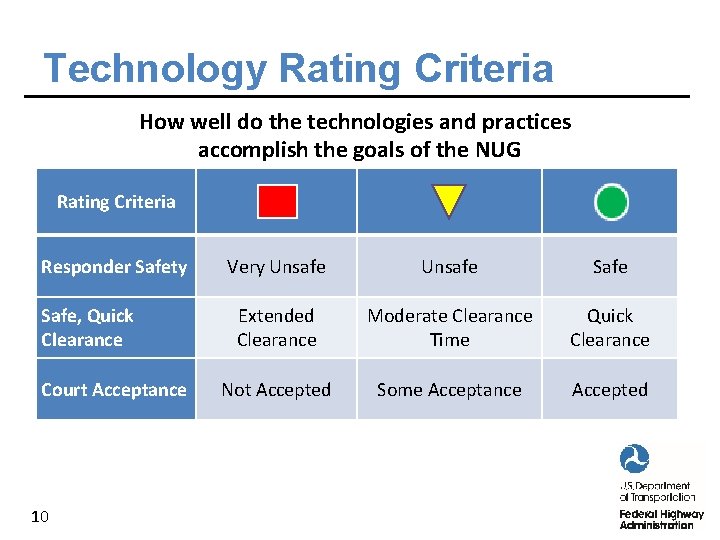
Technology Rating Criteria How well do the technologies and practices accomplish the goals of the NUG Rating Criteria Responder Safety Safe, Quick Clearance Court Acceptance 10 Very Unsafe Safe Extended Clearance Moderate Clearance Time Quick Clearance Not Accepted Some Acceptance Accepted
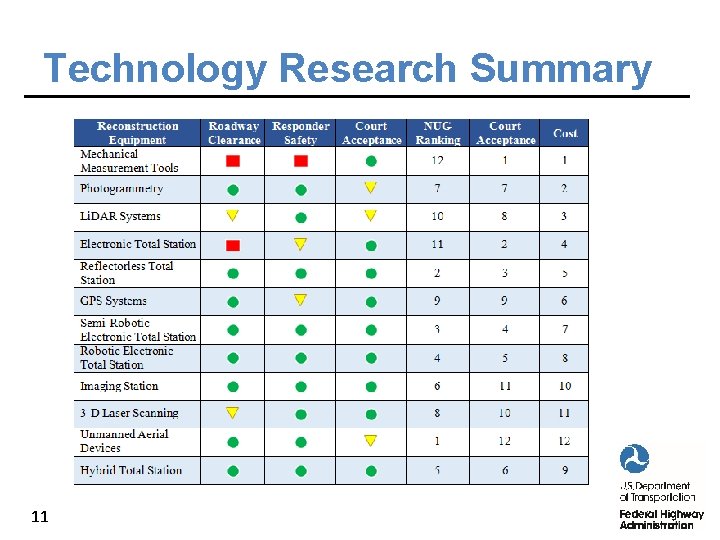
Technology Research Summary 11
Project conclusions • There is no one-size-fits-all solution in traffic crash reconstruction. • Each agency should examine their activities and resources to decide what is best for their environment. – Each agency will have a different traffic environment, organizational structure, political establishment, and funding constraints. • It is recommended that an agency familiarize themselves with the practices and technologies presented in this report and identify those that best match their organizational practices, requirements, and needs. – The benefits and budgetary information provided for each technology can be used to justify expenditures or negotiate budget for purchase, training, operation and maintenance of the system. – This report collects crash reconstruction technology and best practices data to inform those decisions. 12
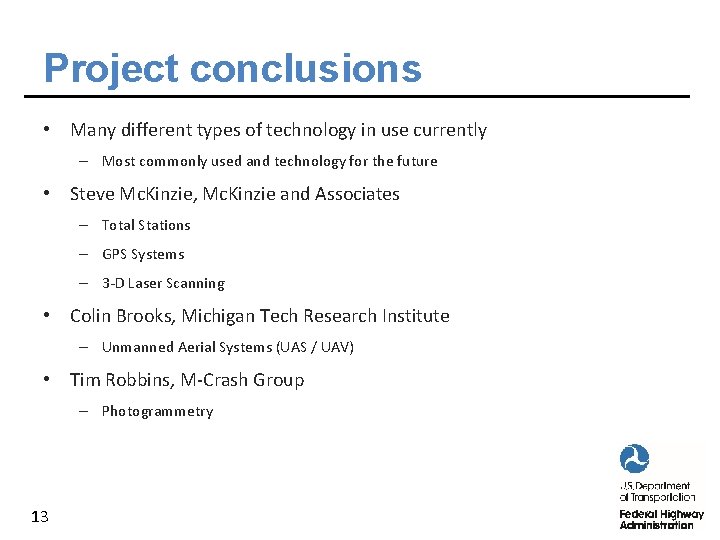
Project conclusions • Many different types of technology in use currently – Most commonly used and technology for the future • Steve Mc. Kinzie, Mc. Kinzie and Associates – Total Stations – GPS Systems – 3 -D Laser Scanning • Colin Brooks, Michigan Tech Research Institute – Unmanned Aerial Systems (UAS / UAV) • Tim Robbins, M-Crash Group – Photogrammetry 13
- Slides: 13