
Cranes Preoperational site activity and inspection v Review

- Slides: 44
Cranes
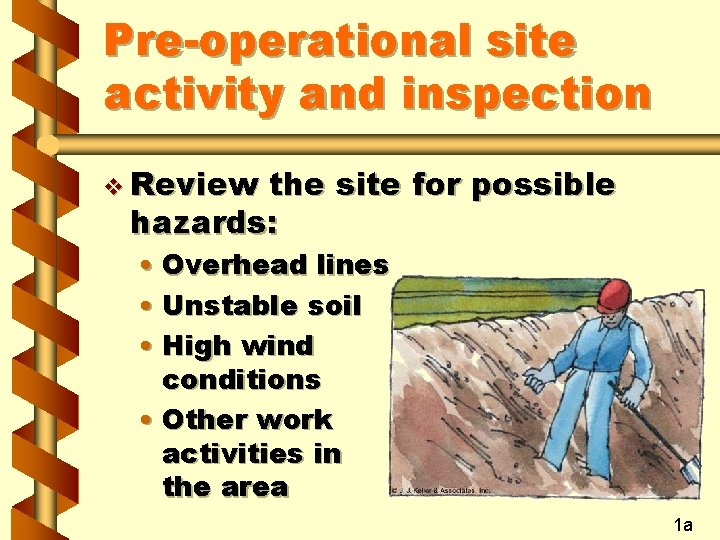
Pre-operational site activity and inspection v Review the site for possible hazards: • Overhead lines • Unstable soil • High wind conditions • Other work activities in the area 1 a
Pre-operational site activity and inspection v Characteristics of the load: • Hazardous or toxic materials • Weight • Dimensions • Center of gravity 1 b
Pre-operational site activity and inspection v Rigging sketches and information: • Lift points • Methods of attachment • Sling angles • Load vectors 1 c
Pre-operational site activity and inspection v Rigging sketches and information: • Broom and swing angles • Crane orientations • Rated capacities • Other factors affecting equipment operation 1 d
Pre-operational site activity and inspection v Operating procedures: • Step-by-step instructions • Applicable rigging precautions • Safety measures • Emergency procedures 1 e
Pre-operational site activity and inspection v Additions and modifications to equipment: • Tags, instruction plates, decals reflect to modifications • Ensure safety factor has not been reduced by additions/modifications 1 f
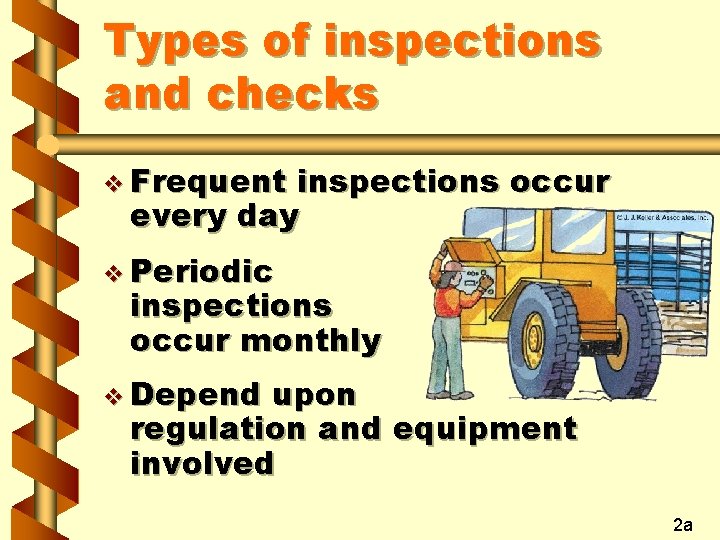
Types of inspections and checks v Frequent inspections occur every day v Periodic inspections occur monthly v Depend upon regulation and equipment involved 2 a
Frequent inspections v Daily pre-operational walkaround or pre-startup check v Exposed moving parts should be guarded/isolated v High voltage warning signs are displayed 3 a
Frequent inspections v Crane v Wire components ropes v Freedom swivels of rotation of all v Tires 3 b
Frequent inspections v Batteries v Proper v Fluid lubrication leaks v Heaves, drums, rigging, hardware, attachments 3 c
Frequent inspections v Operating mechanisms v Guardrails, handholds, steps v Platforms/walkways v Turntable connections 3 d
Frequent inspections v Boom and jib • Look for straightness/damage • Corrosion • Cracking/peeling paint • Bent lacing 3 e
Frequent inspections v Outriggers • Distortion/cracking • Welds • Extension/retraction of beams • Floats 3 f
Frequent inspections: Pre-startup v Cab • Cleanliness of cab • Control labeling • Function of gauges, lights, signals • Service/parking brake • Seat and cab door operation • Inspection and maintenance records 3 g
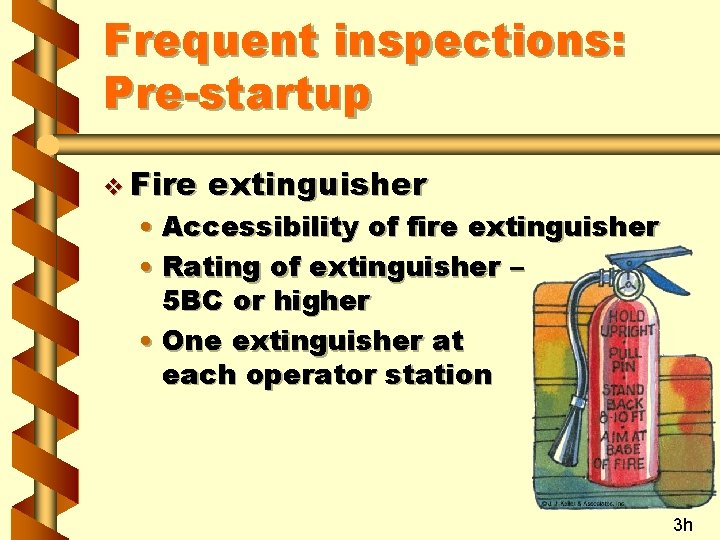
Frequent inspections: Pre-startup v Fire extinguisher • Accessibility of fire extinguisher • Rating of extinguisher – 5 BC or higher • One extinguisher at each operator station 3 h
Frequent inspections: Pre-startup v Field of vision • Broken/cracked windows • Adjustment/operation of brakes/clutches • Operation/calibration of boom hoist lockout • Gauges and warning lights • Controls 3 i
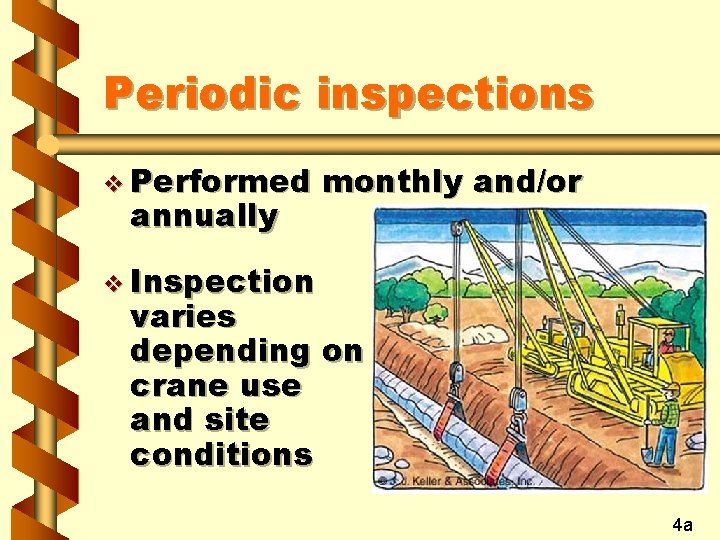
Periodic inspections v Performed annually monthly and/or v Inspection varies depending on crane use and site conditions 4 a
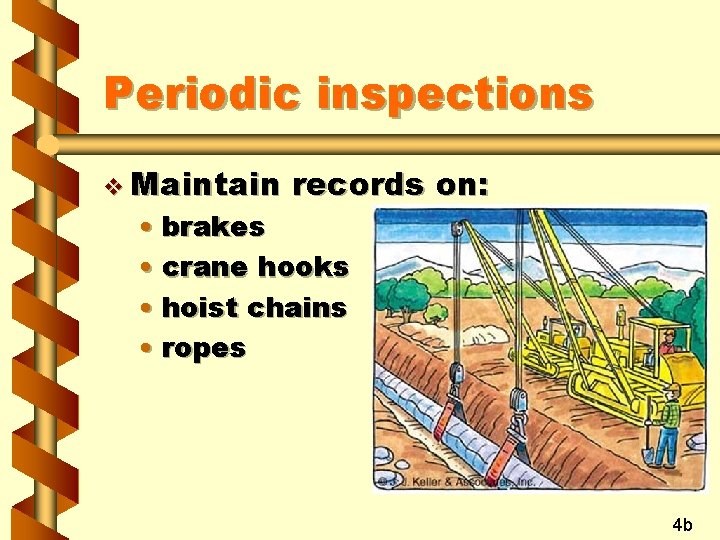
Periodic inspections v Maintain records on: • brakes • crane hooks • hoist chains • ropes 4 b
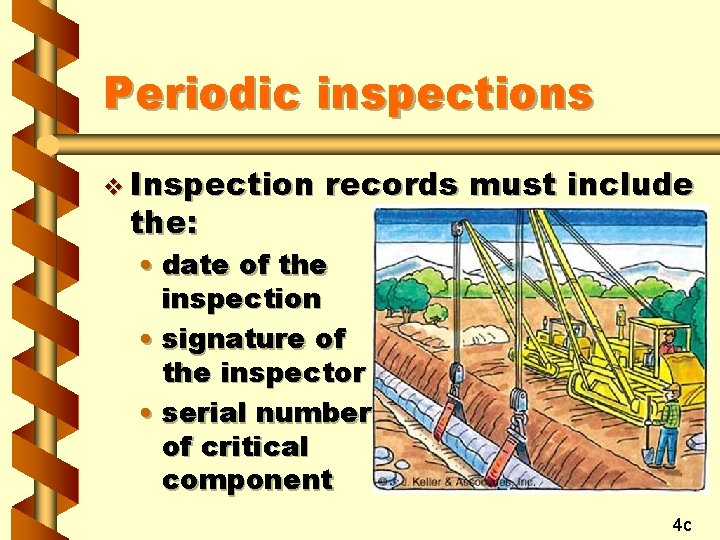
Periodic inspections v Inspection the: records must include • date of the inspection • signature of the inspector • serial number of critical component 4 c
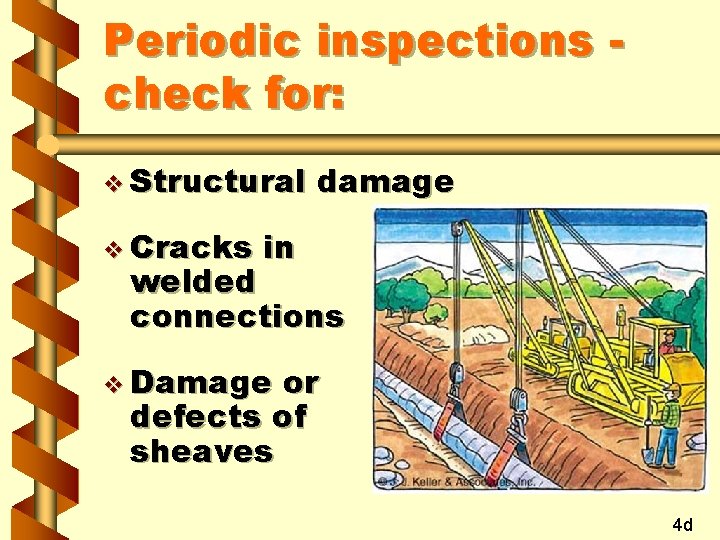
Periodic inspections check for: v Structural v Cracks damage in welded connections v Damage or defects of sheaves 4 d
Periodic inspections check for: v Main hoist and auxiliary drum damage/defects v Even distribution of the wire rope on hoist drum v Proper wire rope integrity 4 e
Periodic inspections check for: v Excessive wear of brake and clutch parts v Worn, cracked, distorted parts v Defects/damage to the main boom, jib, boom extensions 4 f
Periodic inspections check for: v Repairs that meet manufacturer’s specifications v Defects/damage of the load hooks/hook block 4 g
Periodic inspections check for: v Excessive wear of the drive sprockets/chain stretch v Positive stops on jibs v Deterioration components of hydraulic v Stamps of working pressure on flexible hoses 4 h
Periodic inspections check for: v Defects/damage to the turntable v Permanent/legible v Securing/locking counterweight v Easy ID numbers of access to the cab 4 i
Periodic inspections check for: v Proper function of boom stops, hoist disconnects, boom angle indicator, jib stops v Proper plants operation of power v Proper functioning of all other operating mechanisms 4 j
Periodic inspections v Do not use damaged/unsafe equipment until repairs have been made 4 k
Maintenance procedures v Preventive maintenance keeps cranes in good operating condition v Follow the company’s preventive maintenance program 5 a
Maintenance procedures - precautions: v Move the crane where it will create minimum interference with other cranes v Turn all controls to the “off” position v Lock the main/emergency switch in the “off” position 5 b
Maintenance procedures - precautions: v Place “Out of order” signs on the crane v Provide rail stops v Ensure guards are reinstalled after maintenance 5 c
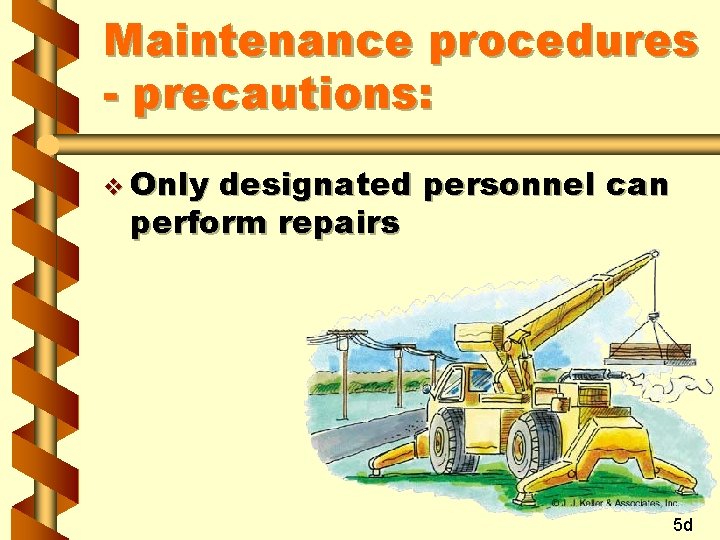
Maintenance procedures - precautions: v Only designated personnel can perform repairs 5 d
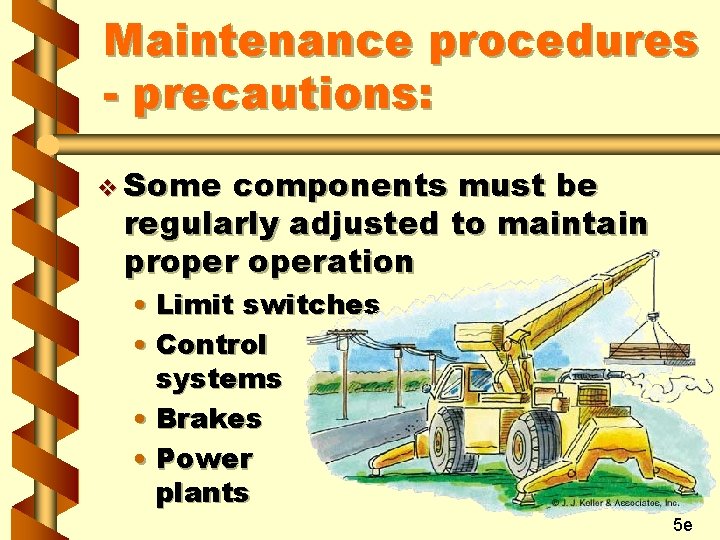
Maintenance procedures - precautions: v Some components must be regularly adjusted to maintain properation • Limit switches • Control systems • Brakes • Power plants 5 e
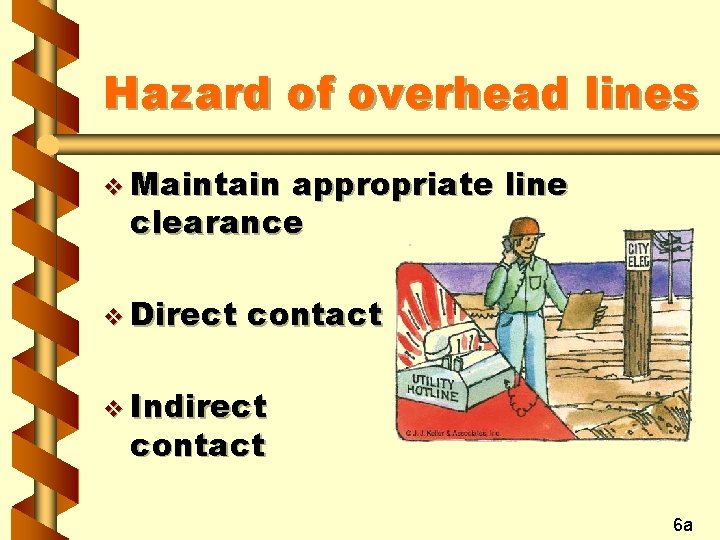
Hazard of overhead lines v Maintain appropriate line clearance v Direct contact v Indirect contact 6 a
Hazard of overhead lines v Preferred methods of safety around overhead lines include: • de-energizing and grounding all electrical lines • erecting insulating barriers 6 b
Hazard of overhead lines v Voltages 50 kv or less, the clearance distance is 10 feet v Voltages greater than 50 kv, the clearance is 10 feet plus 4 inches for every 10 kv over 50 kv 6 c
Hazard of overhead lines v When the vehicle is in transit, and the structure is lowered: • the clearance distance is 4 feet for 50 kv or less; or • 4 feet plus 4 inches for every 10 kv over 50 kv for voltage greater than 50 kv 6 d
Hazard of overhead lines v Use signalmen to assist in maintaining proper clearances where vision is obstructed • Hand signals • Chart of hand signals 6 e
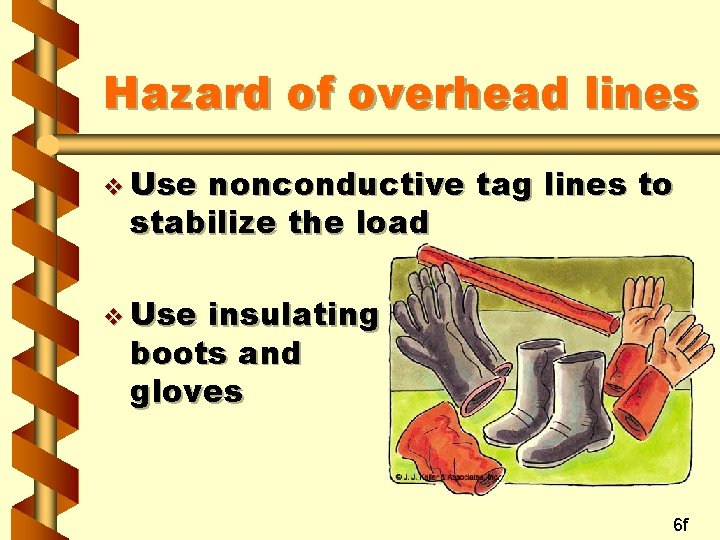
Hazard of overhead lines v Use nonconductive tag lines to stabilize the load v Use insulating boots and gloves 6 f
Operating rules v Post operating rules near the following types of cranes: • Stationary • Overhead • Gantry 7 a
General safety rules v Avoid carrying loads over people v Don’t allow anyone to ride on the hook v Don’t walk away from a crane with a suspended load 8 a
General safety rules v Move loads slowly; avoid sudden movements v Never carry items in your hand while climbing a ladder v Store clothing/equipment so as not to interfere with crane operation 8 b
Prohibited actions v Do not exceed load ratings v Do not change the recommended counterweights v Do not lift an unsecured/unbalanced load 9 a
Prohibited actions v Do not lift two separately rigged loads at the same time v Do not wrap tag lines around one’s body 9 b