
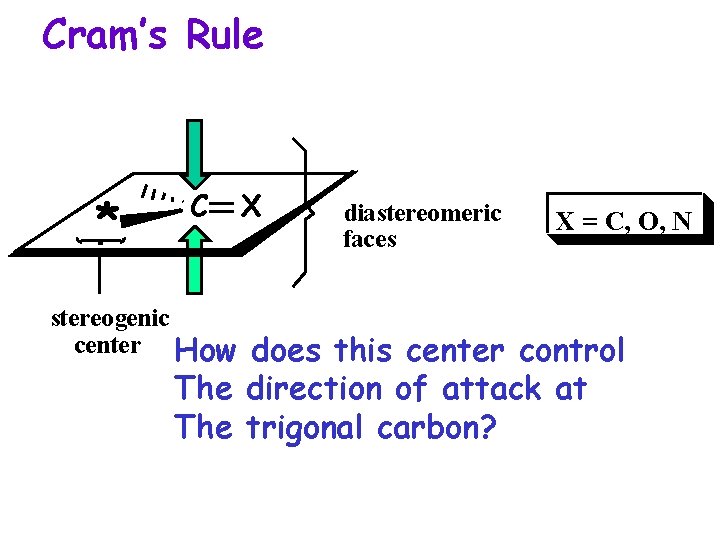
Crams Rule C stereogenic center How X diastereomeric

- Slides: 13
Cram’s Rule * C stereogenic center How X diastereomeric faces X = C, O, N does this center control The direction of attack at The trigonal carbon?
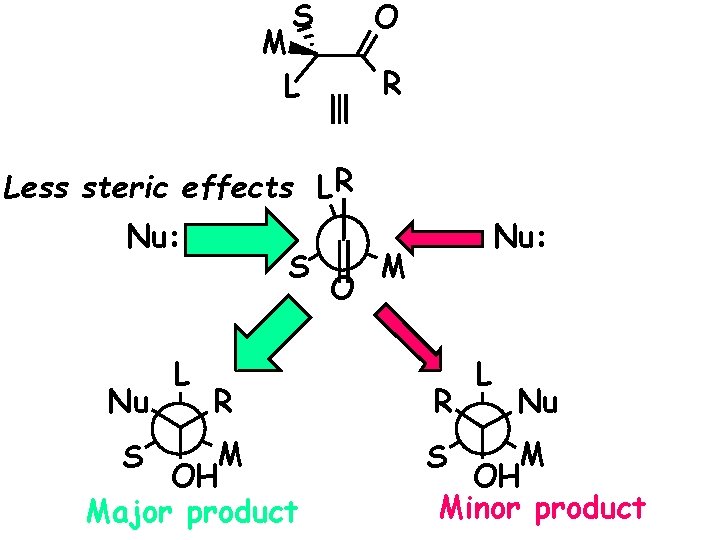
S O M L R Less steric effects LR Nu: Nu L S R M OH Major product S O Nu: M R L Nu M OH Minor product S
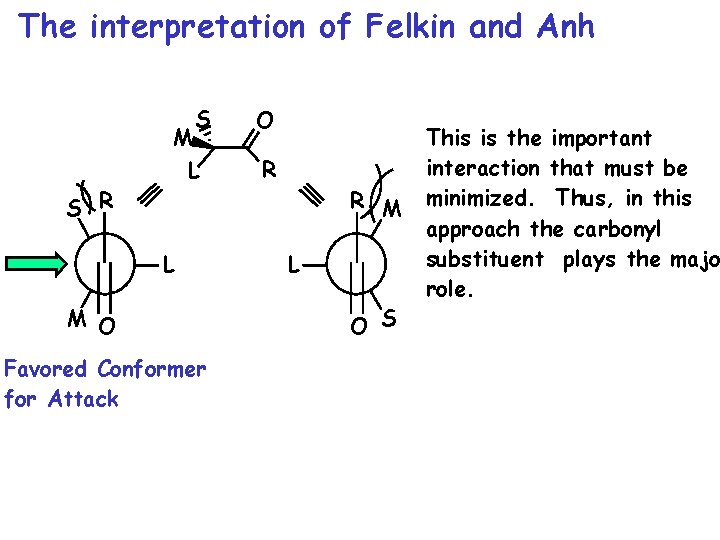
The interpretation of Felkin and Anh M S L S R L M O Favored Conformer for Attack O R R M L O S This is the important interaction that must be minimized. Thus, in this approach the carbonyl substituent plays the majo role.
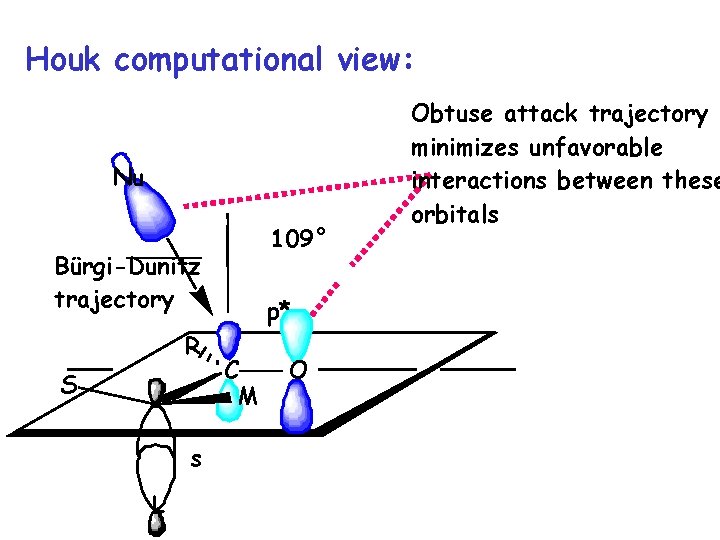
Houk computational view: Nu 109° Bürgi-Dunitz trajectory R S s L p* C M O Obtuse attack trajectory minimizes unfavorable interactions between these orbitals
The obtuse angle of attack supports the nonpassive role of the R-group in ketones. Not only will there be steric interactions between the S or M groups and the R-group, but also interactions with the incoming nucleophile due to the attack trajectory. In this model one would predict an increase of stereodifferentiation as the size of R increases. This has been found experimentally
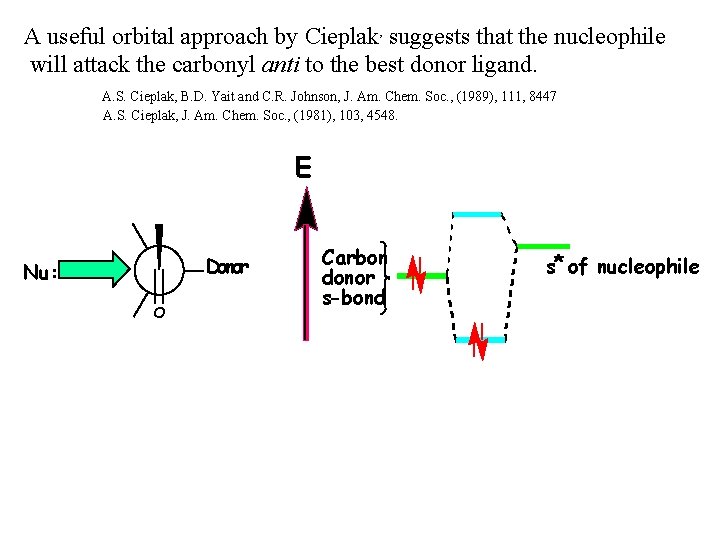
A useful orbital approach by Cieplak, suggests that the nucleophile will attack the carbonyl anti to the best donor ligand. A. S. Cieplak, B. D. Yait and C. R. Johnson, J. Am. Chem. Soc. , (1989), 111, 8447 A. S. Cieplak, J. Am. Chem. Soc. , (1981), 103, 4548. E Donor Nu: O Carbon donor s-bond s* of nucleophile
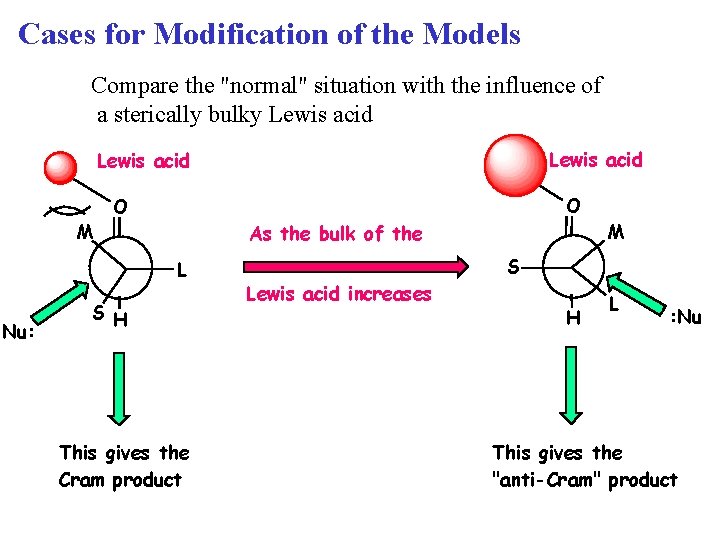
Cases for Modification of the Models Compare the "normal" situation with the influence of a sterically bulky Lewis acid M O O As the bulk of the L Nu: S H This gives the Cram product M S Lewis acid increases H L : Nu This gives the "anti-Cram" product
Dipolar Model often described as the Cornforth model
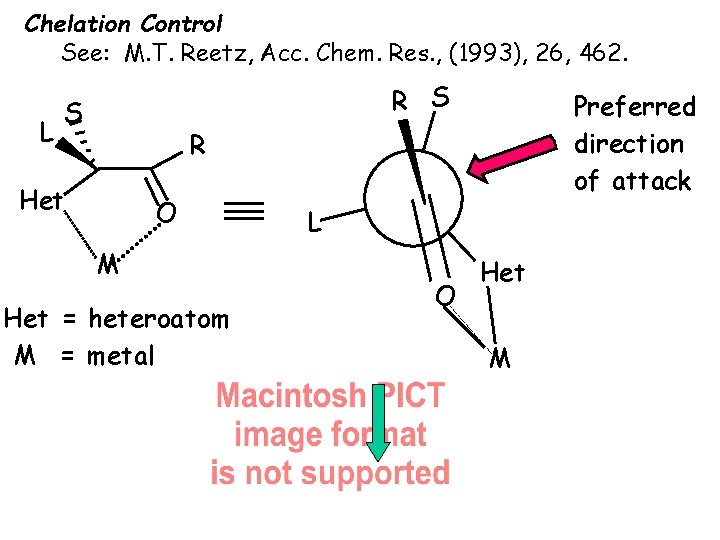
Chelation Control See: M. T. Reetz, Acc. Chem. Res. , (1993), 26, 462. L R S S Preferred direction of attack R Het O M Het = heteroatom M = metal L O Het M
Predict a product from the following reaction
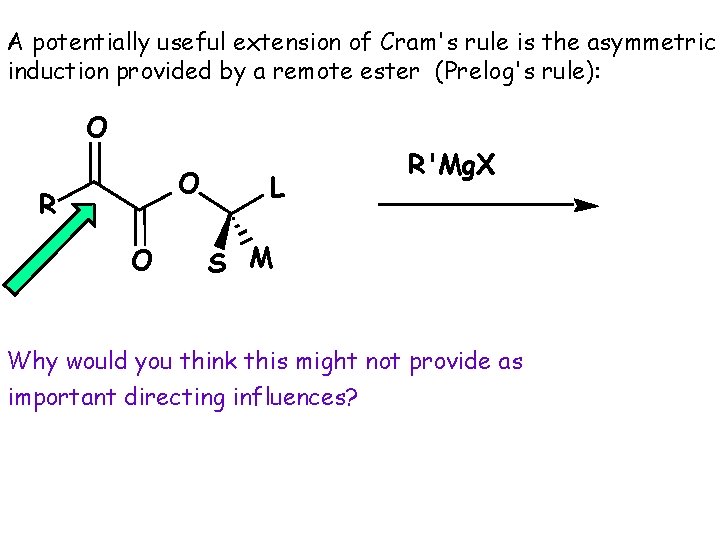
A potentially useful extension of Cram's rule is the asymmetric induction provided by a remote ester (Prelog's rule): O O R O L R'Mg. X S M Why would you think this might not provide as important directing influences?
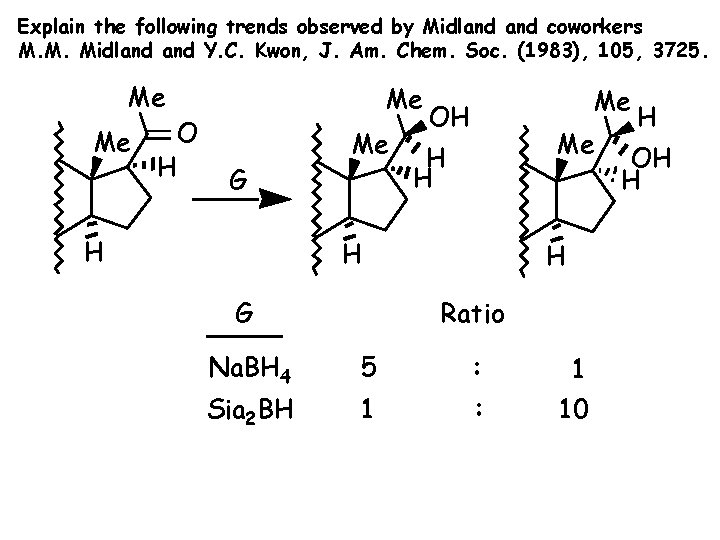
Explain the following trends observed by Midland coworkers M. M. Midland Y. C. Kwon, J. Am. Chem. Soc. (1983), 105, 3725. Me Me O H Me G H Me Me OH Me H H H G H Ratio Na. BH 4 5 : 1 Sia 2 BH 1 : 10 H OH H