
Craig Harper Rebecca Lievesley Rebecca Reynolds Nottingham Trent
Craig Harper Rebecca Lievesley Rebecca Reynolds Nottingham Trent University Jeremy Malcolm Prostasia Foundation Understanding Sex Doll Ownership Exploring the characteristics and experiences of individuals who own sex dolls craig. harper@ntu. ac. uk rebecca. lievesley@ntu. ac. uk @Craig. Harper 19 @R_Lievesley @qirtaiba

Dr. Craig Harper & Dr. Rebecca Lievesley MAP and sexual minority research, and implications for wellbeing and harm reduction Introductions Rebecca Reynolds, Katie Wanless, & Mia Davis PG and UG researchers Jeremy Malcolm Founder of Prostasia Foundation
Explore the legislative and social context of doll ownership Workshop aims What do we currently know about doll owners? Findings from our research Experiences and motivations of doll owners Doll ownership characteristics and links to sexual aggression risk

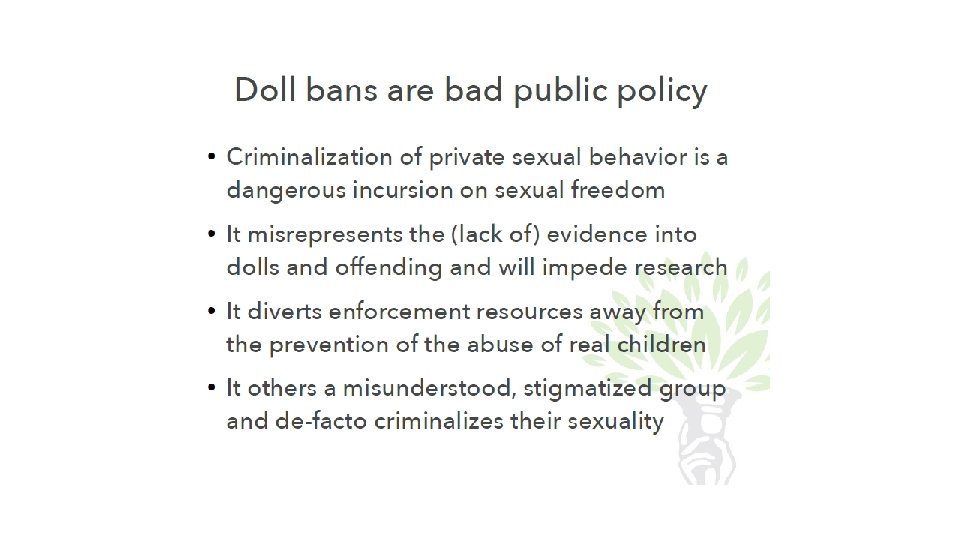
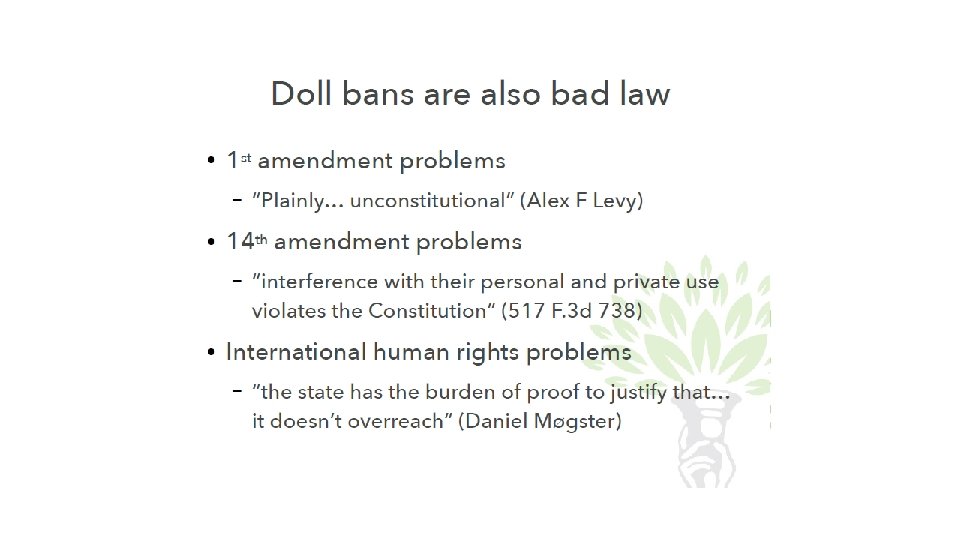
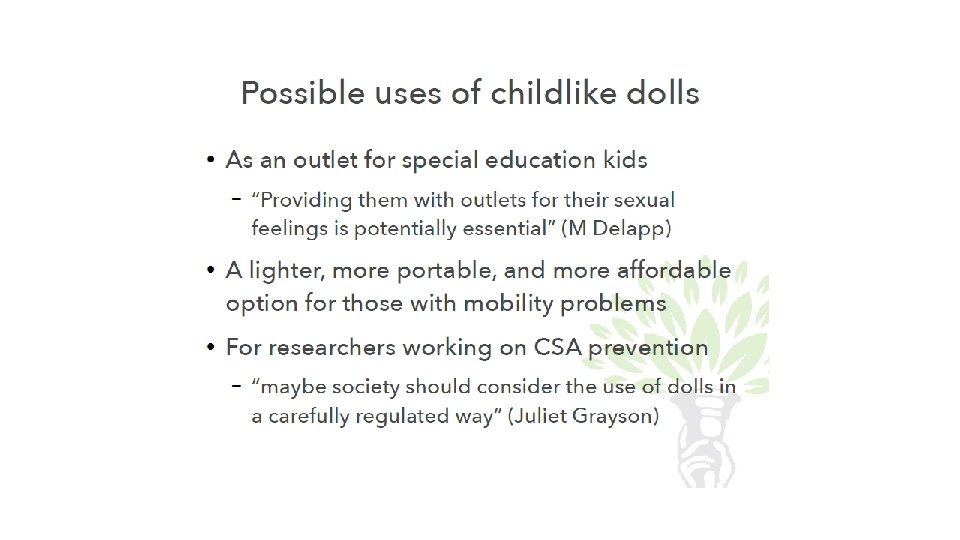
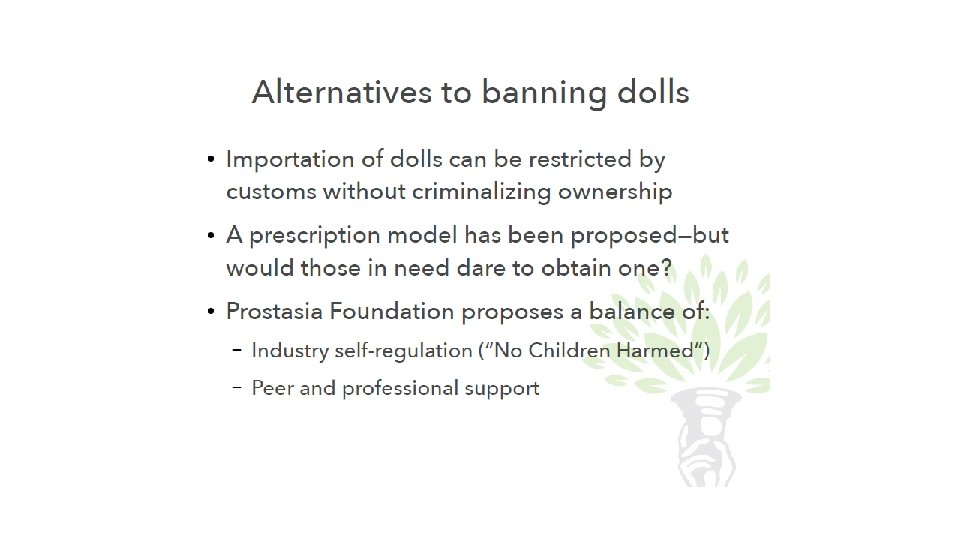


What Do We Currently Know?
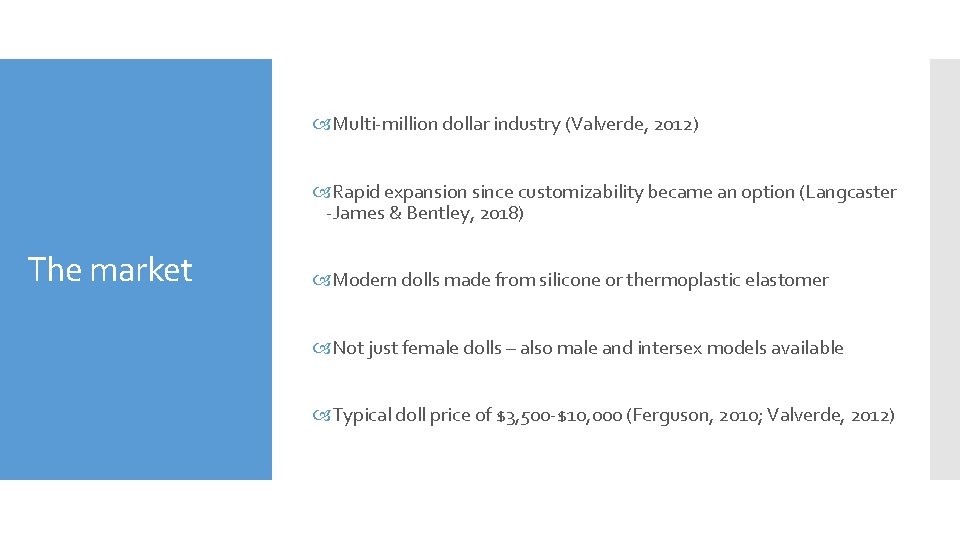
Multi-million dollar industry (Valverde, 2012) Rapid expansion since customizability became an option (Langcaster -James & Bentley, 2018) The market Modern dolls made from silicone or thermoplastic elastomer Not just female dolls – also male and intersex models available Typical doll price of $3, 500 -$10, 000 (Ferguson, 2010; Valverde, 2012)
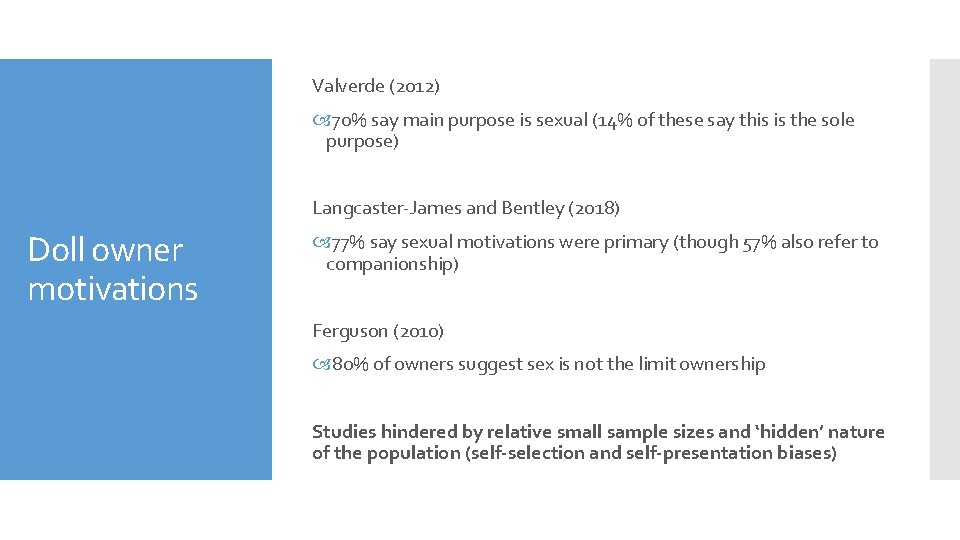
Valverde (2012) 70% say main purpose is sexual (14% of these say this is the sole purpose) Langcaster-James and Bentley (2018) Doll owner motivations 77% say sexual motivations were primary (though 57% also refer to companionship) Ferguson (2010) 80% of owners suggest sex is not the limit ownership Studies hindered by relative small sample sizes and ‘hidden’ nature of the population (self-selection and self-presentation biases)
Understanding the Experiences and Motivations of Sex Doll Owners Rebecca Lievesley Rebecca Reynolds Craig Harper Mia Davis Nottingham Trent University rebecca. lievesley@ntu. ac. uk craig. harper@ntu. ac. uk @R_Lievesley @Craig. Harper 19
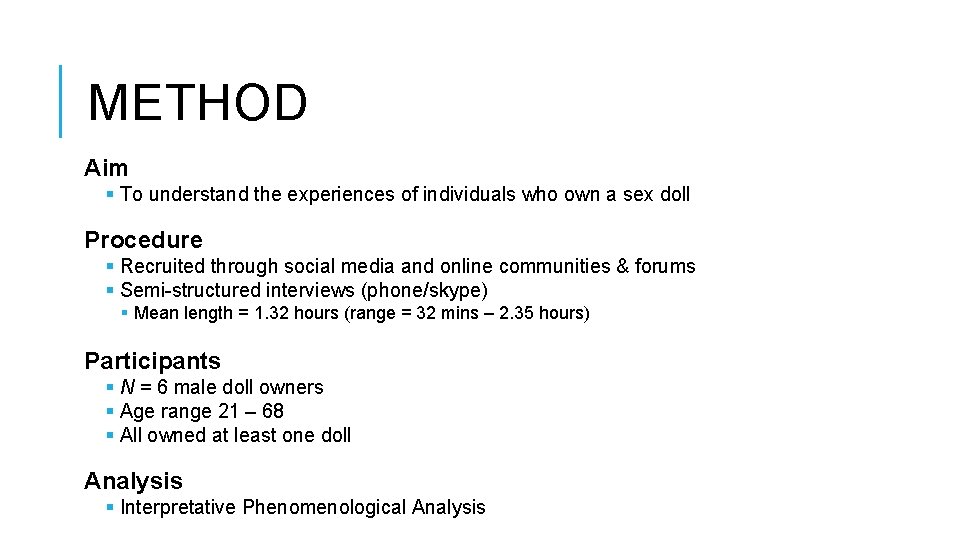
METHOD Aim § To understand the experiences of individuals who own a sex doll Procedure § Recruited through social media and online communities & forums § Semi-structured interviews (phone/skype) § Mean length = 1. 32 hours (range = 32 mins – 2. 35 hours) Participants § N = 6 male doll owners § Age range 21 – 68 § All owned at least one doll Analysis § Interpretative Phenomenological Analysis
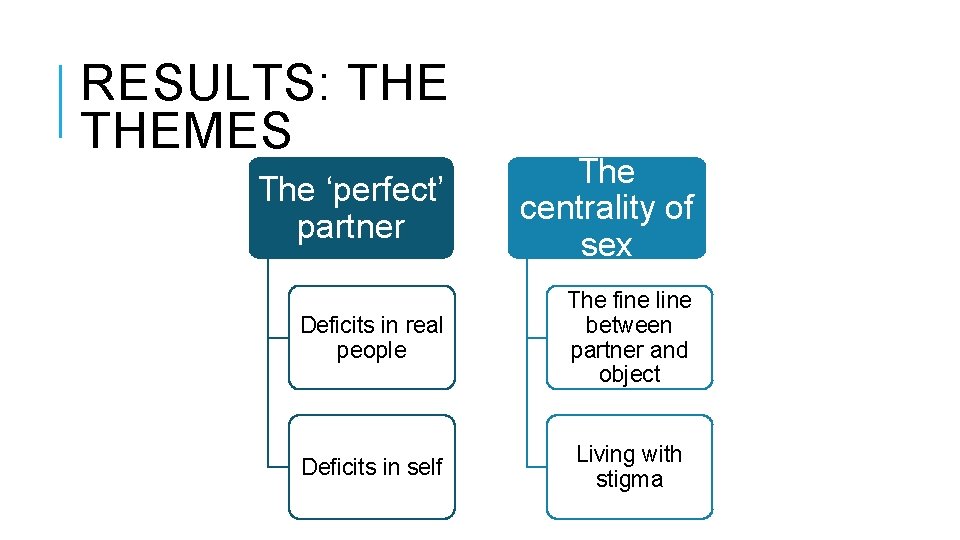
RESULTS: THEMES The ‘perfect’ partner The centrality of sex Deficits in real people The fine line between partner and object Deficits in self Living with stigma
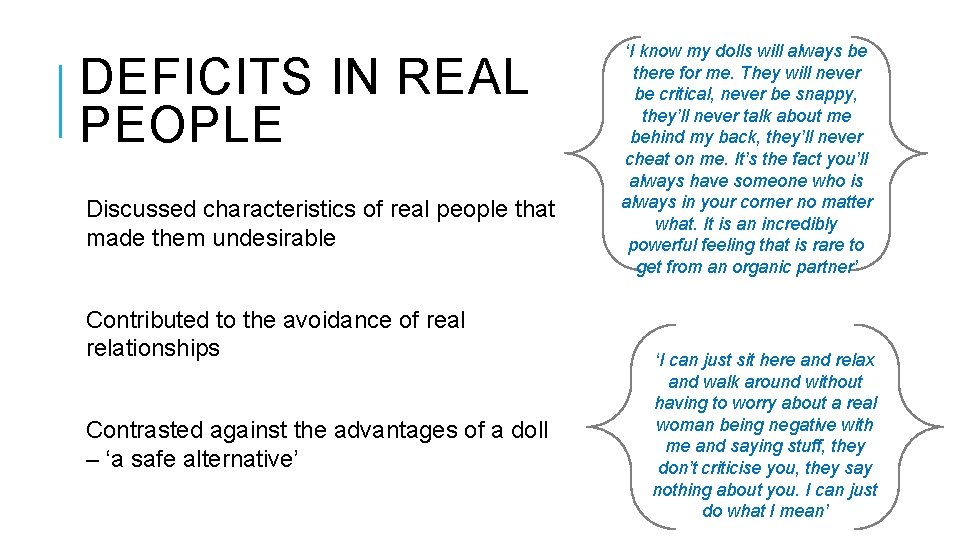
DEFICITS IN REAL PEOPLE Discussed characteristics of real people that made them undesirable Contributed to the avoidance of real relationships Contrasted against the advantages of a doll – ‘a safe alternative’ ‘I know my dolls will always be there for me. They will never be critical, never be snappy, they’ll never talk about me behind my back, they’ll never cheat on me. It’s the fact you’ll always have someone who is always in your corner no matter what. It is an incredibly powerful feeling that is rare to get from an organic partner’ ‘I can just sit here and relax and walk around without having to worry about a real woman being negative with me and saying stuff, they don’t criticise you, they say nothing about you. I can just do what I mean’
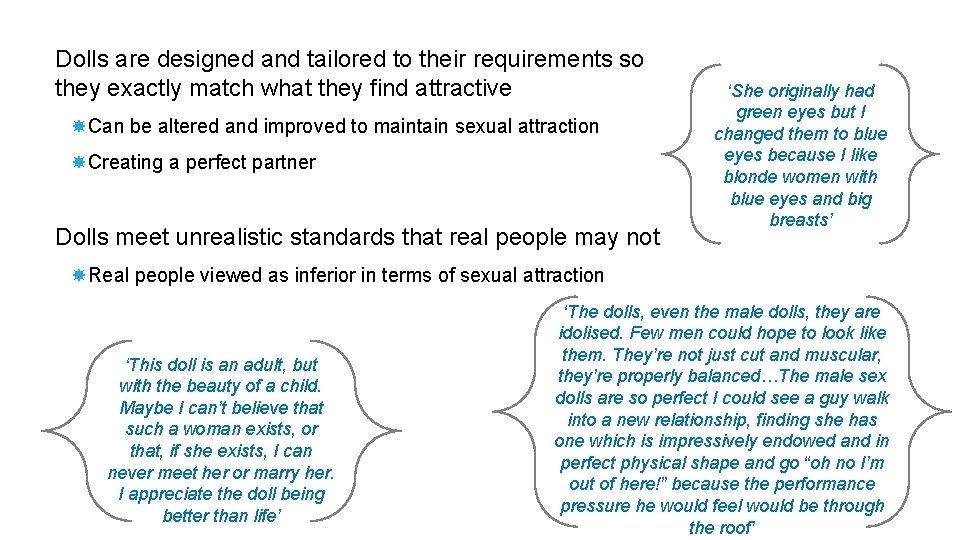
Dolls are designed and tailored to their requirements so they exactly match what they find attractive Can be altered and improved to maintain sexual attraction Creating a perfect partner Dolls meet unrealistic standards that real people may not ‘She originally had green eyes but I changed them to blue eyes because I like blonde women with blue eyes and big breasts’ Real people viewed as inferior in terms of sexual attraction ‘This doll is an adult, but with the beauty of a child. Maybe I can’t believe that such a woman exists, or that, if she exists, I can never meet her or marry her. I appreciate the doll being better than life’ ‘The dolls, even the male dolls, they are idolised. Few men could hope to look like them. They’re not just cut and muscular, they’re properly balanced…The male sex dolls are so perfect I could see a guy walk into a new relationship, finding she has one which is impressively endowed and in perfect physical shape and go “oh no I’m out of here!” because the performance pressure he would feel would be through the roof’
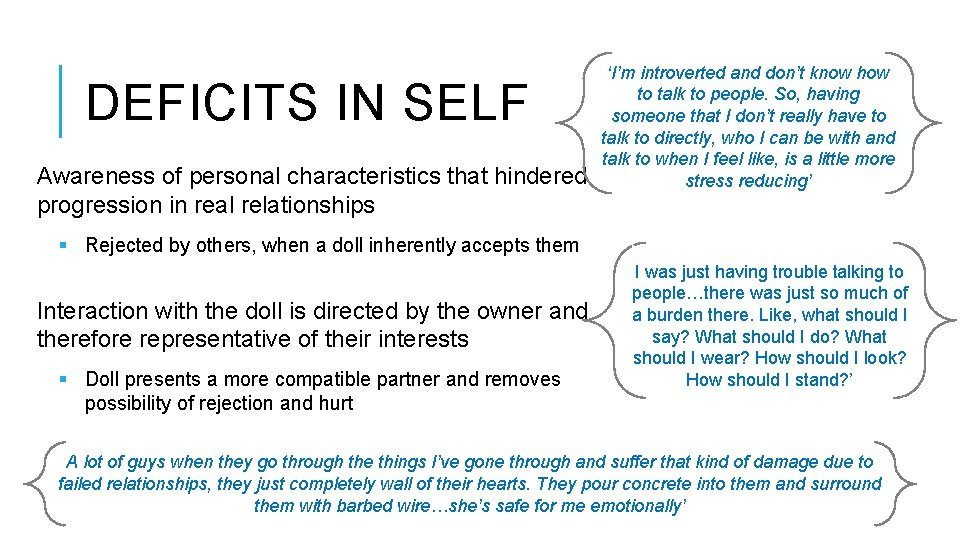
‘ DEFICITS IN SELF Awareness of personal characteristics that hindered progression in real relationships § Rejected by others, when a doll inherently accepts them Interaction with the doll is directed by the owner and therefore representative of their interests § Doll presents a more compatible partner and removes possibility of rejection and hurt ‘I’m introverted and don’t know how to talk to people. So, having someone that I don’t really have to talk to directly, who I can be with and talk to when I feel like, is a little more stress reducing’ ‘ I was just having trouble talking to people…there was just so much of a burden there. Like, what should I say? What should I do? What should I wear? How should I look? How should I stand? ’ A lot of guys when they go through the things I’ve gone through and suffer that kind of damage due to failed relationships, they just completely wall of their hearts. They pour concrete into them and surround them with barbed wire…she’s safe for me emotionally’
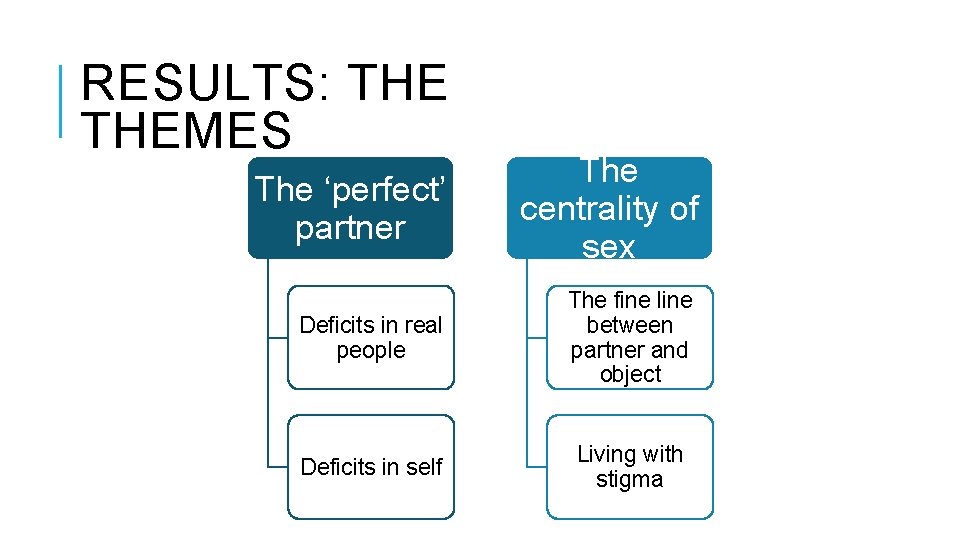
RESULTS: THEMES The ‘perfect’ partner The centrality of sex Deficits in real people The fine line between partner and object Deficits in self Living with stigma
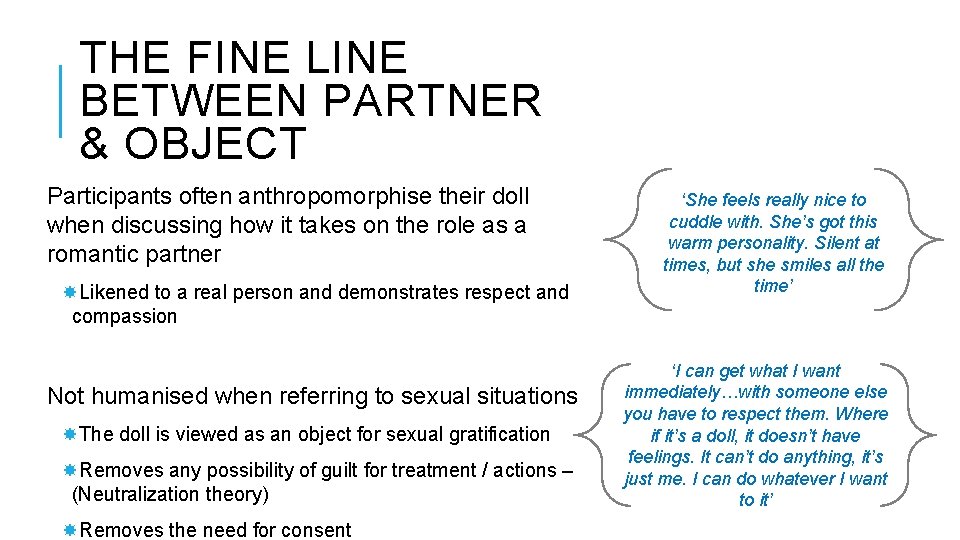
THE FINE LINE BETWEEN PARTNER & OBJECT Participants often anthropomorphise their doll when discussing how it takes on the role as a romantic partner Likened to a real person and demonstrates respect and compassion Not humanised when referring to sexual situations The doll is viewed as an object for sexual gratification Removes any possibility of guilt for treatment / actions – (Neutralization theory) Removes the need for consent ‘She feels really nice to cuddle with. She’s got this warm personality. Silent at times, but she smiles all the time’ ‘I can get what I want immediately…with someone else you have to respect them. Where if it’s a doll, it doesn’t have feelings. It can’t do anything, it’s just me. I can do whatever I want to it’
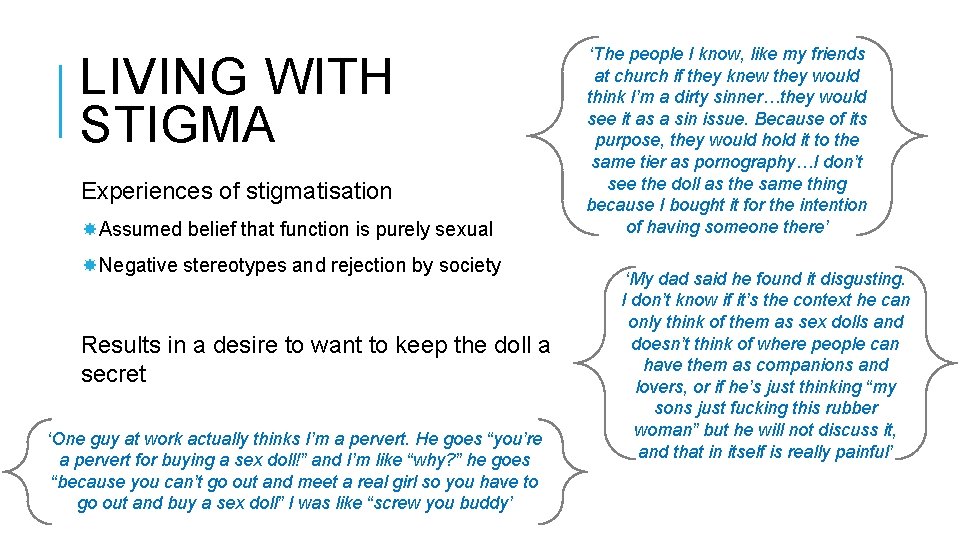
LIVING WITH STIGMA Experiences of stigmatisation Assumed belief that function is purely sexual Negative stereotypes and rejection by society Results in a desire to want to keep the doll a secret ‘One guy at work actually thinks I’m a pervert. He goes “you’re a pervert for buying a sex doll!” and I’m like “why? ” he goes “because you can’t go out and meet a real girl so you have to go out and buy a sex doll” I was like “screw you buddy’ ‘The people I know, like my friends at church if they knew they would think I’m a dirty sinner…they would see it as a sin issue. Because of its purpose, they would hold it to the same tier as pornography…I don’t see the doll as the same thing because I bought it for the intention of having someone there’ ‘My dad said he found it disgusting. I don’t know if it’s the context he can only think of them as sex dolls and doesn’t think of where people can have them as companions and lovers, or if he’s just thinking “my sons just fucking this rubber woman” but he will not discuss it, and that in itself is really painful’
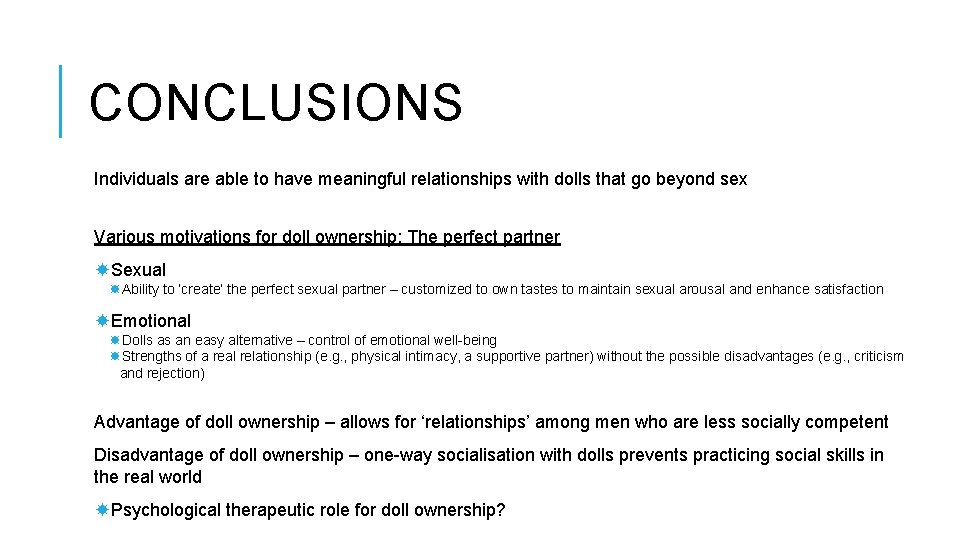
CONCLUSIONS Individuals are able to have meaningful relationships with dolls that go beyond sex Various motivations for doll ownership: The perfect partner Sexual Ability to ‘create’ the perfect sexual partner – customized to own tastes to maintain sexual arousal and enhance satisfaction Emotional Dolls as an easy alternative – control of emotional well-being Strengths of a real relationship (e. g. , physical intimacy, a supportive partner) without the possible disadvantages (e. g. , criticism and rejection) Advantage of doll ownership – allows for ‘relationships’ among men who are less socially competent Disadvantage of doll ownership – one-way socialisation with dolls prevents practicing social skills in the real world Psychological therapeutic role for doll ownership?
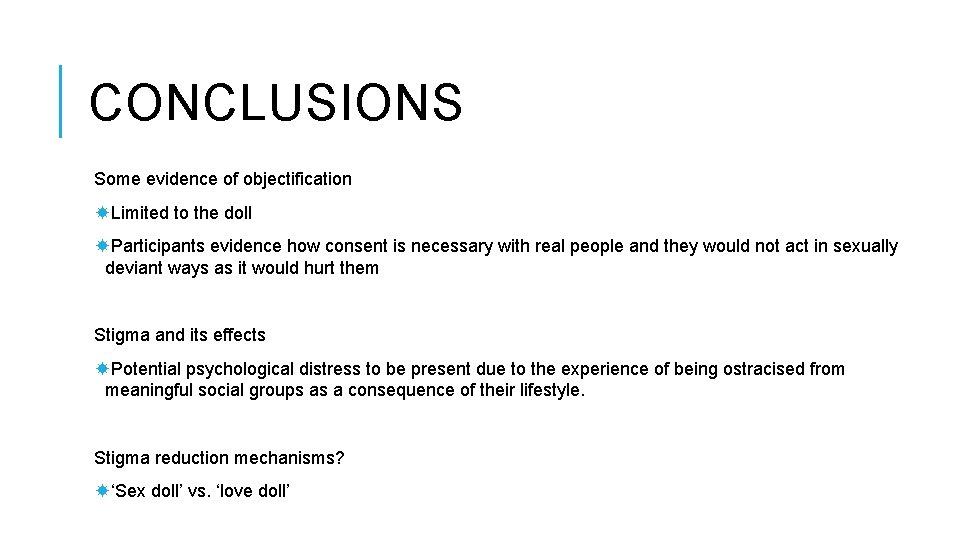
CONCLUSIONS Some evidence of objectification Limited to the doll Participants evidence how consent is necessary with real people and they would not act in sexually deviant ways as it would hurt them Stigma and its effects Potential psychological distress to be present due to the experience of being ostracised from meaningful social groups as a consequence of their lifestyle. Stigma reduction mechanisms? ‘Sex doll’ vs. ‘love doll’
Craig Harper Rebecca Lievesley Katie Wanless Does Sex Doll Ownership Predict Sexual Aggression Proclivity? Nottingham Trent University craig. harper@ntu. ac. uk rebecca. lievesley@ntu. ac. uk Examining the differences between doll owners and non-owners @Craig. Harper 19 @R_Lievesley
Quantitatively-focused anonymous survey about ‘media myths’ Study overview Run concurrently with the interviews previously described Recruitment via doll forums and social media Control sample via Prolific Data collection ongoing (ns = approx. 70 and 90)
General demographics Survey content Sex Age Education Relationship status Sexual orientation (age and sex)
Doll-related variables Survey content Sex doll ownership status Number of dolls Length of time as an owner Functions of dolls Frequency of sex with dolls Interest in doll ownership (if not already an owner)
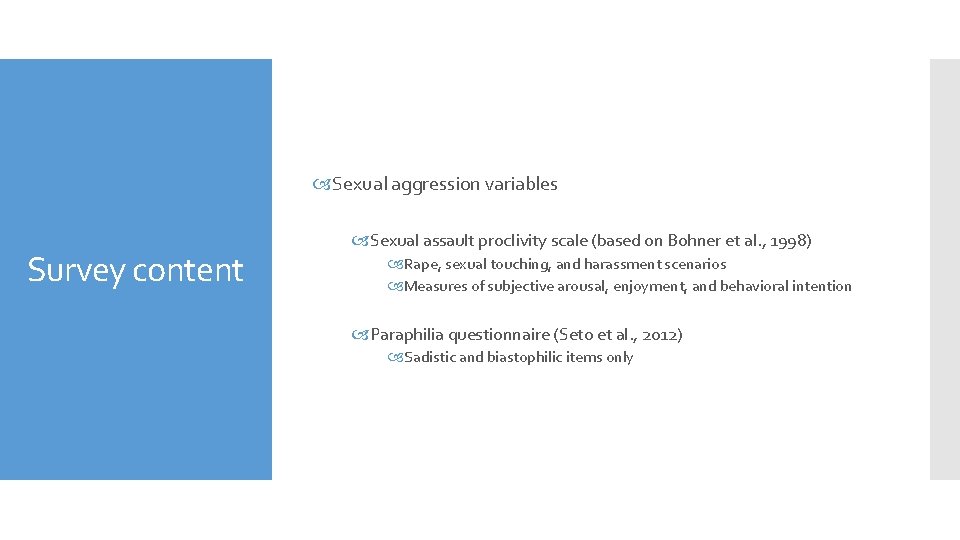
Sexual aggression variables Survey content Sexual assault proclivity scale (based on Bohner et al. , 1998) Rape, sexual touching, and harassment scenarios Measures of subjective arousal, enjoyment, and behavioral intention Paraphilia questionnaire (Seto et al. , 2012) Sadistic and biastophilic items only
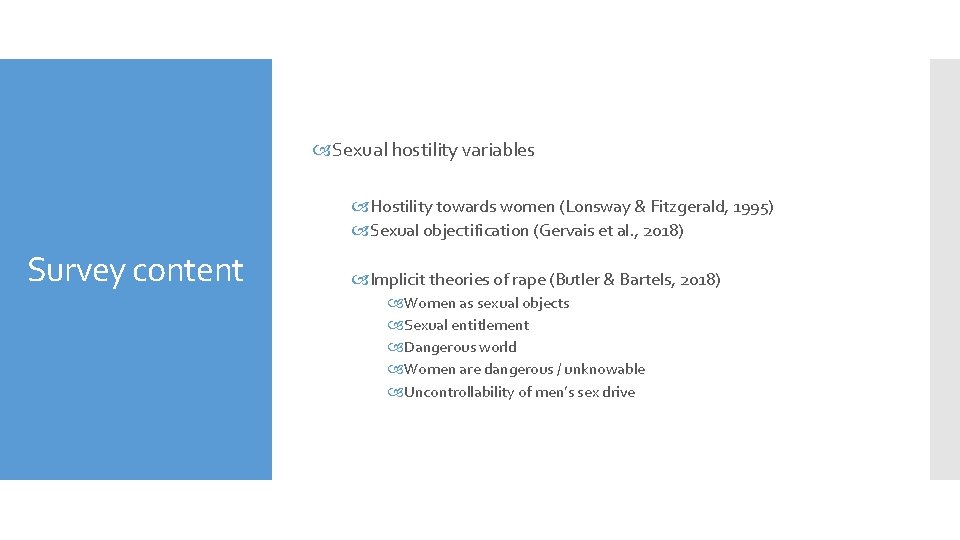
Sexual hostility variables Hostility towards women (Lonsway & Fitzgerald, 1995) Sexual objectification (Gervais et al. , 2018) Survey content Implicit theories of rape (Butler & Bartels, 2018) Women as sexual objects Sexual entitlement Dangerous world Women are dangerous / unknowable Uncontrollability of men’s sex drive
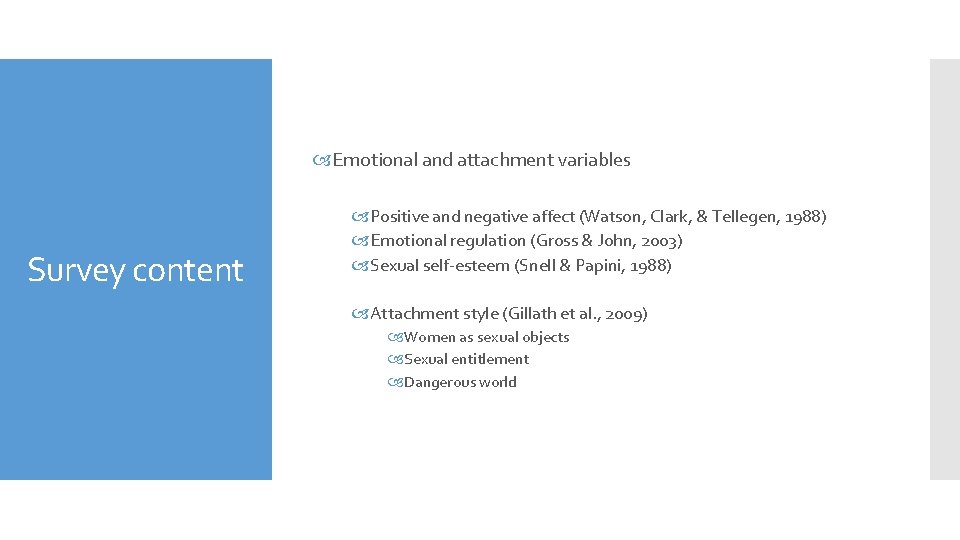
Emotional and attachment variables Survey content Positive and negative affect (Watson, Clark, & Tellegen, 1988) Emotional regulation (Gross & John, 2003) Sexual self-esteem (Snell & Papini, 1988) Attachment style (Gillath et al. , 2009) Women as sexual objects Sexual entitlement Dangerous world
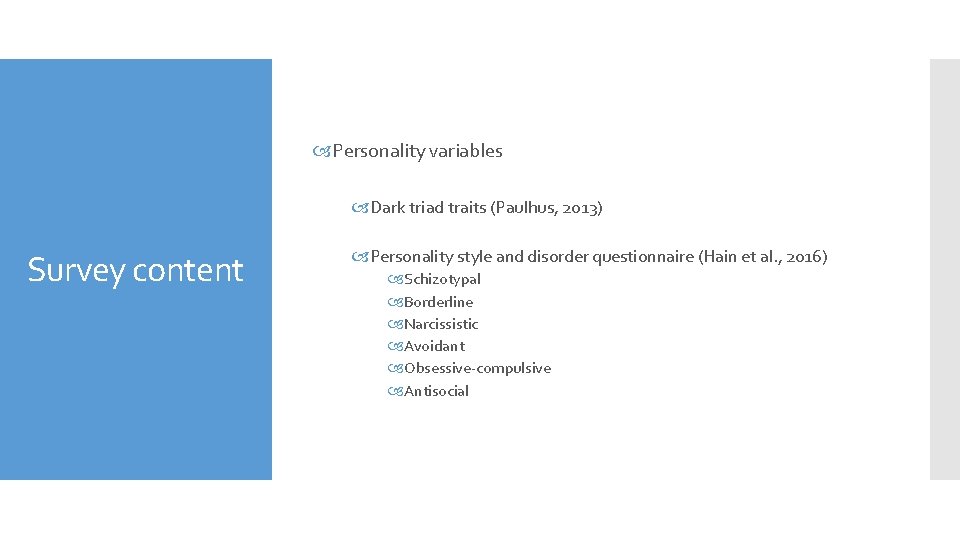
Personality variables Dark triad traits (Paulhus, 2013) Survey content Personality style and disorder questionnaire (Hain et al. , 2016) Schizotypal Borderline Narcissistic Avoidant Obsessive-compulsive Antisocial
DISCLAIMER Small sample sizes Results Approx. 90% power to predict medium effects (d = 0. 50) when comparing groups Moderation / regression designs underpowered
Doll owners older than non-owners (Ms = 40 vs. 33) More likely to be divorced or separated Results – general demographics More likely to identify as bisexual, but less likely to identify as homosexual No differences: Time in education Frequency of partnered sexual activity Average sexual activity with dolls = 9. 22 times per month Sexual and non-sexual (e. g. , emotional / social) motivations for doll ownership equally endorsed
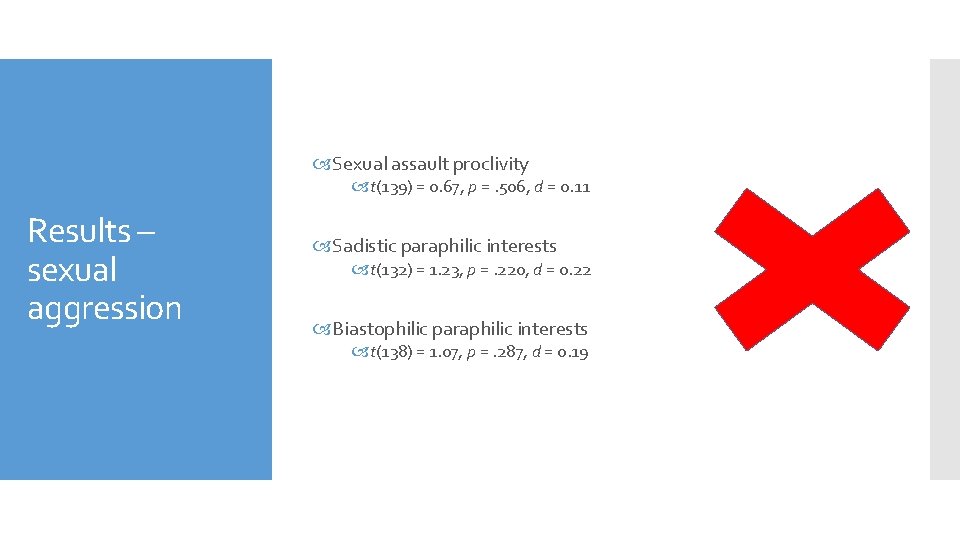
Sexual assault proclivity t(139) = 0. 67, p =. 506, d = 0. 11 Results – sexual aggression Sadistic paraphilic interests t(132) = 1. 23, p =. 220, d = 0. 22 Biastophilic paraphilic interests t(138) = 1. 07, p =. 287, d = 0. 19
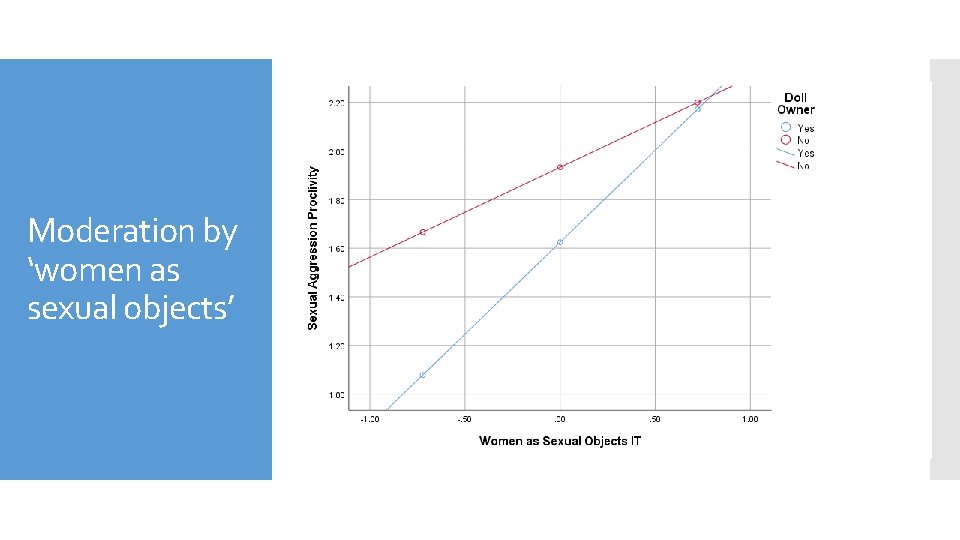
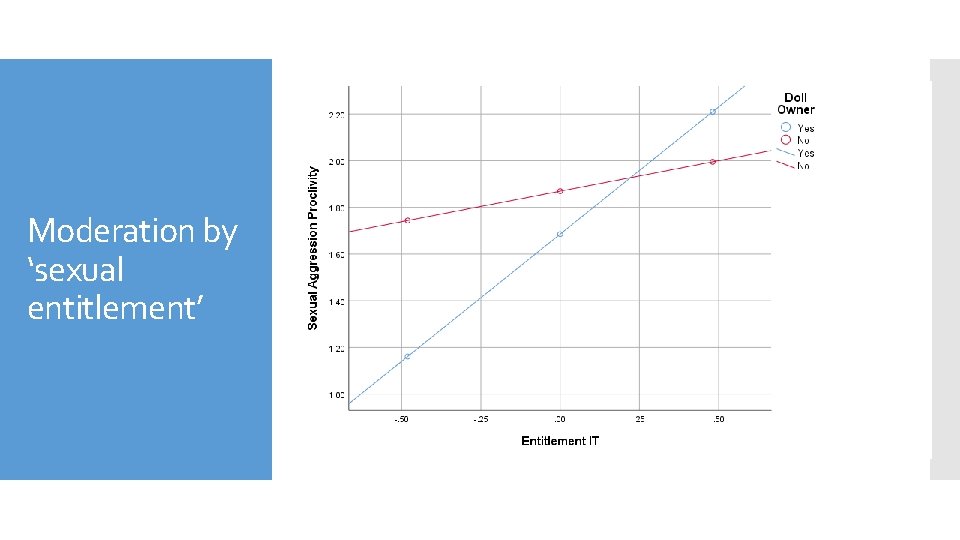
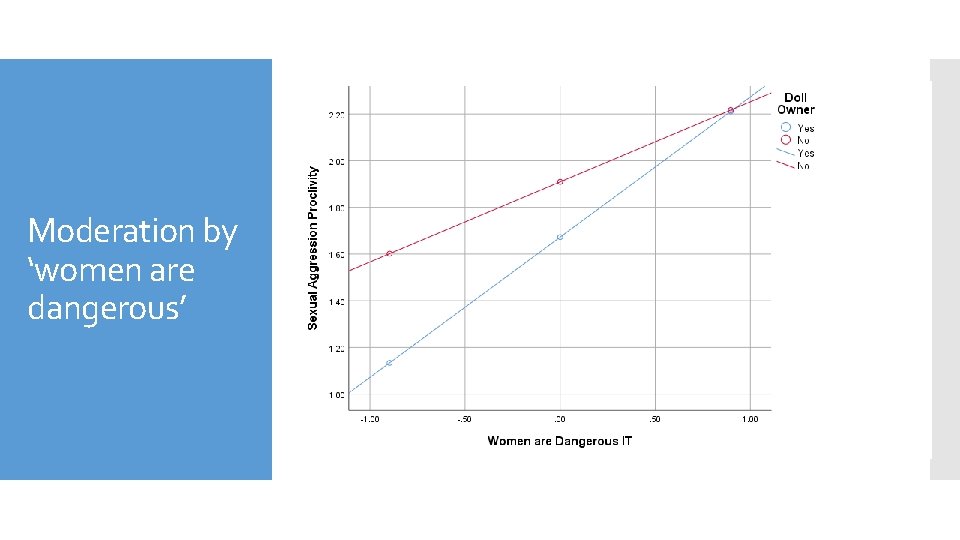
Hostility towards women t(134) = 3. 06, p =. 003, d = 0. 53 Results – sexual hostility and implicit theories Sexual objectification t(134) = 0. 13, p =. 894, d = 0. 02 Implicit theories Women as sex objects: Sexual entitlement: Dangerous world: Women are dangerous / unknowable: Uncontrollability of men’s sex drive: t(133) = 3. 44, p =. 001, d = 0. 60 t(132) = 2. 84, p =. 005, d = 0. 37 t(132) = 1. 53, p =. 128, d = 0. 27 t(132) = 2. 89, p =. 005, d = 0. 51 t(132) = 1. 37, p =. 173, d = 0. 24
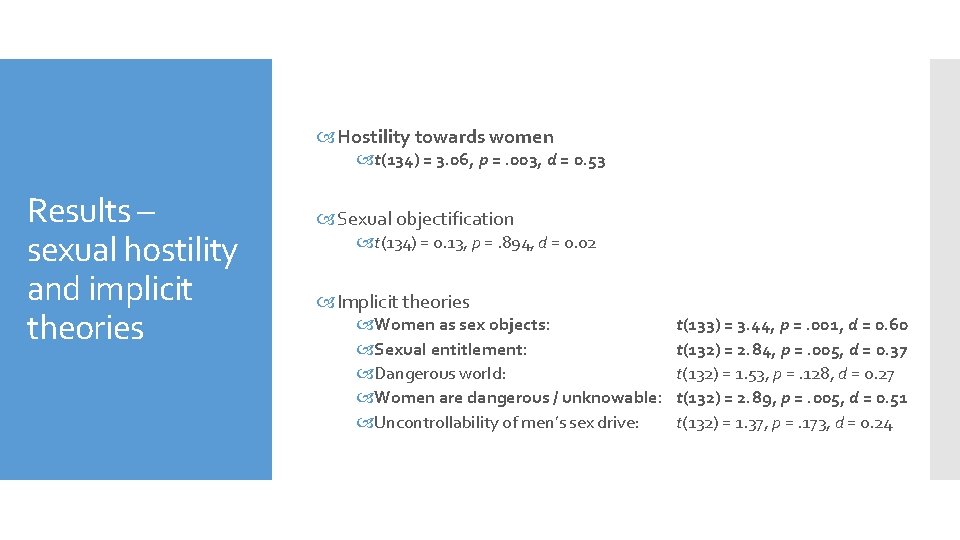
Hostility towards women t(134) = 3. 06, p =. 003, d = 0. 53 Results – sexual hostility and implicit theories Sexual objectification t(134) = 0. 13, p =. 894, d = 0. 02 Implicit theories Women as sex objects: Sexual entitlement: Dangerous world: Women are dangerous / unknowable: Uncontrollability of men’s sex drive: t(133) = 3. 44, p =. 001, d = 0. 60 t(132) = 2. 84, p =. 005, d = 0. 37 t(132) = 1. 53, p =. 128, d = 0. 27 t(132) = 2. 89, p =. 005, d = 0. 51 t(132) = 1. 37, p =. 173, d = 0. 24
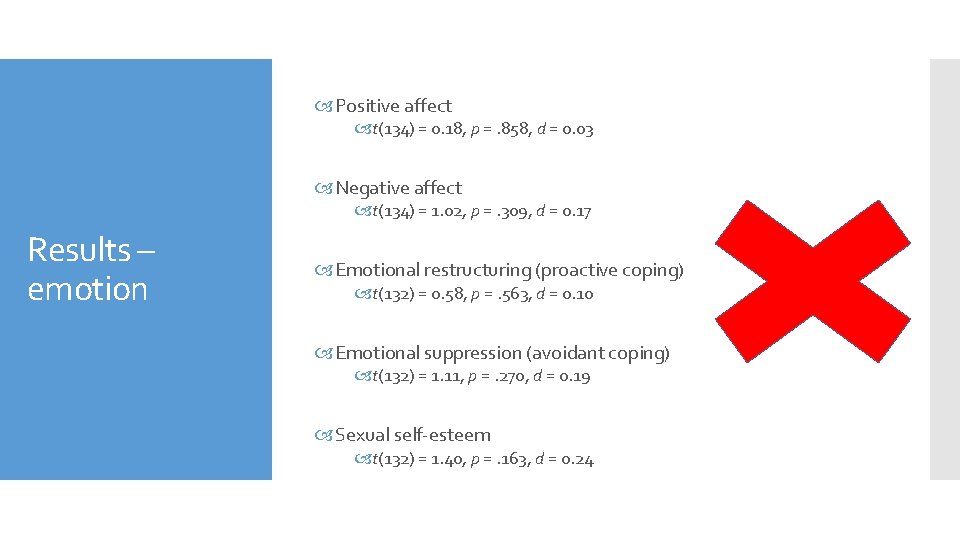
Positive affect t(134) = 0. 18, p =. 858, d = 0. 03 Negative affect t(134) = 1. 02, p =. 309, d = 0. 17 Results – emotion Emotional restructuring (proactive coping) t(132) = 0. 58, p =. 563, d = 0. 10 Emotional suppression (avoidant coping) t(132) = 1. 11, p =. 270, d = 0. 19 Sexual self-esteem t(132) = 1. 40, p =. 163, d = 0. 24
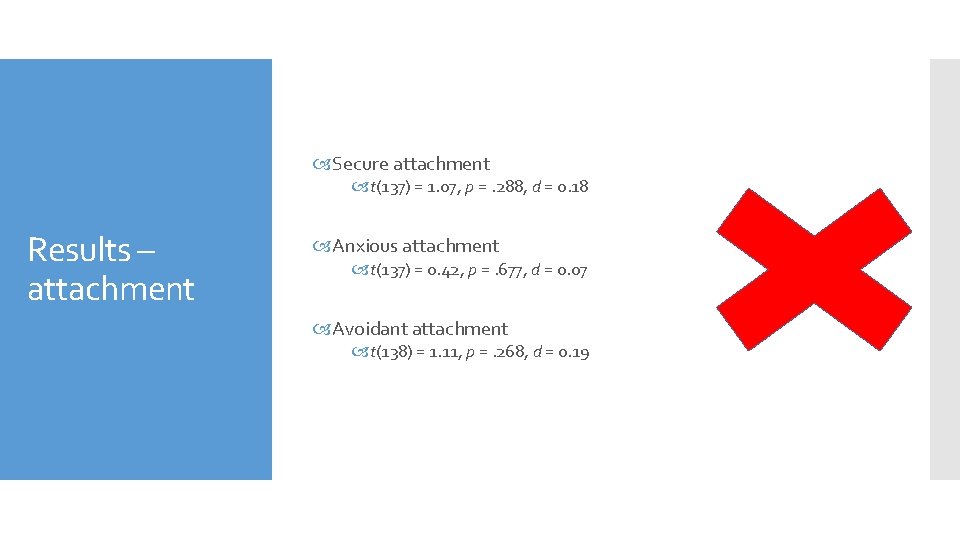
Secure attachment t(137) = 1. 07, p =. 288, d = 0. 18 Results – attachment Anxious attachment t(137) = 0. 42, p =. 677, d = 0. 07 Avoidant attachment t(138) = 1. 11, p =. 268, d = 0. 19
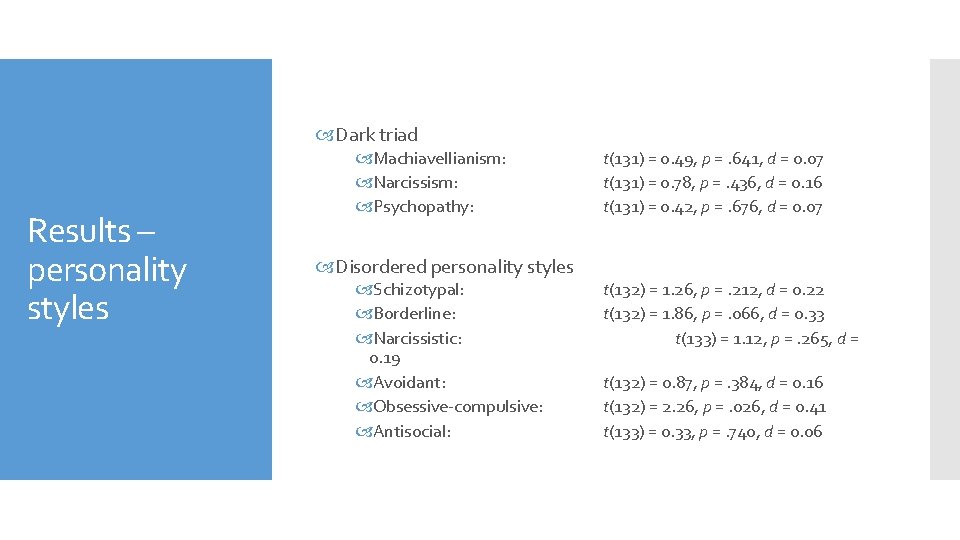
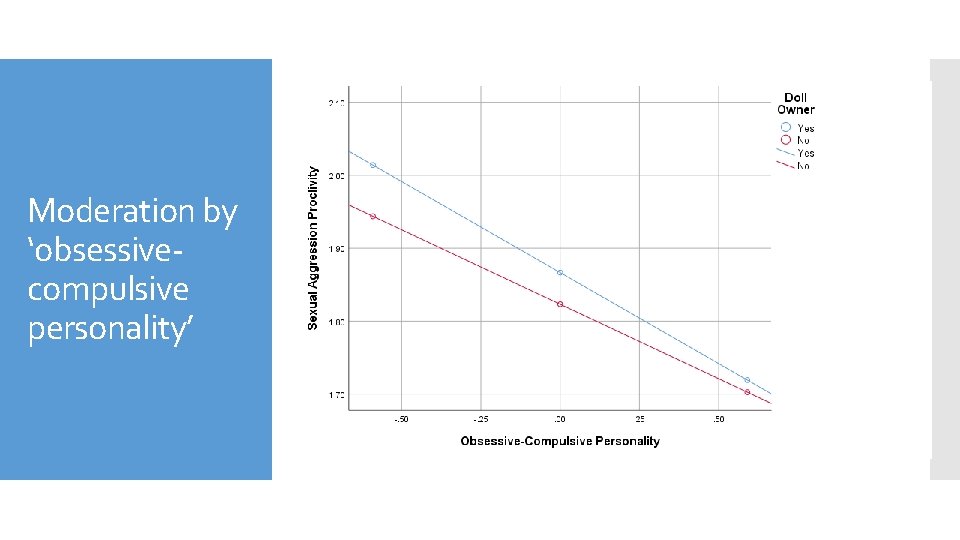
Dark triad Results – personality styles Machiavellianism: Narcissism: Psychopathy: Disordered personality styles Schizotypal: Borderline: Narcissistic: 0. 19 Avoidant: Obsessive-compulsive: Antisocial: t(131) = 0. 49, p =. 641, d = 0. 07 t(131) = 0. 78, p =. 436, d = 0. 16 t(131) = 0. 42, p =. 676, d = 0. 07 t(132) = 1. 26, p =. 212, d = 0. 22 t(132) = 1. 86, p =. 066, d = 0. 33 t(133) = 1. 12, p =. 265, d = t(132) = 0. 87, p =. 384, d = 0. 16 t(132) = 2. 26, p =. 026, d = 0. 41 t(133) = 0. 33, p =. 740, d = 0. 06
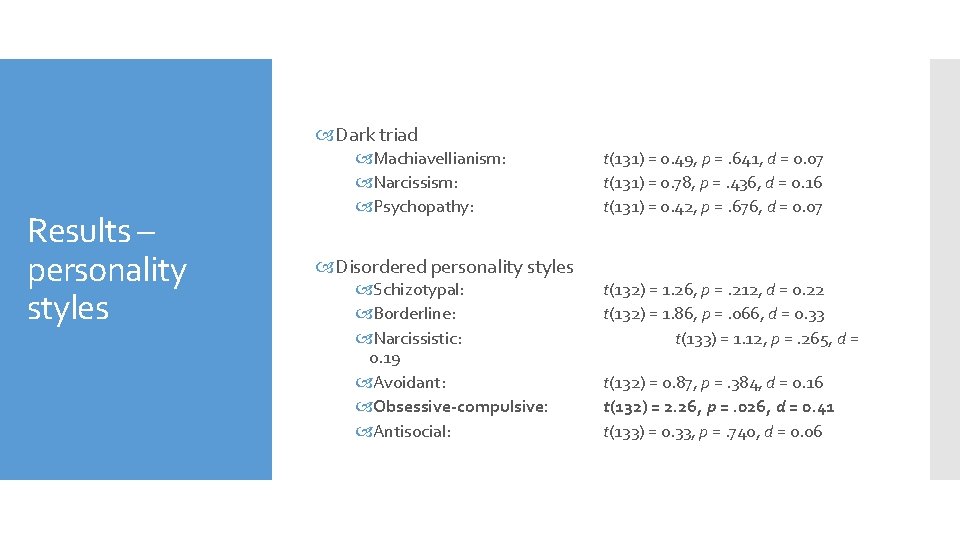
Dark triad Results – personality styles Machiavellianism: Narcissism: Psychopathy: Disordered personality styles Schizotypal: Borderline: Narcissistic: 0. 19 Avoidant: Obsessive-compulsive: Antisocial: t(131) = 0. 49, p =. 641, d = 0. 07 t(131) = 0. 78, p =. 436, d = 0. 16 t(131) = 0. 42, p =. 676, d = 0. 07 t(132) = 1. 26, p =. 212, d = 0. 22 t(132) = 1. 86, p =. 066, d = 0. 33 t(133) = 1. 12, p =. 265, d = t(132) = 0. 87, p =. 384, d = 0. 16 t(132) = 2. 26, p =. 026, d = 0. 41 t(133) = 0. 33, p =. 740, d = 0. 06
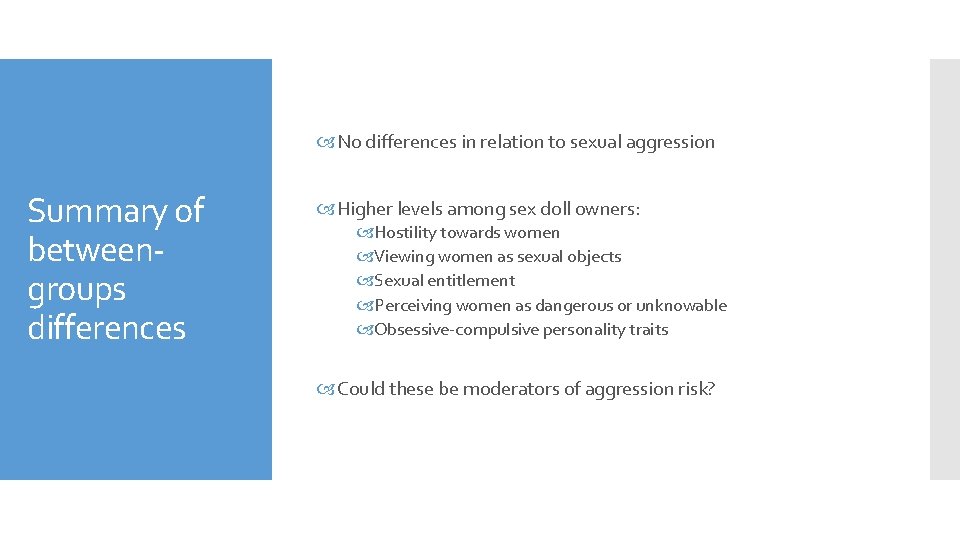
No differences in relation to sexual aggression Summary of betweengroups differences Higher levels among sex doll owners: Hostility towards women Viewing women as sexual objects Sexual entitlement Perceiving women as dangerous or unknowable Obsessive-compulsive personality traits Could these be moderators of aggression risk?
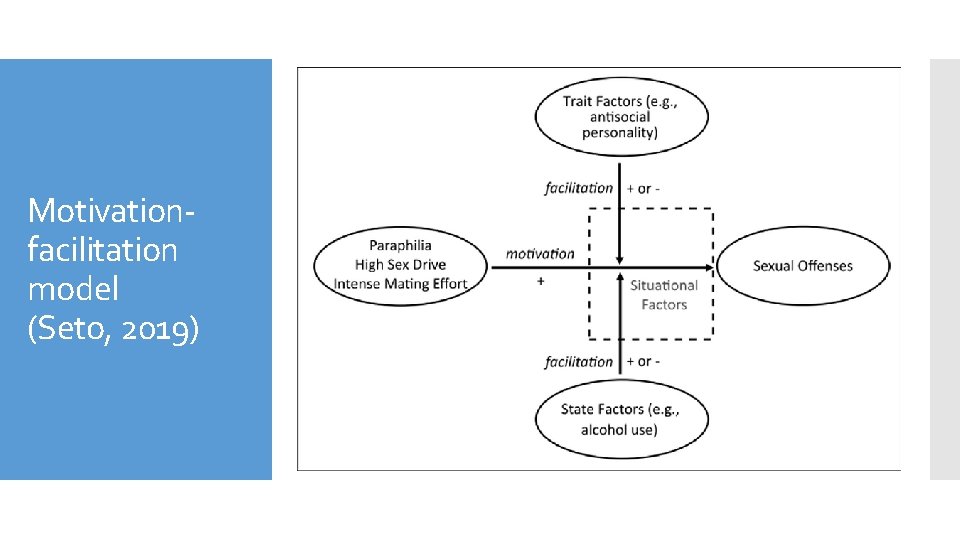
Motivationfacilitation model (Seto, 2019)
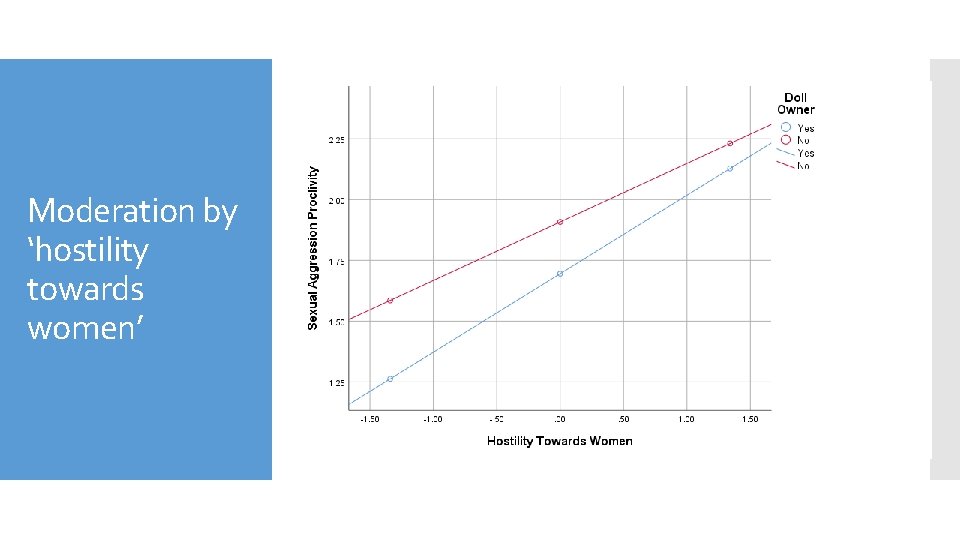
Moderation by ‘hostility towards women’
Moderation by ‘women as sexual objects’
Moderation by ‘sexual entitlement’
Moderation by ‘women are dangerous’
Moderation by ‘obsessivecompulsive personality’
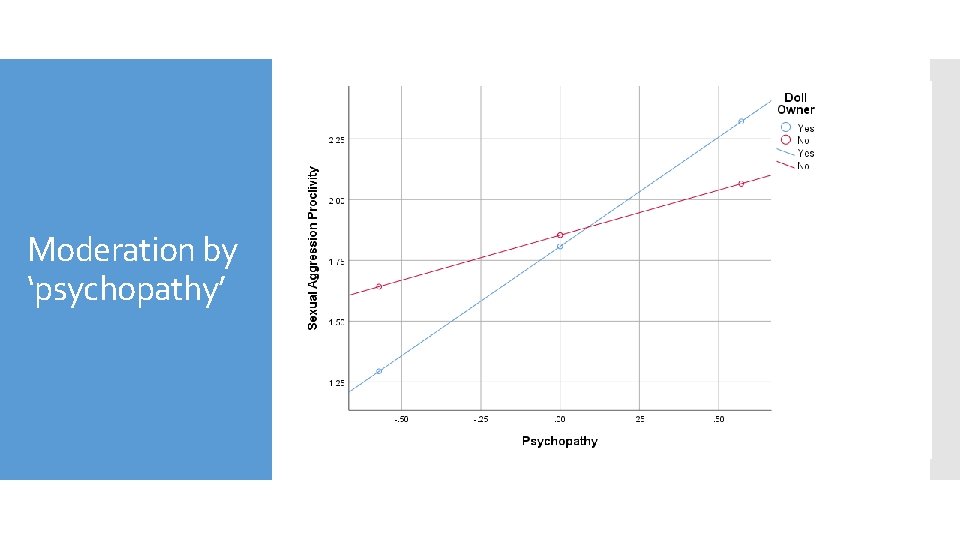
Moderation by ‘psychopathy’
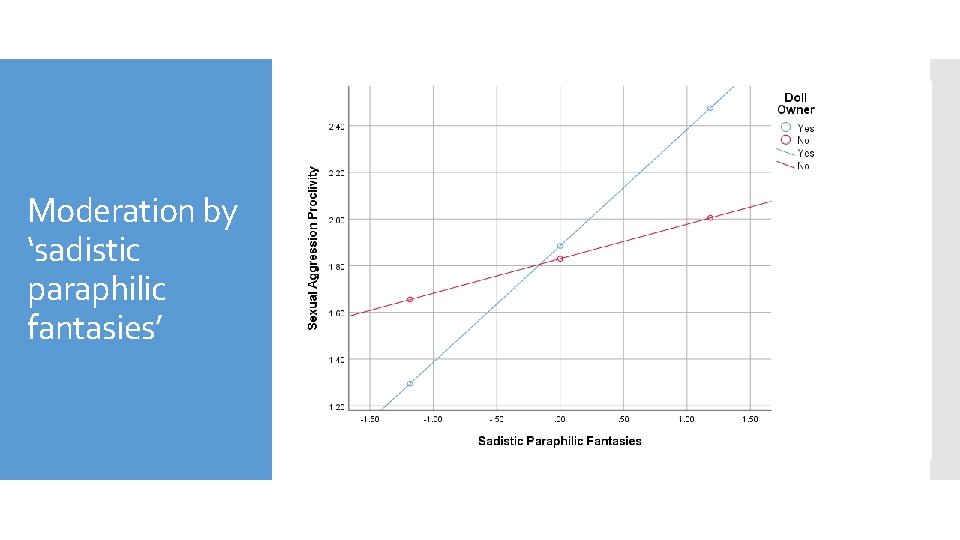
Moderation by ‘sadistic paraphilic fantasies’
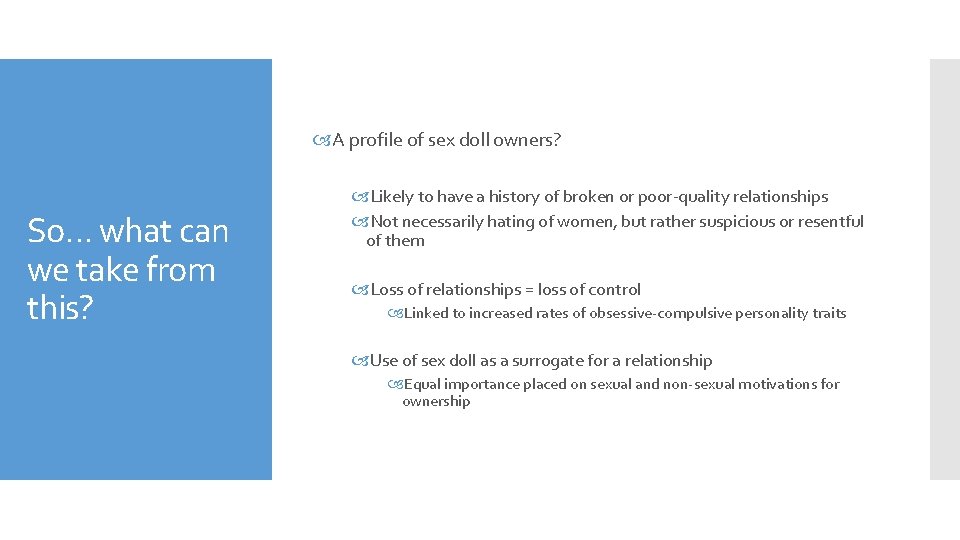
A profile of sex doll owners? So… what can we take from this? Likely to have a history of broken or poor-quality relationships Not necessarily hating of women, but rather suspicious or resentful of them Loss of relationships = loss of control Linked to increased rates of obsessive-compulsive personality traits Use of sex doll as a surrogate for a relationship Equal importance placed on sexual and non-sexual motivations for ownership
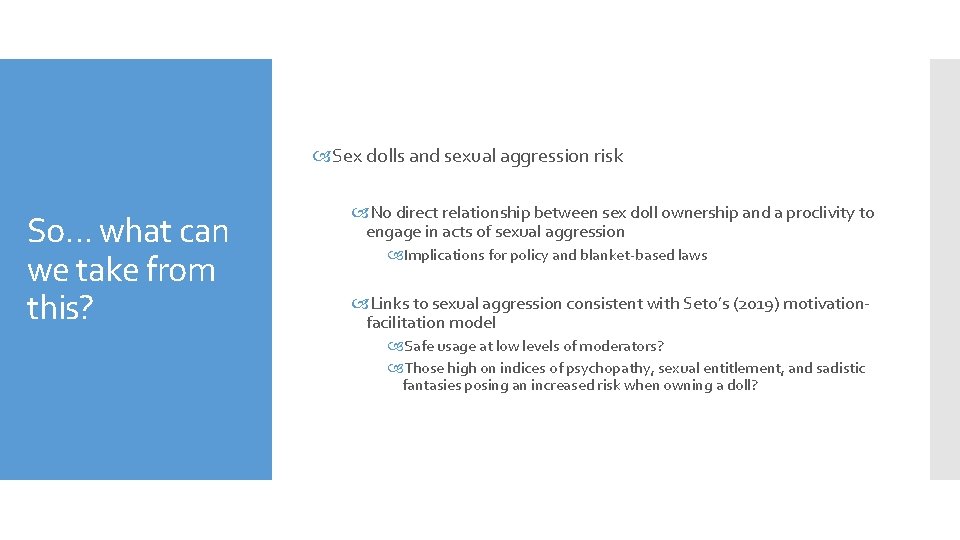
Sex dolls and sexual aggression risk So… what can we take from this? No direct relationship between sex doll ownership and a proclivity to engage in acts of sexual aggression Implications for policy and blanket-based laws Links to sexual aggression consistent with Seto’s (2019) motivationfacilitation model Safe usage at low levels of moderators? Those high on indices of psychopathy, sexual entitlement, and sadistic fantasies posing an increased risk when owning a doll?
Small sample Generalizability is an issue – associations should be interpreted cautiously Limitations Limited predominantly to adult-like doll owners Societal discussions about child-like doll use Cross-sectional data Difficult to interpret in relation to causal relationships

Discussion
Please feel free to get in touch! Craig Harper & Rebecca Lievesley craig. harper@ntu. ac. uk / rebecca. lievesley@ntu. ac. uk Twitter: @Craig. Harper 19 / @R_Lievesley Jeremy Malcolm Twitter: @qirtaiba / @Prostasia. Inc www. prostasia. org TAKE A PICTUR E! Slide Handouts Today’s workshop: https: //osf. io/cwvf 9/ (‘ATSA 2019 – Sex Doll Owners’) THANK YOU FOR LISTENING – ANY QUESTIONS?
- Slides: 63