
Cracking the Climate Engineering Governance Code How discursive
- Slides: 62
Cracking the Climate Engineering Governance Code How discursive structures can inform the anticipatory development of a Code of Conduct for Climate Engineering Research Miranda Boettcher Research Associate Climate Engineering in Science, Society and Politics Institute for Advanced Sustainability Studies e. V. (IASS) Institute for Advanced Sustainability Studies e. V. Cracking the CE Governance Code, Uni Melbourne, 13. 02. 2019 1
Cracking the Climate Engineering Governance Code 1. Background 2. Governance challenges 3. Past developments 4. A Code of Conduct 5. Cracking the Code Institute for Advanced Sustainability Studies e. V. Cracking the CE Governance Code, Uni Melbourne, 13. 02. 2019 2
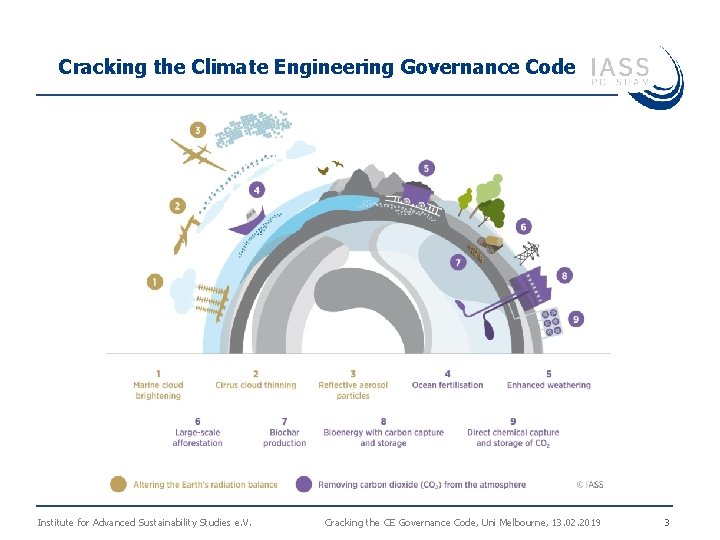
Cracking the Climate Engineering Governance Code Institute for Advanced Sustainability Studies e. V. Cracking the CE Governance Code, Uni Melbourne, 13. 02. 2019 3
Cracking the Climate Engineering Governance Code “The greatest challenges to the successful deployment of geoengineering may be the social, ethical, legal and political issues associated with governance, rather than scientific and technical issues” Royal Society (2009) Institute for Advanced Sustainability Studies e. V. Cracking the CE Governance Code, Uni Melbourne, 13. 02. 2019 4
Cracking the Climate Engineering Governance Code 1. Background § What is climate engineering? § What is the right term—and what is the right level of aggregation? § All-encompassing umbrella terms, sub-categorizations, individual proposals? § What’s in, what’s out? § Why does it matter for governance? Institute for Advanced Sustainability Studies e. V. Cracking the CE Governance Code, Uni Melbourne, 13. 02. 2019 5
Cracking the Climate Engineering Governance Code 1. Background § What is climate engineering? § Summary: The way technologies are defined and conceptualized affects the way they are governed. § The way they are governed affects the way technologies are, in turn, further conceptualized and developed. § Language matters! Institute for Advanced Sustainability Studies e. V. Cracking the CE Governance Code, Uni Melbourne, 13. 02. 2019 6
Cracking the Climate Engineering Governance Code 1. Background § What is governance? § § § Regulation vs. governance Bottom-up vs. top down Hard vs. soft law Binding vs. voluntary Restrictive vs. enabling Institute for Advanced Sustainability Studies e. V. Cracking the CE Governance Code, Uni Melbourne, 13. 02. 2019 7
Cracking the Climate Engineering Governance Code 1. Background § What is governance? § Summary: The term “governance” used in the field of climate engineering to refer a wide range of concepts. § Fuzziness of the term can lead to miscommunication about the “governance” of climate engineering. § Language matters! Institute for Advanced Sustainability Studies e. V. Cracking the CE Governance Code, Uni Melbourne, 13. 02. 2019 8
Cracking the Climate Engineering Governance Code 2. Governance challenges § Why govern climate engineering? (Restricting) § § § § Slippery slope Moral hazard Vested interests Termination effect Rogue actors Differing national interests Attribution problems Institute for Advanced Sustainability Studies e. V. Cracking the CE Governance Code, Uni Melbourne, 13. 02. 2019 9
Cracking the Climate Engineering Governance Code 2. Governance challenges § Why govern climate engineering? (Enabling) § § § Transparency Coordination Mission definition Quality control Legitimacy Institute for Advanced Sustainability Studies e. V. Cracking the CE Governance Code, Uni Melbourne, 13. 02. 2019 10
Cracking the Climate Engineering Governance Code 2. Governance challenges § Why govern climate engineering? § Summary: Governance of climate engineering could entail restricting “undesirable” behaviour and/or enabling “desirable” behaviour. § “Desirable” and “undesirable” behaviour remain to be defined as part of a wider societal debate. Institute for Advanced Sustainability Studies e. V. Cracking the CE Governance Code, Uni Melbourne, 13. 02. 2019 11
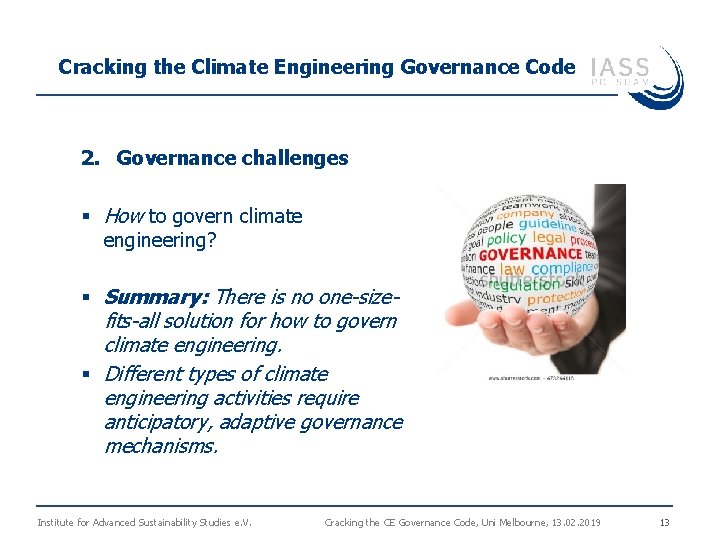
Cracking the Climate Engineering Governance Code 2. Governance challenges § How to govern climate engineering? § Sub-national, international, supranational § Fragmented vs. centralized § Consensus vs. majority § Public participation Institute for Advanced Sustainability Studies e. V. Cracking the CE Governance Code, Uni Melbourne, 13. 02. 2019 12
Cracking the Climate Engineering Governance Code 2. Governance challenges § How to govern climate engineering? § Summary: There is no one-sizefits-all solution for how to govern climate engineering. § Different types of climate engineering activities require anticipatory, adaptive governance mechanisms. Institute for Advanced Sustainability Studies e. V. Cracking the CE Governance Code, Uni Melbourne, 13. 02. 2019 13
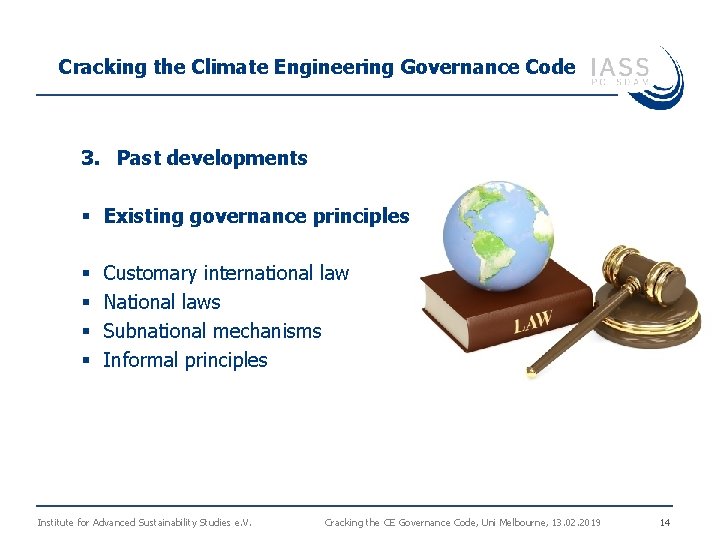
Cracking the Climate Engineering Governance Code 3. Past developments § Existing governance principles § § Customary international law National laws Subnational mechanisms Informal principles Institute for Advanced Sustainability Studies e. V. Cracking the CE Governance Code, Uni Melbourne, 13. 02. 2019 14
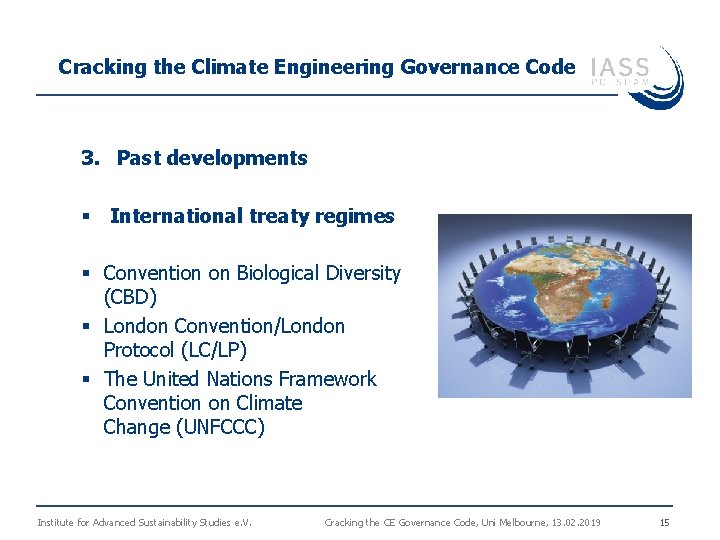
Cracking the Climate Engineering Governance Code 3. Past developments § International treaty regimes § Convention on Biological Diversity (CBD) § London Convention/London Protocol (LC/LP) § The United Nations Framework Convention on Climate Change (UNFCCC) Institute for Advanced Sustainability Studies e. V. Cracking the CE Governance Code, Uni Melbourne, 13. 02. 2019 15
Cracking the Climate Engineering Governance Code 3. Past developments § Summary: Climate engineering is not emerging within a governance vacuum. § Some existing governance principles apply, although how actors interpret their various obligations in light of climate engineering is not yet clear. Institute for Advanced Sustainability Studies e. V. Cracking the CE Governance Code, Uni Melbourne, 13. 02. 2019 16
Cracking the Climate Engineering Governance Code 3. Past developments § Governance lessons learned from experiments § Ocean Iron Fertilization (LOHAFEX) § Marine Cloud Brightening (E -PEACE) § Solar Radiation Management (SPICE) Institute for Advanced Sustainability Studies e. V. Cracking the CE Governance Code, Uni Melbourne, 13. 02. 2019 17
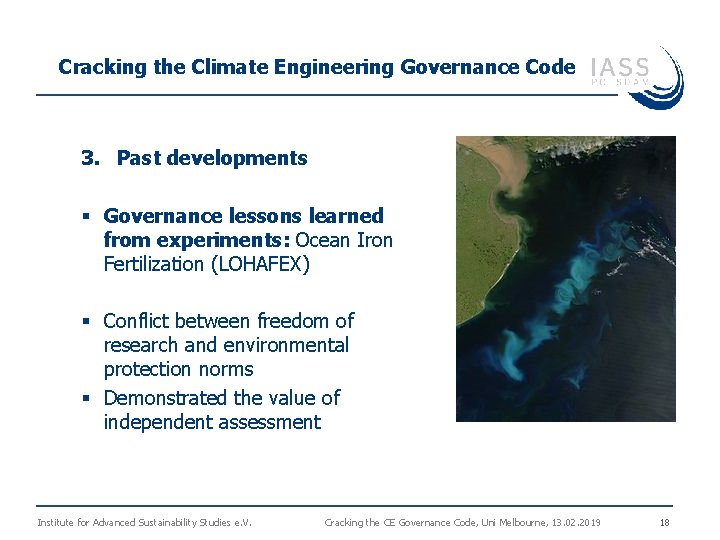
Cracking the Climate Engineering Governance Code 3. Past developments § Governance lessons learned from experiments: Ocean Iron Fertilization (LOHAFEX) § Conflict between freedom of research and environmental protection norms § Demonstrated the value of independent assessment Institute for Advanced Sustainability Studies e. V. Cracking the CE Governance Code, Uni Melbourne, 13. 02. 2019 18
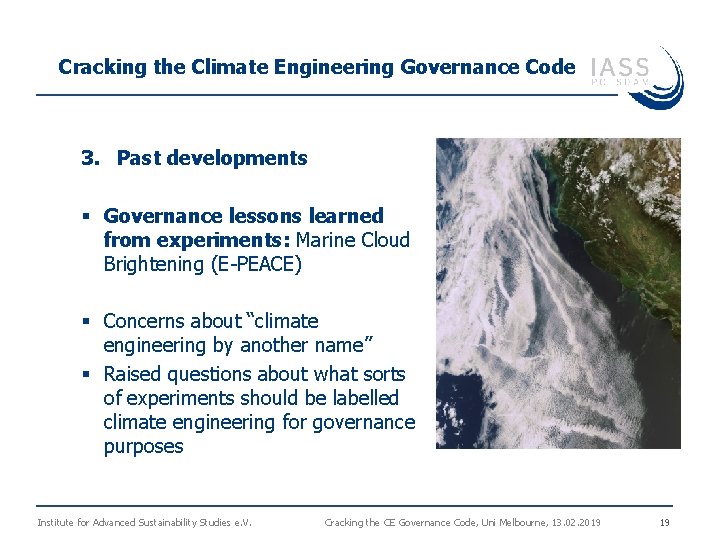
Cracking the Climate Engineering Governance Code 3. Past developments § Governance lessons learned from experiments: Marine Cloud Brightening (E-PEACE) § Concerns about “climate engineering by another name” § Raised questions about what sorts of experiments should be labelled climate engineering for governance purposes Institute for Advanced Sustainability Studies e. V. Cracking the CE Governance Code, Uni Melbourne, 13. 02. 2019 19
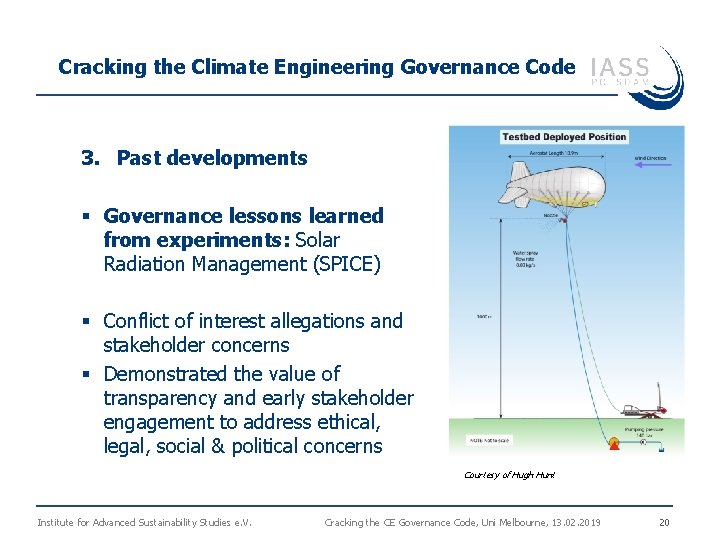
Cracking the Climate Engineering Governance Code 3. Past developments § Governance lessons learned from experiments: Solar Radiation Management (SPICE) § Conflict of interest allegations and stakeholder concerns § Demonstrated the value of transparency and early stakeholder engagement to address ethical, legal, social & political concerns Courtesy of Hugh Hunt Institute for Advanced Sustainability Studies e. V. Cracking the CE Governance Code, Uni Melbourne, 13. 02. 2019 20
Cracking the Climate Engineering Governance Code 3. Past developments § Summary: § Even experiments which pose no environmental risk can raise governance concerns § Engagement between scientists, policymakers and stakeholders is essential to the development of anticipatory, adaptive CE research governance § Governance and research are coevolving within a complex discourse – language matters! Institute for Advanced Sustainability Studies e. V. Cracking the CE Governance Code, Uni Melbourne, 13. 02. 2019 21
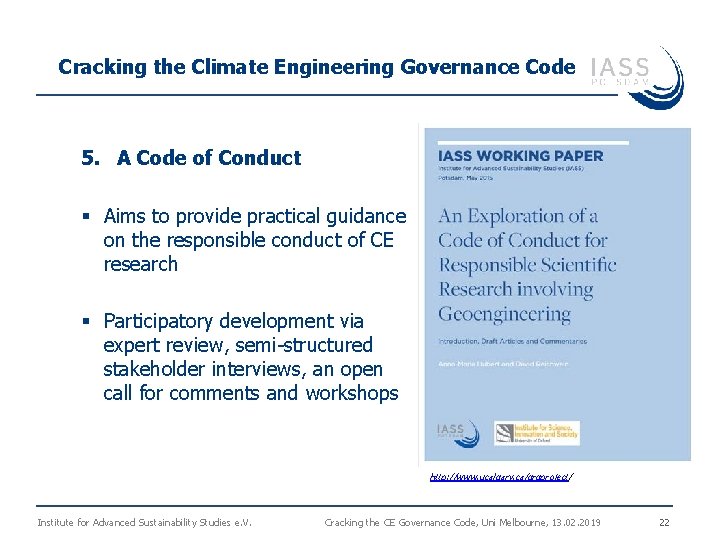
Cracking the Climate Engineering Governance Code 5. A Code of Conduct § Aims to provide practical guidance on the responsible conduct of CE research § Participatory development via expert review, semi-structured stakeholder interviews, an open call for comments and workshops http: //www. ucalgary. ca/grgproject/ Institute for Advanced Sustainability Studies e. V. Cracking the CE Governance Code, Uni Melbourne, 13. 02. 2019 22
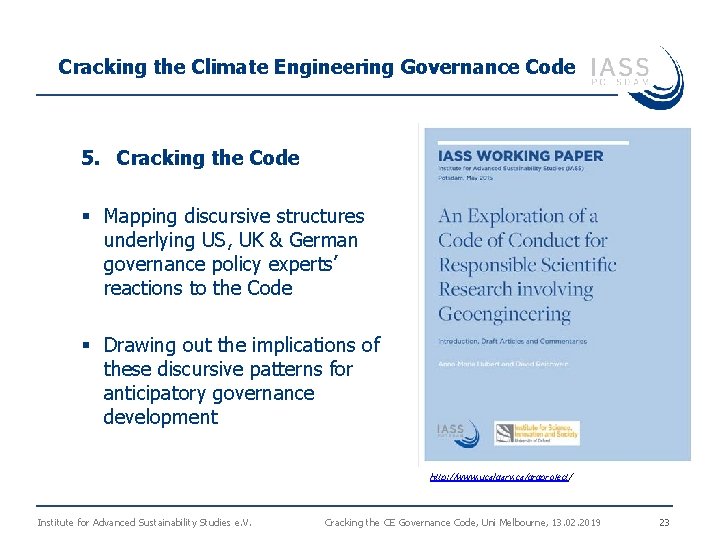
Cracking the Climate Engineering Governance Code 5. Cracking the Code § Mapping discursive structures underlying US, UK & German governance policy experts’ reactions to the Code § Drawing out the implications of these discursive patterns for anticipatory governance development http: //www. ucalgary. ca/grgproject/ Institute for Advanced Sustainability Studies e. V. Cracking the CE Governance Code, Uni Melbourne, 13. 02. 2019 23
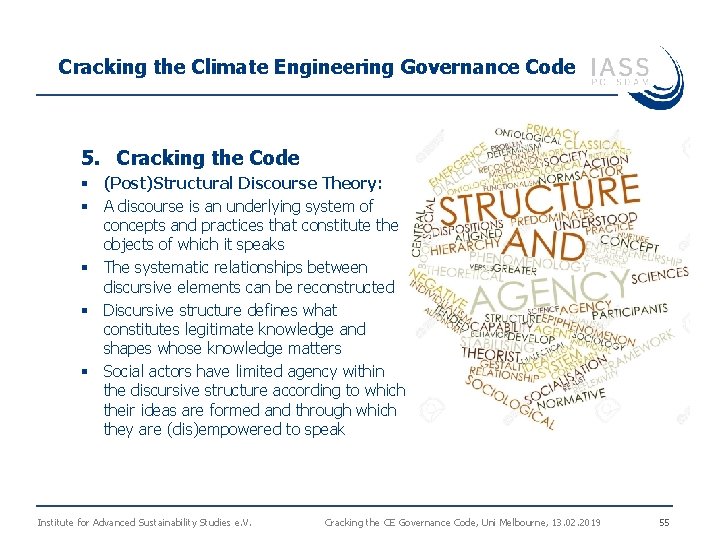
Cracking the Climate Engineering Governance Code 5. Cracking the Code § (Post)Structural Discourse Theory: § A discourse is an underlying system of concepts and practices that constitutes the phenomena of which it speaks § The systematic relationships between discursive elements can be reconstructed § Discursive structure defines what constitutes legitimate knowledge and shapes whose knowledge matters Institute for Advanced Sustainability Studies e. V. Cracking the CE Governance Code, Uni Melbourne, 13. 02. 2019 24
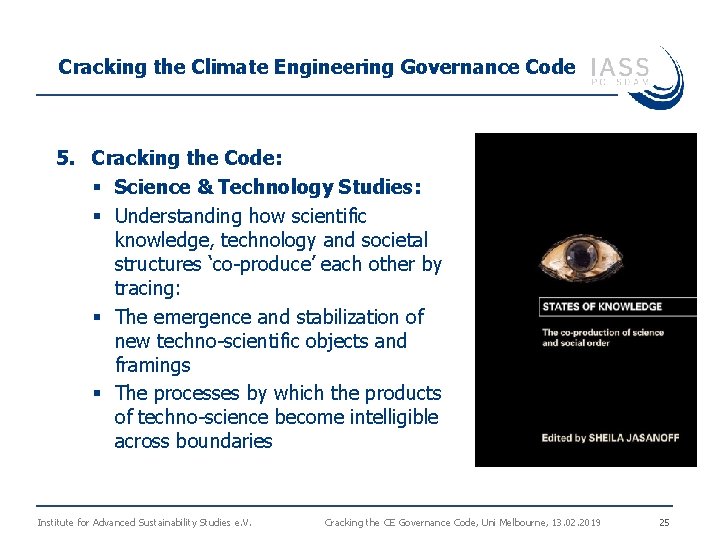
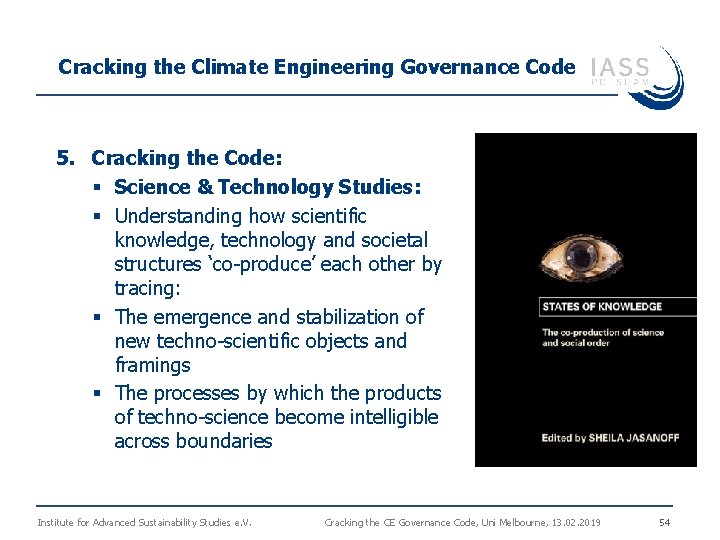
Cracking the Climate Engineering Governance Code 5. Cracking the Code: § Science & Technology Studies: § Understanding how scientific knowledge, technology and societal structures ‘co-produce’ each other by tracing: § The emergence and stabilization of new techno-scientific objects and framings § The processes by which the products of techno-science become intelligible across boundaries Institute for Advanced Sustainability Studies e. V. Cracking the CE Governance Code, Uni Melbourne, 13. 02. 2019 25
Cracking the Climate Engineering Governance Code 5. Cracking the Code § Govern what? Objects § What is governance? Terms § Why govern? Rationales § Who governs? Speaker positions Institute for Advanced Sustainability Studies e. V. Cracking the CE Governance Code, Uni Melbourne, 13. 02. 2019 26
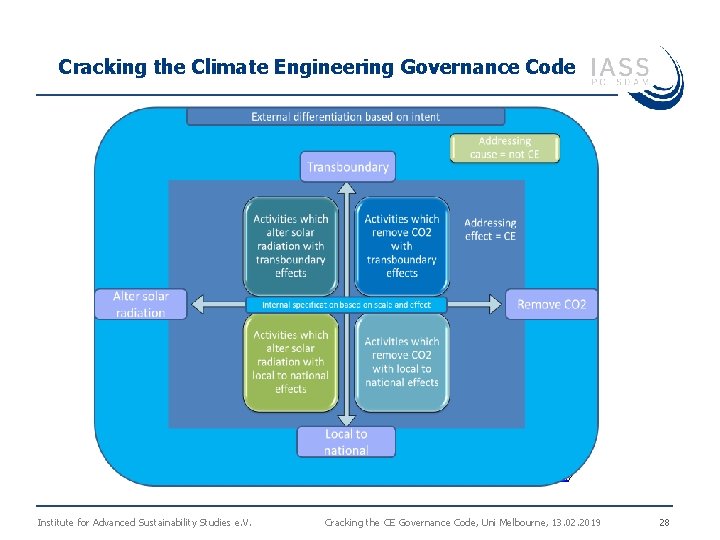
Cracking the Climate Engineering Governance Code 5. Cracking the Code § Govern what? Objects § What is being constructed as the object(s) which should (not) be governed (by the Code)? Institute for Advanced Sustainability Studies e. V. Cracking the CE Governance Code, Uni Melbourne, 13. 02. 2019 27
Cracking the Climate Engineering Governance Code http: //www. ucalgary. ca/grgproject/ Institute for Advanced Sustainability Studies e. V. Cracking the CE Governance Code, Uni Melbourne, 13. 02. 2019 28
Cracking the Climate Engineering Governance Code § Example of external differentiation based on intent: § Despite the fact that the two sets of technologies have different risk profiles, the character and intent of both sets of technologies remain the same – purposeful or intentional intervention into the climate system to mitigate the effects of climate change” (Interviewee 09, emphasis added) § Example of internal specification based on scale and effect: § “Carbon dioxide removal (CDR) is less controversial, actions and impacts are more localized: Association with the term climate engineering tends to imply all CDR approaches have the same or similar transboundary governance issues as solar radiation management (SRM), which is not the case. Especially land-based CDR does not require novel international governance” (Interviewee 22, emphasis added) Institute for Advanced Sustainability Studies e. V. Cracking the CE Governance Code, Uni Melbourne, 13. 02. 2019 29
Cracking the Climate Engineering Governance Code 5. Cracking the Code § Govern what? § Governance implications § External differentiation based on the intent = heterogeneous governance object = one-size-fitsall governance § Internal specification based on scale & effect = plural governance objects = tailor-made governance Institute for Advanced Sustainability Studies e. V. Cracking the CE Governance Code, Uni Melbourne, 13. 02. 2019 30
Cracking the Climate Engineering Governance Code 5. Cracking the Code § What is governance? Terms § How is the term governance being defined (in relation to the Code)? Institute for Advanced Sustainability Studies e. V. Cracking the CE Governance Code, Uni Melbourne, 13. 02. 2019 31
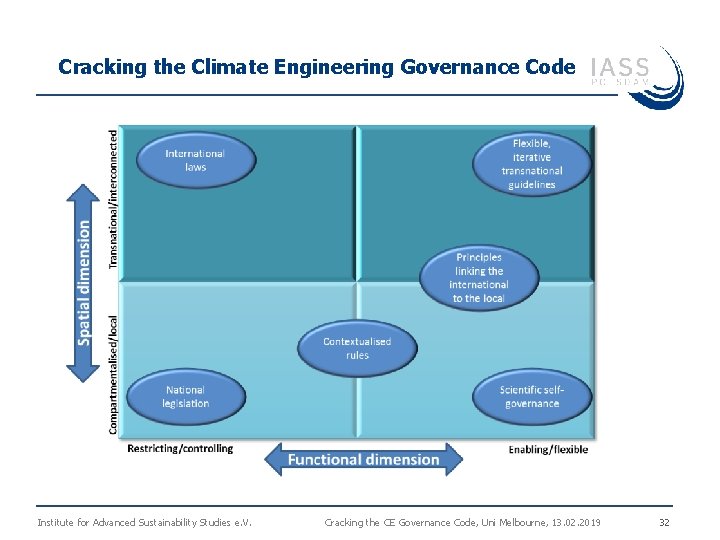
Cracking the Climate Engineering Governance Code Institute for Advanced Sustainability Studies e. V. Cracking the CE Governance Code, Uni Melbourne, 13. 02. 2019 32
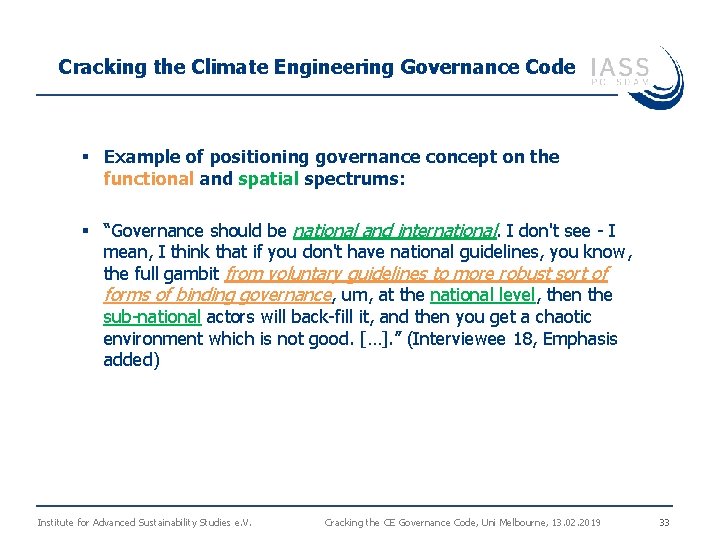
Cracking the Climate Engineering Governance Code § Example of positioning governance concept on the functional and spatial spectrums: § “Governance should be national and international. I don't see - I mean, I think that if you don't have national guidelines, you know, the full gambit from voluntary guidelines to more robust sort of forms of binding governance, um, at the national level, then the sub-national actors will back-fill it, and then you get a chaotic environment which is not good. […]. ” (Interviewee 18, Emphasis added) Institute for Advanced Sustainability Studies e. V. Cracking the CE Governance Code, Uni Melbourne, 13. 02. 2019 33
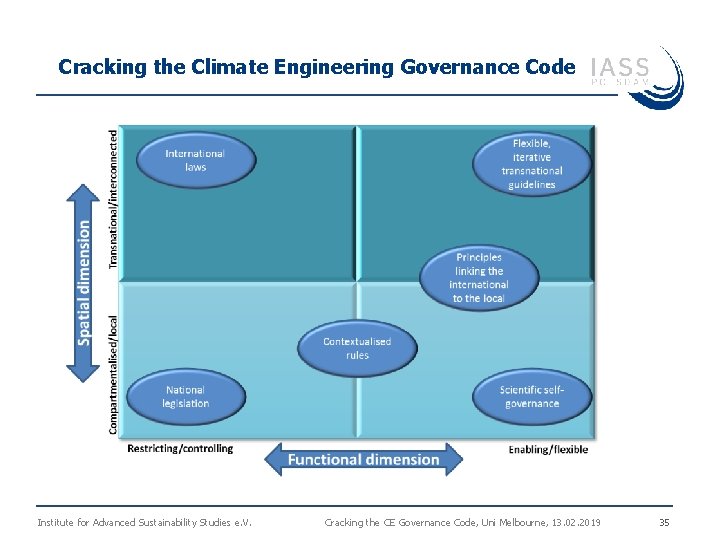
Cracking the Climate Engineering Governance Code 5. Cracking the Code § What is governance? § Governance implications § Binding +(sub)national= legislation § Non-binding +(sub)national= scientific self governance § Binding + transnational = international agreement § Non-binding + transnational= international guidelines Institute for Advanced Sustainability Studies e. V. Cracking the CE Governance Code, Uni Melbourne, 13. 02. 2019 34
Cracking the Climate Engineering Governance Code Institute for Advanced Sustainability Studies e. V. Cracking the CE Governance Code, Uni Melbourne, 13. 02. 2019 35
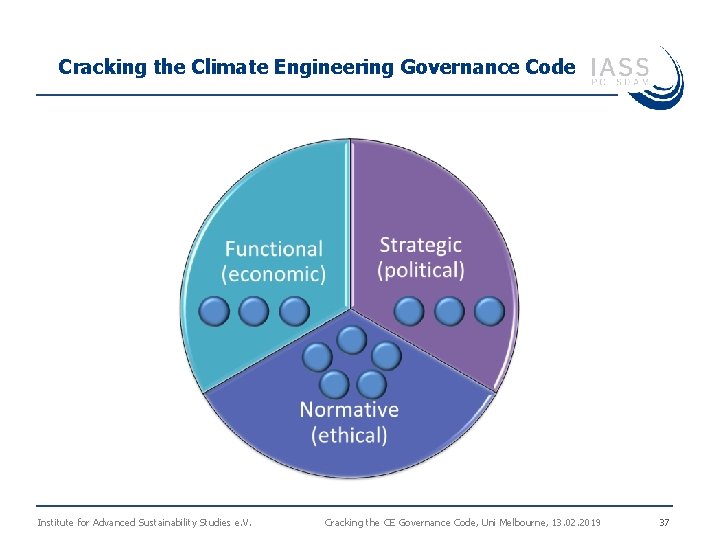
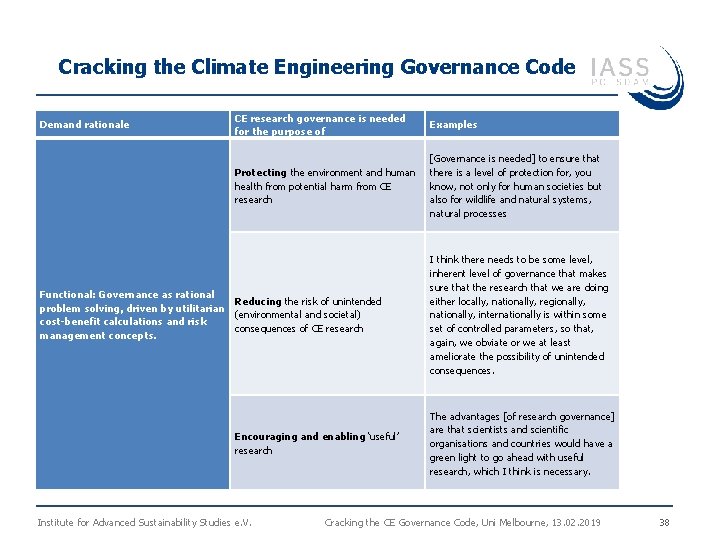
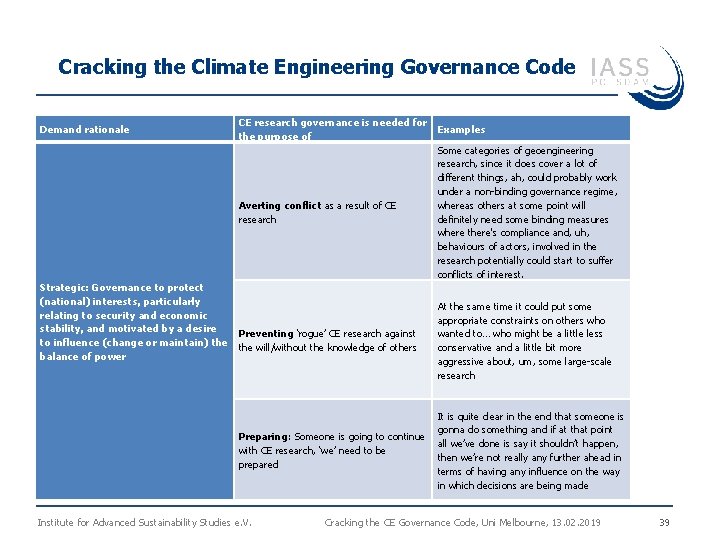
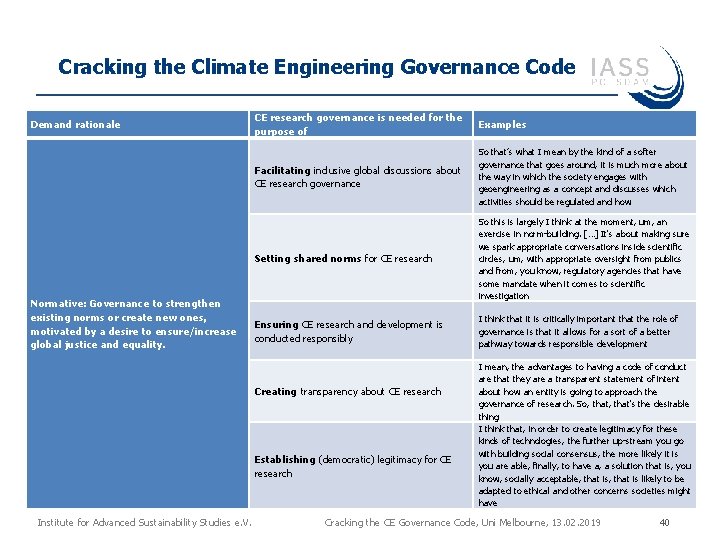
Cracking the Climate Engineering Governance Code 5. Cracking the Code § Why govern? Rationales § What demand rationales are structuring calls for CE research governance? Institute for Advanced Sustainability Studies e. V. Cracking the CE Governance Code, Uni Melbourne, 13. 02. 2019 36
Cracking the Climate Engineering Governance Code Institute for Advanced Sustainability Studies e. V. Cracking the CE Governance Code, Uni Melbourne, 13. 02. 2019 37
Cracking the Climate Engineering Governance Code Demand rationale CE research governance is needed for the purpose of Examples Protecting the environment and human health from potential harm from CE research [Governance is needed] to ensure that there is a level of protection for, you know, not only for human societies but also for wildlife and natural systems, natural processes Functional: Governance as rational Reducing the risk of unintended problem solving, driven by utilitarian (environmental and societal) cost-benefit calculations and risk consequences of CE research management concepts. Encouraging and enabling ‘useful’ research Institute for Advanced Sustainability Studies e. V. I think there needs to be some level, inherent level of governance that makes sure that the research that we are doing either locally, nationally, regionally, nationally, internationally is within some set of controlled parameters, so that, again, we obviate or we at least ameliorate the possibility of unintended consequences. The advantages [of research governance] are that scientists and scientific organisations and countries would have a green light to go ahead with useful research, which I think is necessary. Cracking the CE Governance Code, Uni Melbourne, 13. 02. 2019 38
Cracking the Climate Engineering Governance Code Demand rationale CE research governance is needed for Examples the purpose of Some categories of geoengineering research, since it does cover a lot of different things, ah, could probably work under a non-binding governance regime, Averting conflict as a result of CE whereas others at some point will research definitely need some binding measures where there's compliance and, uh, behaviours of actors, involved in the research potentially could start to suffer conflicts of interest. Strategic: Governance to protect (national) interests, particularly relating to security and economic stability, and motivated by a desire Preventing ‘rogue’ CE research against to influence (change or maintain) the will/without the knowledge of others balance of power At the same time it could put some appropriate constraints on others who wanted to… who might be a little less conservative and a little bit more aggressive about, um, some large-scale research It is quite clear in the end that someone is gonna do something and if at that point Preparing: Someone is going to continue all we’ve done is say it shouldn’t happen, with CE research, ‘we’ need to be then we’re not really any further ahead in prepared terms of having any influence on the way in which decisions are being made Institute for Advanced Sustainability Studies e. V. Cracking the CE Governance Code, Uni Melbourne, 13. 02. 2019 39
Cracking the Climate Engineering Governance Code Demand rationale Normative: Governance to strengthen existing norms or create new ones, motivated by a desire to ensure/increase global justice and equality. CE research governance is needed for the purpose of Examples Facilitating inclusive global discussions about CE research governance So that’s what I mean by the kind of a softer governance that goes around, it is much more about the way in which the society engages with geoengineering as a concept and discusses which activities should be regulated and how Setting shared norms for CE research So this is largely I think at the moment, um, an exercise in norm-building. […] It's about making sure we spark appropriate conversations inside scientific circles, um, with appropriate oversight from publics and from, you know, regulatory agencies that have some mandate when it comes to scientific investigation Ensuring CE research and development is conducted responsibly I think that it is critically important that the role of governance is that it allows for a sort of a better pathway towards responsible development Creating transparency about CE research Establishing (democratic) legitimacy for CE research Institute for Advanced Sustainability Studies e. V. I mean, the advantages to having a code of conduct are that they are a transparent statement of intent about how an entity is going to approach the governance of research. So, that's the desirable thing I think that, in order to create legitimacy for these kinds of technologies, the further up-stream you go with building social consensus, the more likely it is you are able, finally, to have a, a solution that is, you know, socially acceptable, that is likely to be adapted to ethical and other concerns societies might have Cracking the CE Governance Code, Uni Melbourne, 13. 02. 2019 40
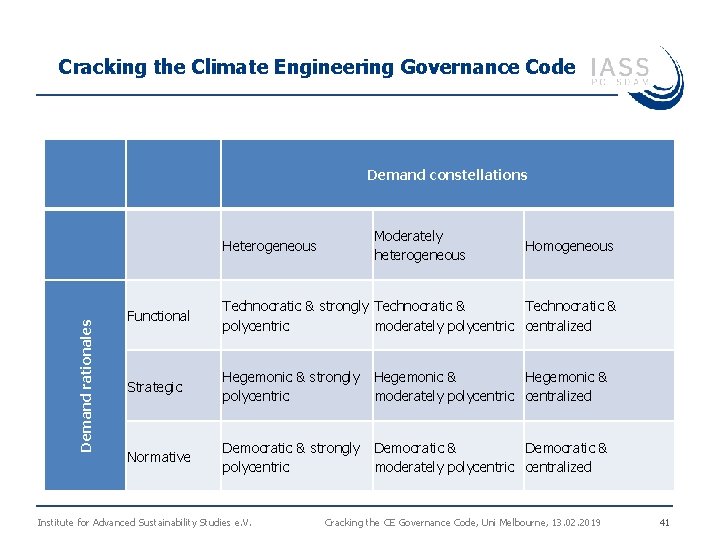
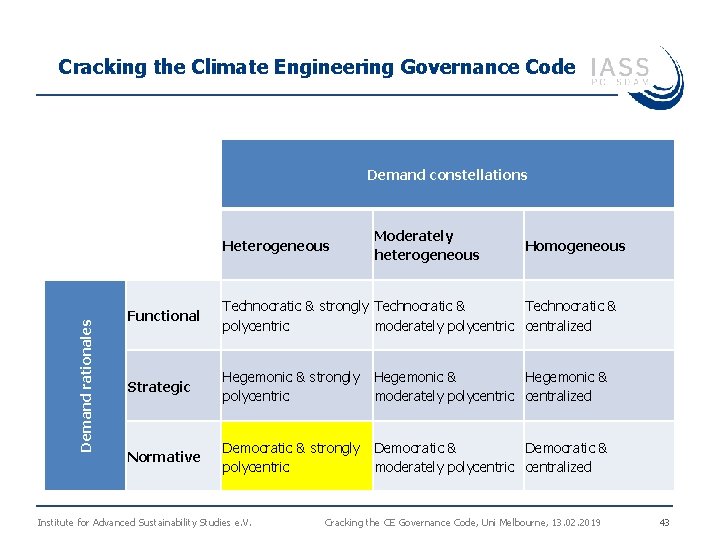
Cracking the Climate Engineering Governance Code Heterogeneous Functional Technocratic & strongly Technocratic & polycentric moderately polycentric centralized Strategic Hegemonic & strongly Hegemonic & polycentric moderately polycentric centralized Normative Democratic & strongly Democratic & polycentric moderately polycentric centralized Demand rationales Demand constellations Institute for Advanced Sustainability Studies e. V. Moderately heterogeneous Homogeneous Cracking the CE Governance Code, Uni Melbourne, 13. 02. 2019 41
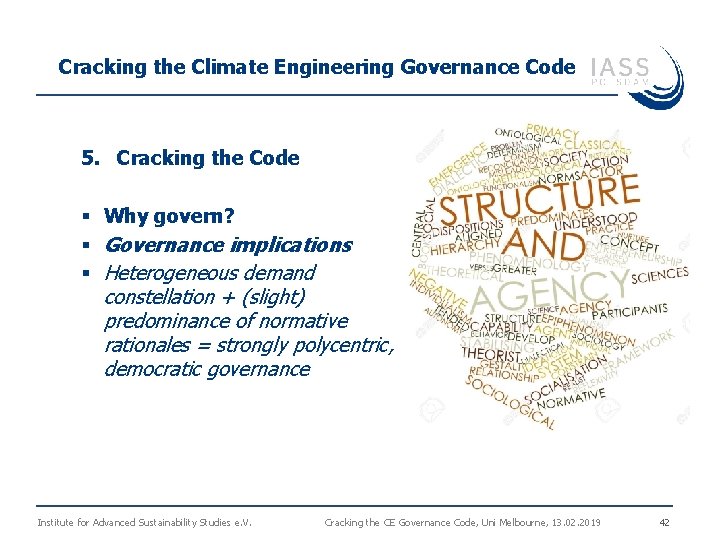
Cracking the Climate Engineering Governance Code 5. Cracking the Code § Why govern? § Governance implications § Heterogeneous demand constellation + (slight) predominance of normative rationales = strongly polycentric, democratic governance Institute for Advanced Sustainability Studies e. V. Cracking the CE Governance Code, Uni Melbourne, 13. 02. 2019 42
Cracking the Climate Engineering Governance Code Heterogeneous Functional Technocratic & strongly Technocratic & polycentric moderately polycentric centralized Strategic Hegemonic & strongly Hegemonic & polycentric moderately polycentric centralized Normative Democratic & strongly Democratic & polycentric moderately polycentric centralized Demand rationales Demand constellations Institute for Advanced Sustainability Studies e. V. Moderately heterogeneous Homogeneous Cracking the CE Governance Code, Uni Melbourne, 13. 02. 2019 43
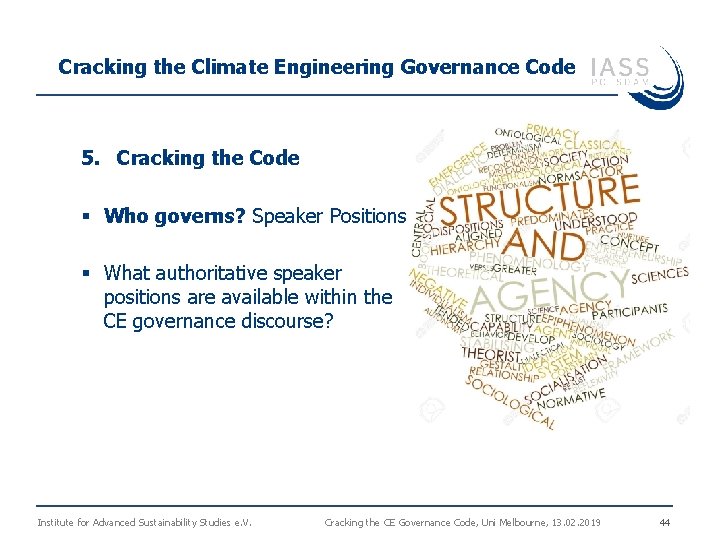
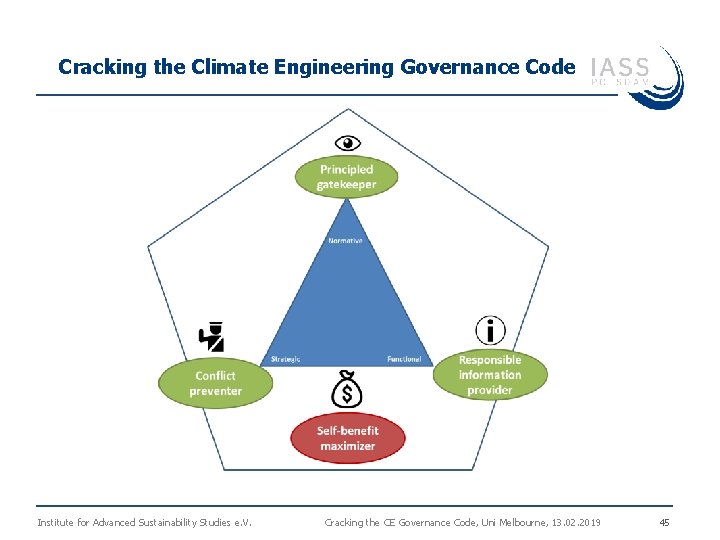
Cracking the Climate Engineering Governance Code 5. Cracking the Code § Who governs? Speaker Positions § What authoritative speaker positions are available within the CE governance discourse? Institute for Advanced Sustainability Studies e. V. Cracking the CE Governance Code, Uni Melbourne, 13. 02. 2019 44
Cracking the Climate Engineering Governance Code Institute for Advanced Sustainability Studies e. V. Cracking the CE Governance Code, Uni Melbourne, 13. 02. 2019 45
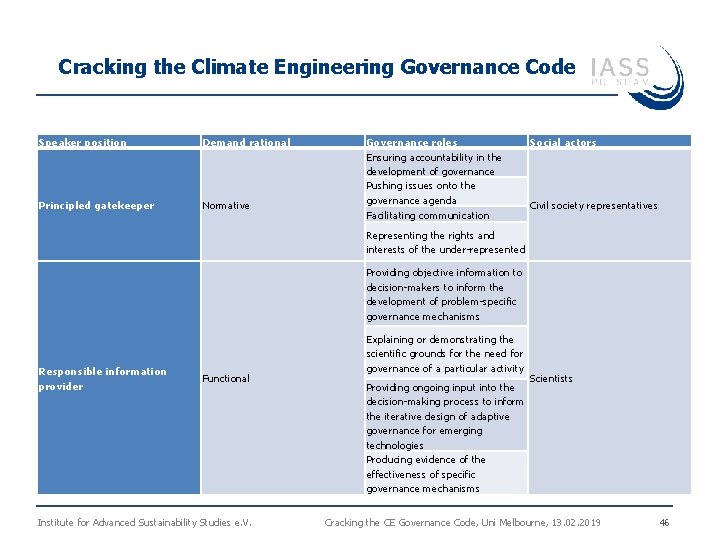
Cracking the Climate Engineering Governance Code Speaker position Demand rational Principled gatekeeper Normative Governance roles Ensuring accountability in the development of governance Pushing issues onto the governance agenda Facilitating communication Social actors Civil society representatives Representing the rights and interests of the under-represented Providing objective information to decision-makers to inform the development of problem-specific governance mechanisms Responsible information provider Functional Institute for Advanced Sustainability Studies e. V. Explaining or demonstrating the scientific grounds for the need for governance of a particular activity Providing ongoing input into the decision-making process to inform the iterative design of adaptive governance for emerging technologies Producing evidence of the effectiveness of specific governance mechanisms Scientists Cracking the CE Governance Code, Uni Melbourne, 13. 02. 2019 46
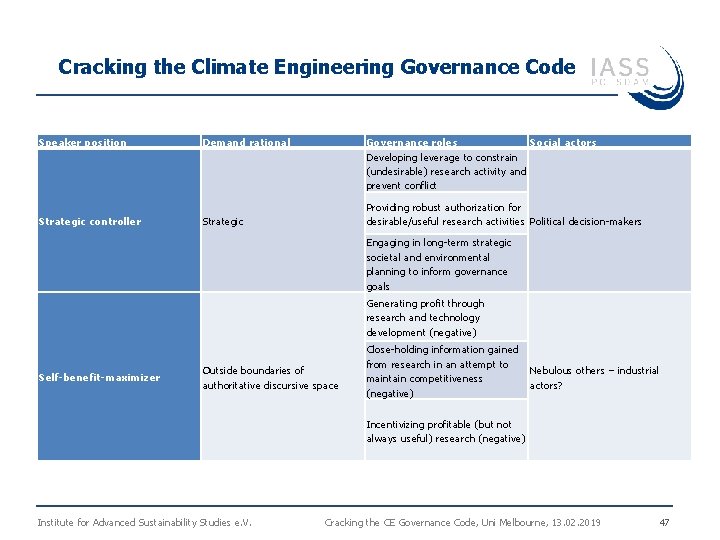
Cracking the Climate Engineering Governance Code Speaker position Strategic controller Demand rational Governance roles Social actors Developing leverage to constrain (undesirable) research activity and prevent conflict Providing robust authorization for desirable/useful research activities Political decision-makers Strategic Engaging in long-term strategic societal and environmental planning to inform governance goals Generating profit through research and technology development (negative) Self-benefit-maximizer Outside boundaries of authoritative discursive space Close-holding information gained from research in an attempt to Nebulous others – industrial maintain competitiveness actors? (negative) Incentivizing profitable (but not always useful) research (negative) Institute for Advanced Sustainability Studies e. V. Cracking the CE Governance Code, Uni Melbourne, 13. 02. 2019 47
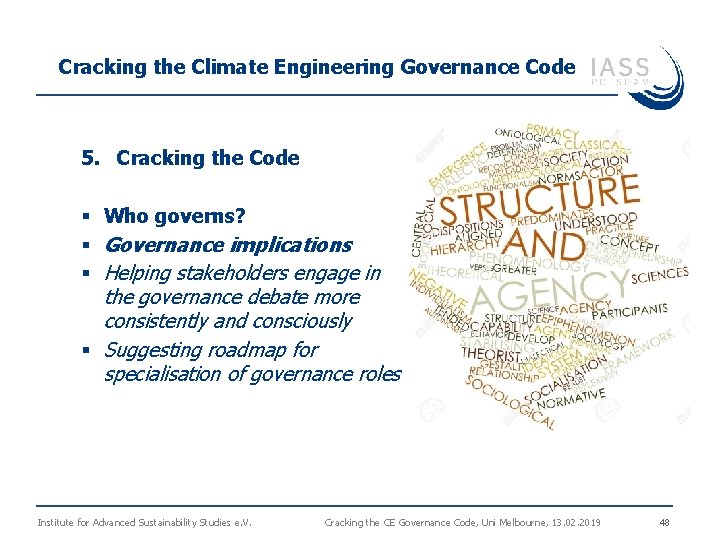
Cracking the Climate Engineering Governance Code 5. Cracking the Code § Who governs? § Governance implications § Helping stakeholders engage in the governance debate more consistently and consciously § Suggesting roadmap for specialisation of governance roles Institute for Advanced Sustainability Studies e. V. Cracking the CE Governance Code, Uni Melbourne, 13. 02. 2019 48
Cracking the Climate Engineering Governance Code Summary: Discursive structures 1. Govern what? Governance object formation underpinned by patterns of external differentiation based on intent and internal specification based on scale/effect of CE activities 2. What is governance? Heterogeneous ‘governance’ terms all situated within a shared conceptual space bounded by a spatial (local to transnational) and a functional (restrictive to enabling) dimension. 3. Why govern? Three central narrative logics structuring calls for CE governance: Functional (economic), strategic (politics) and normative (ethics) 4. Who governs? Three speaker positions identified, each associated with specific types of social actors: Principled gatekeeper (civil society), Responsible information provider (scientists), Strategic controller (political decision makers) Institute for Advanced Sustainability Studies e. V. Cracking the CE Governance Code, Uni Melbourne, 13. 02. 2019 49
Cracking the Climate Engineering Governance Code Summary: Governance implications 1. Govern what? Governance based on intent of CE activities should be broad and adaptive, governance based on scale/effect should be narrow and specific 2. What is governance? CE governance should be reflectively positioned both spatially and functionally: Multi-layered CE research governance is appropriate to the on-going heterogeneous definitional debate 3. Why govern? Polycentric, democratic governance structures focused on enhancing legitimacy and inclusiveness may be best suited to the current demand constellation 4. Who governs? Reflexively engaging with the speaker positions available within the CE governance debate can inform the specification of governance roles for a range of social actors Institute for Advanced Sustainability Studies e. V. Cracking the CE Governance Code, Uni Melbourne, 13. 02. 2019 50
Cracking the Climate Engineering Governance Code § Take-aways § Governance discourses form the objects of which they speak, bound the ways in which different types of governance can be legitimately called for, and constrain who is assigned the authority to govern § Mapping the CE discourse can help inform the development of anticipatory, context-appropriate governance Institute for Advanced Sustainability Studies e. V. Cracking the CE Governance Code, Uni Melbourne, 13. 02. 2019 51
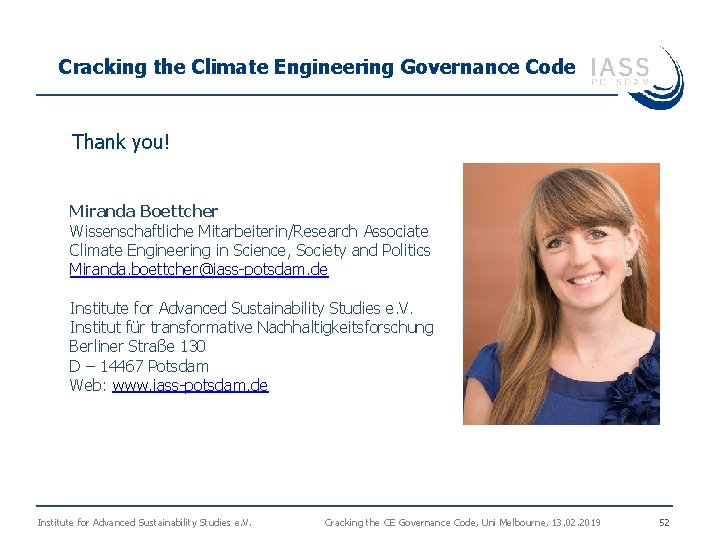
Cracking the Climate Engineering Governance Code Thank you! Miranda Boettcher Wissenschaftliche Mitarbeiterin/Research Associate Climate Engineering in Science, Society and Politics Miranda. boettcher@iass-potsdam. de Institute for Advanced Sustainability Studies e. V. Institut für transformative Nachhaltigkeitsforschung Berliner Straße 130 D – 14467 Potsdam Web: www. iass-potsdam. de Institute for Advanced Sustainability Studies e. V. Cracking the CE Governance Code, Uni Melbourne, 13. 02. 2019 52
Cracking the Climate Engineering Governance Code Thank you! Institute for Advanced Sustainability Studies e. V. Cracking the CE Governance Code, Uni Melbourne, 13. 02. 2019 53
Cracking the Climate Engineering Governance Code 5. Cracking the Code: § Science & Technology Studies: § Understanding how scientific knowledge, technology and societal structures ‘co-produce’ each other by tracing: § The emergence and stabilization of new techno-scientific objects and framings § The processes by which the products of techno-science become intelligible across boundaries Institute for Advanced Sustainability Studies e. V. Cracking the CE Governance Code, Uni Melbourne, 13. 02. 2019 54
Cracking the Climate Engineering Governance Code 5. Cracking the Code § (Post)Structural Discourse Theory: § A discourse is an underlying system of concepts and practices that constitute the objects of which it speaks § The systematic relationships between discursive elements can be reconstructed § Discursive structure defines what constitutes legitimate knowledge and shapes whose knowledge matters § Social actors have limited agency within the discursive structure according to which their ideas are formed and through which they are (dis)empowered to speak Institute for Advanced Sustainability Studies e. V. Cracking the CE Governance Code, Uni Melbourne, 13. 02. 2019 55
Cracking the Climate Engineering Governance Code 4. Evolving governance: Oxford Principles (2009) § Geoengineering to be regulated as a public good § Public participation in geoengineering decision-making § Disclosure of geoengineering research and open publication of results § Independent assessment of impacts § Governance before deployment Institute for Advanced Sustainability Studies e. V. Cracking the CE Governance Code, Uni Melbourne, 13. 02. 2019 56
Cracking the Climate Engineering Governance Code 4. Evolving governance: Asilomar recommendations (2010) 1. 2. 3. 4. 5. Research should be aimed at promoting the collective benefit of humankind and the environment Governments must clarify responsibilities for, and, when necessary, create new mechanisms for the governance and oversight of largescale research activities Research should be conducted openly and cooperatively, preferably within a framework that has broad international support Iterative, independent technical assessments of research progress are required to inform the public and policymakers Public participation and consultation in research planning and oversight, assessments, and development of decision-making mechanisms and processes must be provided Institute for Advanced Sustainability Studies e. V. Cracking the CE Governance Code, Uni Melbourne, 13. 02. 2019 57
Cracking the Climate Engineering Governance Code 4. Evolving governance: SPICE criteria (2010) Experiment allowed to proceed if: 1. It was safe and principal risks had been identified and deemed acceptable 2. It was compliant with relevant regulations 3. Nature and purpose of experiment was clearly communicated to all relevant parties to inform and promote balanced discussion 4. Future applications and impacts had been described, and mechanisms put in place to review these 5. Mechanisms had been identified to understand public and stakeholder views regarding the predicted applications and impacts Institute for Advanced Sustainability Studies e. V. Cracking the CE Governance Code, Uni Melbourne, 13. 02. 2019 58
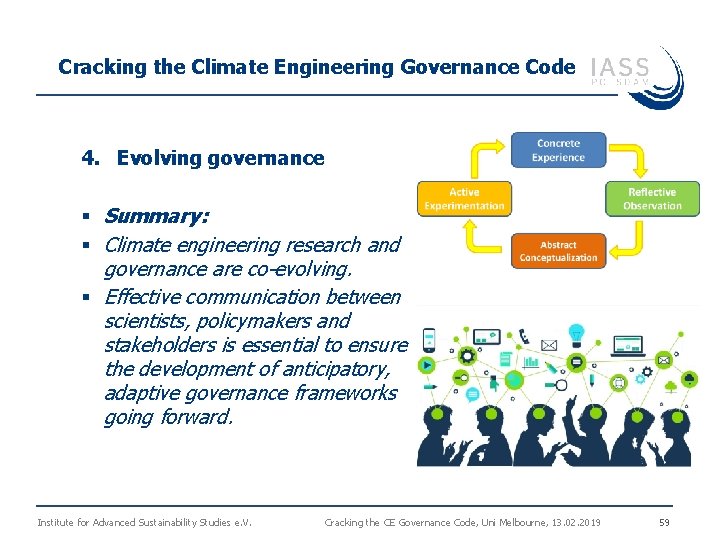
Cracking the Climate Engineering Governance Code 4. Evolving governance § Summary: § Climate engineering research and governance are co-evolving. § Effective communication between scientists, policymakers and stakeholders is essential to ensure the development of anticipatory, adaptive governance frameworks going forward. Institute for Advanced Sustainability Studies e. V. Cracking the CE Governance Code, Uni Melbourne, 13. 02. 2019 59
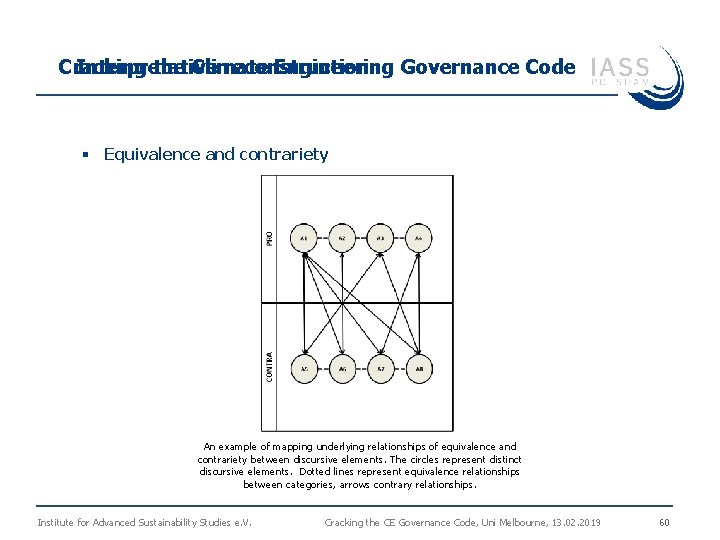
Cracking the Climate Engineering Governance Code Interpretative reconstruction § Equivalence and contrariety An example of mapping underlying relationships of equivalence and contrariety between discursive elements. The circles represent distinct discursive elements. Dotted lines represent equivalence relationships between categories, arrows contrary relationships. Institute for Advanced Sustainability Studies e. V. Cracking the CE Governance Code, Uni Melbourne, 13. 02. 2019 60
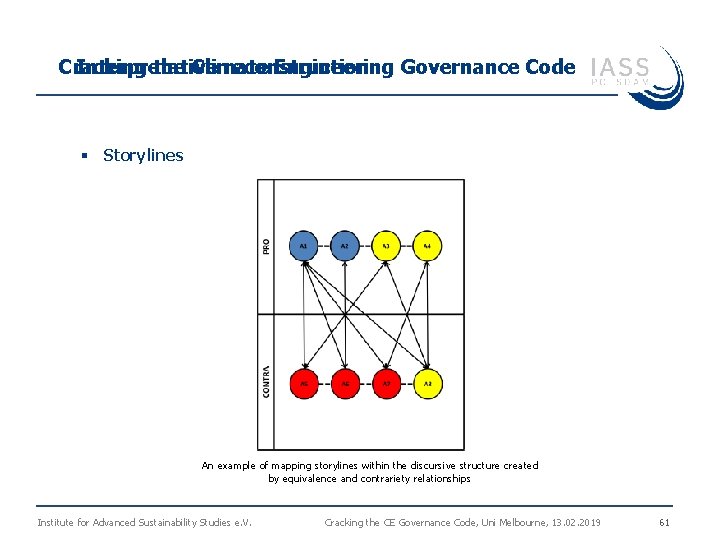
Cracking the Climate Engineering Governance Code Interpretative reconstruction § Storylines An example of mapping storylines within the discursive structure created by equivalence and contrariety relationships Institute for Advanced Sustainability Studies e. V. Cracking the CE Governance Code, Uni Melbourne, 13. 02. 2019 61
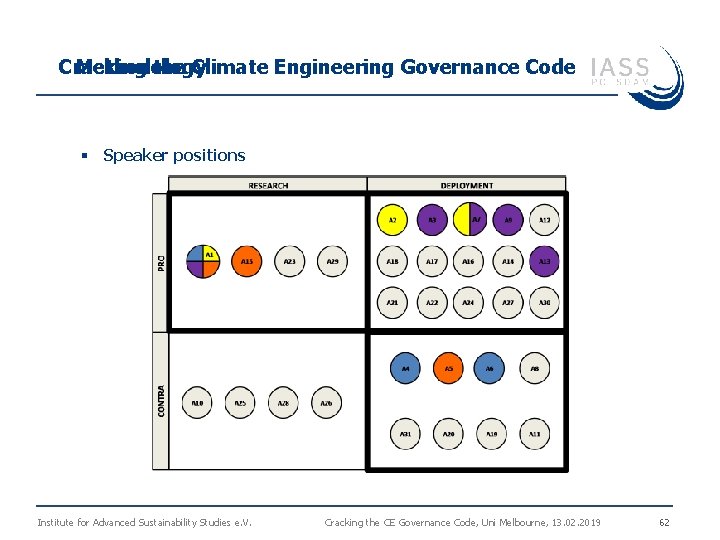
Cracking the Climate Engineering Governance Code Methodology § Speaker positions Institute for Advanced Sustainability Studies e. V. Cracking the CE Governance Code, Uni Melbourne, 13. 02. 2019 62