
Crab cavities cryogenic circuit and heat loads LHC
Crab cavities – cryogenic circuit and heat loads LHC crab cavity engineering meeting – Fermilab, USA 13 -14 December 2012 K. Brodzinski on behalf of cryogenic team at CERN
Contents • Cryogenics in SPS BA 4 (regarding 2 K refrigeration) • Capacity limitations with existing infrastructure • Cryogenic circuits • Available space – integration • Helium availability • Cryostat design – analytical approach • Cryostat circuits • Instrumentation • Heat loads • Pressures, protection and safety, operation aspects • Helium volume and other practical aspects • Budget • Planning time line (for SPS and P 4 testing) • Concept of LHC P 1 and P 5 cryogenics • Conclusions 2 K. Brodzinski - CC_Fermilab 2012
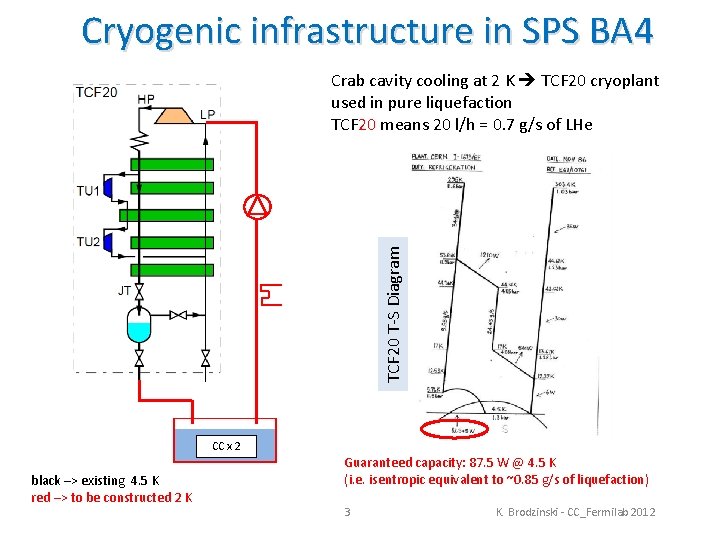
Cryogenic infrastructure in SPS BA 4 TCF 20 T-S Diagram Crab cavity cooling at 2 K TCF 20 cryoplant used in pure liquefaction TCF 20 means 20 l/h = 0. 7 g/s of LHe CC x 2 black –> existing 4. 5 K red –> to be constructed 2 K Guaranteed capacity: 87. 5 W @ 4. 5 K (i. e. isentropic equivalent to ~0. 85 g/s of liquefaction) 3 K. Brodzinski - CC_Fermilab 2012
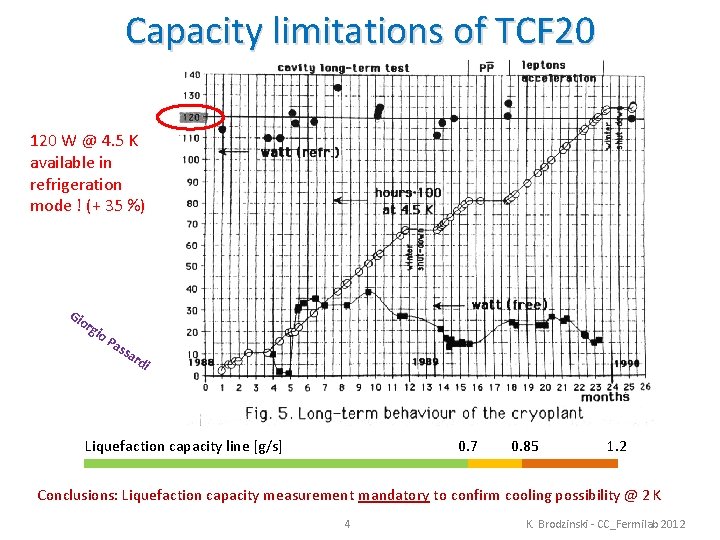
Capacity limitations of TCF 20 120 W @ 4. 5 K available in refrigeration mode ! (+ 35 %) Gi or gio Pa ssa rd i Liquefaction capacity line [g/s] 0. 7 0. 85 1. 2 Conclusions: Liquefaction capacity measurement mandatory to confirm cooling possibility @ 2 K 4 K. Brodzinski - CC_Fermilab 2012
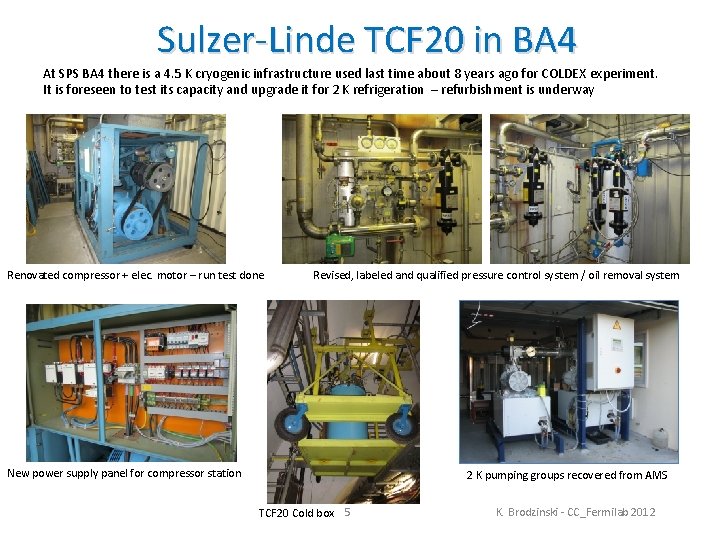
Sulzer-Linde TCF 20 in BA 4 At SPS BA 4 there is a 4. 5 K cryogenic infrastructure used last time about 8 years ago for COLDEX experiment. It is foreseen to test its capacity and upgrade it for 2 K refrigeration – refurbishment is underway Renovated compressor + elec. motor – run test done Revised, labeled and qualified pressure control system / oil removal system Cold box TCF 20 New power supply panel for compressor station 2 K pumping groups recovered from AMS TCF 20 Cold box 5 K. Brodzinski - CC_Fermilab 2012
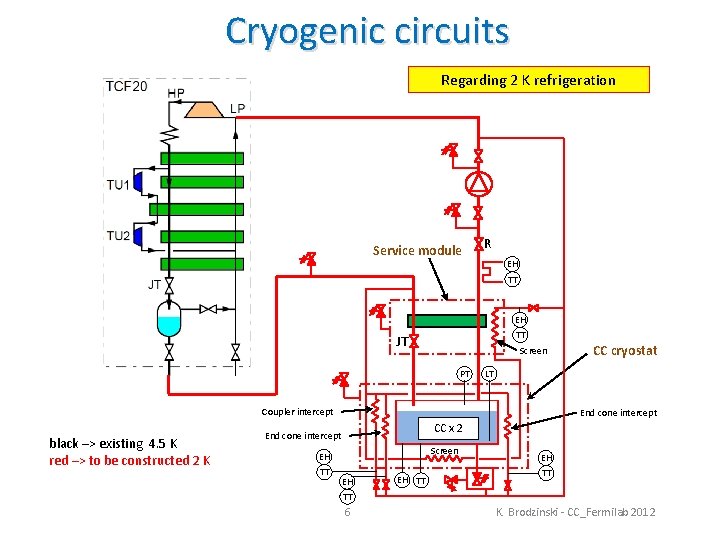
Cryogenic circuits Regarding 2 K refrigeration Service module R EH TT JT Screen PT LT Coupler intercept black –> existing 4. 5 K red –> to be constructed 2 K End cone intercept CC x 2 End cone intercept Screen EH TT CC cryostat EH EH TT TT 6 K. Brodzinski - CC_Fermilab 2012
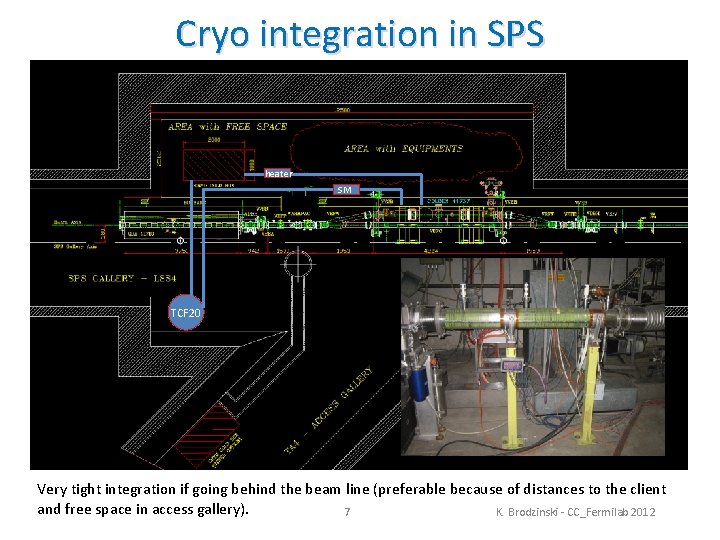
Cryo integration in SPS heater SM TCF 20 Very tight integration if going behind the beam line (preferable because of distances to the client and free space in access gallery). 7 K. Brodzinski - CC_Fermilab 2012
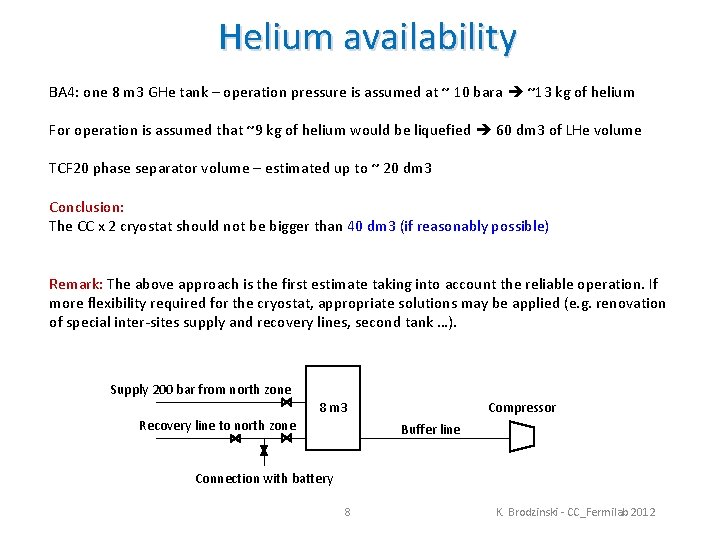
Helium availability BA 4: one 8 m 3 GHe tank – operation pressure is assumed at ~ 10 bara ~13 kg of helium For operation is assumed that ~9 kg of helium would be liquefied 60 dm 3 of LHe volume TCF 20 phase separator volume – estimated up to ~ 20 dm 3 Conclusion: The CC x 2 cryostat should not be bigger than 40 dm 3 (if reasonably possible) Remark: The above approach is the first estimate taking into account the reliable operation. If more flexibility required for the cryostat, appropriate solutions may be applied (e. g. renovation of special inter-sites supply and recovery lines, second tank …). Supply 200 bar from north zone 8 m 3 Recovery line to north zone Compressor Buffer line Connection with battery 8 K. Brodzinski - CC_Fermilab 2012
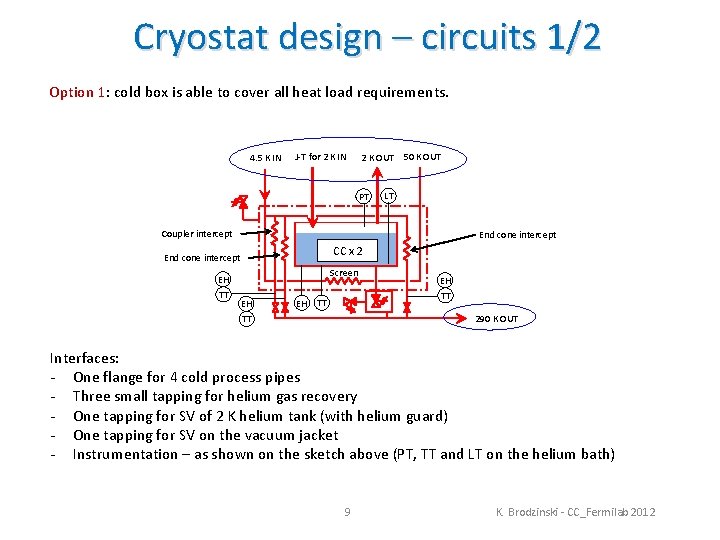
Cryostat design – circuits 1/2 Option 1: cold box is able to cover all heat load requirements. 4. 5 K IN J-T for 2 K IN 2 K OUT 50 K OUT PT LT Coupler intercept End cone intercept CC x 2 End cone intercept Screen EH TT 290 K OUT TT Interfaces: - One flange for 4 cold process pipes - Three small tapping for helium gas recovery - One tapping for SV of 2 K helium tank (with helium guard) - One tapping for SV on the vacuum jacket - Instrumentation – as shown on the sketch above (PT, TT and LT on the helium bath) 9 K. Brodzinski - CC_Fermilab 2012
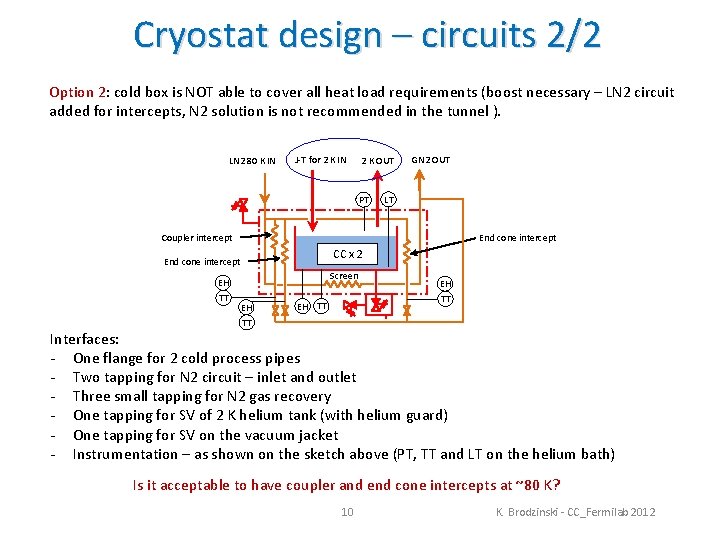
Cryostat design – circuits 2/2 Option 2: cold box is NOT able to cover all heat load requirements (boost necessary – LN 2 circuit added for intercepts, N 2 solution is not recommended in the tunnel ). LN 2 80 K IN J-T for 2 K IN 2 K OUT PT GN 2 OUT LT Coupler intercept End cone intercept CC x 2 End cone intercept Screen EH TT TT Interfaces: - One flange for 2 cold process pipes - Two tapping for N 2 circuit – inlet and outlet - Three small tapping for N 2 gas recovery - One tapping for SV of 2 K helium tank (with helium guard) - One tapping for SV on the vacuum jacket - Instrumentation – as shown on the sketch above (PT, TT and LT on the helium bath) Is it acceptable to have coupler and end cone intercepts at ~80 K? 10 K. Brodzinski - CC_Fermilab 2012
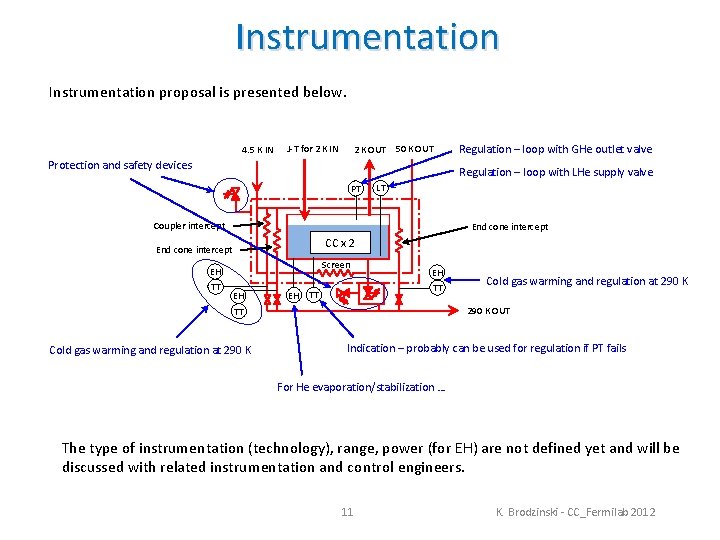
Instrumentation proposal is presented below. 4. 5 K IN 2 K OUT 50 K OUT J-T for 2 K IN Protection and safety devices Regulation – loop with GHe outlet valve Regulation – loop with LHe supply valve PT LT Coupler intercept End cone intercept CC x 2 End cone intercept Screen EH TT 290 K OUT TT Cold gas warming and regulation at 290 K Indication – probably can be used for regulation if PT fails For He evaporation/stabilization … The type of instrumentation (technology), range, power (for EH) are not defined yet and will be discussed with related instrumentation and control engineers. 11 K. Brodzinski - CC_Fermilab 2012
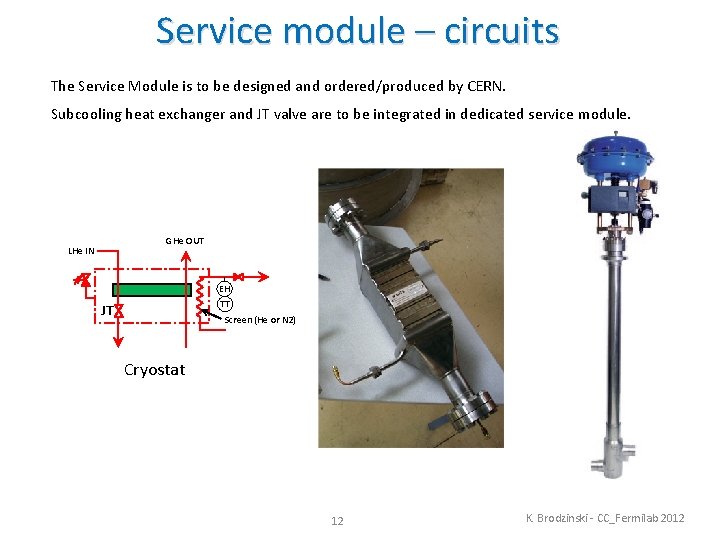
Service module – circuits The Service Module is to be designed and ordered/produced by CERN. Subcooling heat exchanger and JT valve are to be integrated in dedicated service module. GHe OUT LHe IN EH TT JT Screen (He or N 2) Cryostat 12 K. Brodzinski - CC_Fermilab 2012
Heat loads 1/3 Main open questions: Will we have for SPS test a common cryostat for 2 cavities in separated cryostats? Common cryostat: + lower total static heat load + simple distribution system - direct influence of one cavity on the other (quenches) - difficult replacement of one cavity (regarding third cavity testing in SPS) What will be approach for LHC final destination? SPS configuration should be as close as possible with decisions foreseen for LHC if possible. 13 K. Brodzinski - CC_Fermilab 2012
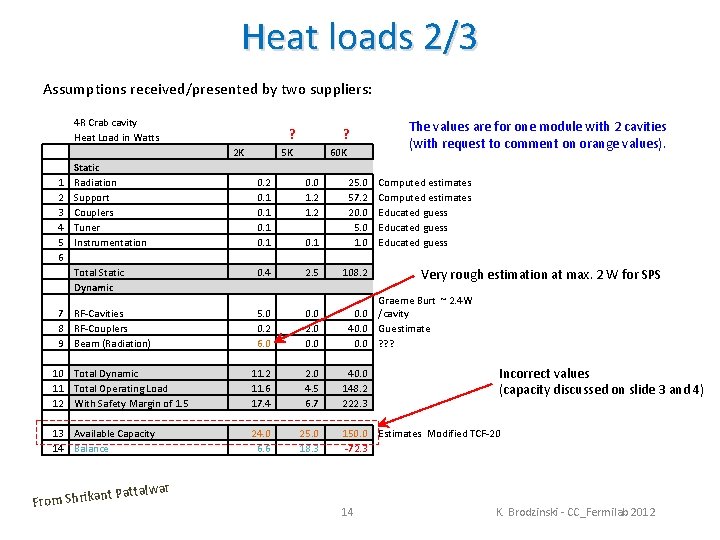
Heat loads 2/3 Assumptions received/presented by two suppliers: 4 R Crab cavity Heat Load in Watts 2 K 1 2 3 4 5 6 Static Radiation Support Couplers Tuner Instrumentation ? ? 5 K 60 K 0. 2 0. 1 0. 0 1. 2 0. 1 25. 0 57. 2 20. 0 5. 0 1. 0 0. 4 2. 5 108. 2 5. 0 0. 2 6. 0 0. 0 2. 0 0. 0 10 Total Dynamic 11 Total Operating Load 12 With Safety Margin of 1. 5 11. 2 11. 6 17. 4 2. 0 4. 5 6. 7 13 Available Capacity 14 Balance 24. 0 6. 6 25. 0 18. 3 Total Static Dynamic 7 RF-Cavities 8 RF-Couplers 9 Beam (Radiation) The values are for one module with 2 cavities (with request to comment on orange values). Computed estimates Educated guess Very rough estimation at max. 2 W for SPS Graeme Burt ~ 2. 4 W 0. 0 /cavity 40. 0 Guestimate 0. 0 ? ? ? 40. 0 148. 2 222. 3 Incorrect values (capacity discussed on slide 3 and 4) 150. 0 Estimates Modified TCF-20 -72. 3 r nt Pattalwa From Shrika 14 K. Brodzinski - CC_Fermilab 2012
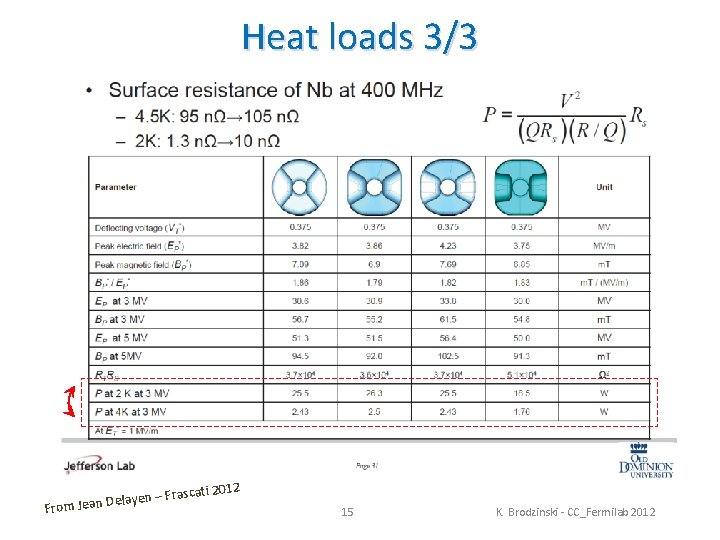
Heat loads 3/3 elayen – From Jean D 2 Frascati 201 15 K. Brodzinski - CC_Fermilab 2012
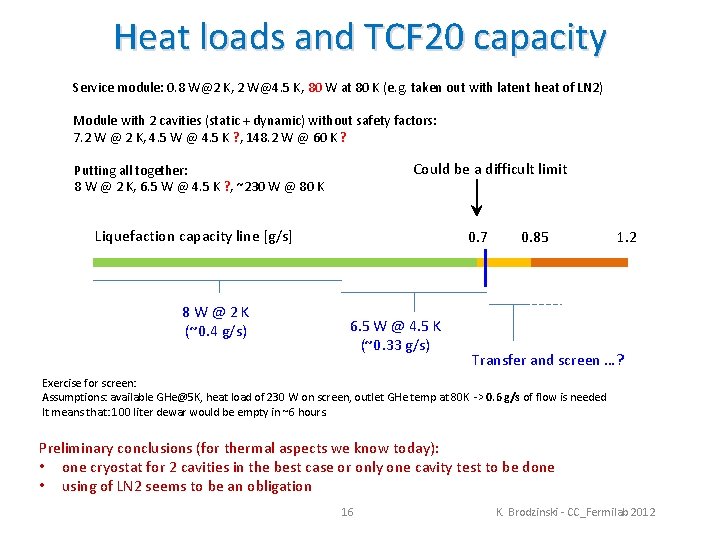
Heat loads and TCF 20 capacity Service module: 0. 8 W@2 K, 2 W@4. 5 K, 80 W at 80 K (e. g. taken out with latent heat of LN 2) Module with 2 cavities (static + dynamic) without safety factors: 7. 2 W @ 2 K, 4. 5 W @ 4. 5 K ? , 148. 2 W @ 60 K ? Could be a difficult limit Putting all together: 8 W @ 2 K, 6. 5 W @ 4. 5 K ? , ~230 W @ 80 K Liquefaction capacity line [g/s] 8 W@2 K (~0. 4 g/s) 0. 7 6. 5 W @ 4. 5 K (~0. 33 g/s) 0. 85 1. 2 Transfer and screen …? Exercise for screen: Assumptions: available GHe@5 K, heat load of 230 W on screen, outlet GHe temp at 80 K -> 0. 6 g/s of flow is needed It means that: 100 liter dewar would be empty in ~6 hours. Preliminary conclusions (for thermal aspects we know today): • one cryostat for 2 cavities in the best case or only one cavity test to be done • using of LN 2 seems to be an obligation 16 K. Brodzinski - CC_Fermilab 2012
Cryostat operation – first approach Pressures – safety : • The cavity should be designed to withstand external pressure of 2. 6 bara (delta. P = 2. 6 bar) at ambient temperature without plastic deformation, • Design pressure for the cryostat should be based on installed safety devices according to design rules (cryostat equipped with a rupture disc set at 2. 2 bara and safety valve set at 1. 8 bara) • both safety devices should be placed on the cryostat in the way to avoid potential projection of helium towards the passages or transport area (deflectors installation to be analyzed), • Both safety devices should protect cavity and cryostat from pressure rise causing plastic deformations • Operating pressure during the cool down can oscillate between 1. 2 and 1. 5 bara – estimation, • Normal operation pressure will be set at ~ 20 mbara (for 2 K cooling) Cool down – stable operation – warm up: • Cool down will be done with direct filling of LHe to the cavity cryostat, very roughly estimated cool down time is ~ 1 day • Stable operation availability will be affected by impurities in the system (there is no purifier installed in the infrastructure). A few days continues availability should be guaranteed. • Warm up of the cavities will be done by natural evaporation of helium and temperature floating towards 300 K (additional heater on the helium bath can be used to speed up the process) 17 K. Brodzinski - CC_Fermilab 2012
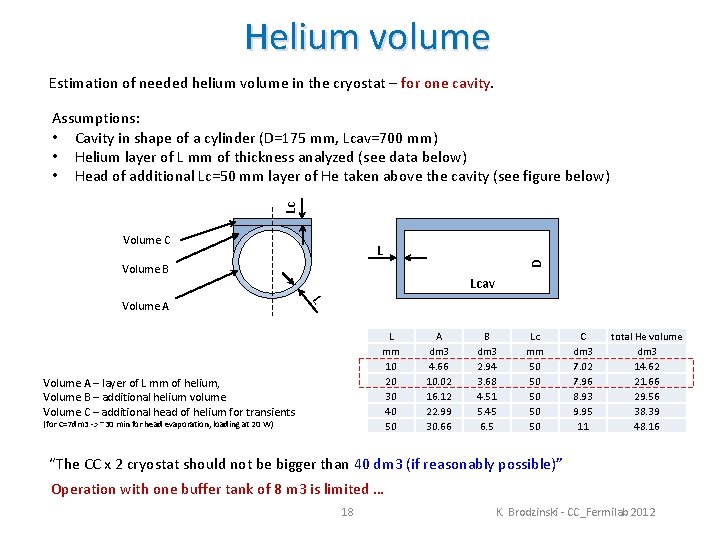
Helium volume Estimation of needed helium volume in the cryostat – for one cavity. Lc Assumptions: • Cavity in shape of a cylinder (D=175 mm, Lcav=700 mm) • Helium layer of L mm of thickness analyzed (see data below) • Head of additional Lc=50 mm layer of He taken above the cavity (see figure below) Volume C D L Volume B L Volume A Lcav L mm 10 20 30 40 50 Volume A – layer of L mm of helium, Volume B – additional helium volume Volume C – additional head of helium for transients (for C=7 dm 3 -> ~30 min for head evaporation, loading at 20 W) A dm 3 4. 66 10. 02 16. 12 22. 99 30. 66 B dm 3 2. 94 3. 68 4. 51 5. 45 6. 5 Lc mm 50 50 50 C dm 3 7. 02 7. 96 8. 93 9. 95 11 total He volume dm 3 14. 62 21. 66 29. 56 38. 39 48. 16 “The CC x 2 cryostat should not be bigger than 40 dm 3 (if reasonably possible)” Operation with one buffer tank of 8 m 3 is limited … 18 K. Brodzinski - CC_Fermilab 2012
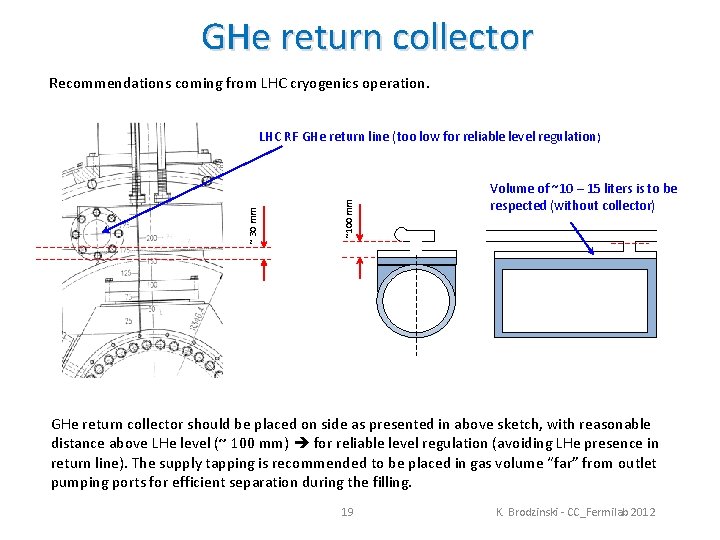
GHe return collector Recommendations coming from LHC cryogenics operation. ~100 mm ~ 30 mm LHC RF GHe return line (too low for reliable level regulation) Volume of ~10 – 15 liters is to be respected (without collector) GHe return collector should be placed on side as presented in above sketch, with reasonable distance above LHe level (~ 100 mm) for reliable level regulation (avoiding LHe presence in return line). The supply tapping is recommended to be placed in gas volume “far” from outlet pumping ports for efficient separation during the filling. 19 K. Brodzinski - CC_Fermilab 2012
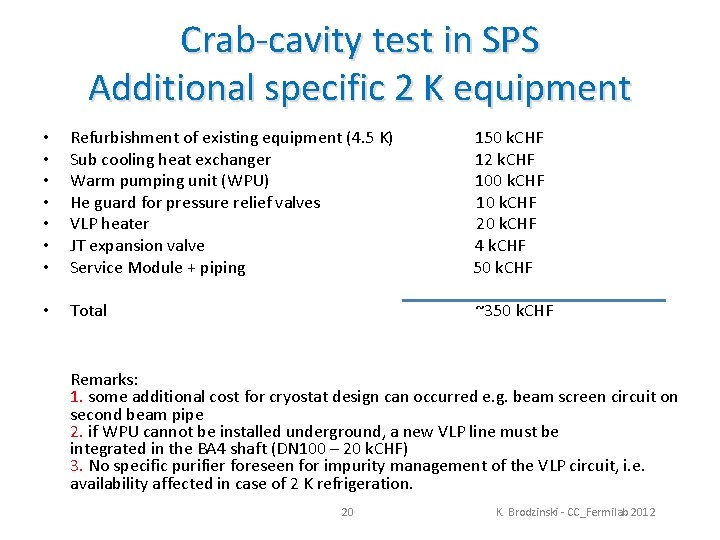
Crab-cavity test in SPS Additional specific 2 K equipment • • Refurbishment of existing equipment (4. 5 K) Sub cooling heat exchanger Warm pumping unit (WPU) He guard for pressure relief valves VLP heater JT expansion valve Service Module + piping 150 k. CHF 12 k. CHF 100 k. CHF 10 k. CHF 20 k. CHF 4 k. CHF 50 k. CHF • Total ~350 k. CHF Remarks: 1. some additional cost for cryostat design can occurred e. g. beam screen circuit on second beam pipe 2. if WPU cannot be installed underground, a new VLP line must be integrated in the BA 4 shaft (DN 100 – 20 k. CHF) 3. No specific purifier foreseen for impurity management of the VLP circuit, i. e. availability affected in case of 2 K refrigeration. 20 K. Brodzinski - CC_Fermilab 2012
Tentative SPS CC cryogenic schedule • Surface equipment (GHe storage, compressor station and oil separation system) – refurbishment completed (run test done on 28. 11. 2012) – first results OK • Cold box refurbishment is underway – run test on the beginning of LS 1 • Installation of liquefaction test instrumentation and test performance – by 15 June 2013 (cut of cooling water in SPS BA 4 until ~ 15 September 2013). • Development, installation and commissioning of 2 K equipment by end of LS 1 Remark: Integration of 2 K cryo equipment in the tunnel looks tight – if not possible heavy complications – possibility of mentioned transfer line construction in the shaft to the surface = more logistics, more manpower and time required. 21 K. Brodzinski - CC_Fermilab 2012
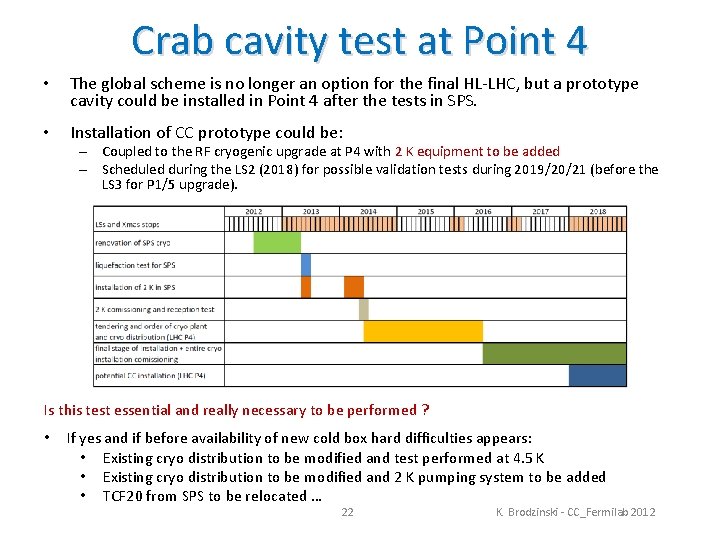
Crab cavity test at Point 4 • The global scheme is no longer an option for the final HL-LHC, but a prototype cavity could be installed in Point 4 after the tests in SPS. • Installation of CC prototype could be: – Coupled to the RF cryogenic upgrade at P 4 with 2 K equipment to be added – Scheduled during the LS 2 (2018) for possible validation tests during 2019/20/21 (before the LS 3 for P 1/5 upgrade). Is this test essential and really necessary to be performed ? • If yes and if before availability of new cold box hard difficulties appears: • Existing cryo distribution to be modified and test performed at 4. 5 K • Existing cryo distribution to be modified and 2 K pumping system to be added • TCF 20 from SPS to be relocated … 22 K. Brodzinski - CC_Fermilab 2012
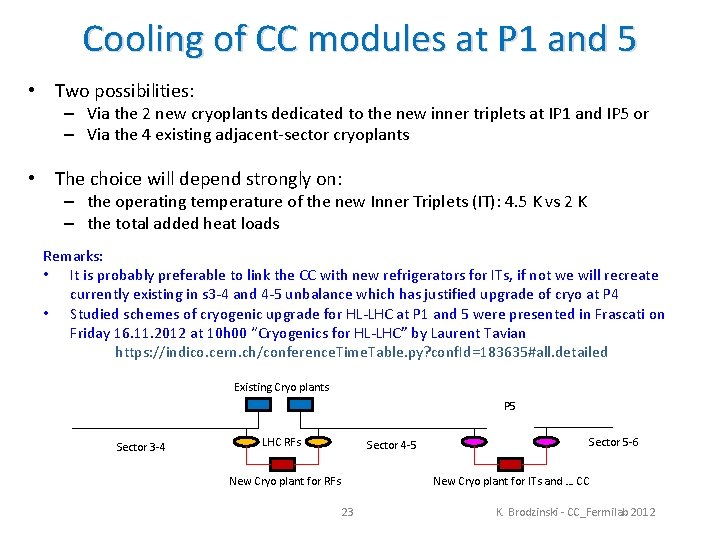
Cooling of CC modules at P 1 and 5 • Two possibilities: – Via the 2 new cryoplants dedicated to the new inner triplets at IP 1 and IP 5 or – Via the 4 existing adjacent-sector cryoplants • The choice will depend strongly on: – the operating temperature of the new Inner Triplets (IT): 4. 5 K vs 2 K – the total added heat loads Remarks: • It is probably preferable to link the CC with new refrigerators for ITs, if not we will recreate currently existing in s 3 -4 and 4 -5 unbalance which has justified upgrade of cryo at P 4 • Studied schemes of cryogenic upgrade for HL-LHC at P 1 and 5 were presented in Frascati on Friday 16. 11. 2012 at 10 h 00 “Cryogenics for HL-LHC” by Laurent Tavian https: //indico. cern. ch/conference. Time. Table. py? conf. Id=183635#all. detailed Existing Cryo plants P 5 Sector 3 -4 LHC RFs Sector 5 -6 Sector 4 -5 New Cryo plant for RFs New Cryo plant for ITs and … CC 23 K. Brodzinski - CC_Fermilab 2012
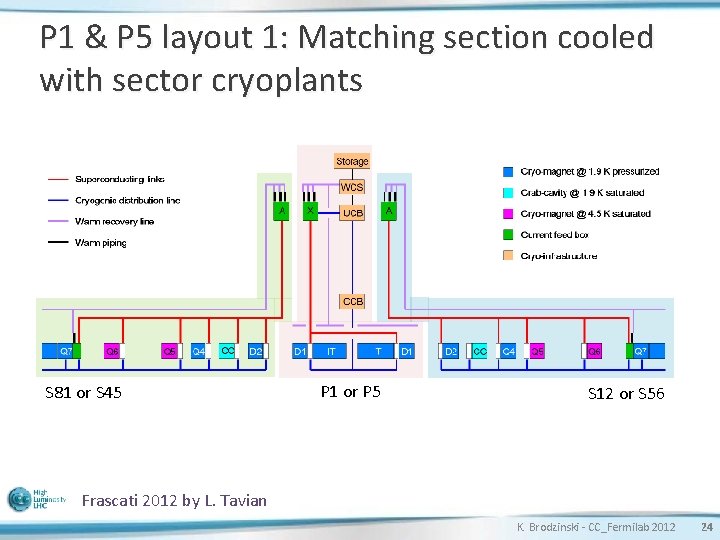
P 1 & P 5 layout 1: Matching section cooled with sector cryoplants S 81 or S 45 P 1 or P 5 S 12 or S 56 Frascati 2012 by L. Tavian K. Brodzinski - CC_Fermilab 2012 24
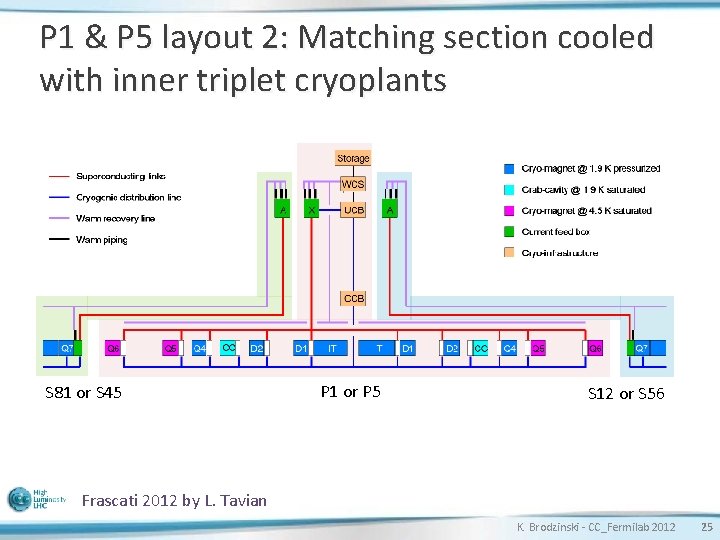
P 1 & P 5 layout 2: Matching section cooled with inner triplet cryoplants S 81 or S 45 P 1 or P 5 S 12 or S 56 Frascati 2012 by L. Tavian K. Brodzinski - CC_Fermilab 2012 25
Conclusions • Prototype crab-cavity testing in SPS: – Test possible from end 2014. – Refrigeration at 2 K: • liquefaction capacity of the TCF 20 must be measured and sufficient. • Additional resources (P + M) must be allocated. – Additional 2 K infrastructure to be built – could be in conflict with the LS 1 activities – tight to be integrated. • Prototype crab-cavity testing at LHC P 4: – If test necessary before availability of a new cold box -> difficulties for infrastructure – 2 K cooling (~1 MCHF + 2 FTE + a possible noise-insulated building tension/construction…? ). • Series crab-cavities for the final HL-LHC local scheme: – Cryogenic implementation during the LHC LS 3 (2022) – 2 K cooling via new ITs cryoplants preferable: • Option for Matching Section area to be cooled by the same new cryoplant • Cooling with existing sectors cryo plants not excluded but with load unbalance wrto the other LHC sectors 26 K. Brodzinski - CC_Fermilab 2012
Discussion Remind of main open points: • • • Is it acceptable to have coupler and end cone intercepts at ~80 K? Heat loads clarification at 5 K and 60 K (for 4 R cavity) SPS test – common or separated cryostat? Is the P 4 test really necessary? (if yes -> When? At what temperature? ) … THANK YOU FOR YOUR ATTENTION ! 27 K. Brodzinski - CC_Fermilab 2012
- Slides: 27