
CRA Regulation What Is It and How Do




- Slides: 37
CRA Regulation: What Is It and How Do Banks Use It? February 8, 2018 Jason Paulateer
Objectives Upon completion of this session, you should: • Understand CRA better • Types of “CRA Dollars” • “CRA Dollars” Contacts 2
CRA Dollars: What is CRA Anyway? April 30, 2018 Jason Paulateer
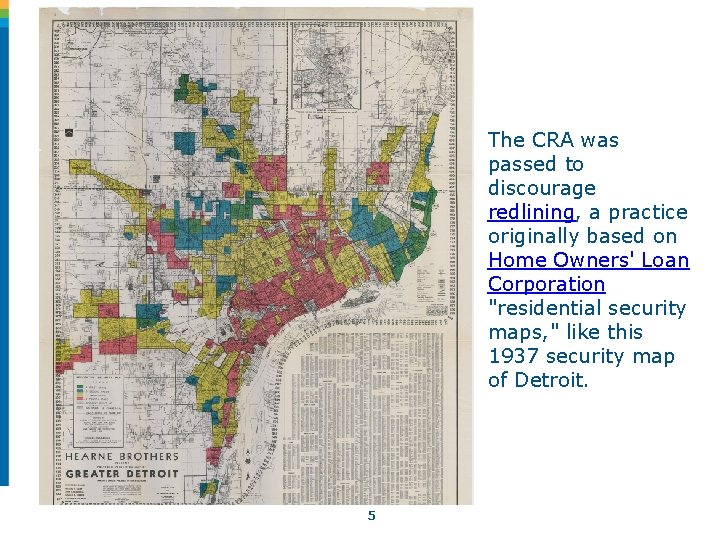
Community Reinvestment Act (CRA) • The Community Reinvestment Act (CRA) is a United States federal law designed to encourage commercial banks and savings associations to help meet the needs of borrowers in all segments of their communities, including low- and moderate-income neighborhoods. • Congress passed the Act in 1977 to reduce discriminatory credit practices against low-income neighborhoods, a practice known as redlining. 4
The CRA was passed to discourage redlining, a practice originally based on Home Owners' Loan Corporation "residential security maps, " like this 1937 security map of Detroit. 5
Low- and Moderate-Income (LMI) • Low-income = an individual income, or tract income, that is less than 50% of the AMI • Moderate-income = an individual income, or tract income, that is at least 50% and less than 80% of the AMI • Middle-income = an individual income, or tract income, that is at least 80% of AMI but less than 120% of AMI • Upper-income = an individual income, or tract income, that is equal to or greater than 120% of AMI Heart of the City Health Center, Grand Rapids 6
What is “CRA Qualified”? What constitutes a “CRA qualified” CD activity is specifically defined. There are several wonderful things financial institutions do to support communities that do not qualify for CRA credit. For all financial institutions, there is a focus in seeking to obtain CD loans, services or investments. 7
What is “Community Development”? Community Development is an important concept in Intermediate Small Bank and Large Bank evaluations. In order to receive CRA credit, a bank’s activities must have one of the following as its primary purpose: 8
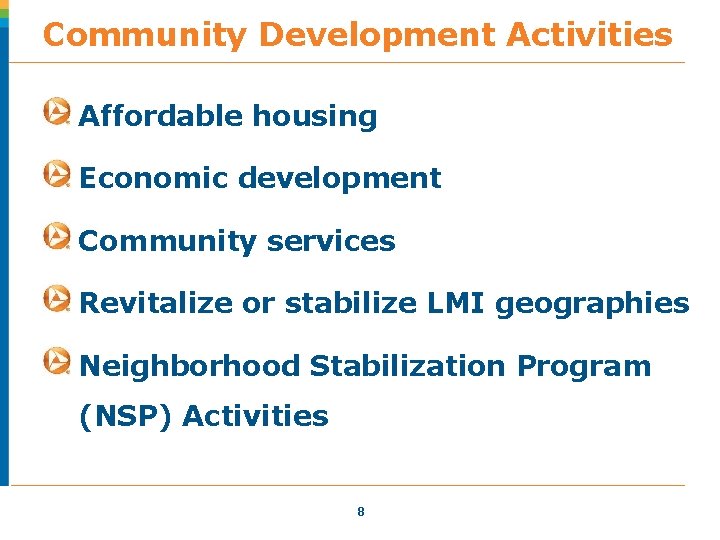
Community Development Activities Affordable housing Economic development Community services Revitalize or stabilize LMI geographies Neighborhood Stabilization Program (NSP) Activities 8
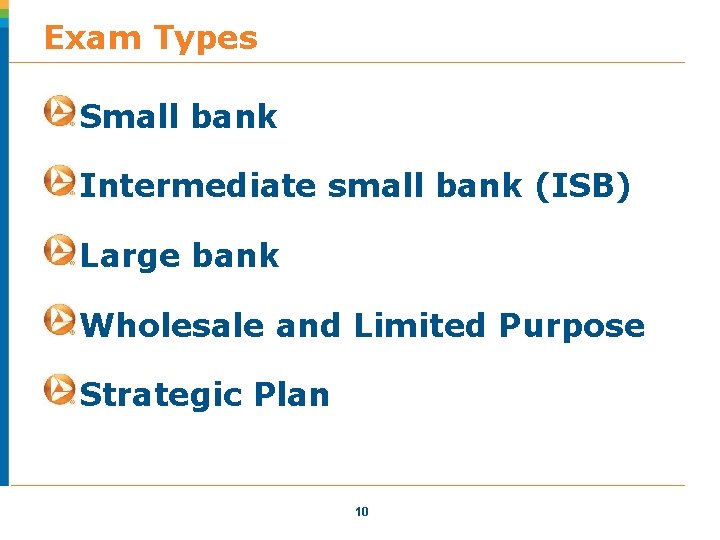
Exam Types Small bank Intermediate small bank (ISB) Large bank Wholesale and Limited Purpose Strategic Plan 10
Overall Ratings (Grades) Outstanding Satisfactory Needs to Improve Substantial Noncompliance 11
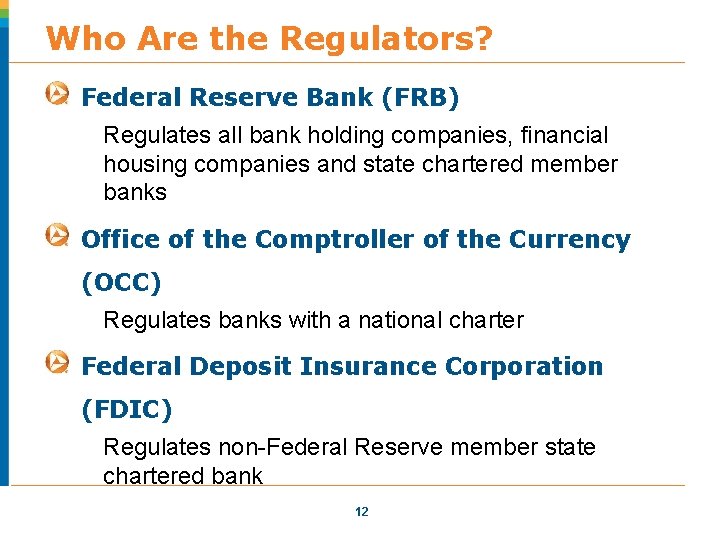
Who Are the Regulators? Federal Reserve Bank (FRB) Regulates all bank holding companies, financial housing companies and state chartered member banks Office of the Comptroller of the Currency (OCC) Regulates banks with a national charter Federal Deposit Insurance Corporation (FDIC) Regulates non-Federal Reserve member state chartered bank 12
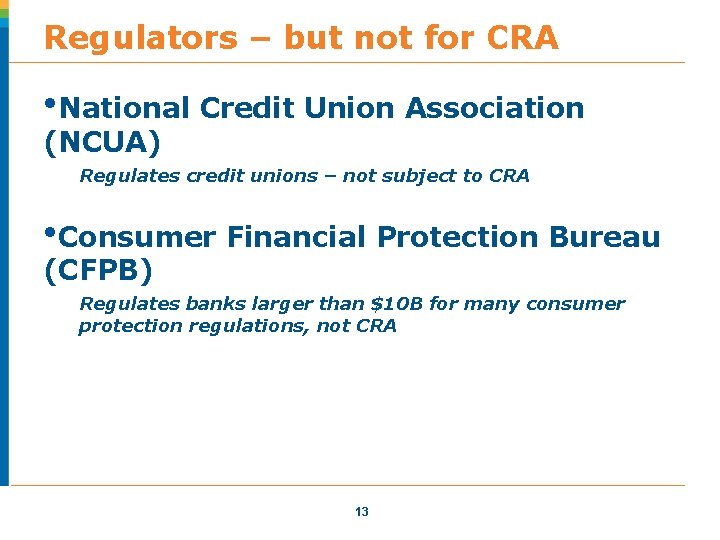
Regulators – but not for CRA • National Credit Union Association (NCUA) Regulates credit unions – not subject to CRA • Consumer Financial Protection Bureau (CFPB) Regulates banks larger than $10 B for many consumer protection regulations, not CRA 13
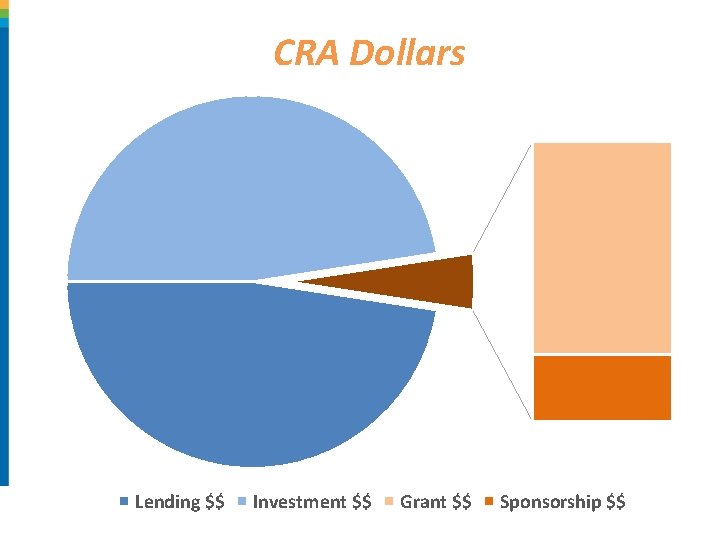
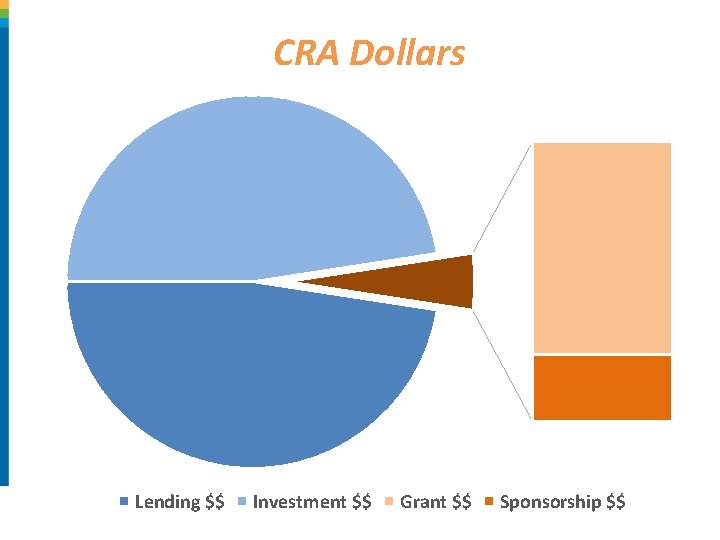
CRA Dollars Loans Equity Investments Giving Grants Sponsorships Service 14
CRA Dollars Lending $$ Investment $$ Grant $$ Sponsorship $$
Money Follows, It Does Not Lead 16
CRA Dollars: Community Development Loan and Investment (Equity) Dollars
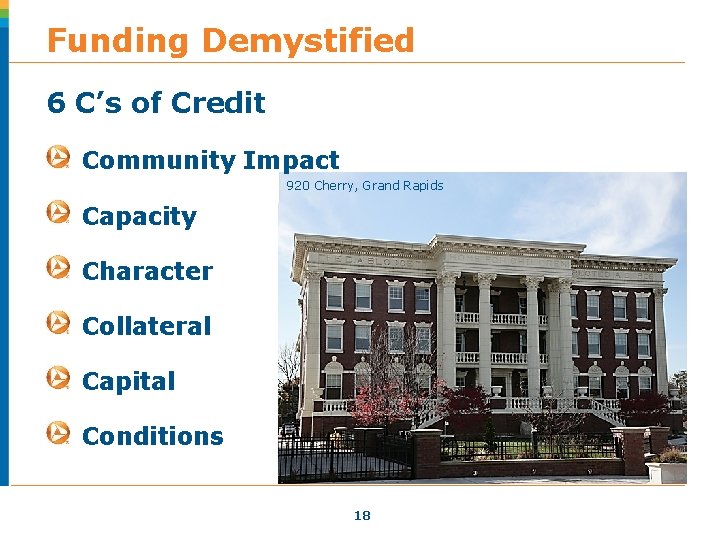
Funding Demystified 6 C’s of Credit Community Impact 920 Cherry, Grand Rapids Capacity Character Collateral Capital Conditions 18
Community Impact Does your project qualify for CRA credit? Is it in a low- or moderate-income census tract? Does this project help to stabilize or revitalize the community? What is the level of jobs that will be created by/at the project? Is it affordable housing? How many units of housing will be created? 19
Capacity/Cash Flow What is your organization's borrowing history and track record of repayment? How much debt can your organization handle? Will you be able to honor the obligation and repay the debt? There are numerous financial benchmarks such as debt and liquidity ratios that banks use before advancing funds. 20
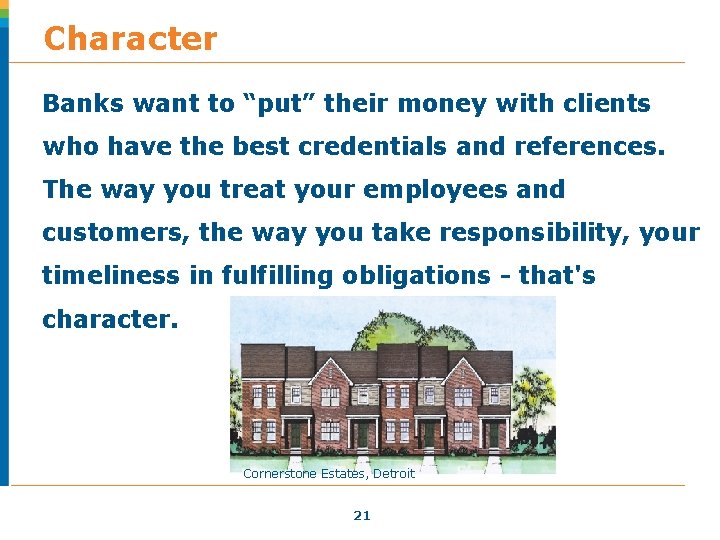
Character Banks want to “put” their money with clients who have the best credentials and references. The way you treat your employees and customers, the way you take responsibility, your timeliness in fulfilling obligations - that's character. Cornerstone Estates, Detroit 21
Collateral While cash flow will nearly always be the primary source of repayment of a loan, bankers often look at what they call a secondary source of repayment. Collateral represents assets that the company pledges as an alternate repayment source for the loan. Hard assets. Collateral can come in the form of real estate and office or manufacturing equipment. Your accounts receivable and inventory can also be pledged as collateral. 22
Capital How well capitalized is your organization? How much money have you invested/reinvested in the organization? 23
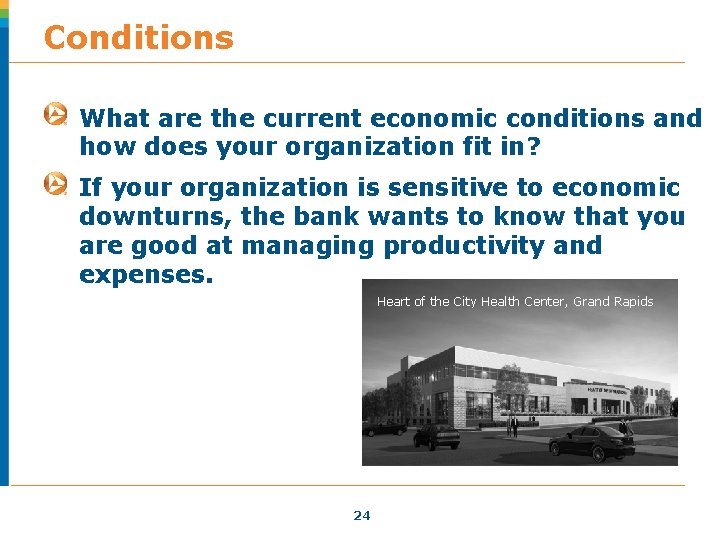
Conditions What are the current economic conditions and how does your organization fit in? If your organization is sensitive to economic downturns, the bank wants to know that you are good at managing productivity and expenses. Heart of the City Health Center, Grand Rapids 24
CRA Dollars: Time, Talent and Treasure May 18, 2017
Money Follows, It Does Not Lead 26
CRA Dollars: Time, Talent and Treasure Time & Talent Community Development Service Talent Sponsorship with CD Service Component Treasure Foundation/Corporate Grant funding 27
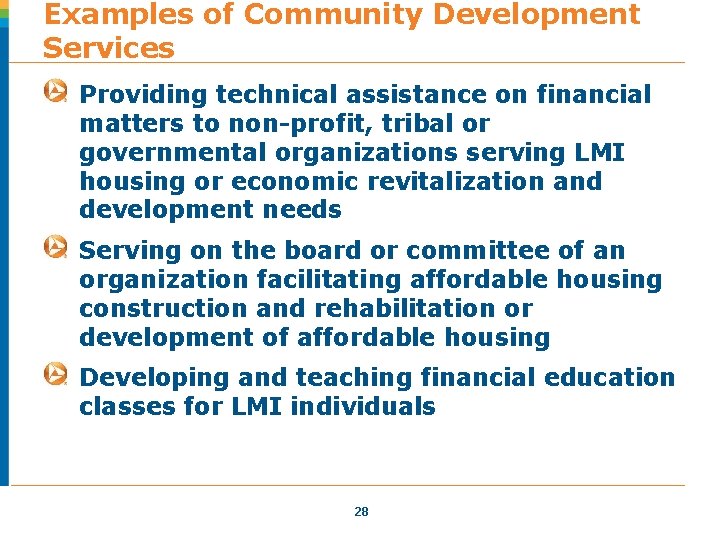
Examples of Community Development Services Providing technical assistance on financial matters to non-profit, tribal or governmental organizations serving LMI housing or economic revitalization and development needs Serving on the board or committee of an organization facilitating affordable housing construction and rehabilitation or development of affordable housing Developing and teaching financial education classes for LMI individuals 28
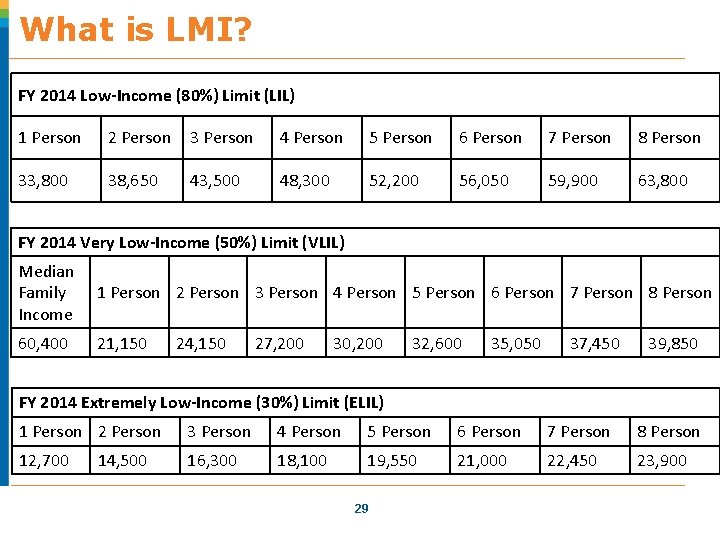
What is LMI? FY 2014 Low-Income (80%) Limit (LIL) 1 Person 2 Person 3 Person 4 Person 5 Person 6 Person 7 Person 8 Person 33, 800 38, 650 43, 500 48, 300 52, 200 56, 050 59, 900 63, 800 FY 2014 Very Low-Income (50%) Limit (VLIL) Median Family Income 1 Person 2 Person 3 Person 4 Person 5 Person 6 Person 7 Person 8 Person 60, 400 21, 150 24, 150 27, 200 30, 200 32, 600 35, 050 37, 450 39, 850 FY 2014 Extremely Low-Income (30%) Limit (ELIL) 1 Person 2 Person 3 Person 4 Person 5 Person 6 Person 7 Person 8 Person 12, 700 16, 300 18, 100 19, 550 21, 000 22, 450 23, 900 14, 500 29
CRA Dollars: Grant and Sponsorship $$$ May 18, 2017
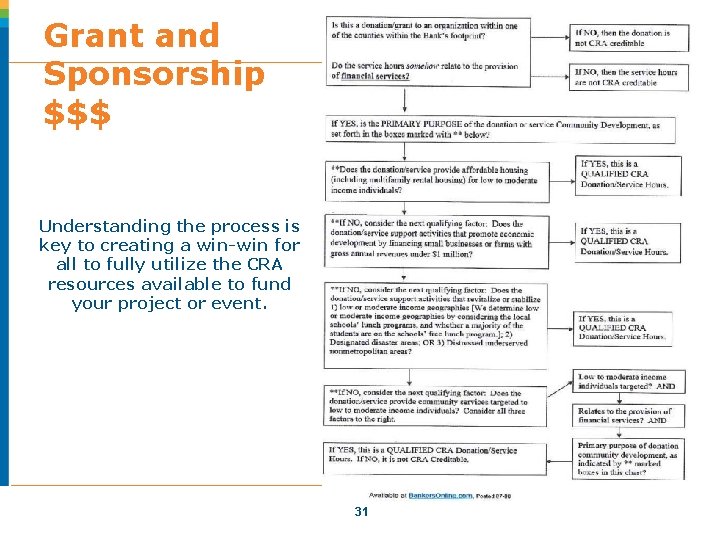
Grant and Sponsorship $$$ Understanding the process is key to creating a win-win for all to fully utilize the CRA resources available to fund your project or event. 31
Grant and Sponsorship $$$ • Understand the Funding Priorities • Sustainable and Measurable • Clear and Concise Goals 32
CRA Dollars Lending $$ Investment $$ Grant $$ Sponsorship $$
Questions 34
Contact Information Jason L. Paulateer, Vice President Market Manager PNC Community Development Banking Phone: (248) 729 -8654 Email: jason. paulateer@pnc. com Renee A. Kent, Vice President Relationship Manager PNC Community Development Banking Phone: (248) 729 -8186 Email: renee. kent@pnc. com Brynne Banks, Vice President Community Consultant PNC Community Development Banking Phone: (517) 334 -5265 Email: brynne. banks@pnc. com Brandon Ivory, Program Officer Economic Development Detroit LISC Phone: (313) 265 -2890 Email: bivory@lisc. org 35
Appendix
Resources • • • Interagency Questions & Answers on Community Reinvestment March 11, 2010 http: //www. ffiec. gov/cra/pdf/2010 -4903. pdf Supplemental Interagency Procedures http: //www. ffiec. gov/cra/examinations. htm#EX_PROCEDURES – Intermediate Small Bank issued in 2005 – Small Bank, Large Bank, Limited Purpose, and Strategic Plan issued in 2006 OCC Large Bank Examiner Guidance, December 2000 OCC Bulletin 97 -26 Performance Context Supervisory Agency Community Affairs Departments http: //www. ffiec. gov: HMDA data, CRA data, geocoding/mapping system, rate spread calculator, links to CRA Performance Evaluations http: //www. fdic. gov: Deposit market share data, list of branches, Bank Call Reports http: //www. bls. gov: Employment/unemployment data https: //www. pnc. com/en/about-pnc/corporateresponsibility/corporate-social-responsibility. html 37