
CQC The new approach to inspection of ambulance
CQC: The new approach to inspection of ambulance services 1
Our purpose and role Our purpose We make sure health and social care services provide people with safe, effective, compassionate, high-quality care and we encourage care services to improve Our role We monitor, inspect and regulate services to make sure they meet fundamental standards of quality and safety and we publish what we find, including performance ratings to help people choose care 2
Our New Approach We ask these questions of all services: • • • Is it safe? Is it effective? Is it responsive? Is it caring? Is it well led? 3
Our New Approach For people using services: • CQC is always on their side and acts in their best interests • CQC engages with people using services and acts on what they tell us • CQC acts swiftly on safety and quality concerns to ensure action is taken • People have confidence in CQC and trust in our independence, expertise and judgement • CQC provides clear, relevant and authoritative reports that focus on the needs and experiences of people 4
Our New Approach For organisations providing care: • Respecting CQC as open, professional, expert and independent that provides value for money • CQC listens, respects honesty and communicates clearly • CQC is proportionate, consistent and uses fair processes • CQC shares their commitment to improving the services they deliver and providers se CQC’s ratings to drive improvement • CQC listens to staff working in services 5
The Chief Inspector of Hospitals’ remit • To develop and implement a new approach to inspection, covering • • Acute hospital services Specialist mental health services Community health services Ambulance services • Covers NHS and independent providers • All providers will be rated on a four point scale (outstanding; good; requires improvement or inadequate) 6
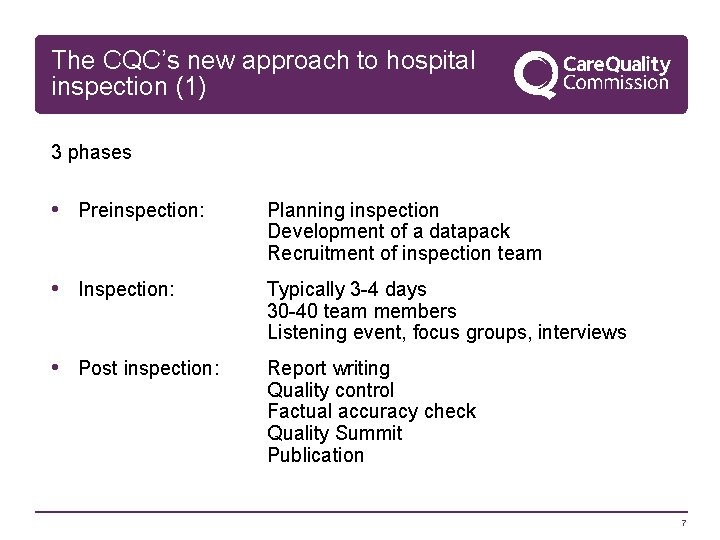
The CQC’s new approach to hospital inspection (1) 3 phases • Preinspection: Planning inspection Development of a datapack Recruitment of inspection team • Inspection: Typically 3 -4 days 30 -40 team members Listening event, focus groups, interviews • Post inspection: Report writing Quality control Factual accuracy check Quality Summit Publication 7
The CQC’s new approach inspection • 5 key questions (Safe? Effective? Caring? Responsive? Well led? ) • 4 ratings for each service/domain (Outstanding, Good, Requires Improvement, Inadequate) 8
Developing CQC’s approach to inspection of ambulance services Services provided include • Receiving and triaging 999 calls • Receiving and triaging non-life threatening 999 calls and providing appropriate responses, advice and treatment • Undertaking high dependency and intensive care transfers between hospitals • Patient transport services • Response to major incidents • Provision of 111 services • Assessment, treatment and care at home, where appropriate • Air ambulance services 9
Ambulance services - Overview • Wide variation in size and scope • NHS and independent sector provision • 10 large (and one small) NHS Trusts • Over 50% of NHS hospital transfers handled by private companies 10
Applying CQC’s five questions to ambulance services (1) Safe? • • Clean? Safe equipment? Well maintained fleet? Safe medicines management? Safeguarding? Learning from incidents? Staff training in safe practices? Clinicians maintaining essential skills? 11
Applying CQC’s five questions to ambulance services (2) Effective? • • • Appropriate assessment? Correct diagnosis? Evidence-based care pathways? Audits of services, treatment and destination? National comparisons of quality standards (where feasible)? 12
Applying CQC’s five questions to ambulance services (3) Caring? • Are patients treated with dignity, respect and compassion? • Are families and friends treated with dignity, respect and compassion • How is feedback from patients and carers gathered? 13
Applying CQC’s five questions to ambulance services (4) Responsive to patients’ needs? • Timely responses • Appropriate information sharing • Management of specific groups of patients (e. g. vulnerable; patients with dementia; patients with mental health problems) • Gathering and responding to complaints 14
Applying CQC’s five questions to ambulance services (5) Well-led? • • Vision and strategy? Culture? Governance arrangements? Leadership? • Learning from good practice • Integration with other providers 15
Approach to inspection of ambulance services (1) Defining core services – still a work in progress • Original version: • Responding to life threatening conditions or incidents • Responding to non-life threatening conditions • Clinically required services requested by care professionals • Patient transport services • Another version: • Access • Emergency and Urgent Care • Patient transport services 16
Approach to inspection of ambulance services (2) Defining groups with specific needs • • People with mental health needs Children and young people People with a long term condition Bariatric users of services End of life care Patients who have fallen Stroke Cardiac arrest 17
Approach to inspection of ambulance services (3) • Developing our information to monitor providers • Focusing on local partnerships and arrangements for integration • Sampling – we cannot inspect every location for all services 18
- Slides: 18