
CPU scheduling Interleave processes so as to maximize
- Slides: 46
CPU scheduling • Interleave processes so as to maximize utilization of CPU and I/O resources • Scheduler should be fast as time spent in scheduler is wasted time – Switching context (h/w assists – register windows [sparc]) – Switching to user mode – Jumping to proper location • Preemptive scheduling: – Context switch without waiting for application to relinquish – Process could be in the middle of an operation – Especially bad for kernel structures • Non-preemptive (cooperative) scheduling: – Can lead to Starvation CSE 542: Operating Systems
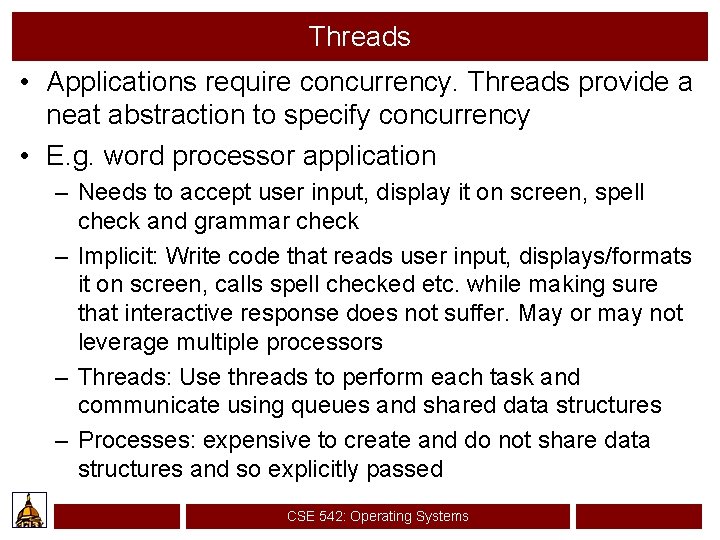
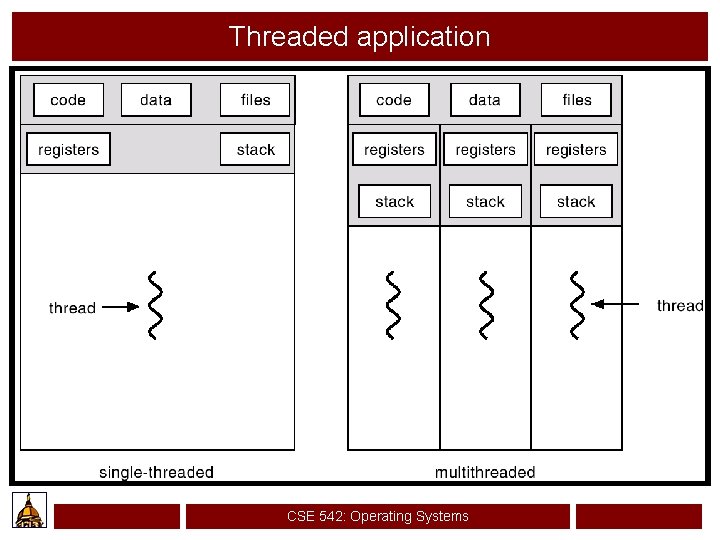
Threads • Applications require concurrency. Threads provide a neat abstraction to specify concurrency • E. g. word processor application – Needs to accept user input, display it on screen, spell check and grammar check – Implicit: Write code that reads user input, displays/formats it on screen, calls spell checked etc. while making sure that interactive response does not suffer. May or may not leverage multiple processors – Threads: Use threads to perform each task and communicate using queues and shared data structures – Processes: expensive to create and do not share data structures and so explicitly passed CSE 542: Operating Systems
Threaded application CSE 542: Operating Systems
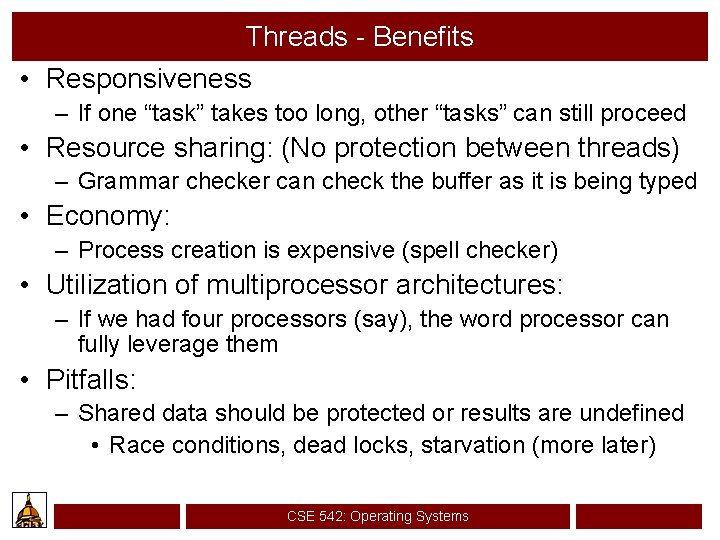
Threads - Benefits • Responsiveness – If one “task” takes too long, other “tasks” can still proceed • Resource sharing: (No protection between threads) – Grammar checker can check the buffer as it is being typed • Economy: – Process creation is expensive (spell checker) • Utilization of multiprocessor architectures: – If we had four processors (say), the word processor can fully leverage them • Pitfalls: – Shared data should be protected or results are undefined • Race conditions, dead locks, starvation (more later) CSE 542: Operating Systems
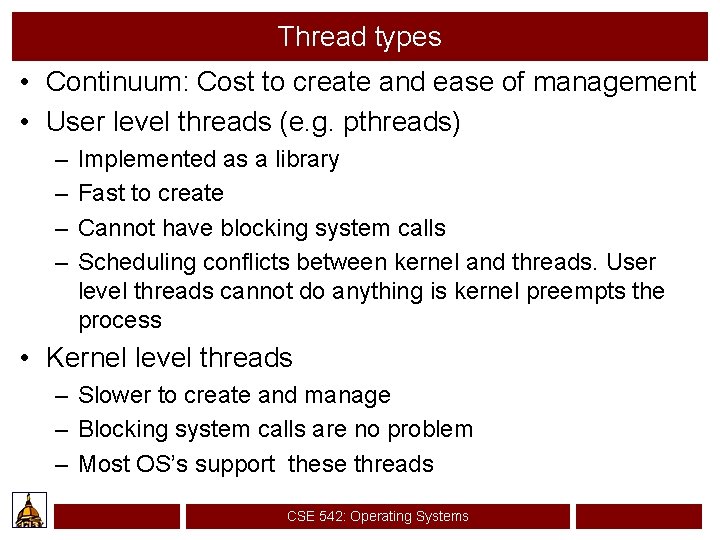
Thread types • Continuum: Cost to create and ease of management • User level threads (e. g. pthreads) – – Implemented as a library Fast to create Cannot have blocking system calls Scheduling conflicts between kernel and threads. User level threads cannot do anything is kernel preempts the process • Kernel level threads – Slower to create and manage – Blocking system calls are no problem – Most OS’s support these threads CSE 542: Operating Systems
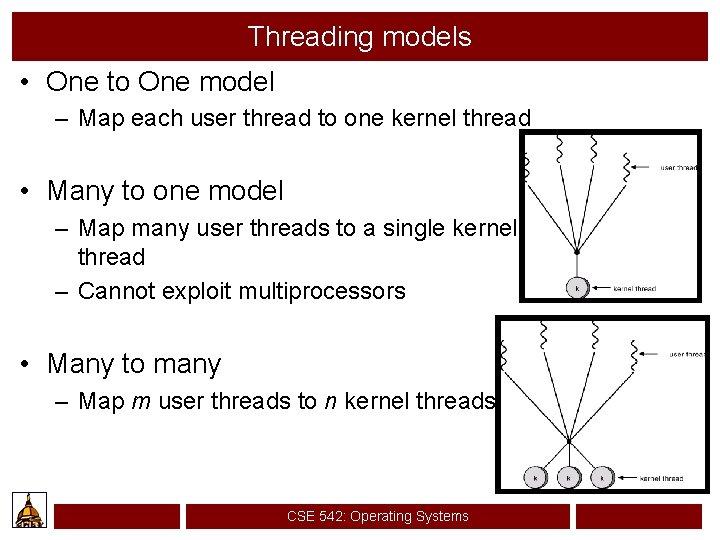
Threading models • One to One model – Map each user thread to one kernel thread • Many to one model – Map many user threads to a single kernel thread – Cannot exploit multiprocessors • Many to many – Map m user threads to n kernel threads CSE 542: Operating Systems
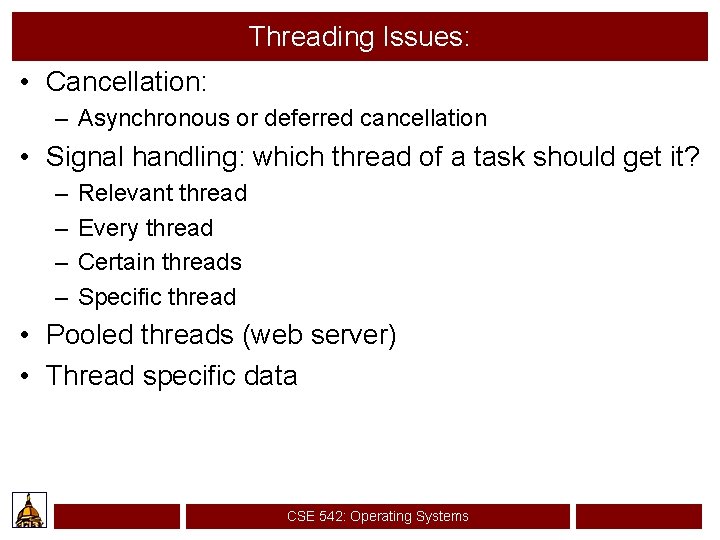
Threading Issues: • Cancellation: – Asynchronous or deferred cancellation • Signal handling: which thread of a task should get it? – – Relevant thread Every thread Certain threads Specific thread • Pooled threads (web server) • Thread specific data CSE 542: Operating Systems
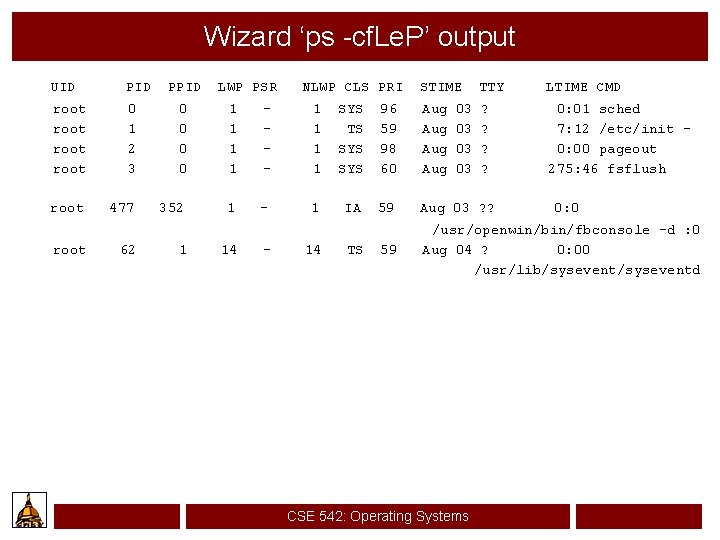
Wizard ‘ps -cf. Le. P’ output UID PID root 0 1 2 3 0 0 1 1 - 1 1 SYS TS SYS root 477 352 1 - 1 IA root 62 PPID 1 LWP PSR 14 - NLWP CLS PRI 14 TS STIME TTY LTIME CMD 96 59 98 60 Aug Aug ? ? 0: 01 sched 7: 12 /etc/init 0: 00 pageout 275: 46 fsflush 59 Aug 03 ? ? 59 /usr/openwin/bin/fbconsole -d : 0 Aug 04 ? 0: 00 /usr/lib/syseventd 03 03 CSE 542: Operating Systems 0: 0
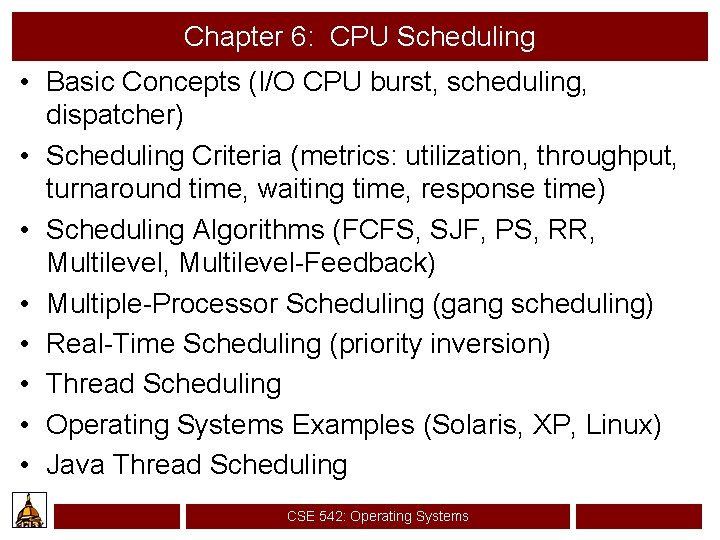
Chapter 6: CPU Scheduling • Basic Concepts (I/O CPU burst, scheduling, dispatcher) • Scheduling Criteria (metrics: utilization, throughput, turnaround time, waiting time, response time) • Scheduling Algorithms (FCFS, SJF, PS, RR, Multilevel-Feedback) • Multiple-Processor Scheduling (gang scheduling) • Real-Time Scheduling (priority inversion) • Thread Scheduling • Operating Systems Examples (Solaris, XP, Linux) • Java Thread Scheduling CSE 542: Operating Systems
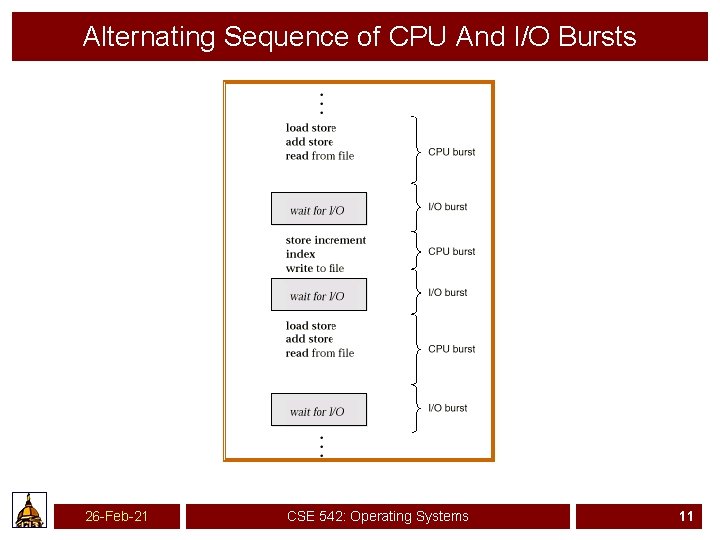
Basic Concepts • Maximum CPU utilization obtained with multiprogramming • CPU–I/O Burst Cycle – Process execution consists of a cycle of CPU execution and I/O wait • CPU burst distribution CSE 542: Operating Systems
Alternating Sequence of CPU And I/O Bursts 26 -Feb-21 CSE 542: Operating Systems 11
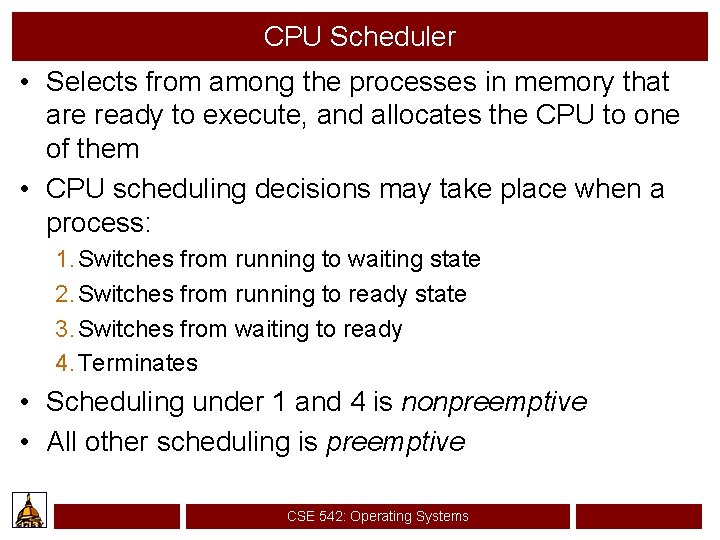
CPU Scheduler • Selects from among the processes in memory that are ready to execute, and allocates the CPU to one of them • CPU scheduling decisions may take place when a process: 1. Switches from running to waiting state 2. Switches from running to ready state 3. Switches from waiting to ready 4. Terminates • Scheduling under 1 and 4 is nonpreemptive • All other scheduling is preemptive CSE 542: Operating Systems
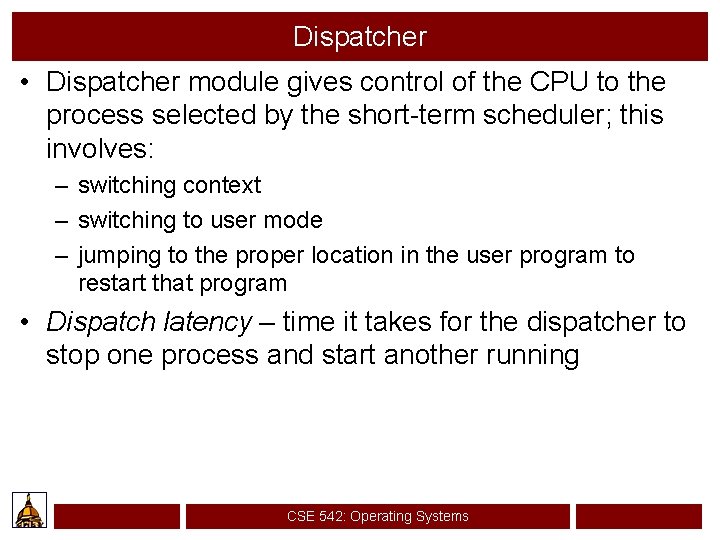
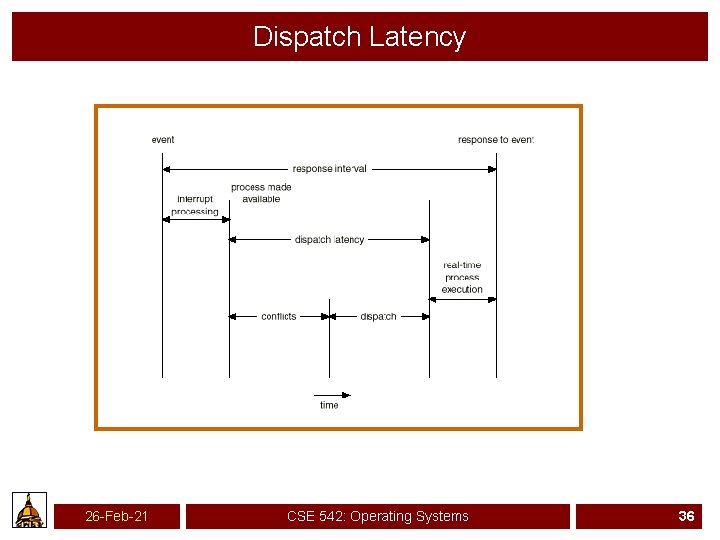
Dispatcher • Dispatcher module gives control of the CPU to the process selected by the short-term scheduler; this involves: – switching context – switching to user mode – jumping to the proper location in the user program to restart that program • Dispatch latency – time it takes for the dispatcher to stop one process and start another running CSE 542: Operating Systems
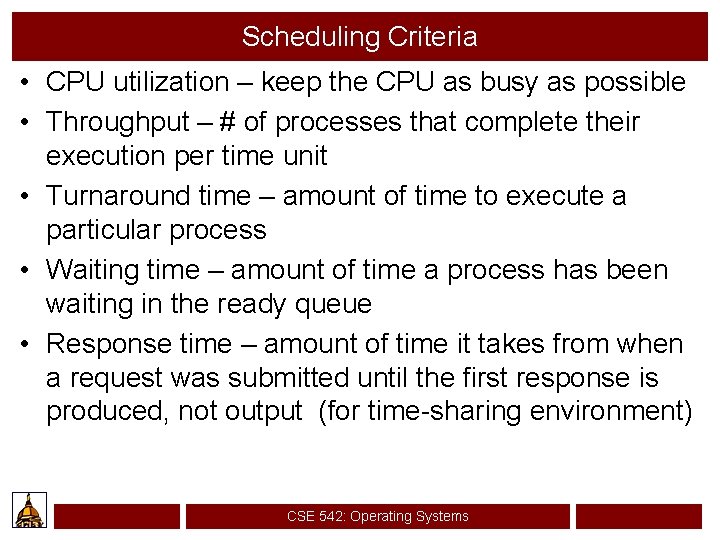
Scheduling Criteria • CPU utilization – keep the CPU as busy as possible • Throughput – # of processes that complete their execution per time unit • Turnaround time – amount of time to execute a particular process • Waiting time – amount of time a process has been waiting in the ready queue • Response time – amount of time it takes from when a request was submitted until the first response is produced, not output (for time-sharing environment) CSE 542: Operating Systems
Optimization Criteria • • • Max CPU utilization Max throughput Min turnaround time Min waiting time Min response time CSE 542: Operating Systems
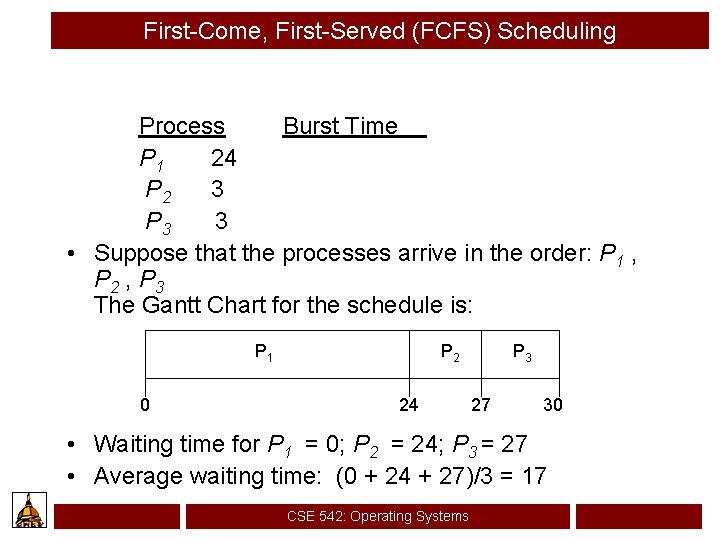
First-Come, First-Served (FCFS) Scheduling Process Burst Time P 1 24 P 2 3 P 3 3 • Suppose that the processes arrive in the order: P 1 , P 2 , P 3 The Gantt Chart for the schedule is: P 1 0 P 2 24 P 3 27 30 • Waiting time for P 1 = 0; P 2 = 24; P 3 = 27 • Average waiting time: (0 + 24 + 27)/3 = 17 CSE 542: Operating Systems
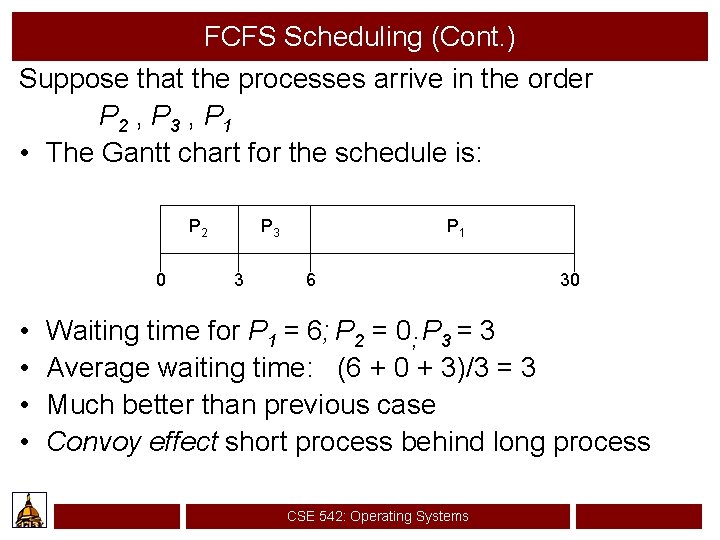
FCFS Scheduling (Cont. ) Suppose that the processes arrive in the order P 2 , P 3 , P 1 • The Gantt chart for the schedule is: P 2 0 • • P 3 3 P 1 6 30 Waiting time for P 1 = 6; P 2 = 0; P 3 = 3 Average waiting time: (6 + 0 + 3)/3 = 3 Much better than previous case Convoy effect short process behind long process CSE 542: Operating Systems
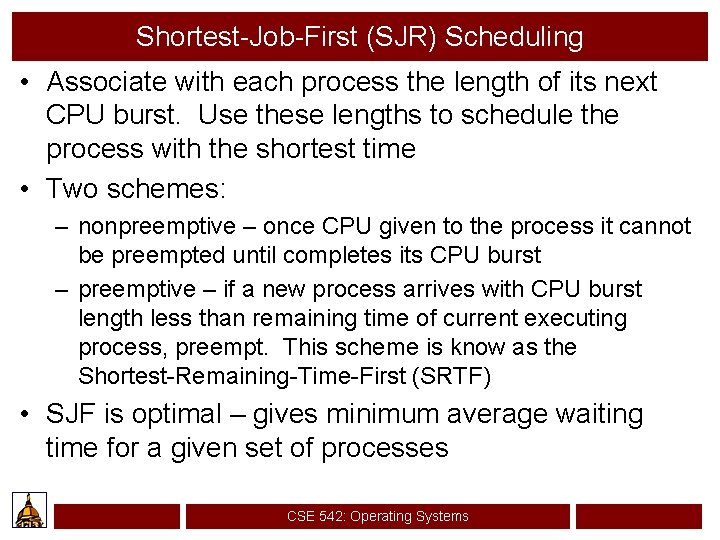
Shortest-Job-First (SJR) Scheduling • Associate with each process the length of its next CPU burst. Use these lengths to schedule the process with the shortest time • Two schemes: – nonpreemptive – once CPU given to the process it cannot be preempted until completes its CPU burst – preemptive – if a new process arrives with CPU burst length less than remaining time of current executing process, preempt. This scheme is know as the Shortest-Remaining-Time-First (SRTF) • SJF is optimal – gives minimum average waiting time for a given set of processes CSE 542: Operating Systems
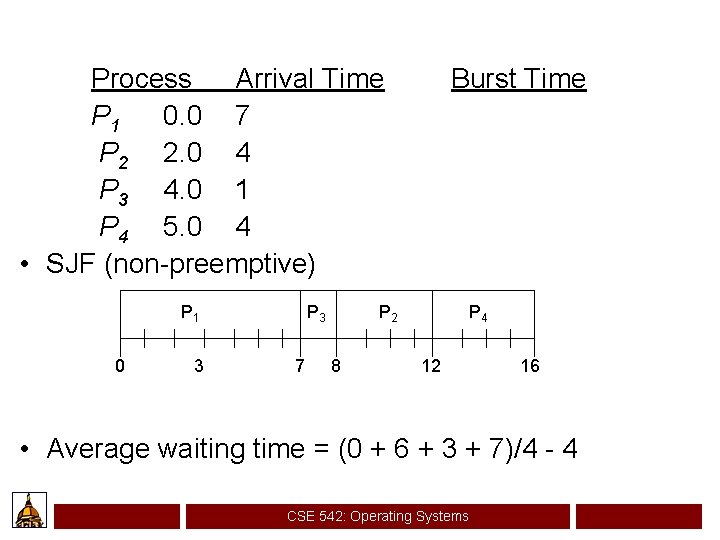
Example of Non-Preemptive SJF Process Arrival Time Burst Time P 1 0. 0 7 P 2 2. 0 4 P 3 4. 0 1 P 4 5. 0 4 • SJF (non-preemptive) P 1 0 3 P 3 7 P 2 8 P 4 12 16 • Average waiting time = (0 + 6 + 3 + 7)/4 - 4 CSE 542: Operating Systems
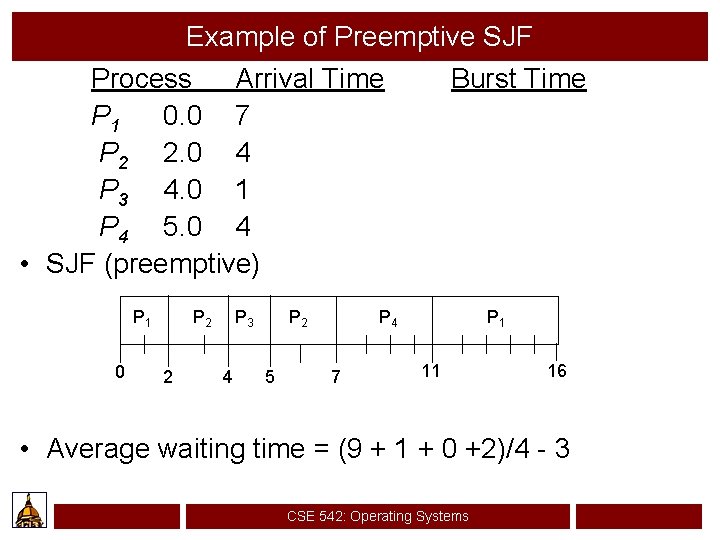
Example of Preemptive SJF Process Arrival Time Burst Time P 1 0. 0 7 P 2 2. 0 4 P 3 4. 0 1 P 4 5. 0 4 • SJF (preemptive) P 1 0 P 2 2 P 3 4 P 2 5 P 4 7 P 1 11 16 • Average waiting time = (9 + 1 + 0 +2)/4 - 3 CSE 542: Operating Systems
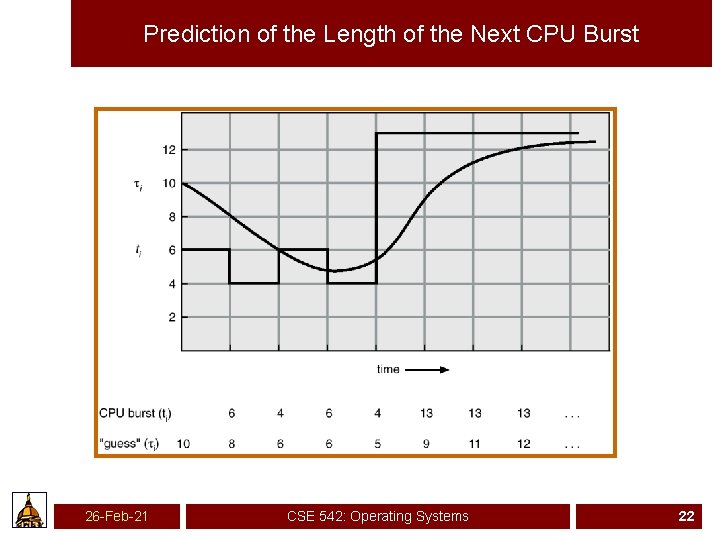
Determining Length of Next CPU Burst • Can only estimate the length • Can be done by using the length of previous CPU bursts, using exponential averaging 26 -Feb-21 CSE 542: Operating Systems 21
Prediction of the Length of the Next CPU Burst 26 -Feb-21 CSE 542: Operating Systems 22
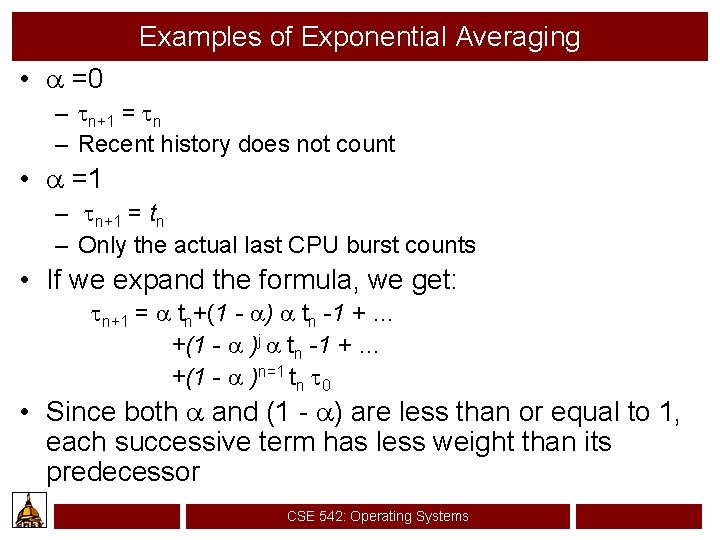
Examples of Exponential Averaging • =0 – n+1 = n – Recent history does not count • =1 – n+1 = tn – Only the actual last CPU burst counts • If we expand the formula, we get: n+1 = tn+(1 - ) tn -1 + … +(1 - )j tn -1 + … +(1 - )n=1 tn 0 • Since both and (1 - ) are less than or equal to 1, each successive term has less weight than its predecessor CSE 542: Operating Systems
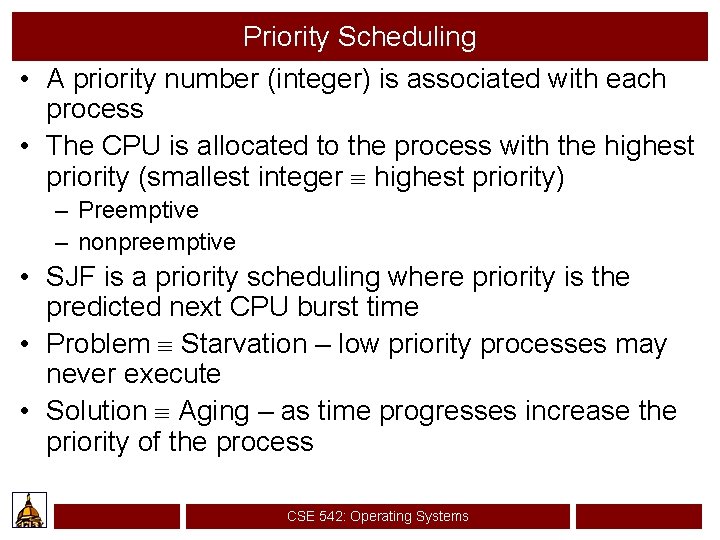
Priority Scheduling • A priority number (integer) is associated with each process • The CPU is allocated to the process with the highest priority (smallest integer highest priority) – Preemptive – nonpreemptive • SJF is a priority scheduling where priority is the predicted next CPU burst time • Problem Starvation – low priority processes may never execute • Solution Aging – as time progresses increase the priority of the process CSE 542: Operating Systems
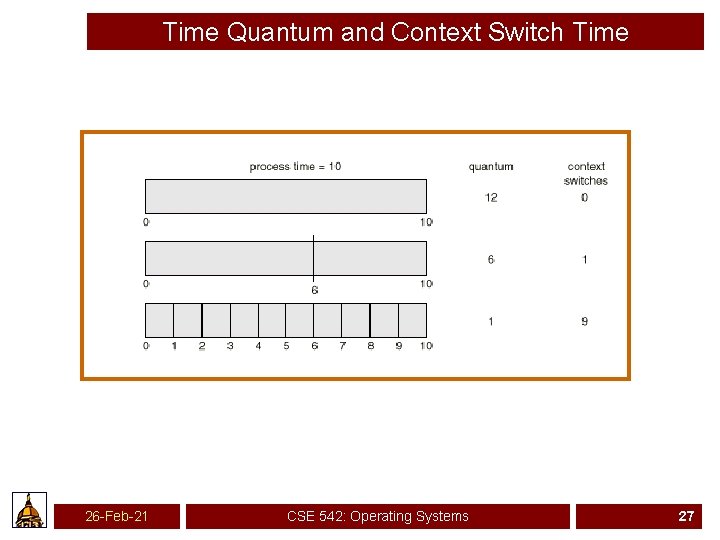
Round Robin (RR) • Each process gets a small unit of CPU time (time quantum), usually 10 -100 milliseconds. After this time has elapsed, the process is preempted and added to the end of the ready queue. • If there are n processes in the ready queue and the time quantum is q, then each process gets 1/n of the CPU time in chunks of at most q time units at once. No process waits more than (n-1)q time units. • Performance – q large FIFO – q small q must be large with respect to context switch, otherwise overhead is too high CSE 542: Operating Systems
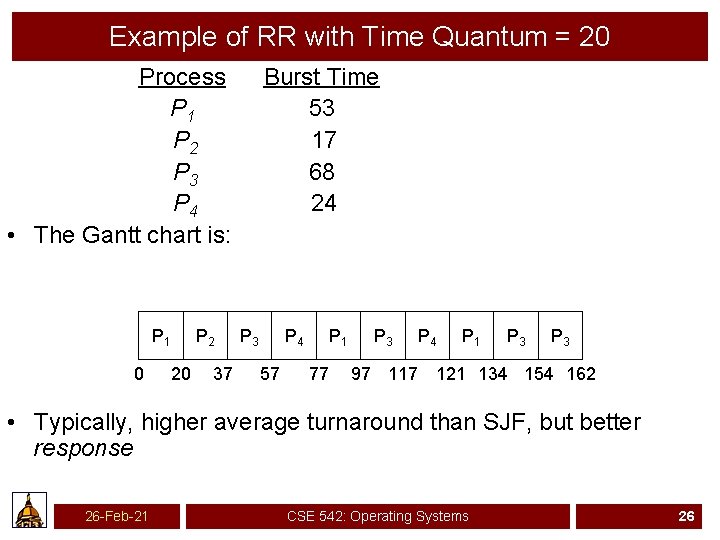
Example of RR with Time Quantum = 20 Process P 1 P 2 P 3 P 4 • The Gantt chart is: P 1 0 P 2 20 37 Burst Time 53 17 68 24 P 3 P 4 57 P 1 77 P 3 P 4 P 1 P 3 97 117 121 134 154 162 • Typically, higher average turnaround than SJF, but better response 26 -Feb-21 CSE 542: Operating Systems 26
Time Quantum and Context Switch Time 26 -Feb-21 CSE 542: Operating Systems 27
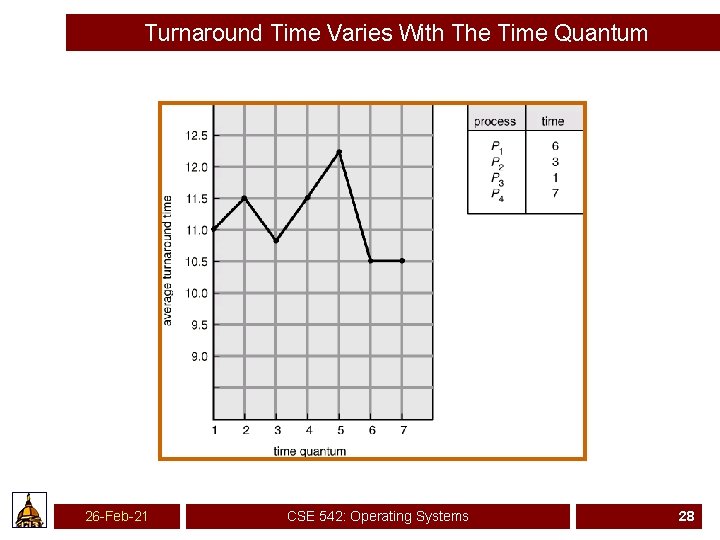
Turnaround Time Varies With The Time Quantum 26 -Feb-21 CSE 542: Operating Systems 28
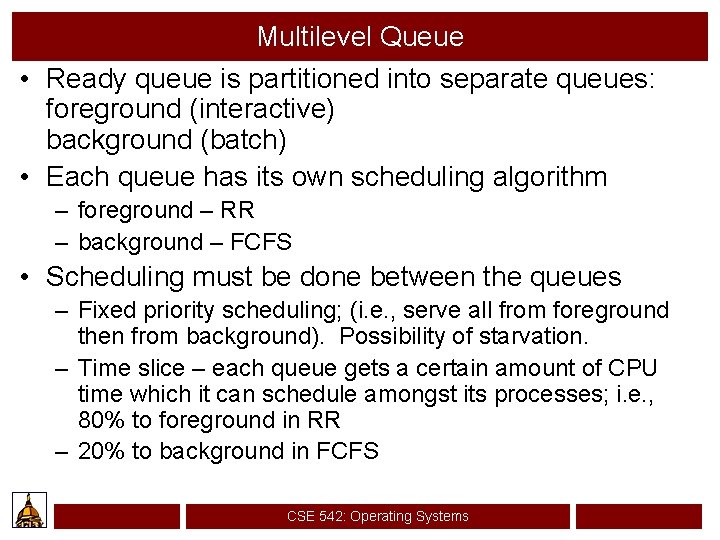
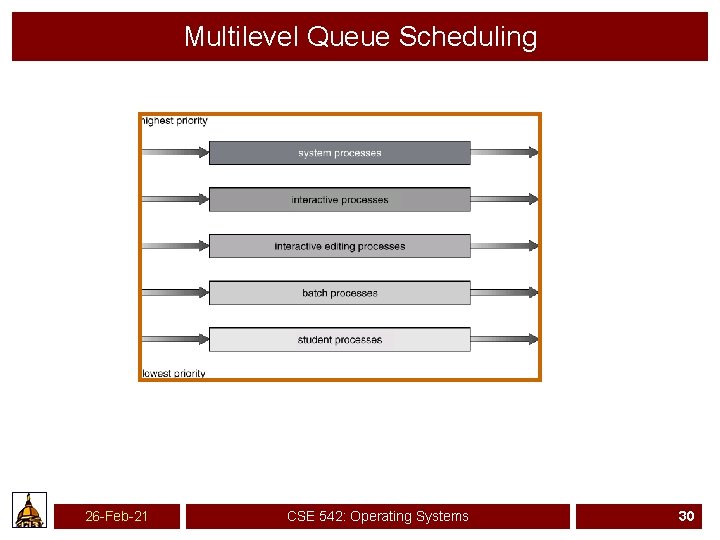
Multilevel Queue • Ready queue is partitioned into separate queues: foreground (interactive) background (batch) • Each queue has its own scheduling algorithm – foreground – RR – background – FCFS • Scheduling must be done between the queues – Fixed priority scheduling; (i. e. , serve all from foreground then from background). Possibility of starvation. – Time slice – each queue gets a certain amount of CPU time which it can schedule amongst its processes; i. e. , 80% to foreground in RR – 20% to background in FCFS CSE 542: Operating Systems
Multilevel Queue Scheduling 26 -Feb-21 CSE 542: Operating Systems 30
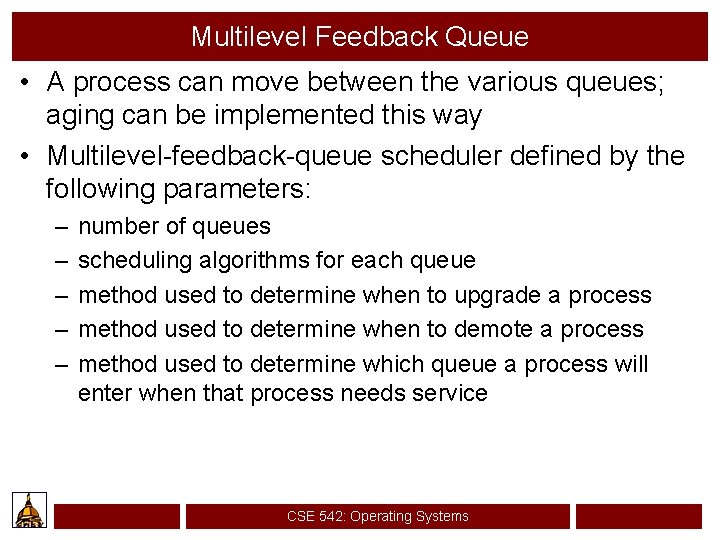
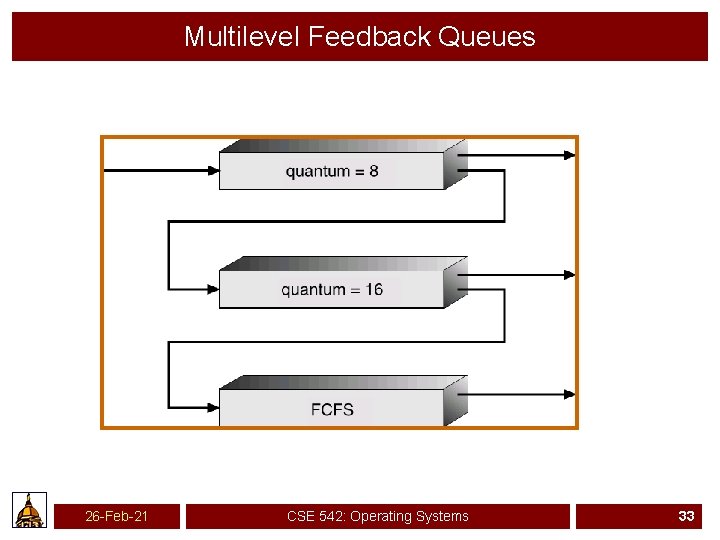
Multilevel Feedback Queue • A process can move between the various queues; aging can be implemented this way • Multilevel-feedback-queue scheduler defined by the following parameters: – – – number of queues scheduling algorithms for each queue method used to determine when to upgrade a process method used to determine when to demote a process method used to determine which queue a process will enter when that process needs service CSE 542: Operating Systems
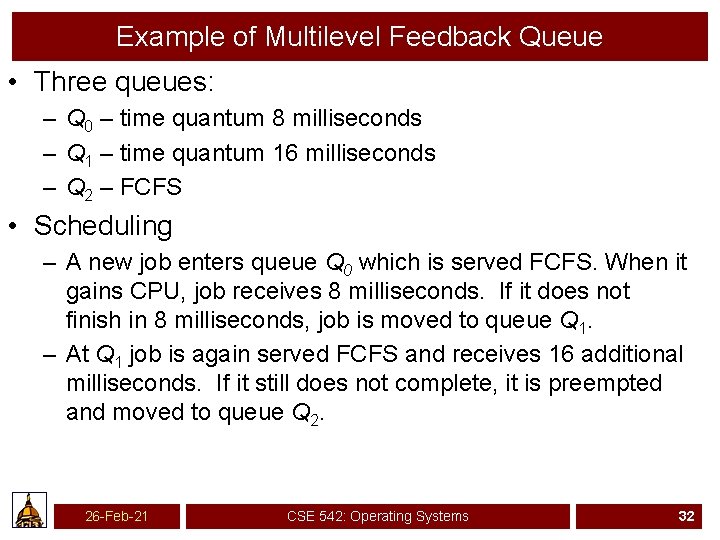
Example of Multilevel Feedback Queue • Three queues: – Q 0 – time quantum 8 milliseconds – Q 1 – time quantum 16 milliseconds – Q 2 – FCFS • Scheduling – A new job enters queue Q 0 which is served FCFS. When it gains CPU, job receives 8 milliseconds. If it does not finish in 8 milliseconds, job is moved to queue Q 1. – At Q 1 job is again served FCFS and receives 16 additional milliseconds. If it still does not complete, it is preempted and moved to queue Q 2. 26 -Feb-21 CSE 542: Operating Systems 32
Multilevel Feedback Queues 26 -Feb-21 CSE 542: Operating Systems 33
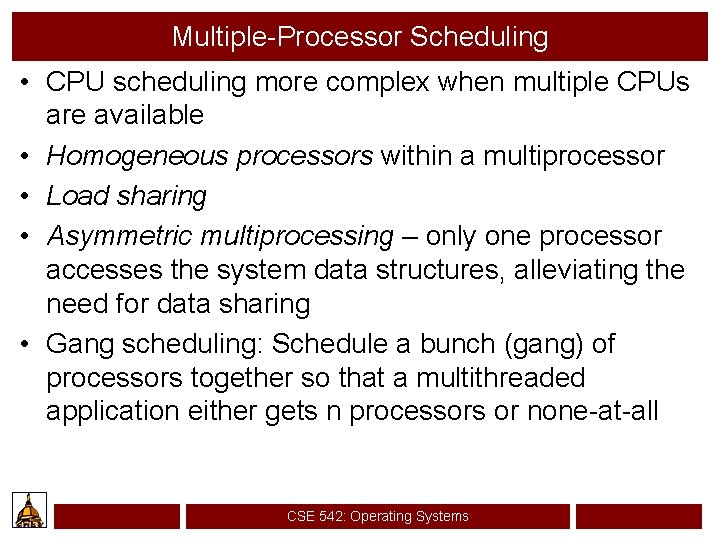
Multiple-Processor Scheduling • CPU scheduling more complex when multiple CPUs are available • Homogeneous processors within a multiprocessor • Load sharing • Asymmetric multiprocessing – only one processor accesses the system data structures, alleviating the need for data sharing • Gang scheduling: Schedule a bunch (gang) of processors together so that a multithreaded application either gets n processors or none-at-all CSE 542: Operating Systems
Real-Time Scheduling • Hard real-time systems – required to complete a critical task within a guaranteed amount of time • Soft real-time computing – requires that critical processes receive priority over less fortunate ones CSE 542: Operating Systems
Dispatch Latency 26 -Feb-21 CSE 542: Operating Systems 36
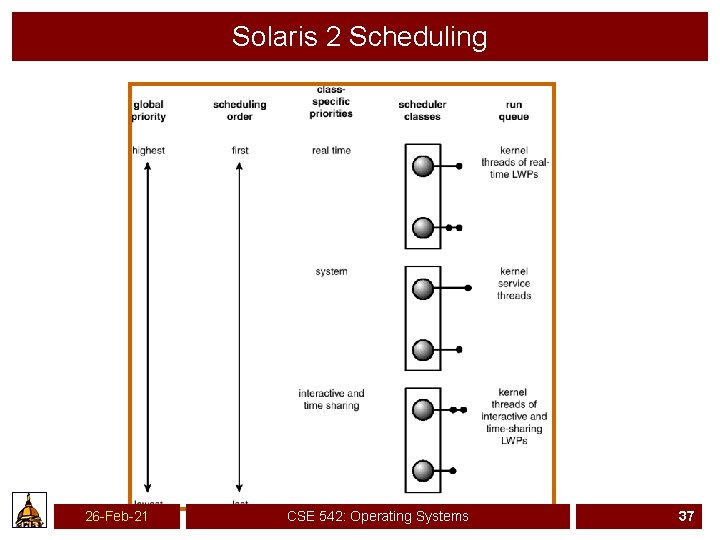
Solaris 2 Scheduling 26 -Feb-21 CSE 542: Operating Systems 37
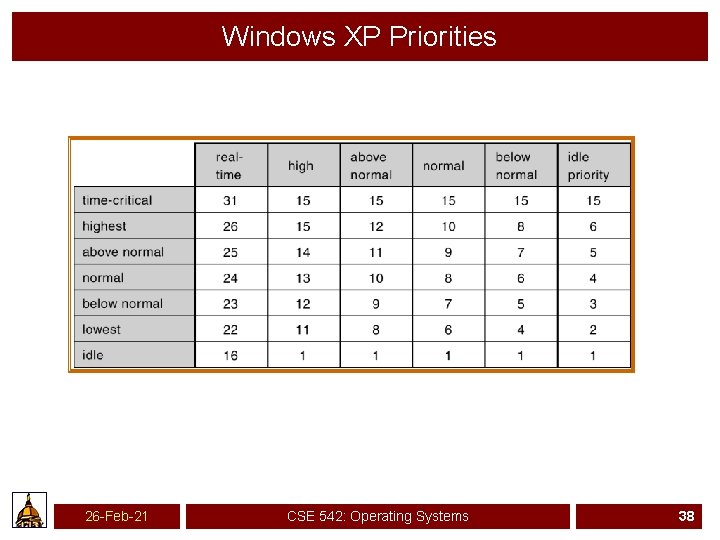
Windows XP Priorities 26 -Feb-21 CSE 542: Operating Systems 38
Linux Scheduling • Two algorithms: time-sharing and real-time • Time-sharing – – Prioritized credit-based – process with most credits is scheduled next Credit subtracted when timer interrupt occurs When credit = 0, another process chosen When all processes have credit = 0, recrediting occurs • Based on factors including priority and history • Real-time – Soft real-time – Posix. 1 b compliant – two classes • FCFS and RR • Highest priority process always runs first CSE 542: Operating Systems
Thread Scheduling • Local Scheduling – How the threads library decides which thread to put onto an available LWP • Global Scheduling – How the kernel decides which kernel thread to run next CSE 542: Operating Systems
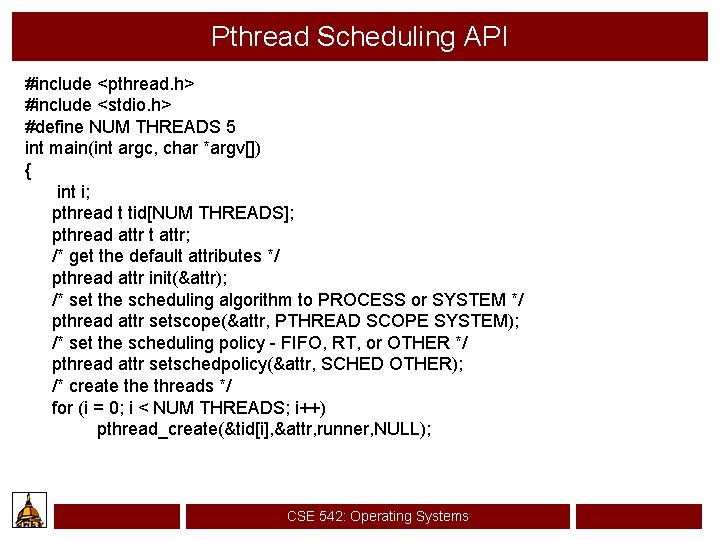
Pthread Scheduling API #include <pthread. h> #include <stdio. h> #define NUM THREADS 5 int main(int argc, char *argv[]) { int i; pthread t tid[NUM THREADS]; pthread attr t attr; /* get the default attributes */ pthread attr init(&attr); /* set the scheduling algorithm to PROCESS or SYSTEM */ pthread attr setscope(&attr, PTHREAD SCOPE SYSTEM); /* set the scheduling policy - FIFO, RT, or OTHER */ pthread attr setschedpolicy(&attr, SCHED OTHER); /* create threads */ for (i = 0; i < NUM THREADS; i++) pthread_create(&tid[i], &attr, runner, NULL); CSE 542: Operating Systems
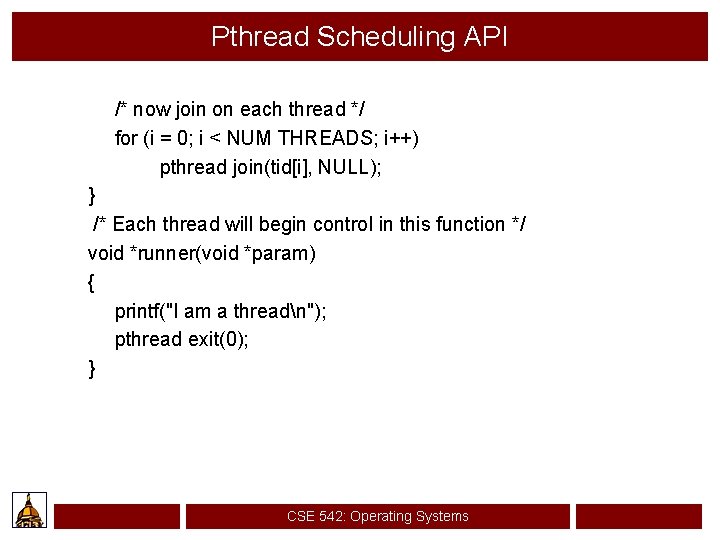
Pthread Scheduling API /* now join on each thread */ for (i = 0; i < NUM THREADS; i++) pthread join(tid[i], NULL); } /* Each thread will begin control in this function */ void *runner(void *param) { printf("I am a threadn"); pthread exit(0); } CSE 542: Operating Systems
Java Thread Scheduling • JVM Uses a Preemptive, Priority-Based Scheduling Algorithm • FIFO Queue is Used if There Are Multiple Threads With the Same Priority CSE 542: Operating Systems
Java Thread Scheduling (cont) JVM Schedules a Thread to Run When: 1. The Currently Running Thread Exits the Runnable State 2. A Higher Priority Thread Enters the Runnable State * Note – the JVM Does Not Specify Whether Threads are Time-Sliced or Not CSE 542: Operating Systems
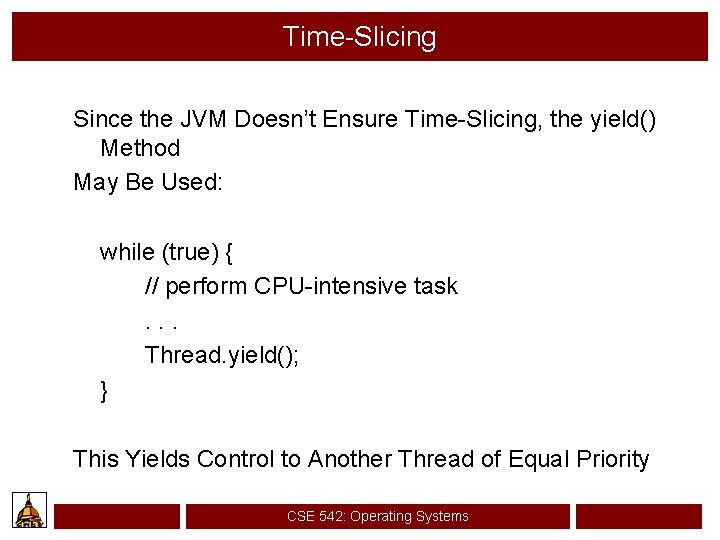
Time-Slicing Since the JVM Doesn’t Ensure Time-Slicing, the yield() Method May Be Used: while (true) { // perform CPU-intensive task. . . Thread. yield(); } This Yields Control to Another Thread of Equal Priority CSE 542: Operating Systems
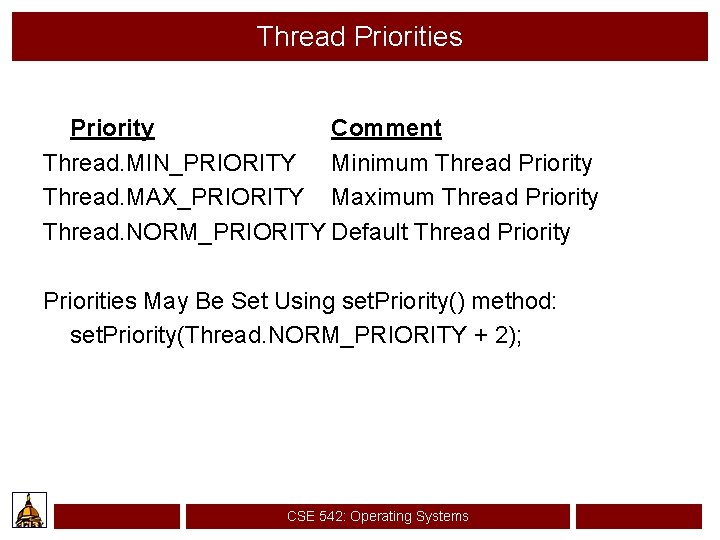
Thread Priorities Priority Comment Thread. MIN_PRIORITY Minimum Thread Priority Thread. MAX_PRIORITY Maximum Thread Priority Thread. NORM_PRIORITY Default Thread Priority Priorities May Be Set Using set. Priority() method: set. Priority(Thread. NORM_PRIORITY + 2); CSE 542: Operating Systems