
CPT Coding Cash and Compliance Inpatient Coding Thomas



- Slides: 14
CPT Coding, Cash, and Compliance Inpatient Coding Thomas Weida, M. D. Professor Department of Family and Community Medicine Penn State Milton S. Hershey Medical Center
Disclosures • I have nothing up my sleeve. • I have nothing to disclose other than I’m on everyone’s best loved committee – the RUC
• Outpatient tends to under-code • Inpatient tends to over-code Comorbidities are important
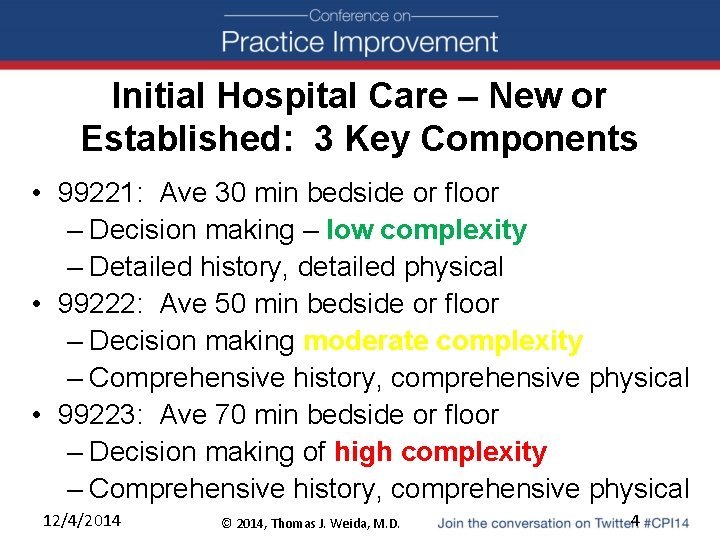
Initial Hospital Care – New or Established: 3 Key Components • 99221: Ave 30 min bedside or floor – Decision making – low complexity – Detailed history, detailed physical • 99222: Ave 50 min bedside or floor – Decision making moderate complexity – Comprehensive history, comprehensive physical • 99223: Ave 70 min bedside or floor – Decision making of high complexity – Comprehensive history, comprehensive physical 12/4/2014 © 2014, Thomas J. Weida, M. D. 4
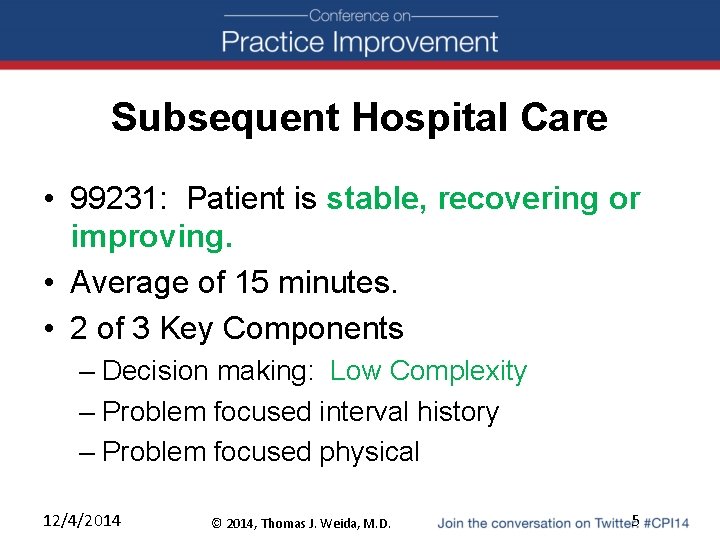
Subsequent Hospital Care • 99231: Patient is stable, recovering or improving. • Average of 15 minutes. • 2 of 3 Key Components – Decision making: Low Complexity – Problem focused interval history – Problem focused physical 12/4/2014 © 2014, Thomas J. Weida, M. D. 5
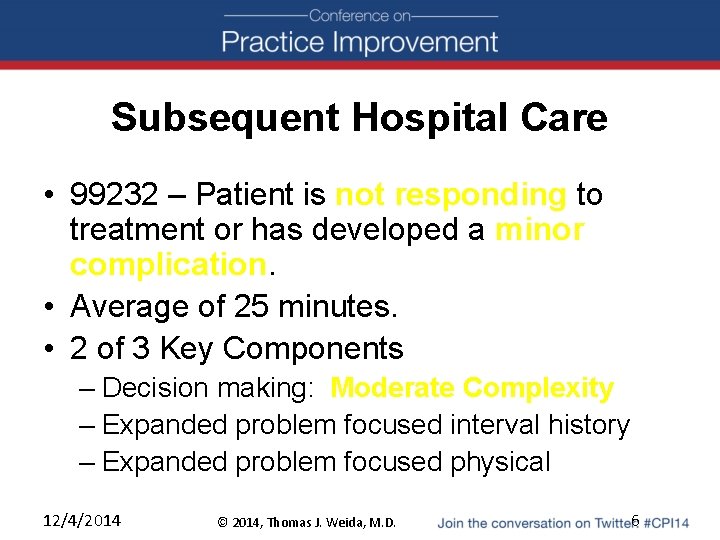
Subsequent Hospital Care • 99232 – Patient is not responding to treatment or has developed a minor complication. • Average of 25 minutes. • 2 of 3 Key Components – Decision making: Moderate Complexity – Expanded problem focused interval history – Expanded problem focused physical 12/4/2014 © 2014, Thomas J. Weida, M. D. 6
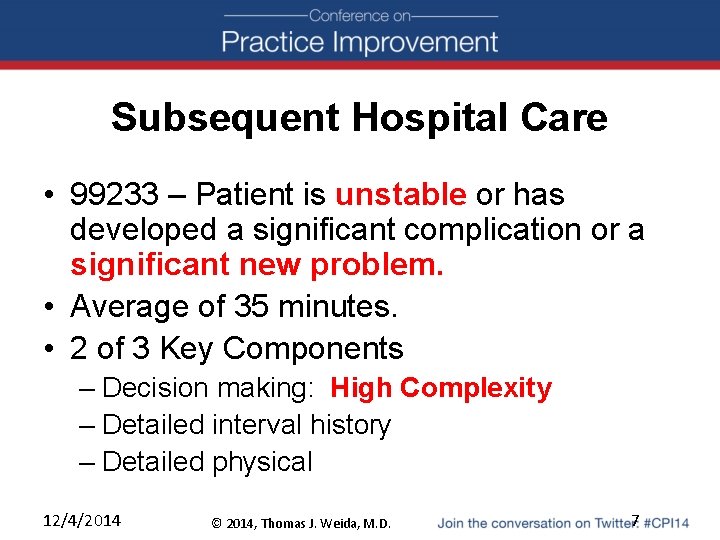
Subsequent Hospital Care • 99233 – Patient is unstable or has developed a significant complication or a significant new problem. • Average of 35 minutes. • 2 of 3 Key Components – Decision making: High Complexity – Detailed interval history – Detailed physical 12/4/2014 © 2014, Thomas J. Weida, M. D. 7
Initial Observation Care: New or Established, 3/3 Key Components • 99218 – Low Complexity Decision Making – Detailed History, Detailed Exam • 99219 – Moderate Complexity Decision Making – Comprehensive History, Comprehensive Exam • 99220 – High Complexity Decision Making – Comprehensive History, Comprehensive Exam 12/4/2014 © 2014, Thomas J. Weida, M. D. 8
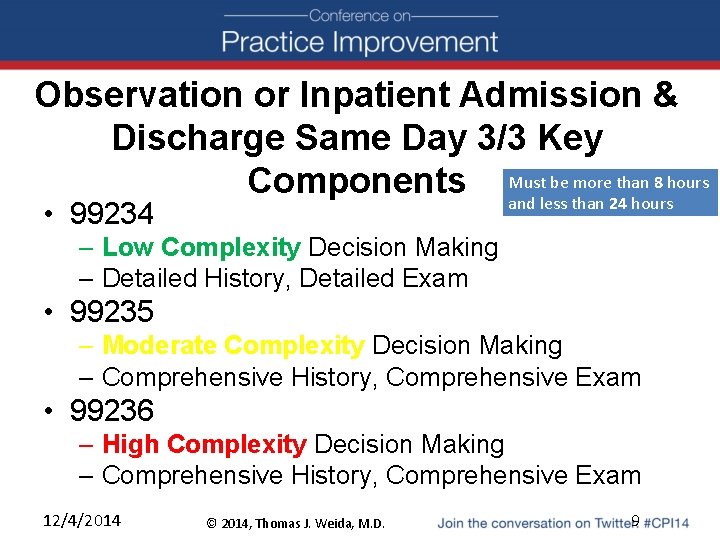
Observation or Inpatient Admission & Discharge Same Day 3/3 Key be more than 8 hours Components Must and less than 24 hours • 99234 – Low Complexity Decision Making – Detailed History, Detailed Exam • 99235 – Moderate Complexity Decision Making – Comprehensive History, Comprehensive Exam • 99236 – High Complexity Decision Making – Comprehensive History, Comprehensive Exam 12/4/2014 © 2014, Thomas J. Weida, M. D. 9
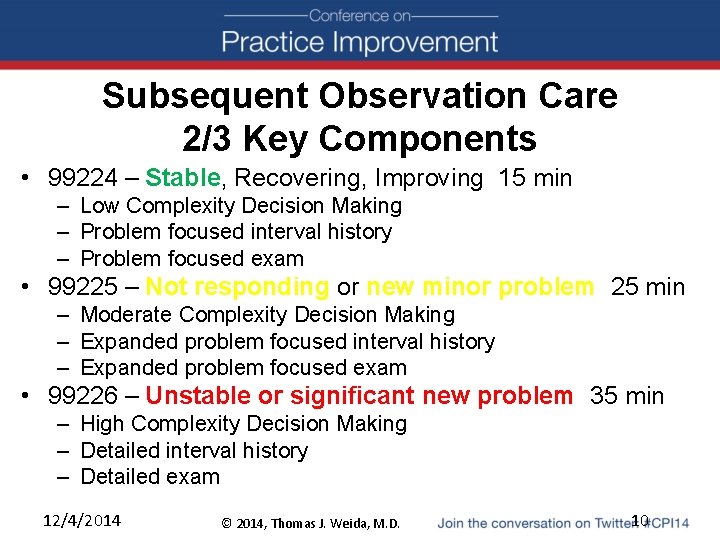
Subsequent Observation Care 2/3 Key Components • 99224 – Stable, Recovering, Improving 15 min – Low Complexity Decision Making – Problem focused interval history – Problem focused exam • 99225 – Not responding or new minor problem 25 min – Moderate Complexity Decision Making – Expanded problem focused interval history – Expanded problem focused exam • 99226 – Unstable or significant new problem 35 min – High Complexity Decision Making – Detailed interval history – Detailed exam 12/4/2014 © 2014, Thomas J. Weida, M. D. 10
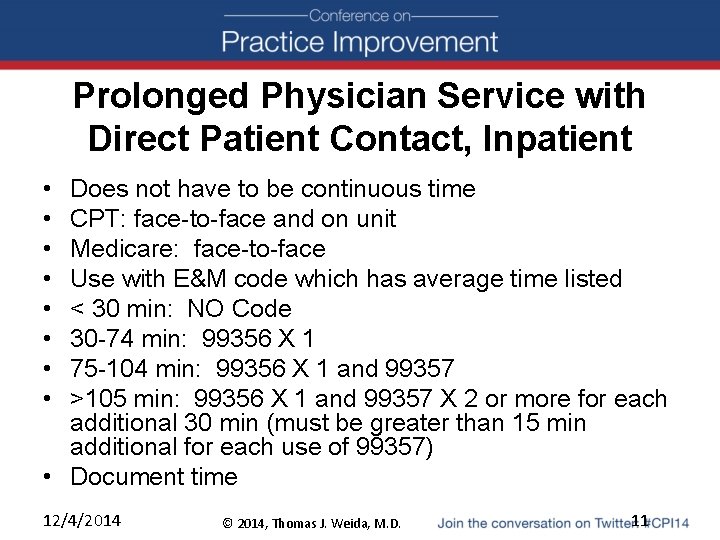
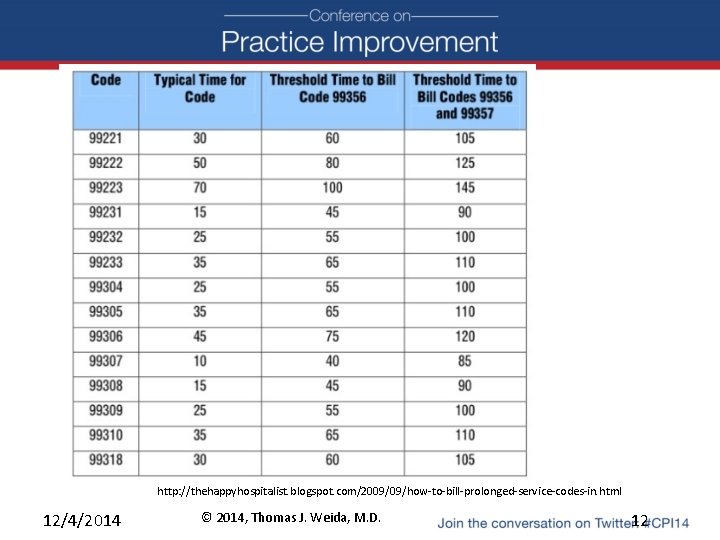
Prolonged Physician Service with Direct Patient Contact, Inpatient • • Does not have to be continuous time CPT: face-to-face and on unit Medicare: face-to-face Use with E&M code which has average time listed < 30 min: NO Code 30 -74 min: 99356 X 1 75 -104 min: 99356 X 1 and 99357 >105 min: 99356 X 1 and 99357 X 2 or more for each additional 30 min (must be greater than 15 min additional for each use of 99357) • Document time 12/4/2014 © 2014, Thomas J. Weida, M. D. 11
http: //thehappyhospitalist. blogspot. com/2009/09/how-to-bill-prolonged-service-codes-in. html 12/4/2014 © 2014, Thomas J. Weida, M. D. 12
99356 Example • 34 - year old primigravida presents to hospital in early labor. Patient has severe preeclampsia. Physician supervises management of preeclampsia, IV magnesium, labor augmentation with pitocin and close maternal-fetal monitoring. Physician face-to-face involvement includes 40 minutes of continuous bedside care until the patient is stable, then is intermittent over several hours until the delivery. 12/4/2014 © 2014, Thomas J. Weida, M. D. 13
Observation Care Discharge Services: 99217 • Discharge on separate day than admission from observation status • Cannot use 9922499226 and 99217 for service on the same day. 12/4/2014 © 2014, Thomas J. Weida, M. D. 14