
CPSC 422 Lecture 2 Review of Bayesian Networks
CPSC 422 Lecture 2 Review of Bayesian Networks, Representational Issues
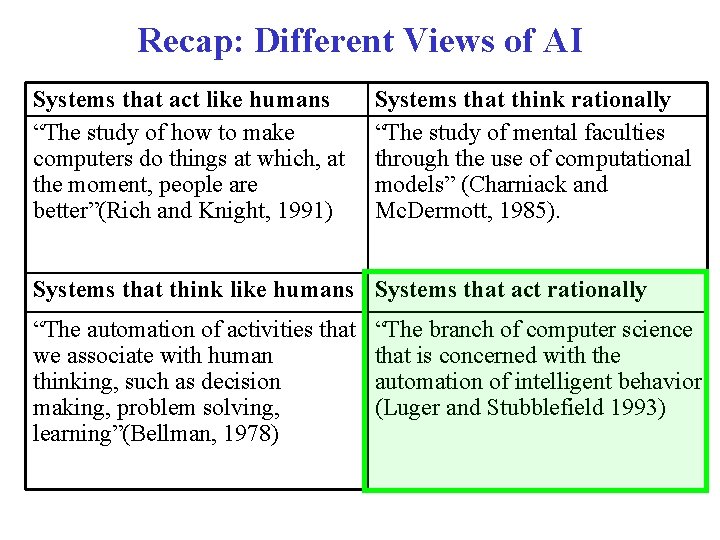
Recap: Different Views of AI Systems that act like humans “The study of how to make computers do things at which, at the moment, people are better”(Rich and Knight, 1991) Systems that think rationally “The study of mental faculties through the use of computational models” (Charniack and Mc. Dermott, 1985). Systems that think like humans Systems that act rationally “The automation of activities that we associate with human thinking, such as decision making, problem solving, learning”(Bellman, 1978) “The branch of computer science that is concerned with the automation of intelligent behavior (Luger and Stubblefield 1993)
Recap: Our View. AI as Study and Design of Intelligent Agents • An intelligent agent is such that • Its actions are appropriate for its goals and circumstances • It is flexible to changing environments and goals • It learns from experience • It makes appropriate choices given perceptual limitations and limited resources • This definition drops the constraint of cognitive plausibility (“think like a human) • Same as building flying machines by understanding general principles of flying (aerodynamic) vs. by reproducing how birds fly • Normative vs. Descriptive theories of Intelligent Behavior • What is the relation with the “act like a human” view?
Recap: Intelligent Agents • artificial agents that have a physical presence in the world are usually known as Robots • Another class of artificial agents include interface agents, for either stand alone or Web-based applications • intelligent desktop assistants, recommender systems, intelligent tutoring systems • We will focus on these agents in this course
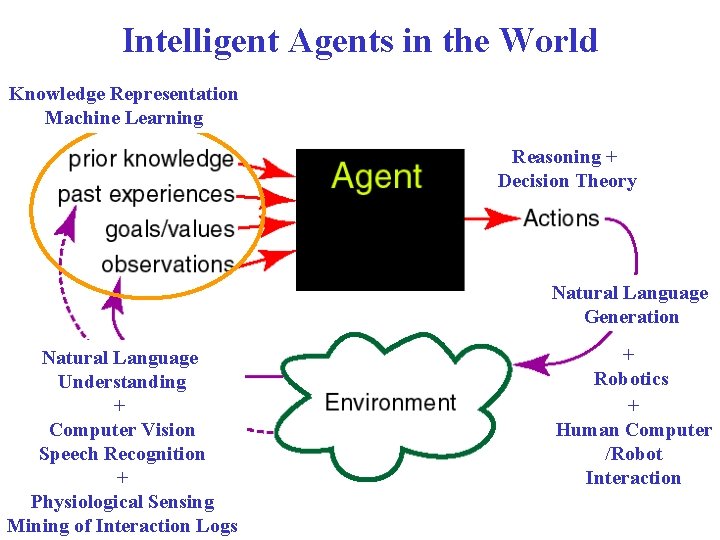
Intelligent Agents in the World Knowledge Representation Machine Learning Reasoning + Decision Theory Natural Language Generation Natural Language Understanding + Computer Vision Speech Recognition + Physiological Sensing Mining of Interaction Logs + Robotics + Human Computer /Robot Interaction
Recap: Course Overview • Reasoning under uncertainty: • Bayesian networks: brief review, approximate inference, an application • Probability and Time: algorithms, Hidden Markov Models and Dynamic Bayesian Networks • Decision Making: planning under uncertainty • Markov Decision Processes: Value and Policy Iteration • Partially Observable Markov Decision Processes (POMDP) • Learning • Decision Trees, Neural Networks, Learning Bayesian Networks, Reinforcement Learning • Knowledge Representation and Reasoning • Semantic Nets, Ontologies and the Semantic Web
Lecture 2 Review of Bayesian Networks, Representational Issues
What we will review/learn in this module • What Bayesian networks are, and their advantages with respect to using joint probability distributions for performing probabilistic inference • The semantics of Bayesian network. • A procedure to define the structure of the network that maintains this semantics • How to compare alternative network structures for the same domain, and how to chose a suitable one • How to evaluate indirect conditional dependencies among variables in a network • What is the Noisy-Or distribution and why it is useful in Bayesian networks
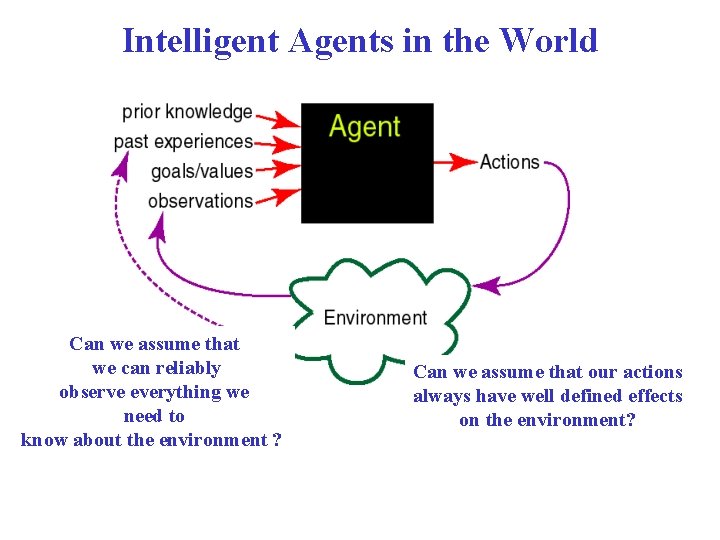
Intelligent Agents in the World Can we assume that we can reliably observe everything we need to know about the environment ? Can we assume that our actions always have well defined effects on the environment?
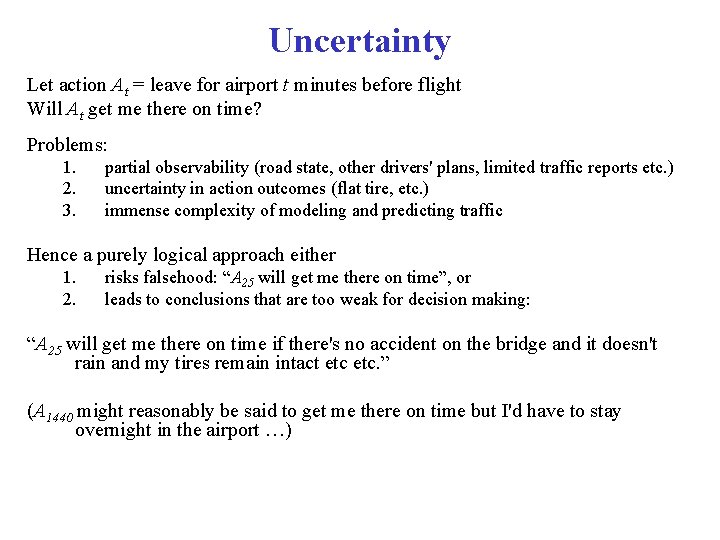
Uncertainty Let action At = leave for airport t minutes before flight Will At get me there on time? Problems: 1. 2. 3. partial observability (road state, other drivers' plans, limited traffic reports etc. ) uncertainty in action outcomes (flat tire, etc. ) immense complexity of modeling and predicting traffic Hence a purely logical approach either 1. 2. risks falsehood: “A 25 will get me there on time”, or leads to conclusions that are too weak for decision making: “A 25 will get me there on time if there's no accident on the bridge and it doesn't rain and my tires remain intact etc. ” (A 1440 might reasonably be said to get me there on time but I'd have to stay overnight in the airport …)
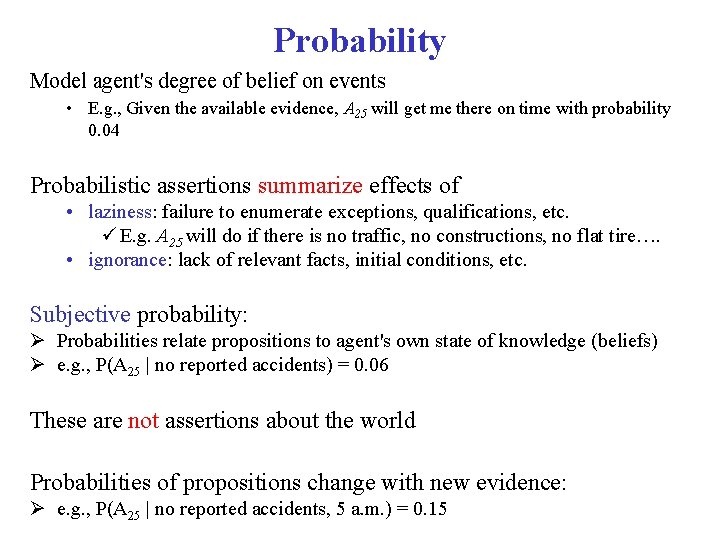
Probability Model agent's degree of belief on events • E. g. , Given the available evidence, A 25 will get me there on time with probability 0. 04 Probabilistic assertions summarize effects of • laziness: failure to enumerate exceptions, qualifications, etc. ü E. g. A 25 will do if there is no traffic, no constructions, no flat tire…. • ignorance: lack of relevant facts, initial conditions, etc. Subjective probability: Ø Probabilities relate propositions to agent's own state of knowledge (beliefs) Ø e. g. , P(A 25 | no reported accidents) = 0. 06 These are not assertions about the world Probabilities of propositions change with new evidence: Ø e. g. , P(A 25 | no reported accidents, 5 a. m. ) = 0. 15
Probability theory Ø System of axioms and formal operations for sound reasoning under uncertainty Ø Basic element: random variable, with a set of possible values (domain) Ø You must be familiar with the basic concepts of probability theory. See Ch. 13 in textbook and review slides posted in the schedule
Bayesian networks Ø A simple, graphical notation for conditional independence assertions and hence for compact specification of full joint distributions Ø Syntax: • a set of nodes, one per variable • a directed, acyclic graph (link ≈ "directly influences") • a conditional probability distribution for each node given its parents: P (Xi | Parents (Xi)) Ø In the simplest case, conditional distribution represented as a conditional probability table (CPT) giving the distribution over Xi for each combination of parent values
Example Ø I have an anti-burglair alarm in my house Ø I have an agreement with two of my neighbors, John and Mary, that they call me if they hear the alarm go off when I am at work Ø Sometime they call me at work for other reasons Ø Sometimes the alarm is set off by minor earthquakes. Ø Variables: Burglary (B), Earthquake (E), Alarm (A), John. Calls (J), Mary. Calls (M) Ø One possible network topology reflects "causal" knowledge: • • A burglary can set the alarm off An earthquake can set the alarm off The alarm can cause Mary to call The alarm can cause John to call
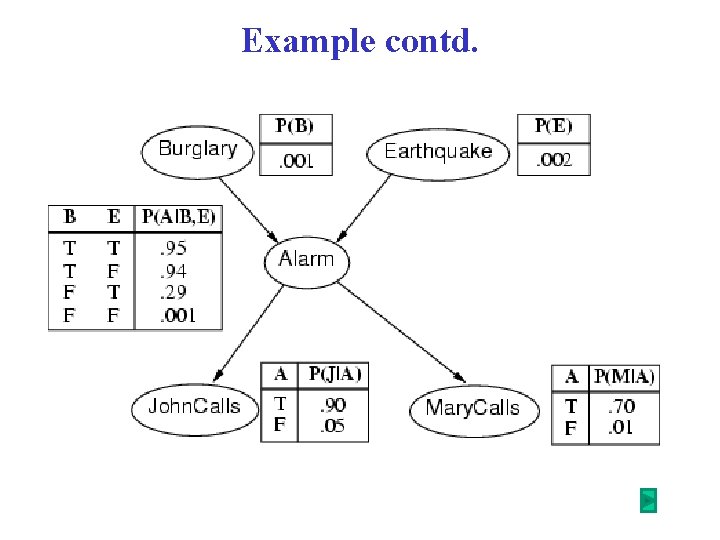
Example contd.
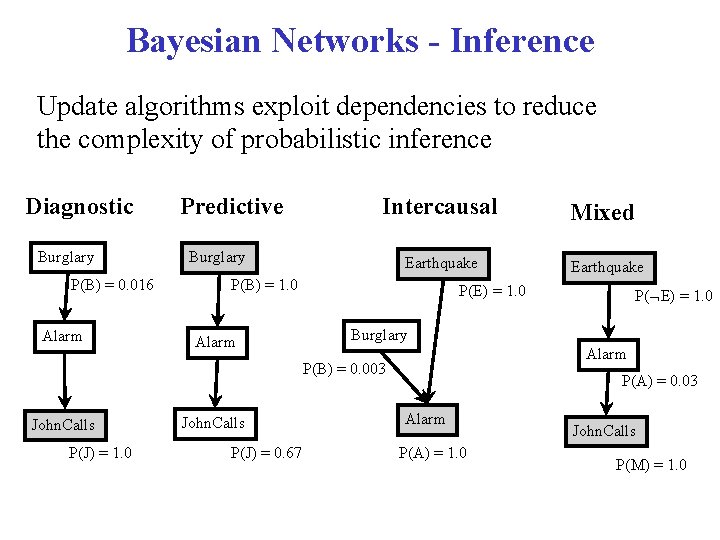
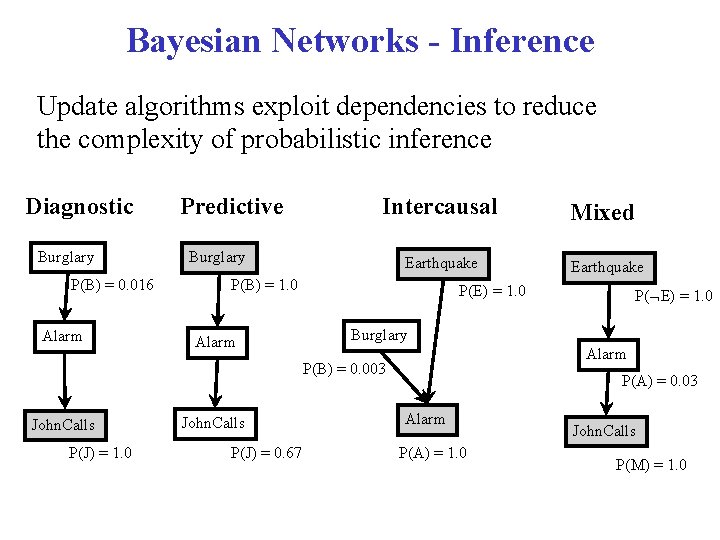
Bayesian Networks - Inference Update algorithms exploit dependencies to reduce the complexity of probabilistic inference Diagnostic Burglary P(B) = 0. 016 Alarm Predictive Intercausal Burglary Earthquake P(B) = 1. 0 Alarm P(J) = 1. 0 John. Calls P(J) = 0. 67 Earthquake P(E) = 1. 0 P( E) = 1. 0 Burglary Alarm P(B) = 0. 003 John. Calls Mixed P(A) = 0. 03 Alarm P(A) = 1. 0 John. Calls P(M) = 1. 0
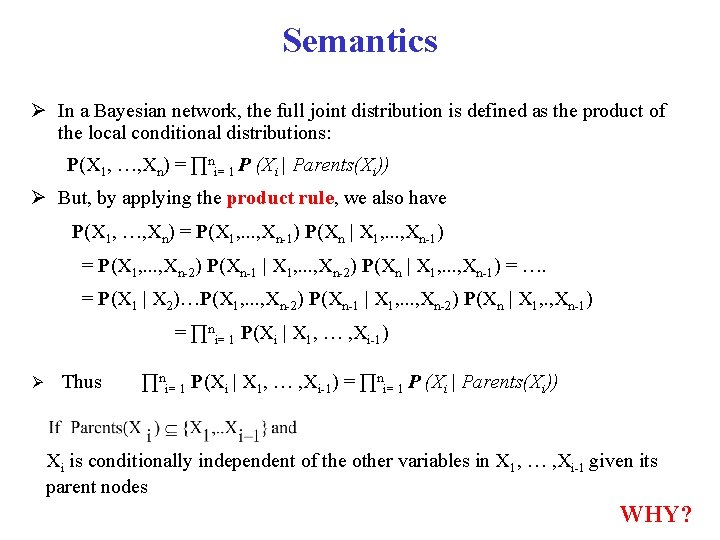
Semantics Ø In a Bayesian network, the full joint distribution is defined as the product of the local conditional distributions: P(X 1, …, Xn) = ∏ni= 1 P (Xi | Parents(Xi)) Ø But, by applying the product rule, we also have P(X 1, …, Xn) = P(X 1, . . . , Xn-1) P(Xn | X 1, . . . , Xn-1) = P(X 1, . . . , Xn-2) P(Xn-1 | X 1, . . . , Xn-2) P(Xn | X 1, . . . , Xn-1) = …. = P(X 1 | X 2)…P(X 1, . . . , Xn-2) P(Xn-1 | X 1, . . . , Xn-2) P(Xn | X 1, . , Xn-1) = ∏ni= 1 P(Xi | X 1, … , Xi-1) Ø Thus ∏ni= 1 P(Xi | X 1, … , Xi-1) = ∏ni= 1 P (Xi | Parents(Xi)) Xi is conditionally independent of the other variables in X 1, … , Xi-1 given its parent nodes WHY?
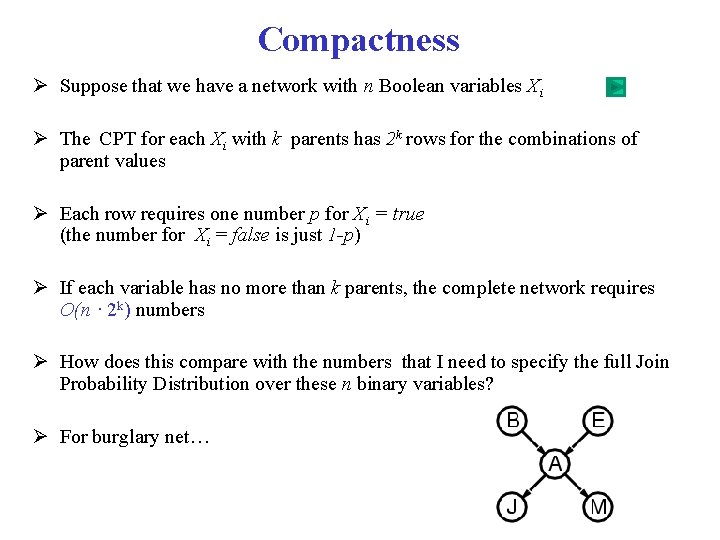
Compactness Ø Suppose that we have a network with n Boolean variables Xi Ø The CPT for each Xi with k parents has 2 k rows for the combinations of parent values Ø Each row requires one number p for Xi = true (the number for Xi = false is just 1 -p) Ø If each variable has no more than k parents, the complete network requires O(n · 2 k) numbers Ø How does this compare with the numbers that I need to specify the full Join Probability Distribution over these n binary variables? Ø For burglary net…
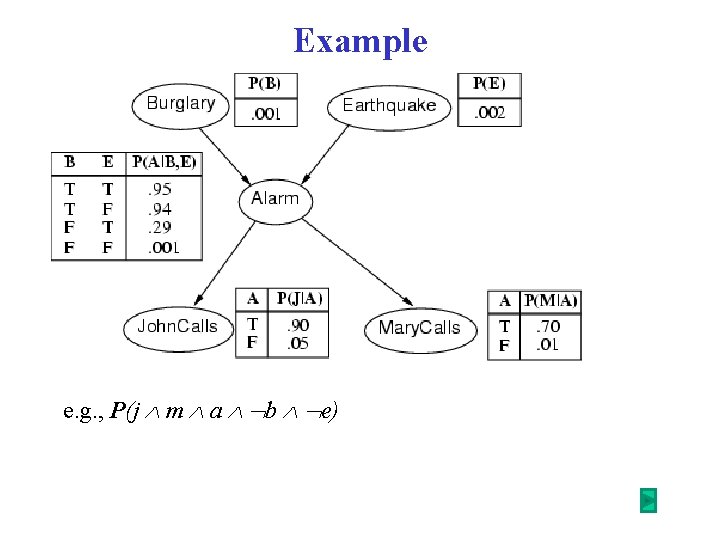
Example e. g. , P(j m a b e)
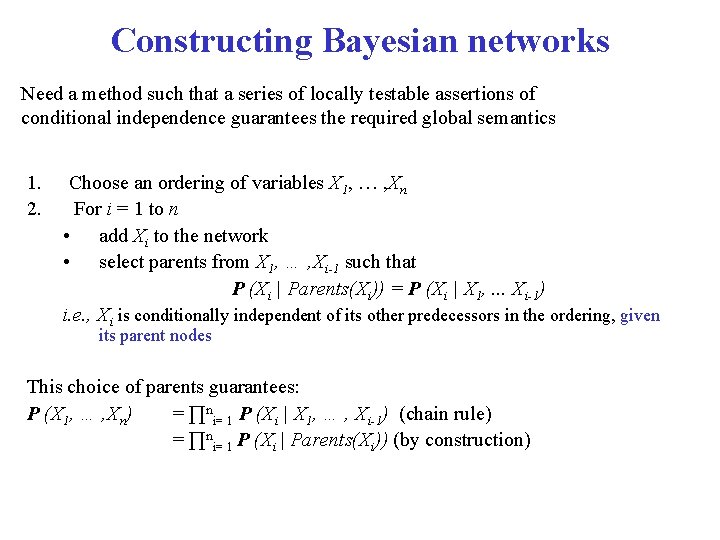
Constructing Bayesian networks Need a method such that a series of locally testable assertions of conditional independence guarantees the required global semantics 1. 2. Choose an ordering of variables X 1, … , Xn For i = 1 to n • add Xi to the network • select parents from X 1, … , Xi-1 such that P (Xi | Parents(Xi)) = P (Xi | X 1, . . . Xi-1) i. e. , Xi is conditionally independent of its other predecessors in the ordering, given its parent nodes This choice of parents guarantees: P (X 1, … , Xn) = ∏ni= 1 P (Xi | X 1, … , Xi-1) (chain rule) = ∏ni= 1 P (Xi | Parents(Xi)) (by construction)
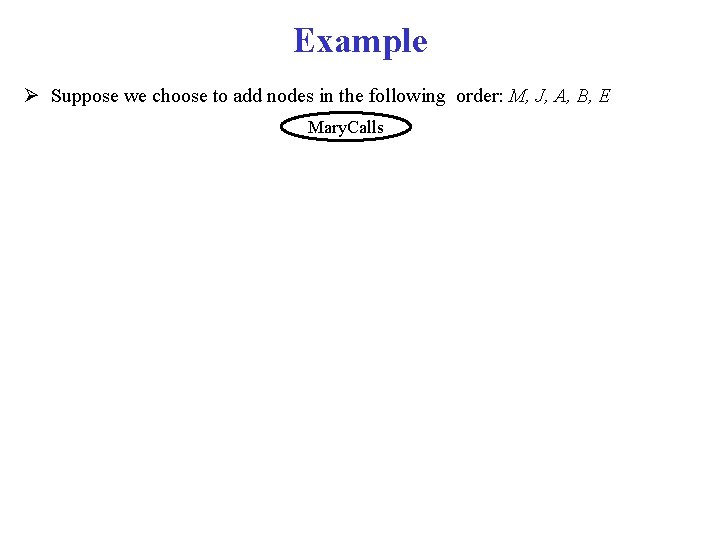
Example Ø Suppose we choose to add nodes in the following order: M, J, A, B, E Mary. Calls
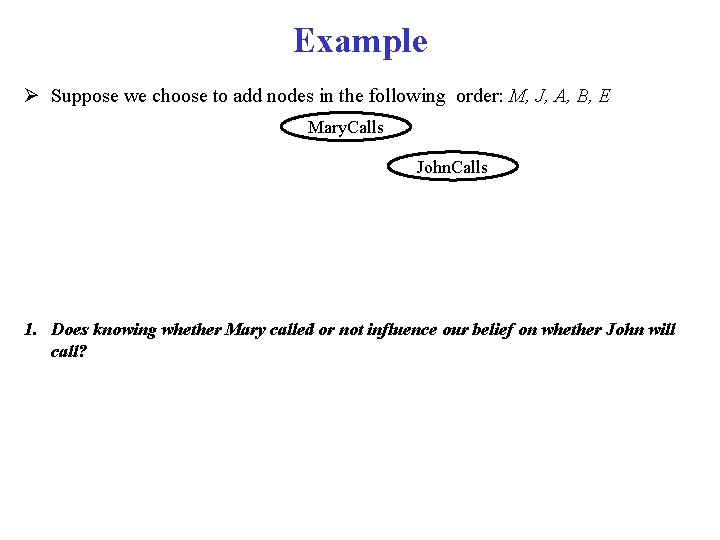
Example Ø Suppose we choose to add nodes in the following order: M, J, A, B, E Mary. Calls John. Calls 1. Does knowing whether Mary called or not influence our belief on whether John will call?
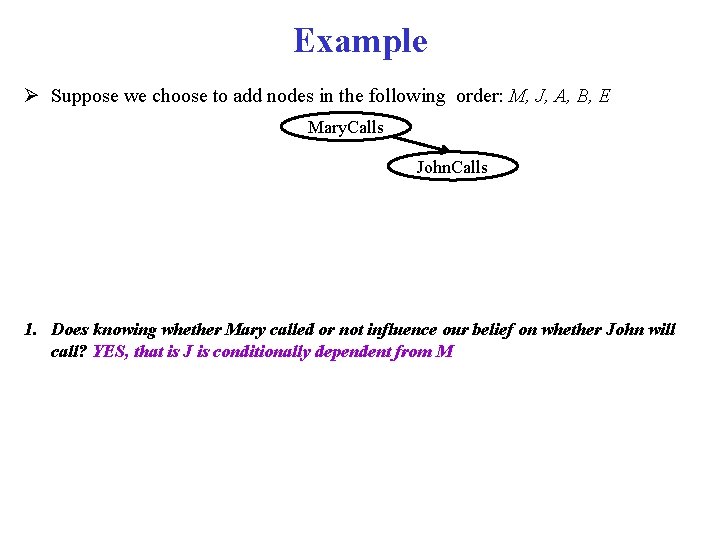
Example Ø Suppose we choose to add nodes in the following order: M, J, A, B, E Mary. Calls John. Calls 1. Does knowing whether Mary called or not influence our belief on whether John will call? YES, that is J is conditionally dependent from M
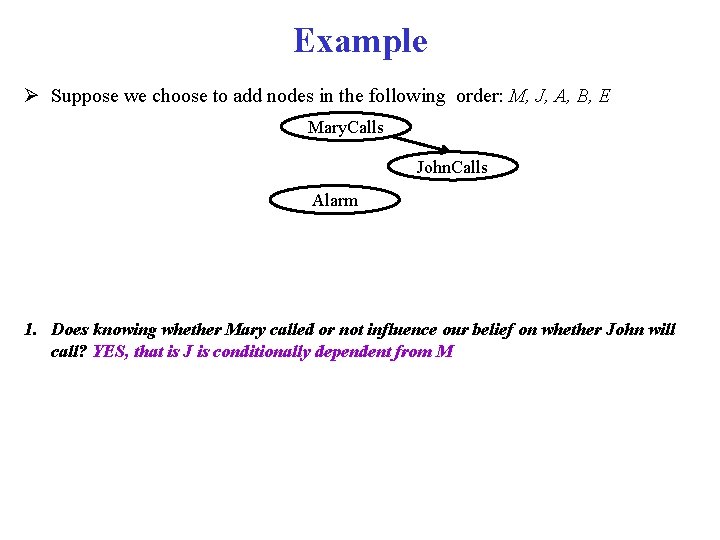
Example Ø Suppose we choose to add nodes in the following order: M, J, A, B, E Mary. Calls John. Calls Alarm 1. Does knowing whether Mary called or not influence our belief on whether John will call? YES, that is J is conditionally dependent from M
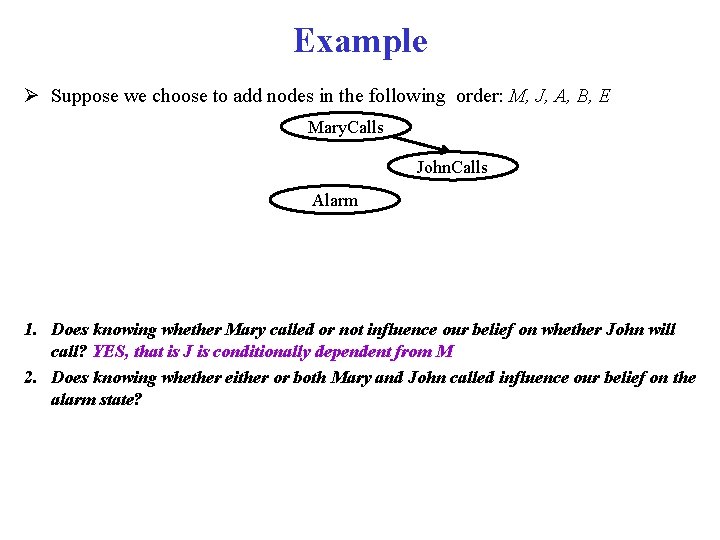
Example Ø Suppose we choose to add nodes in the following order: M, J, A, B, E Mary. Calls John. Calls Alarm 1. Does knowing whether Mary called or not influence our belief on whether John will call? YES, that is J is conditionally dependent from M 2. Does knowing whether either or both Mary and John called influence our belief on the alarm state?
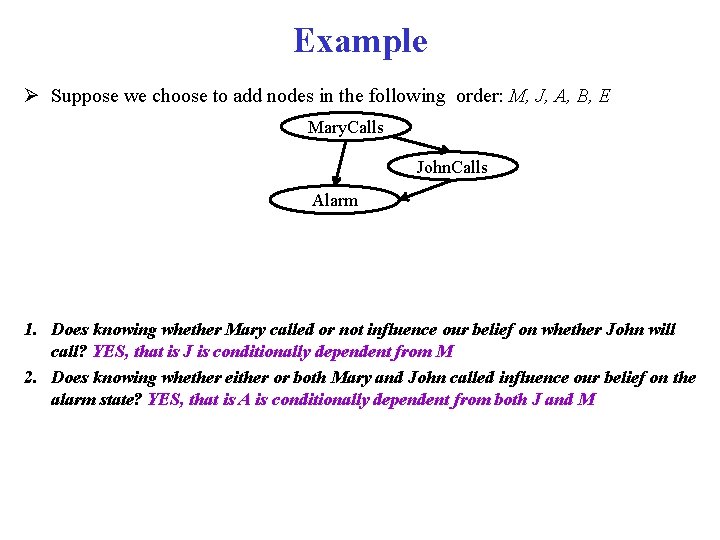
Example Ø Suppose we choose to add nodes in the following order: M, J, A, B, E Mary. Calls John. Calls Alarm 1. Does knowing whether Mary called or not influence our belief on whether John will call? YES, that is J is conditionally dependent from M 2. Does knowing whether either or both Mary and John called influence our belief on the alarm state? YES, that is A is conditionally dependent from both J and M
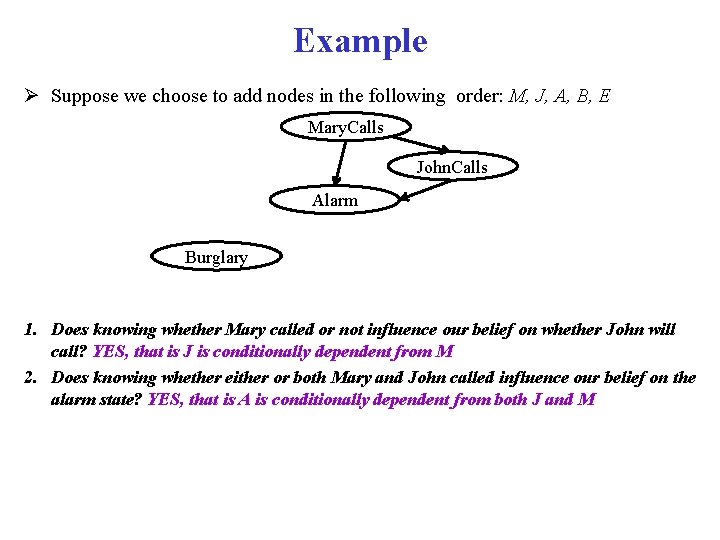
Example Ø Suppose we choose to add nodes in the following order: M, J, A, B, E Mary. Calls John. Calls Alarm Burglary 1. Does knowing whether Mary called or not influence our belief on whether John will call? YES, that is J is conditionally dependent from M 2. Does knowing whether either or both Mary and John called influence our belief on the alarm state? YES, that is A is conditionally dependent from both J and M
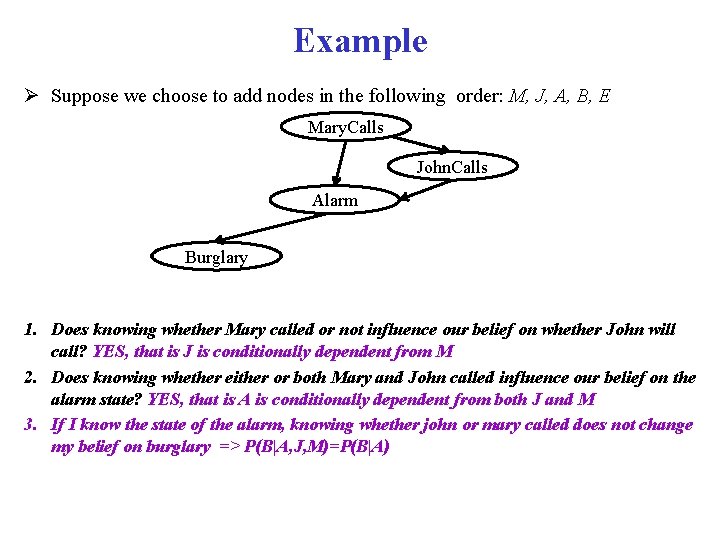
Example Ø Suppose we choose to add nodes in the following order: M, J, A, B, E Mary. Calls John. Calls Alarm Burglary 1. Does knowing whether Mary called or not influence our belief on whether John will call? YES, that is J is conditionally dependent from M 2. Does knowing whether either or both Mary and John called influence our belief on the alarm state? YES, that is A is conditionally dependent from both J and M 3. If I know the state of the alarm, knowing whether john or mary called does not change my belief on burglary => P(B|A, J, M)=P(B|A)
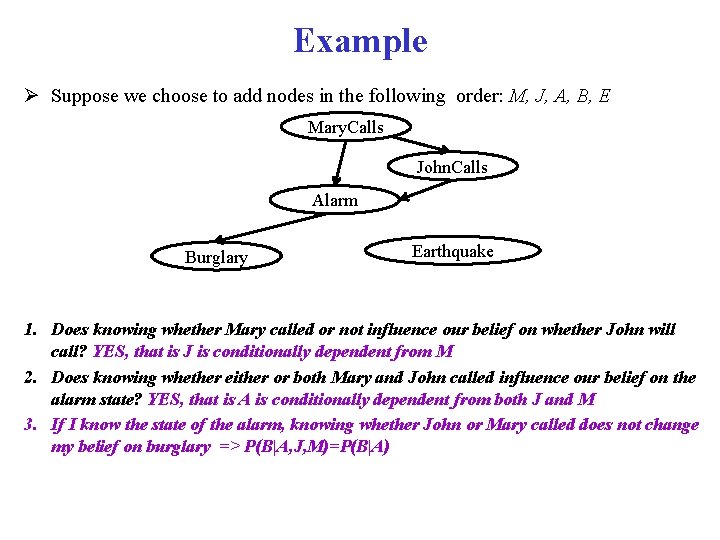
Example Ø Suppose we choose to add nodes in the following order: M, J, A, B, E Mary. Calls John. Calls Alarm Burglary Earthquake 1. Does knowing whether Mary called or not influence our belief on whether John will call? YES, that is J is conditionally dependent from M 2. Does knowing whether either or both Mary and John called influence our belief on the alarm state? YES, that is A is conditionally dependent from both J and M 3. If I know the state of the alarm, knowing whether John or Mary called does not change my belief on burglary => P(B|A, J, M)=P(B|A)
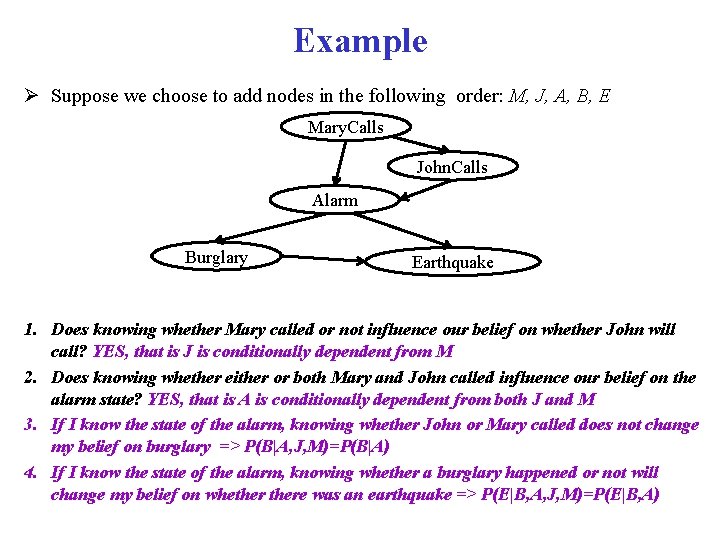
Example Ø Suppose we choose to add nodes in the following order: M, J, A, B, E Mary. Calls John. Calls Alarm Burglary Earthquake 1. Does knowing whether Mary called or not influence our belief on whether John will call? YES, that is J is conditionally dependent from M 2. Does knowing whether either or both Mary and John called influence our belief on the alarm state? YES, that is A is conditionally dependent from both J and M 3. If I know the state of the alarm, knowing whether John or Mary called does not change my belief on burglary => P(B|A, J, M)=P(B|A) 4. If I know the state of the alarm, knowing whether a burglary happened or not will change my belief on whethere was an earthquake => P(E|B, A, J, M)=P(E|B, A)
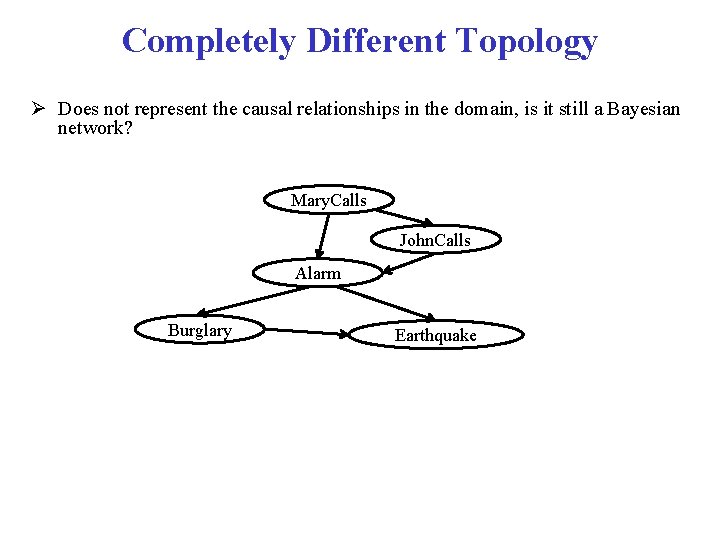
Completely Different Topology Ø Does not represent the causal relationships in the domain, is it still a Bayesian network? Mary. Calls John. Calls Alarm Burglary Earthquake
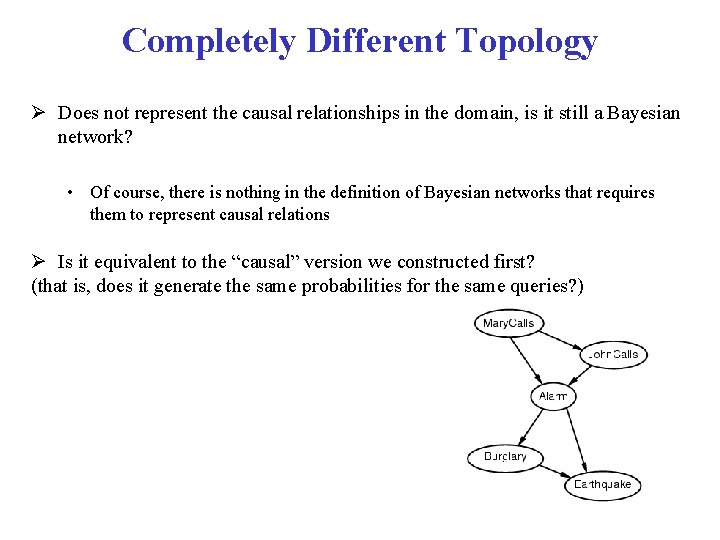
Completely Different Topology Ø Does not represent the causal relationships in the domain, is it still a Bayesian network? • Of course, there is nothing in the definition of Bayesian networks that requires them to represent causal relations Ø Is it equivalent to the “causal” version we constructed first? (that is, does it generate the same probabilities for the same queries? )
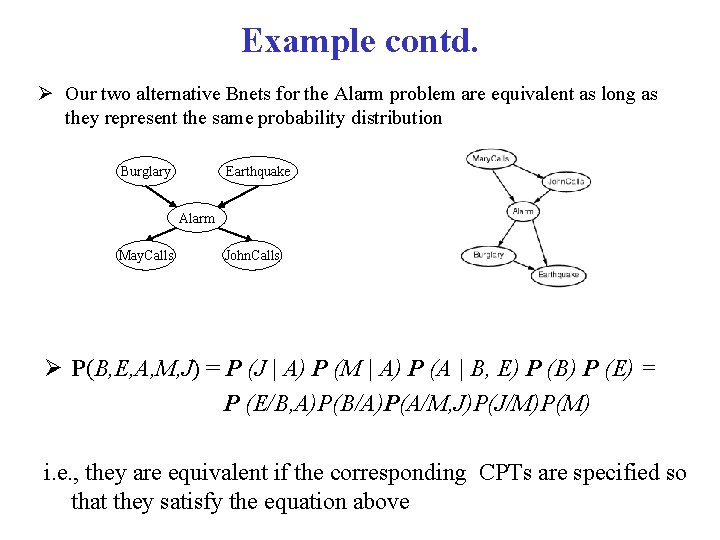
Example contd. Ø Our two alternative Bnets for the Alarm problem are equivalent as long as they represent the same probability distribution Earthquake Burglary Alarm May. Calls John. Calls Ø P(B, E, A, M, J) = P (J | A) P (M | A) P (A | B, E) P (B) P (E) = P (E/B, A)P(B/A)P(A/M, J)P(J/M)P(M) i. e. , they are equivalent if the corresponding CPTs are specified so that they satisfy the equation above
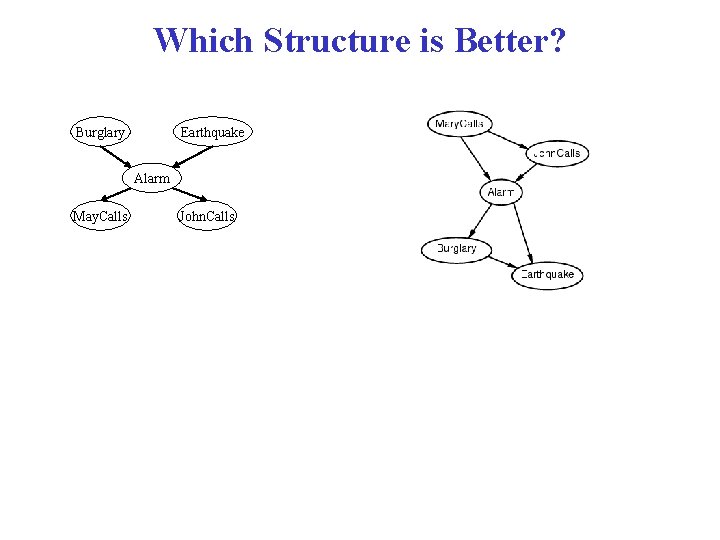
Which Structure is Better? Earthquake Burglary Alarm May. Calls John. Calls
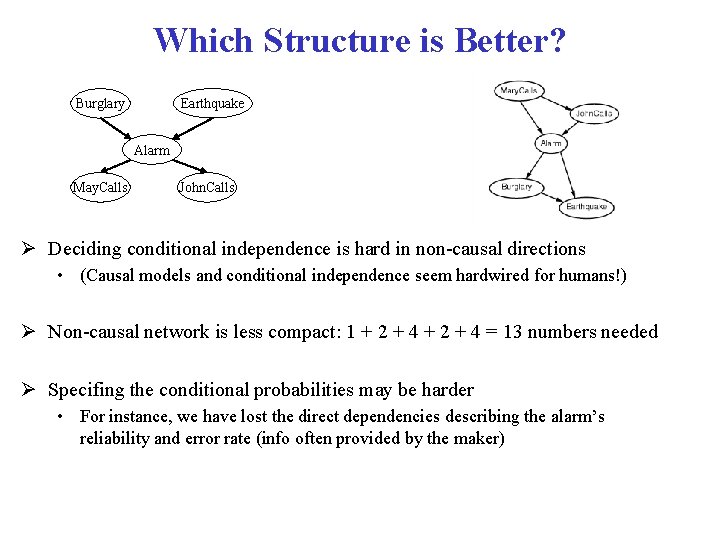
Which Structure is Better? Earthquake Burglary Alarm May. Calls John. Calls Ø Deciding conditional independence is hard in non-causal directions • (Causal models and conditional independence seem hardwired for humans!) Ø Non-causal network is less compact: 1 + 2 + 4 = 13 numbers needed Ø Specifing the conditional probabilities may be harder • For instance, we have lost the direct dependencies describing the alarm’s reliability and error rate (info often provided by the maker)
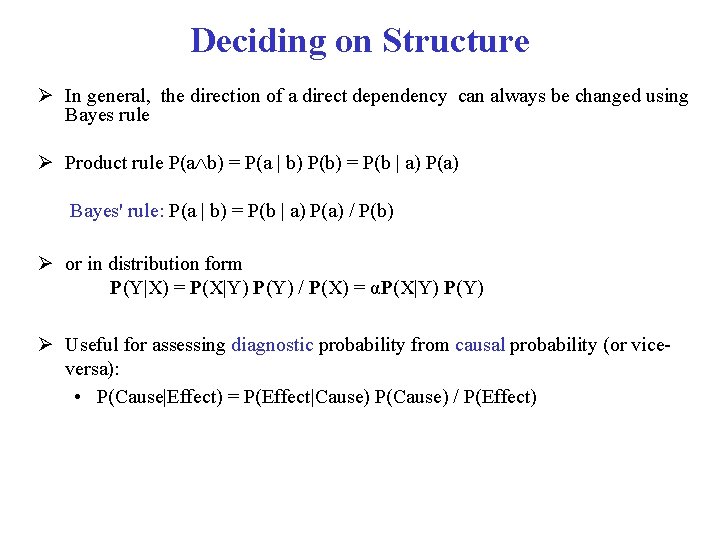
Deciding on Structure Ø In general, the direction of a direct dependency can always be changed using Bayes rule Ø Product rule P(a b) = P(a | b) P(b) = P(b | a) P(a) Bayes' rule: P(a | b) = P(b | a) P(a) / P(b) Ø or in distribution form P(Y|X) = P(X|Y) P(Y) / P(X) = αP(X|Y) P(Y) Ø Useful for assessing diagnostic probability from causal probability (or viceversa): • P(Cause|Effect) = P(Effect|Cause) P(Cause) / P(Effect)
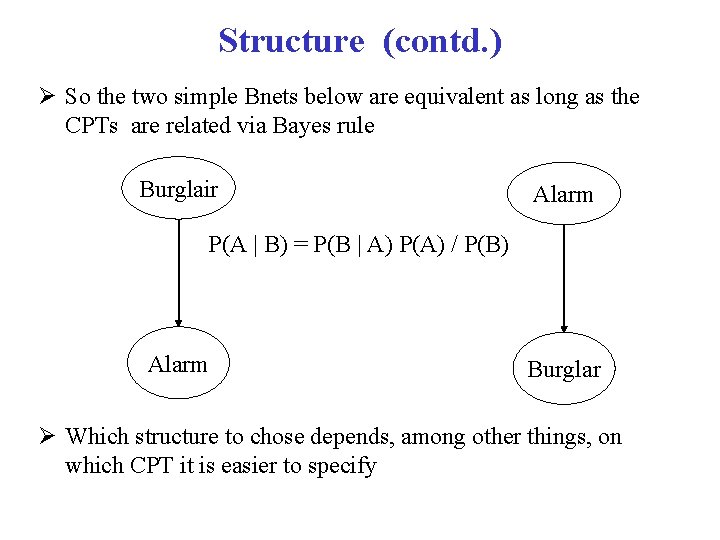
Structure (contd. ) Ø So the two simple Bnets below are equivalent as long as the CPTs are related via Bayes rule Burglair Alarm P(A | B) = P(B | A) P(A) / P(B) Alarm Burglar Ø Which structure to chose depends, among other things, on which CPT it is easier to specify
Stucture (contd. ) Ø CPTs for causal relationships represent knowledge of the mechanims underlying the process of interest. • e. g. how an alarm works, why a disease generates certain symptoms Ø CPTs for diagnostic relations can be defined only based on past observations. Ø E. g. , let m be meningitis, s be stiff neck: P(m|s) = P(s|m) P(m) / P(s) • P(s|m) can be defined based on medical knowledge on the workings of meningitis • P(m|s) requires statistics on how often the symptom of stiff neck appears in conjuction with meningities. What is the main problem here?
Stucture (contd. ) Ø Another factor that should be taken into account when deciding on the structure of a Bnet is the types of dependencies that it represents Ø Let’s review the basics
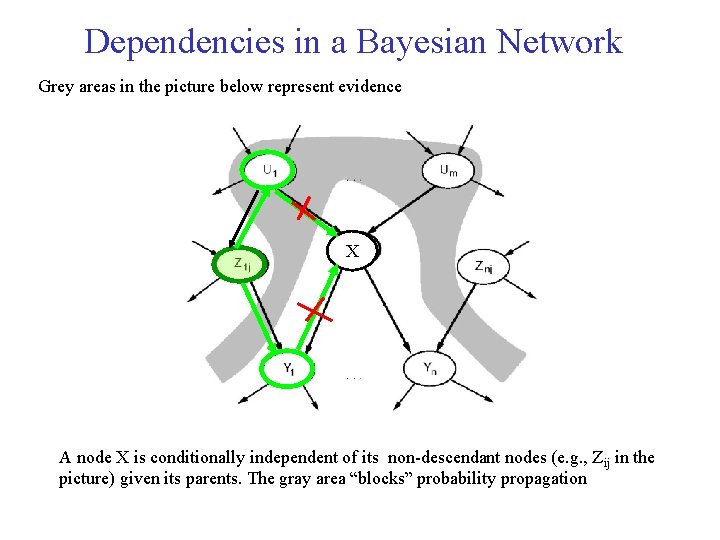
Dependencies in a Bayesian Network Grey areas in the picture below represent evidence X A node X is conditionally independent of its non-descendant nodes (e. g. , Zij in the picture) given its parents. The gray area “blocks” probability propagation
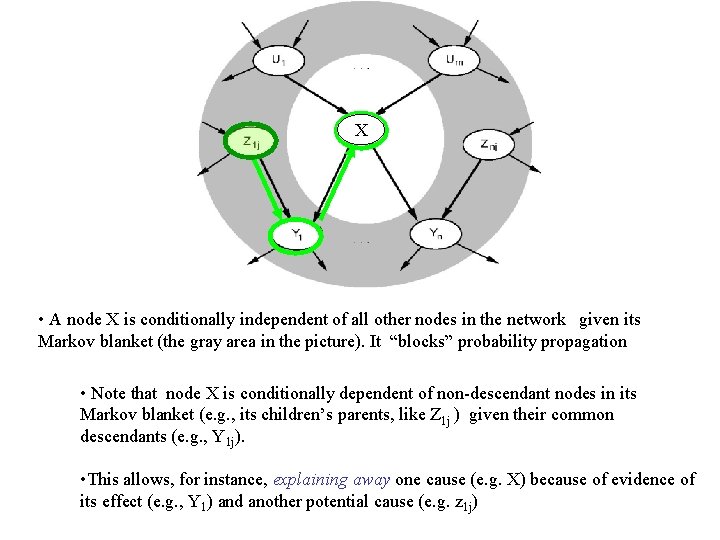
X • A node X is conditionally independent of all other nodes in the network given its Markov blanket (the gray area in the picture). It “blocks” probability propagation • Note that node X is conditionally dependent of non-descendant nodes in its Markov blanket (e. g. , its children’s parents, like Z 1 j ) given their common descendants (e. g. , Y 1 j). • This allows, for instance, explaining away one cause (e. g. X) because of evidence of its effect (e. g. , Y 1) and another potential cause (e. g. z 1 j)
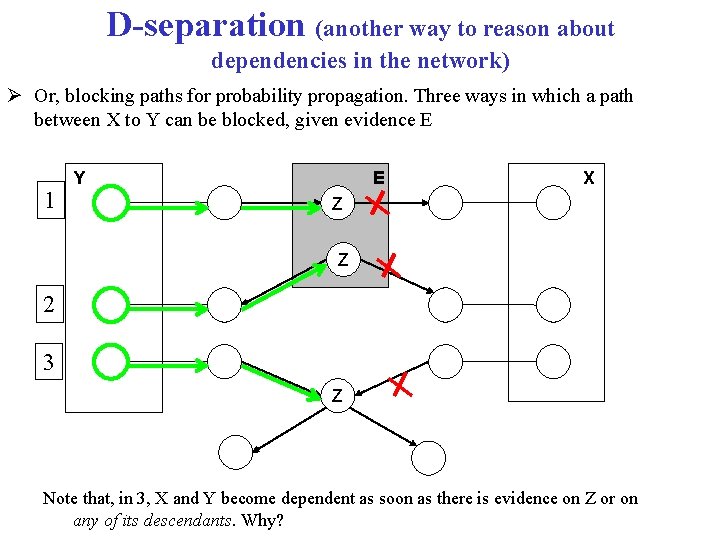
D-separation (another way to reason about dependencies in the network) Ø Or, blocking paths for probability propagation. Three ways in which a path between X to Y can be blocked, given evidence E 1 Y E X Z Z 2 3 Z Note that, in 3, X and Y become dependent as soon as there is evidence on Z or on any of its descendants. Why?
What does this means in terms of choosing structure? Ø That you need to double check the appropriateness of the indirect dependencies/independencies generated by your chosen structures Ø Example: representing a domain for an intelligent system that acts as a tutor (aka Intelligent Tutoring System) • Topics divided in sub-topics • Student knowledge of a topic depends on student knowledge of its subtopics • We can never observe student knowledge directly, we can only observe it indirectly via student test answers
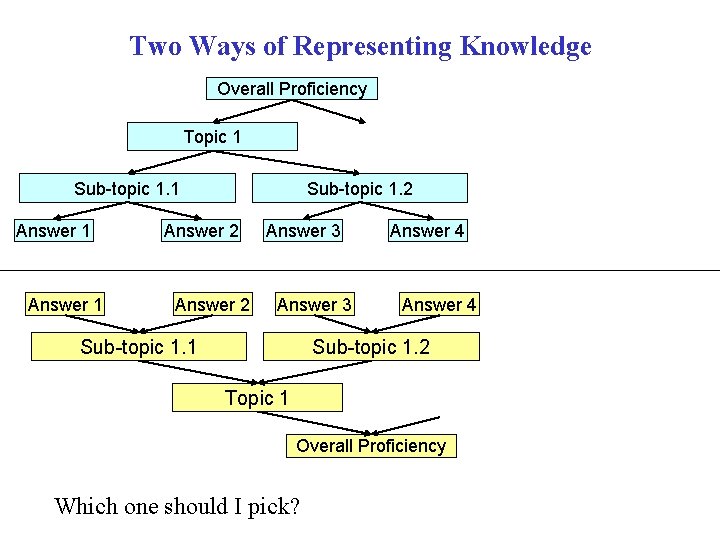
Two Ways of Representing Knowledge Overall Proficiency Topic 1 Sub-topic 1. 1 Answer 1 Sub-topic 1. 2 Answer 3 Sub-topic 1. 1 Answer 4 Sub-topic 1. 2 Topic 1 Overall Proficiency Which one should I pick?
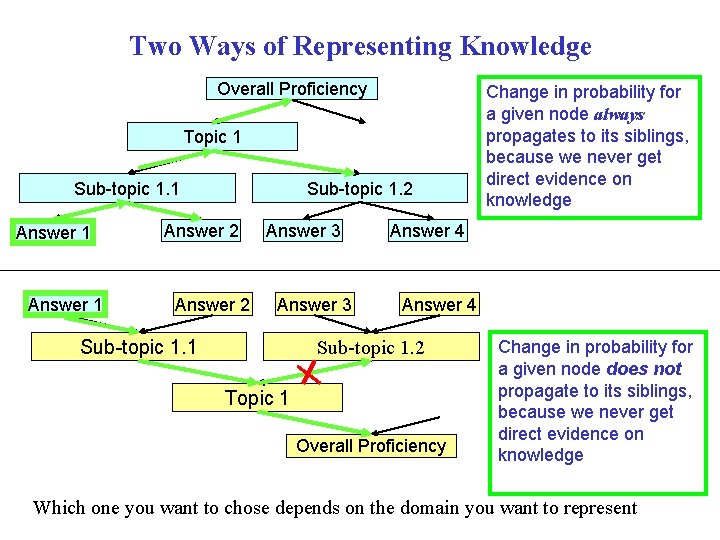
Two Ways of Representing Knowledge Overall Proficiency Topic 1 Sub-topic 1. 1 Answer 1 Sub-topic 1. 2 Answer 3 Sub-topic 1. 1 Change in probability for a given node always propagates to its siblings, because we never get direct evidence on knowledge Answer 4 Sub-topic 1. 2 Topic 1 Overall Proficiency Change in probability for a given node does not propagate to its siblings, because we never get direct evidence on knowledge Which one you want to chose depends on the domain you want to represent
Test your understandings of dependencies in a Bnet Ø Use the AISpace (http: //www. aispace. org/main. Applets. shtml) applet for Belief and Decision networks (http: //www. aispace. org/bayes/index. shtml) Ø Load the “conditional independence quiz” network Ø Go in “Solve” mode and select “Independence Quiz”
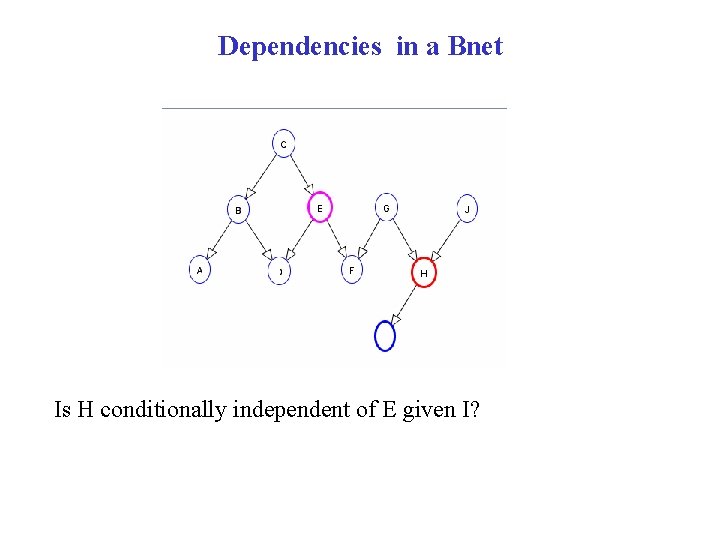
Dependencies in a Bnet Is H conditionally independent of E given I?
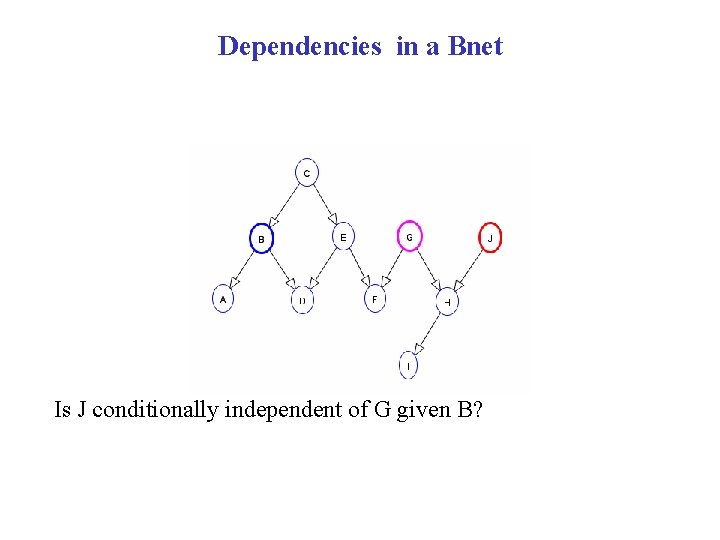
Dependencies in a Bnet Is J conditionally independent of G given B?
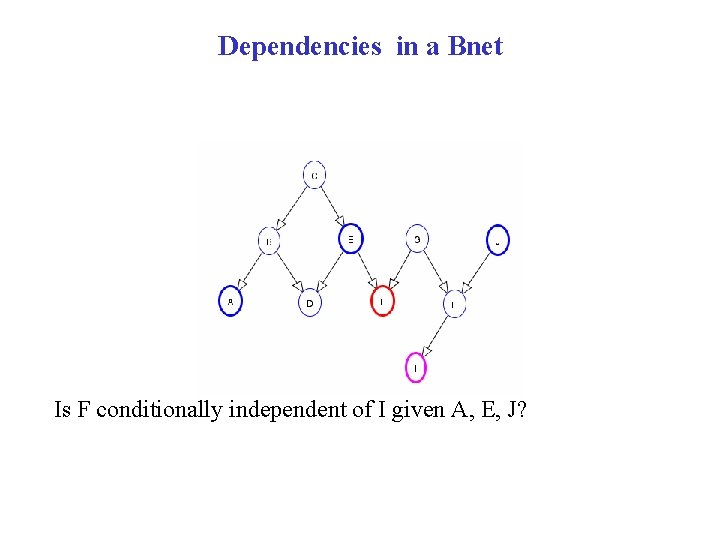
Dependencies in a Bnet Is F conditionally independent of I given A, E, J?
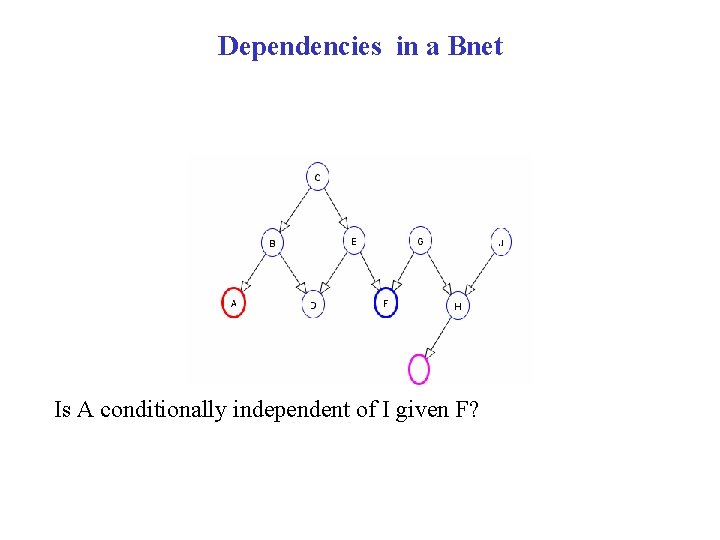
Dependencies in a Bnet Is A conditionally independent of I given F?
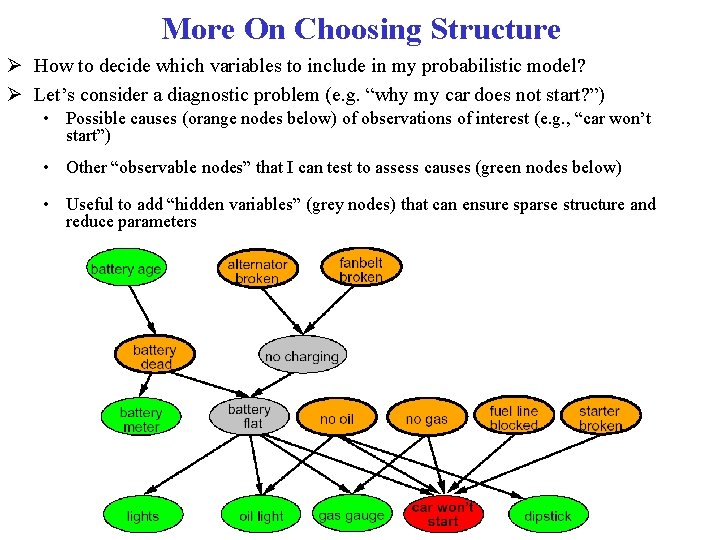
More On Choosing Structure Ø How to decide which variables to include in my probabilistic model? Ø Let’s consider a diagnostic problem (e. g. “why my car does not start? ”) • Possible causes (orange nodes below) of observations of interest (e. g. , “car won’t start”) • Other “observable nodes” that I can test to assess causes (green nodes below) • Useful to add “hidden variables” (grey nodes) that can ensure sparse structure and reduce parameters
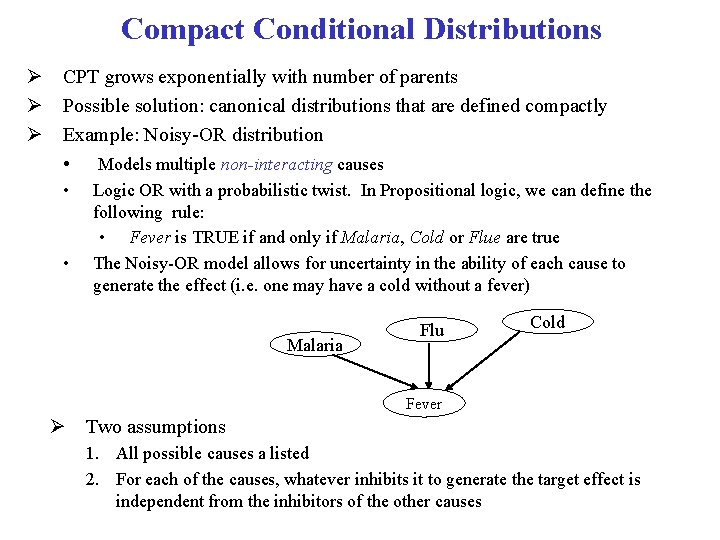
Compact Conditional Distributions Ø CPT grows exponentially with number of parents Ø Possible solution: canonical distributions that are defined compactly Ø Example: Noisy-OR distribution • Models multiple non-interacting causes • • Logic OR with a probabilistic twist. In Propositional logic, we can define the following rule: • Fever is TRUE if and only if Malaria, Cold or Flue are true The Noisy-OR model allows for uncertainty in the ability of each cause to generate the effect (i. e. one may have a cold without a fever) Malaria Flu Cold Fever Ø Two assumptions 1. All possible causes a listed 2. For each of the causes, whatever inhibits it to generate the target effect is independent from the inhibitors of the other causes
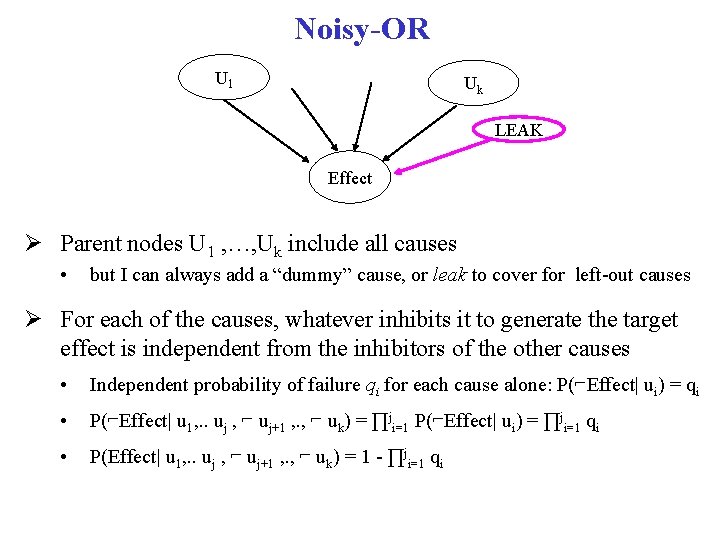
Noisy-OR U 1 Uk LEAK Effect Ø Parent nodes U 1 , …, Uk include all causes • but I can always add a “dummy” cause, or leak to cover for left-out causes Ø For each of the causes, whatever inhibits it to generate the target effect is independent from the inhibitors of the other causes • Independent probability of failure qi for each cause alone: P(⌐Effect| ui) = qi • P(⌐Effect| u 1, . . uj , ⌐ uj+1 , . , ⌐ uk) = ∏ji=1 P(⌐Effect| ui) = ∏ji=1 qi • P(Effect| u 1, . . uj , ⌐ uj+1 , . , ⌐ uk) = 1 - ∏ji=1 qi
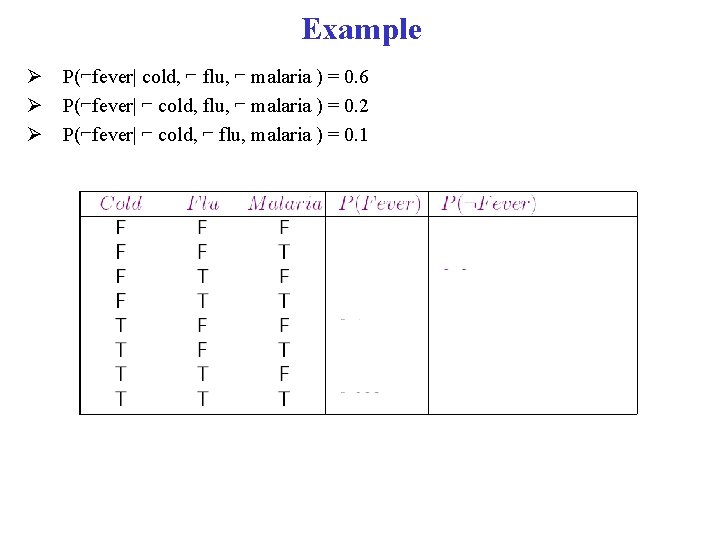
Example Ø P(⌐fever| cold, ⌐ flu, ⌐ malaria ) = 0. 6 Ø P(⌐fever| ⌐ cold, flu, ⌐ malaria ) = 0. 2 Ø P(⌐fever| ⌐ cold, ⌐ flu, malaria ) = 0. 1
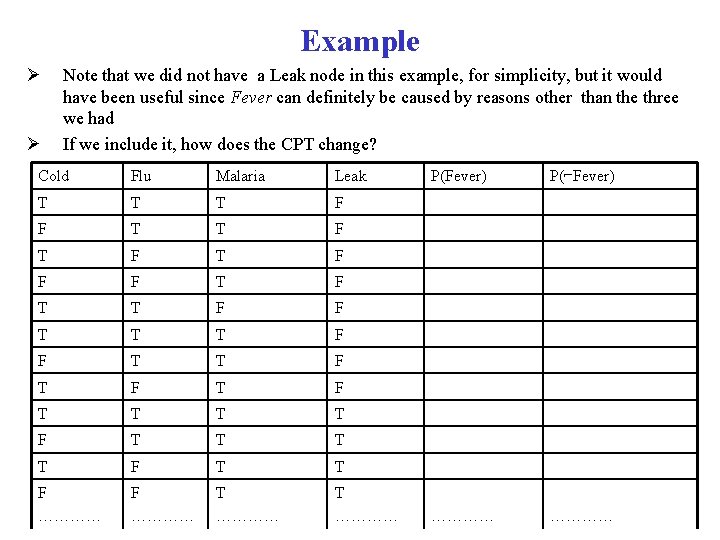
Example Ø Ø Note that we did not have a Leak node in this example, for simplicity, but it would have been useful since Fever can definitely be caused by reasons other than the three we had If we include it, how does the CPT change? Cold Flu Malaria Leak T T T F F T T F T F F F T T F T F T T T T F ………… T ………… P(Fever) P(⌐Fever) …………
Bayesian Networks - Inference Update algorithms exploit dependencies to reduce the complexity of probabilistic inference Diagnostic Burglary P(B) = 0. 016 Alarm Predictive Intercausal Burglary Earthquake P(B) = 1. 0 Alarm P(J) = 1. 0 John. Calls P(J) = 0. 67 Earthquake P(E) = 1. 0 P( E) = 1. 0 Burglary Alarm P(B) = 0. 003 John. Calls Mixed P(A) = 0. 03 Alarm P(A) = 1. 0 John. Calls P(M) = 1. 0
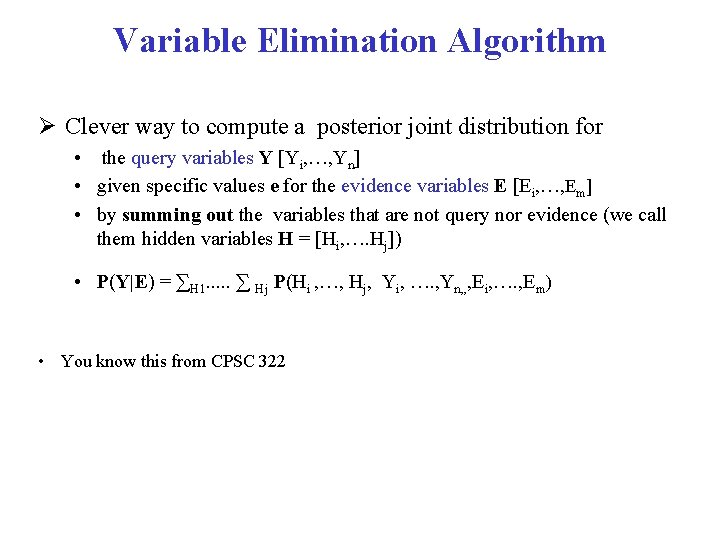
Variable Elimination Algorithm Ø Clever way to compute a posterior joint distribution for • the query variables Y [Yi, …, Yn] • given specific values e for the evidence variables E [Ei, …, Em] • by summing out the variables that are not query nor evidence (we call them hidden variables H = [Hi, …. Hj]) • P(Y|E) = ∑H 1. . . ∑ Hj P(Hi , …, Hj, Yi, …. , Yn, , , Ei, …. , Em) • You know this from CPSC 322
Inference in Bayesian Networks Ø In worst case scenario (e. g. fully connected network) exact inference is NP-hard Ø However space/time complexity is very sensitive to topology Ø In singly connected graphs (single path from any two nodes), time complexity of exact inference is polynomial in the number of nodes Ø If things are bad, one can resort to algorithms for approximate inference • We we’ll look at these next week
Issues in Bayesian Networks Ø Often creating a suitable structure is doable for domain experts. But… Ø “Where do the numbers come from? ” Ø From experts • Tedious • Costly • Not always reliable Ø From data => Machine Learning • • There algorithms to learn both structures and numbers CPTs easier to learn when all variables are observable: use frequencies Can be hard to get enough data We will look into learning Bnets as part of the machine learning portion of the course
Applications Ø Bayesian networks have been extensively used in real world applications for several domains • Medicine, troubleshooting, Intelligent Interfaces, Intelligent Tutoring systems Ø We will see an example from Tutoring Systems: • Andes, an Intelligent Learning Environment (ILE) for physics • Discussion-based class of Tu. Jan 19

Next Week • • Approximate algorithms for Bnets I will be away Giuseppe Carenini will be guest lecturer on Tuesday Jacek Kisynski will be guest lecturer on Thursday
- Slides: 61