
CPSC 233 Introduction to Classes and Objects Part
CPSC 233: Introduction to Classes and Objects, Part II More on Java methods Relations between classes • Association • Aggregation Multiplicity Issues associated with references The static keyword Scope Classes and state Debugging code James Tam
More On Java Methods Method overloading and the signature of a method Message passing Implementation hiding James Tam
Method Overloading • Same method name but the type, number or order of the parameters is different • Used for methods that implement similar but not identical tasks. • Good coding style • Example: System. out. println(int) System. out. println(double) etc. For more details on this class see: http: //java. sun. com/j 2 se/1. 4. 2/docs/api/java/io/Print. Stream. html James Tam
Method Signatures And Method Overloading Signature consists of: • The name of the method • The number and type of parameters (Reminder: Don’t distinguish methods solely by the order of the parameters). Usage of method signatures: • To distinguish overloaded methods (same name but the type, number or ordering of the parameters is different). James Tam
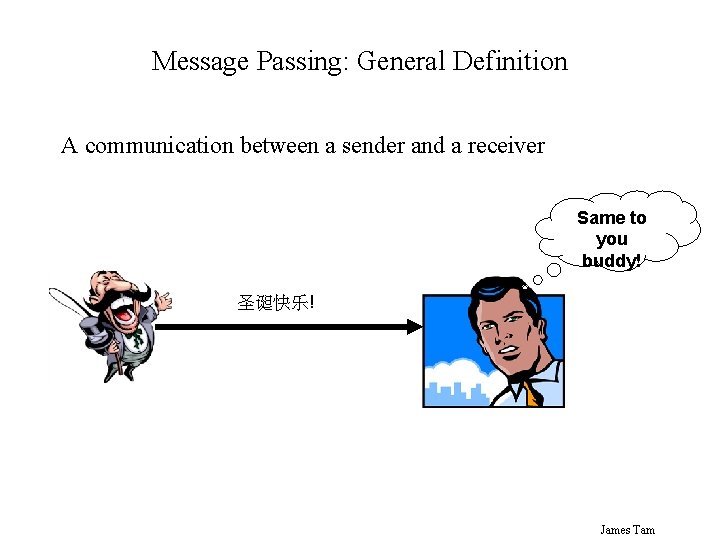
Message Passing: General Definition A communication between a sender and a receiver Same to you buddy! 圣诞快乐! James Tam
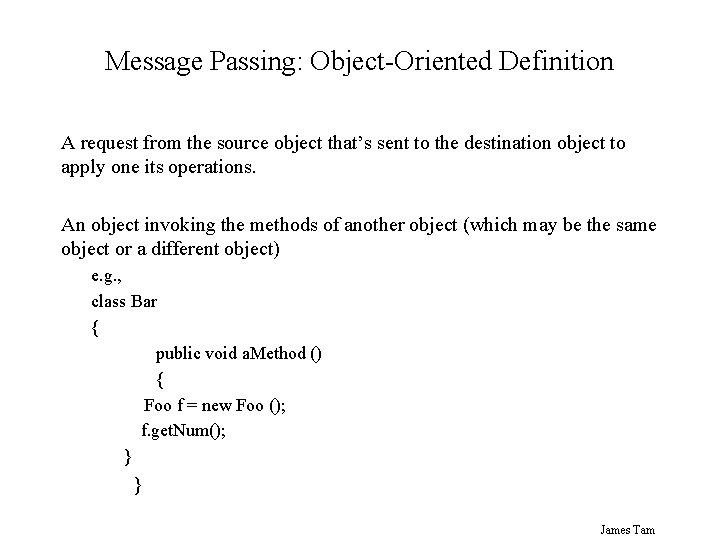
Message Passing: Object-Oriented Definition A request from the source object that’s sent to the destination object to apply one its operations. An object invoking the methods of another object (which may be the same object or a different object) e. g. , class Bar { public void a. Method () { Foo f = new Foo (); f. get. Num(); } } James Tam
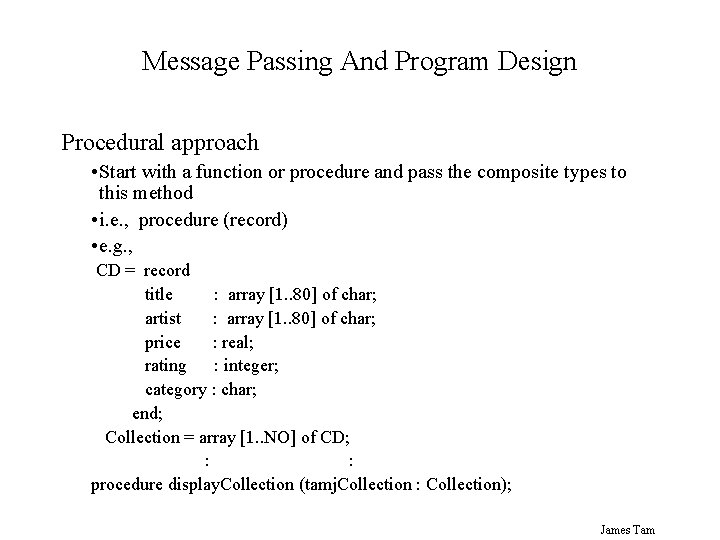
Message Passing And Program Design Procedural approach • Start with a function or procedure and pass the composite types to this method • i. e. , procedure (record) • e. g. , CD = record title : array [1. . 80] of char; artist : array [1. . 80] of char; price : real; rating : integer; category : char; end; Collection = array [1. . NO] of CD; : : procedure display. Collection (tamj. Collection : Collection); James Tam
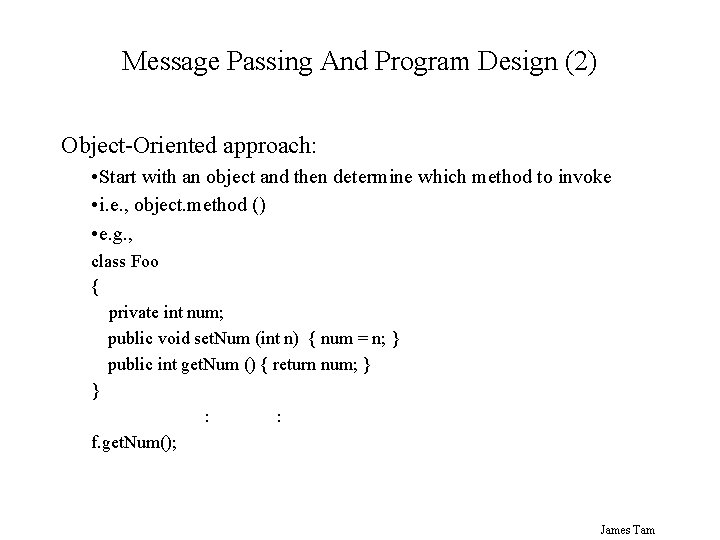
Message Passing And Program Design (2) Object-Oriented approach: • Start with an object and then determine which method to invoke • i. e. , object. method () • e. g. , class Foo { private int num; public void set. Num (int n) { num = n; } public int get. Num () { return num; } } : : f. get. Num(); James Tam
Implementation Hiding • Allows you to use a program module (e. g. , a method) but you don’t care about how the code in the module (implementation) was written. • For example, a list can be implemented as either an array or as a linked list. James Tam
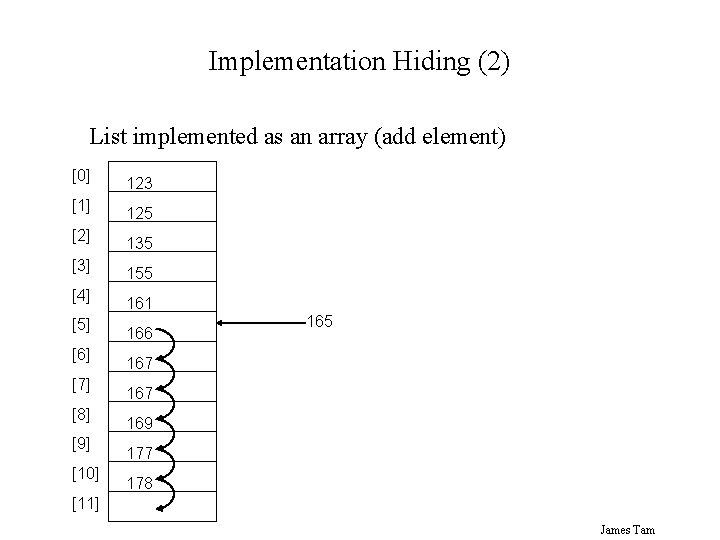
Implementation Hiding (2) List implemented as an array (add element) [0] 123 [1] 125 [2] 135 [3] 155 [4] [5] [6] [7] [8] [9] [10] 161 166 165 167 169 177 178 [11] James Tam
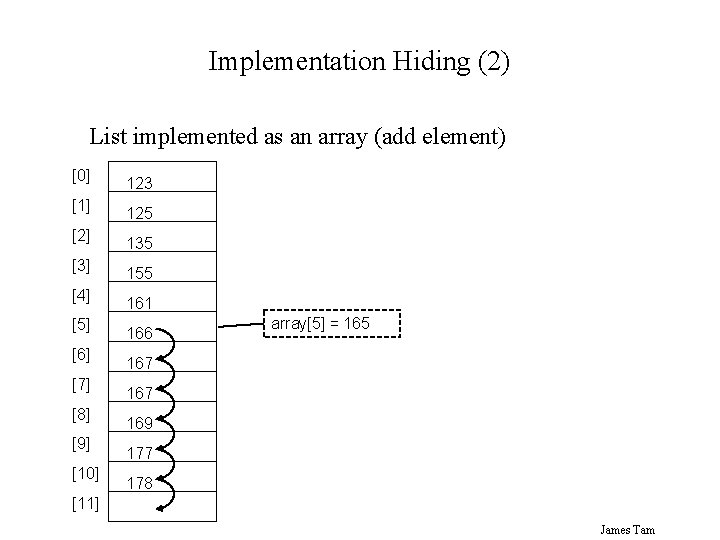
Implementation Hiding (2) List implemented as an array (add element) [0] 123 [1] 125 [2] 135 [3] 155 [4] [5] [6] [7] [8] [9] [10] 161 166 array[5] = 165 167 169 177 178 [11] James Tam
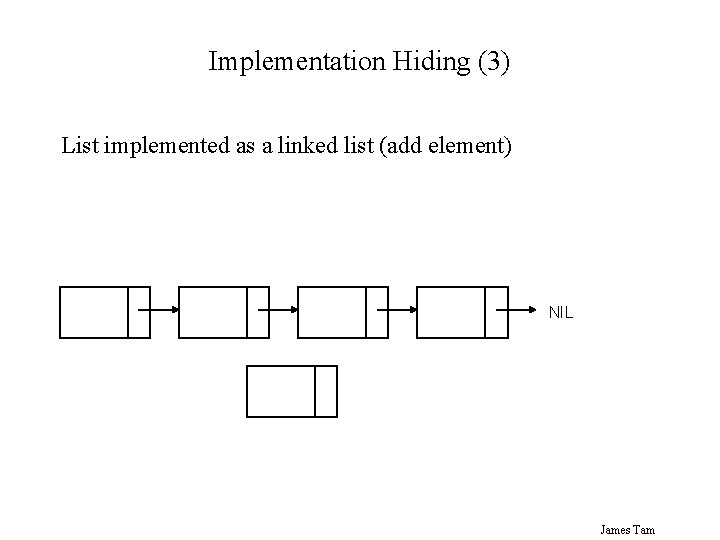
Implementation Hiding (3) List implemented as a linked list (add element) NIL James Tam
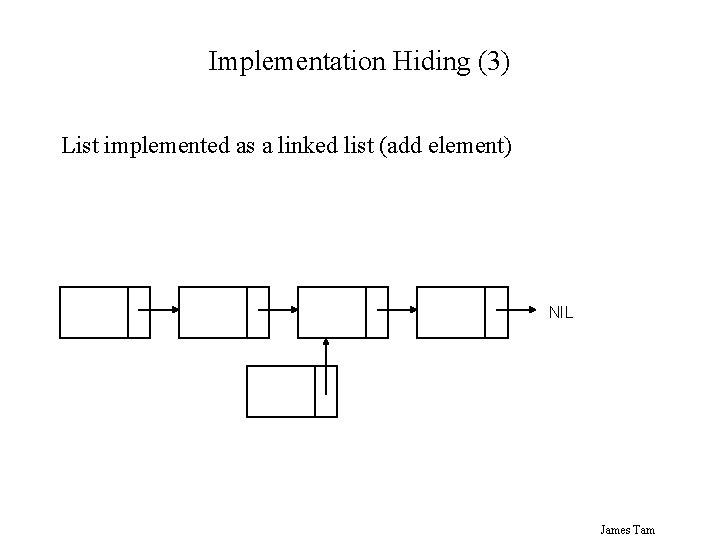
Implementation Hiding (3) List implemented as a linked list (add element) NIL James Tam
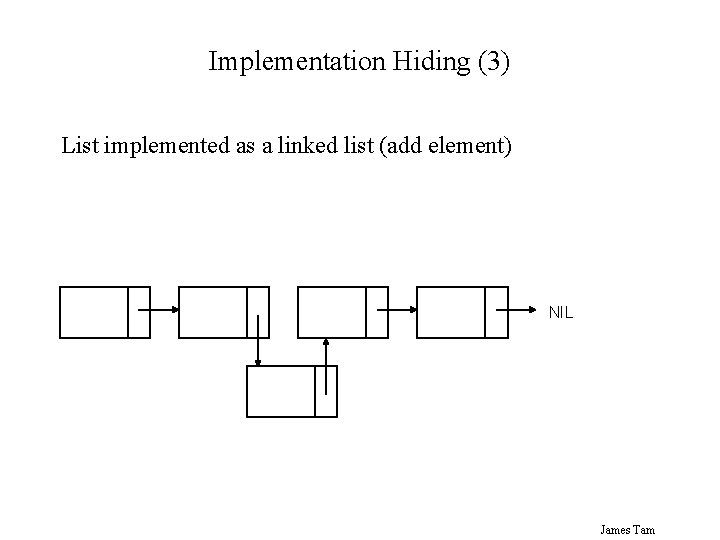
Implementation Hiding (3) List implemented as a linked list (add element) NIL James Tam
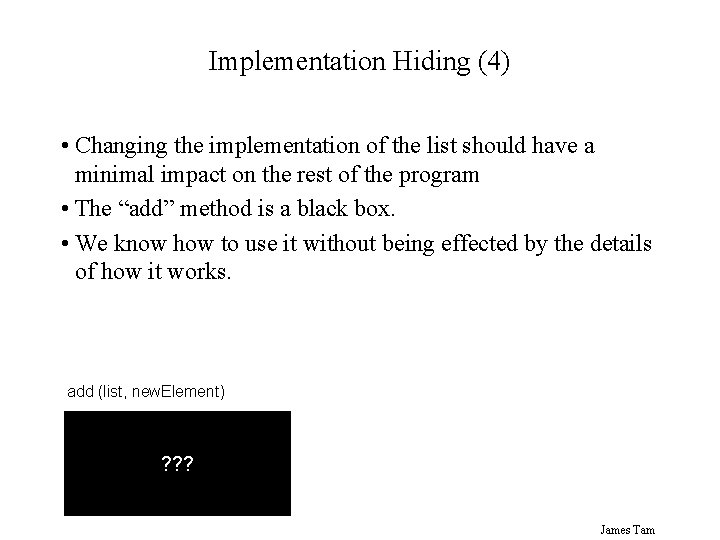
Implementation Hiding (4) • Changing the implementation of the list should have a minimal impact on the rest of the program • The “add” method is a black box. • We know how to use it without being effected by the details of how it works. add (list, new. Element) ? ? ? James Tam
Relations Between Classes 1. Association (this section) 2. Aggregation (this section) 3. Inheritance (next section) James Tam
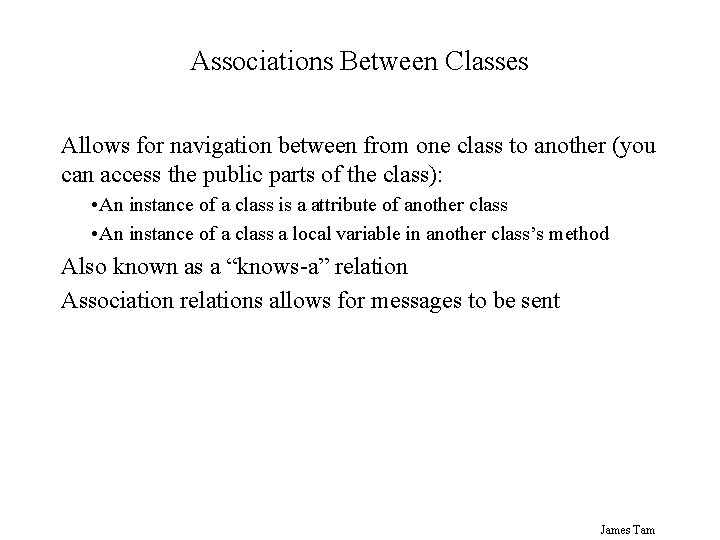
Associations Between Classes Allows for navigation between from one class to another (you can access the public parts of the class): • An instance of a class is a attribute of another class • An instance of a class a local variable in another class’s method Also known as a “knows-a” relation Association relations allows for messages to be sent James Tam
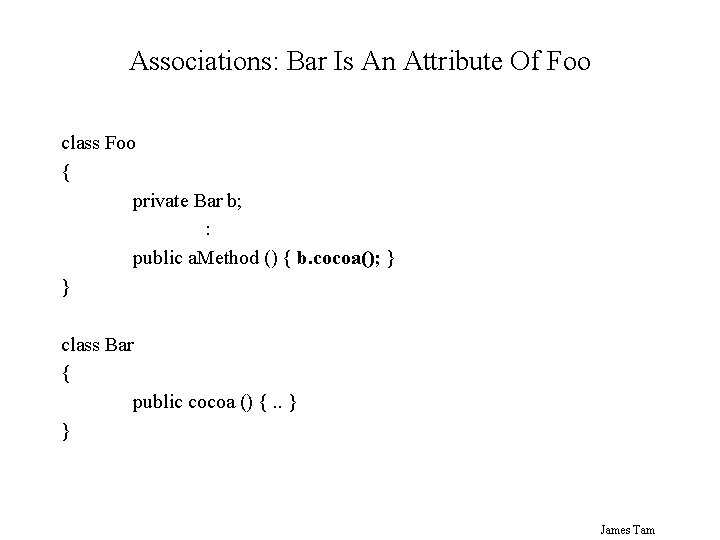
Associations: Bar Is An Attribute Of Foo class Foo { private Bar b; : public a. Method () { b. cocoa(); } } class Bar { public cocoa () {. . } } James Tam
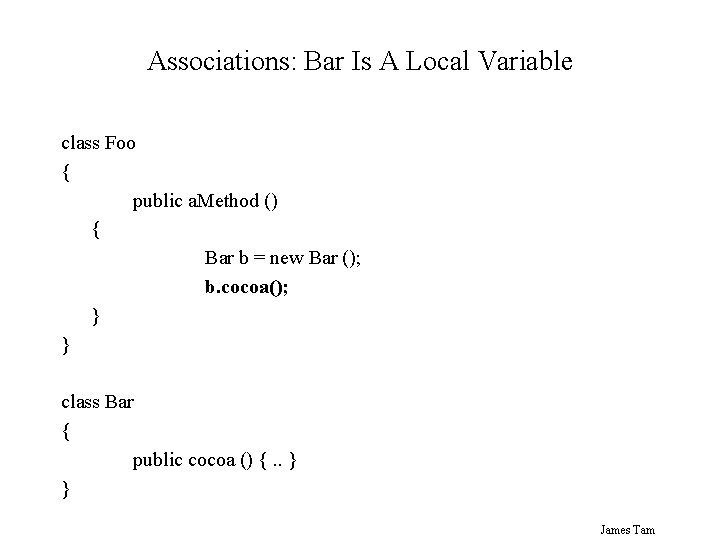
Associations: Bar Is A Local Variable class Foo { public a. Method () { Bar b = new Bar (); b. cocoa(); } } class Bar { public cocoa () {. . } } James Tam
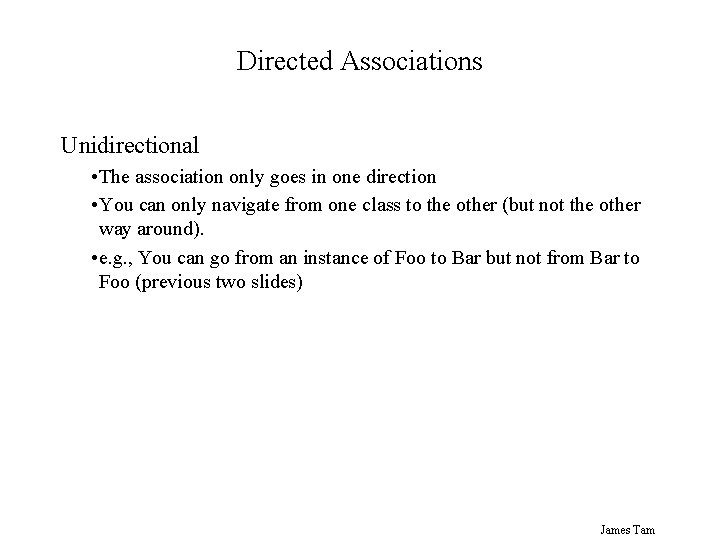
Directed Associations Unidirectional • The association only goes in one direction • You can only navigate from one class to the other (but not the other way around). • e. g. , You can go from an instance of Foo to Bar but not from Bar to Foo (previous two slides) James Tam
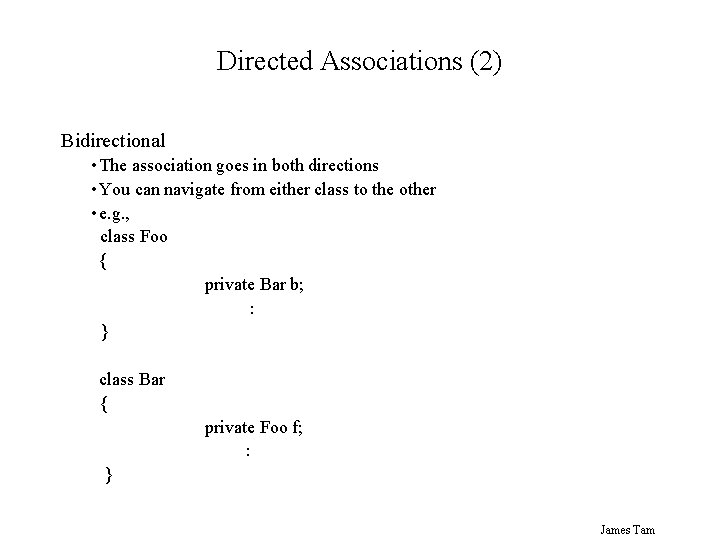
Directed Associations (2) Bidirectional • The association goes in both directions • You can navigate from either class to the other • e. g. , class Foo { private Bar b; : } class Bar { private Foo f; : } James Tam
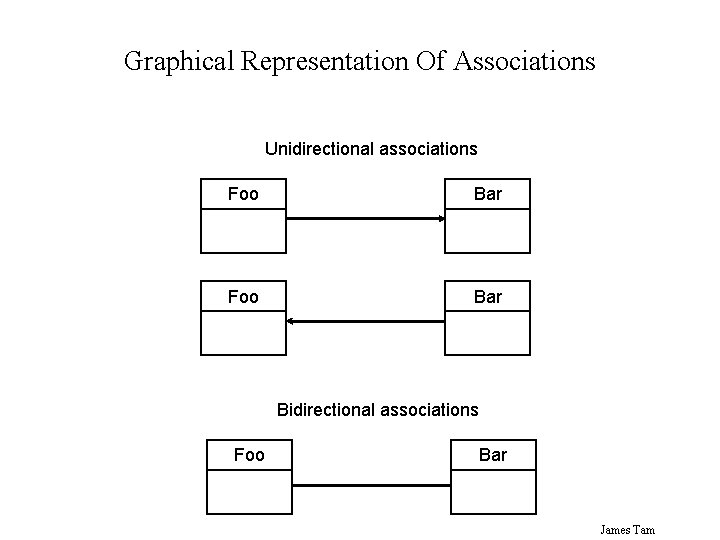
Graphical Representation Of Associations Unidirectional associations Foo Bar Bidirectional associations Foo Bar James Tam
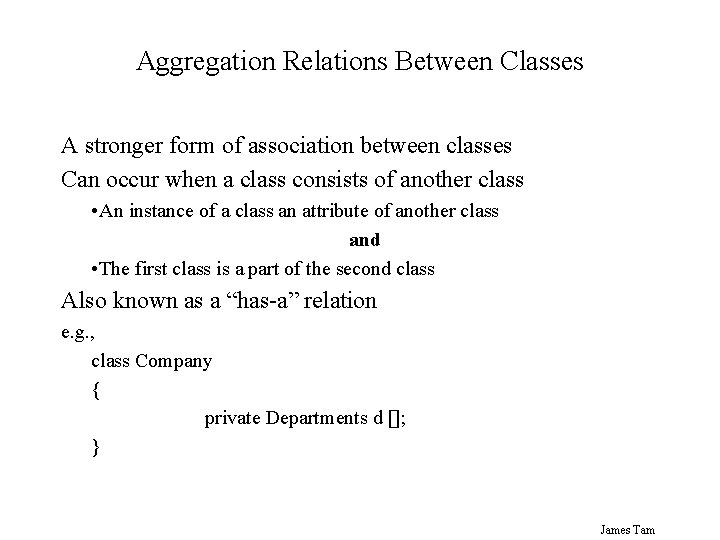
Aggregation Relations Between Classes A stronger form of association between classes Can occur when a class consists of another class • An instance of a class an attribute of another class and • The first class is a part of the second class Also known as a “has-a” relation e. g. , class Company { private Departments d []; } James Tam
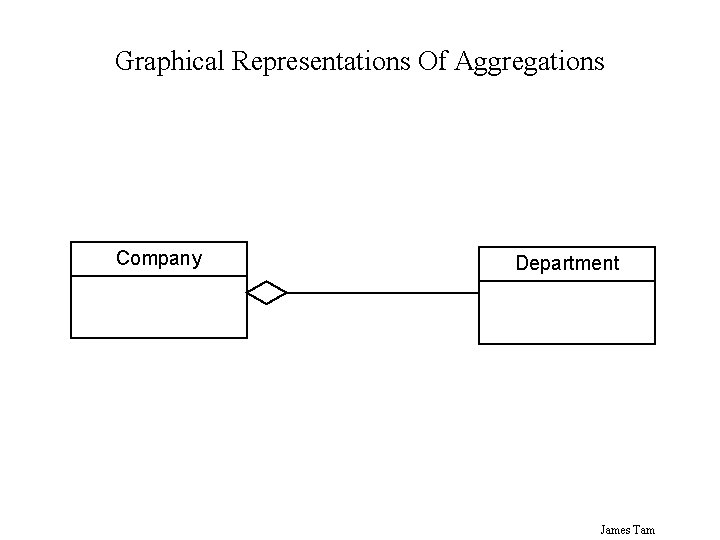
Graphical Representations Of Aggregations Company Department James Tam
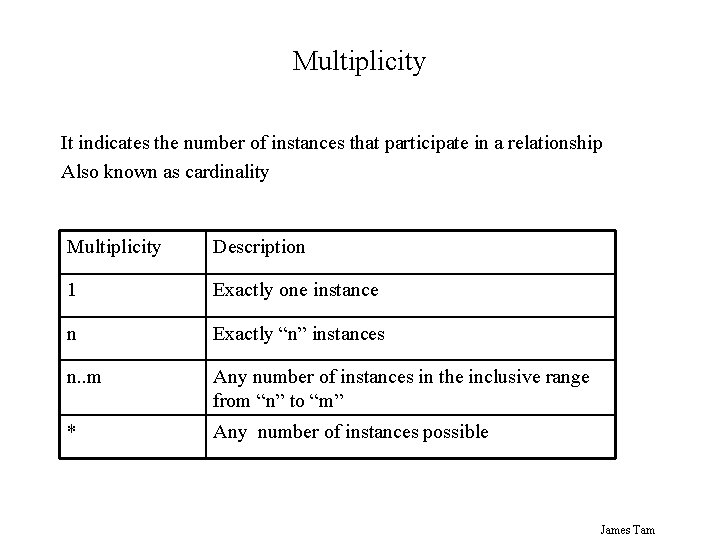
Multiplicity It indicates the number of instances that participate in a relationship Also known as cardinality Multiplicity Description 1 Exactly one instance n Exactly “n” instances n. . m Any number of instances in the inclusive range from “n” to “m” * Any number of instances possible James Tam
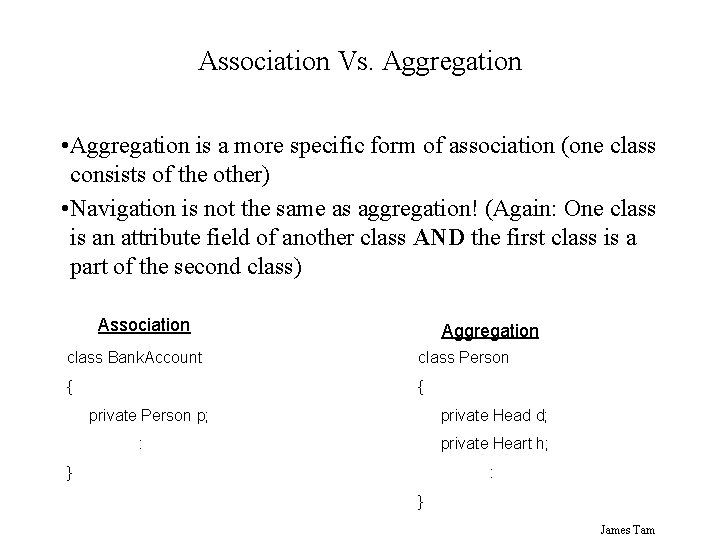
Association Vs. Aggregation • Aggregation is a more specific form of association (one class consists of the other) • Navigation is not the same as aggregation! (Again: One class is an attribute field of another class AND the first class is a part of the second class) Association Aggregation class Bank. Account class Person { { private Person p; private Head d; : private Heart h; } : } James Tam
Issues Associated With References Parameter passing Assignment of references and deep vs. shallow copies Comparisons of references James Tam
Issues Associated With References Parameter passing Assignment of references and deep vs. shallow copies Comparisons of references James Tam
Parameter Passing Mechanisms Pass by value Pass by reference James Tam
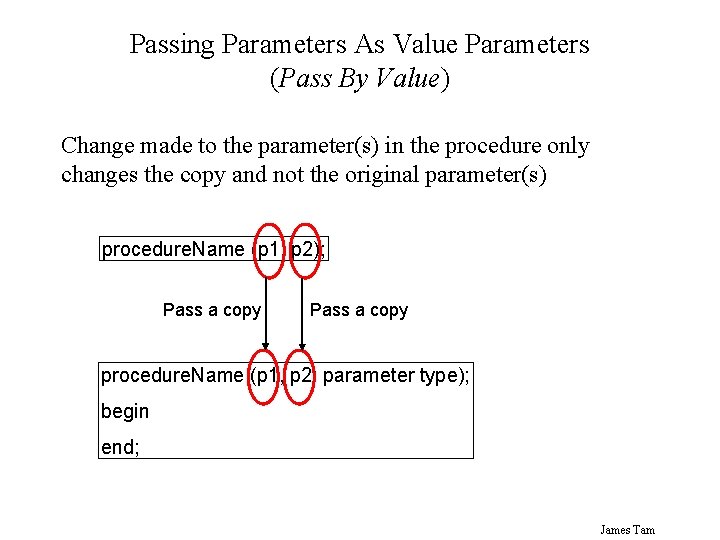
Passing Parameters As Value Parameters (Pass By Value) Change made to the parameter(s) in the procedure only changes the copy and not the original parameter(s) procedure. Name (p 1, p 2); Pass a copy procedure. Name (p 1, p 2: parameter type); begin end; James Tam
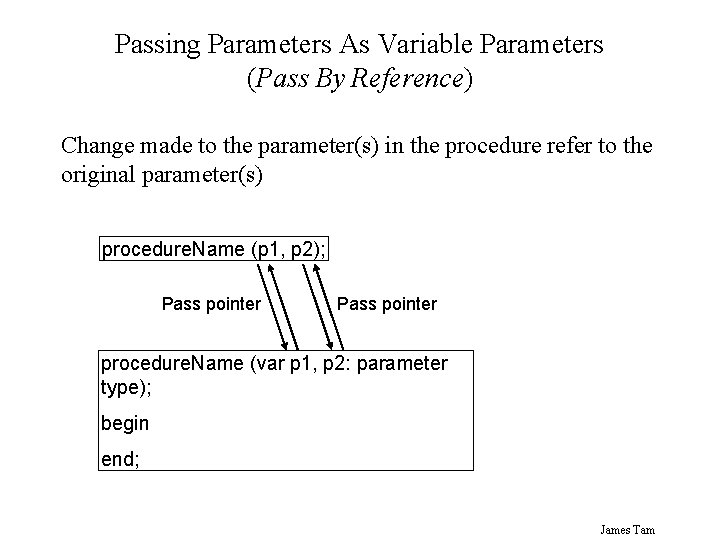
Passing Parameters As Variable Parameters (Pass By Reference) Change made to the parameter(s) in the procedure refer to the original parameter(s) procedure. Name (p 1, p 2); Pass pointer procedure. Name (var p 1, p 2: parameter type); begin end; James Tam
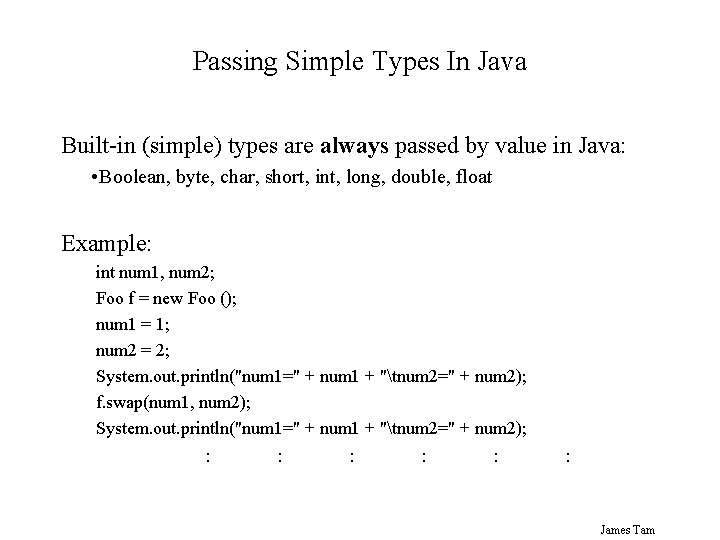
Passing Simple Types In Java Built-in (simple) types are always passed by value in Java: • Boolean, byte, char, short, int, long, double, float Example: int num 1, num 2; Foo f = new Foo (); num 1 = 1; num 2 = 2; System. out. println("num 1=" + num 1 + "tnum 2=" + num 2); f. swap(num 1, num 2); System. out. println("num 1=" + num 1 + "tnum 2=" + num 2); : : : James Tam
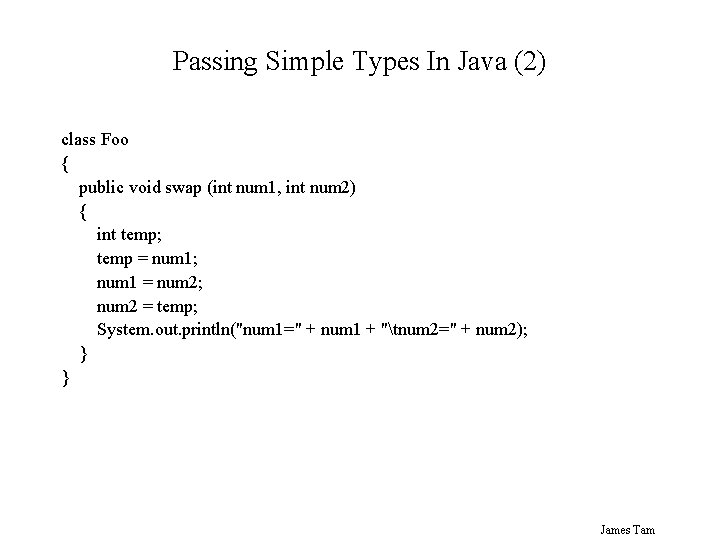
Passing Simple Types In Java (2) class Foo { public void swap (int num 1, int num 2) { int temp; temp = num 1; num 1 = num 2; num 2 = temp; System. out. println("num 1=" + num 1 + "tnum 2=" + num 2); } } James Tam
Passing References In Java (Reminder: References are required for variables that are arrays or objects) Question: • If a reference is passed as a parameter to a method do changes made in the method continue on after the method is finished? Hint: If a reference is passed as a parameter into a method then a copy of the reference is what is being manipulated in the method. James Tam
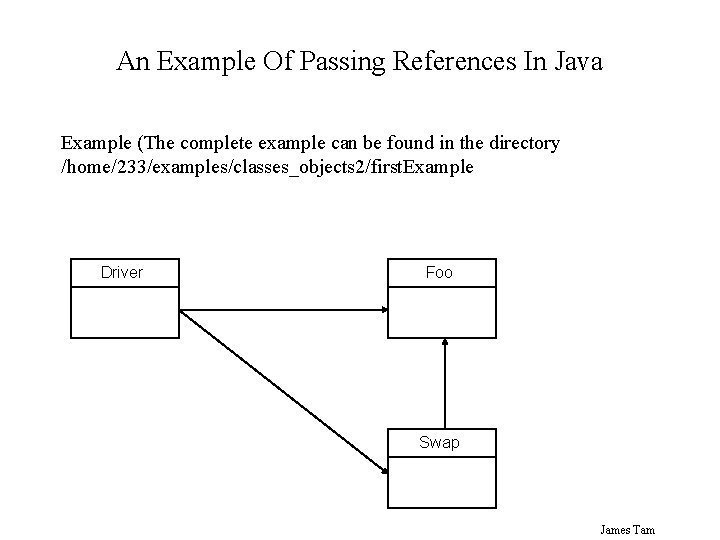
An Example Of Passing References In Java Example (The complete example can be found in the directory /home/233/examples/classes_objects 2/first. Example Driver Foo Swap James Tam
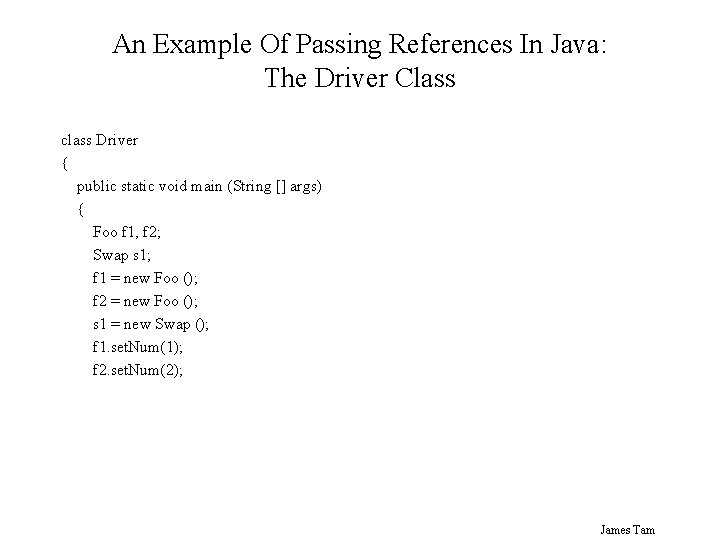
An Example Of Passing References In Java: The Driver Class class Driver { public static void main (String [] args) { Foo f 1, f 2; Swap s 1; f 1 = new Foo (); f 2 = new Foo (); s 1 = new Swap (); f 1. set. Num(1); f 2. set. Num(2); James Tam
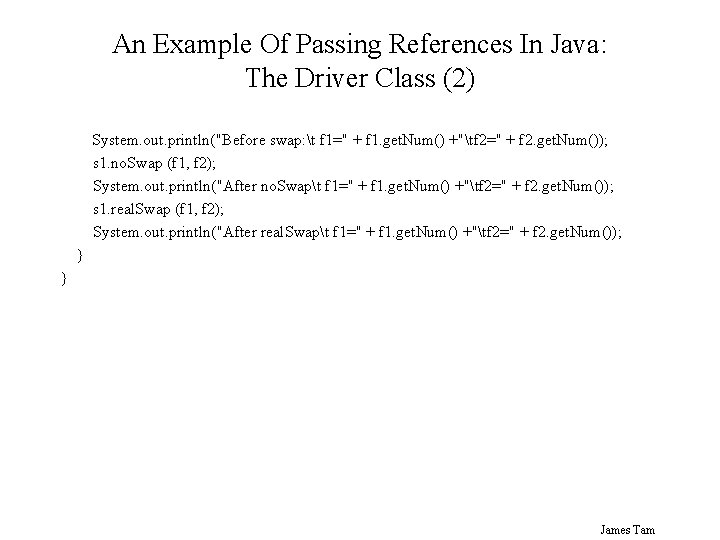
An Example Of Passing References In Java: The Driver Class (2) System. out. println("Before swap: t f 1=" + f 1. get. Num() +"tf 2=" + f 2. get. Num()); s 1. no. Swap (f 1, f 2); System. out. println("After no. Swapt f 1=" + f 1. get. Num() +"tf 2=" + f 2. get. Num()); s 1. real. Swap (f 1, f 2); System. out. println("After real. Swapt f 1=" + f 1. get. Num() +"tf 2=" + f 2. get. Num()); } } James Tam
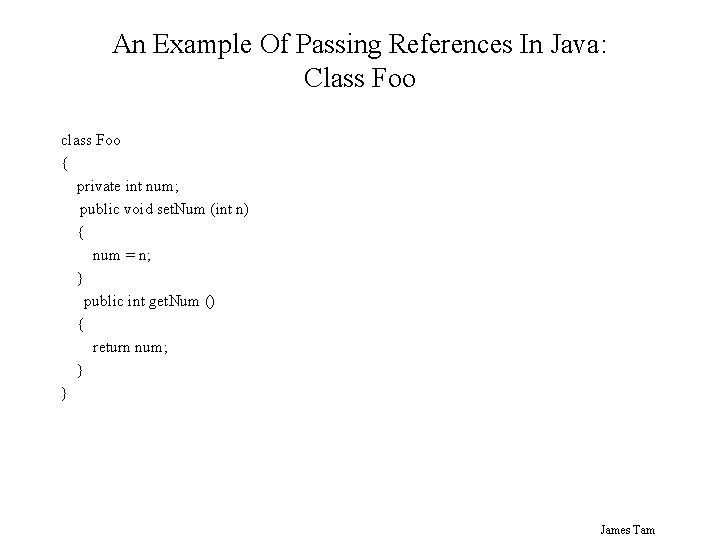
An Example Of Passing References In Java: Class Foo class Foo { private int num; public void set. Num (int n) { num = n; } public int get. Num () { return num; } } James Tam
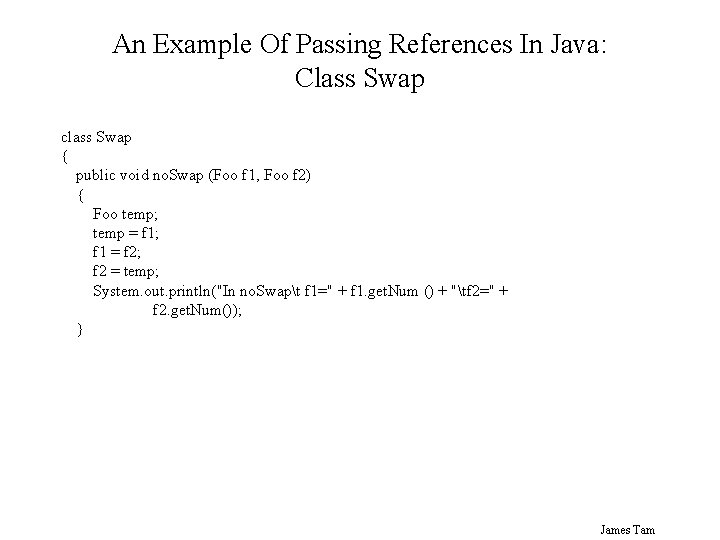
An Example Of Passing References In Java: Class Swap class Swap { public void no. Swap (Foo f 1, Foo f 2) { Foo temp; temp = f 1; f 1 = f 2; f 2 = temp; System. out. println("In no. Swapt f 1=" + f 1. get. Num () + "tf 2=" + f 2. get. Num()); } James Tam
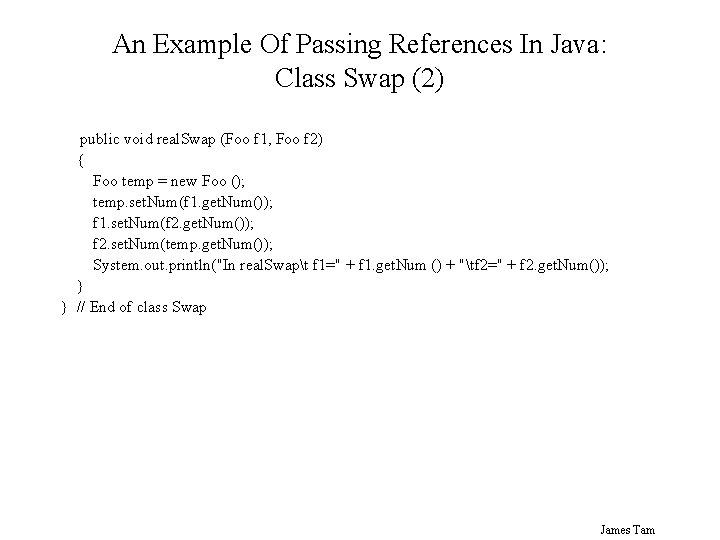
An Example Of Passing References In Java: Class Swap (2) public void real. Swap (Foo f 1, Foo f 2) { Foo temp = new Foo (); temp. set. Num(f 1. get. Num()); f 1. set. Num(f 2. get. Num()); f 2. set. Num(temp. get. Num()); System. out. println("In real. Swapt f 1=" + f 1. get. Num () + "tf 2=" + f 2. get. Num()); } } // End of class Swap James Tam
Passing By Reference For Simple Types It cannot be done directly in Java You must use a wrapper! James Tam
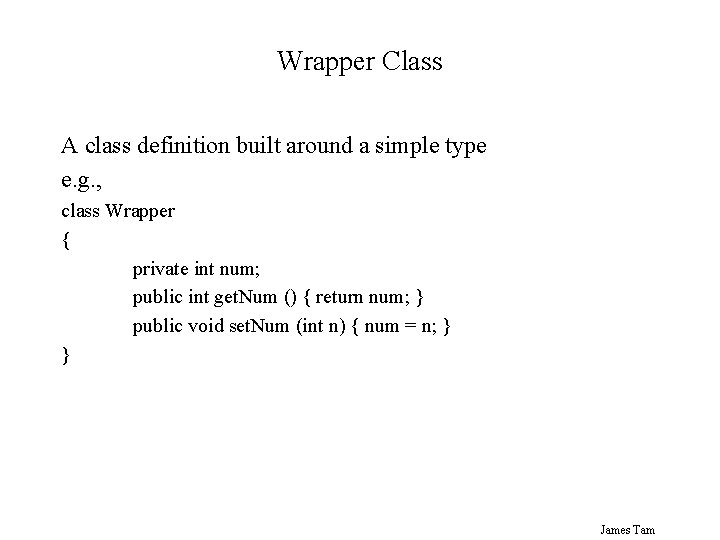
Wrapper Class A class definition built around a simple type e. g. , class Wrapper { private int num; public int get. Num () { return num; } public void set. Num (int n) { num = n; } } James Tam
Issues Associated With References Parameter passing Assignment of references and deep vs. shallow copies Comparisons of references James Tam
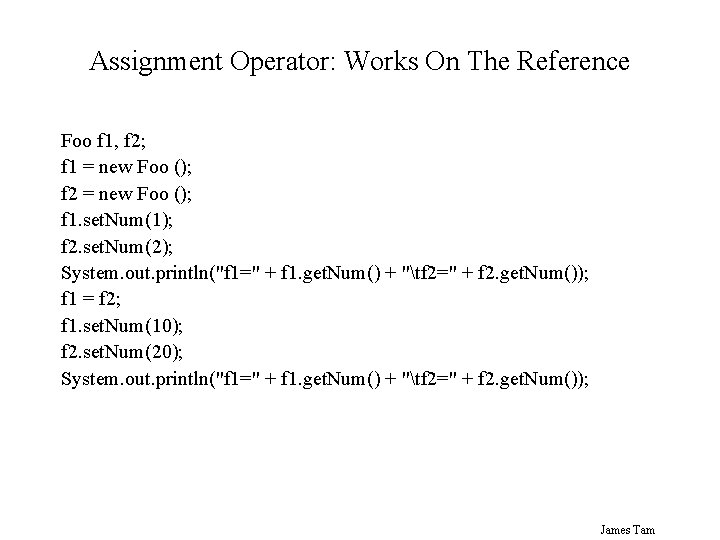
Assignment Operator: Works On The Reference Foo f 1, f 2; f 1 = new Foo (); f 2 = new Foo (); f 1. set. Num(1); f 2. set. Num(2); System. out. println("f 1=" + f 1. get. Num() + "tf 2=" + f 2. get. Num()); f 1 = f 2; f 1. set. Num(10); f 2. set. Num(20); System. out. println("f 1=" + f 1. get. Num() + "tf 2=" + f 2. get. Num()); James Tam
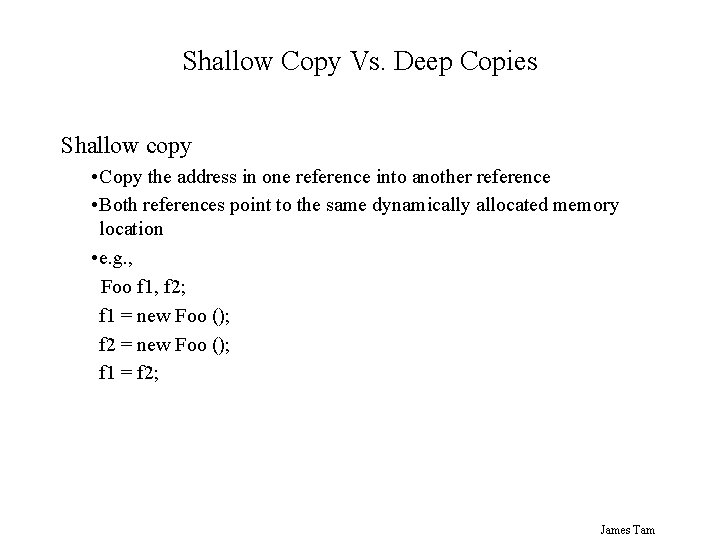
Shallow Copy Vs. Deep Copies Shallow copy • Copy the address in one reference into another reference • Both references point to the same dynamically allocated memory location • e. g. , Foo f 1, f 2; f 1 = new Foo (); f 2 = new Foo (); f 1 = f 2; James Tam
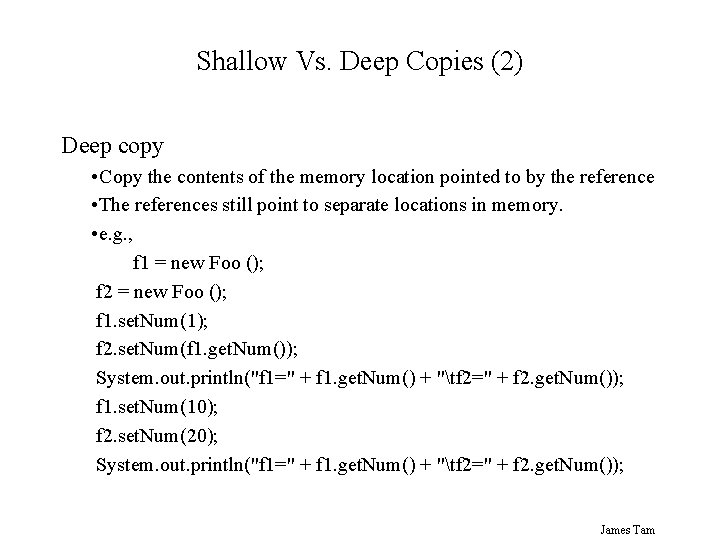
Shallow Vs. Deep Copies (2) Deep copy • Copy the contents of the memory location pointed to by the reference • The references still point to separate locations in memory. • e. g. , f 1 = new Foo (); f 2 = new Foo (); f 1. set. Num(1); f 2. set. Num(f 1. get. Num()); System. out. println("f 1=" + f 1. get. Num() + "tf 2=" + f 2. get. Num()); f 1. set. Num(10); f 2. set. Num(20); System. out. println("f 1=" + f 1. get. Num() + "tf 2=" + f 2. get. Num()); James Tam
Issues Associated With References Parameter passing Assignment of references and deep vs. shallow copies Comparisons of references James Tam
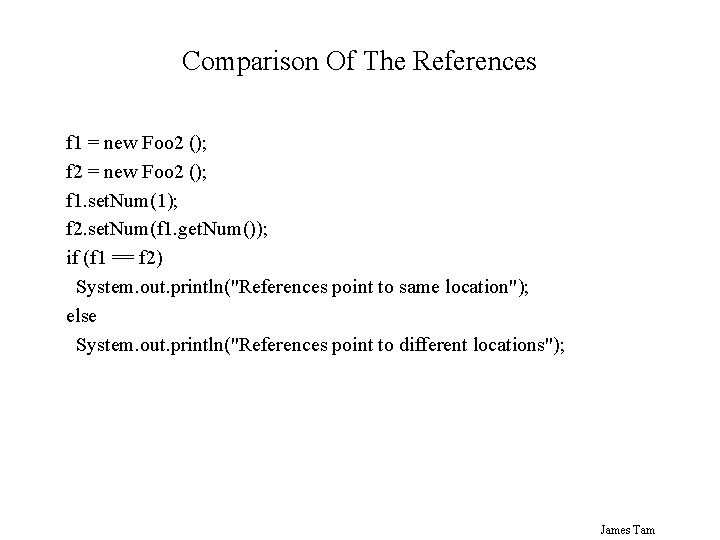
Comparison Of The References f 1 = new Foo 2 (); f 2 = new Foo 2 (); f 1. set. Num(1); f 2. set. Num(f 1. get. Num()); if (f 1 == f 2) System. out. println("References point to same location"); else System. out. println("References point to different locations"); James Tam
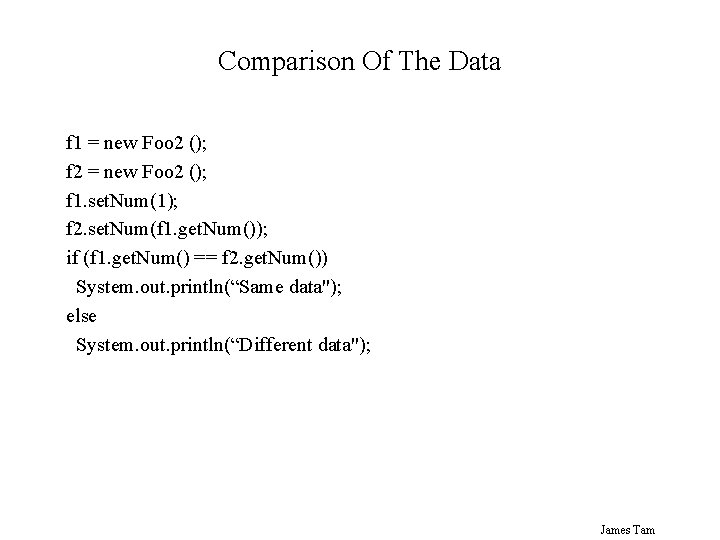
Comparison Of The Data f 1 = new Foo 2 (); f 2 = new Foo 2 (); f 1. set. Num(1); f 2. set. Num(f 1. get. Num()); if (f 1. get. Num() == f 2. get. Num()) System. out. println(“Same data"); else System. out. println(“Different data"); James Tam
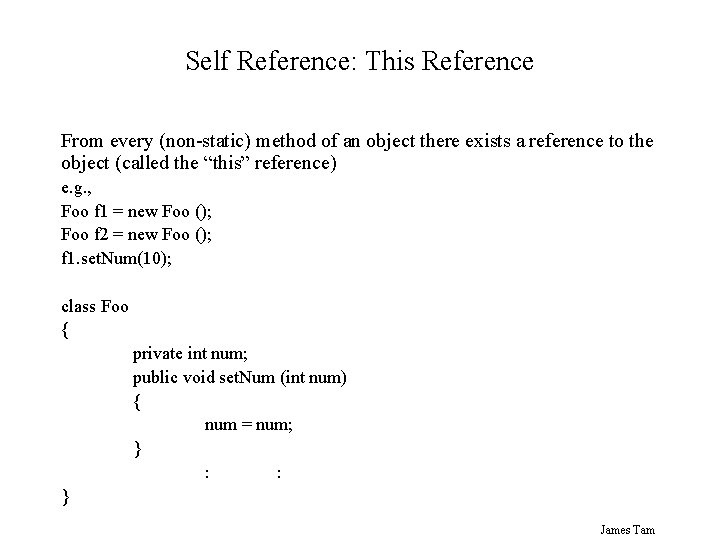
Self Reference: This Reference From every (non-static) method of an object there exists a reference to the object (called the “this” reference) e. g. , Foo f 1 = new Foo (); Foo f 2 = new Foo (); f 1. set. Num(10); class Foo { private int num; public void set. Num (int num) { num = num; } : : } James Tam
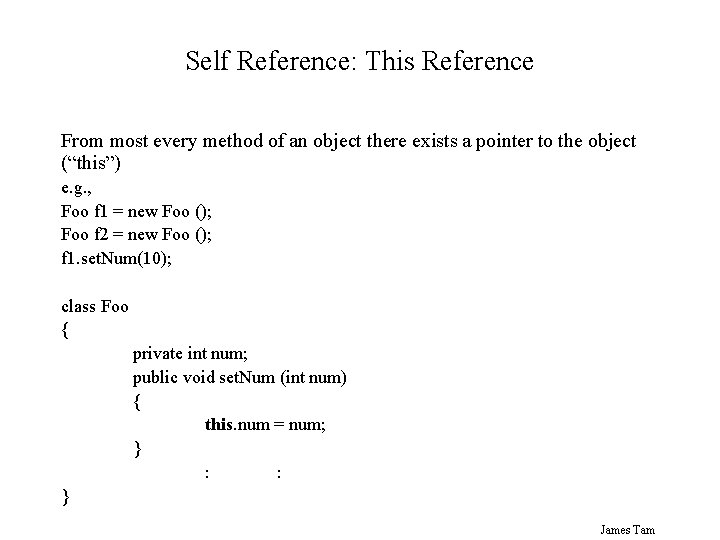
Self Reference: This Reference From most every method of an object there exists a pointer to the object (“this”) e. g. , Foo f 1 = new Foo (); Foo f 2 = new Foo (); f 1. set. Num(10); class Foo { private int num; public void set. Num (int num) { this. num = num; } : : } James Tam
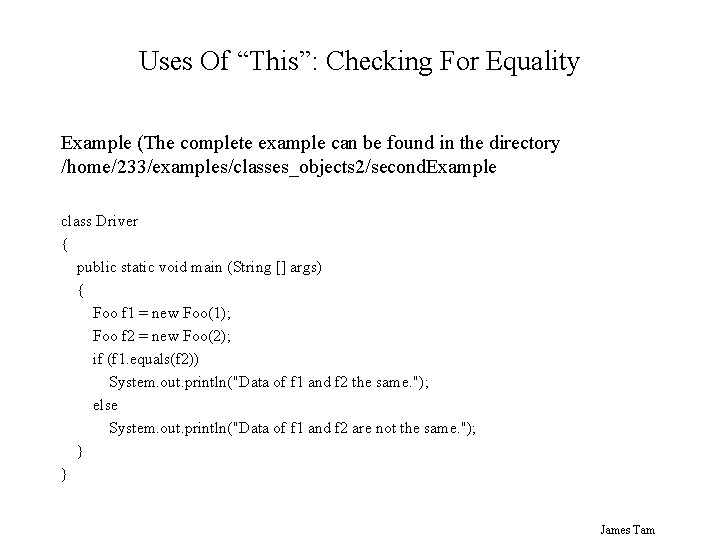
Uses Of “This”: Checking For Equality Example (The complete example can be found in the directory /home/233/examples/classes_objects 2/second. Example class Driver { public static void main (String [] args) { Foo f 1 = new Foo(1); Foo f 2 = new Foo(2); if (f 1. equals(f 2)) System. out. println("Data of f 1 and f 2 the same. "); else System. out. println("Data of f 1 and f 2 are not the same. "); } } James Tam
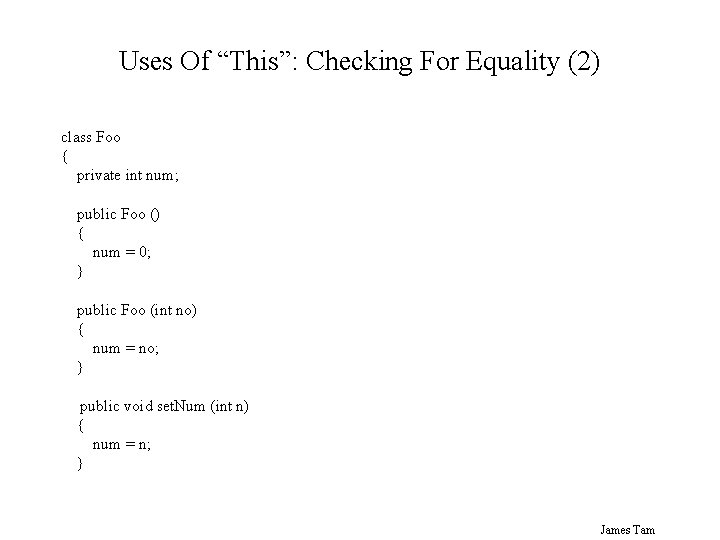
Uses Of “This”: Checking For Equality (2) class Foo { private int num; public Foo () { num = 0; } public Foo (int no) { num = no; } public void set. Num (int n) { num = n; } James Tam
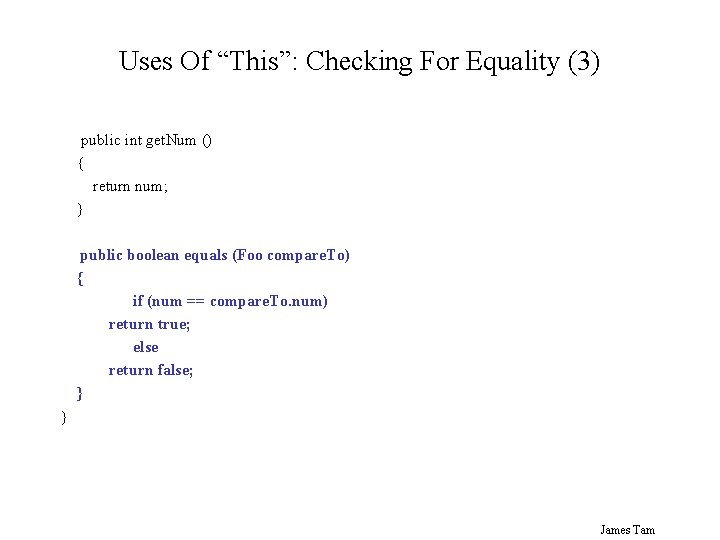
Uses Of “This”: Checking For Equality (3) public int get. Num () { return num; } public boolean equals (Foo compare. To) { if (num == compare. To. num) return true; else return false; } } James Tam
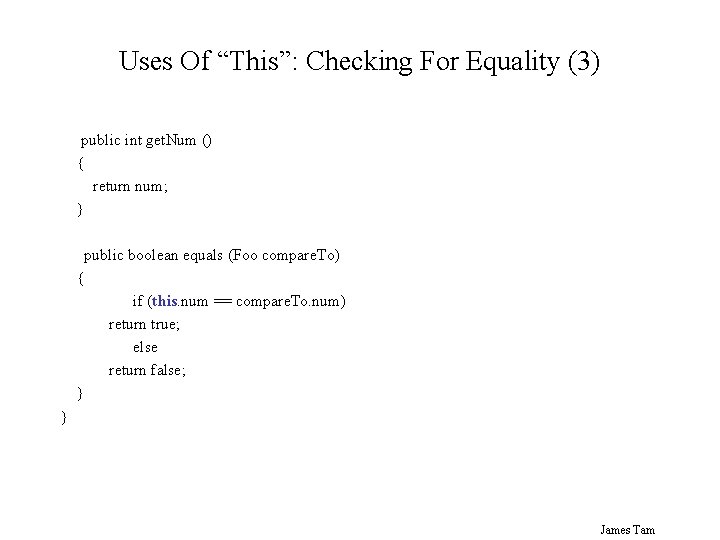
Uses Of “This”: Checking For Equality (3) public int get. Num () { return num; } public boolean equals (Foo compare. To) { if (this. num == compare. To. num) return true; else return false; } } James Tam
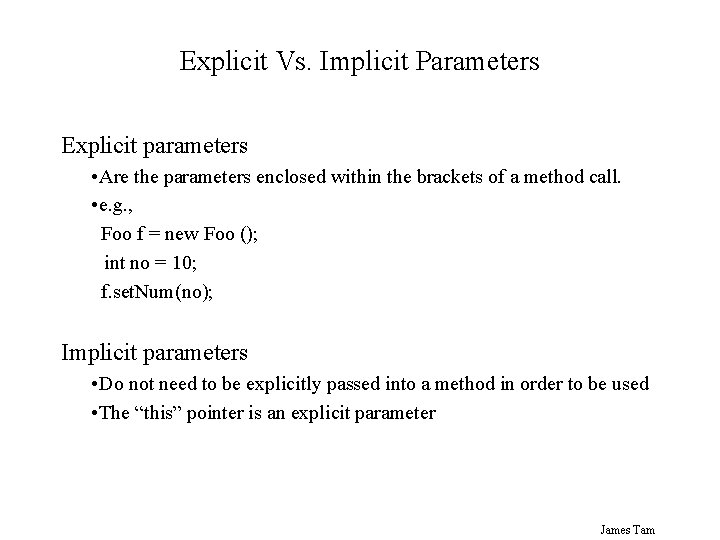
Explicit Vs. Implicit Parameters Explicit parameters • Are the parameters enclosed within the brackets of a method call. • e. g. , Foo f = new Foo (); int no = 10; f. set. Num(no); Implicit parameters • Do not need to be explicitly passed into a method in order to be used • The “this” pointer is an explicit parameter James Tam
The String Class Revisited A Java class but the attribute fields can be displayed directly (via print/println) A String is created like a simple type (when double quotes are encountered). Any of the simple types will be converted to a string when passed to the print/println method. String concatenation: • Plus sign: e. g. , System. out. println(“Str 1” + “Str 2”); • Method: e. g. , public String concat (String str) For more detailed information regarding the String class go to the url: http: //java. sun. com/j 2 se/1. 4/docs/api/java/lang/String. html James Tam
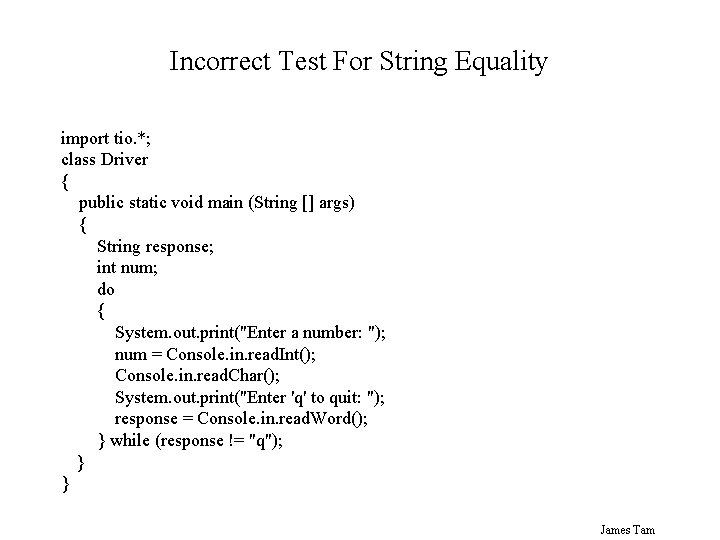
Incorrect Test For String Equality import tio. *; class Driver { public static void main (String [] args) { String response; int num; do { System. out. print("Enter a number: "); num = Console. in. read. Int(); Console. in. read. Char(); System. out. print("Enter 'q' to quit: "); response = Console. in. read. Word(); } while (response != "q"); } } James Tam
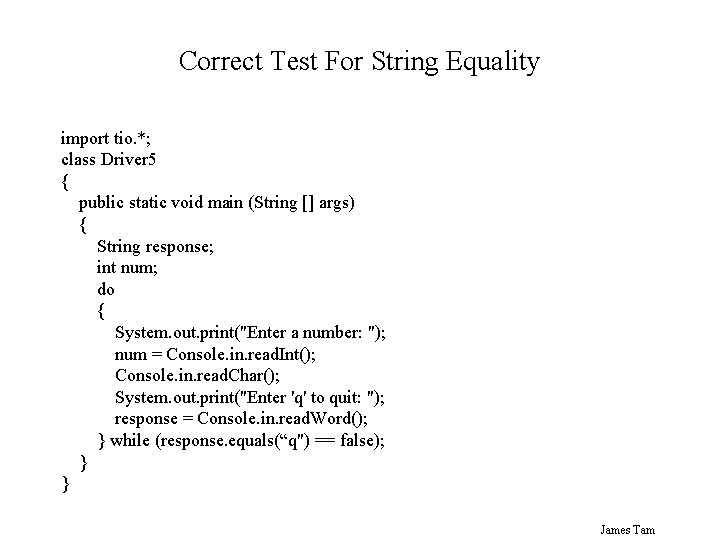
Correct Test For String Equality import tio. *; class Driver 5 { public static void main (String [] args) { String response; int num; do { System. out. print("Enter a number: "); num = Console. in. read. Int(); Console. in. read. Char(); System. out. print("Enter 'q' to quit: "); response = Console. in. read. Word(); } while (response. equals(“q") == false); } } James Tam
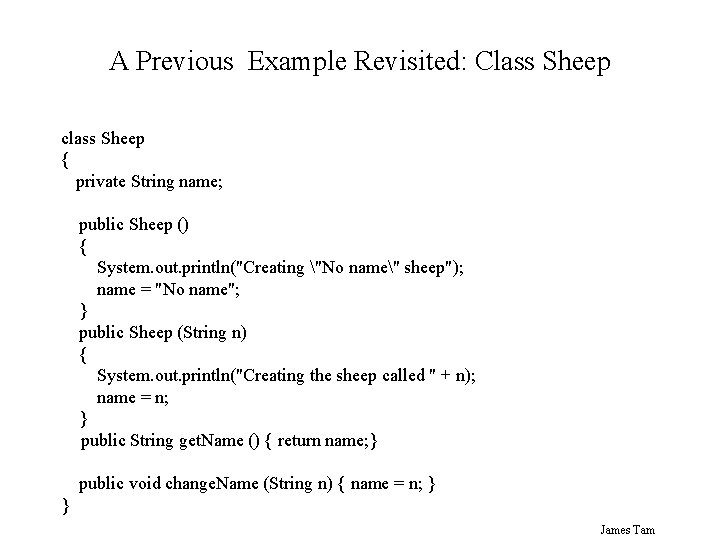
A Previous Example Revisited: Class Sheep class Sheep { private String name; public Sheep () { System. out. println("Creating "No name" sheep"); name = "No name"; } public Sheep (String n) { System. out. println("Creating the sheep called " + n); name = n; } public String get. Name () { return name; } public void change. Name (String n) { name = n; } } James Tam
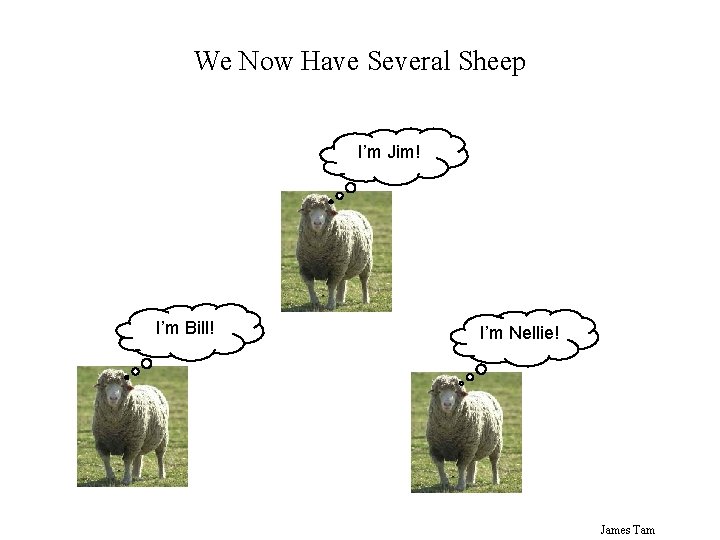
We Now Have Several Sheep I’m Jim! I’m Bill! I’m Nellie! James Tam
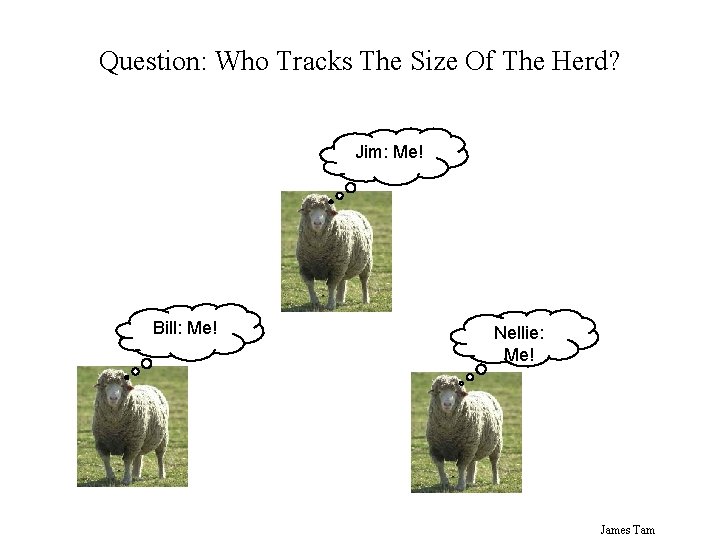
Question: Who Tracks The Size Of The Herd? Jim: Me! Bill: Me! Nellie: Me! James Tam
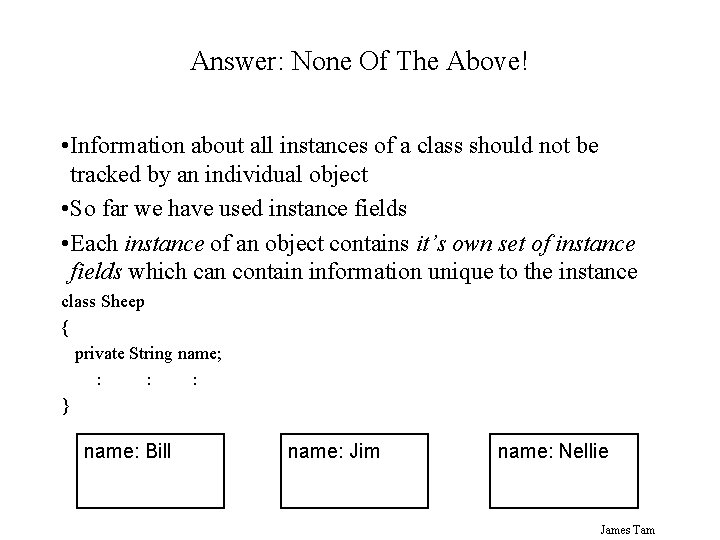
Answer: None Of The Above! • Information about all instances of a class should not be tracked by an individual object • So far we have used instance fields • Each instance of an object contains it’s own set of instance fields which can contain information unique to the instance class Sheep { private String name; : : : } name: Bill name: Jim name: Nellie James Tam
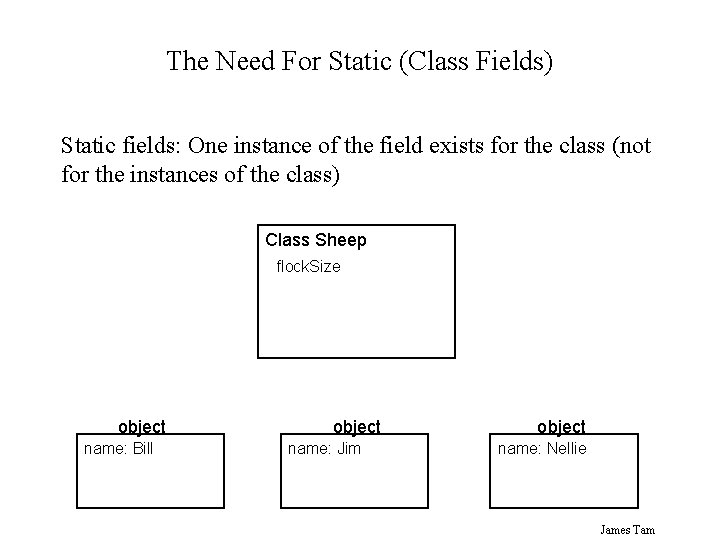
The Need For Static (Class Fields) Static fields: One instance of the field exists for the class (not for the instances of the class) Class Sheep flock. Size object name: Bill object name: Jim object name: Nellie James Tam
Static (Class) Methods • Are associated with the class as a whole and not individual instances of the class • Often used to act on the class fields James Tam
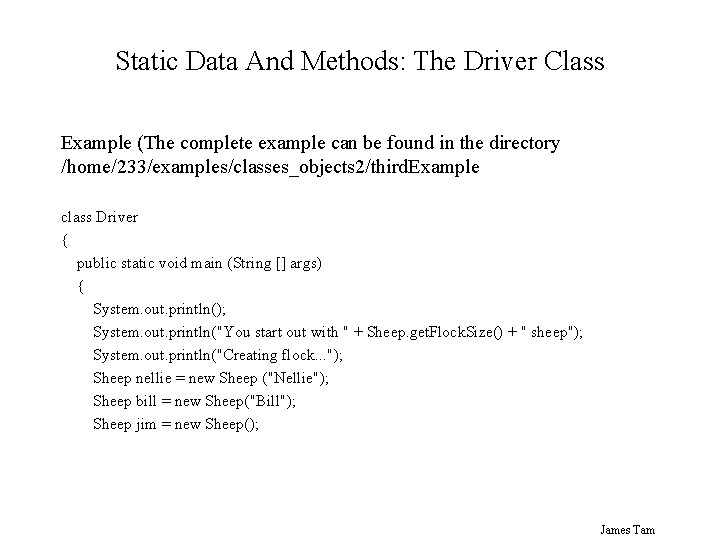
Static Data And Methods: The Driver Class Example (The complete example can be found in the directory /home/233/examples/classes_objects 2/third. Example class Driver { public static void main (String [] args) { System. out. println(); System. out. println("You start out with " + Sheep. get. Flock. Size() + " sheep"); System. out. println("Creating flock. . . "); Sheep nellie = new Sheep ("Nellie"); Sheep bill = new Sheep("Bill"); Sheep jim = new Sheep(); James Tam
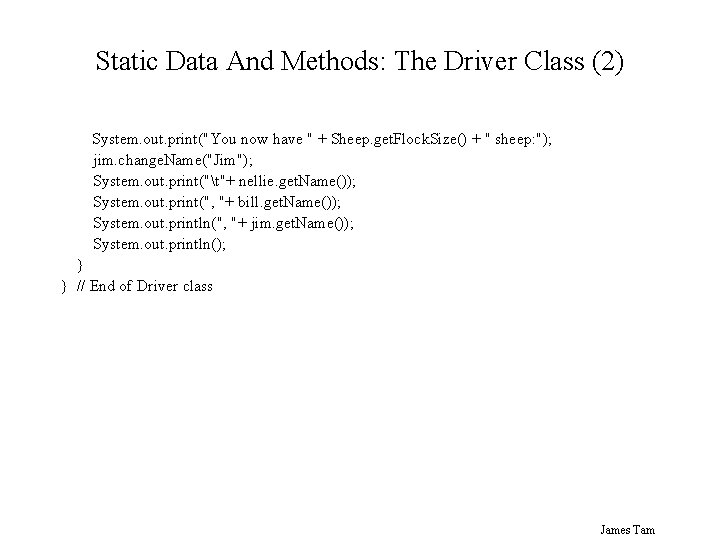
Static Data And Methods: The Driver Class (2) System. out. print("You now have " + Sheep. get. Flock. Size() + " sheep: "); jim. change. Name("Jim"); System. out. print("t"+ nellie. get. Name()); System. out. print(", "+ bill. get. Name()); System. out. println(", "+ jim. get. Name()); System. out. println(); } } // End of Driver class James Tam
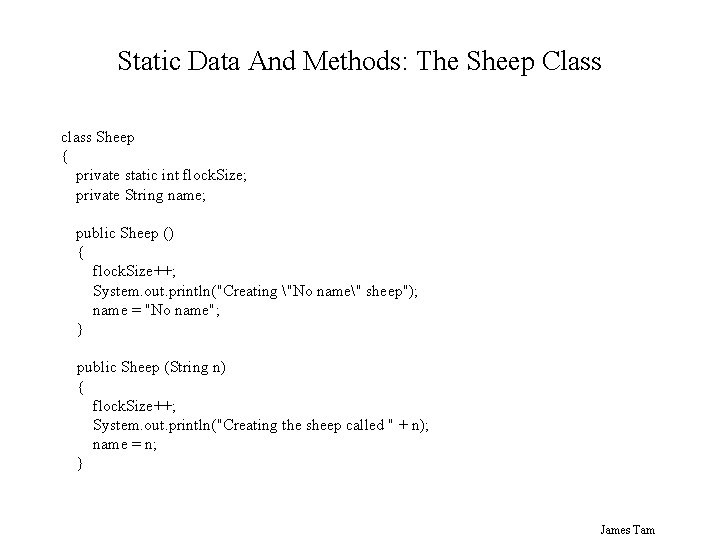
Static Data And Methods: The Sheep Class class Sheep { private static int flock. Size; private String name; public Sheep () { flock. Size++; System. out. println("Creating "No name" sheep"); name = "No name"; } public Sheep (String n) { flock. Size++; System. out. println("Creating the sheep called " + n); name = n; } James Tam
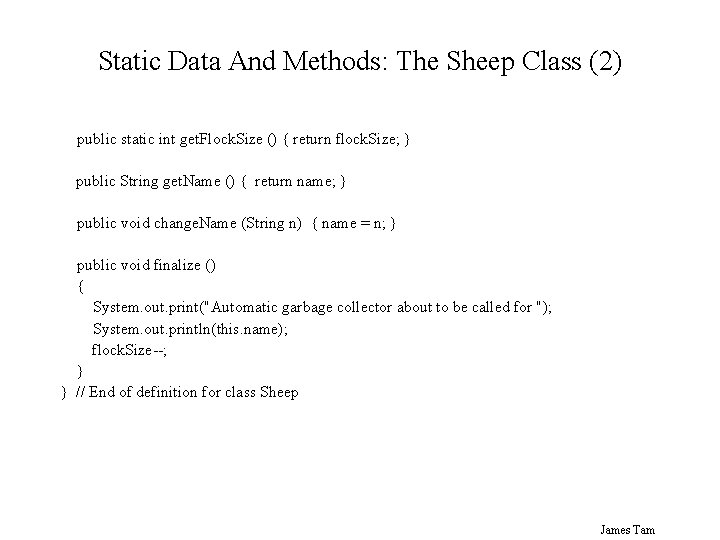
Static Data And Methods: The Sheep Class (2) public static int get. Flock. Size () { return flock. Size; } public String get. Name () { return name; } public void change. Name (String n) { name = n; } public void finalize () { System. out. print("Automatic garbage collector about to be called for "); System. out. println(this. name); flock. Size--; } } // End of definition for class Sheep James Tam
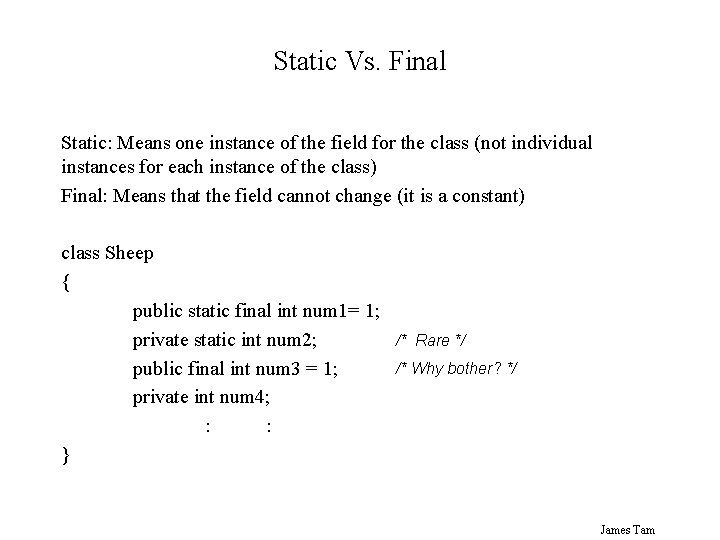
Static Vs. Final Static: Means one instance of the field for the class (not individual instances for each instance of the class) Final: Means that the field cannot change (it is a constant) class Sheep { public static final int num 1= 1; private static int num 2; public final int num 3 = 1; private int num 4; : : } /* Rare */ /* Why bother? */ James Tam
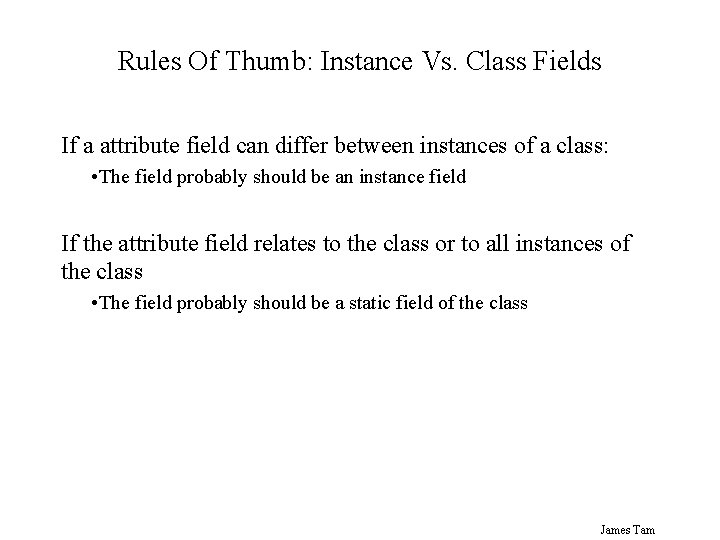
Rules Of Thumb: Instance Vs. Class Fields If a attribute field can differ between instances of a class: • The field probably should be an instance field If the attribute field relates to the class or to all instances of the class • The field probably should be a static field of the class James Tam
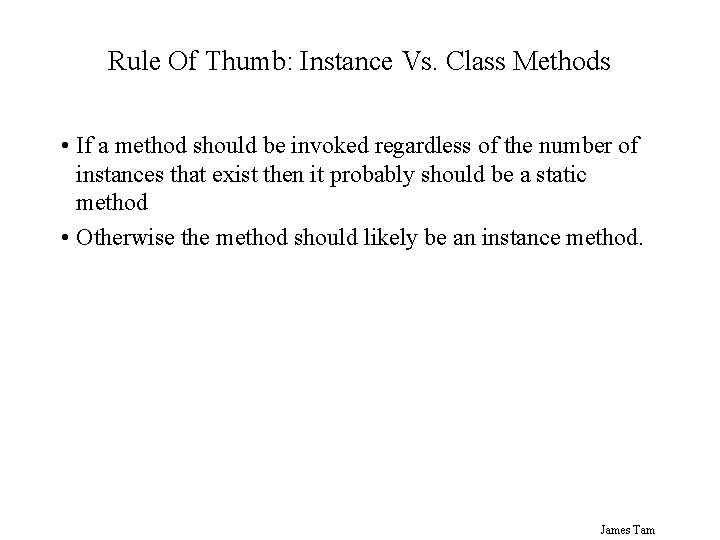
Rule Of Thumb: Instance Vs. Class Methods • If a method should be invoked regardless of the number of instances that exist then it probably should be a static method • Otherwise the method should likely be an instance method. James Tam
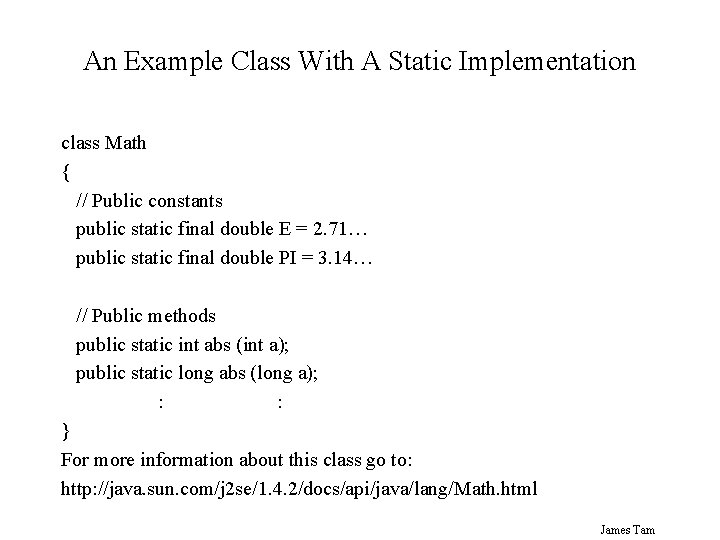
An Example Class With A Static Implementation class Math { // Public constants public static final double E = 2. 71… public static final double PI = 3. 14… // Public methods public static int abs (int a); public static long abs (long a); : : } For more information about this class go to: http: //java. sun. com/j 2 se/1. 4. 2/docs/api/java/lang/Math. html James Tam
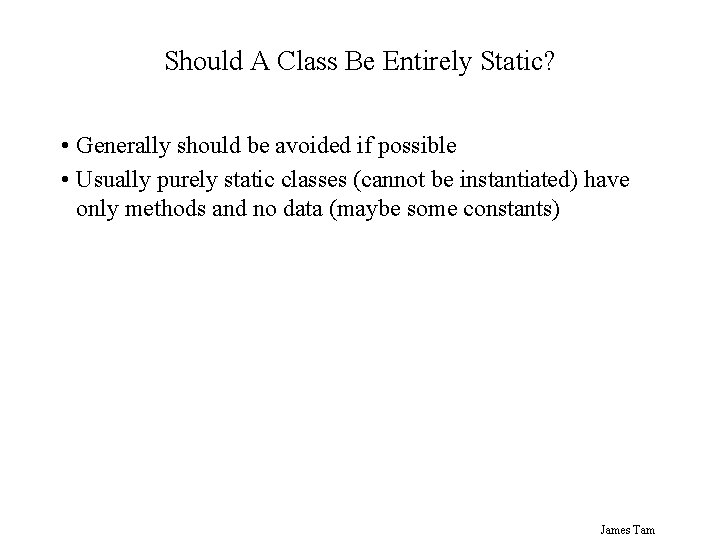
Should A Class Be Entirely Static? • Generally should be avoided if possible • Usually purely static classes (cannot be instantiated) have only methods and no data (maybe some constants) James Tam
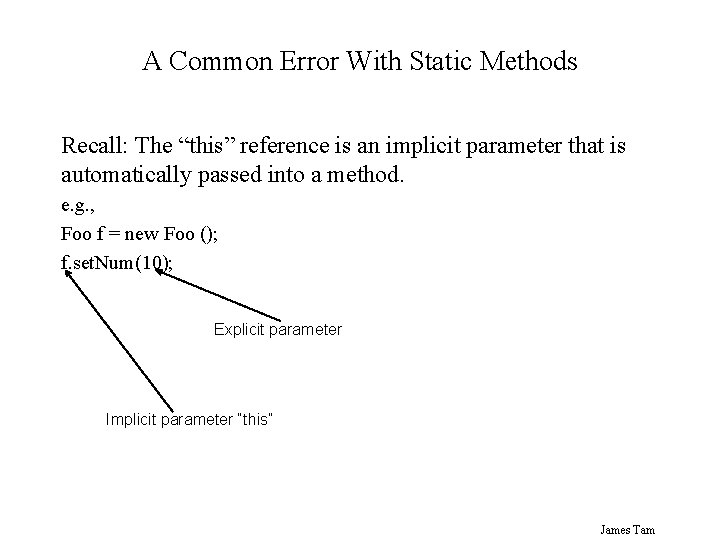
A Common Error With Static Methods Recall: The “this” reference is an implicit parameter that is automatically passed into a method. e. g. , Foo f = new Foo (); f. set. Num(10); Explicit parameter Implicit parameter “this” James Tam
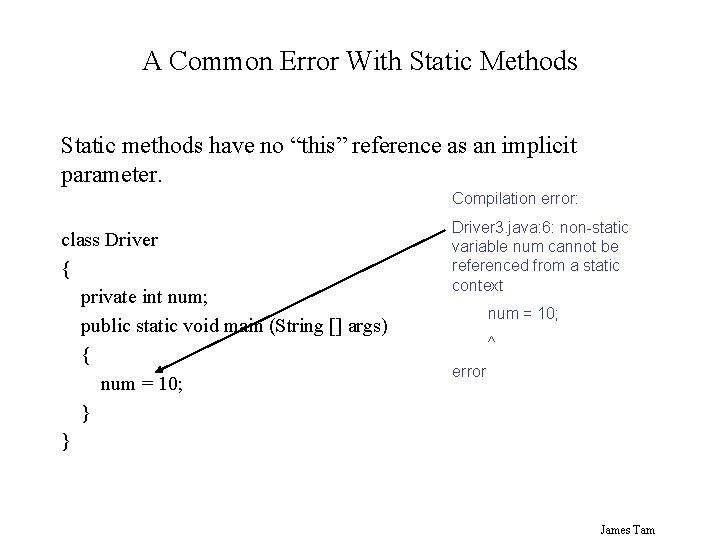
A Common Error With Static Methods Static methods have no “this” reference as an implicit parameter. Compilation error: class Driver { private int num; public static void main (String [] args) { num = 10; } } Driver 3. java: 6: non-static variable num cannot be referenced from a static context num = 10; ^ error James Tam
The Finalize Method Example sequence: Sheep jim = new Sheep (“Jim”); jim James Tam
The Finalize Method Example sequence: Sheep jim = new Sheep (“Jim”); : jim Jim No name jim = new Sheep (); James Tam
The Finalize Method Example sequence: Sheep jim = new Sheep (“Jim”); jim Jim : No name jim = new Sheep (); When? ? ? James Tam
The Finalize Method Example sequence: Sheep jim = new Sheep (“Jim”); : jim Jim No name jim = new Sheep (); jim. finalize() James Tam
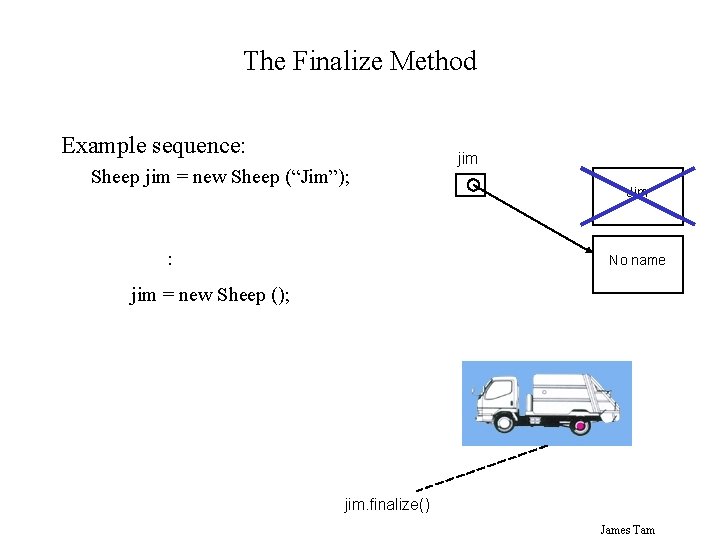
The Finalize Method Example sequence: Sheep jim = new Sheep (“Jim”); : jim Jim No name jim = new Sheep (); jim. finalize() James Tam
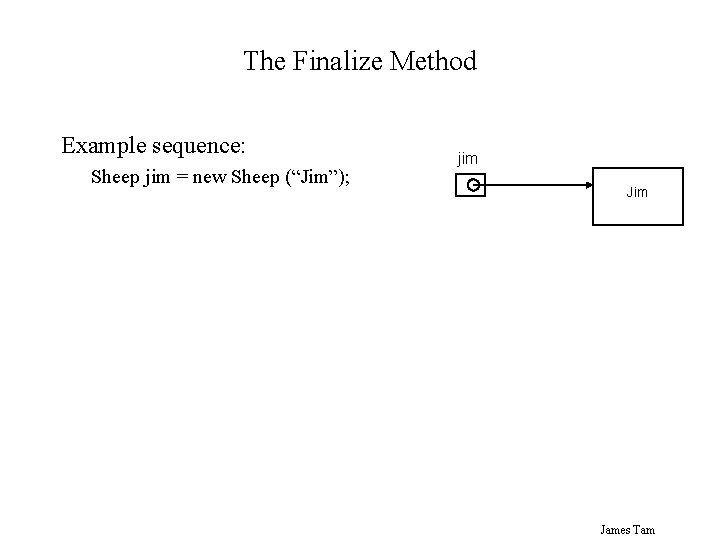
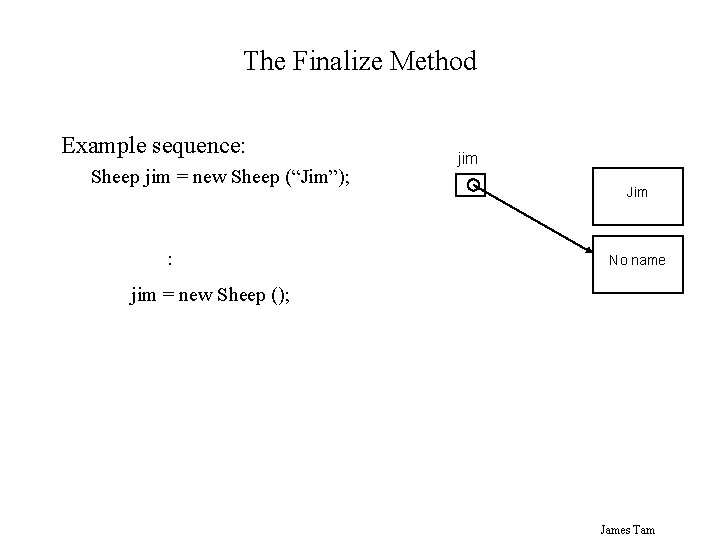
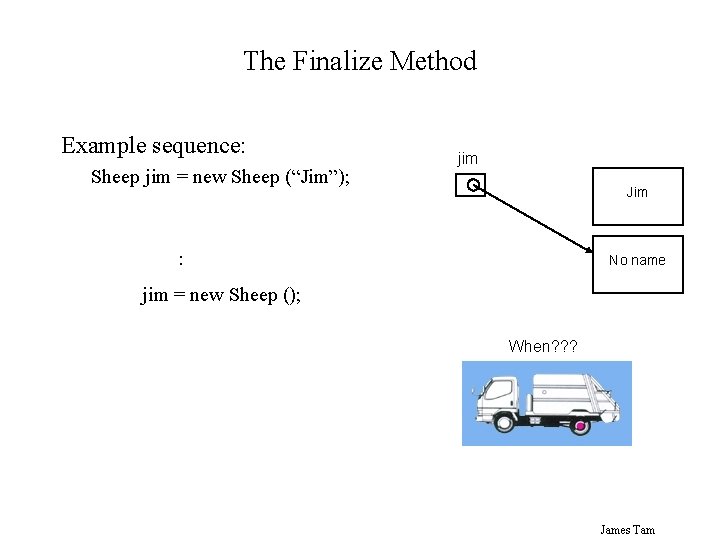
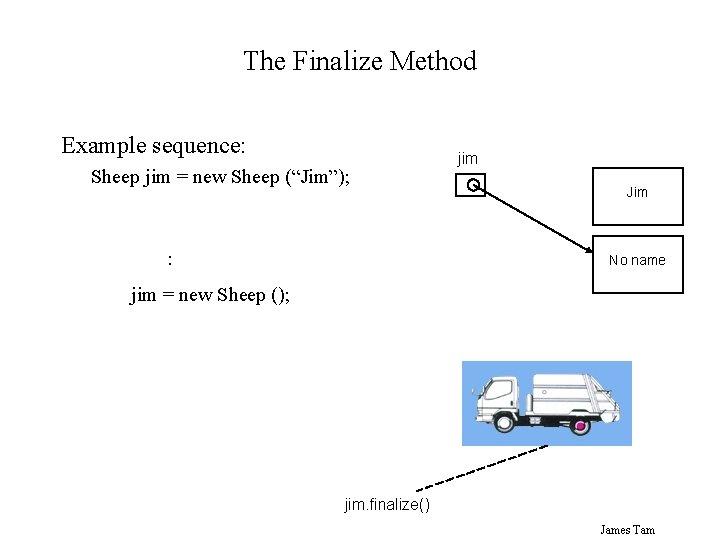
Synopsis Of The Finalize Method • The Java interpreter tracks what memory has been dynamically allocated. • It also tracks when memory is no longer referenced. • When system isn’t busy, the Automatic Garbage Collector is invoked. • If an object has a finalizer method then it is invoked: • The finalizer is a method written by the programmer to free up nonmemory resources e. g. , closing and deleting temporary files created by the program, network connections. • This method takes no arguments and returns no values. • Dynamic memory is NOT freed up by this method. • Then the dynamic memory is freed up by the Automatic Garbage Collector. James Tam
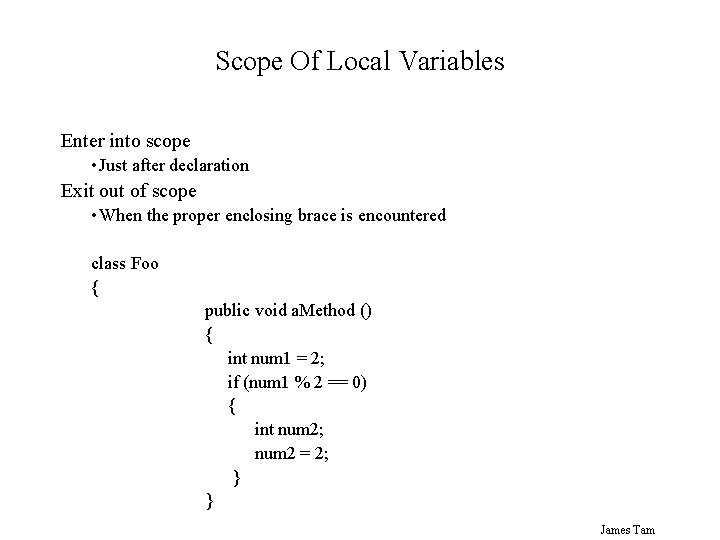
Scope Of Local Variables Enter into scope • Just after declaration Exit out of scope • When the proper enclosing brace is encountered class Foo { public void a. Method () { int num 1 = 2; if (num 1 % 2 == 0) { int num 2; num 2 = 2; } } James Tam
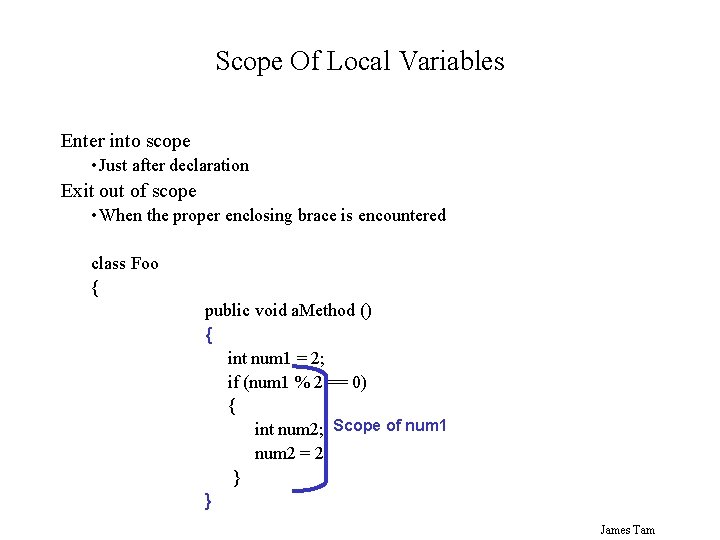
Scope Of Local Variables Enter into scope • Just after declaration Exit out of scope • When the proper enclosing brace is encountered class Foo { public void a. Method () { int num 1 = 2; if (num 1 % 2 == 0) { int num 2; Scope of num 1 num 2 = 2; } } James Tam
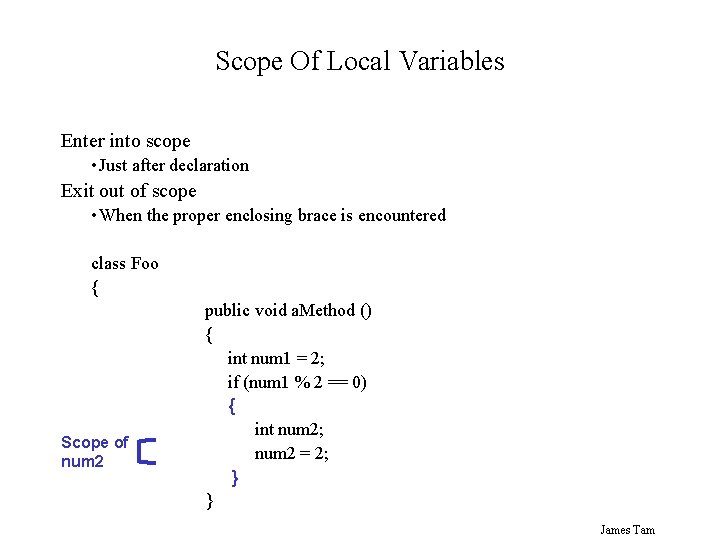
Scope Of Local Variables Enter into scope • Just after declaration Exit out of scope • When the proper enclosing brace is encountered class Foo { Scope of num 2 public void a. Method () { int num 1 = 2; if (num 1 % 2 == 0) { int num 2; num 2 = 2; } } James Tam
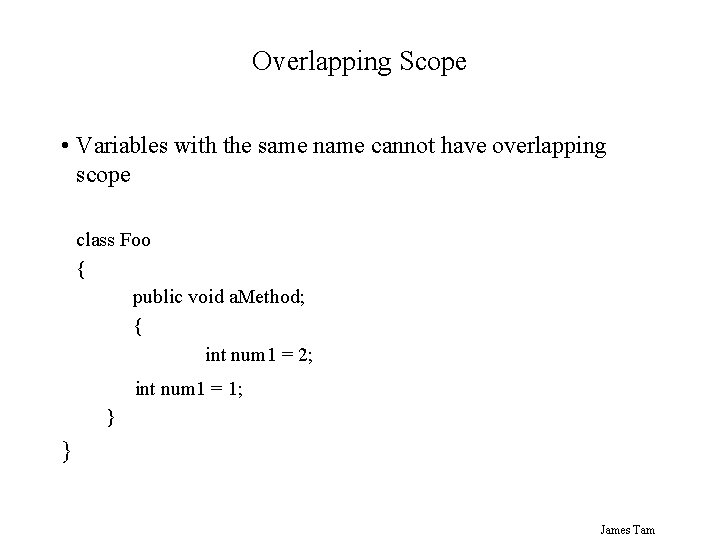
Overlapping Scope • Variables with the same name cannot have overlapping scope class Foo { public void a. Method; { int num 1 = 2; int num 1 = 1; } } James Tam
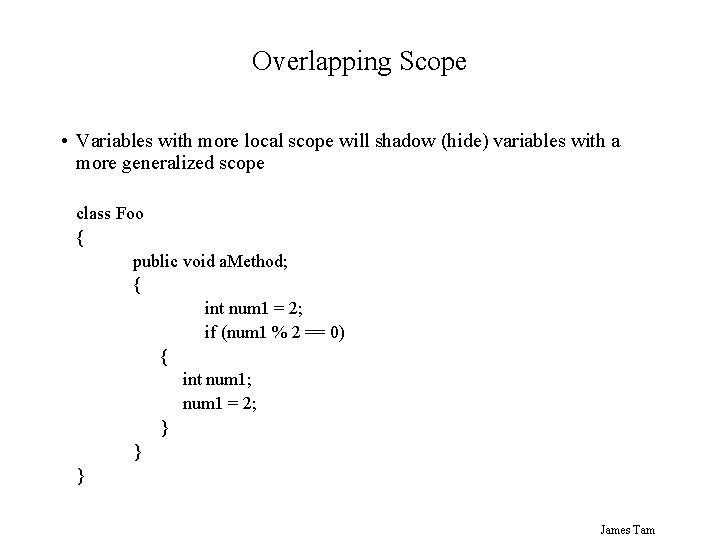
Overlapping Scope • Variables with more local scope will shadow (hide) variables with a more generalized scope class Foo { public void a. Method; { int num 1 = 2; if (num 1 % 2 == 0) { int num 1; num 1 = 2; } } } James Tam
Scope Of Instance/Class Constants And Variables Constants stay in scope for the entire class definition (opening -closing brace) Instance variables and instance methods • Can access the attributes by the name of the attribute alone (because of the implicit parameter “this”) Instance variables and static methods • Can’t access the attributes by the name of the attribute alone (because there is no implicit parameter “this”) James Tam
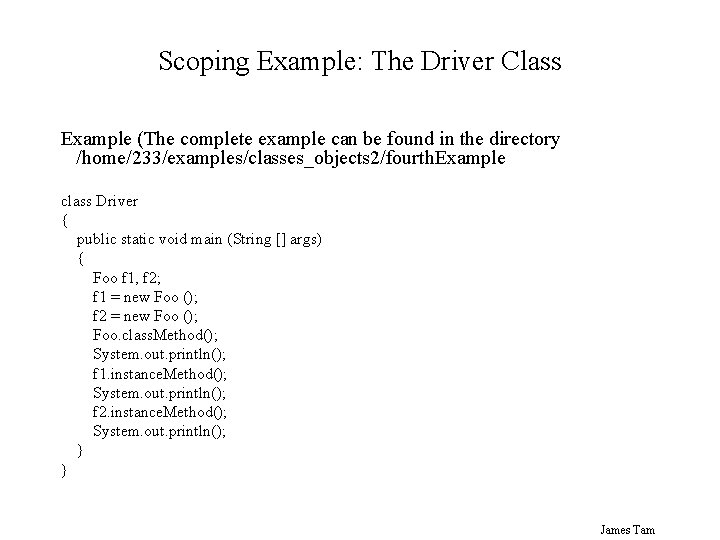
Scoping Example: The Driver Class Example (The complete example can be found in the directory /home/233/examples/classes_objects 2/fourth. Example class Driver { public static void main (String [] args) { Foo f 1, f 2; f 1 = new Foo (); f 2 = new Foo (); Foo. class. Method(); System. out. println(); f 1. instance. Method(); System. out. println(); f 2. instance. Method(); System. out. println(); } } James Tam
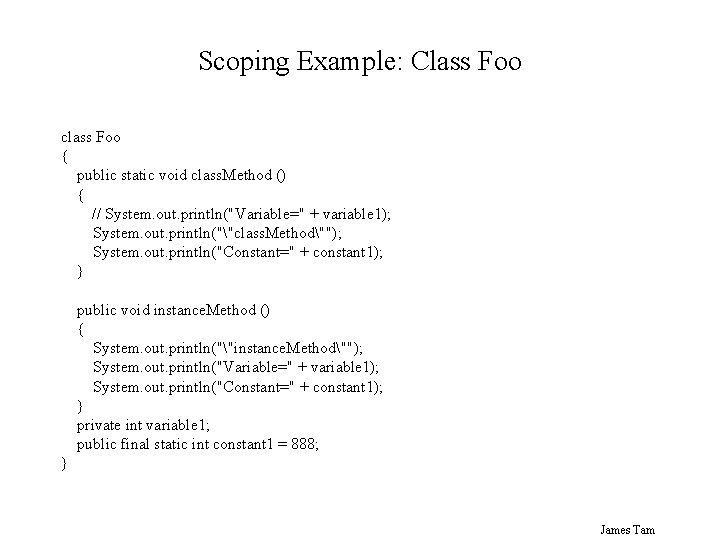
Scoping Example: Class Foo class Foo { public static void class. Method () { // System. out. println("Variable=" + variable 1); System. out. println(""class. Method""); System. out. println("Constant=" + constant 1); } public void instance. Method () { System. out. println(""instance. Method""); System. out. println("Variable=" + variable 1); System. out. println("Constant=" + constant 1); } private int variable 1; public final static int constant 1 = 888; } James Tam
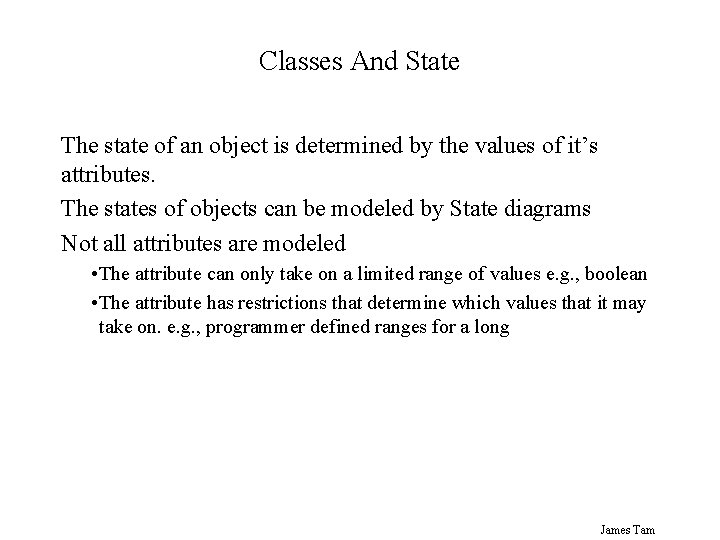
Classes And State The state of an object is determined by the values of it’s attributes. The states of objects can be modeled by State diagrams Not all attributes are modeled • The attribute can only take on a limited range of values e. g. , boolean • The attribute has restrictions that determine which values that it may take on. e. g. , programmer defined ranges for a long James Tam
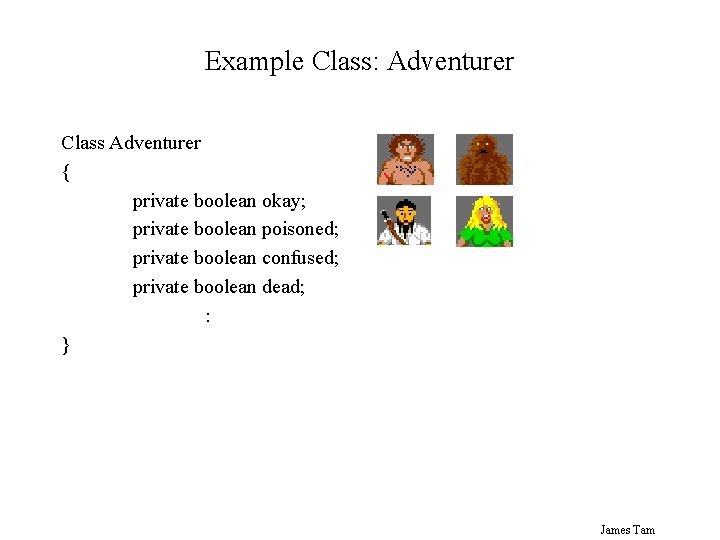
Example Class: Adventurer Class Adventurer { private boolean okay; private boolean poisoned; private boolean confused; private boolean dead; : } James Tam
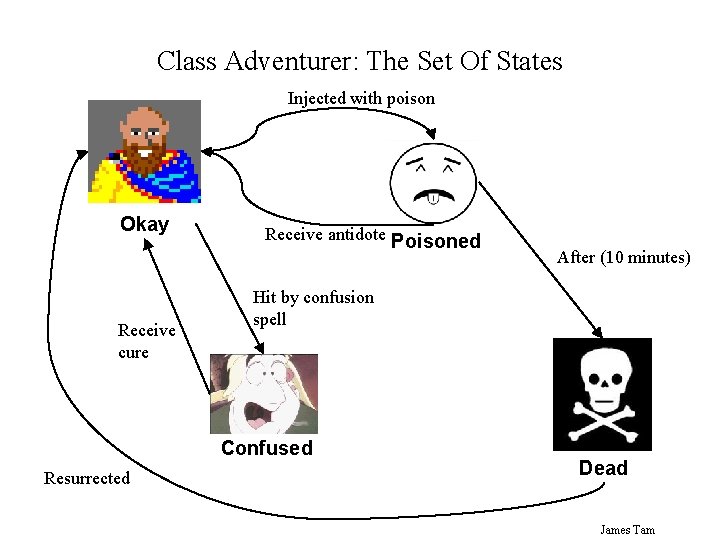
Class Adventurer: The Set Of States Injected with poison Okay Receive cure Receive antidote Poisoned Hit by confusion spell Confused Resurrected After (10 minutes) Dead James Tam
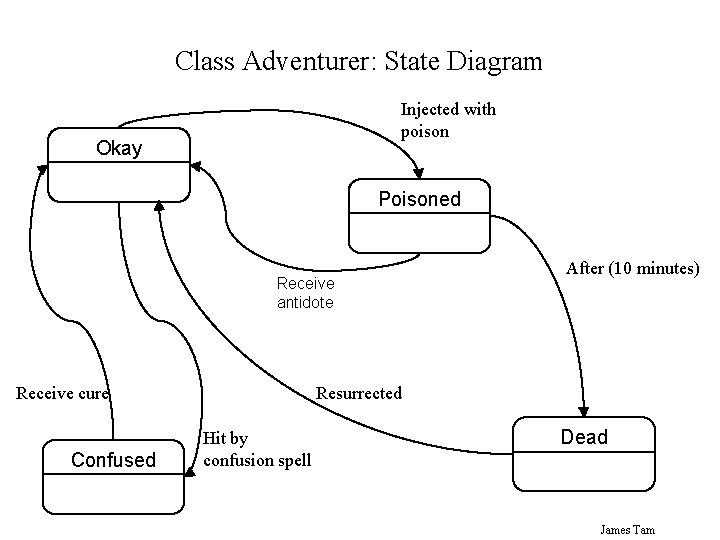
Class Adventurer: State Diagram Injected with poison Okay Poisoned Receive antidote Receive cure Confused After (10 minutes) Resurrected Hit by confusion spell Dead James Tam
Determining The State Of Objects Determining the value of the attributes of a object (state) can be a useful debugging tool. James Tam
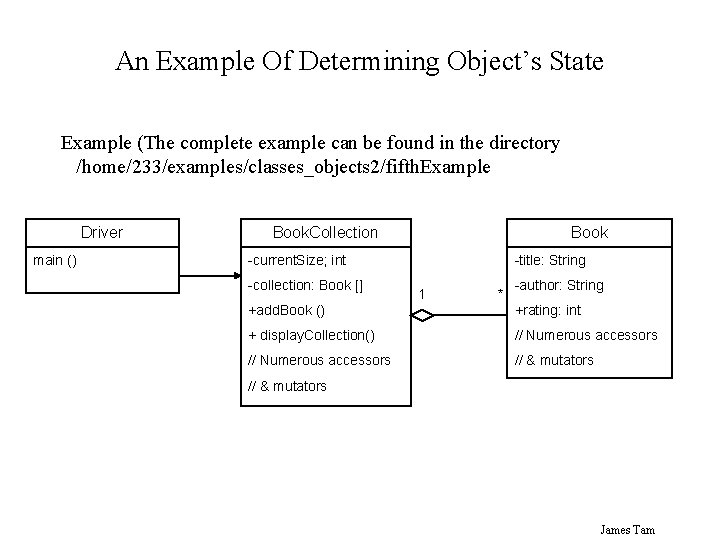
An Example Of Determining Object’s State Example (The complete example can be found in the directory /home/233/examples/classes_objects 2/fifth. Example Driver main () Book. Collection Book -current. Size; int -collection: Book [] -title: String 1 * -author: String +add. Book () +rating: int + display. Collection() // Numerous accessors // & mutators James Tam
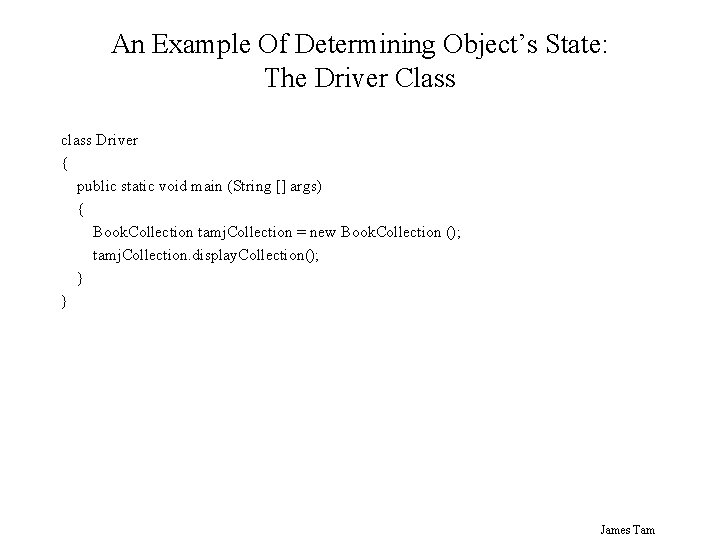
An Example Of Determining Object’s State: The Driver Class class Driver { public static void main (String [] args) { Book. Collection tamj. Collection = new Book. Collection (); tamj. Collection. display. Collection(); } } James Tam
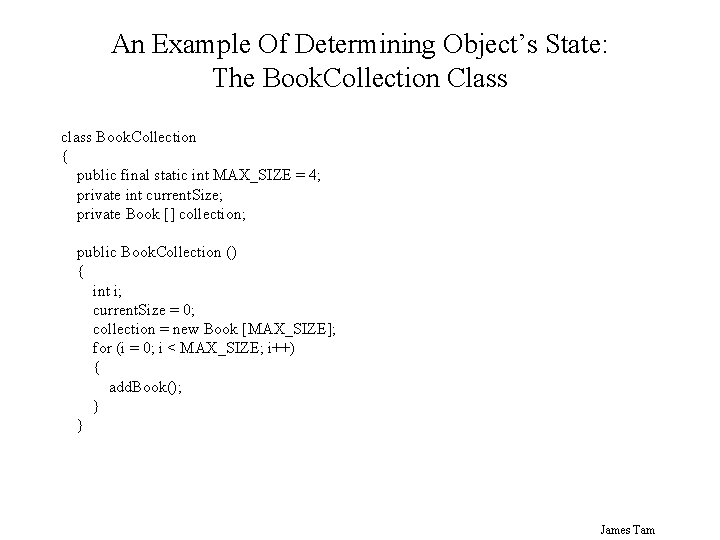
An Example Of Determining Object’s State: The Book. Collection Class class Book. Collection { public final static int MAX_SIZE = 4; private int current. Size; private Book [] collection; public Book. Collection () { int i; current. Size = 0; collection = new Book [MAX_SIZE]; for (i = 0; i < MAX_SIZE; i++) { add. Book(); } } James Tam
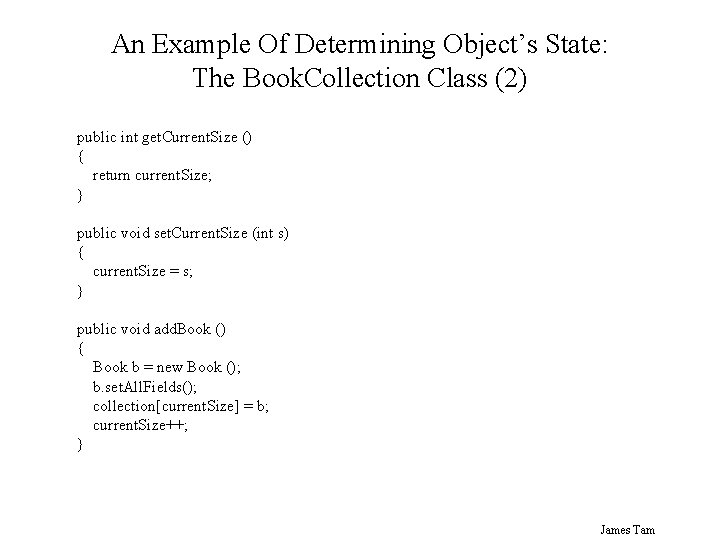
An Example Of Determining Object’s State: The Book. Collection Class (2) public int get. Current. Size () { return current. Size; } public void set. Current. Size (int s) { current. Size = s; } public void add. Book () { Book b = new Book (); b. set. All. Fields(); collection[current. Size] = b; current. Size++; } James Tam
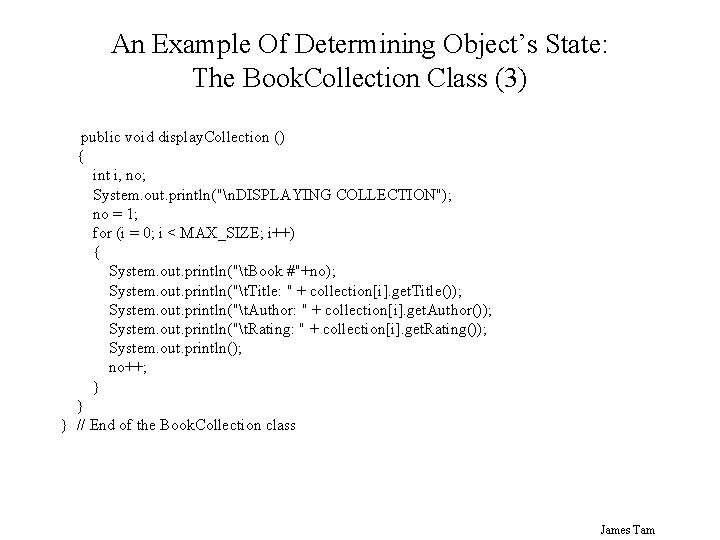
An Example Of Determining Object’s State: The Book. Collection Class (3) public void display. Collection () { int i, no; System. out. println("n. DISPLAYING COLLECTION"); no = 1; for (i = 0; i < MAX_SIZE; i++) { System. out. println("t. Book #"+no); System. out. println("t. Title: " + collection[i]. get. Title()); System. out. println("t. Author: " + collection[i]. get. Author()); System. out. println("t. Rating: " + collection[i]. get. Rating()); System. out. println(); no++; } } } // End of the Book. Collection class James Tam
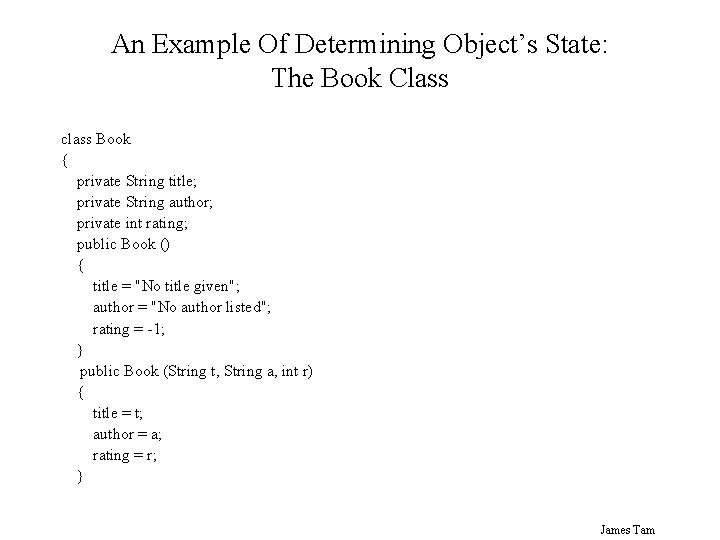
An Example Of Determining Object’s State: The Book Class class Book { private String title; private String author; private int rating; public Book () { title = "No title given"; author = "No author listed"; rating = -1; } public Book (String t, String a, int r) { title = t; author = a; rating = r; } James Tam
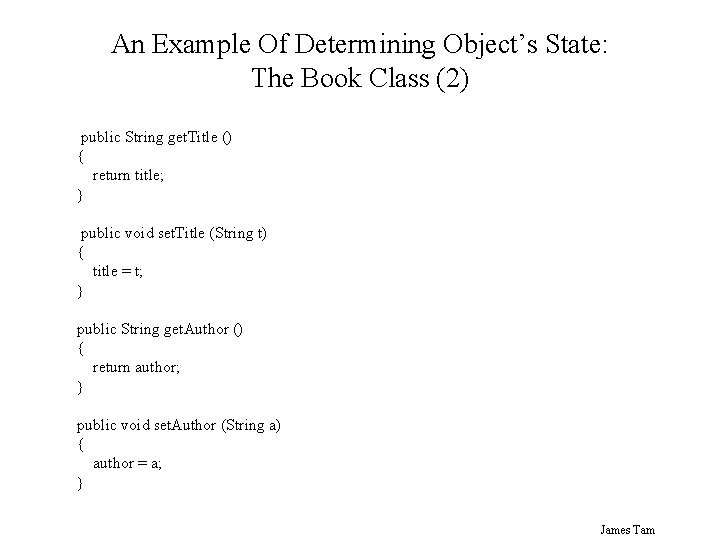
An Example Of Determining Object’s State: The Book Class (2) public String get. Title () { return title; } public void set. Title (String t) { title = t; } public String get. Author () { return author; } public void set. Author (String a) { author = a; } James Tam
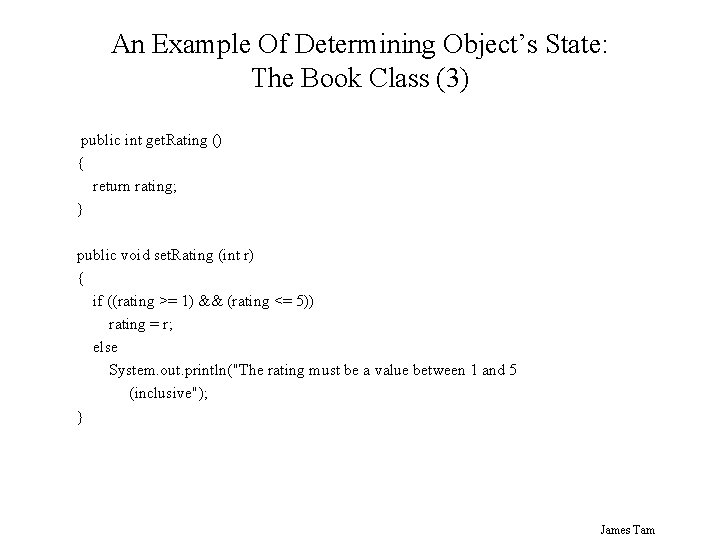
An Example Of Determining Object’s State: The Book Class (3) public int get. Rating () { return rating; } public void set. Rating (int r) { if ((rating >= 1) && (rating <= 5)) rating = r; else System. out. println("The rating must be a value between 1 and 5 (inclusive"); } James Tam
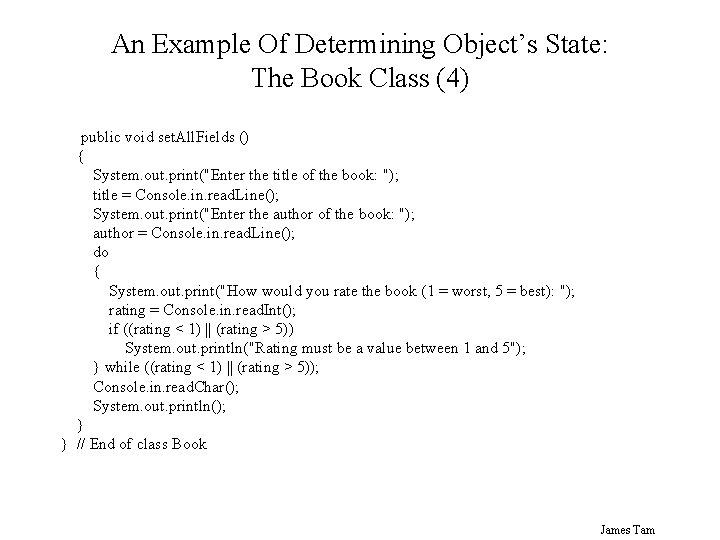
An Example Of Determining Object’s State: The Book Class (4) public void set. All. Fields () { System. out. print("Enter the title of the book: "); title = Console. in. read. Line(); System. out. print("Enter the author of the book: "); author = Console. in. read. Line(); do { System. out. print("How would you rate the book (1 = worst, 5 = best): "); rating = Console. in. read. Int(); if ((rating < 1) || (rating > 5)) System. out. println("Rating must be a value between 1 and 5"); } while ((rating < 1) || (rating > 5)); Console. in. read. Char(); System. out. println(); } } // End of class Book James Tam
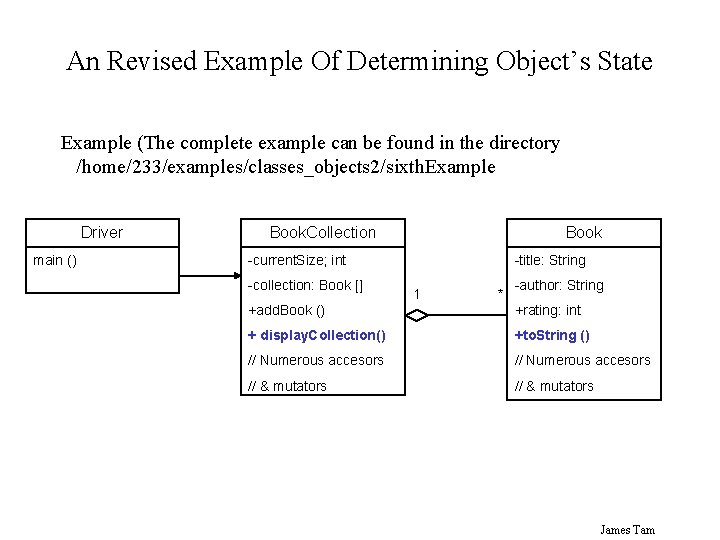
An Revised Example Of Determining Object’s State Example (The complete example can be found in the directory /home/233/examples/classes_objects 2/sixth. Example Driver main () Book. Collection Book -current. Size; int -collection: Book [] -title: String 1 * -author: String +add. Book () +rating: int + display. Collection() +to. String () // Numerous accesors // & mutators James Tam
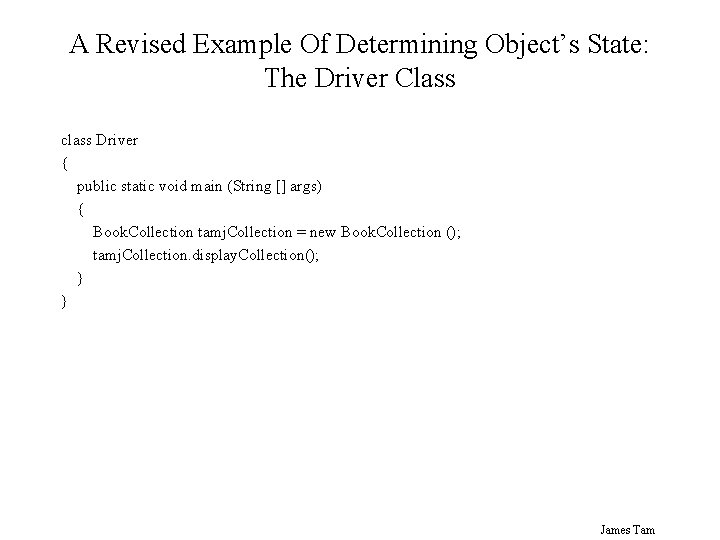
A Revised Example Of Determining Object’s State: The Driver Class class Driver { public static void main (String [] args) { Book. Collection tamj. Collection = new Book. Collection (); tamj. Collection. display. Collection(); } } James Tam
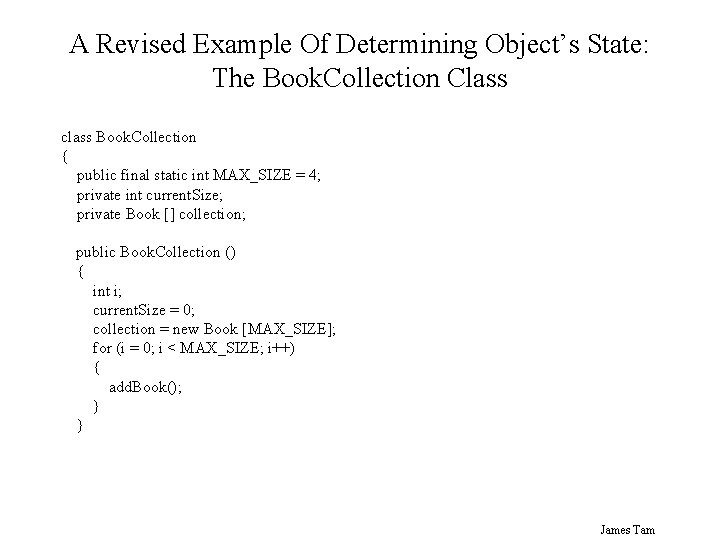
A Revised Example Of Determining Object’s State: The Book. Collection Class class Book. Collection { public final static int MAX_SIZE = 4; private int current. Size; private Book [] collection; public Book. Collection () { int i; current. Size = 0; collection = new Book [MAX_SIZE]; for (i = 0; i < MAX_SIZE; i++) { add. Book(); } } James Tam
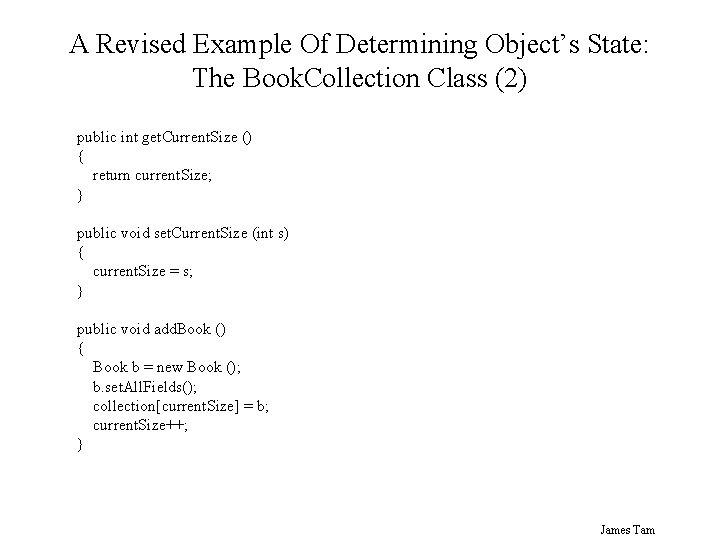
A Revised Example Of Determining Object’s State: The Book. Collection Class (2) public int get. Current. Size () { return current. Size; } public void set. Current. Size (int s) { current. Size = s; } public void add. Book () { Book b = new Book (); b. set. All. Fields(); collection[current. Size] = b; current. Size++; } James Tam
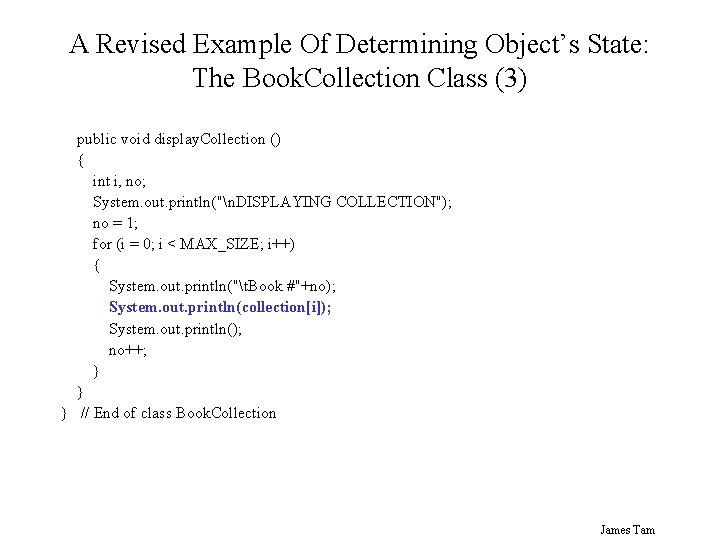
A Revised Example Of Determining Object’s State: The Book. Collection Class (3) public void display. Collection () { int i, no; System. out. println("n. DISPLAYING COLLECTION"); no = 1; for (i = 0; i < MAX_SIZE; i++) { System. out. println("t. Book #"+no); System. out. println(collection[i]); System. out. println(); no++; } } } // End of class Book. Collection James Tam
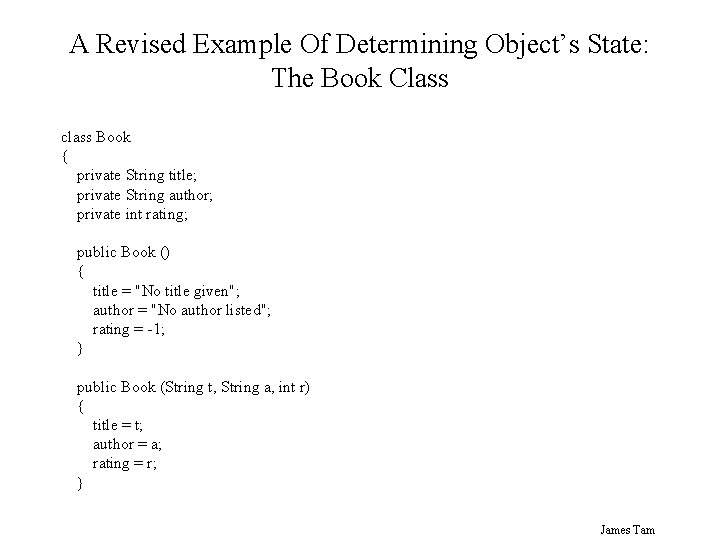
A Revised Example Of Determining Object’s State: The Book Class class Book { private String title; private String author; private int rating; public Book () { title = "No title given"; author = "No author listed"; rating = -1; } public Book (String t, String a, int r) { title = t; author = a; rating = r; } James Tam
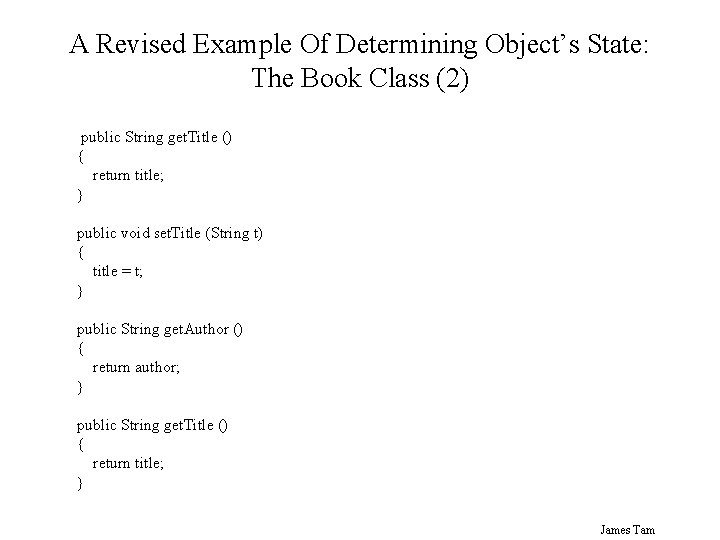
A Revised Example Of Determining Object’s State: The Book Class (2) public String get. Title () { return title; } public void set. Title (String t) { title = t; } public String get. Author () { return author; } public String get. Title () { return title; } James Tam
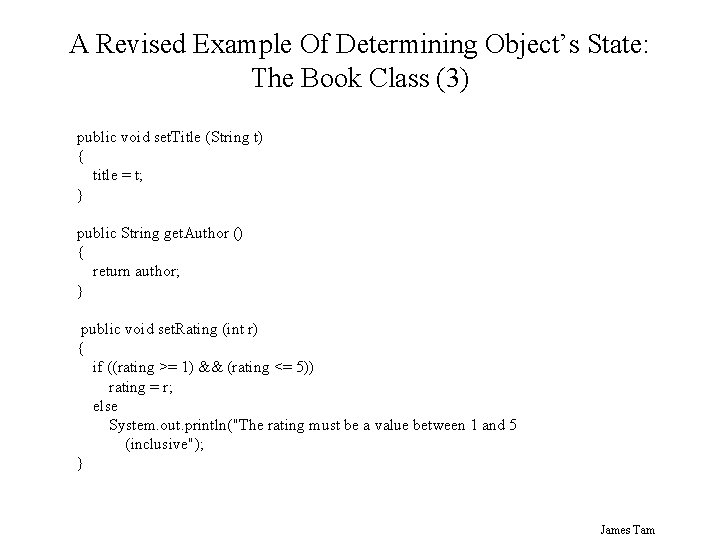
A Revised Example Of Determining Object’s State: The Book Class (3) public void set. Title (String t) { title = t; } public String get. Author () { return author; } public void set. Rating (int r) { if ((rating >= 1) && (rating <= 5)) rating = r; else System. out. println("The rating must be a value between 1 and 5 (inclusive"); } James Tam
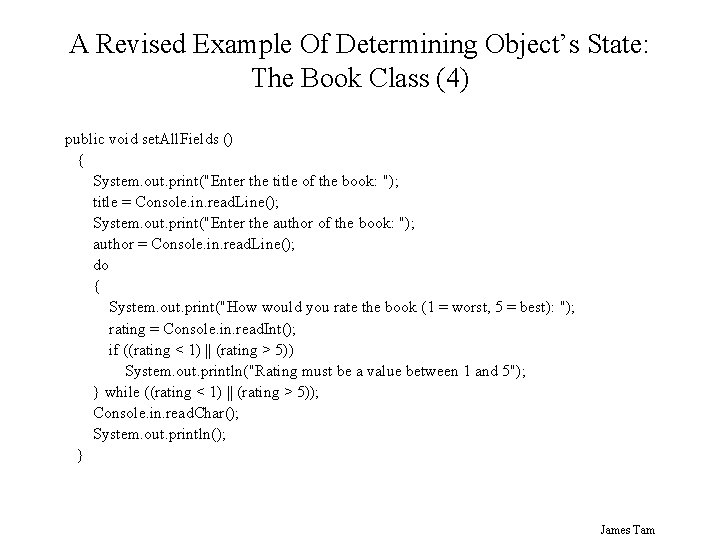
A Revised Example Of Determining Object’s State: The Book Class (4) public void set. All. Fields () { System. out. print("Enter the title of the book: "); title = Console. in. read. Line(); System. out. print("Enter the author of the book: "); author = Console. in. read. Line(); do { System. out. print("How would you rate the book (1 = worst, 5 = best): "); rating = Console. in. read. Int(); if ((rating < 1) || (rating > 5)) System. out. println("Rating must be a value between 1 and 5"); } while ((rating < 1) || (rating > 5)); Console. in. read. Char(); System. out. println(); } James Tam
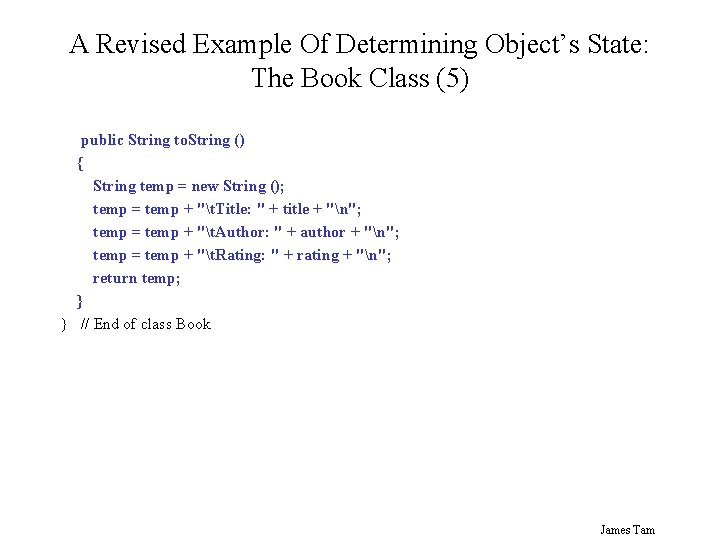
A Revised Example Of Determining Object’s State: The Book Class (5) public String to. String () { String temp = new String (); temp = temp + "t. Title: " + title + "n"; temp = temp + "t. Author: " + author + "n"; temp = temp + "t. Rating: " + rating + "n"; return temp; } } // End of class Book James Tam
You Should Now Know • New terminology and concepts relevant to methods: message passing, method signatures, overloading of methods • What is implementation hiding and what is the benefit of employing it • Two types of relationships that can exist between classes: associations and aggregation • Some specific issues and problems associated with Java references • The parameter passing mechanism that is employed for different types in Java • How does the assignment and comparison of references work in Java • What is the "this" reference: how does it work and when is used James Tam
You Should Now Know (2) • What is the difference between static and instance methods, and static and instance attributes and when to should each one be employed • More advanced concepts in the Java garbage collection process: the finalize method and how it fits into the garbage collection for references • What is the scope of the different attributes and methods of a class • Classes and states: • What is meant by the state of an instance of a class • Debugging programs by examining the state of instances James Tam
- Slides: 116