
CPSC 233 Introduction to Classes and Objects Part
CPSC 233: Introduction to Classes and Objects, Part I Attributes and methods Creating new classes References: Dynamic memory allocation and automatic garbage collection Encapsulation and information hiding Constructors Shadowing Arrays James Tam
What Does Object-Oriented Mean? Procedural approach (CPSC 231) • Design and build the software in terms of actions (verbs) Object-Oriented approach (CPSC 233) • Design and build the software in terms of things (nouns) James Tam
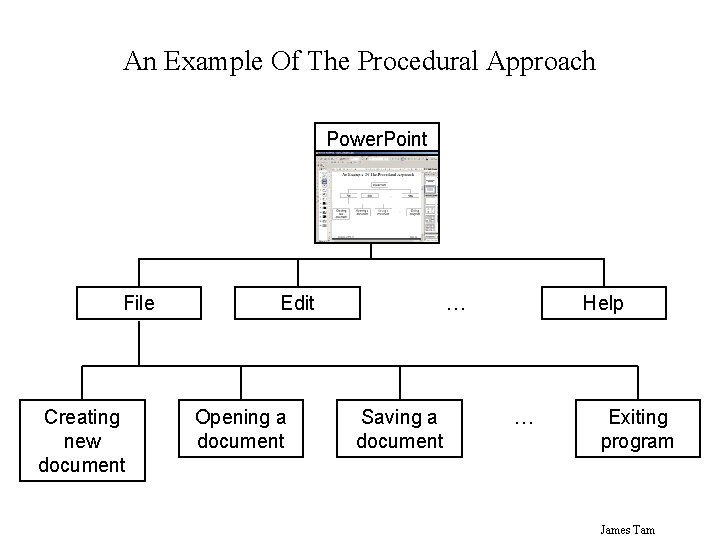
An Example Of The Procedural Approach Power. Point File Creating new document Edit Opening a document … Saving a document Help … Exiting program James Tam
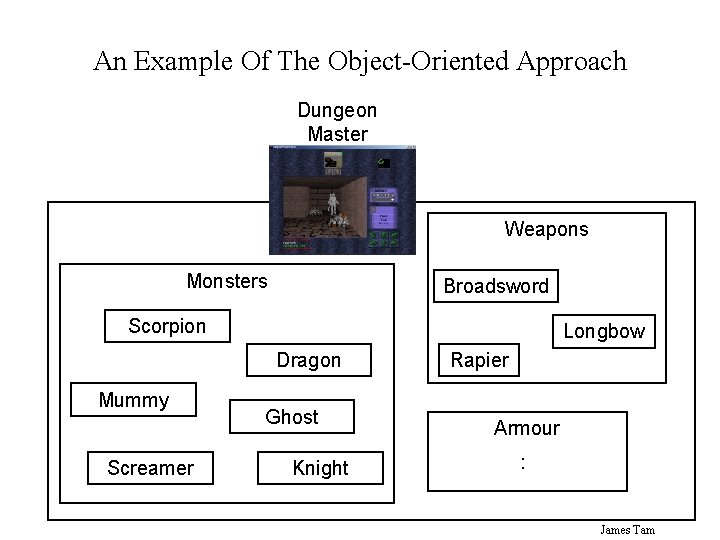
An Example Of The Object-Oriented Approach Dungeon Master Weapons Monsters Broadsword Scorpion Longbow Dragon Mummy Screamer Ghost Knight Rapier Armour : James Tam
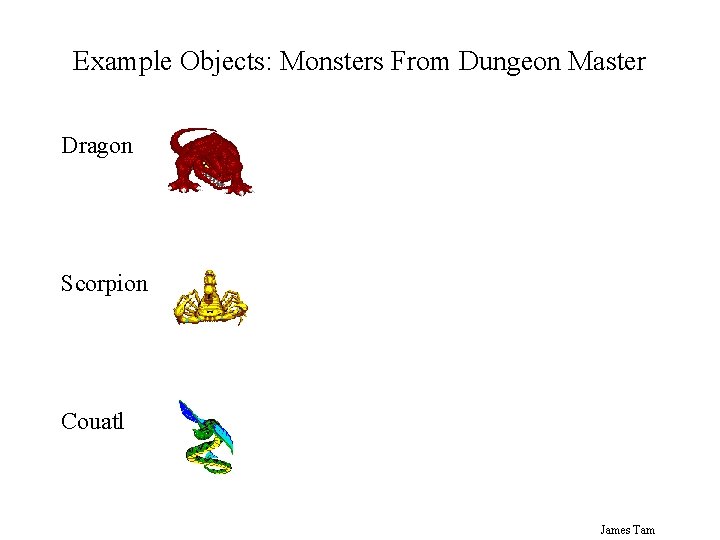
Example Objects: Monsters From Dungeon Master Dragon Scorpion Couatl James Tam
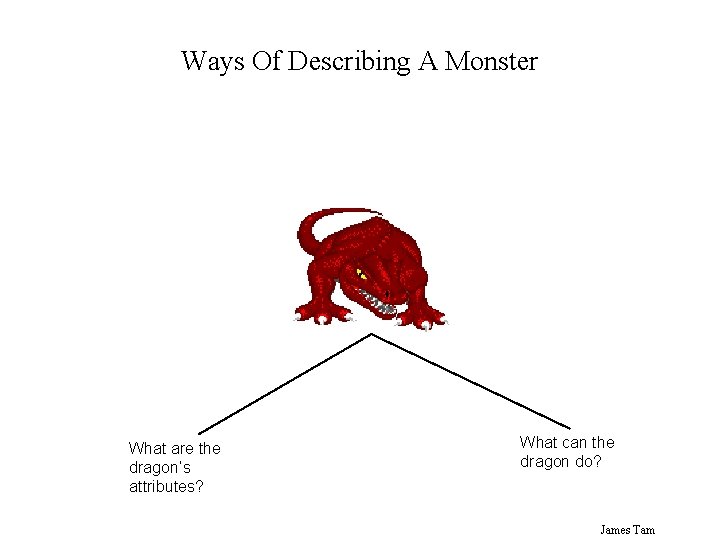
Ways Of Describing A Monster What are the dragon’s attributes? What can the dragon do? James Tam
Monsters: Attributes Represents information about the monster: • Name • Damage it inflicts • Damage it can sustain • Speed : James Tam
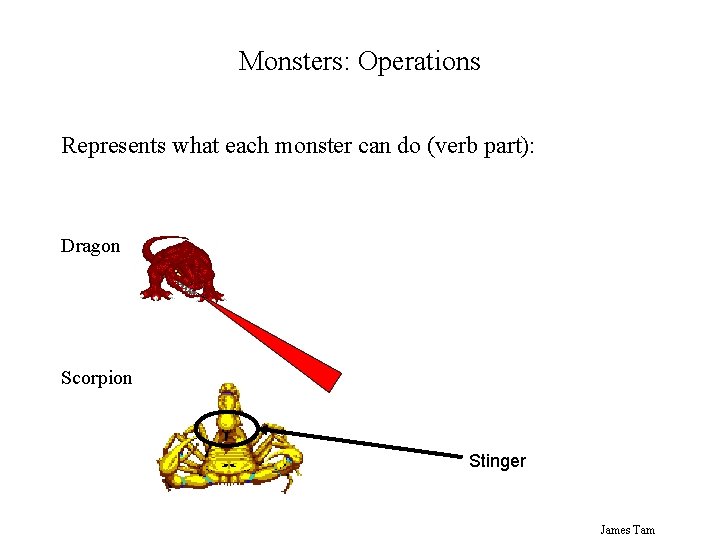
Monsters: Operations Represents what each monster can do (verb part): Dragon Scorpion Stinger James Tam
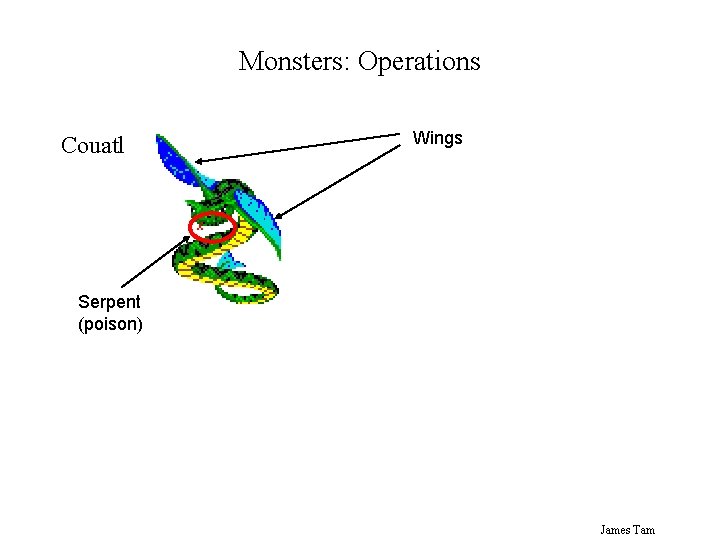
Monsters: Operations Couatl Wings Serpent (poison) James Tam
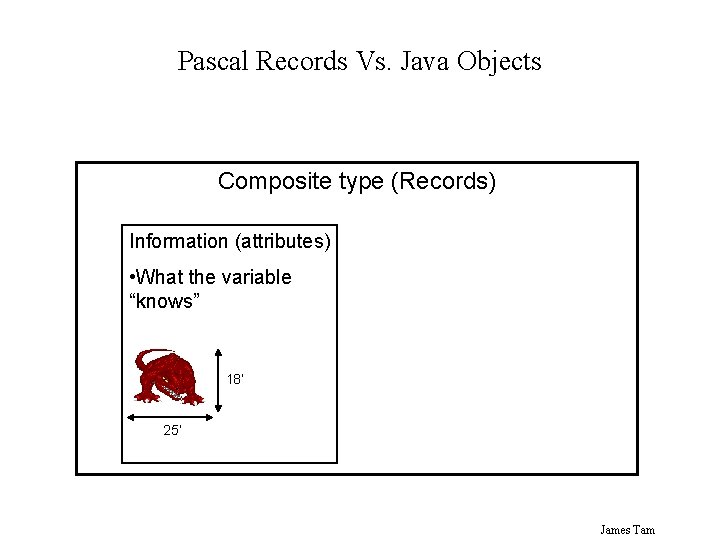
Pascal Records Vs. Java Objects Composite type (Records) Information (attributes) • What the variable “knows” 18’ 25’ James Tam
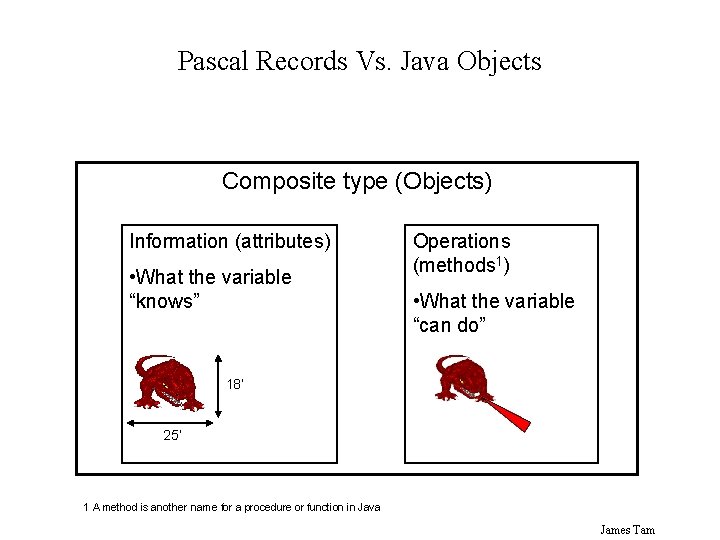
Pascal Records Vs. Java Objects Composite type (Objects) Information (attributes) • What the variable “knows” Operations (methods 1) • What the variable “can do” 18’ 25’ 1 A method is another name for a procedure or function in Java James Tam
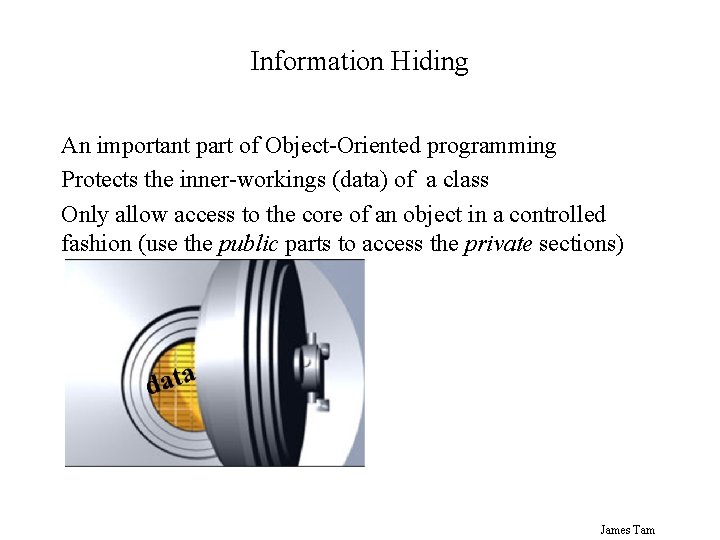
Information Hiding An important part of Object-Oriented programming Protects the inner-workings (data) of a class Only allow access to the core of an object in a controlled fashion (use the public parts to access the private sections) James Tam
Illustrating The Need For Information Hiding: An Example Creating a new monster: “The Critter” Attribute: Height (must be 60” – 72”) James Tam
Illustrating The Need For Information Hiding: An Example Creating a new monster: “The Critter” Attribute: Height (must be 60” – 72”) James Tam
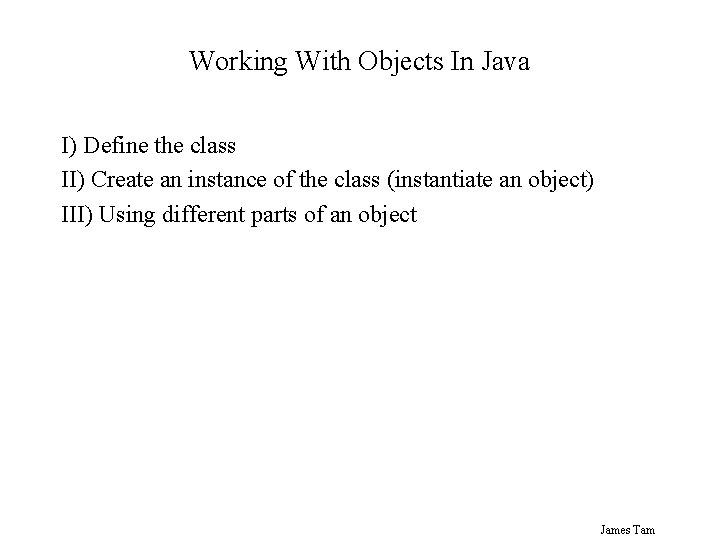
Working With Objects In Java I) Define the class II) Create an instance of the class (instantiate an object) III) Using different parts of an object James Tam
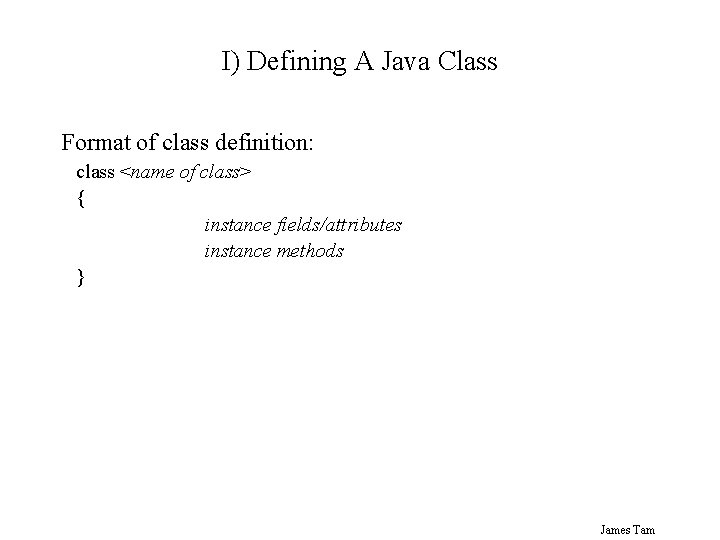
I) Defining A Java Class Format of class definition: class <name of class> { instance fields/attributes instance methods } James Tam
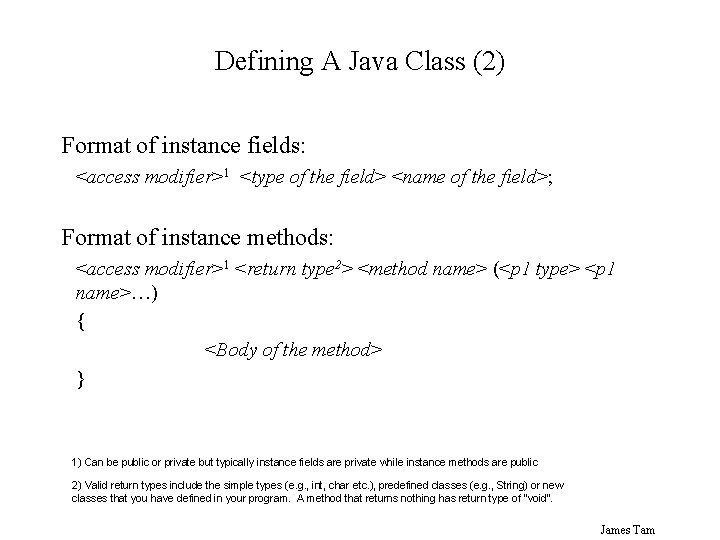
Defining A Java Class (2) Format of instance fields: <access modifier>1 <type of the field> <name of the field>; Format of instance methods: <access modifier>1 <return type 2> <method name> (<p 1 type> <p 1 name>…) { <Body of the method> } 1) Can be public or private but typically instance fields are private while instance methods are public 2) Valid return types include the simple types (e. g. , int, char etc. ), predefined classes (e. g. , String) or new classes that you have defined in your program. A method that returns nothing has return type of “void”. James Tam
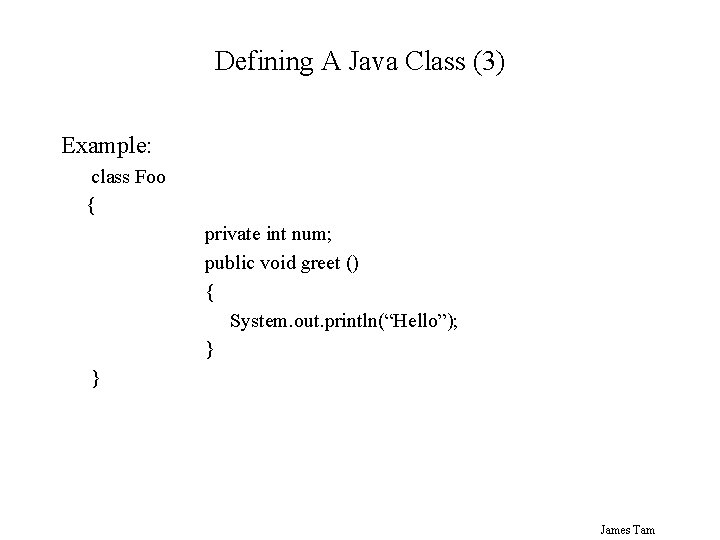
Defining A Java Class (3) Example: class Foo { private int num; public void greet () { System. out. println(“Hello”); } } James Tam
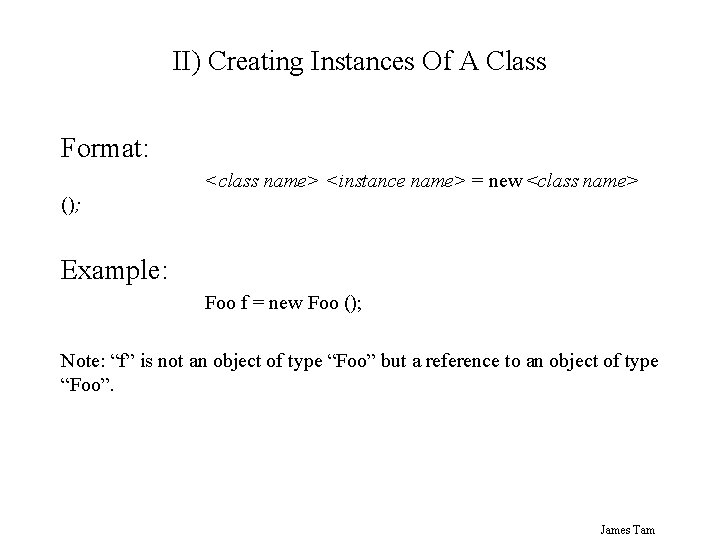
II) Creating Instances Of A Class Format: <class name> <instance name> = new <class name> (); Example: Foo f = new Foo (); Note: “f” is not an object of type “Foo” but a reference to an object of type “Foo”. James Tam
References It is a pointer that cannot be de-referenced by the programmer Automatically garbage collected when no longer needed James Tam
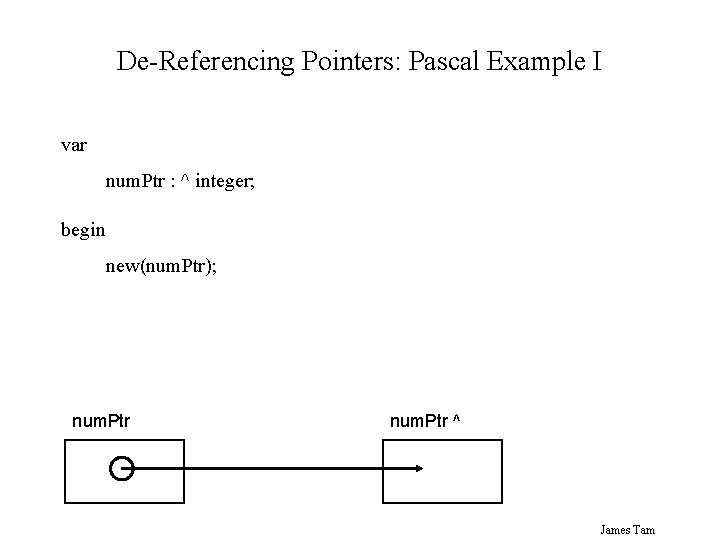
De-Referencing Pointers: Pascal Example I var num. Ptr : ^ integer; begin new(num. Ptr); num. Ptr ^ James Tam
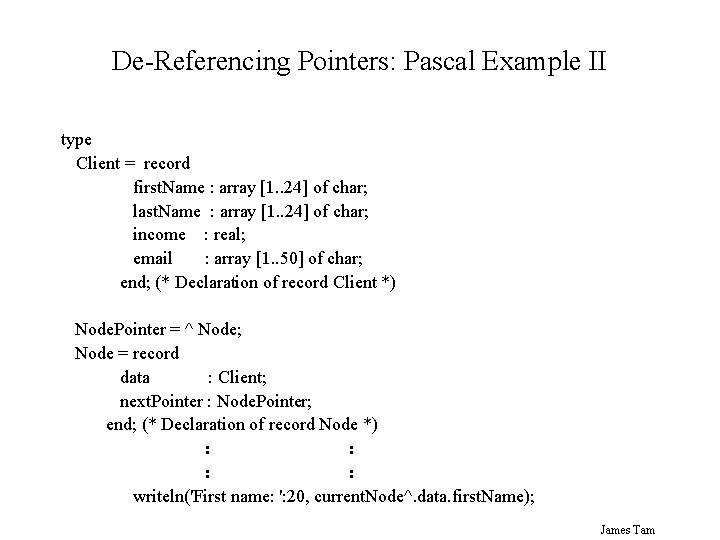
De-Referencing Pointers: Pascal Example II type Client = record first. Name : array [1. . 24] of char; last. Name : array [1. . 24] of char; income : real; email : array [1. . 50] of char; end; (* Declaration of record Client *) Node. Pointer = ^ Node; Node = record data : Client; next. Pointer : Node. Pointer; end; (* Declaration of record Node *) : : writeln('First name: ': 20, current. Node^. data. first. Name); James Tam
III) Using The Parts Of A Class Format: <instance name>. <attribute name>; <instance name>. <method name>; Example: Foo f = new Foo (); f. greet(); Note: In order to use the dot-operator “. ” the instance field or method cannot have a private level of access James Tam
Java References It is a pointer that cannot be de-referenced by the programmer Automatically garbage collected when no longer needed James Tam
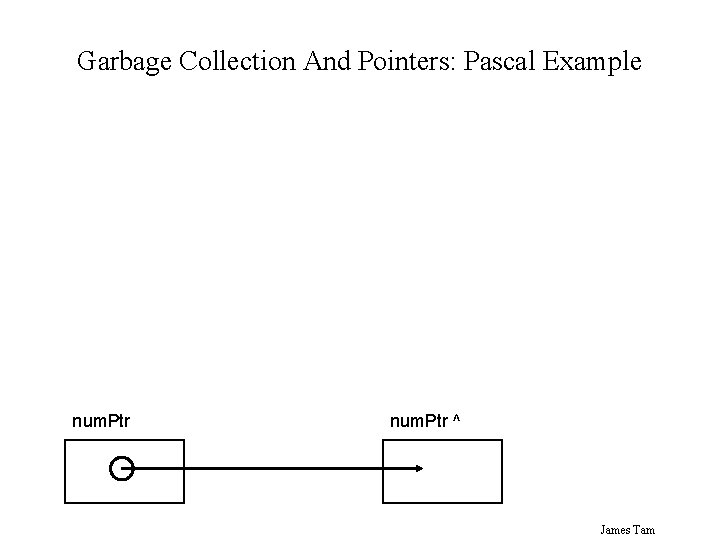
Garbage Collection And Pointers: Pascal Example num. Ptr ^ James Tam
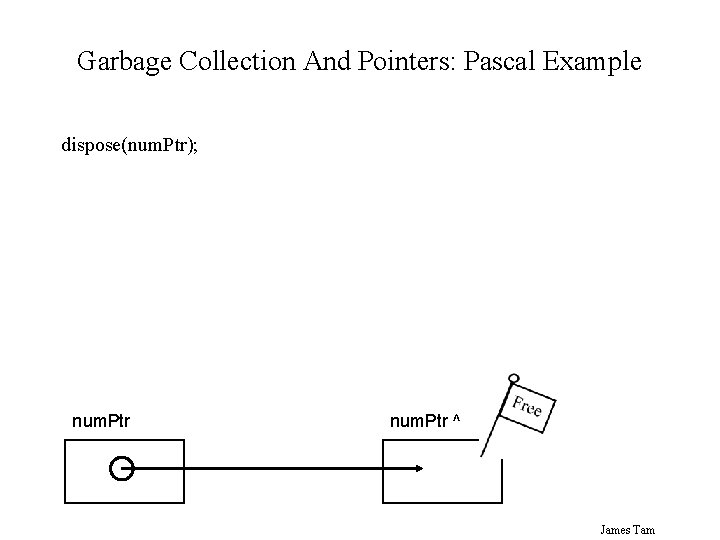
Garbage Collection And Pointers: Pascal Example dispose(num. Ptr); num. Ptr ^ James Tam
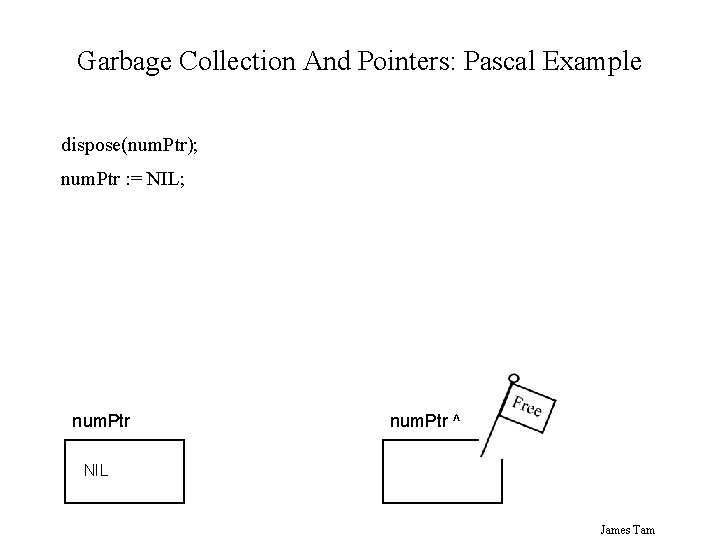
Garbage Collection And Pointers: Pascal Example dispose(num. Ptr); num. Ptr : = NIL; num. Ptr ^ NIL James Tam
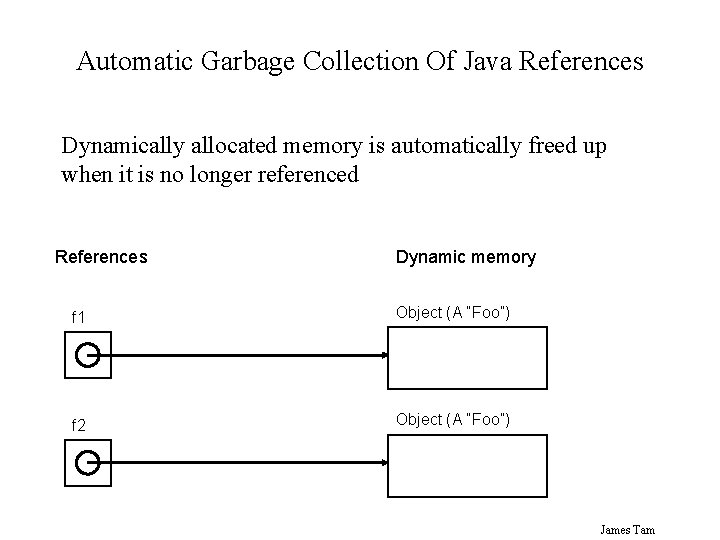
Automatic Garbage Collection Of Java References Dynamically allocated memory is automatically freed up when it is no longer referenced References Dynamic memory f 1 Object (A “Foo”) f 2 Object (A “Foo”) James Tam
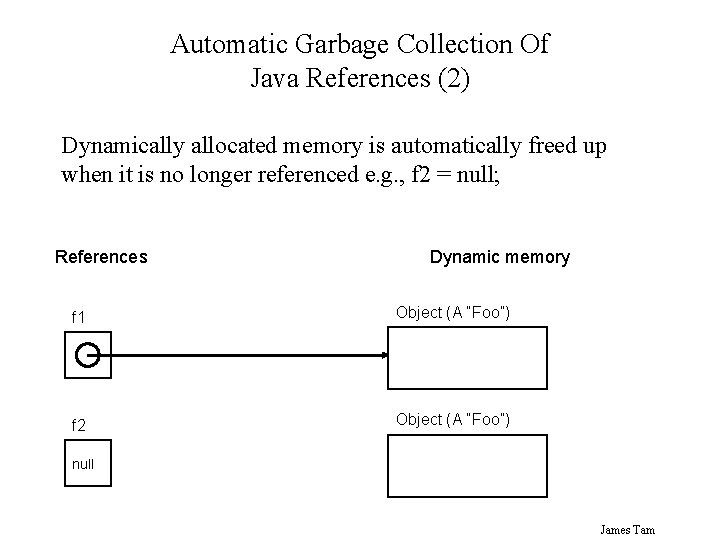
Automatic Garbage Collection Of Java References (2) Dynamically allocated memory is automatically freed up when it is no longer referenced e. g. , f 2 = null; References Dynamic memory f 1 Object (A “Foo”) f 2 Object (A “Foo”) null James Tam
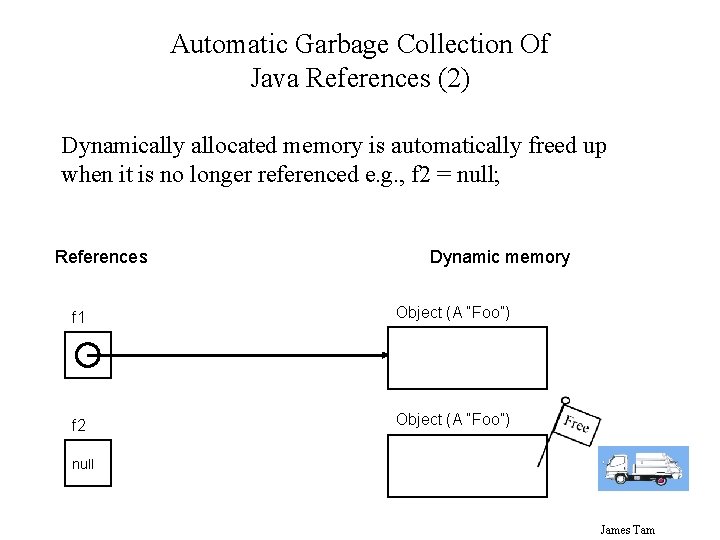
Automatic Garbage Collection Of Java References (2) Dynamically allocated memory is automatically freed up when it is no longer referenced e. g. , f 2 = null; References Dynamic memory f 1 Object (A “Foo”) f 2 Object (A “Foo”) null James Tam
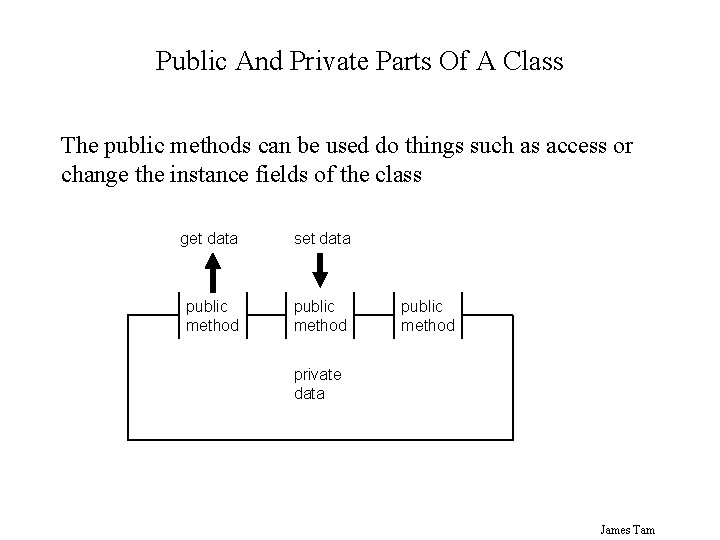
Public And Private Parts Of A Class The public methods can be used do things such as access or change the instance fields of the class get data set data public method private data James Tam
Public And Private Parts Of A Class (2) Types of methods that utilize the instance fields: 1) Accessor methods “get” • • Used to determine the current value of a field Example: public int get. Num () { return num; } 2) Mutator methods “set” • • Used to set a field to a new value Example: public void set. Num (int n) { num = n; } James Tam
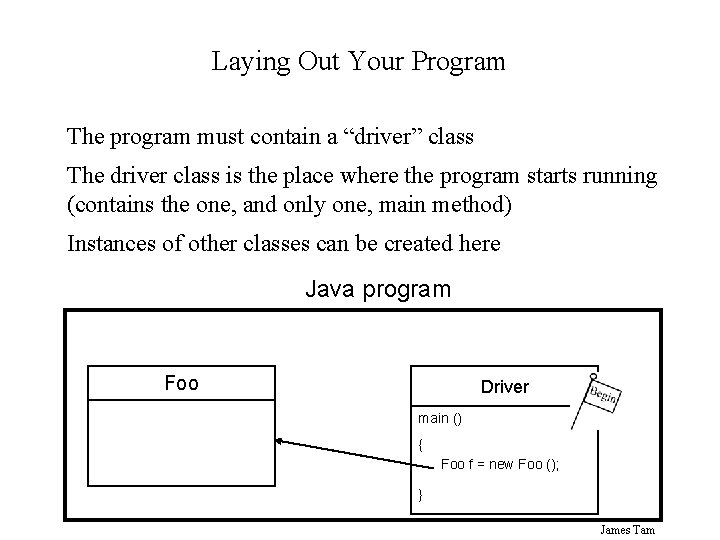
Laying Out Your Program The program must contain a “driver” class The driver class is the place where the program starts running (contains the one, and only one, main method) Instances of other classes can be created here Java program Foo Driver main () { Foo f = new Foo (); } James Tam
Points To Keep In Mind About The Driver Class • Contains the only main method of the whole program (where execution begins) • Do not instantiate instances of the Driver 1 • For now avoid: • Defining instance fields / attributes for the Driver 1 • Defining methods for the Driver (other than the main method)1 1 Details will be provided later in this course James Tam
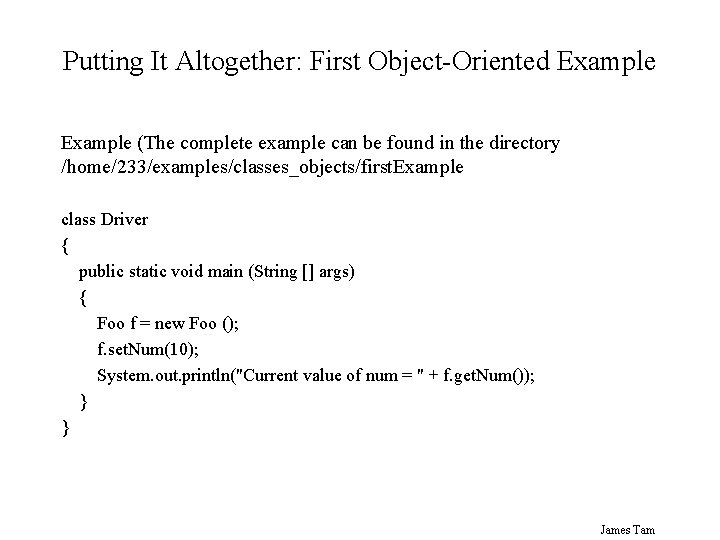
Putting It Altogether: First Object-Oriented Example (The complete example can be found in the directory /home/233/examples/classes_objects/first. Example class Driver { public static void main (String [] args) { Foo f = new Foo (); f. set. Num(10); System. out. println("Current value of num = " + f. get. Num()); } } James Tam
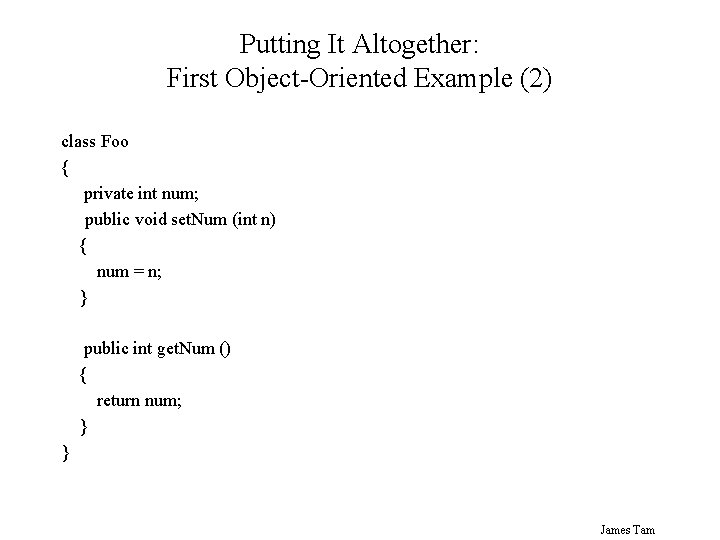
Putting It Altogether: First Object-Oriented Example (2) class Foo { private int num; public void set. Num (int n) { num = n; } public int get. Num () { return num; } } James Tam
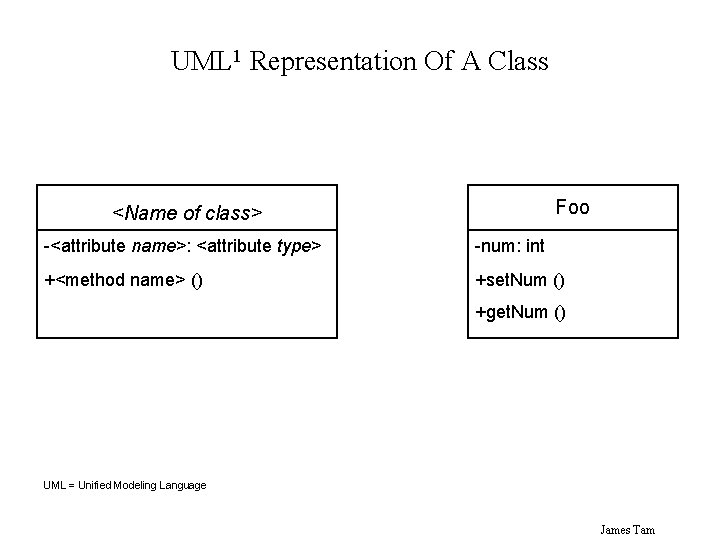
UML 1 Representation Of A Class Foo <Name of class> -<attribute name>: <attribute type> -num: int +<method name> () +set. Num () +get. Num () UML = Unified Modeling Language James Tam
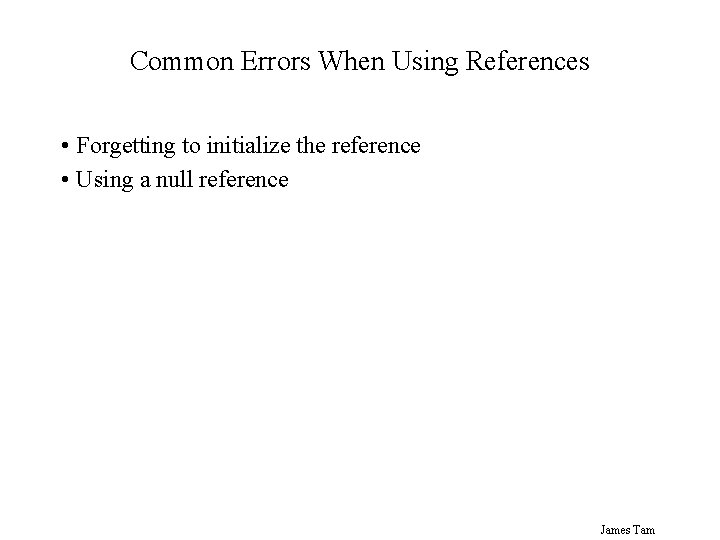
Common Errors When Using References • Forgetting to initialize the reference • Using a null reference James Tam
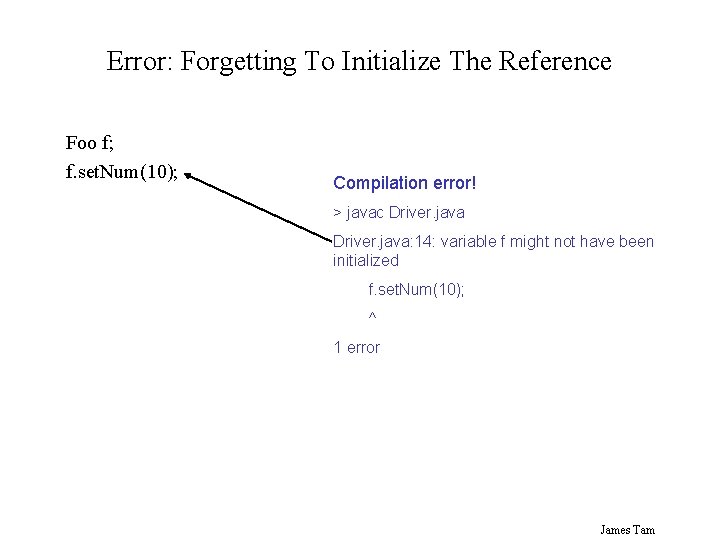
Error: Forgetting To Initialize The Reference Foo f; f. set. Num(10); Compilation error! > javac Driver. java: 14: variable f might not have been initialized f. set. Num(10); ^ 1 error James Tam
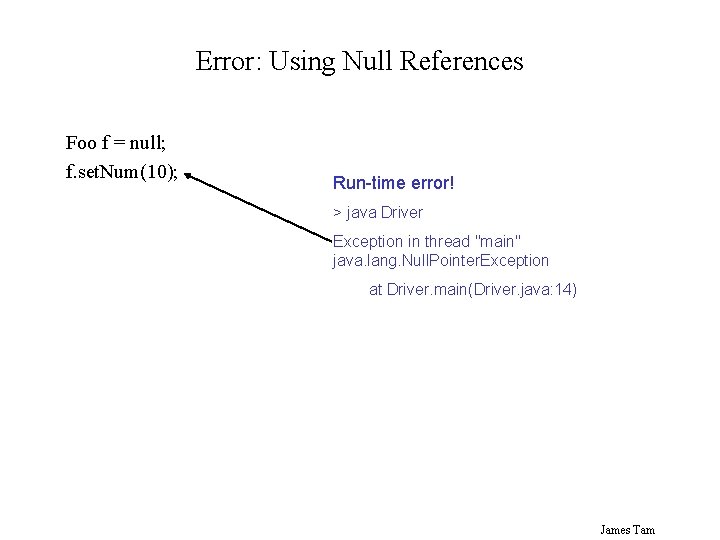
Error: Using Null References Foo f = null; f. set. Num(10); Run-time error! > java Driver Exception in thread "main" java. lang. Null. Pointer. Exception at Driver. main(Driver. java: 14) James Tam
Encapsulation Grouping data methods together within a class definition to allow the private attributes to be accessible only through the public methods. James Tam
How Does Hiding Information Protect The Class? Protects the inner-workings (data) of a class • e. g. , range checking for inventory levels (0 – 100) The complete example can be found in the directory /home/233/examples/classes_objects/second. Example James Tam
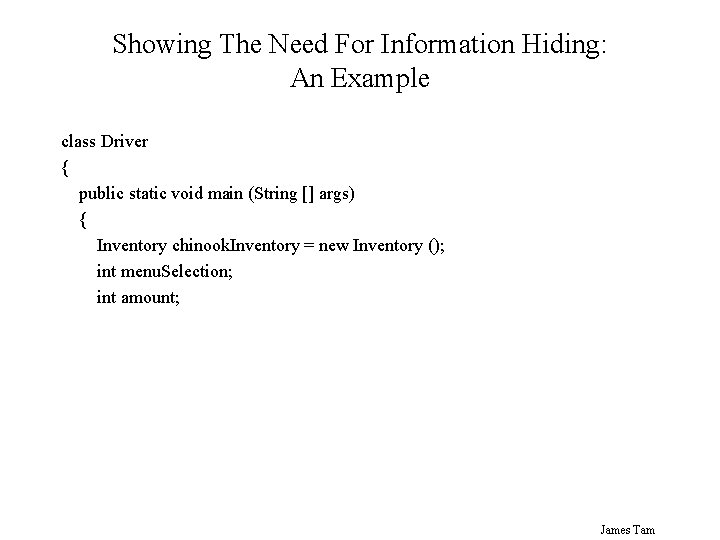
Showing The Need For Information Hiding: An Example class Driver { public static void main (String [] args) { Inventory chinook. Inventory = new Inventory (); int menu. Selection; int amount; James Tam
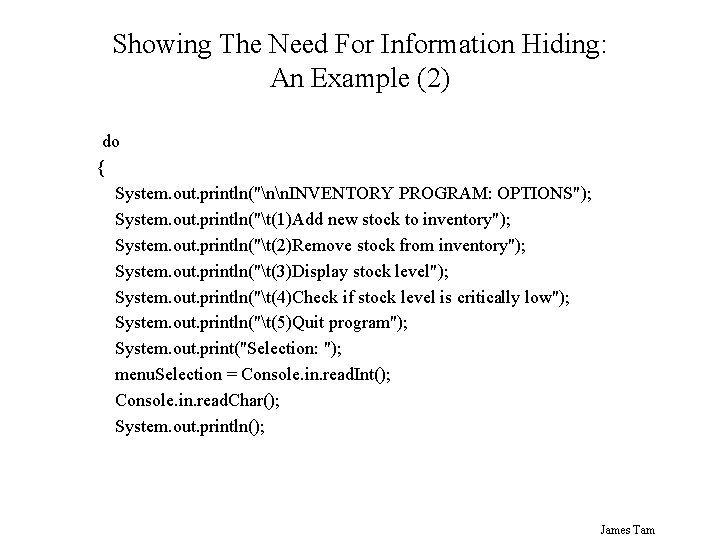
Showing The Need For Information Hiding: An Example (2) do { System. out. println("nn. INVENTORY PROGRAM: OPTIONS"); System. out. println("t(1)Add new stock to inventory"); System. out. println("t(2)Remove stock from inventory"); System. out. println("t(3)Display stock level"); System. out. println("t(4)Check if stock level is critically low"); System. out. println("t(5)Quit program"); System. out. print("Selection: "); menu. Selection = Console. in. read. Int(); Console. in. read. Char(); System. out. println(); James Tam
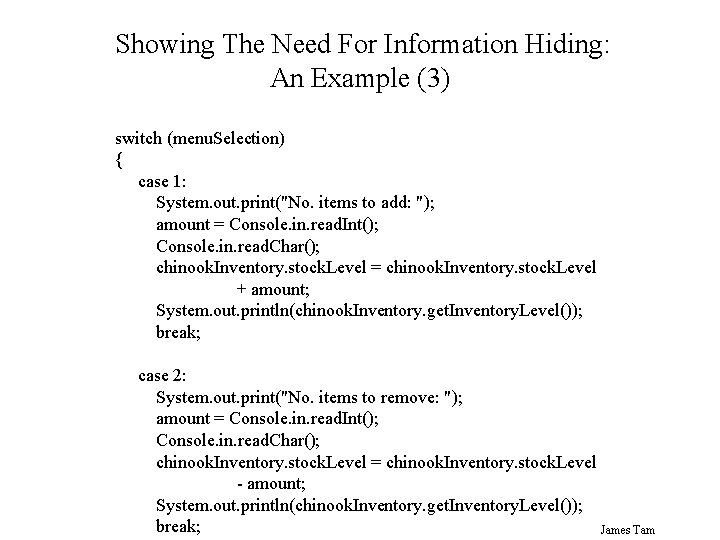
Showing The Need For Information Hiding: An Example (3) switch (menu. Selection) { case 1: System. out. print("No. items to add: "); amount = Console. in. read. Int(); Console. in. read. Char(); chinook. Inventory. stock. Level = chinook. Inventory. stock. Level + amount; System. out. println(chinook. Inventory. get. Inventory. Level()); break; case 2: System. out. print("No. items to remove: "); amount = Console. in. read. Int(); Console. in. read. Char(); chinook. Inventory. stock. Level = chinook. Inventory. stock. Level - amount; System. out. println(chinook. Inventory. get. Inventory. Level()); break; James Tam
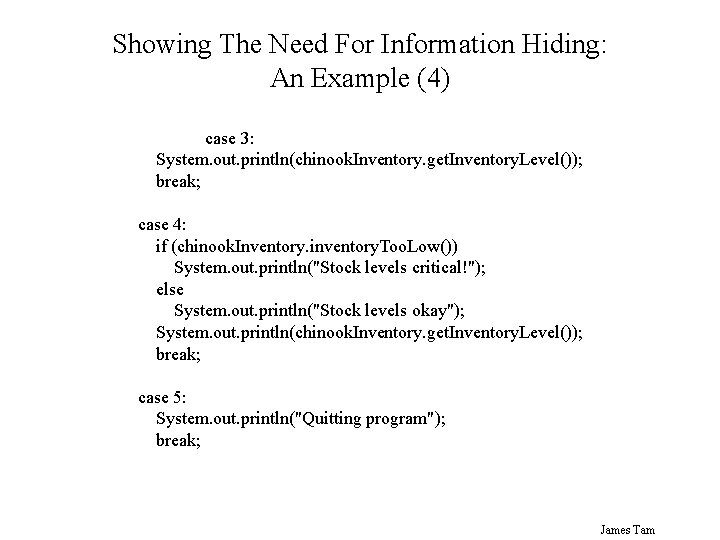
Showing The Need For Information Hiding: An Example (4) case 3: System. out. println(chinook. Inventory. get. Inventory. Level()); break; case 4: if (chinook. Inventory. inventory. Too. Low()) System. out. println("Stock levels critical!"); else System. out. println("Stock levels okay"); System. out. println(chinook. Inventory. get. Inventory. Level()); break; case 5: System. out. println("Quitting program"); break; James Tam
Showing The Need For Information Hiding: An Example (5) default: System. out. println("Enter one of 1, 2, 3, 4 or 5"); } } while (menu. Selection != 5); } } James Tam
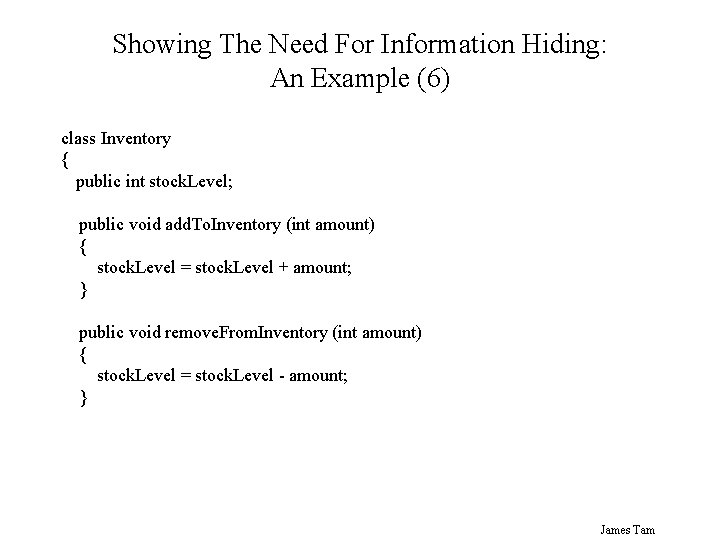
Showing The Need For Information Hiding: An Example (6) class Inventory { public int stock. Level; public void add. To. Inventory (int amount) { stock. Level = stock. Level + amount; } public void remove. From. Inventory (int amount) { stock. Level = stock. Level - amount; } James Tam
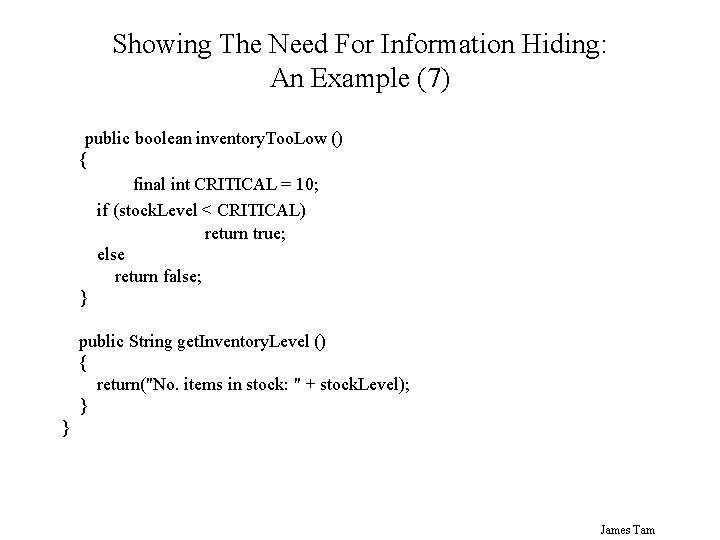
Showing The Need For Information Hiding: An Example (7) public boolean inventory. Too. Low () { final int CRITICAL = 10; if (stock. Level < CRITICAL) return true; else return false; } public String get. Inventory. Level () { return("No. items in stock: " + stock. Level); } } James Tam
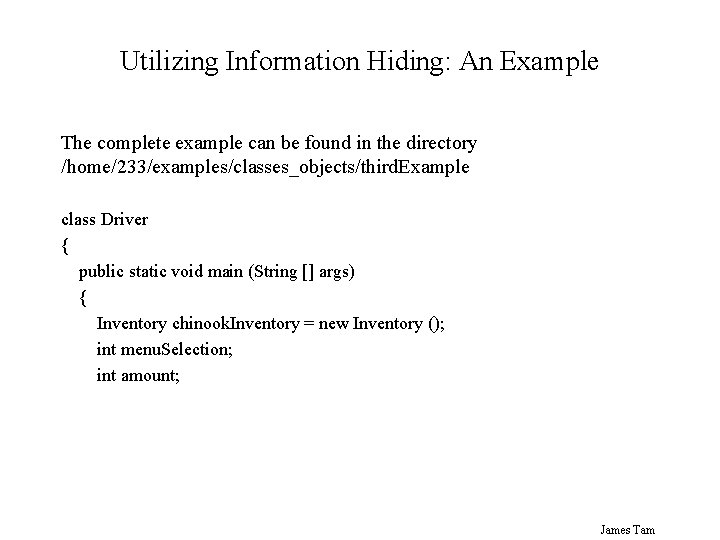
Utilizing Information Hiding: An Example The complete example can be found in the directory /home/233/examples/classes_objects/third. Example class Driver { public static void main (String [] args) { Inventory chinook. Inventory = new Inventory (); int menu. Selection; int amount; James Tam
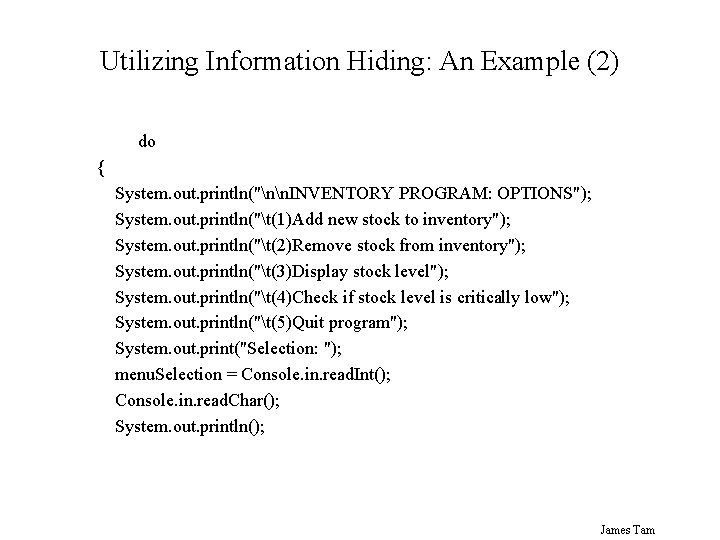
Utilizing Information Hiding: An Example (2) do { System. out. println("nn. INVENTORY PROGRAM: OPTIONS"); System. out. println("t(1)Add new stock to inventory"); System. out. println("t(2)Remove stock from inventory"); System. out. println("t(3)Display stock level"); System. out. println("t(4)Check if stock level is critically low"); System. out. println("t(5)Quit program"); System. out. print("Selection: "); menu. Selection = Console. in. read. Int(); Console. in. read. Char(); System. out. println(); James Tam
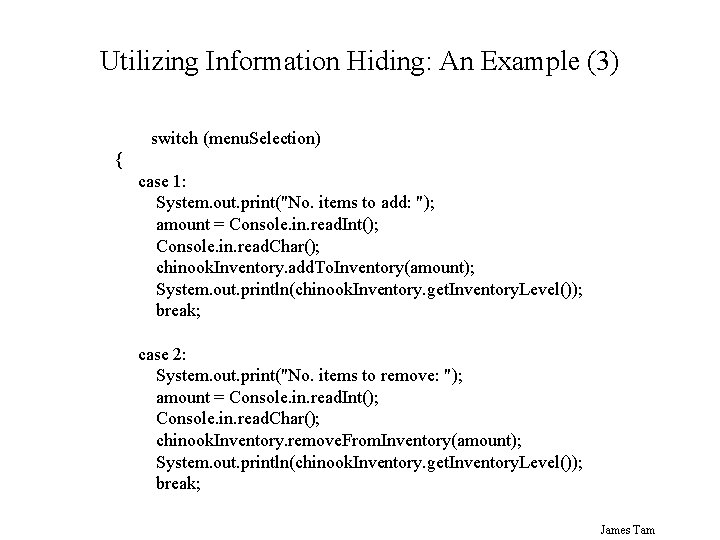
Utilizing Information Hiding: An Example (3) switch (menu. Selection) { case 1: System. out. print("No. items to add: "); amount = Console. in. read. Int(); Console. in. read. Char(); chinook. Inventory. add. To. Inventory(amount); System. out. println(chinook. Inventory. get. Inventory. Level()); break; case 2: System. out. print("No. items to remove: "); amount = Console. in. read. Int(); Console. in. read. Char(); chinook. Inventory. remove. From. Inventory(amount); System. out. println(chinook. Inventory. get. Inventory. Level()); break; James Tam
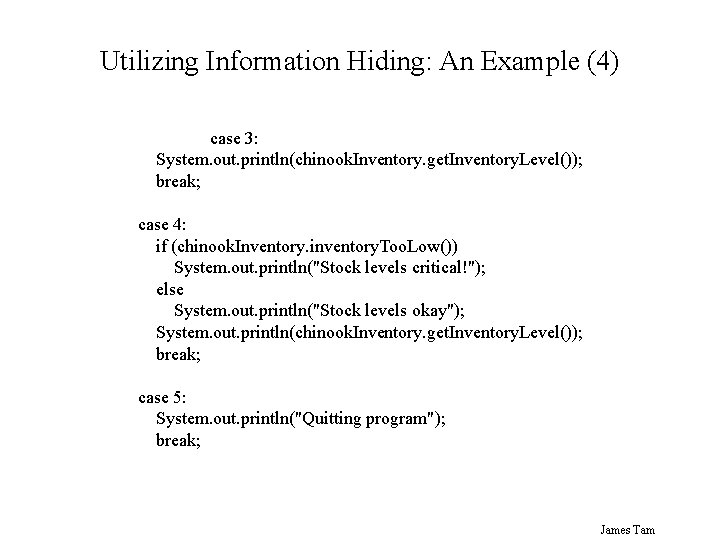
Utilizing Information Hiding: An Example (4) case 3: System. out. println(chinook. Inventory. get. Inventory. Level()); break; case 4: if (chinook. Inventory. inventory. Too. Low()) System. out. println("Stock levels critical!"); else System. out. println("Stock levels okay"); System. out. println(chinook. Inventory. get. Inventory. Level()); break; case 5: System. out. println("Quitting program"); break; James Tam
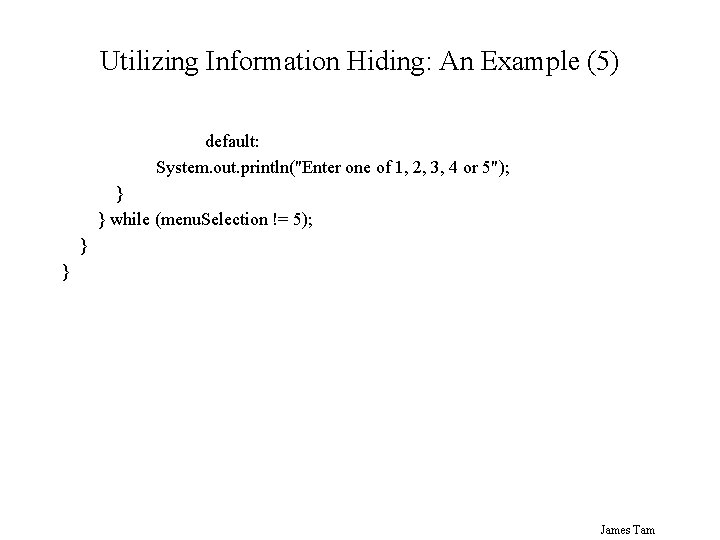
Utilizing Information Hiding: An Example (5) default: System. out. println("Enter one of 1, 2, 3, 4 or 5"); } } while (menu. Selection != 5); } } James Tam
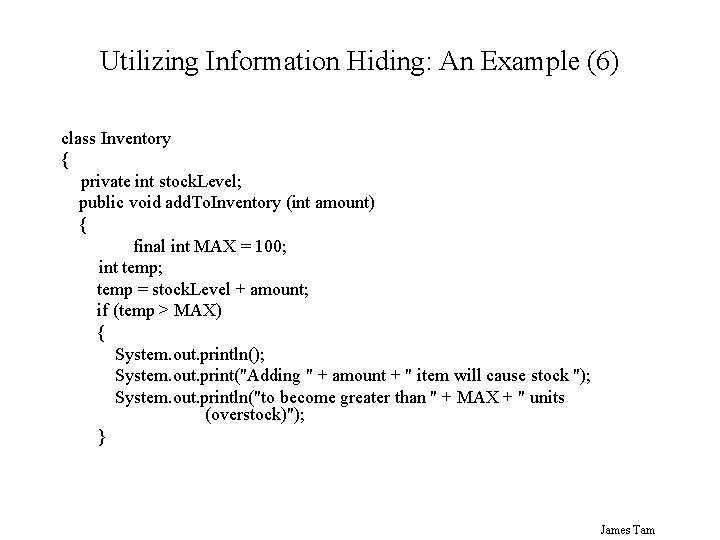
Utilizing Information Hiding: An Example (6) class Inventory { private int stock. Level; public void add. To. Inventory (int amount) { final int MAX = 100; int temp; temp = stock. Level + amount; if (temp > MAX) { System. out. println(); System. out. print("Adding " + amount + " item will cause stock "); System. out. println("to become greater than " + MAX + " units (overstock)"); } James Tam
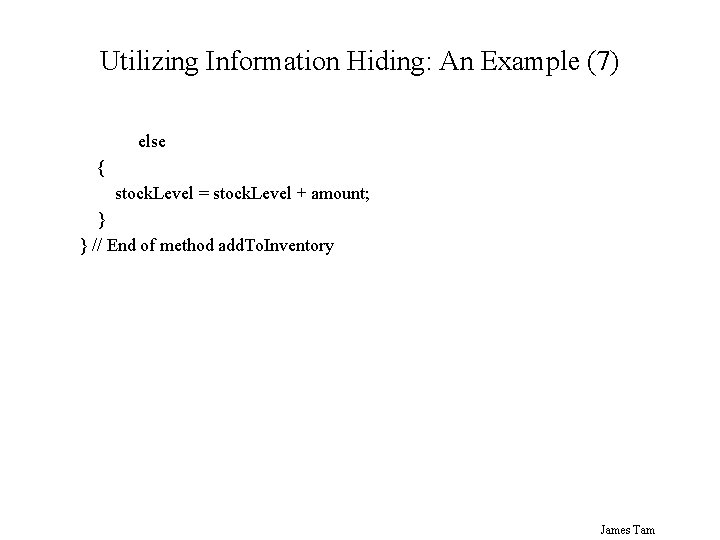
Utilizing Information Hiding: An Example (7) else { stock. Level = stock. Level + amount; } } // End of method add. To. Inventory James Tam
Utilizing Information Hiding: An Example (8) public void remove. From. Inventory (int amount) { final int MIN = 0; int temp; temp = stock. Level - amount; if (temp < MIN) { System. out. print("Removing " + amount + " item will cause stock "); System. out. println("to become less than " + MIN + " units (understock)"); } else { stock. Level = temp; } } James Tam
Utilizing Information Hiding: An Example (9) public boolean inventory. Too. Low () { final int CRITICAL = 10; if (stock. Level < CRITICAL) return true; else return false; } public String get. Inventory. Level () { return("No. items in stock: " + stock. Level); } } // End of class Inventory James Tam
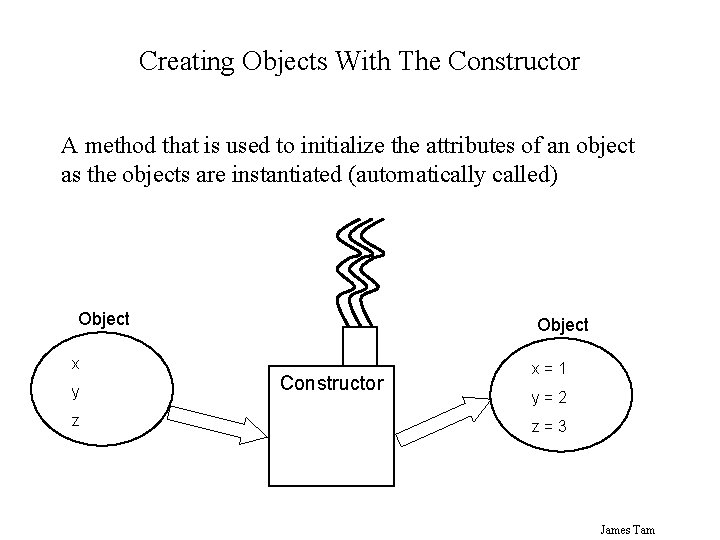
Creating Objects With The Constructor A method that is used to initialize the attributes of an object as the objects are instantiated (automatically called) Object x y z Object Constructor x=1 y=2 z=3 James Tam
Creating Objects With The Constructor (2) If no constructor is specified then the default constructor is called • e. g. , Sheep jim = new Sheep(); James Tam
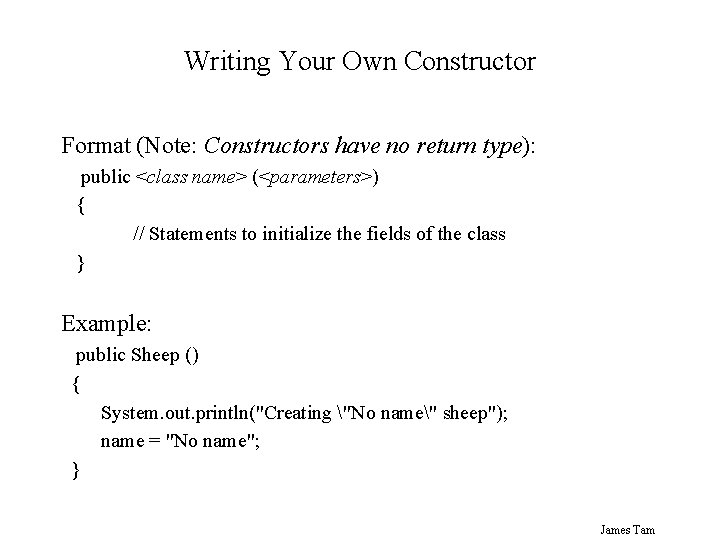
Writing Your Own Constructor Format (Note: Constructors have no return type): public <class name> (<parameters>) { // Statements to initialize the fields of the class } Example: public Sheep () { System. out. println("Creating "No name" sheep"); name = "No name"; } James Tam
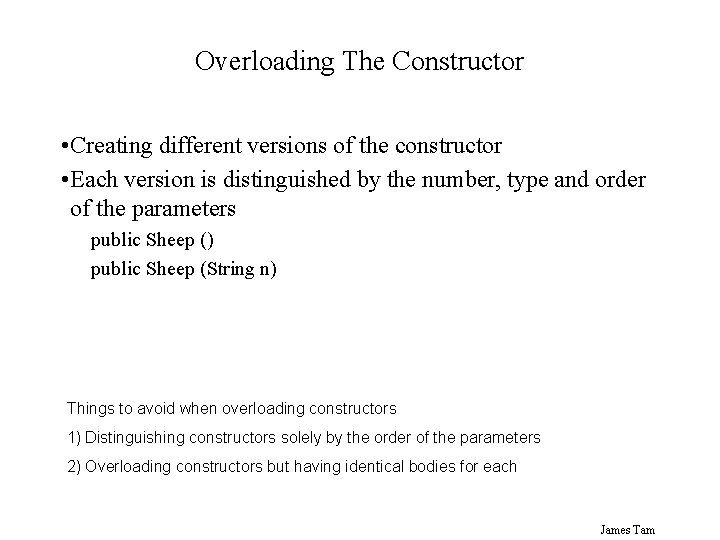
Overloading The Constructor • Creating different versions of the constructor • Each version is distinguished by the number, type and order of the parameters public Sheep () public Sheep (String n) Things to avoid when overloading constructors 1) Distinguishing constructors solely by the order of the parameters 2) Overloading constructors but having identical bodies for each James Tam
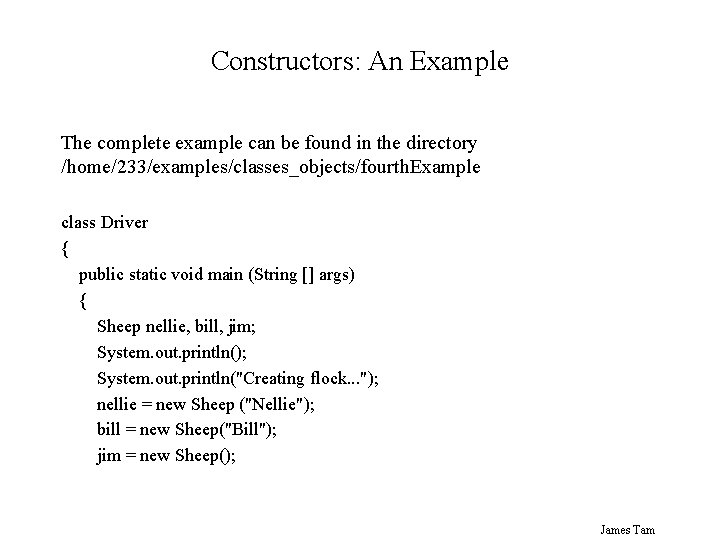
Constructors: An Example The complete example can be found in the directory /home/233/examples/classes_objects/fourth. Example class Driver { public static void main (String [] args) { Sheep nellie, bill, jim; System. out. println(); System. out. println("Creating flock. . . "); nellie = new Sheep ("Nellie"); bill = new Sheep("Bill"); jim = new Sheep(); James Tam
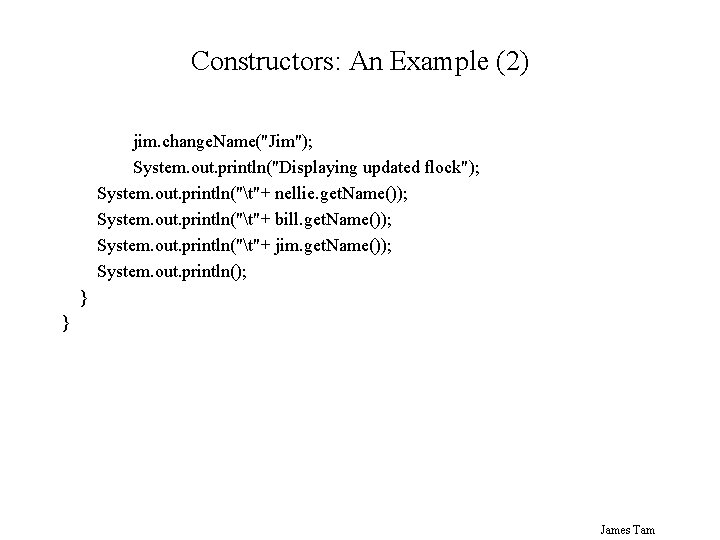
Constructors: An Example (2) jim. change. Name("Jim"); System. out. println("Displaying updated flock"); System. out. println("t"+ nellie. get. Name()); System. out. println("t"+ bill. get. Name()); System. out. println("t"+ jim. get. Name()); System. out. println(); } } James Tam
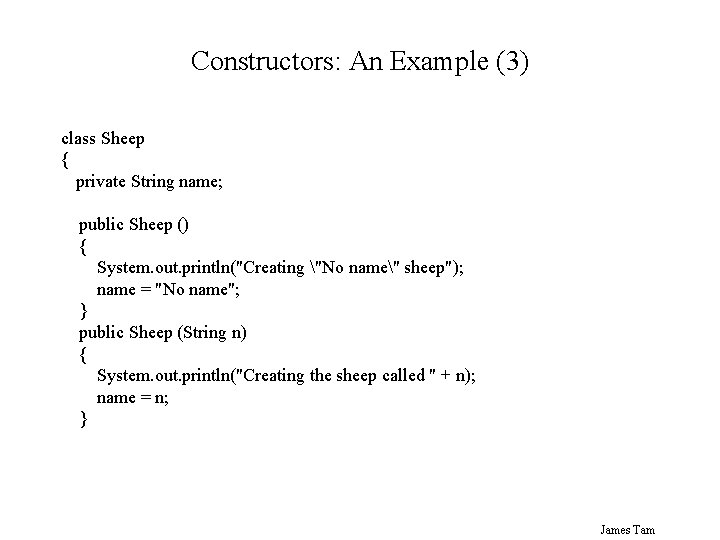
Constructors: An Example (3) class Sheep { private String name; public Sheep () { System. out. println("Creating "No name" sheep"); name = "No name"; } public Sheep (String n) { System. out. println("Creating the sheep called " + n); name = n; } James Tam
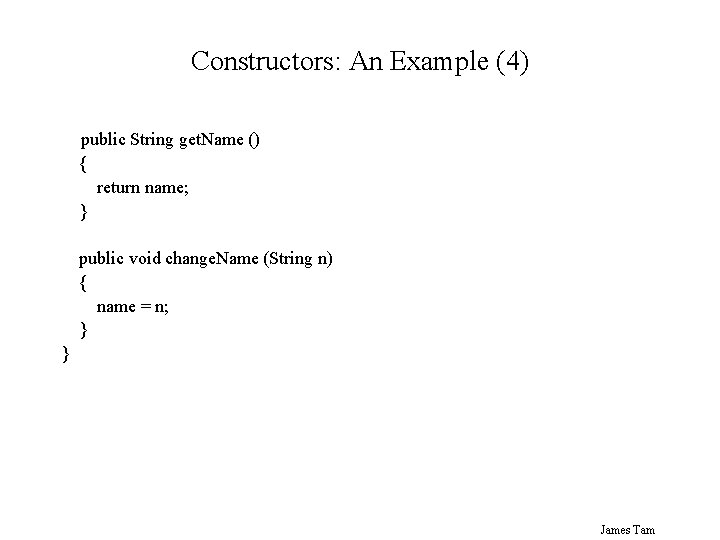
Constructors: An Example (4) public String get. Name () { return name; } public void change. Name (String n) { name = n; } } James Tam
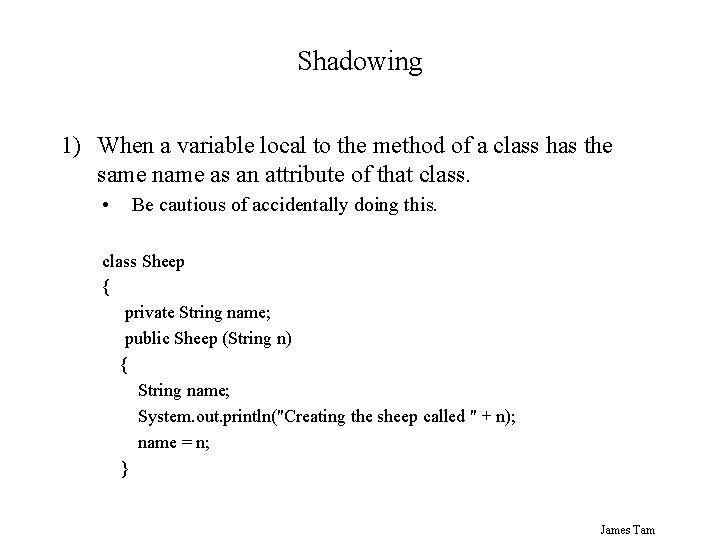
Shadowing 1) When a variable local to the method of a class has the same name as an attribute of that class. • Be cautious of accidentally doing this. class Sheep { private String name; public Sheep (String n) { String name; System. out. println("Creating the sheep called " + n); name = n; } James Tam
Arrays In Java Important points to remember for arrays in Java: • An array of n elements will have an index of zero for the first element up to (n-1) for the last element • The array index must be an integer • Arrays employ dynamic memory allocation (references) • Several error checking mechanisms are available James Tam
Arrays In Java Important points to remember for arrays in Java: • An array of n elements will have an index of zero for the first element up to (n-1) for the last element • The array index must be an integer • Arrays employ dynamic memory allocation (references) • Several error checking mechanisms are available James Tam
Arrays In Java Important points to remember for arrays in Java: • An array of n elements will have an index of zero for the first element up to (n-1) for the last element • The array index must be an integer • Arrays employ dynamic memory allocation (references) • Several error checking mechanisms are available James Tam
Declaring Arrays in Java involve a reference to the array so declaring an array requires two steps: 1) Declaring a reference to the array 2) Allocating the memory for the array James Tam
![Declaring A Reference To An Array Format: <type> [] <array name>; Example: int []](http://slidetodoc.com/presentation_image_h2/0a1050d40a751cfd6f7ce985ef2ffbb7/image-72.jpg "Declaring A Reference To An Array Format: <type> [] <array name>; Example: int []")
Declaring A Reference To An Array Format: <type> [] <array name>; Example: int [] arr; int [][] arr; James Tam
![Allocating Memory For An Array Format: <array name> = new <array type> [<no elements>];](http://slidetodoc.com/presentation_image_h2/0a1050d40a751cfd6f7ce985ef2ffbb7/image-73.jpg "Allocating Memory For An Array Format: <array name> = new <array type> [<no elements>];")
Allocating Memory For An Array Format: <array name> = new <array type> [<no elements>]; Example: arr = new int[SIZE]; (Or combining both steps together): int [] arr = new int[SIZE]; James Tam
![Arrays: An Example int i, len; int [] arr; System. out. print("Enter the number](http://slidetodoc.com/presentation_image_h2/0a1050d40a751cfd6f7ce985ef2ffbb7/image-74.jpg "Arrays: An Example int i, len; int [] arr; System. out. print(\"Enter the number")
Arrays: An Example int i, len; int [] arr; System. out. print("Enter the number of array elements: "); len = Console. in. read. Int(); arr = new int [len]; System. out. println("Array Arr has " + arr. length + " elements. "); for (i = 0; i < arr. length; i++) { arr[i] = i; System. out. println("Element[" + i + "]=" + arr[i]); } James Tam
Arrays In Java Important points to remember for arrays in Java: • An array of n elements will have an index of zero for the first element up to (n-1) for the last element • The array index must be an integer • Arrays involve dynamic memory allocation (references) • Several error checking mechanisms are available Using a null array reference Array bounds checking James Tam
![Using A Null Reference int [] arr = null; arr[0] = 1; Null. Pointer.](http://slidetodoc.com/presentation_image_h2/0a1050d40a751cfd6f7ce985ef2ffbb7/image-76.jpg "Using A Null Reference int [] arr = null; arr[0] = 1; Null. Pointer.")
Using A Null Reference int [] arr = null; arr[0] = 1; Null. Pointer. Exception James Tam
![Exceeding The Array Bounds int [] arr = new int [4]; int i; for](http://slidetodoc.com/presentation_image_h2/0a1050d40a751cfd6f7ce985ef2ffbb7/image-77.jpg "Exceeding The Array Bounds int [] arr = new int [4]; int i; for")
Exceeding The Array Bounds int [] arr = new int [4]; int i; for (i = 0; i <= 4; i++) arr[i] = i; Array. Index. Out. Of. Bounds. Exception (when i = 4) James Tam
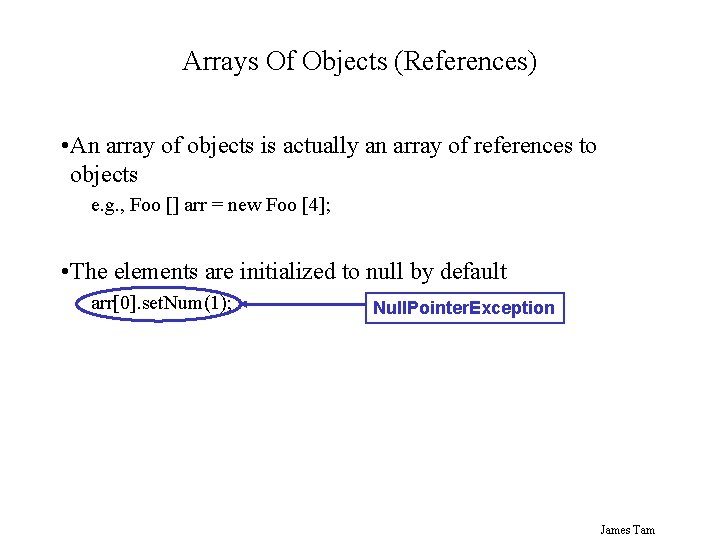
Arrays Of Objects (References) • An array of objects is actually an array of references to objects e. g. , Foo [] arr = new Foo [4]; • The elements are initialized to null by default arr[0]. set. Num(1); Null. Pointer. Exception James Tam
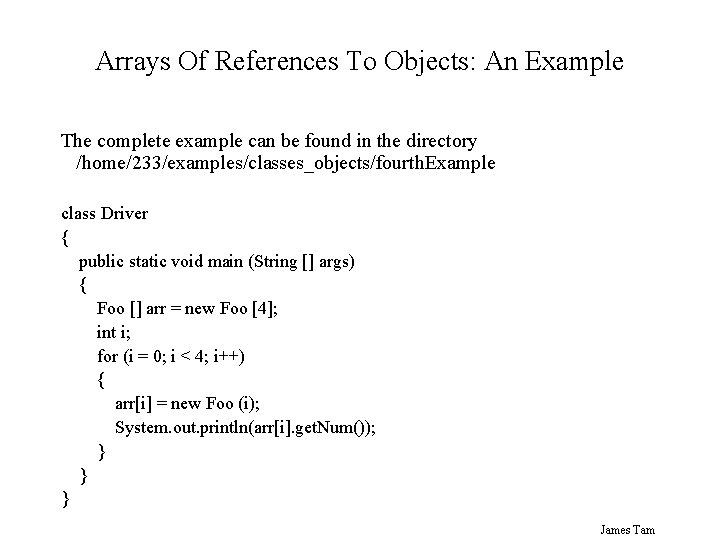
Arrays Of References To Objects: An Example The complete example can be found in the directory /home/233/examples/classes_objects/fourth. Example class Driver { public static void main (String [] args) { Foo [] arr = new Foo [4]; int i; for (i = 0; i < 4; i++) { arr[i] = new Foo (i); System. out. println(arr[i]. get. Num()); } } } James Tam
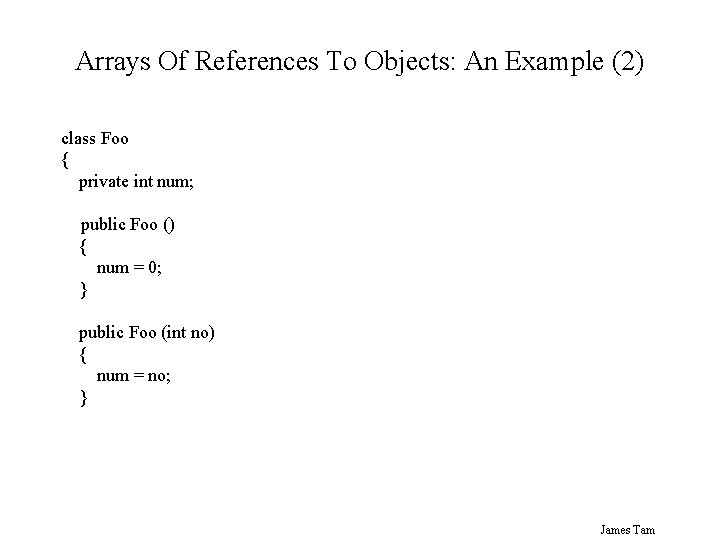
Arrays Of References To Objects: An Example (2) class Foo { private int num; public Foo () { num = 0; } public Foo (int no) { num = no; } James Tam
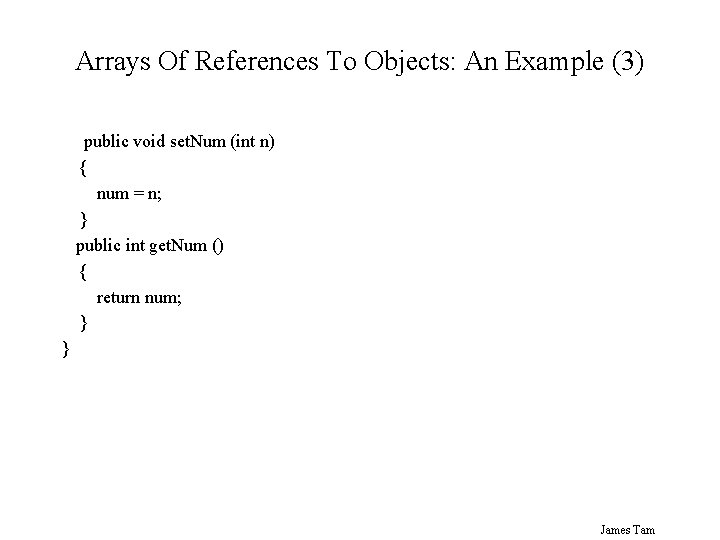
Arrays Of References To Objects: An Example (3) public void set. Num (int n) { num = n; } public int get. Num () { return num; } } James Tam
You Should Now Know • The difference between the Object-Oriented and the Procedural approaches to software design • How to use classes and objects in a Java program • Defining new classes • Creating references to new instances of a class • Using the attributes and methods of a object • What is information hiding and what are the benefits of this approach in the design a classes • How to write a Java program with multiple classes (driver and with an additional class) • How to write and overload constructors • How to declare and manipulate arrays James Tam
- Slides: 82