
CPS 120 Introduction to Computer Science Fall 2002
- Slides: 23
CPS 120: Introduction to Computer Science Fall: 2002 Instructor: Paul J. Millis
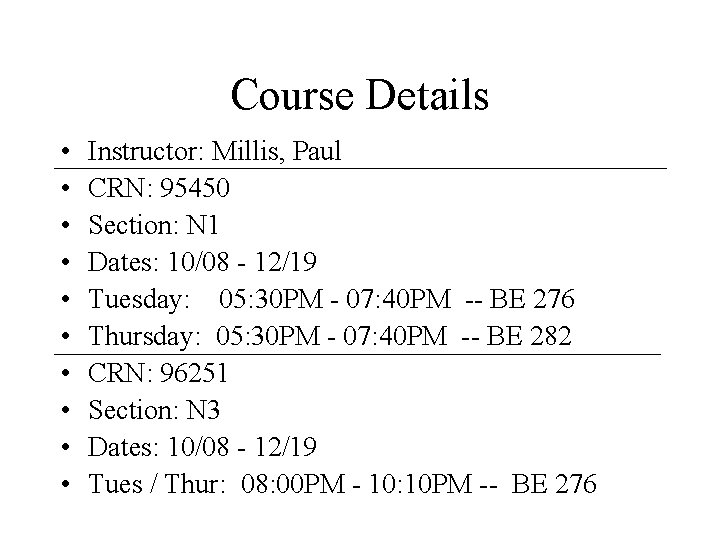
Course Details • • • Instructor: Millis, Paul CRN: 95450 Section: N 1 Dates: 10/08 - 12/19 Tuesday: 05: 30 PM - 07: 40 PM -- BE 276 Thursday: 05: 30 PM - 07: 40 PM -- BE 282 CRN: 96251 Section: N 3 Dates: 10/08 - 12/19 Tues / Thur: 08: 00 PM - 10: 10 PM -- BE 276
Instructor Details Instructor: Paul J. Millis Office Phone Number: (734) 647 -7508 Class Email: pmillis@wccnet. org Emergency Email: pmillis@umich. edu Office Hours: Before class and by appointment
Course Description • This is a course in introductory problem solving and programming techniques that introduces students to computers and computer programming. • It is assumed that you have a basic high school mathematics background, although no prior computer science is assumed. • Topics covered will include the general characteristics of computers, the properties of algorithms, techniques of problem solving and creating of computer programs.
Objectives • • · · · · Basic concepts and vocabulary Internal representation of data Programming concepts Operating systems Programming languages and software Databases Data communications
Tentative Schedule • I reserve to make appropriate changes to the schedule as we go along. I will notify you of all changes that are made at the earliest possible juncture and all changes will be posted to the class web site.
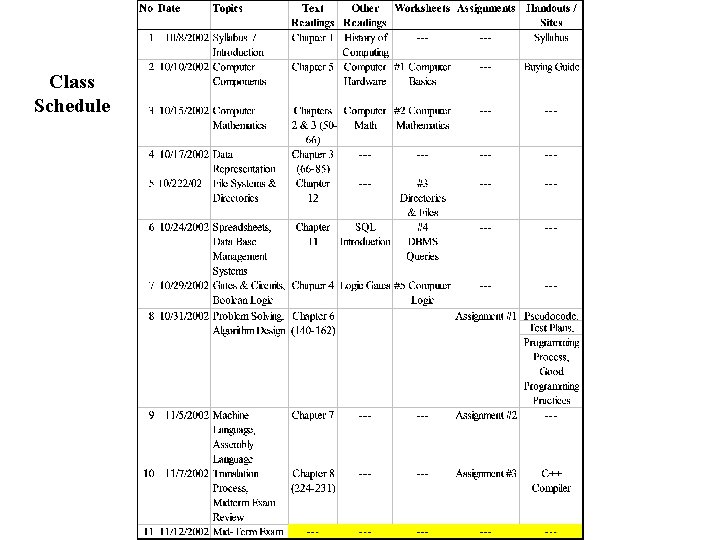
Class Schedule
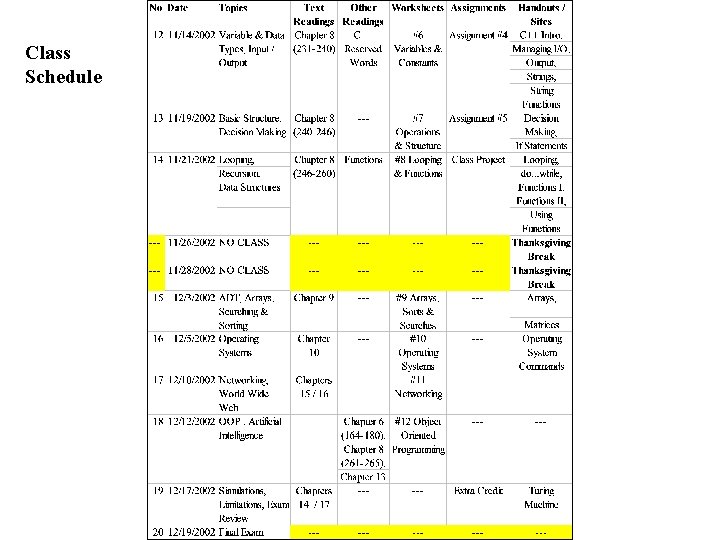
Class Schedule
Text • Computer Science Illuminated by Nell Dale and John Lewis, published by Jones and Bartlett Publishers, copyright 2002, ISBN: 0 -7637 -1760 -6
Recommended • Computers Simplified, 5 th Edition, Published by IDG Books Worldwide Inc. , copyright 2000, ISBN: 0 -7645 -3524 -2 • Introduction to Computer Science by Ramon A. Mata-Toledo and Pauline K. Cushman, published by Mc. Graw-Hill, copyright 2000, ISBN: 0 -07 -134554 -X
Other Sources of Information • Introduction to Computer Science Using C++ by Todd Knowlton, published by South-Western Educational Publishing, copyright 1998, ISBN: 0 -538 -67600 -0 • Sams Teach Yourself C++ in 21 Days (4 th Edition) by Jesse Liberty, published by Sams, April 2001; ISBN: 067232072 X • Programming Logic for Business by Laura Saret, published by Mc. Graw-Hill Higher Education, November 2000; ISBN: 0073660965 • A Guide to Programming Logic and Design - Introductory by Joyce M. Farrell published by Course Technology, March 1999; ISBN: 0760011486 • An Introduction to Programming with C++, Second Edition by Diane Zak, published by Course Technology, December 2000; ISBN: 0619033592 • Starting Out Quickly with Visual C++ by Doug White, published by Delmar Publishers, June 2001; ISBN: 1576760693
Other Resources • You will need approximately 12 floppy disks with labels. One floppy should contain your working files. – Make sure you have these on the nights of the labs – Zip disks are also OK – YOU are responsible for backups • You need to use your WCC email account for the purposes of this class – If you haven't activated it, check the course schedule for directions on how to do this – Techs in the labs will help you with this
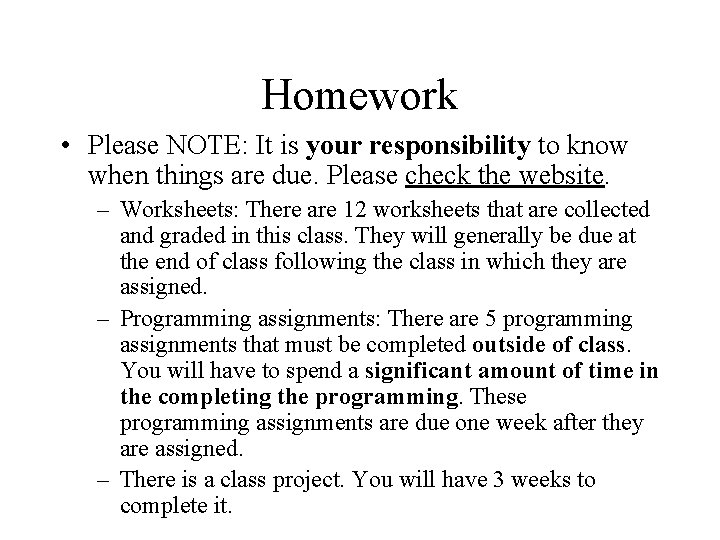
Homework • Please NOTE: It is your responsibility to know when things are due. Please check the website. – Worksheets: There are 12 worksheets that are collected and graded in this class. They will generally be due at the end of class following the class in which they are assigned. – Programming assignments: There are 5 programming assignments that must be completed outside of class. You will have to spend a significant amount of time in the completing the programming. These programming assignments are due one week after they are assigned. – There is a class project. You will have 3 weeks to complete it.
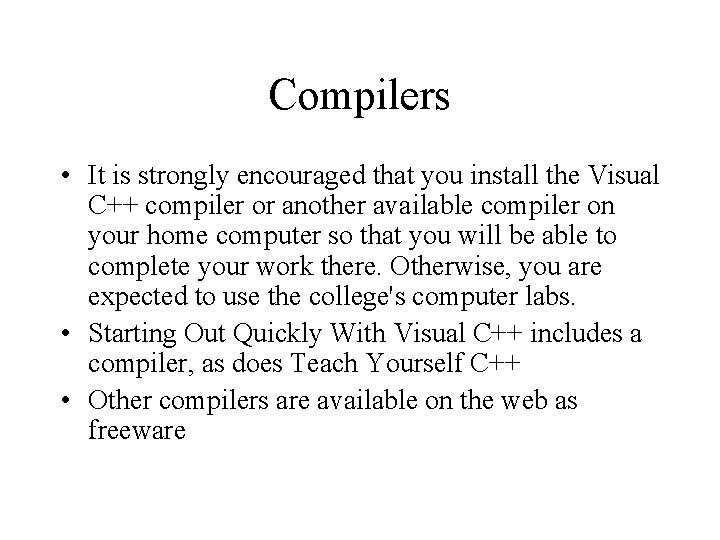
Compilers • It is strongly encouraged that you install the Visual C++ compiler or another available compiler on your home computer so that you will be able to complete your work there. Otherwise, you are expected to use the college's computer labs. • Starting Out Quickly With Visual C++ includes a compiler, as does Teach Yourself C++ • Other compilers are available on the web as freeware
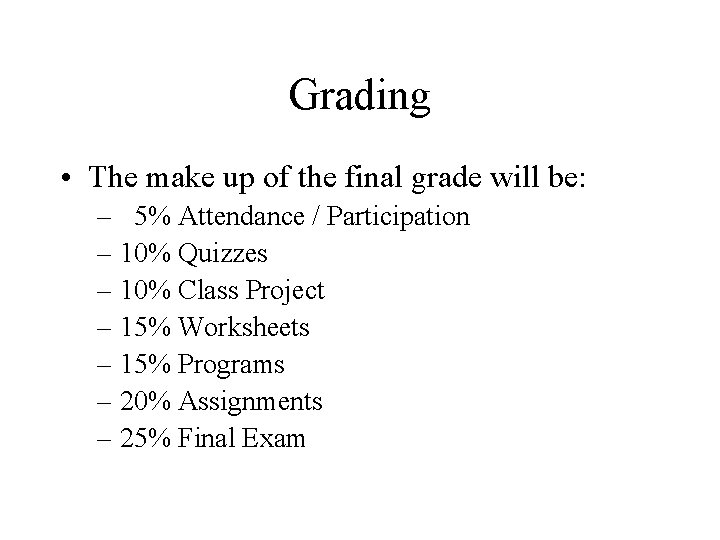
Grading • The make up of the final grade will be: – 5% Attendance / Participation – 10% Quizzes – 10% Class Project – 15% Worksheets – 15% Programs – 20% Assignments – 25% Final Exam
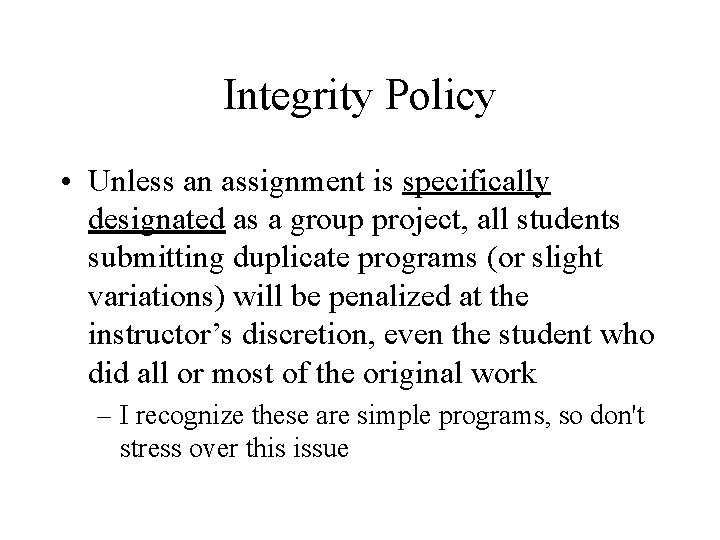
Integrity Policy • Unless an assignment is specifically designated as a group project, all students submitting duplicate programs (or slight variations) will be penalized at the instructor’s discretion, even the student who did all or most of the original work – I recognize these are simple programs, so don't stress over this issue
Quizzes • Quizzes may be given at the beginning and/or end of a number of classes. – Expect approximately four • Students who are not present for a quiz, unless they have an emergency and have informed the instructor, will receive a zero. • There is no makeup opportunity for quizzes. • I will drop the lowest score on quizzes to allow for emergencies students have during the term.
Late Assignments • Late programming assignments and worksheets will be accepted but they will be worth significantly fewer points • If your program does not compile or work correctly, you should still submit it
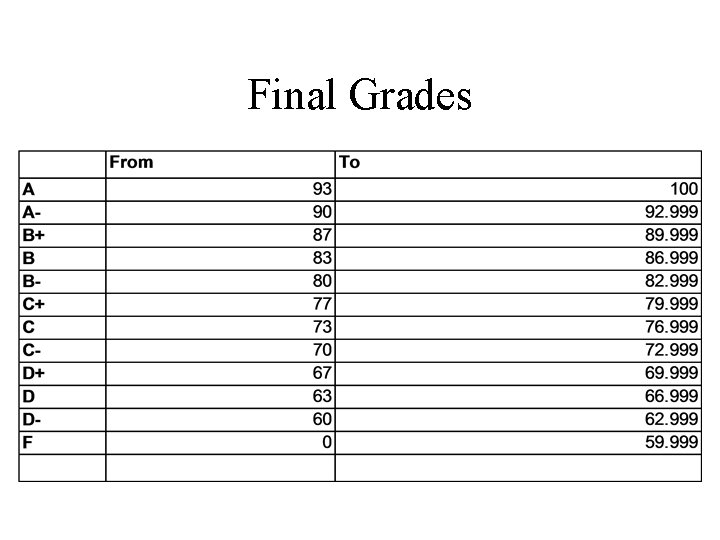
Final Grades
Exams • There will be two exams in this class, a midterm on 11/12/02 and the final on 12/19/02 • These tests will contain multiple choice and true & false questions as well as debugging and programming problems • The mid-term will be more conceptual and the final more practical in nature. The final will be cummulative • Make-up exams will be given only for emergency circumstances – The instructor reserves the right to make a decision in all such cases • If an emergency does arise, you must call or email the instructor as soon as possible before the exam in order to arrange for a make-up
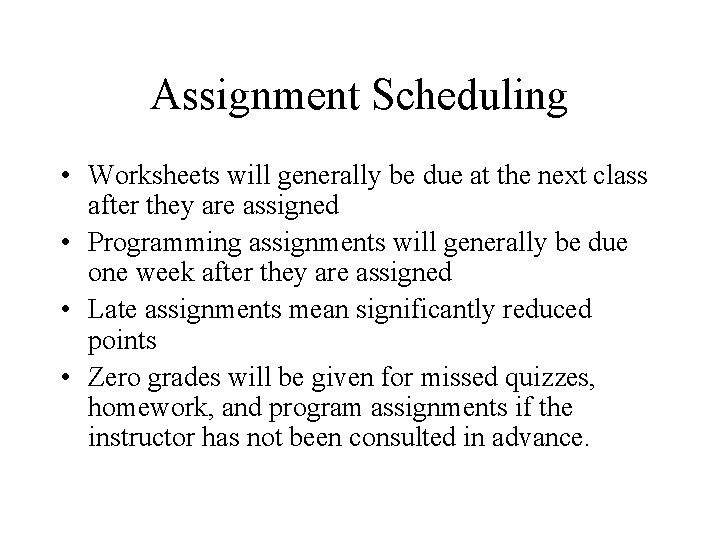
Assignment Scheduling • Worksheets will generally be due at the next class after they are assigned • Programming assignments will generally be due one week after they are assigned • Late assignments mean significantly reduced points • Zero grades will be given for missed quizzes, homework, and program assignments if the instructor has not been consulted in advance.
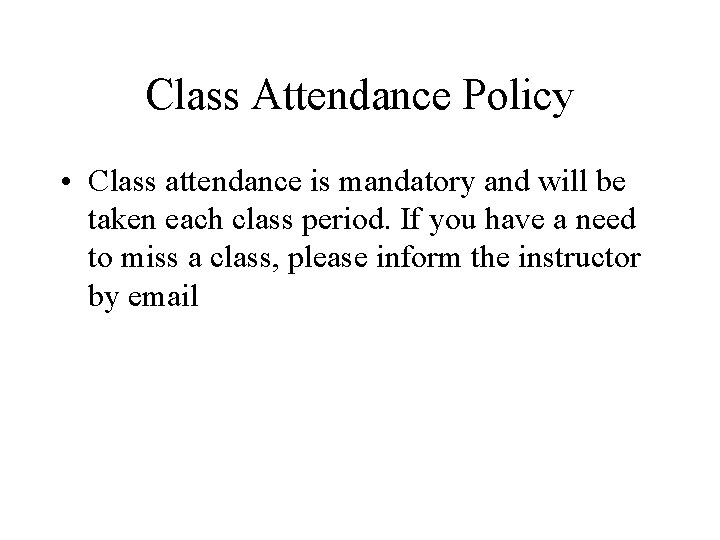
Class Attendance Policy • Class attendance is mandatory and will be taken each class period. If you have a need to miss a class, please inform the instructor by email
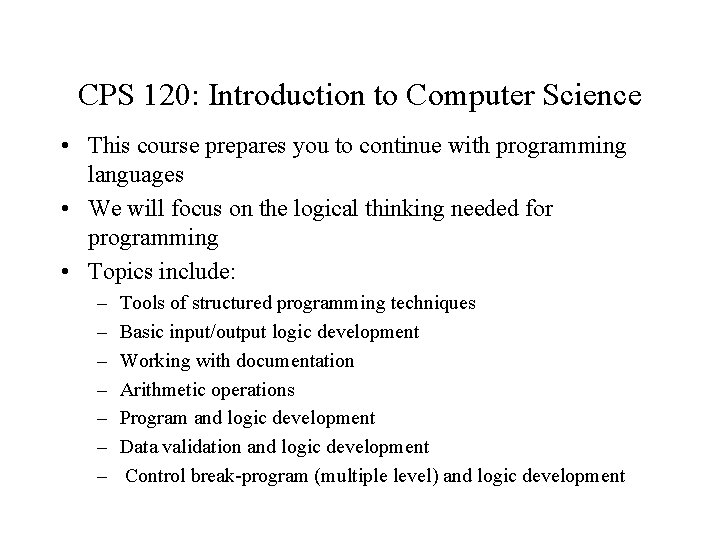
CPS 120: Introduction to Computer Science • This course prepares you to continue with programming languages • We will focus on the logical thinking needed for programming • Topics include: – – – – Tools of structured programming techniques Basic input/output logic development Working with documentation Arithmetic operations Program and logic development Data validation and logic development Control break-program (multiple level) and logic development