
Cpr E Microcontroller Evolution 211 ABSTRACT DESIGN CONSTRAINTS
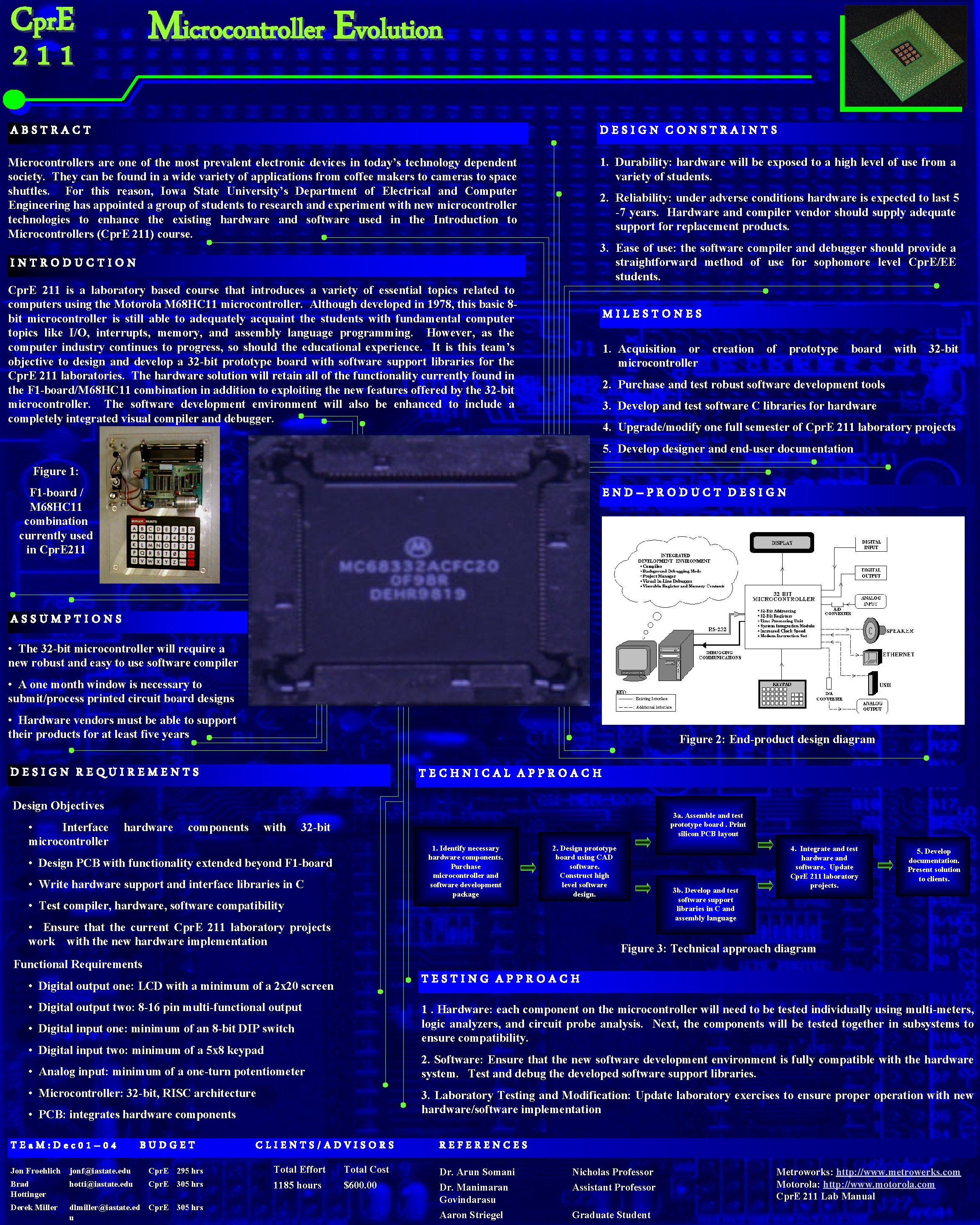
Cpr. E Microcontroller Evolution 211 ABSTRACT DESIGN CONSTRAINTS Microcontrollers are one of the most prevalent electronic devices in today’s technology dependent society. They can be found in a wide variety of applications from coffee makers to cameras to space shuttles. For this reason, Iowa State University’s Department of Electrical and Computer Engineering has appointed a group of students to research and experiment with new microcontroller technologies to enhance the existing hardware and software used in the Introduction to Microcontrollers (Cpr. E 211) course. 1. Durability: hardware will be exposed to a high level of use from a variety of students. 2. Reliability: under adverse conditions hardware is expected to last 5 -7 years. Hardware and compiler vendor should supply adequate support for replacement products. 3. Ease of use: the software compiler and debugger should provide a straightforward method of use for sophomore level Cpr. E/EE students. INTRODUCTION Cpr. E 211 is a laboratory based course that introduces a variety of essential topics related to computers using the Motorola M 68 HC 11 microcontroller. Although developed in 1978, this basic 8 bit microcontroller is still able to adequately acquaint the students with fundamental computer topics like I/O, interrupts, memory, and assembly language programming. However, as the computer industry continues to progress, so should the educational experience. It is this team’s objective to design and develop a 32 -bit prototype board with software support libraries for the Cpr. E 211 laboratories. The hardware solution will retain all of the functionality currently found in the F 1 -board/M 68 HC 11 combination in addition to exploiting the new features offered by the 32 -bit microcontroller. The software development environment will also be enhanced to include a completely integrated visual compiler and debugger. MILESTONES 1. Acquisition or microcontroller creation of prototype board with 32 -bit 2. Purchase and test robust software development tools 3. Develop and test software C libraries for hardware 4. Upgrade/modify one full semester of Cpr. E 211 laboratory projects 5. Develop designer and end-user documentation Figure 1: END–PRODUCT DESIGN F 1 -board / M 68 HC 11 combination currently used in Cpr. E 211 ASSUMPTIONS • The 32 -bit microcontroller will require a new robust and easy to use software compiler • A one month window is necessary to submit/process printed circuit board designs • Hardware vendors must be able to support their products for at least five years Figure 2: End-product design diagram DESIGN REQUIREMENTS TECHNICAL APPROACH Design Objectives • Interface microcontroller hardware components with 3 a. Assemble and test prototype board. Print silicon PCB layout 32 -bit 1. Identify necessary hardware components. Purchase microcontroller and software development package • Design PCB with functionality extended beyond F 1 -board • Write hardware support and interface libraries in C 2. Design prototype board using CAD software. Construct high level software design. 3 b. Develop and test software support libraries in C and assembly language • Test compiler, hardware, software compatibility • Ensure that the current Cpr. E 211 laboratory projects work with the new hardware implementation 4. Integrate and test hardware and software. Update Cpr. E 211 laboratory projects. 5. Develop documentation. Present solution to clients. Figure 3: Technical approach diagram Functional Requirements TESTING APPROACH • Digital output one: LCD with a minimum of a 2 x 20 screen • Digital output two: 8 -16 pin multi-functional output 1. Hardware: each component on the microcontroller will need to be tested individually using multi-meters, logic analyzers, and circuit probe analysis. Next, the components will be tested together in subsystems to ensure compatibility. • Digital input one: minimum of an 8 -bit DIP switch • Digital input two: minimum of a 5 x 8 keypad 2. Software: Ensure that the new software development environment is fully compatible with the hardware system. Test and debug the developed software support libraries. • Analog input: minimum of a one-turn potentiometer • Microcontroller: 32 -bit, RISC architecture 3. Laboratory Testing and Modification: Update laboratory exercises to ensure properation with new hardware/software implementation • PCB: integrates hardware components TEa. M: Dec 01– 04 BUDGET CLIENTS/ADVISORS Jon Froehlich jonf@iastate. edu Cpr. E 295 hrs Total Effort Total Cost Brad Hottinger hotti@iastate. edu Cpr. E 305 hrs 1185 hours $600. 00 Derek Miller dlmiller@iastate. ed Cpr. E 305 hrs u REFERENCES Dr. Arun Somani Dr. Manimaran Govindarasu Nicholas Professor Assistant Professor Aaron Striegel Graduate Student Metroworks: http: //www. metrowerks. com Motorola: http: //www. motorola. com Cpr. E 211 Lab Manual
- Slides: 1