
Cpr E 281 Digital Logic Instructor Alexander Stoytchev

![The Half-Adder [ Figure 3. 1 c-d from the textbook ]](https://slidetodoc.com/presentation_image_h/93aa0b922803e96b3b0499a6d45962a5/image-8.jpg "The Half-Adder [ Figure 3. 1 c-d from the textbook ]")
![Problem Statement and Truth Table [ Figure 3. 2 b from the textbook ]](https://slidetodoc.com/presentation_image_h/93aa0b922803e96b3b0499a6d45962a5/image-10.jpg "Problem Statement and Truth Table [ Figure 3. 2 b from the textbook ]")
![Let’s fill-in the two K-maps [ Figure 3. 3 a-b from the textbook ]](https://slidetodoc.com/presentation_image_h/93aa0b922803e96b3b0499a6d45962a5/image-11.jpg "Let’s fill-in the two K-maps [ Figure 3. 3 a-b from the textbook ]")
![Let’s fill-in the two K-maps [ Figure 3. 3 a-b from the textbook ]](https://slidetodoc.com/presentation_image_h/93aa0b922803e96b3b0499a6d45962a5/image-12.jpg "Let’s fill-in the two K-maps [ Figure 3. 3 a-b from the textbook ]")
![This is called the Full-Adder [ Figure 3. 3 c from the textbook ]](https://slidetodoc.com/presentation_image_h/93aa0b922803e96b3b0499a6d45962a5/image-14.jpg "This is called the Full-Adder [ Figure 3. 3 c from the textbook ]")


- Slides: 84
Cpr. E 281: Digital Logic Instructor: Alexander Stoytchev http: //www. ece. iastate. edu/~alexs/classes/
Serial Adder Cpr. E 281: Digital Logic Iowa State University, Ames, IA Copyright © Alexander Stoytchev
Administrative Stuff • Homework 10 is out • It is due on Monday Nov 17, 2014
Quick Review
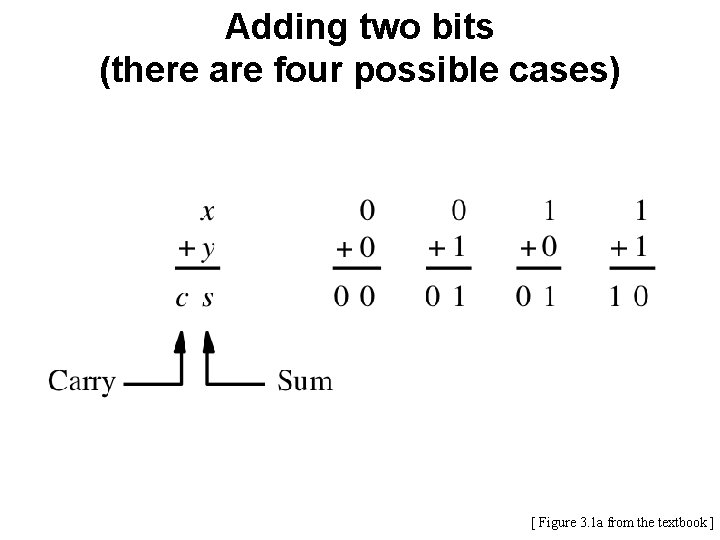
Adding two bits (there are four possible cases) [ Figure 3. 1 a from the textbook ]
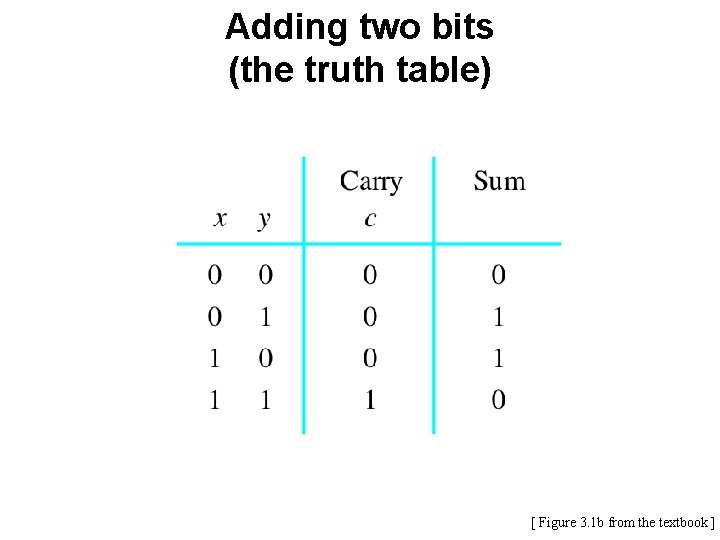
Adding two bits (the truth table) [ Figure 3. 1 b from the textbook ]
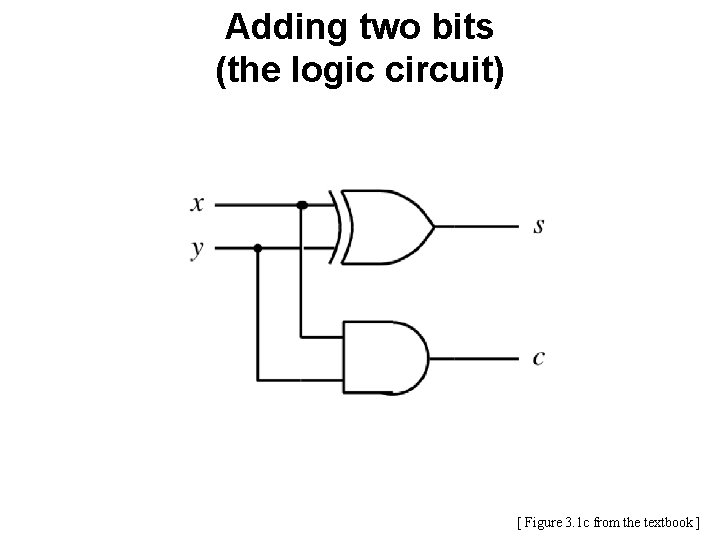
Adding two bits (the logic circuit) [ Figure 3. 1 c from the textbook ]
The Half-Adder [ Figure 3. 1 c-d from the textbook ]
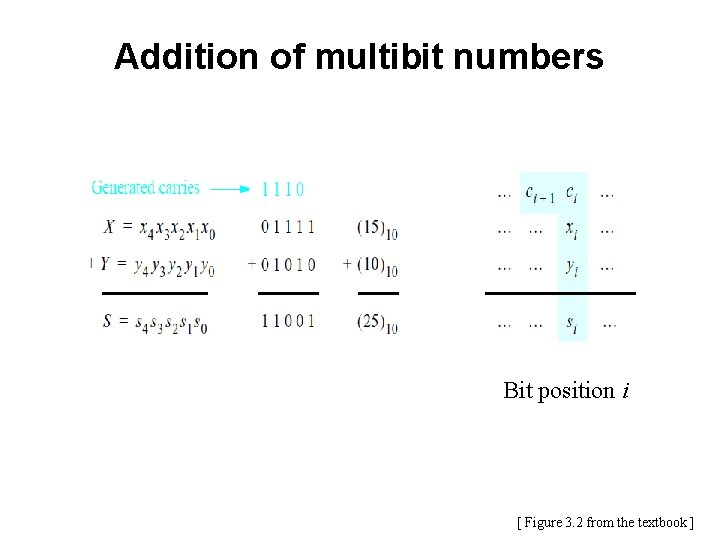
Addition of multibit numbers Bit position i [ Figure 3. 2 from the textbook ]
Problem Statement and Truth Table [ Figure 3. 2 b from the textbook ] [ Figure 3. 3 a from the textbook ]
Let’s fill-in the two K-maps [ Figure 3. 3 a-b from the textbook ]
Let’s fill-in the two K-maps [ Figure 3. 3 a-b from the textbook ]
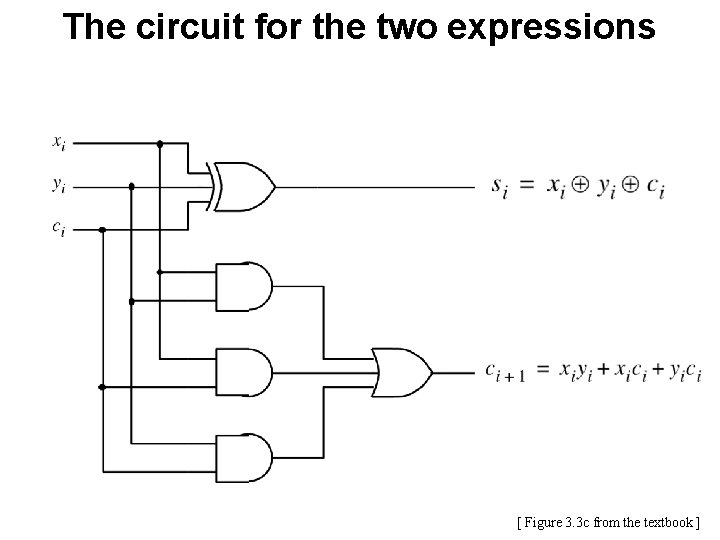
The circuit for the two expressions [ Figure 3. 3 c from the textbook ]
This is called the Full-Adder [ Figure 3. 3 c from the textbook ]
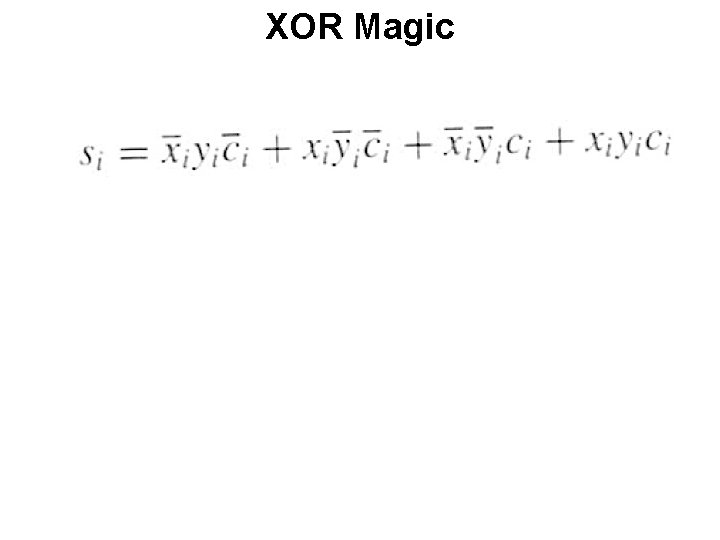
XOR Magic
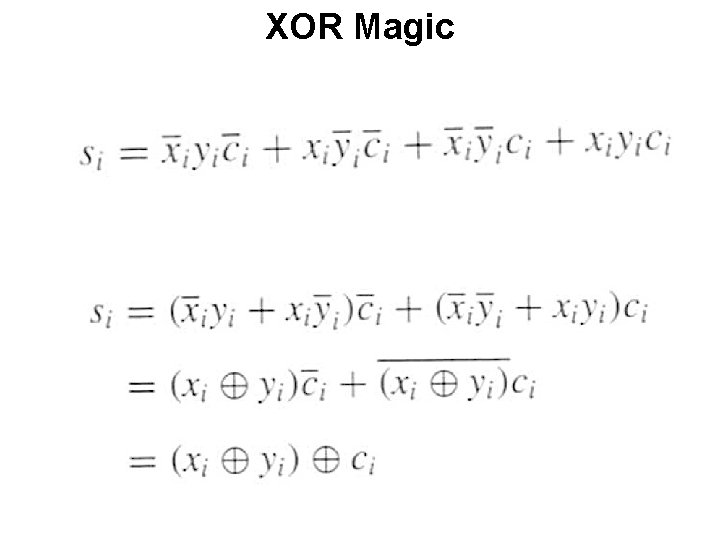
XOR Magic
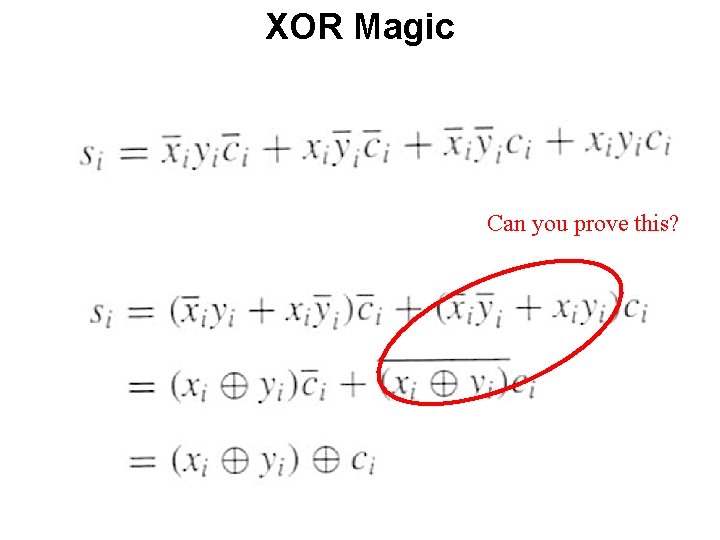
XOR Magic Can you prove this?
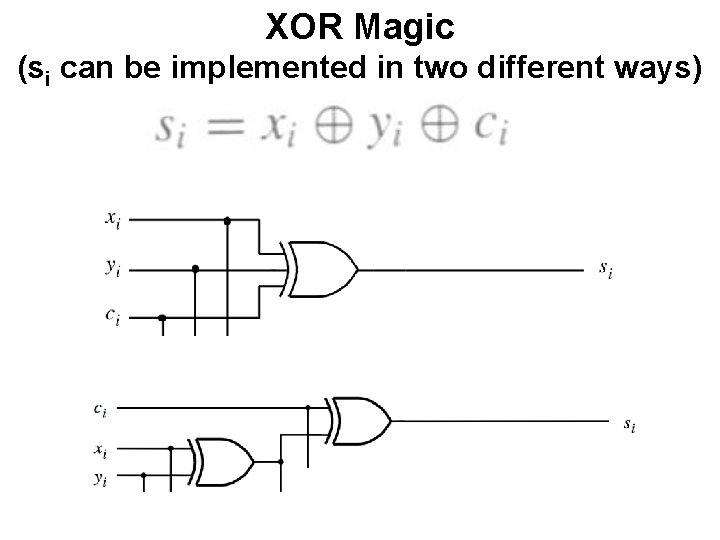
XOR Magic (si can be implemented in two different ways)
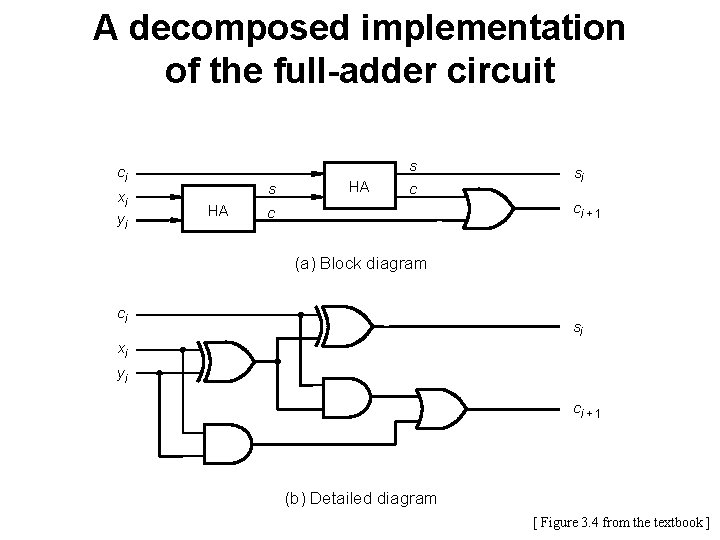
A decomposed implementation of the full-adder circuit s ci xi yi s HA HA c si ci + 1 c (a) Block diagram ci si xi yi ci + 1 (b) Detailed diagram [ Figure 3. 4 from the textbook ]
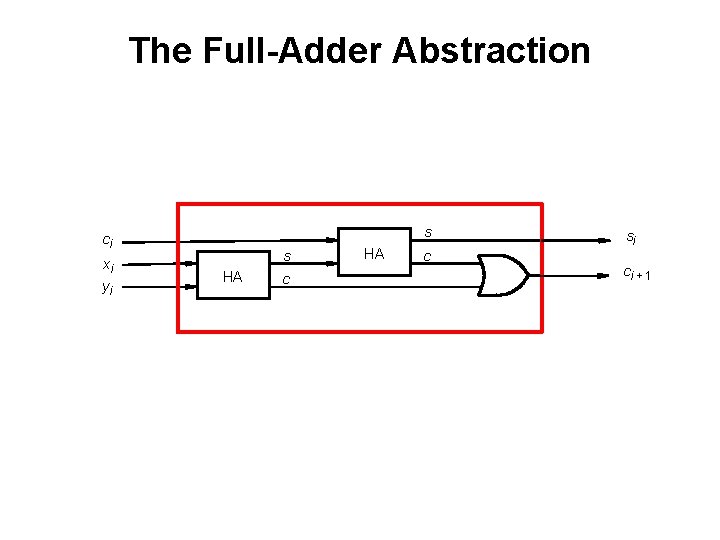
The Full-Adder Abstraction s ci xi yi s HA c si ci + 1
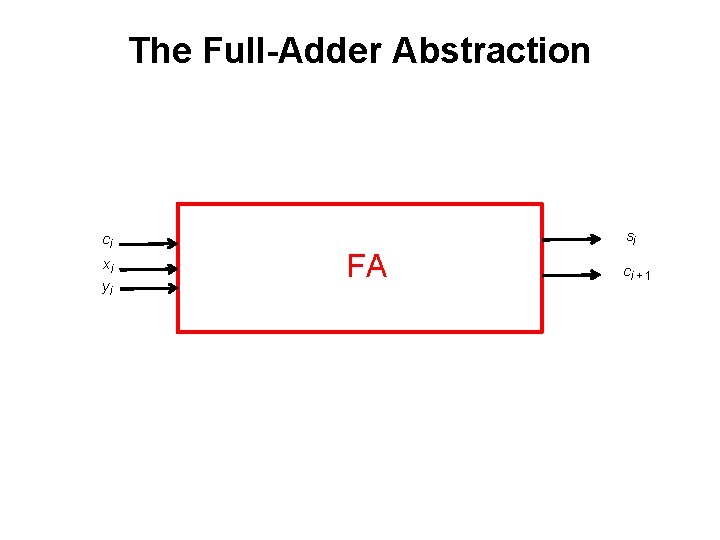
The Full-Adder Abstraction ci xi yi si FA ci + 1
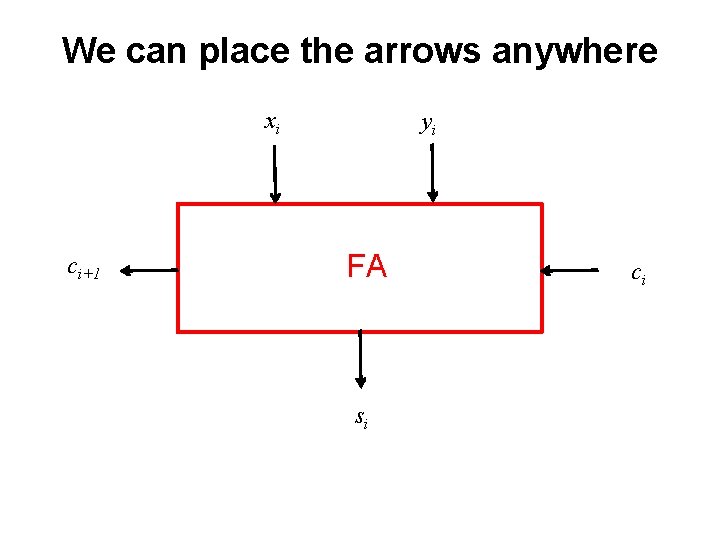
We can place the arrows anywhere xi ci+1 yi FA si ci
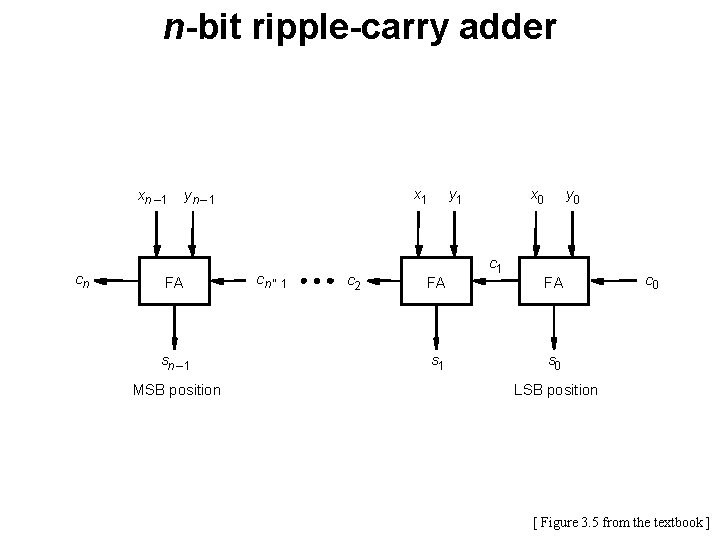
n-bit ripple-carry adder xn – 1 cn x 1 yn – 1 FA sn – 1 MSB position cn ” 1 c 2 y 1 FA s 1 x 0 c 1 y 0 FA c 0 s 0 LSB position [ Figure 3. 5 from the textbook ]
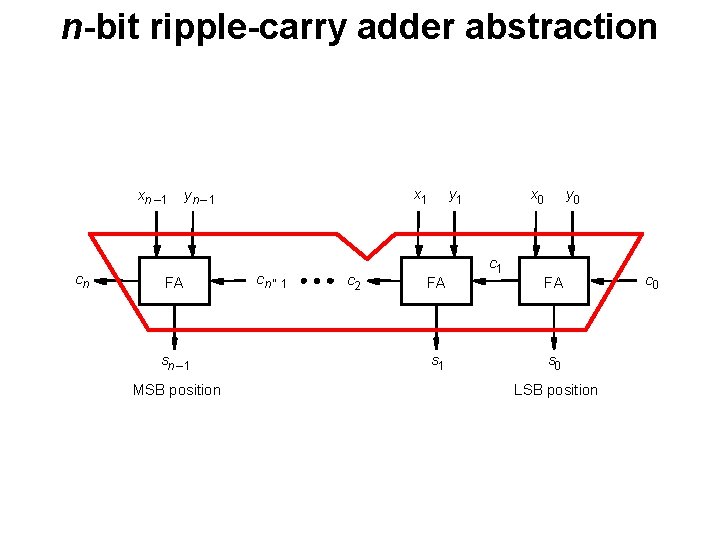
n-bit ripple-carry adder abstraction xn – 1 cn x 1 yn – 1 FA sn – 1 MSB position cn ” 1 c 2 y 1 FA s 1 x 0 c 1 y 0 FA s 0 LSB position c 0
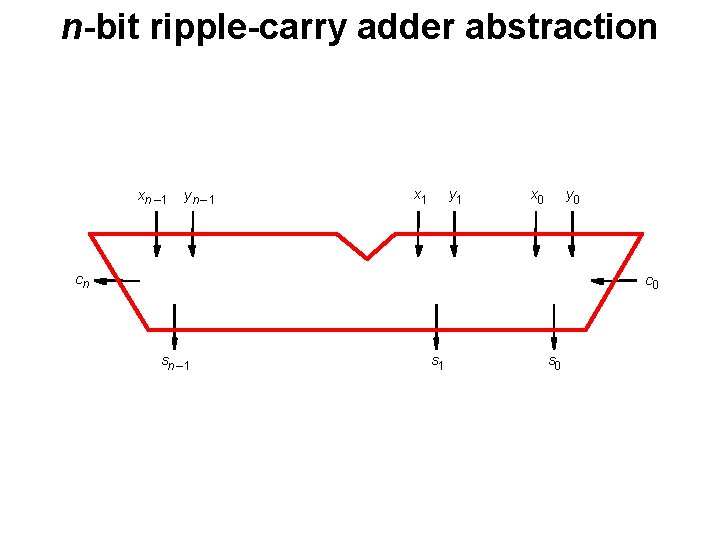
n-bit ripple-carry adder abstraction xn – 1 yn – 1 x 1 y 1 x 0 y 0 cn c 0 sn – 1 s 0
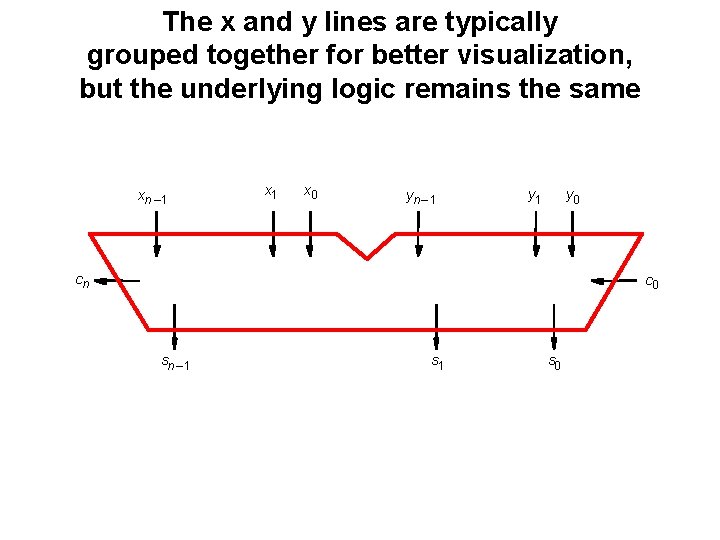
The x and y lines are typically grouped together for better visualization, but the underlying logic remains the same xn – 1 x 0 yn – 1 y 0 cn c 0 sn – 1 s 0
Serial Adder • The n-bit adder requires all bits to be provided at the same time. • In some cases we may want to add the numbers as the bits come in. • Also, with an n-bit adder we are limited to n-bits. Circuits for larger n are more complex. • Can we add arbitrarily long numbers.
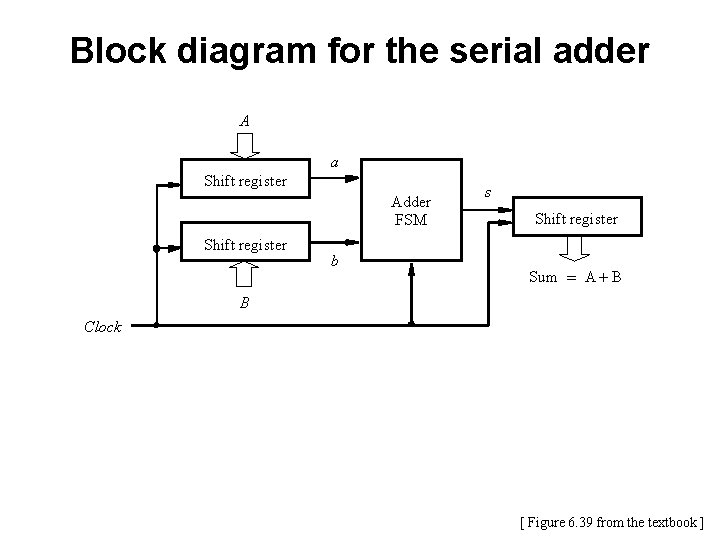
Block diagram for the serial adder A a Shift register Adder FSM Shift register b s Shift register Sum = A + B B Clock [ Figure 6. 39 from the textbook ]
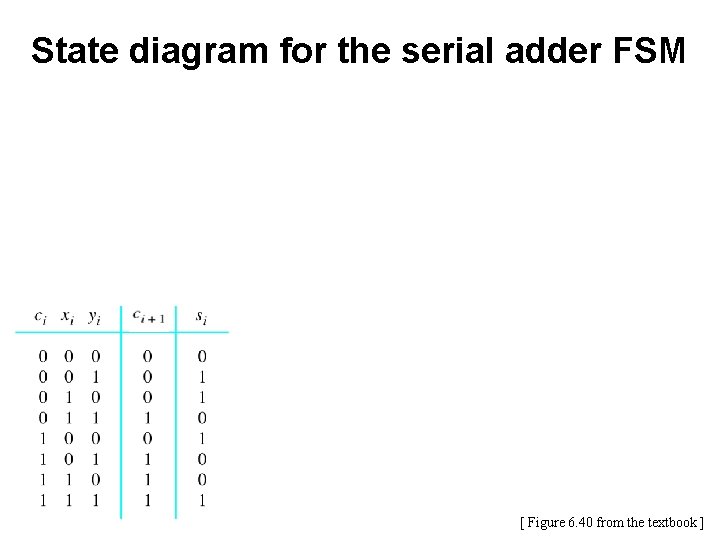
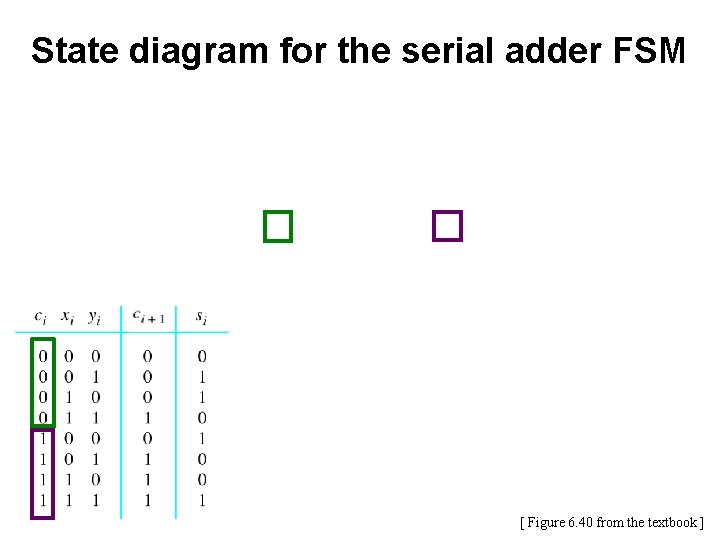
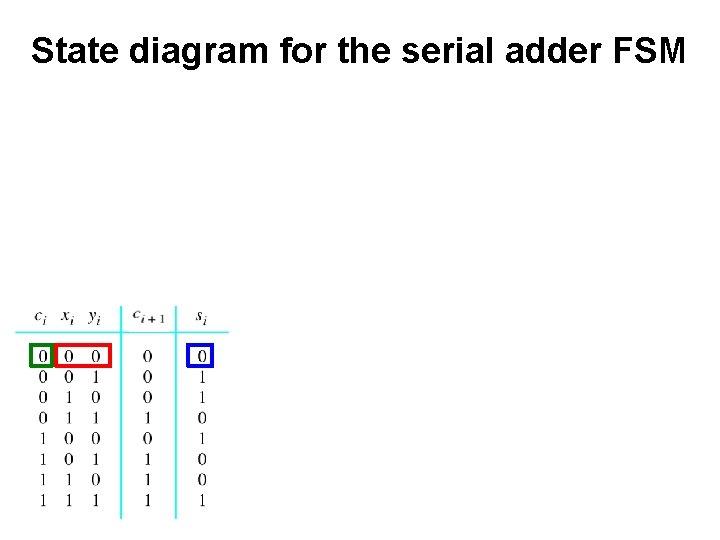
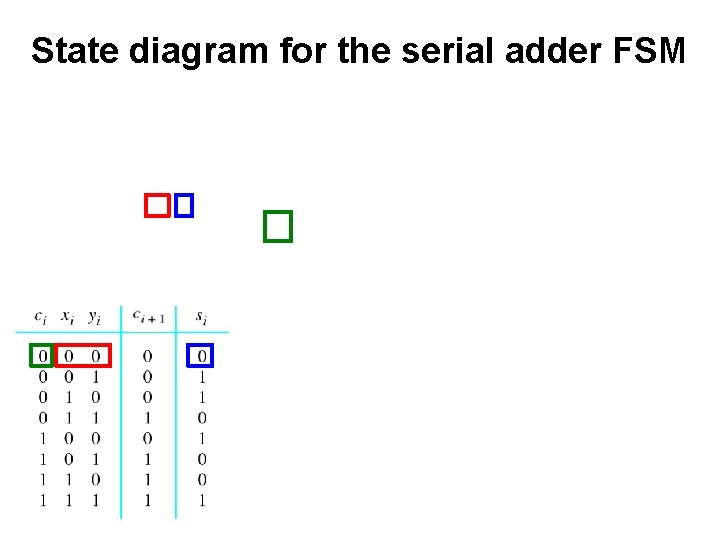
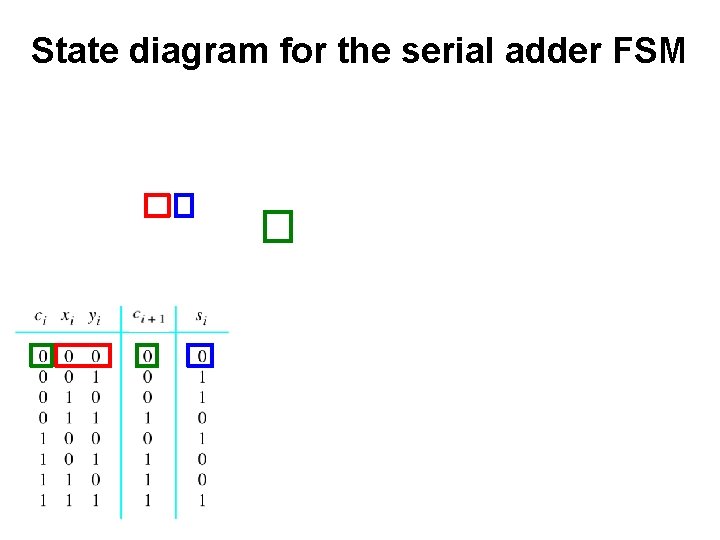
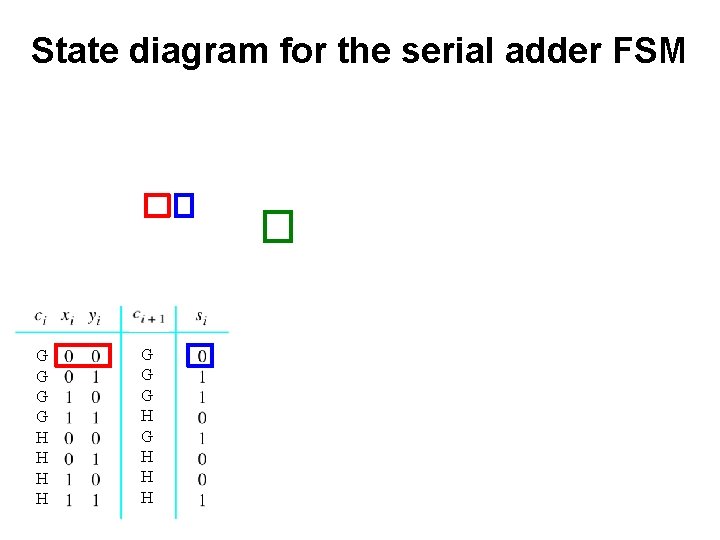
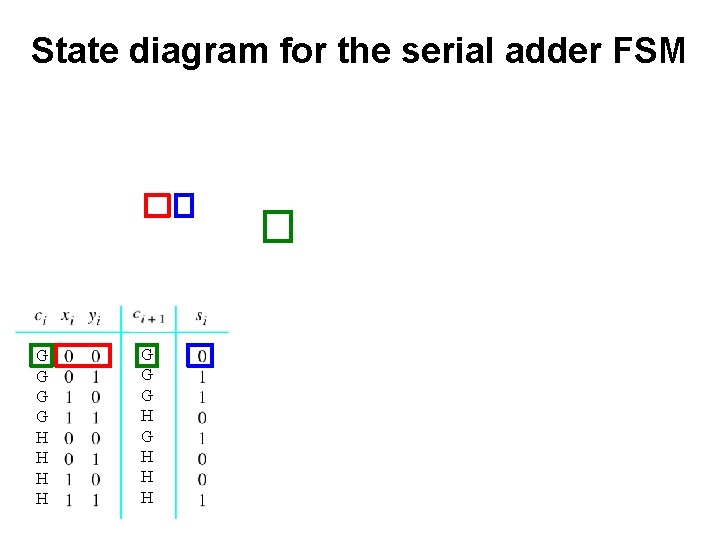
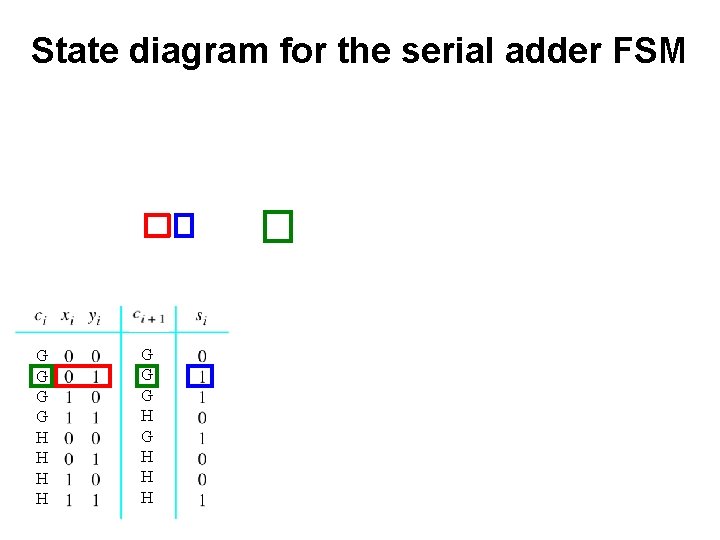
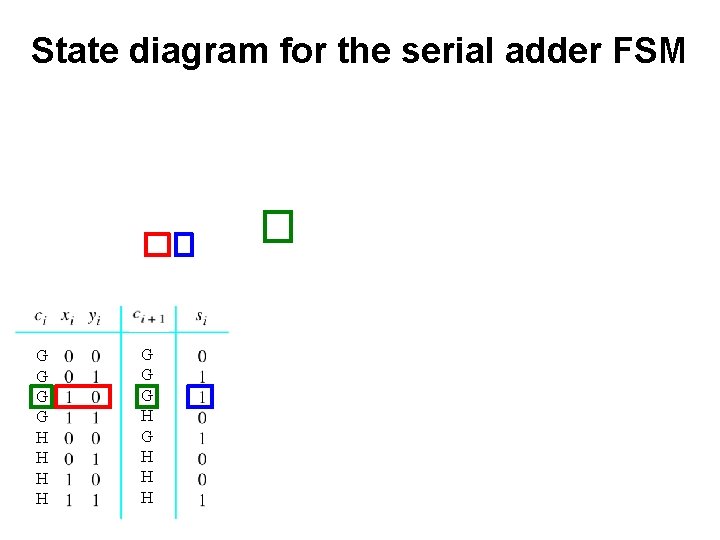
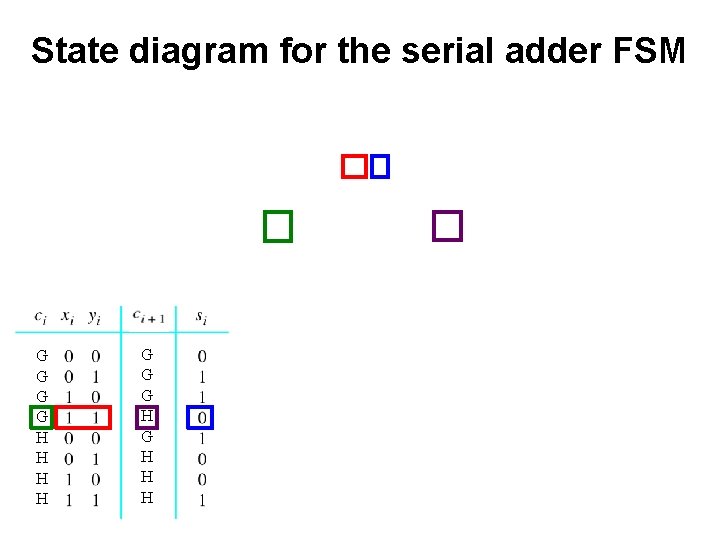
State diagram for the serial adder FSM [ Figure 6. 40 from the textbook ]
State diagram for the serial adder FSM [ Figure 6. 40 from the textbook ]
State diagram for the serial adder FSM [ Figure 6. 40 from the textbook ]
State diagram for the serial adder FSM
State diagram for the serial adder FSM
State diagram for the serial adder FSM
State diagram for the serial adder FSM G G H H G G G H H H
State diagram for the serial adder FSM G G H H G G G H H H
State diagram for the serial adder FSM G G H H G G G H H H
State diagram for the serial adder FSM G G H H G G G H H H
State diagram for the serial adder FSM G G H H G G G H H H
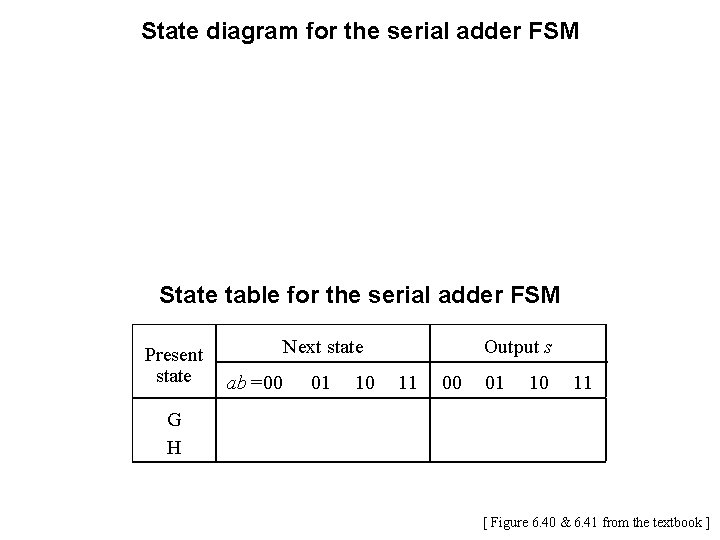
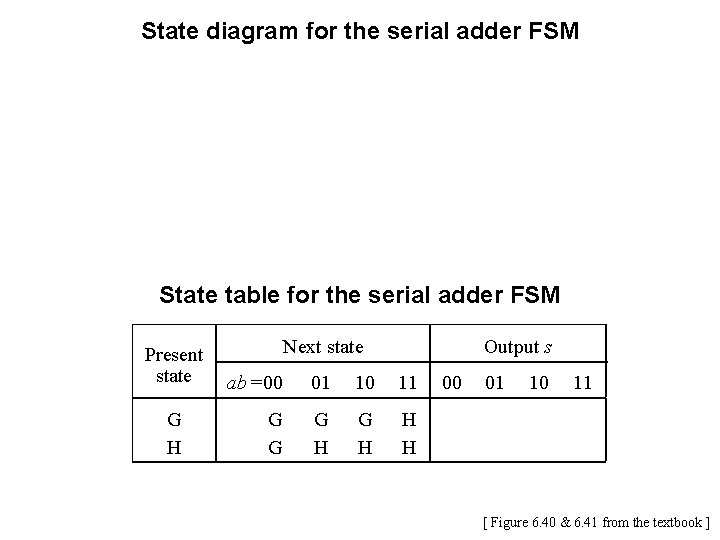
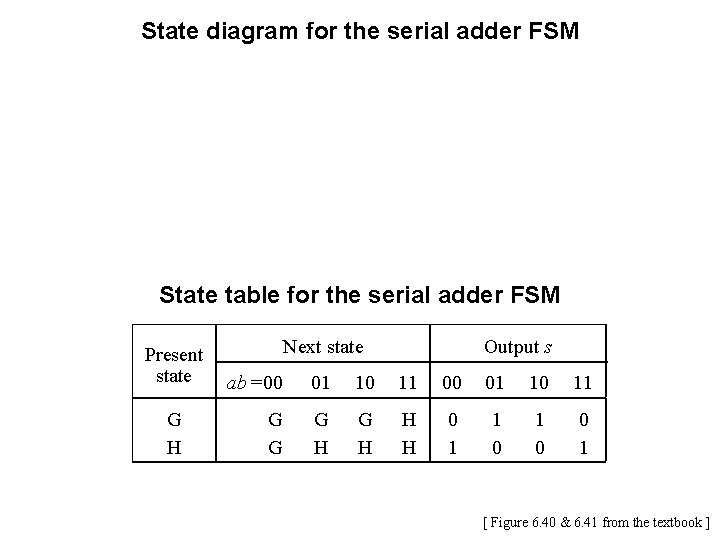
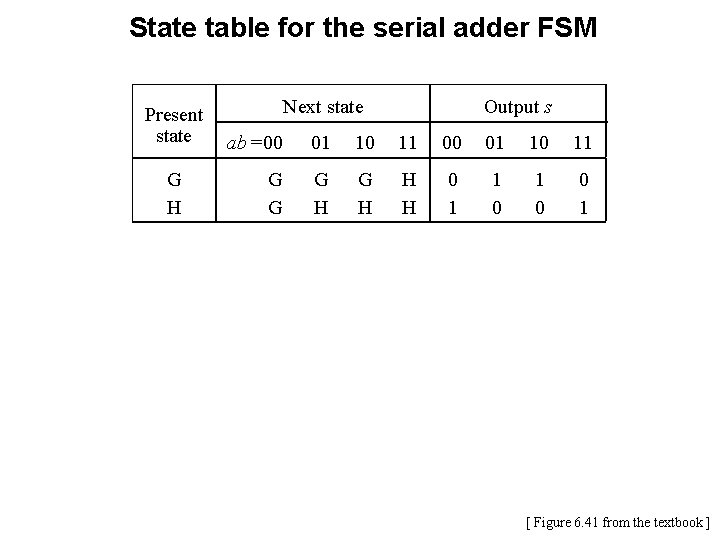
State diagram for the serial adder FSM State table for the serial adder FSM Present state G H Output s Next state ab =00 01 10 11 G G G H H H 0 1 1 0 0 1 [ Figure 6. 40 & 6. 41 from the textbook ]
State diagram for the serial adder FSM State table for the serial adder FSM Present state G H Output s Next state ab =00 01 10 11 G G G H H H 0 1 1 0 0 1 [ Figure 6. 40 & 6. 41 from the textbook ]
State diagram for the serial adder FSM State table for the serial adder FSM Present state G H Output s Next state ab =00 01 10 11 G G G H H H 0 1 1 0 0 1 [ Figure 6. 40 & 6. 41 from the textbook ]
State table for the serial adder FSM Present state G H Output s Next state ab =00 01 10 11 G G G H H H 0 1 1 0 0 1 [ Figure 6. 41 from the textbook ]
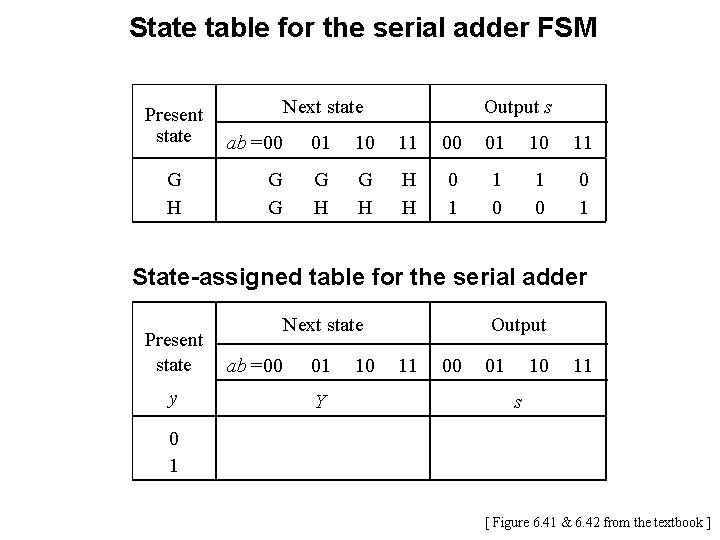
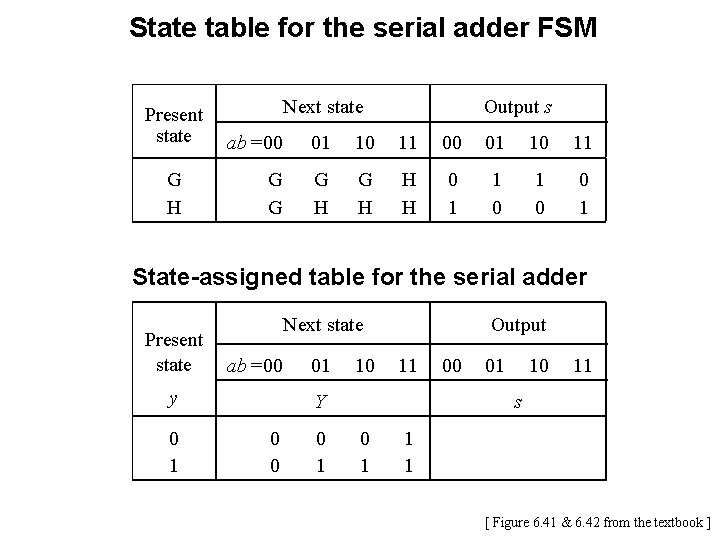
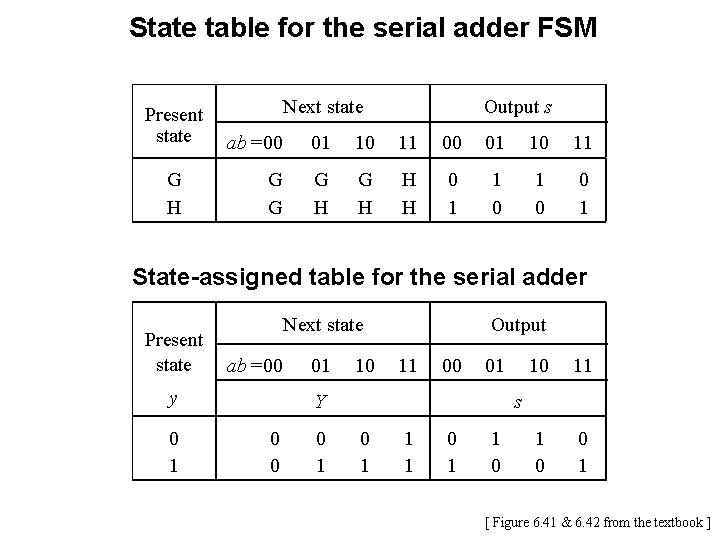
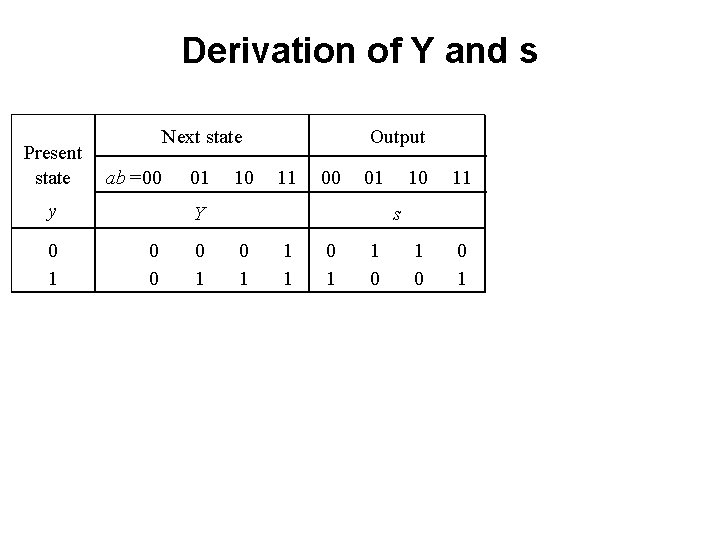
State table for the serial adder FSM Present state G H Output s Next state ab =00 01 10 11 G G G H H H 0 1 1 0 0 1 State-assigned table for the serial adder Present state Next state ab =00 y 0 1 01 10 Output 11 00 01 Y 0 0 0 1 10 11 1 0 0 1 s 0 1 1 1 0 [ Figure 6. 41 & 6. 42 from the textbook ]
State table for the serial adder FSM Present state G H Output s Next state ab =00 01 10 11 G G G H H H 0 1 1 0 0 1 State-assigned table for the serial adder Present state Next state ab =00 y 0 1 01 10 Output 11 00 01 Y 0 0 0 1 10 11 1 0 0 1 s 0 1 1 1 0 [ Figure 6. 41 & 6. 42 from the textbook ]
State table for the serial adder FSM Present state G H Output s Next state ab =00 01 10 11 G G G H H H 0 1 1 0 0 1 State-assigned table for the serial adder Present state Next state ab =00 y 0 1 01 10 Output 11 00 01 Y 0 0 0 1 10 11 1 0 0 1 s 0 1 1 1 0 [ Figure 6. 41 & 6. 42 from the textbook ]
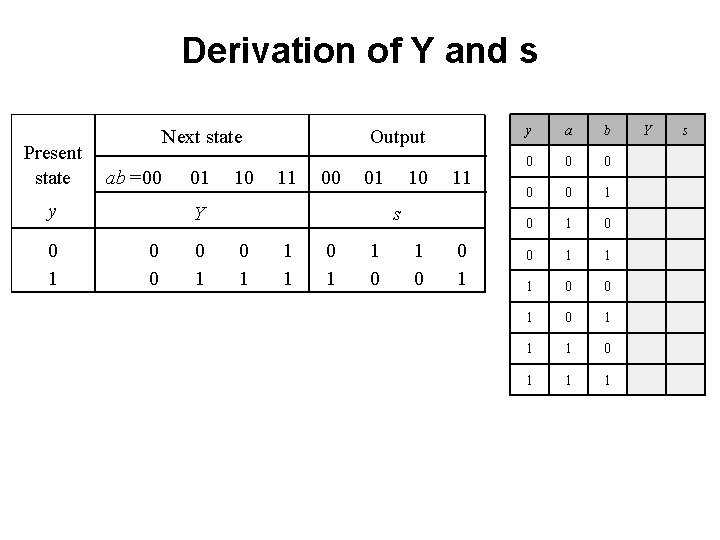
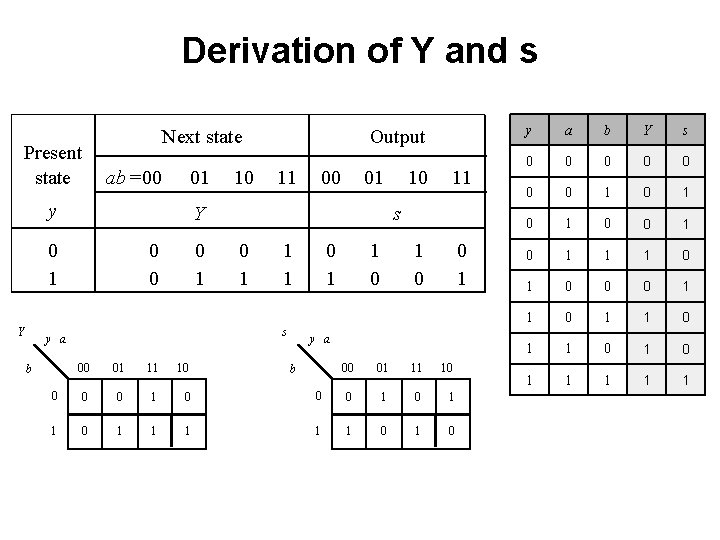
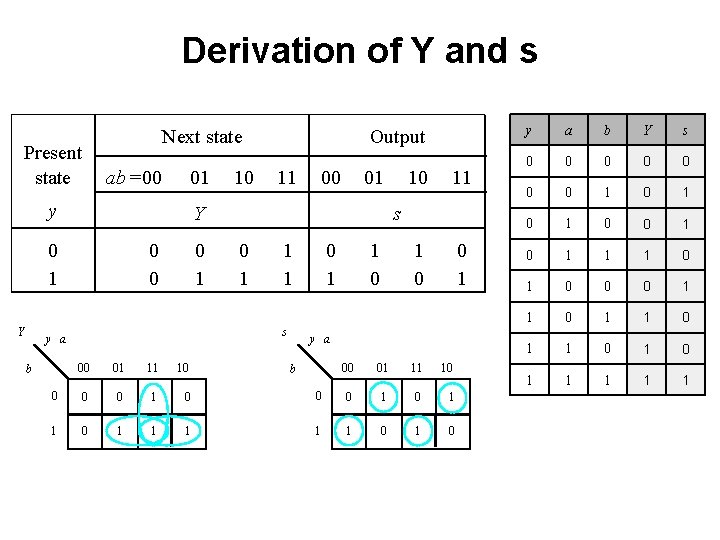
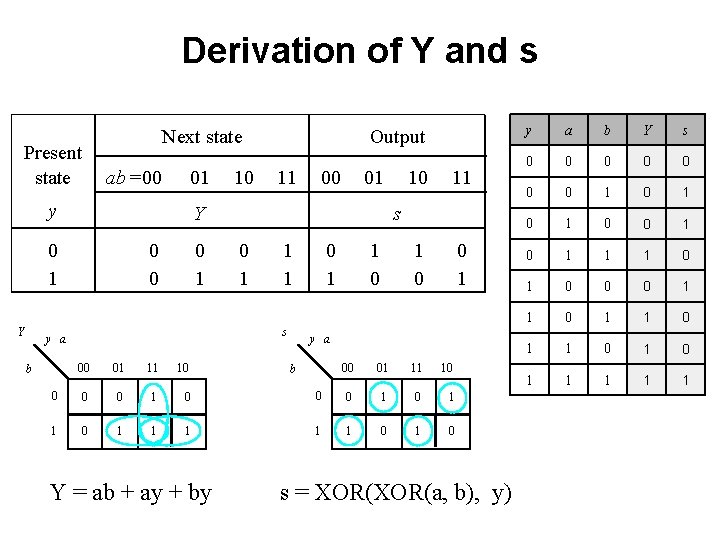
Derivation of Y and s Present state Next state ab =00 y 0 1 01 10 Output 11 00 01 Y 0 0 0 1 10 11 1 0 0 1 s 0 1 1 1 0
Derivation of Y and s Present state Next state ab =00 y 0 1 01 10 Output 11 00 01 Y 0 0 0 1 10 11 s 0 1 1 1 0 1 0 0 1 y a b 0 0 0 1 1 1 0 0 1 1 1 Y s
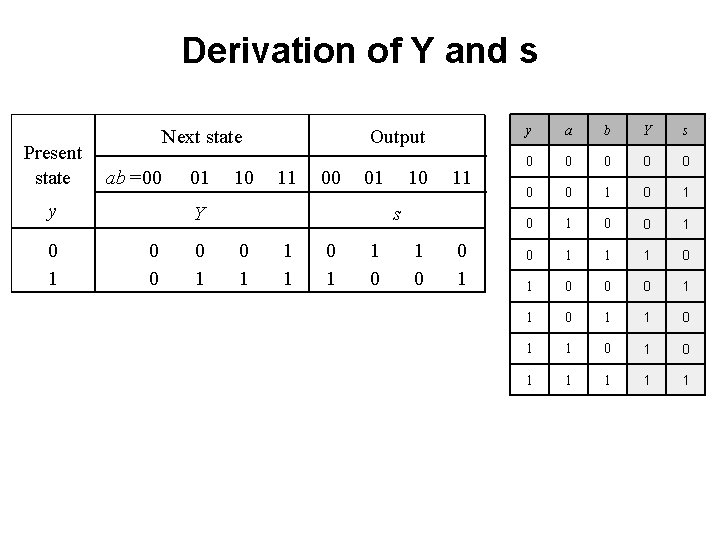
Derivation of Y and s Present state Next state ab =00 y 0 1 01 10 Output 11 00 01 Y 0 0 0 1 10 11 s 0 1 1 1 0 1 0 0 1 y a b Y s 0 0 0 0 1 0 1 0 1 1 1 0 0 0 1 1 0 1 1 1
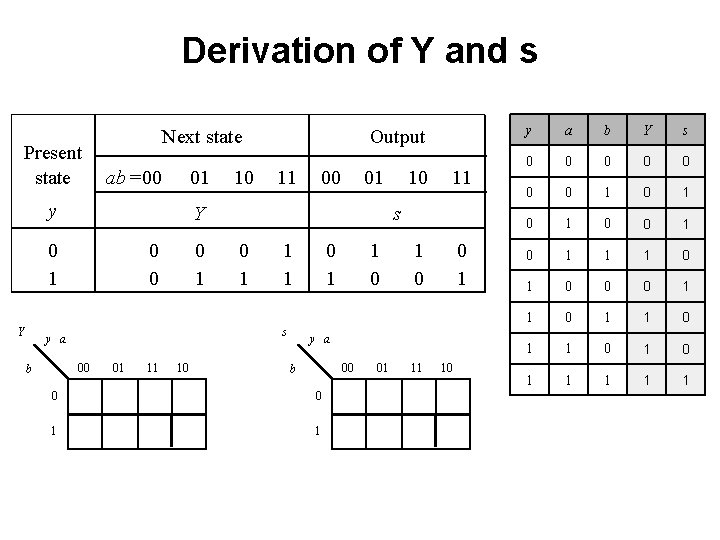
Derivation of Y and s Present state Next state ab =00 01 y 0 0 0 1 00 01 11 10 10 11 s 0 1 1 1 s y a b 11 Y 0 1 Y 10 Output 0 1 1 0 0 1 y a 00 b 0 0 1 1 01 11 10 y a b Y s 0 0 0 0 1 0 1 0 1 1 1 0 0 0 1 1 0 1 1 1
Derivation of Y and s Present state Next state ab =00 01 y 0 0 0 1 00 01 11 10 0 1 0 1 1 1 10 11 s 0 1 1 1 s y a b 11 Y 0 1 Y 10 Output 0 1 1 0 0 1 y a 00 01 11 10 0 0 1 1 1 0 b y a b Y s 0 0 0 0 1 0 1 0 1 1 1 0 0 0 1 1 0 1 1 1
Derivation of Y and s Present state Next state ab =00 01 y 0 0 0 1 00 01 11 10 0 1 0 1 1 1 10 11 s 0 1 1 1 s y a b 11 Y 0 1 Y 10 Output 0 1 1 0 0 1 y a 00 01 11 10 0 0 1 1 1 0 b y a b Y s 0 0 0 0 1 0 1 0 1 1 1 0 0 0 1 1 0 1 1 1
Derivation of Y and s Present state Next state ab =00 01 y 0 0 0 1 00 01 11 10 0 1 0 1 1 1 Y = ab + ay + by 10 11 s 0 1 1 1 s y a b 11 Y 0 1 Y 10 Output 0 1 1 0 0 1 y a 00 01 11 10 0 0 1 1 1 0 b s = XOR(a, b), y) y a b Y s 0 0 0 0 1 0 1 0 1 1 1 0 0 0 1 1 0 1 1 1
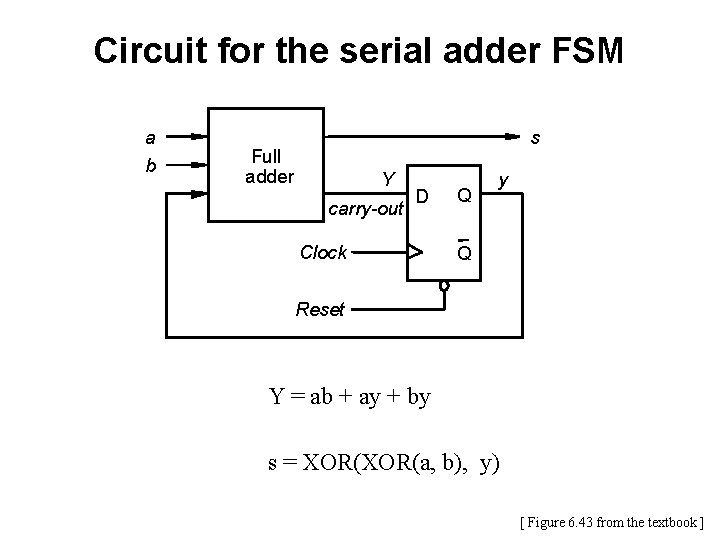
Circuit for the serial adder FSM a b s Full adder Y carry-out D Clock Q y Q Reset Y = ab + ay + by s = XOR(a, b), y) [ Figure 6. 43 from the textbook ]
Moore Machine Implementation
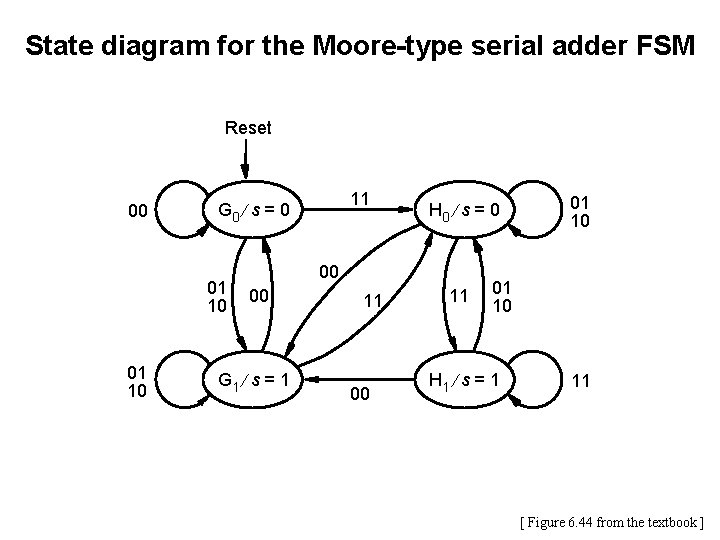
State diagram for the Moore-type serial adder FSM Reset 00 01 10 11 G 0 ¤ s = 0 H 0 ¤ s = 0 00 00 G 1 ¤ s = 1 11 00 11 01 10 H 1 ¤ s = 1 11 [ Figure 6. 44 from the textbook ]
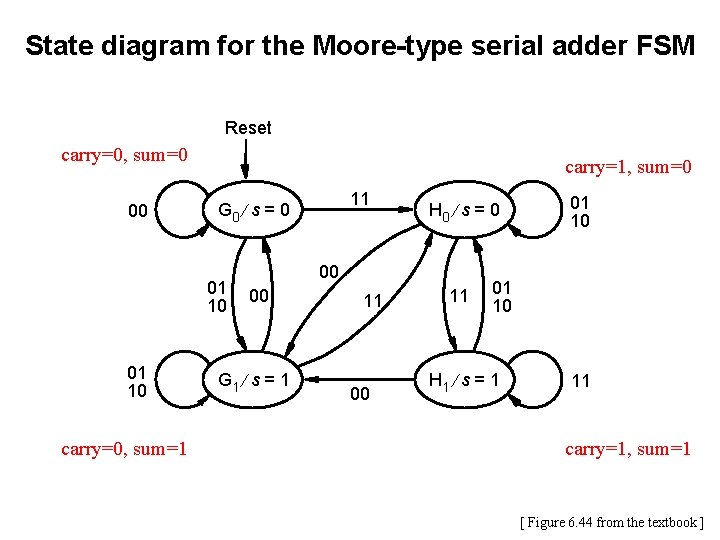
State diagram for the Moore-type serial adder FSM Reset carry=0, sum=0 00 carry=1, sum=0 01 10 carry=0, sum=1 11 G 0 ¤ s = 0 H 0 ¤ s = 0 00 00 G 1 ¤ s = 1 11 00 11 01 10 H 1 ¤ s = 1 11 carry=1, sum=1 [ Figure 6. 44 from the textbook ]
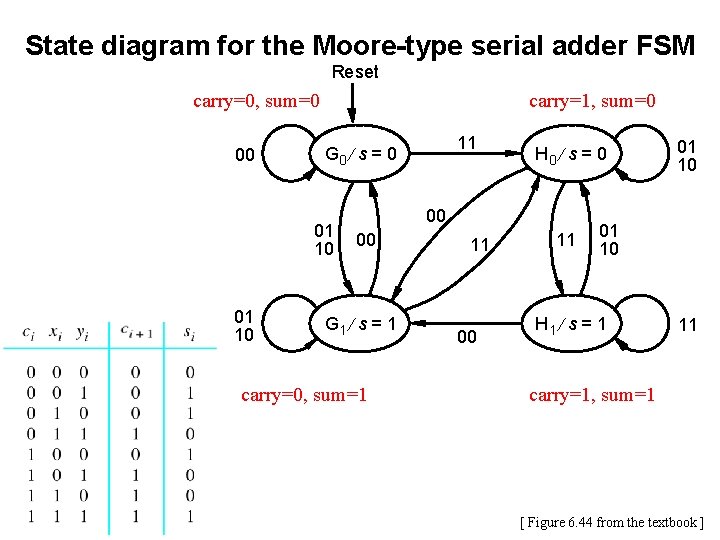
State diagram for the Moore-type serial adder FSM Reset carry=0, sum=0 00 carry=1, sum=0 01 10 11 G 0 ¤ s = 0 H 0 ¤ s = 0 00 00 G 1 ¤ s = 1 carry=0, sum=1 11 00 11 01 10 H 1 ¤ s = 1 11 carry=1, sum=1 [ Figure 6. 44 from the textbook ]
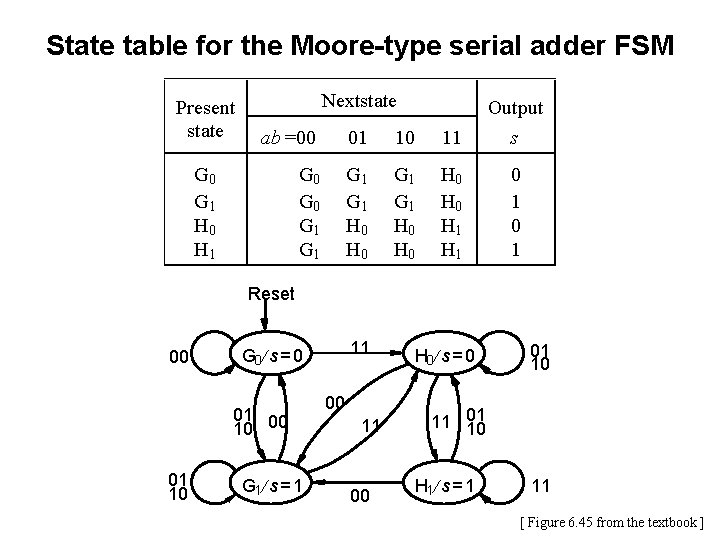
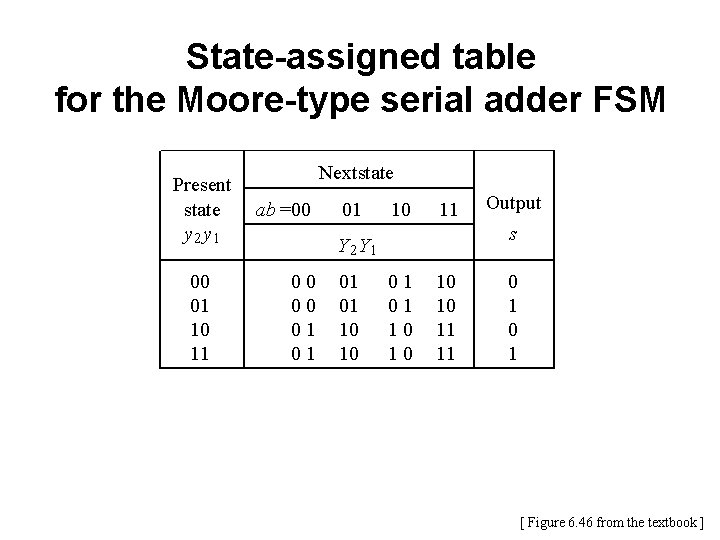
State table for the Moore-type serial adder FSM Present state Nextstate ab =00 01 10 11 Output s G 0 G 1 G 1 H 0 H 0 H 1 0 1 G 0 G 1 H 0 H 1 Reset 00 01 00 10 01 10 11 G 0 ¤ s = 0 G 1 ¤ s = 1 00 11 00 H 0 ¤ s = 0 01 10 11 01 10 H 1 ¤ s = 1 11 [ Figure 6. 45 from the textbook ]
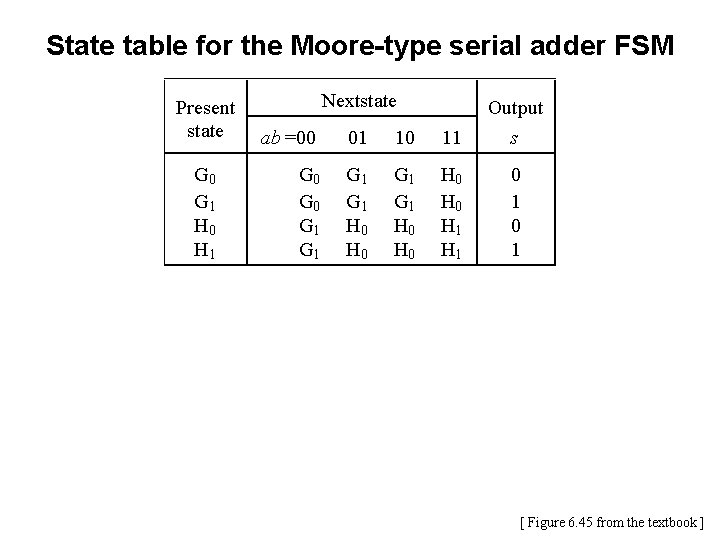
State table for the Moore-type serial adder FSM Present state G 0 G 1 H 0 H 1 Nextstate ab =00 01 10 11 Output s G 0 G 1 G 1 H 0 H 0 H 1 0 1 [ Figure 6. 45 from the textbook ]
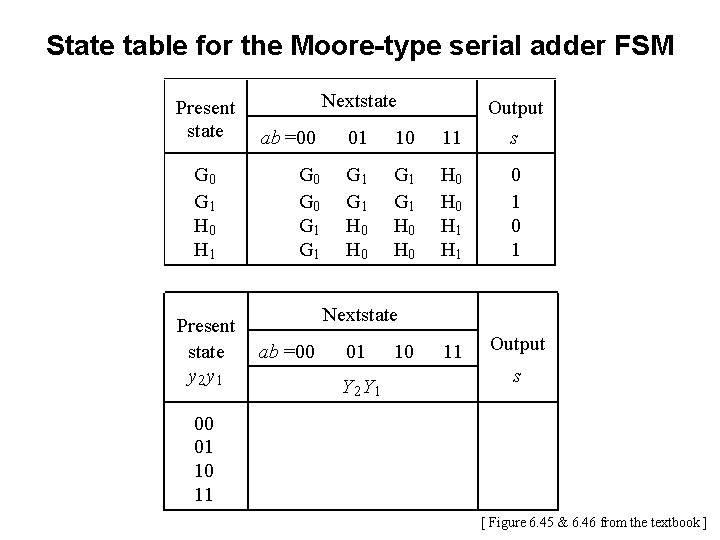
State table for the Moore-type serial adder FSM Present state G 0 G 1 H 0 H 1 Present state y 2 y 1 Nextstate ab =00 01 10 11 Output s G 0 G 1 G 1 H 0 H 0 H 1 0 1 11 Output Nextstate ab =00 01 Y 2 Y 1 10 s 00 01 10 11 [ Figure 6. 45 & 6. 46 from the textbook ]
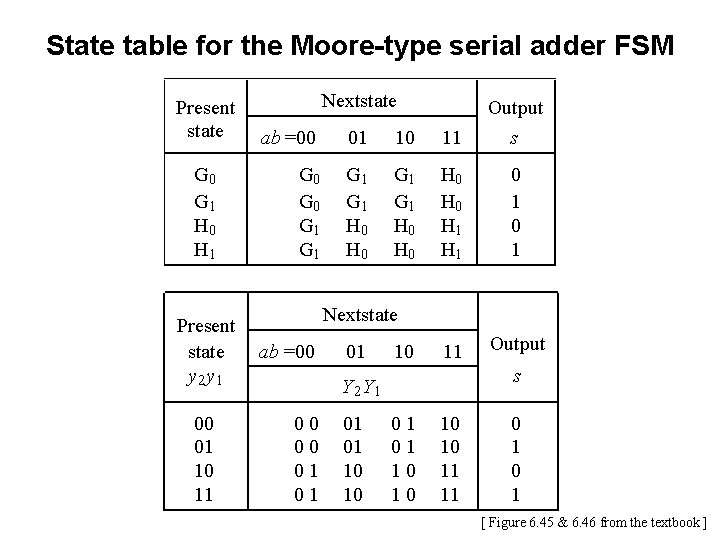
State table for the Moore-type serial adder FSM Present state G 0 G 1 H 0 H 1 Present state y 2 y 1 00 01 10 11 Nextstate ab =00 01 10 11 Output s G 0 G 1 G 1 H 0 H 0 H 1 0 1 11 Output Nextstate ab =00 01 10 s Y 2 Y 1 00 00 01 01 10 10 11 11 0 1 [ Figure 6. 45 & 6. 46 from the textbook ]
State-assigned table for the Moore-type serial adder FSM Present state y 2 y 1 00 01 10 11 Nextstate ab =00 01 10 11 s Y 2 Y 1 00 00 01 01 10 10 Output 01 01 10 10 11 11 0 1 [ Figure 6. 46 from the textbook ]
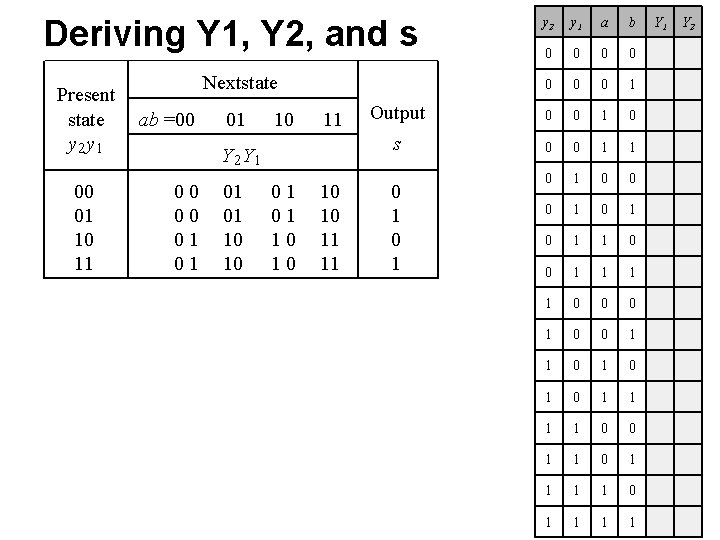
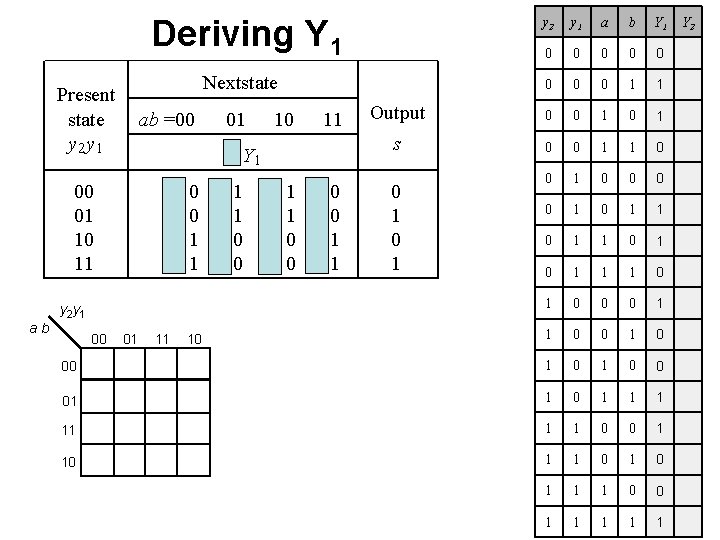
Deriving Y 1, Y 2, and s Present state y 2 y 1 00 01 10 11 y 2 y 1 a b 0 0 0 0 1 Output 0 0 1 0 s 0 0 1 1 0 0 0 1 0 1 1 0 0 0 1 1 0 1 0 1 1 0 0 1 1 1 1 0 1 1 Nextstate ab =00 01 10 11 Y 2 Y 1 00 00 01 01 10 10 11 11 0 1 Y 2
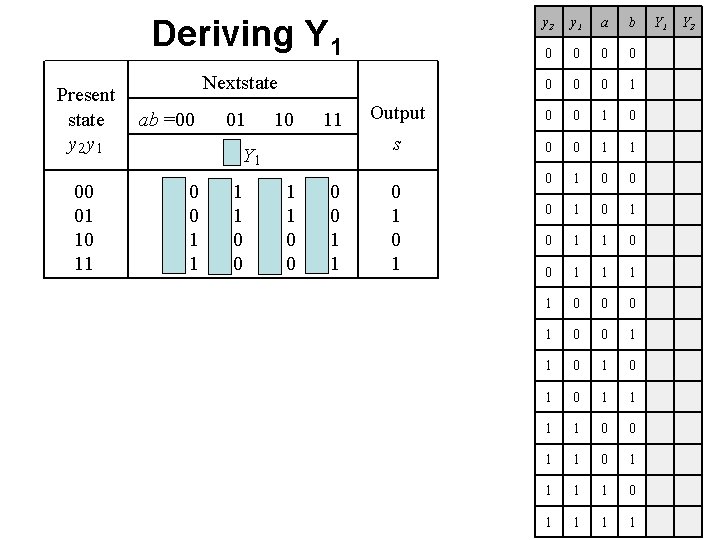
Deriving Y 1 Present state y 2 y 1 00 01 10 11 y 2 y 1 a b 0 0 0 0 1 Output 0 0 1 0 s 0 0 1 1 0 0 0 1 0 1 1 0 0 0 1 1 0 1 0 1 1 0 0 1 1 1 1 0 1 1 Nextstate ab =00 01 10 11 Y 2 Y 1 00 00 01 01 10 10 11 11 0 1 Y 2
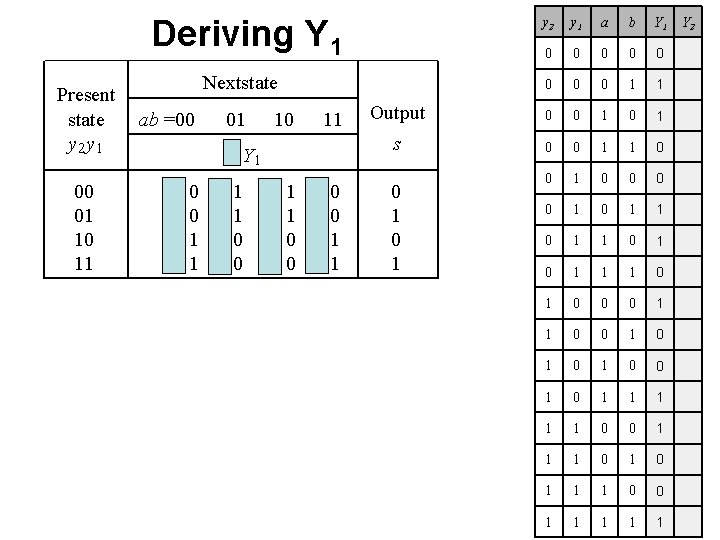
Deriving Y 1 Present state y 2 y 1 00 01 10 11 y 2 y 1 a b Y 1 0 0 0 0 1 1 Output 0 0 1 s 0 0 1 1 0 0 0 0 1 1 0 1 0 1 1 1 0 0 0 1 1 0 0 1 0 1 0 1 1 1 0 0 1 1 1 Nextstate ab =00 01 10 11 Y 2 Y 1 00 00 01 01 10 10 11 11 0 1 Y 2
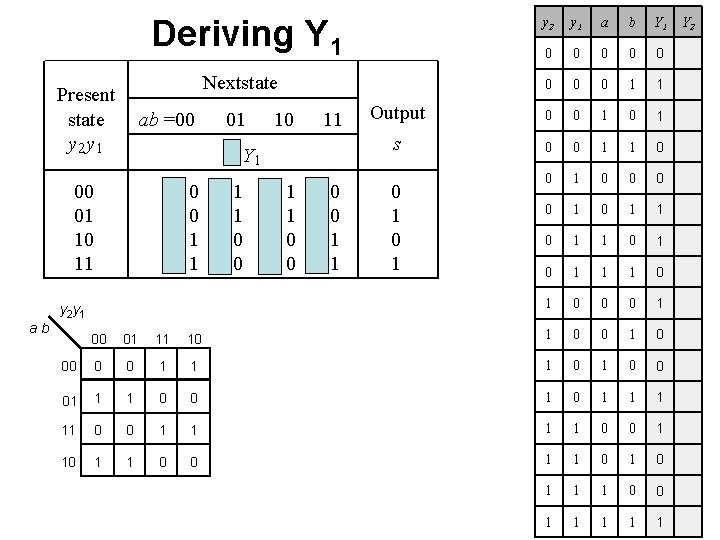
Deriving Y 1 y 2 y 1 a b Y 1 0 0 0 0 1 1 Output 0 0 1 s 0 0 1 1 0 0 0 0 1 1 0 1 0 1 1 1 0 0 0 1 1 0 00 1 0 0 01 1 0 1 11 1 1 0 0 1 1 1 0 0 1 1 1 Nextstate Present state y 2 y 1 ab =00 00 00 01 01 y 2 y 1 00 10 11 Y 2 Y 1 00 01 10 11 ab 01 01 11 10 01 01 10 10 11 11 0 1 Y 2
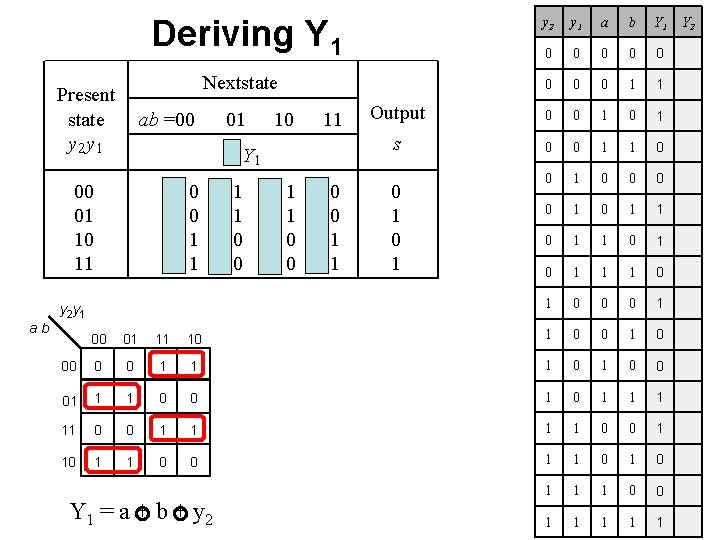
Deriving Y 1 y 1 a b Y 1 0 0 0 0 1 1 Output 0 0 1 s 0 0 1 1 0 0 0 0 1 1 0 1 0 1 1 1 0 0 0 1 Nextstate Present state y 2 y 1 ab =00 01 10 11 Y 2 Y 1 00 01 10 11 00 00 01 01 y 2 y 1 ab y 2 01 01 10 10 11 11 0 1 00 01 11 10 1 0 00 0 0 1 1 1 0 0 01 1 1 0 0 1 1 1 11 0 0 1 1 0 0 1 1 1 0 0 1 1 1 Y 2
Deriving Y 1 y 1 a b Y 1 0 0 0 0 1 1 Output 0 0 1 s 0 0 1 1 0 0 0 0 1 1 0 1 0 1 1 1 0 0 0 1 Nextstate Present state y 2 y 1 ab =00 01 10 11 Y 2 Y 1 00 01 10 11 00 00 01 01 y 2 y 1 ab y 2 01 01 10 10 11 11 0 1 00 01 11 10 1 0 00 0 0 1 1 1 0 0 01 1 1 0 0 1 1 1 11 0 0 1 1 0 0 1 1 1 0 0 1 1 1 Y 1 = a + b + y 2 Y 2
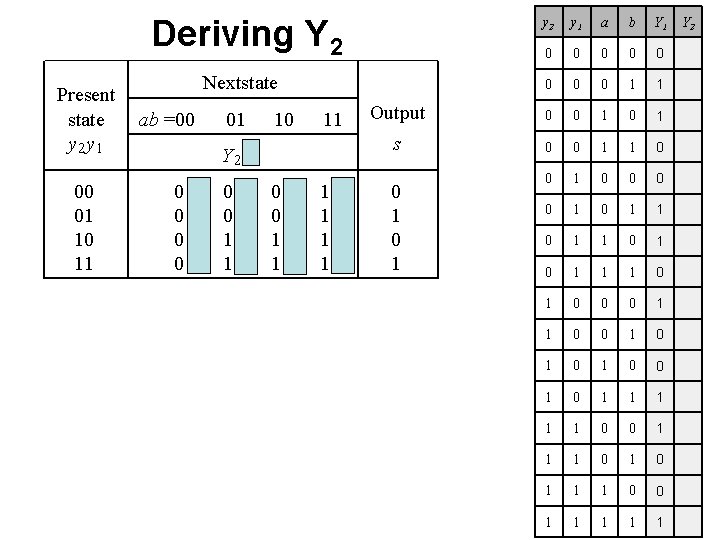
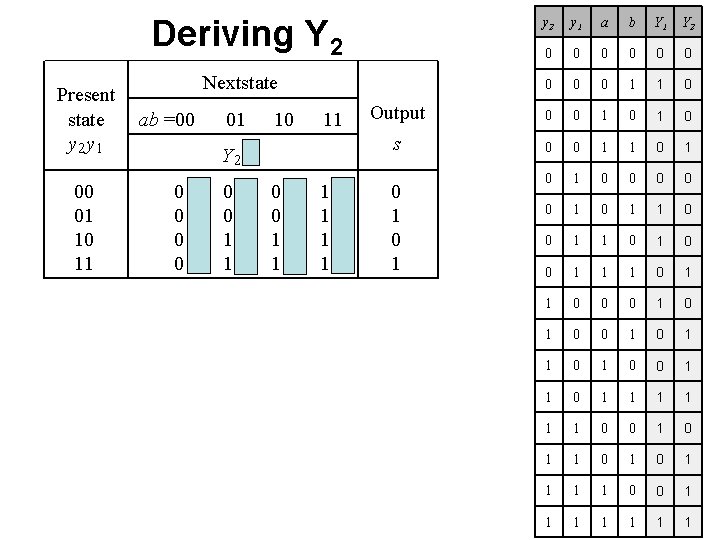
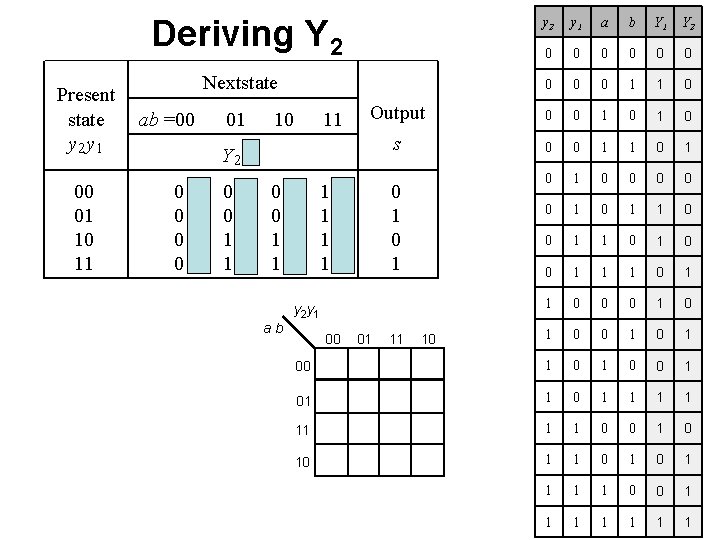
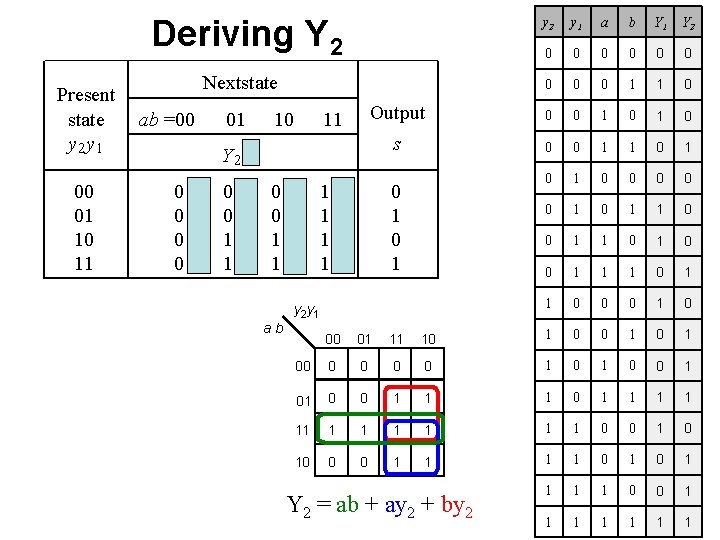
Deriving Y 2 Present state y 2 y 1 00 01 10 11 y 2 y 1 a b Y 1 0 0 0 0 1 1 Output 0 0 1 s 0 0 1 1 0 0 0 0 1 1 0 1 0 1 1 1 0 0 0 1 1 0 0 1 0 1 0 1 1 1 0 0 1 1 1 Nextstate ab =00 01 10 11 Y 2 Y 1 00 00 01 01 10 10 11 11 0 1 Y 2
Deriving Y 2 Present state y 2 y 1 00 01 10 11 y 2 y 1 a b Y 1 Y 2 0 0 0 0 0 1 1 0 Output 0 0 1 0 s 0 0 1 1 0 1 0 0 0 1 1 0 0 1 1 1 0 0 0 1 0 1 1 0 0 1 1 1 1 0 0 1 1 1 1 Nextstate ab =00 01 10 11 Y 2 Y 1 00 00 01 01 10 10 11 11 0 1
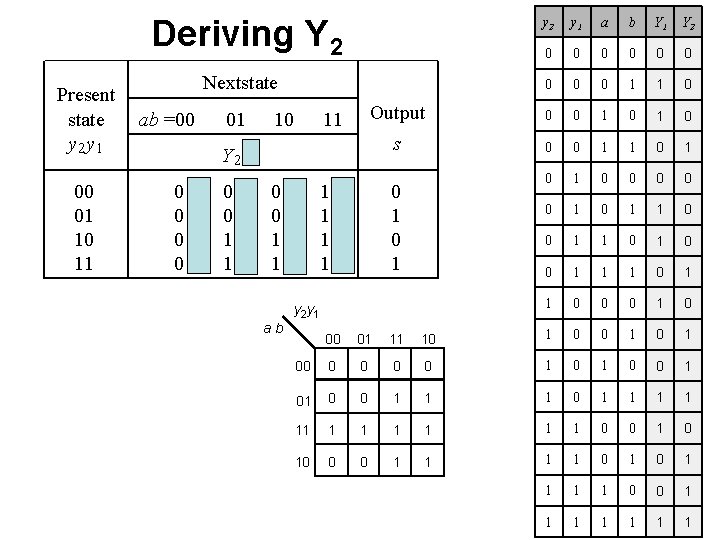
Deriving Y 2 Present state y 2 y 1 00 01 10 11 y 2 y 1 a b Y 1 Y 2 0 0 0 0 0 1 1 0 Output 0 0 1 0 s 0 0 1 1 0 1 0 0 0 1 1 0 0 1 1 1 0 0 0 1 0 1 00 1 01 1 0 1 1 11 1 1 0 0 10 1 1 0 0 1 1 1 1 Nextstate ab =00 01 10 11 Y 2 Y 1 00 00 01 01 10 10 11 11 0 1 y 2 y 1 ab 00 01 11 10
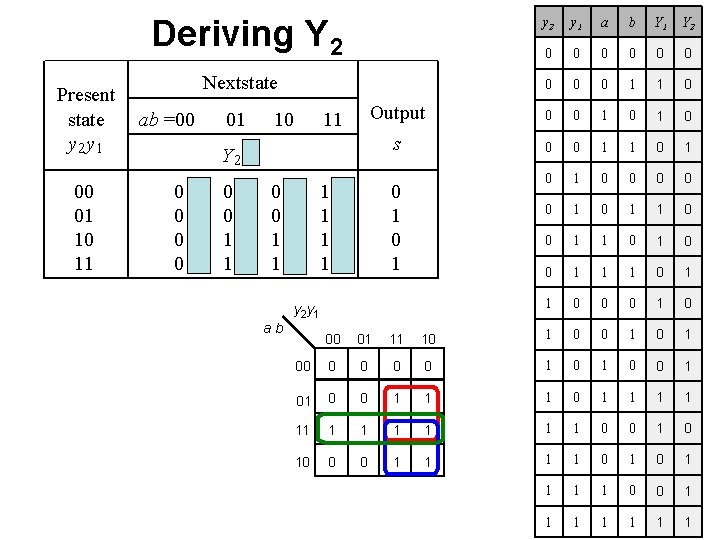
Deriving Y 2 Present state y 2 y 1 00 01 10 11 y 2 y 1 a b Y 1 Y 2 0 0 0 0 0 1 1 0 Output 0 0 1 0 s 0 0 1 1 0 1 0 0 0 1 1 0 0 1 1 1 0 0 0 1 0 Nextstate ab =00 01 10 11 Y 2 Y 1 00 00 01 01 10 10 11 11 0 1 y 2 y 1 ab 00 01 11 10 1 0 1 00 0 0 1 01 0 0 1 1 1 1 11 1 1 1 0 0 10 0 0 1 1 1 1 0 0 1 1 1 1
Deriving Y 2 Present state y 2 y 1 00 01 10 11 y 2 y 1 a b Y 1 Y 2 0 0 0 0 0 1 1 0 Output 0 0 1 0 s 0 0 1 1 0 1 0 0 0 1 1 0 0 1 1 1 0 0 0 1 0 Nextstate ab =00 01 10 11 Y 2 Y 1 00 00 01 01 10 10 11 11 0 1 y 2 y 1 ab 00 01 11 10 1 0 1 00 0 0 1 01 0 0 1 1 1 1 11 1 1 1 0 0 10 0 0 1 1 1 1 0 0 1 1 1 1
Deriving Y 2 Present state y 2 y 1 00 01 10 11 y 2 y 1 a b Y 1 Y 2 0 0 0 0 0 1 1 0 Output 0 0 1 0 s 0 0 1 1 0 1 0 0 0 1 1 0 0 1 1 1 0 0 0 1 0 Nextstate ab =00 01 10 11 Y 2 Y 1 00 00 01 01 10 10 11 11 0 1 y 2 y 1 ab 00 01 11 10 1 0 1 00 0 0 1 01 0 0 1 1 1 1 11 1 1 1 0 0 10 0 0 1 1 1 1 0 0 1 1 1 1 Y 2 = ab + ay 2 + by 2
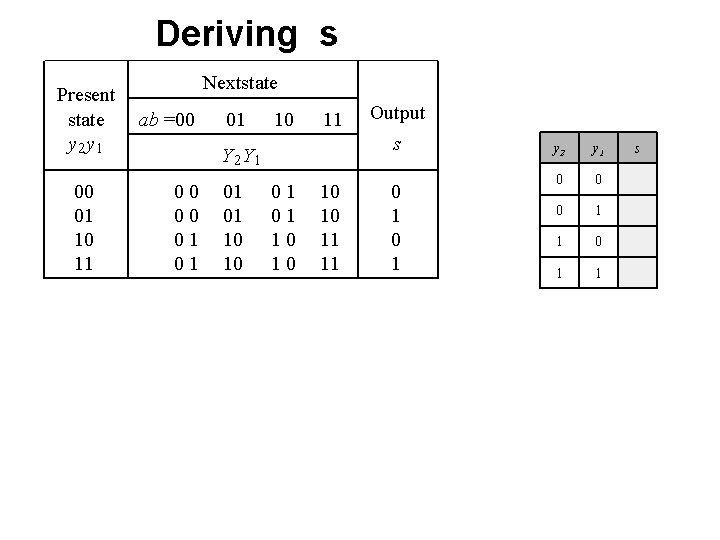
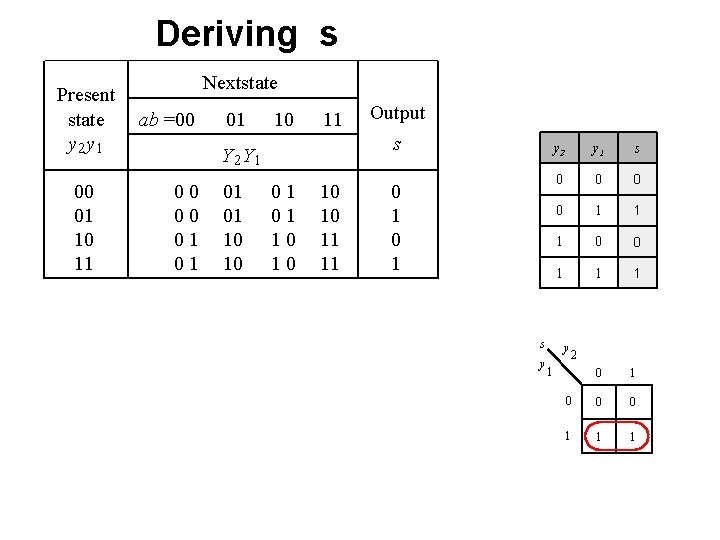
Deriving s Present state y 2 y 1 00 01 10 11 Nextstate ab =00 01 10 11 s Y 2 Y 1 00 00 01 01 10 10 Output 01 01 10 10 11 11 0 1 y 2 y 1 0 0 0 1 1 s
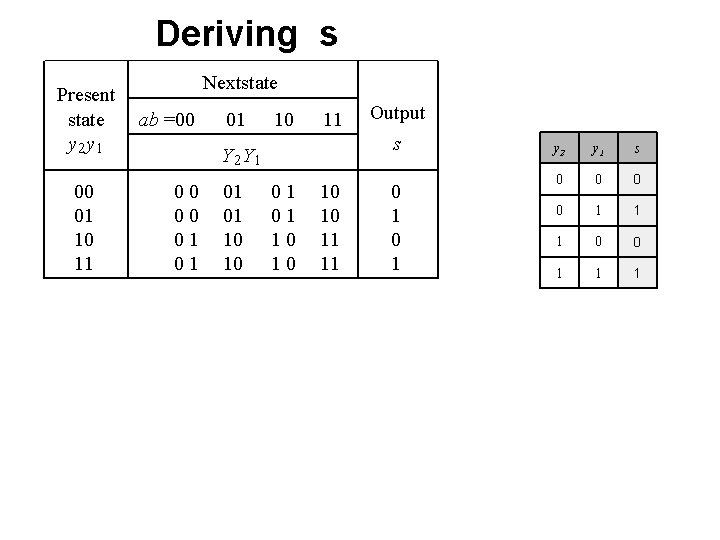
Deriving s Present state y 2 y 1 00 01 10 11 Nextstate ab =00 01 10 11 s Y 2 Y 1 00 00 01 01 10 10 Output 01 01 10 10 11 11 0 1 y 2 y 1 s 0 0 1 1 1
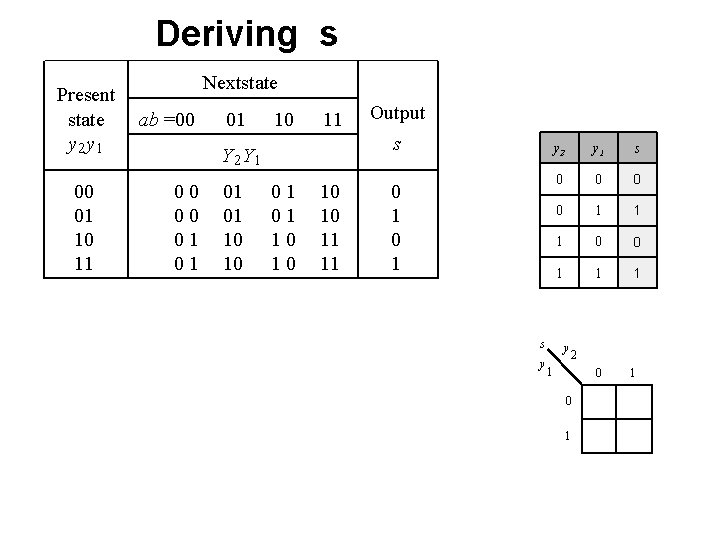
Deriving s Present state y 2 y 1 00 01 10 11 Nextstate ab =00 01 10 11 s Y 2 Y 1 00 00 01 01 10 10 Output 01 01 10 10 11 11 0 1 s y y 2 y 1 s 0 0 1 1 1 0 1 y 2 1 0 1
Deriving s Present state y 2 y 1 00 01 10 11 Nextstate ab =00 01 10 11 s Y 2 Y 1 00 00 01 01 10 10 Output 01 01 10 10 11 11 0 1 s y y 2 y 1 s 0 0 1 1 1 0 0 0 1 1 1 y 2 1
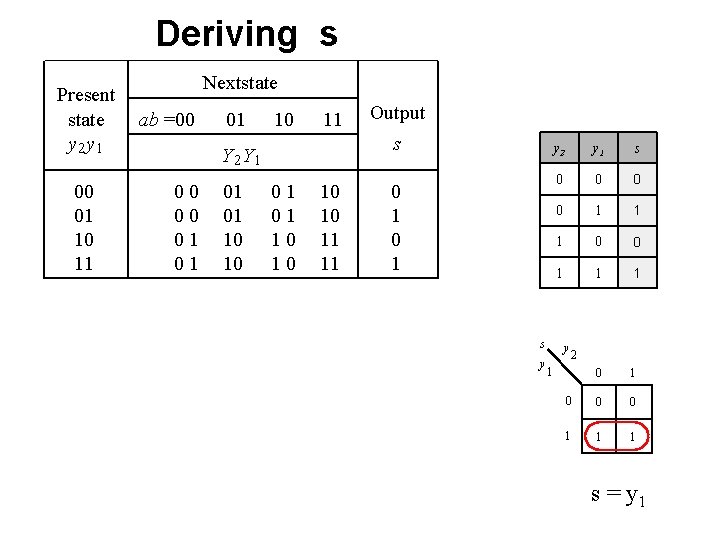
Deriving s Present state y 2 y 1 00 01 10 11 Nextstate ab =00 01 10 11 s Y 2 Y 1 00 00 01 01 10 10 Output 01 01 10 10 11 11 0 1 s y y 2 y 1 s 0 0 1 1 1 0 0 0 1 1 1 y 2 1 s = y 1
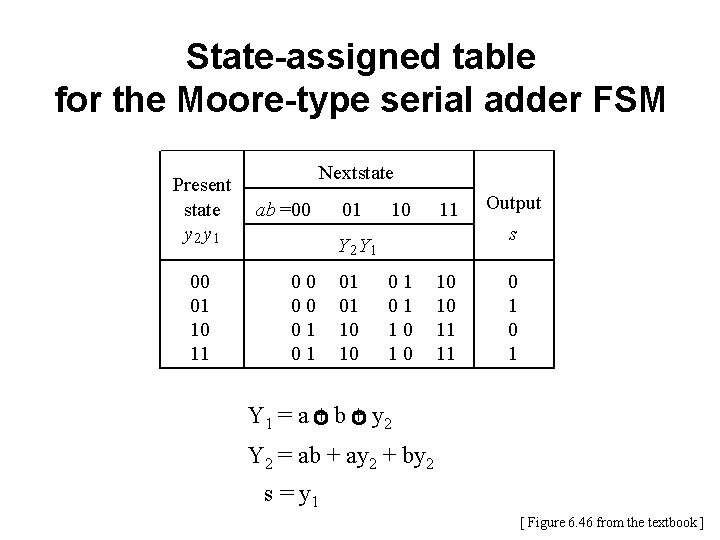
State-assigned table for the Moore-type serial adder FSM Present state y 2 y 1 00 01 10 11 Nextstate ab =00 01 10 11 s Y 2 Y 1 00 00 01 01 10 10 Output 01 01 10 10 11 11 0 1 Y 1 = a + b + y 2 Y 2 = ab + ay 2 + by 2 s = y 1 [ Figure 6. 46 from the textbook ]
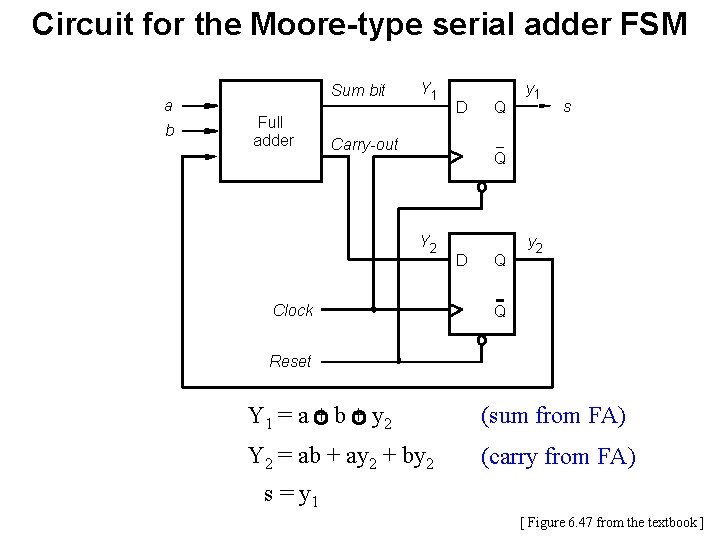
Circuit for the Moore-type serial adder FSM a b Sum bit Full adder Y 1 D Carry-out Q y 1 s Q Y 2 Clock D Q y 2 Q Reset Y 1 = a + b + y 2 (sum from FA) Y 2 = ab + ay 2 + by 2 (carry from FA) s = y 1 [ Figure 6. 47 from the textbook ]
Questions?
THE END