
Cpr E 281 Digital Logic Instructor Alexander Stoytchev


![Adding an Enable Input En [ Figure 4. 13 c from the textbook ]](https://slidetodoc.com/presentation_image/be1129237ac7f46d46b3f60322097524/image-9.jpg "Adding an Enable Input En [ Figure 4. 13 c from the textbook ]")


![A hex-to-7 -segment display code converter [ Figure 4. 21 from the textbook ]](https://slidetodoc.com/presentation_image/be1129237ac7f46d46b3f60322097524/image-29.jpg "A hex-to-7 -segment display code converter [ Figure 4. 21 from the textbook ]")
![A hex-to-7 -segment display code converter [ Figure 4. 21 from the textbook ]](https://slidetodoc.com/presentation_image/be1129237ac7f46d46b3f60322097524/image-30.jpg "A hex-to-7 -segment display code converter [ Figure 4. 21 from the textbook ]")
![A hex-to-7 -segment display code converter [ Figure 4. 21 from the textbook ]](https://slidetodoc.com/presentation_image/be1129237ac7f46d46b3f60322097524/image-31.jpg "A hex-to-7 -segment display code converter [ Figure 4. 21 from the textbook ]")
![A hex-to-7 -segment display code converter [ Figure 4. 21 from the textbook ]](https://slidetodoc.com/presentation_image/be1129237ac7f46d46b3f60322097524/image-32.jpg "A hex-to-7 -segment display code converter [ Figure 4. 21 from the textbook ]")
![A hex-to-7 -segment display code converter [ Figure 4. 21 from the textbook ]](https://slidetodoc.com/presentation_image/be1129237ac7f46d46b3f60322097524/image-33.jpg "A hex-to-7 -segment display code converter [ Figure 4. 21 from the textbook ]")
![Truth table for a one-bit digital comparator [http: //en. wikipedia. org/wiki/Digital_comparator]](https://slidetodoc.com/presentation_image/be1129237ac7f46d46b3f60322097524/image-40.jpg "Truth table for a one-bit digital comparator [http: //en. wikipedia. org/wiki/Digital_comparator]")
![A one-bit digital comparator circuit [http: //www. personal. psu. edu/users///c/w/cwb 5096/Old%20 Site/index_files/cmpenlab 4. htm]](https://slidetodoc.com/presentation_image/be1129237ac7f46d46b3f60322097524/image-41.jpg "A one-bit digital comparator circuit [http: //www. personal. psu. edu/users///c/w/cwb 5096/Old%20 Site/index_files/cmpenlab 4. htm]")
![Truth table for a two-bit digital comparator [http: //en. wikipedia. org/wiki/Digital_comparator]](https://slidetodoc.com/presentation_image/be1129237ac7f46d46b3f60322097524/image-42.jpg "Truth table for a two-bit digital comparator [http: //en. wikipedia. org/wiki/Digital_comparator]")
![A two-bit digital comparator circuit [http: //forum. allaboutcircuits. com/showthread. php? t=10561]](https://slidetodoc.com/presentation_image/be1129237ac7f46d46b3f60322097524/image-43.jpg "A two-bit digital comparator circuit [http: //forum. allaboutcircuits. com/showthread. php? t=10561]")
![A four-bit comparator circuit [ Figure 4. 22 from the textbook ]](https://slidetodoc.com/presentation_image/be1129237ac7f46d46b3f60322097524/image-44.jpg "A four-bit comparator circuit [ Figure 4. 22 from the textbook ]")
![Solution Circuit [ Figure 4. 46 from the textbook ]](https://slidetodoc.com/presentation_image/be1129237ac7f46d46b3f60322097524/image-51.jpg "Solution Circuit [ Figure 4. 46 from the textbook ]")


- Slides: 53
Cpr. E 281: Digital Logic Instructor: Alexander Stoytchev http: //www. ece. iastate. edu/~alexs/classes/
Code Converters Cpr. E 281: Digital Logic Iowa State University, Ames, IA Copyright © Alexander Stoytchev
Administrative Stuff • HW 7 is out • It is due next Monday (March 10) @ 4 pm
Quick Review
Decoders
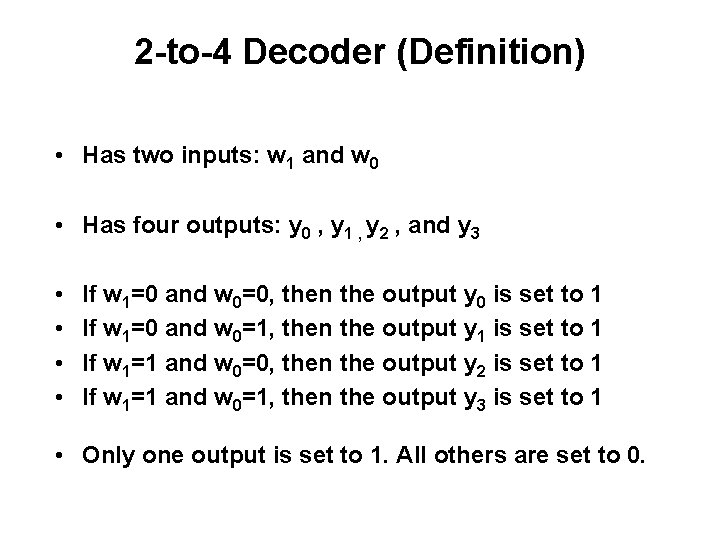
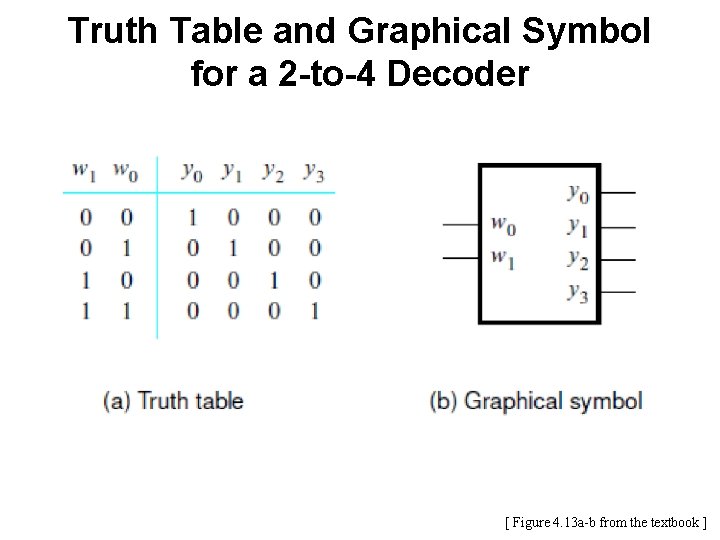
2 -to-4 Decoder (Definition) • Has two inputs: w 1 and w 0 • Has four outputs: y 0 , y 1 , y 2 , and y 3 • • If w 1=0 and w 0=0, then the output y 0 is set to 1 If w 1=0 and w 0=1, then the output y 1 is set to 1 If w 1=1 and w 0=0, then the output y 2 is set to 1 If w 1=1 and w 0=1, then the output y 3 is set to 1 • Only one output is set to 1. All others are set to 0.
Truth Table and Graphical Symbol for a 2 -to-4 Decoder [ Figure 4. 13 a-b from the textbook ]
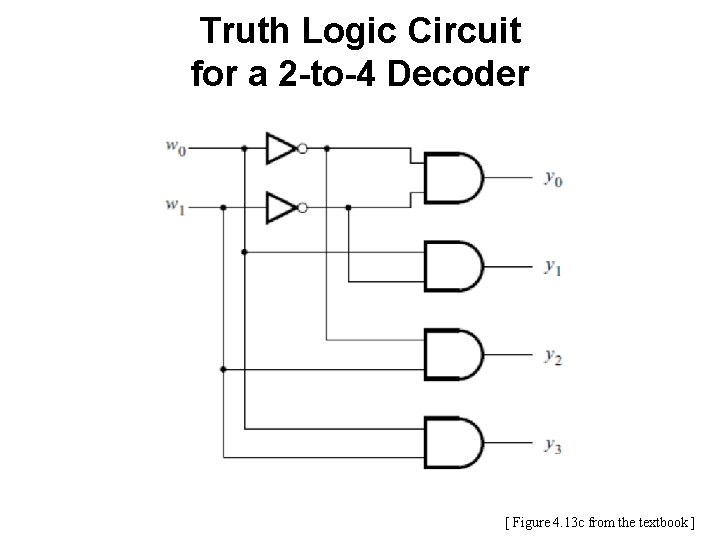
Truth Logic Circuit for a 2 -to-4 Decoder [ Figure 4. 13 c from the textbook ]
Adding an Enable Input En [ Figure 4. 13 c from the textbook ]
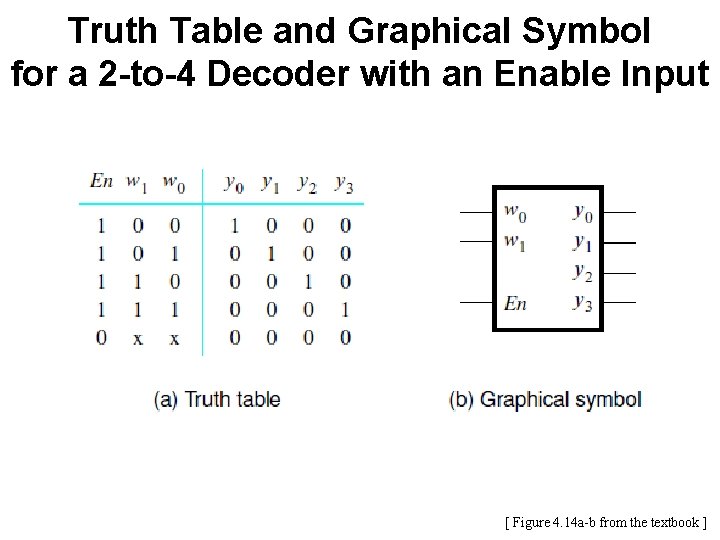
Truth Table and Graphical Symbol for a 2 -to-4 Decoder with an Enable Input [ Figure 4. 14 a-b from the textbook ]
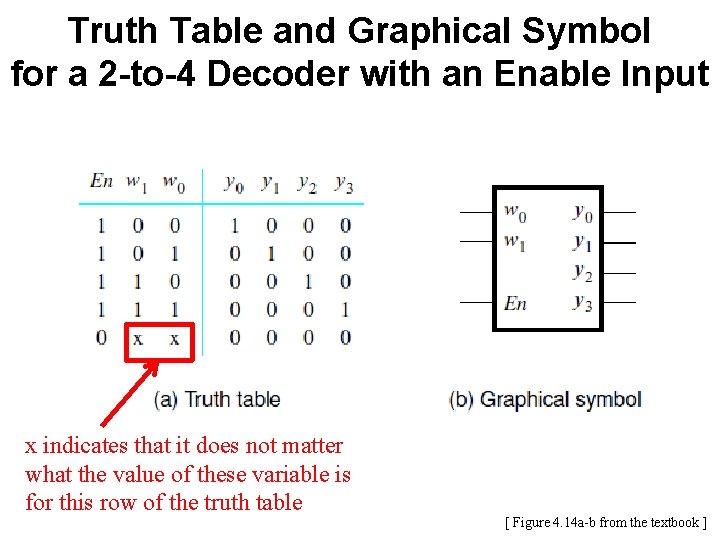
Truth Table and Graphical Symbol for a 2 -to-4 Decoder with an Enable Input x indicates that it does not matter what the value of these variable is for this row of the truth table [ Figure 4. 14 a-b from the textbook ]
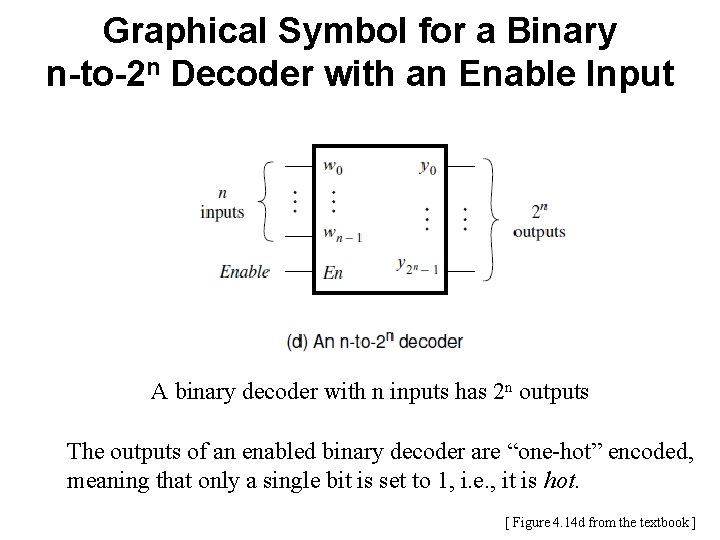
Graphical Symbol for a Binary n-to-2 n Decoder with an Enable Input A binary decoder with n inputs has 2 n outputs The outputs of an enabled binary decoder are “one-hot” encoded, meaning that only a single bit is set to 1, i. e. , it is hot. [ Figure 4. 14 d from the textbook ]
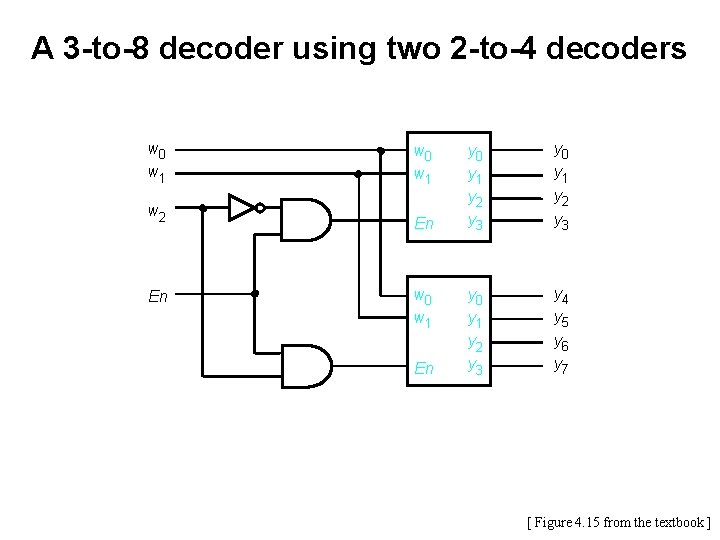
A 3 -to-8 decoder using two 2 -to-4 decoders w 0 w 1 w 2 En w 0 w 1 En y 0 y 1 y 2 y 3 y 4 y 5 y 6 y 7 [ Figure 4. 15 from the textbook ]
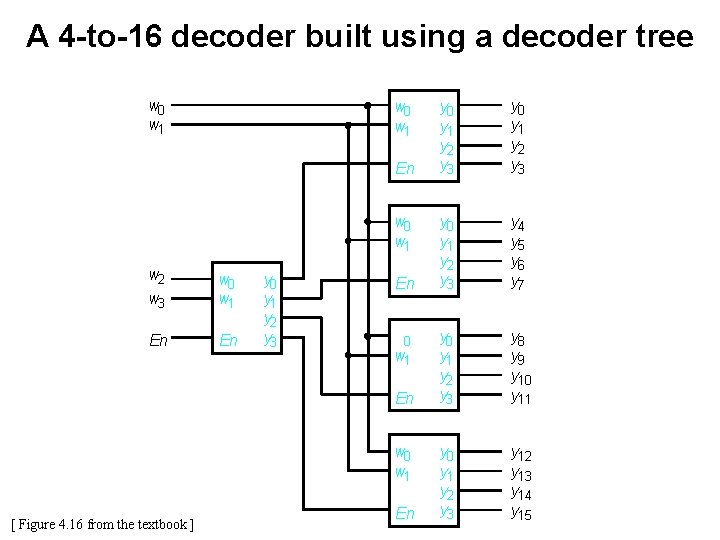
A 4 -to-16 decoder built using a decoder tree w 0 w 1 En w 0 w 1 w 2 w 3 w 0 w 1 En En y 0 y 1 y 2 y 3 En w 0 w 1 [ Figure 4. 16 from the textbook ] En y 0 y 1 y 2 y 3 y 4 y 5 y 6 y 7 y 0 y 1 y 2 y 3 y 8 y 9 y 10 y 11 y 0 y 1 y 2 y 3 y 12 y 13 y 14 y 15
Demultiplexers
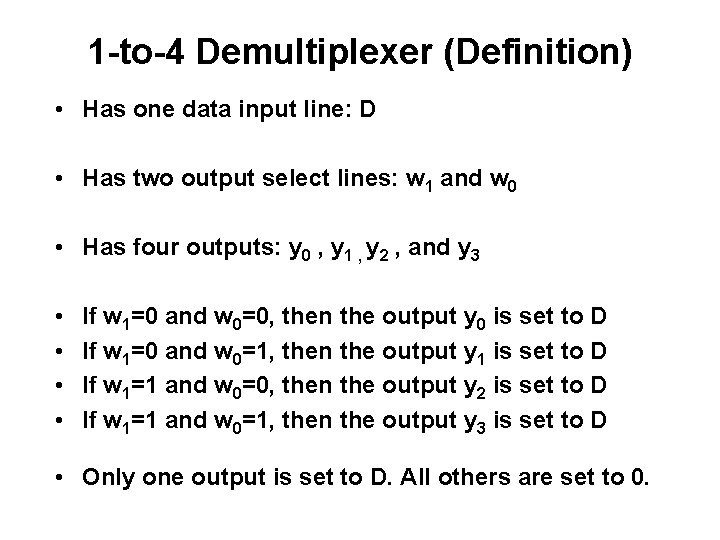
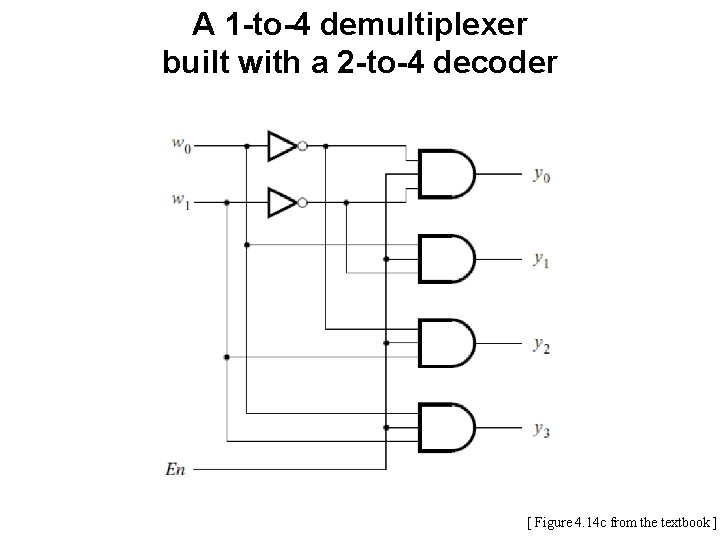
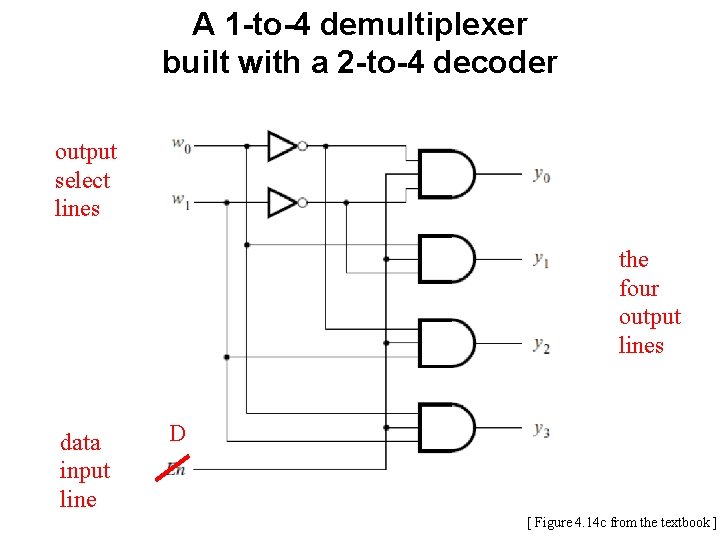
1 -to-4 Demultiplexer (Definition) • Has one data input line: D • Has two output select lines: w 1 and w 0 • Has four outputs: y 0 , y 1 , y 2 , and y 3 • • If w 1=0 and w 0=0, then the output y 0 is set to D If w 1=0 and w 0=1, then the output y 1 is set to D If w 1=1 and w 0=0, then the output y 2 is set to D If w 1=1 and w 0=1, then the output y 3 is set to D • Only one output is set to D. All others are set to 0.
A 1 -to-4 demultiplexer built with a 2 -to-4 decoder [ Figure 4. 14 c from the textbook ]
A 1 -to-4 demultiplexer built with a 2 -to-4 decoder output select lines the four output lines data input line D [ Figure 4. 14 c from the textbook ]
Multiplexers (Implemented with Decoders)
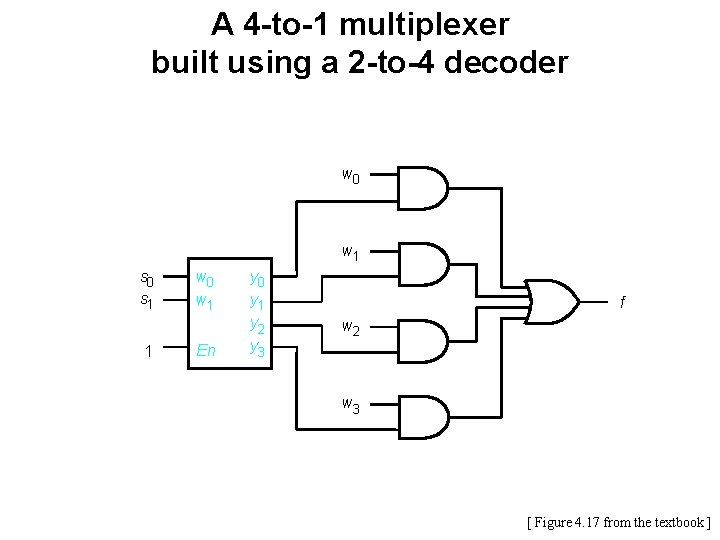
A 4 -to-1 multiplexer built using a 2 -to-4 decoder w 0 w 1 s 0 s 1 1 w 0 w 1 En y 0 y 1 y 2 y 3 f w 2 w 3 [ Figure 4. 17 from the textbook ]
Encoders
Binary Encoders
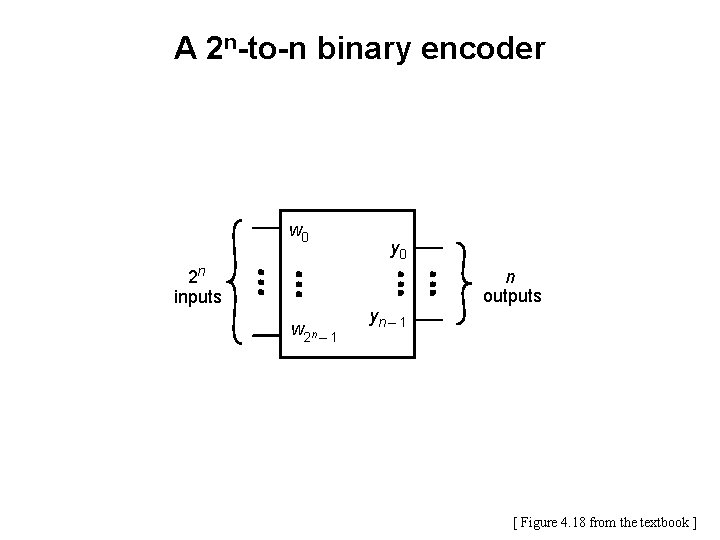
A 2 n-to-n binary encoder w 0 2 n inputs w 2 n – 1 y 0 yn – 1 n outputs [ Figure 4. 18 from the textbook ]
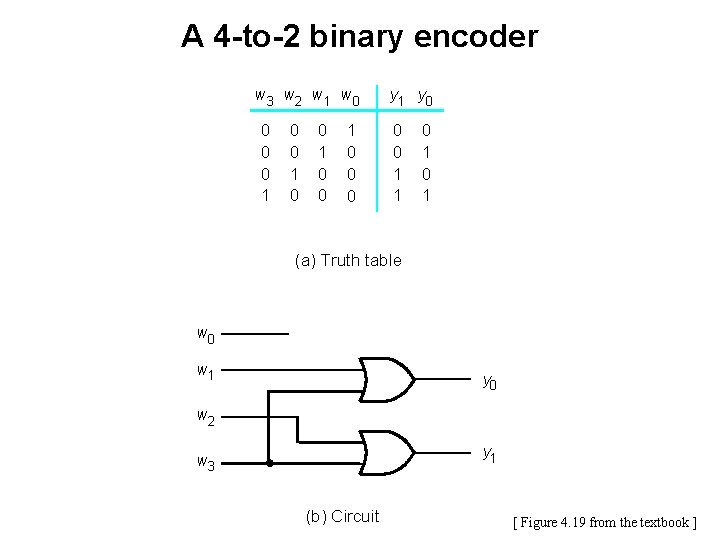
A 4 -to-2 binary encoder w 3 w 2 w 1 w 0 0 1 0 0 0 y 1 y 0 0 0 1 1 0 1 (a) Truth table w 0 w 1 y 0 w 2 y 1 w 3 (b) Circuit [ Figure 4. 19 from the textbook ]
Priority Encoders
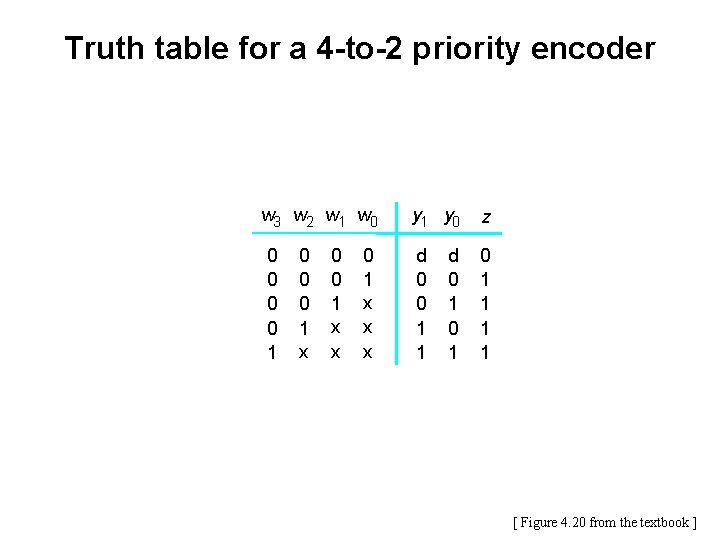
Truth table for a 4 -to-2 priority encoder w 3 w 2 w 1 w 0 0 0 1 x x 0 1 x x x y 1 y 0 z d 0 0 1 1 1 1 d 0 1 [ Figure 4. 20 from the textbook ]
Code Converter (Definition) • Converts from one type of input encoding to a different type of output encoding.
Code Converter (Definition) • Converts from one type of input encoding to a different type of output encoding. • A decoder does that as well, but its outputs are always one-hot encoded so the output code is really one type of output code. • A binary encoder does that as well but its inputs are always one-hot encoded so the input code is really one type of input code.
A hex-to-7 -segment display code converter [ Figure 4. 21 from the textbook ]
A hex-to-7 -segment display code converter [ Figure 4. 21 from the textbook ]
A hex-to-7 -segment display code converter [ Figure 4. 21 from the textbook ]
A hex-to-7 -segment display code converter [ Figure 4. 21 from the textbook ]
A hex-to-7 -segment display code converter [ Figure 4. 21 from the textbook ]
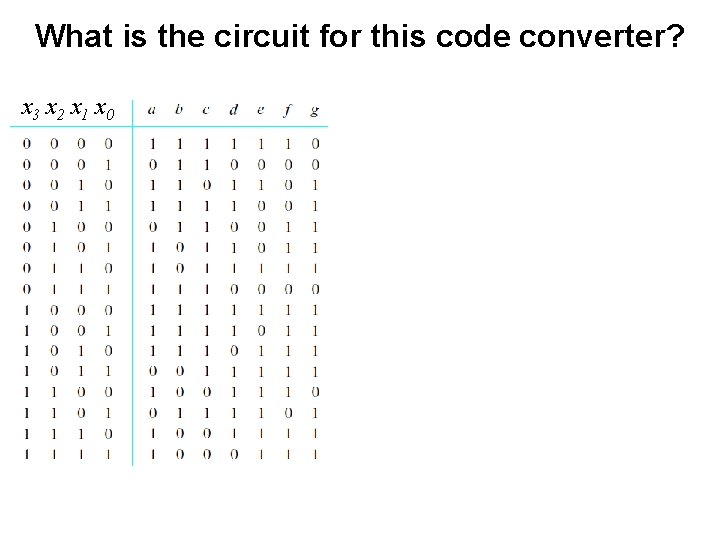
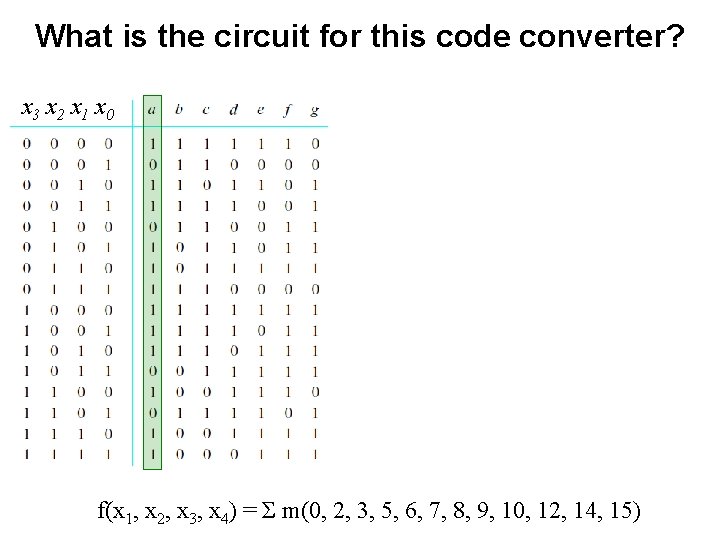
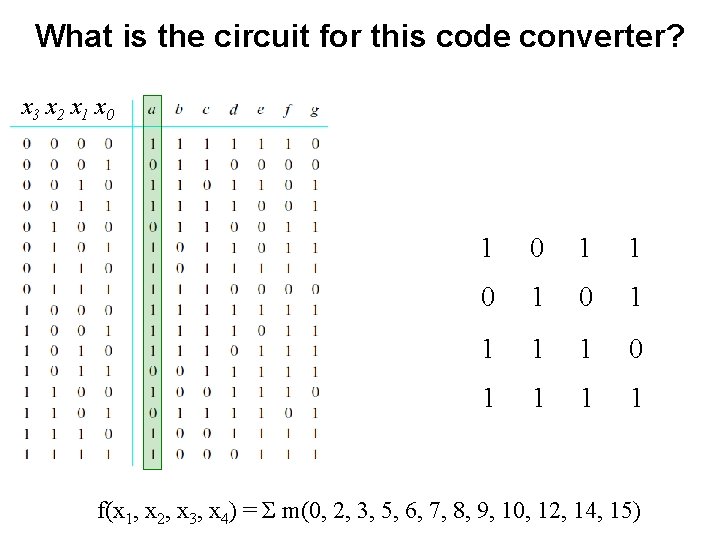
What is the circuit for this code converter? x 3 x 2 x 1 x 0
What is the circuit for this code converter? x 3 x 2 x 1 x 0 f(x 1, x 2, x 3, x 4) = Σ m(0, 2, 3, 5, 6, 7, 8, 9, 10, 12, 14, 15)
What is the circuit for this code converter? x 3 x 2 x 1 x 0 1 0 1 1 1 1 0 1 1 f(x 1, x 2, x 3, x 4) = Σ m(0, 2, 3, 5, 6, 7, 8, 9, 10, 12, 14, 15)
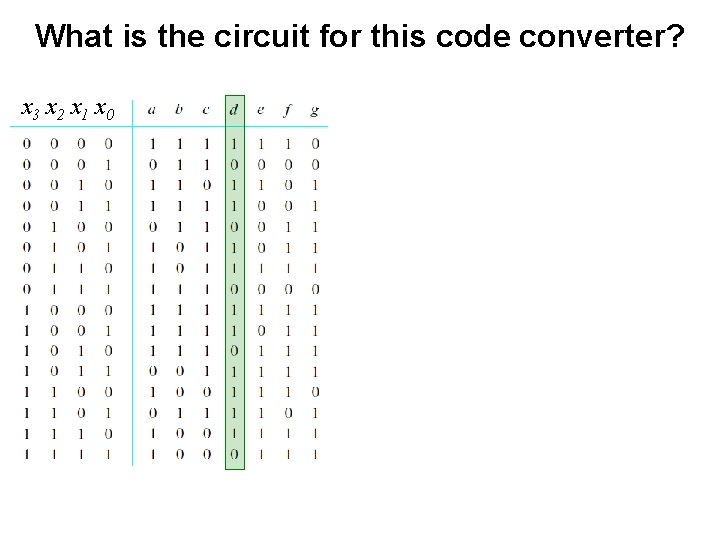
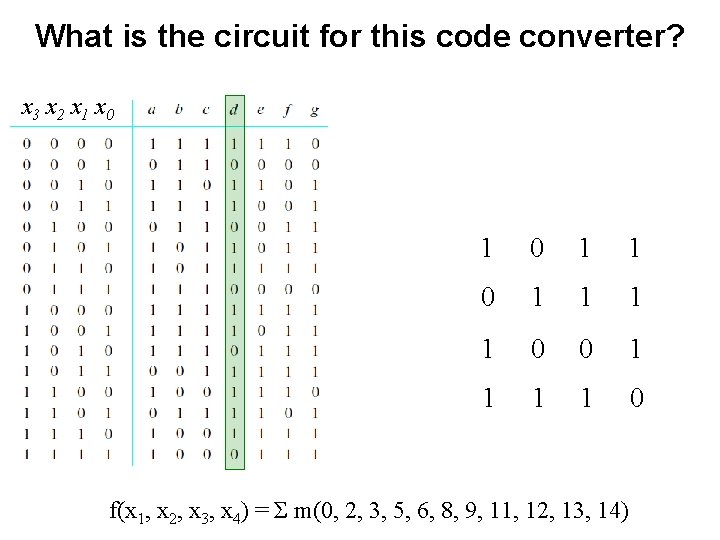
What is the circuit for this code converter? x 3 x 2 x 1 x 0
What is the circuit for this code converter? x 3 x 2 x 1 x 0 1 1 1 1 0 f(x 1, x 2, x 3, x 4) = Σ m(0, 2, 3, 5, 6, 8, 9, 11, 12, 13, 14)
Arithmetic Comparison Circuits
Truth table for a one-bit digital comparator [http: //en. wikipedia. org/wiki/Digital_comparator]
A one-bit digital comparator circuit [http: //www. personal. psu. edu/users///c/w/cwb 5096/Old%20 Site/index_files/cmpenlab 4. htm]
Truth table for a two-bit digital comparator [http: //en. wikipedia. org/wiki/Digital_comparator]
A two-bit digital comparator circuit [http: //forum. allaboutcircuits. com/showthread. php? t=10561]
A four-bit comparator circuit [ Figure 4. 22 from the textbook ]
Example Problems from Chapter 4
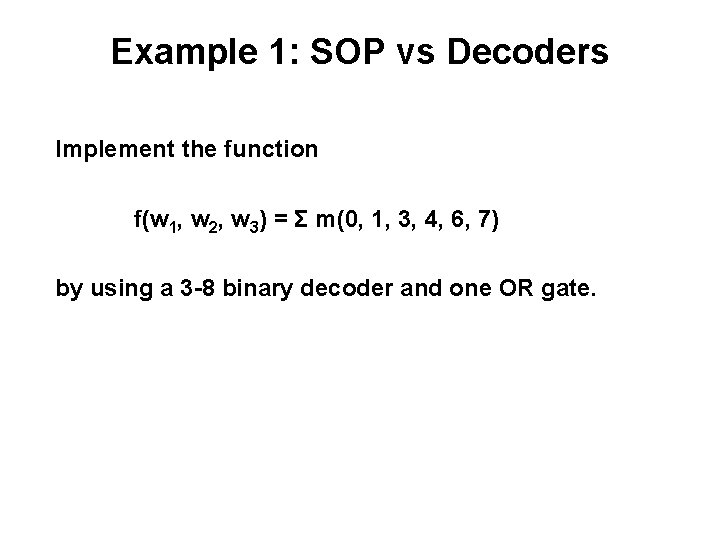
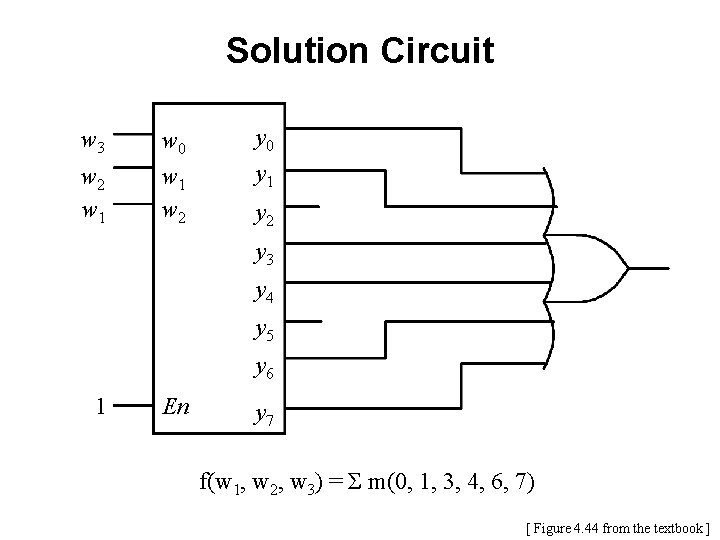
Example 1: SOP vs Decoders Implement the function f(w 1, w 2, w 3) = Σ m(0, 1, 3, 4, 6, 7) by using a 3 -8 binary decoder and one OR gate.
Solution Circuit w 3 w 2 w 1 w 0 w 1 w 2 y 0 y 1 y 2 y 3 y 4 y 5 y 6 1 En y 7 f(w 1, w 2, w 3) = Σ m(0, 1, 3, 4, 6, 7) [ Figure 4. 44 from the textbook ]
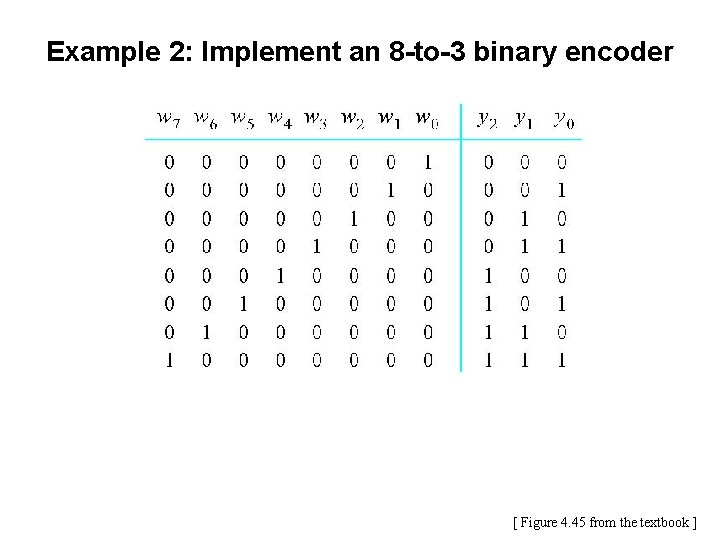
Example 2: Implement an 8 -to-3 binary encoder [ Figure 4. 45 from the textbook ]
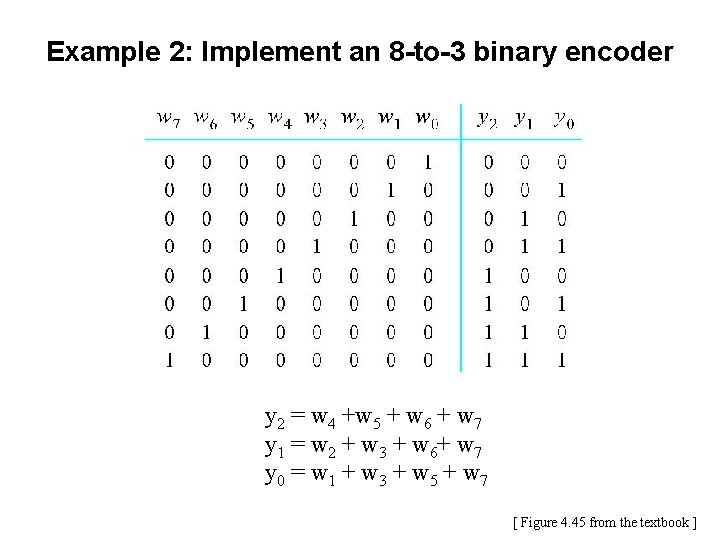
Example 2: Implement an 8 -to-3 binary encoder y 2 = w 4 +w 5 + w 6 + w 7 y 1 = w 2 + w 3 + w 6+ w 7 y 0 = w 1 + w 3 + w 5 + w 7 [ Figure 4. 45 from the textbook ]
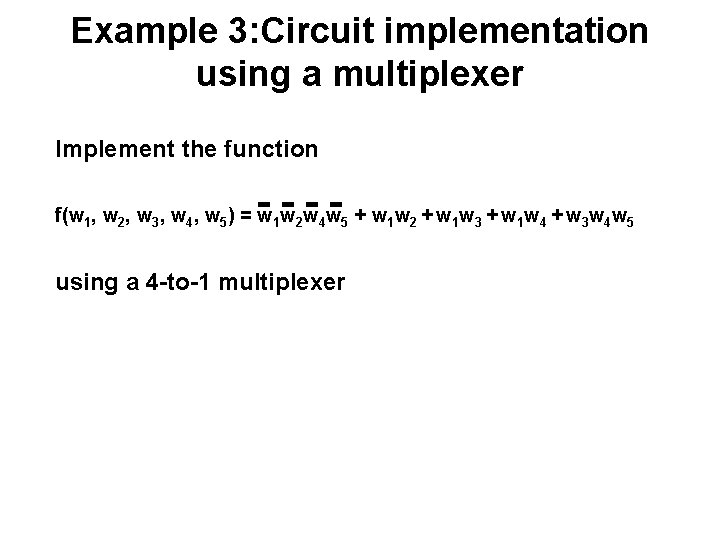
Example 3: Circuit implementation using a multiplexer Implement the function f(w 1, w 2, w 3, w 4, w 5) = w 1 w 2 w 4 w 5 + w 1 w 2 + w 1 w 3 + w 1 w 4 + w 3 w 4 w 5 using a 4 -to-1 multiplexer
Solution Circuit [ Figure 4. 46 from the textbook ]
Questions?
THE END