
Cpr E 185 Intro to Problem Solving using
Cpr. E 185: Intro to Problem Solving (using C) Slides from Shane Griffith (TA and guest instructor in Fall 2008) http: //www. ece. iastate. edu/~alexs/classes/2009_Fall_185/
Strings Cpr. E 185: Intro to Problem Solving Iowa State University, Ames, IA Copyright © 2008
Chapter 9 (Strings)
Outline • Declare a String • Input a String • Assign a String • String functions • Character type operations
![Print a character Array Program: // character array char c[10] = {‘E’, ‘/’, ‘C’,](http://slidetodoc.com/presentation_image_h2/b0a13476f2237b2200bf51e800654d09/image-5.jpg "Print a character Array Program: // character array char c[10] = {‘E’, ‘/’, ‘C’,")
Print a character Array Program: // character array char c[10] = {‘E’, ‘/’, ‘C’, ‘p’, ‘r’, ‘E’}; for(i=0; i< 7; i++) { printf(“%c“, c[i]); } ______________________ Output: EE/Cpr. E
![Print another way Program: // character array char c[10] = {‘E’, ‘/’, ‘C’, ‘p’,](http://slidetodoc.com/presentation_image_h2/b0a13476f2237b2200bf51e800654d09/image-6.jpg "Print another way Program: // character array char c[10] = {‘E’, ‘/’, ‘C’, ‘p’,")
Print another way Program: // character array char c[10] = {‘E’, ‘/’, ‘C’, ‘p’, ‘r’, ‘E’}; printf(“%s”, c); //%s to print a string ______________________ Output: EE/Cpr. E
![Declare another way Program: // define character array with a string char c[10] =](http://slidetodoc.com/presentation_image_h2/b0a13476f2237b2200bf51e800654d09/image-7.jpg "Declare another way Program: // define character array with a string char c[10] =")
Declare another way Program: // define character array with a string char c[10] = “EE/Cpr. E”; printf(“%s”, c); //%s to print a string ______________________ Output: EE/Cpr. E
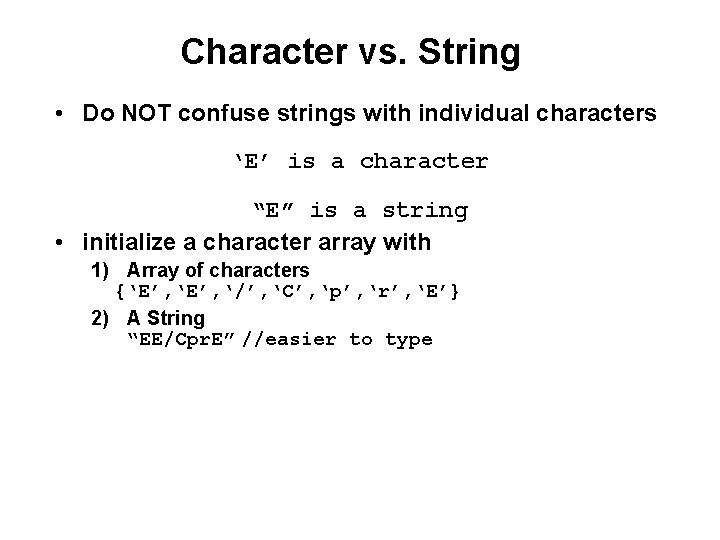
Character vs. String • Do NOT confuse strings with individual characters ‘E’ is a character “E” is a string • initialize a character array with 1) Array of characters {‘E’, ‘/’, ‘C’, ‘p’, ‘r’, ‘E’} 2) A String “EE/Cpr. E” //easier to type
![Declaring strings char c[10] = “EE/Cpr. E”; //only 7 chars • What about the](http://slidetodoc.com/presentation_image_h2/b0a13476f2237b2200bf51e800654d09/image-9.jpg "Declaring strings char c[10] = “EE/Cpr. E”; //only 7 chars • What about the")
Declaring strings char c[10] = “EE/Cpr. E”; //only 7 chars • What about the uninitialized characters in the string?
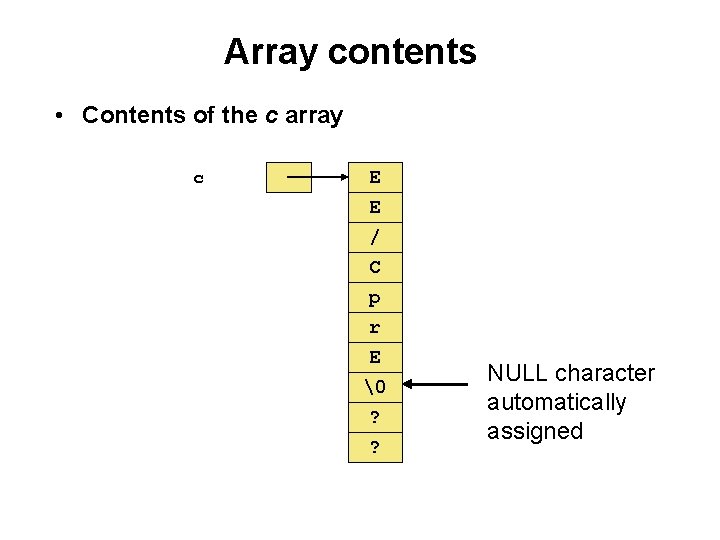
Array contents • Contents of the c array c E E / C p r E ? ? NULL character automatically assigned
![Array Contents Program: // character char c[10] = printf(“%s”, c[8] = ‘a’; printf(“%s”, array](http://slidetodoc.com/presentation_image_h2/b0a13476f2237b2200bf51e800654d09/image-11.jpg "Array Contents Program: // character char c[10] = printf(“%s”, c[8] = ‘a’; printf(“%s”, array")
Array Contents Program: // character char c[10] = printf(“%s”, c[8] = ‘a’; printf(“%s”, array c “EE/Cpr. E”; c); //output 1 c); //output 2 _____________ Output 1: EE/Cpr. E Output 2: EE/Cpr. E E E / C p r E a ?
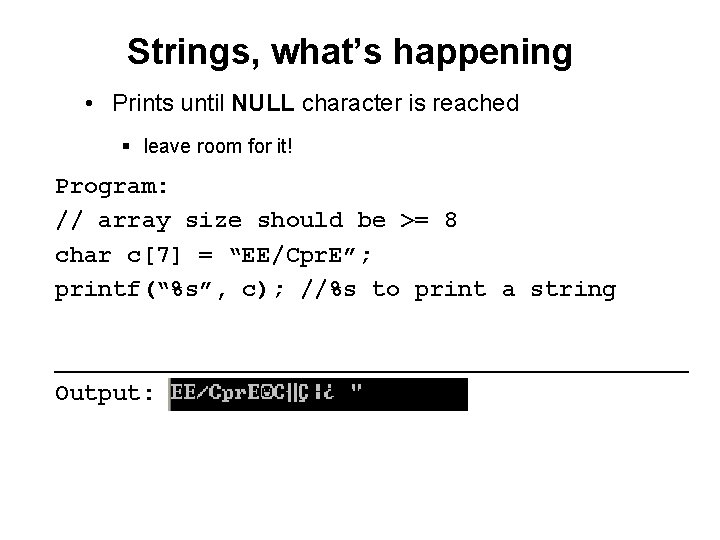
Strings, what’s happening • Prints until NULL character is reached § leave room for it! Program: // array size should be >= 8 char c[7] = “EE/Cpr. E”; printf(“%s”, c); //%s to print a string ______________________ Output:
Strings • Length is determined by first NULL in the string • Most string functions in C add NULL automatically • Array of strings is a double array of characters § From the book: char month[12][10] = {“January”, “February”, … , “December”};
![Input a String Program: char c[N]; scanf(“%s”, c); //no & symbol is required printf(“%s”,](http://slidetodoc.com/presentation_image_h2/b0a13476f2237b2200bf51e800654d09/image-14.jpg "Input a String Program: char c[N]; scanf(“%s”, c); //no & symbol is required printf(“%s”,")
Input a String Program: char c[N]; scanf(“%s”, c); //no & symbol is required printf(“%s”, c); ______________________ Input: “EE Cpr. E” Output: EE //input separated by white space
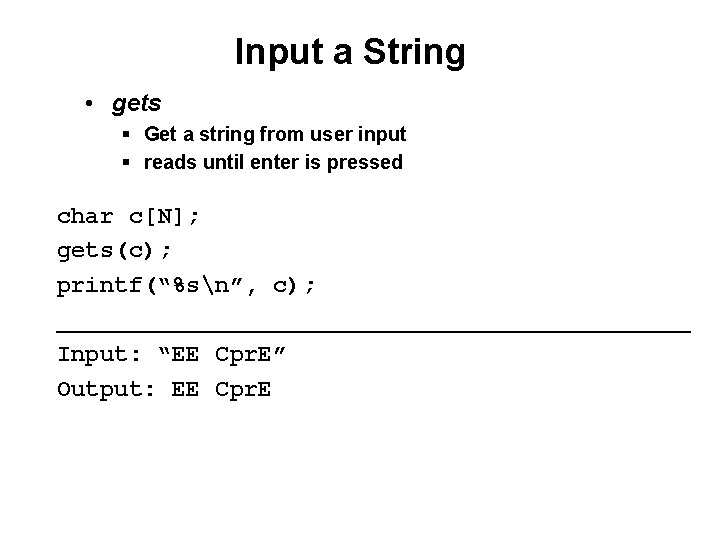
Input a String • gets § Get a string from user input § reads until enter is pressed char c[N]; gets(c); printf(“%sn”, c); ______________________ Input: “EE Cpr. E” Output: EE Cpr. E
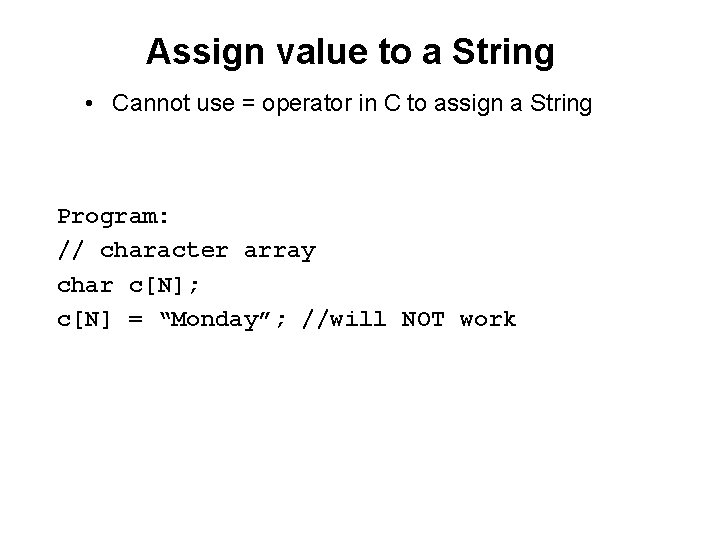
Assign value to a String • Cannot use = operator in C to assign a String Program: // character array char c[N]; c[N] = “Monday”; //will NOT work
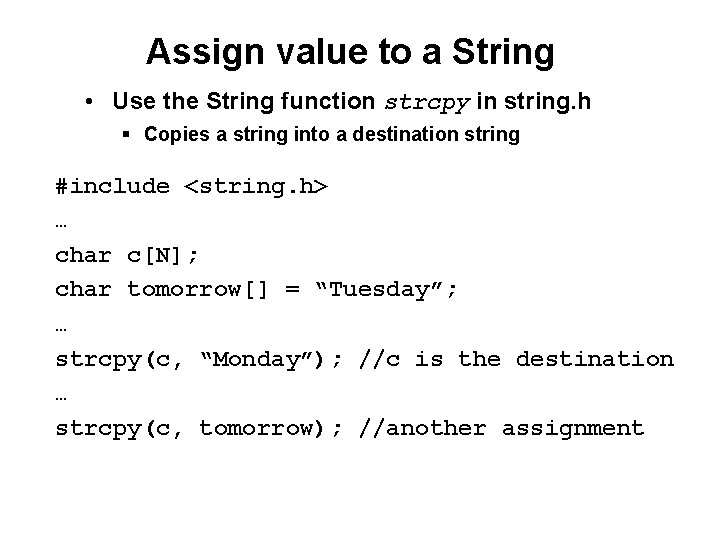
Assign value to a String • Use the String function strcpy in string. h § Copies a string into a destination string #include <string. h> … char c[N]; char tomorrow[] = “Tuesday”; … strcpy(c, “Monday”); //c is the destination … strcpy(c, tomorrow); //another assignment
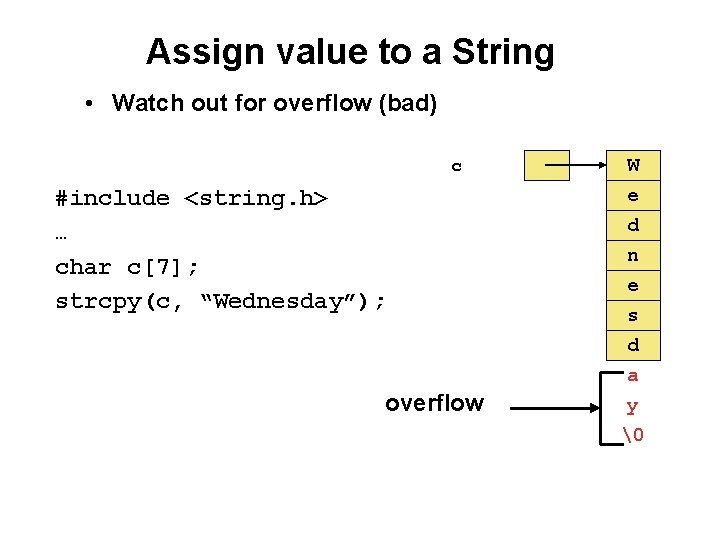
Assign value to a String • Watch out for overflow (bad) c #include <string. h> … char c[7]; strcpy(c, “Wednesday”); overflow W e d n e s d a y
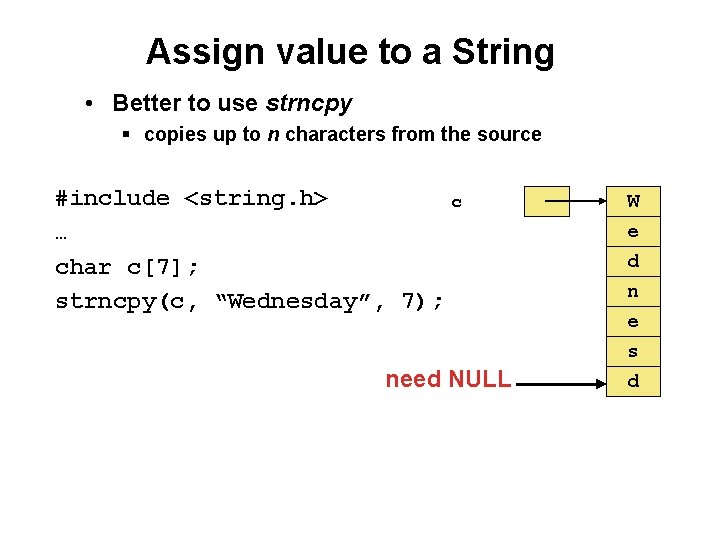
Assign value to a String • Better to use strncpy § copies up to n characters from the source #include <string. h> c … char c[7]; strncpy(c, “Wednesday”, 7); need NULL W e d n e s d
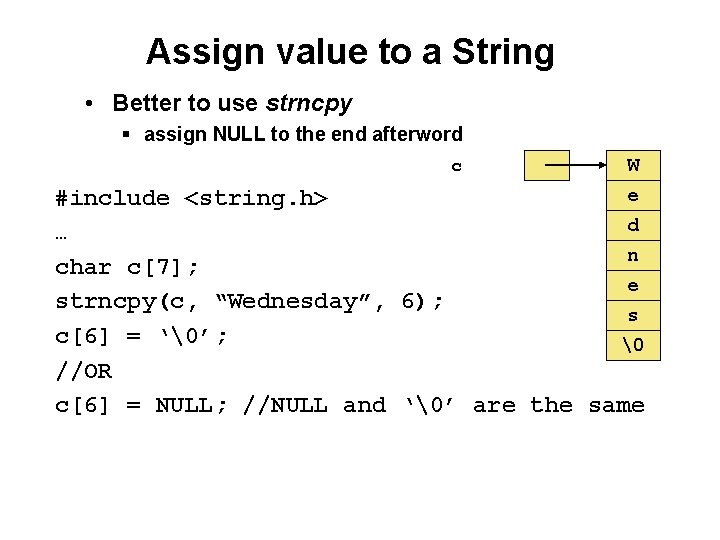
Assign value to a String • Better to use strncpy § assign NULL to the end afterword c W e d n #include <string. h> … char c[7]; e strncpy(c, “Wednesday”, 6); s c[6] = ‘’; //OR c[6] = NULL; //NULL and ‘’ are the same
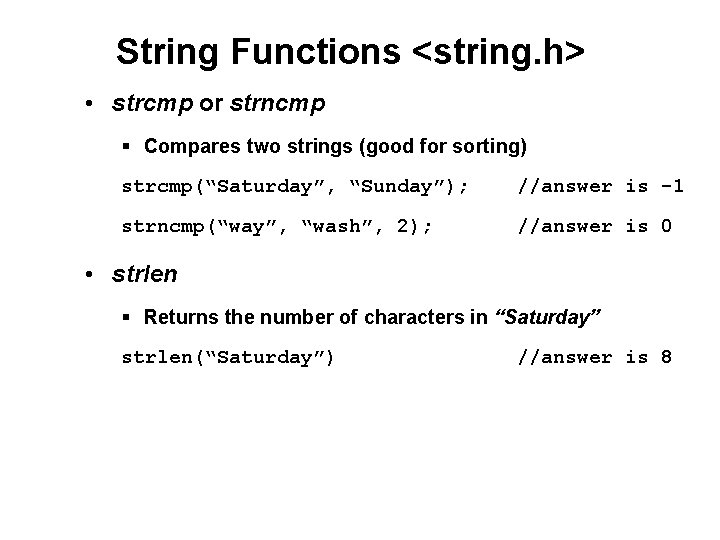
String Functions <string. h> • strcmp or strncmp § Compares two strings (good for sorting) strcmp(“Saturday”, “Sunday”); //answer is -1 strncmp(“way”, “wash”, 2); //answer is 0 • strlen § Returns the number of characters in “Saturday” strlen(“Saturday”) //answer is 8
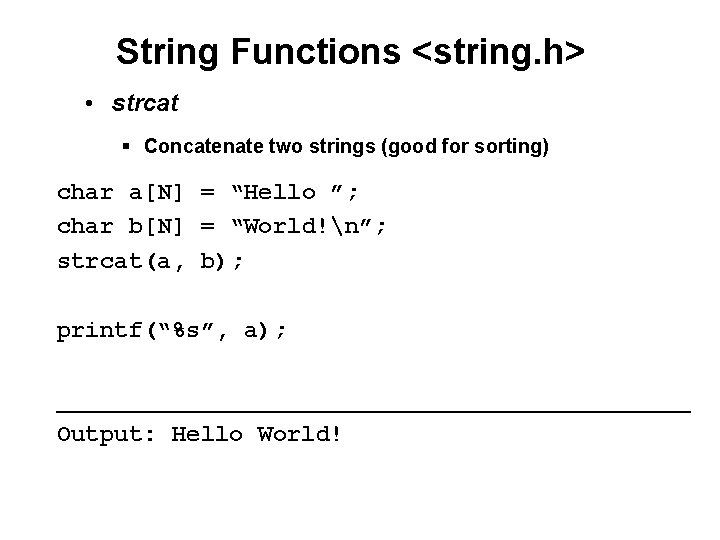
String Functions <string. h> • strcat § Concatenate two strings (good for sorting) char a[N] = “Hello ”; char b[N] = “World!n”; strcat(a, b); printf(“%s”, a); ______________________ Output: Hello World!
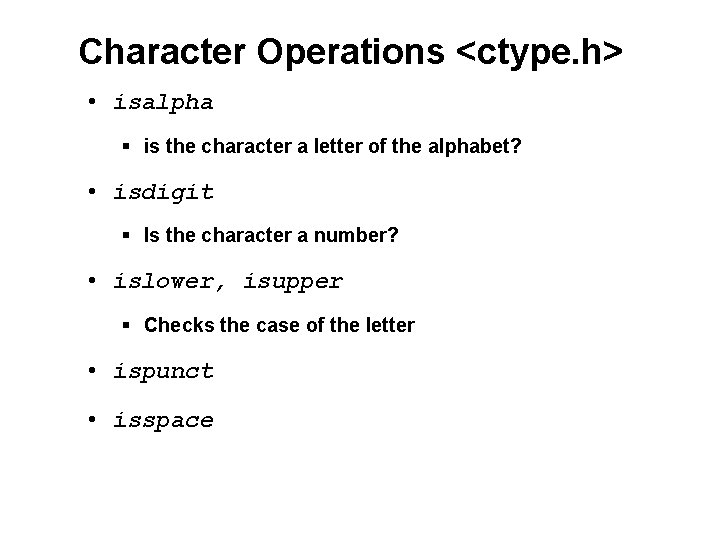
Character Operations <ctype. h> • isalpha § is the character a letter of the alphabet? • isdigit § Is the character a number? • islower, isupper § Checks the case of the letter • ispunct • isspace
A good reference • http: //www. crasseux. com/books/ctutorial/Stringlibraryfunctions. html#String%20 library%20 functions

Questions?
THE END
- Slides: 26