
Cpr E 185 Intro to Problem Solving using
Cpr. E 185: Intro to Problem Solving (using C) Instructor: Alexander Stoytchev http: //www. ece. iastate. edu/~alexs/classes/2009_Fall_185/
Loops (part 1) Cpr. E 185: Intro to Problem Solving Iowa State University, Ames, IA Copyright © Alexander Stoytchev

Administrative Stuff • Midterm grades due next Friday Oct 16 • Please double check your grades on Web CT
Administrative Stuff • HW 4 is due this Wed, Oct 7 @ 8 pm • HW 5 is out (due next Wed, Oct 14 @ 8 pm) • HW 6 is out (due Wed, Oct 21 @ 8 pm) • HW 7 not out yet (due Friday, Oct 23 @ 8 pm) • Midterm 2: Oct 27, Oct 28 (same format) • Drop Deadline: Oct 30
Quick Review of Last Lecture
The switch Statement • The switch statement provides another way to decide which statement to execute next • The switch statement evaluates an expression, then attempts to match the result to one of several possible cases • Each case contains a value and a list of statements • The flow of control transfers to statement associated with the first case value that matches © 2004 Pearson Addison-Wesley. All rights reserved
The switch Statement • Often a break statement is used as the last statement in each case's statement list • A break statement causes control to transfer to the end of the switch statement • If a break statement is not used, the flow of control will continue into the next case • Sometimes this may be appropriate, but often we want to execute only the statements associated with one case © 2004 Pearson Addison-Wesley. All rights reserved
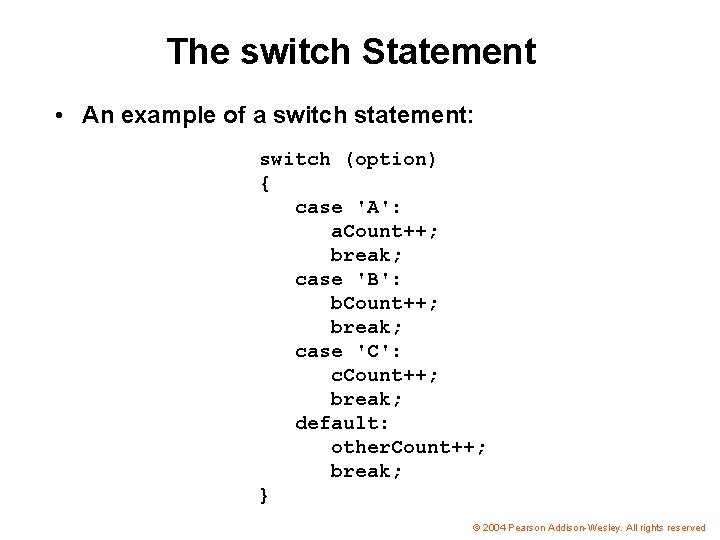
The switch Statement • An example of a switch statement: switch (option) { case 'A': a. Count++; break; case 'B': b. Count++; break; case 'C': c. Count++; break; default: other. Count++; break; } © 2004 Pearson Addison-Wesley. All rights reserved
The switch Statement • A switch statement can have an optional default case • The default case has no associated value and simply uses the reserved word default • If the default case is present, control will transfer to it if no other case value matches • If there is no default case, and no other value matches, control falls through to the statement after the switch © 2004 Pearson Addison-Wesley. All rights reserved
The switch Statement • The expression of a switch statement must result in an integral type, meaning an integer (byte, short, int, ) or a char • It cannot be a floating point value (float or double) • The implicit test condition in a switch statement is equality • You cannot perform relational checks with a switch statement © 2004 Pearson Addison-Wesley. All rights reserved
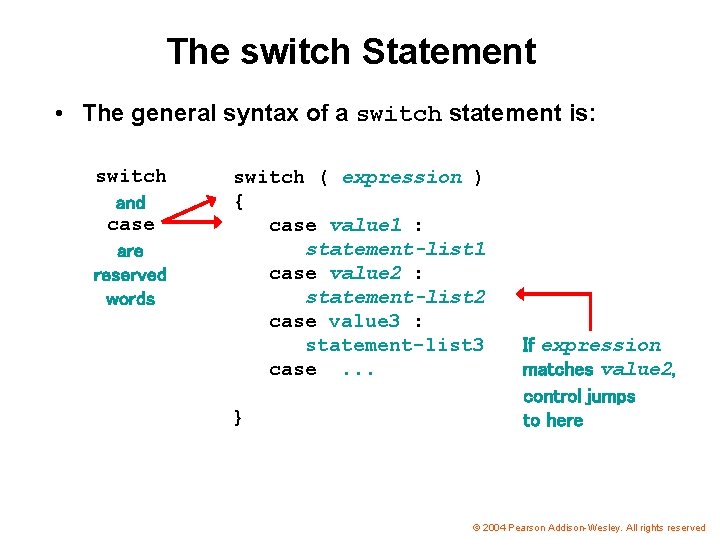
The switch Statement • The general syntax of a switch statement is: switch and case are reserved words switch ( expression ) { case value 1 : statement-list 1 case value 2 : statement-list 2 case value 3 : statement-list 3 case. . . } If expression matches value 2, control jumps to here © 2004 Pearson Addison-Wesley. All rights reserved
Chapter 5 (Loops)
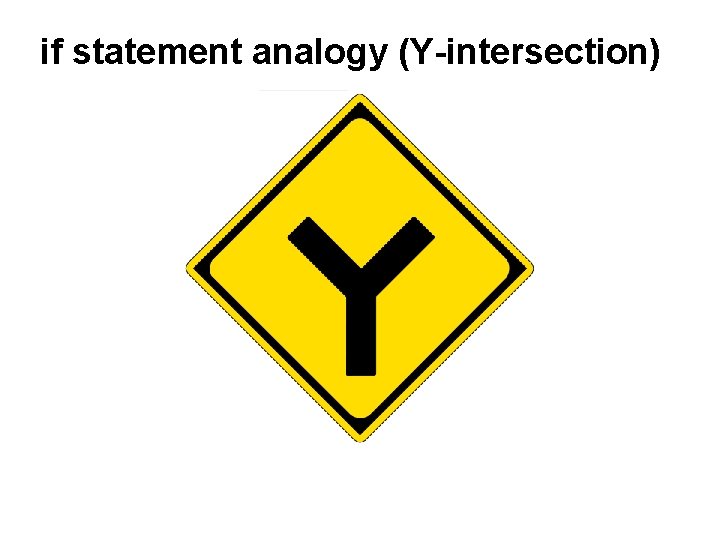
if statement analogy (Y-intersection)
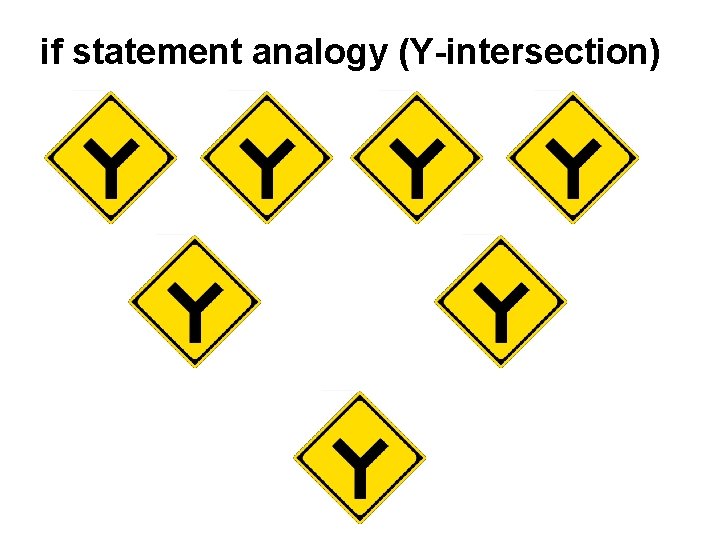
if statement analogy (Y-intersection)
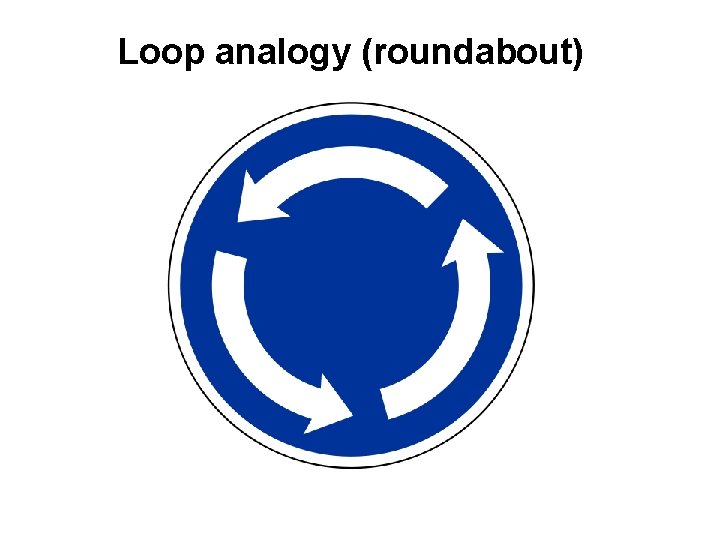
Loop analogy (roundabout)
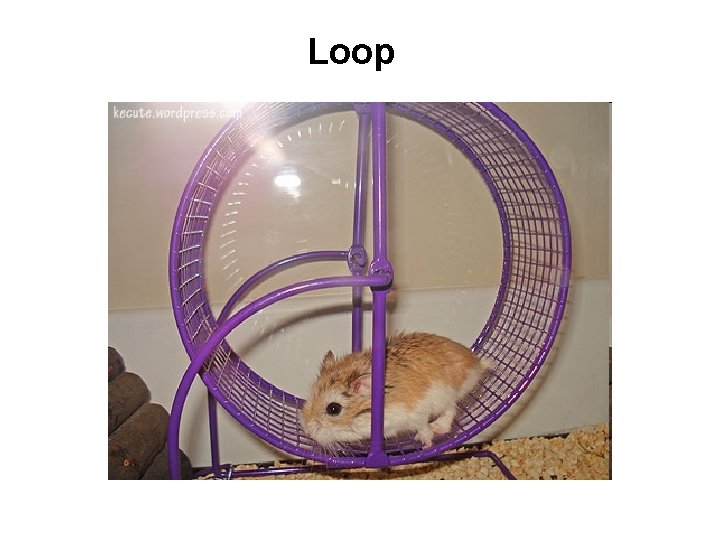
Loop
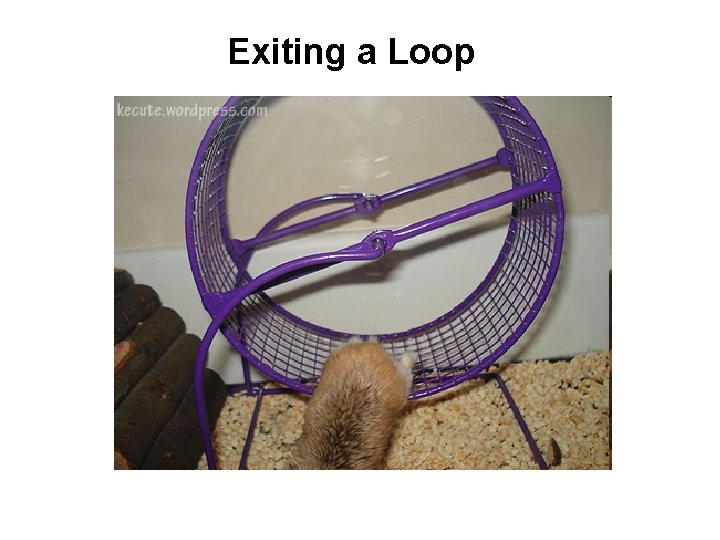
Exiting a Loop
Ninja Cat
Repetition Statements • Repetition statements allow us to execute a statement multiple times • Often they are referred to as loops • C has three kinds of repetition statements: § the while loop § the do loop § the for loop • The programmer should choose the right kind of loop for the situation © 2004 Pearson Addison-Wesley. All rights reserved
There are three loop constructs in C • do-while loop (or do loop for short) • while loop • for loop • We’ll quickly cover all of them today. We’ll revisit them again next time. • Loops = repetition statements
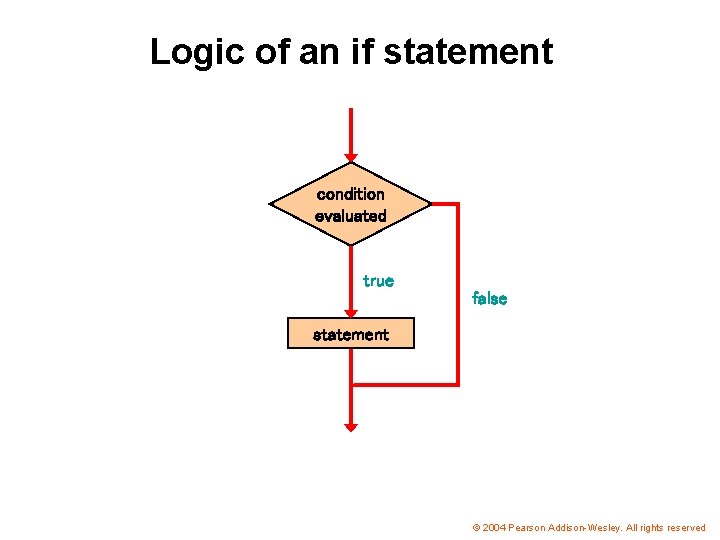
Logic of an if statement condition evaluated true false statement © 2004 Pearson Addison-Wesley. All rights reserved
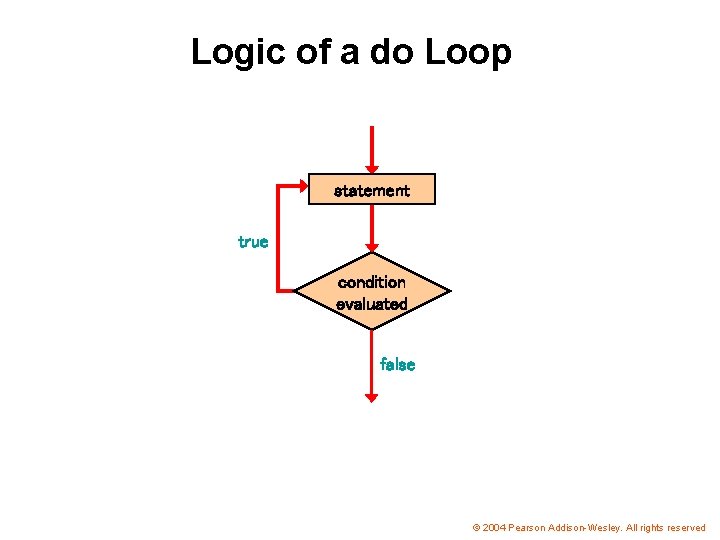
Logic of a do Loop statement true condition evaluated false © 2004 Pearson Addison-Wesley. All rights reserved
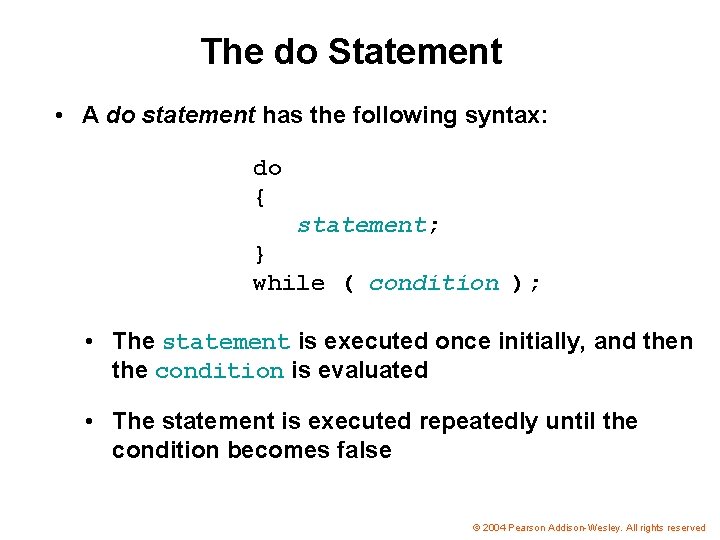
The do Statement • A do statement has the following syntax: do { statement; } while ( condition ); • The statement is executed once initially, and then the condition is evaluated • The statement is executed repeatedly until the condition becomes false © 2004 Pearson Addison-Wesley. All rights reserved
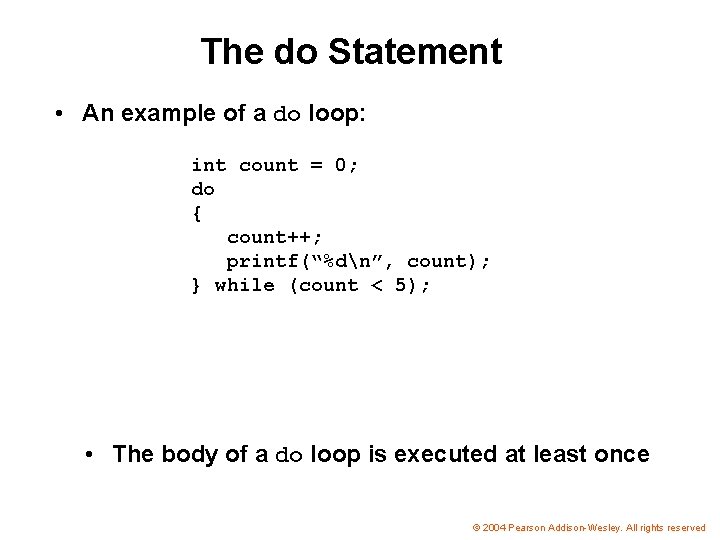
The do Statement • An example of a do loop: int count = 0; do { count++; printf(“%dn”, count); } while (count < 5); • The body of a do loop is executed at least once © 2004 Pearson Addison-Wesley. All rights reserved
Example: Fixing Bad Keyboard Input • Write a program that refuses to accept a negative number as an input. • The program must keep asking the user to enter a value until he/she enters a positive number. • How can we do this?
Example: Reverse a number
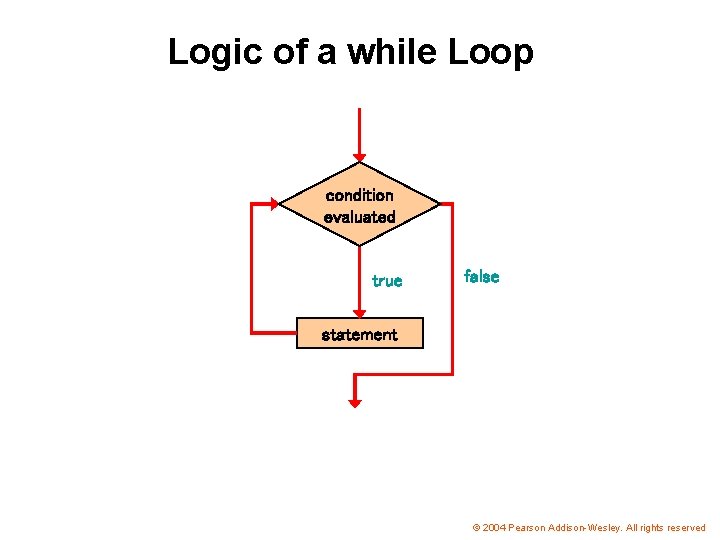
Logic of a while Loop condition evaluated true false statement © 2004 Pearson Addison-Wesley. All rights reserved
The while Statement • A while statement has the following syntax: while ( condition ) statement; • If the condition is true, the statement is executed • Then the condition is evaluated again, and if it is still true, the statement is executed again • The statement is executed repeatedly until the condition becomes false © 2004 Pearson Addison-Wesley. All rights reserved
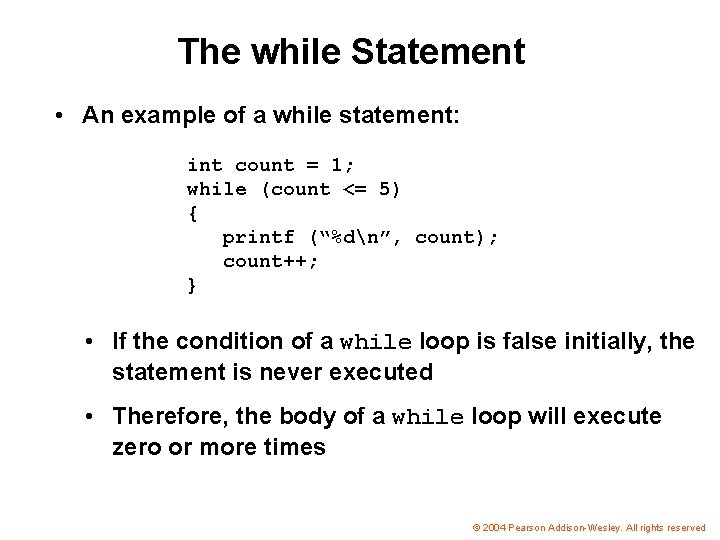
The while Statement • An example of a while statement: int count = 1; while (count <= 5) { printf (“%dn”, count); count++; } • If the condition of a while loop is false initially, the statement is never executed • Therefore, the body of a while loop will execute zero or more times © 2004 Pearson Addison-Wesley. All rights reserved
The while Statement • Let's look at some examples of loop processing • A loop can be used to maintain a running sum • A sentinel value is a special input value that represents the end of input • A loop can also be used for input validation, making a program more robust © 2004 Pearson Addison-Wesley. All rights reserved
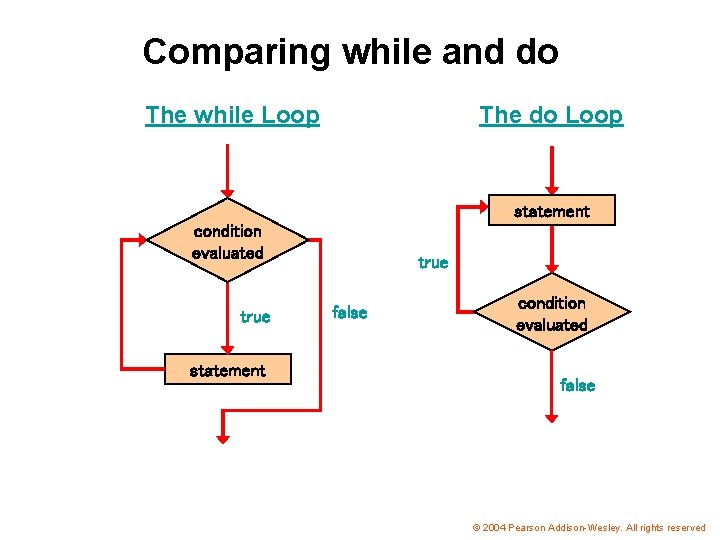
Comparing while and do The while Loop The do Loop statement condition evaluated true statement true false condition evaluated false © 2004 Pearson Addison-Wesley. All rights reserved
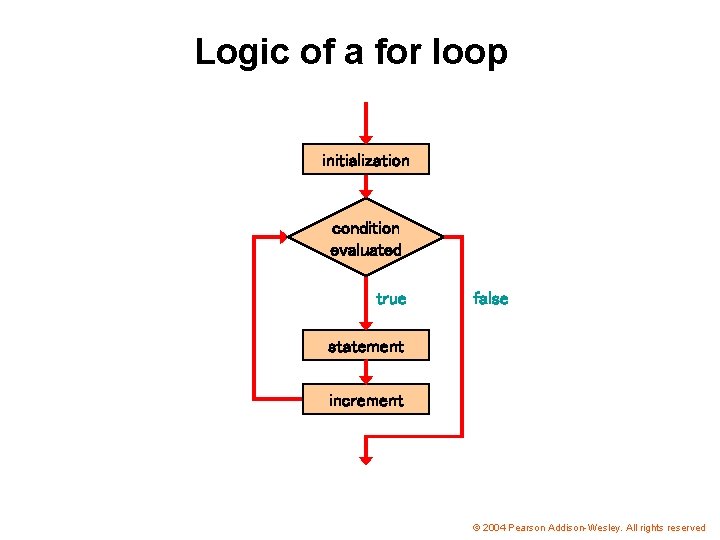
Logic of a for loop initialization condition evaluated true false statement increment © 2004 Pearson Addison-Wesley. All rights reserved
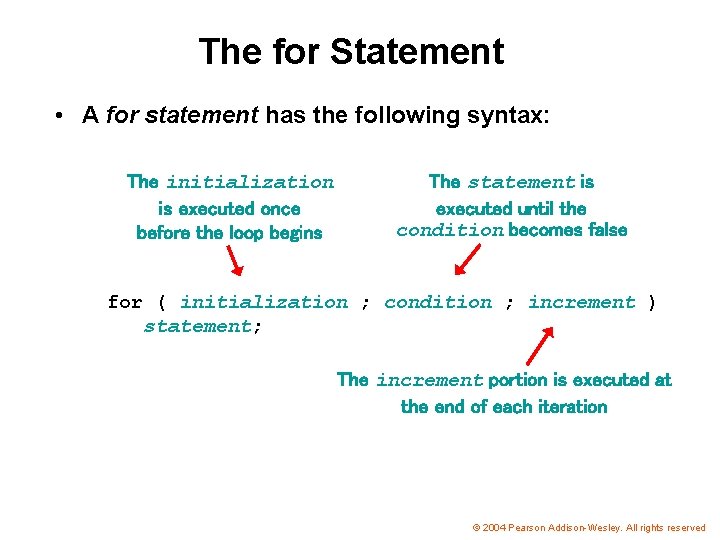
The for Statement • A for statement has the following syntax: The initialization is executed once before the loop begins The statement is executed until the condition becomes false for ( initialization ; condition ; increment ) statement; The increment portion is executed at the end of each iteration © 2004 Pearson Addison-Wesley. All rights reserved
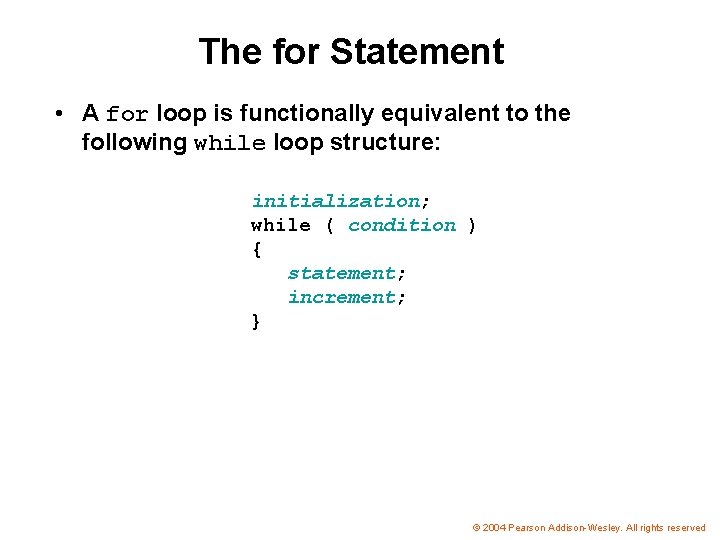
The for Statement • A for loop is functionally equivalent to the following while loop structure: initialization; while ( condition ) { statement; increment; } © 2004 Pearson Addison-Wesley. All rights reserved
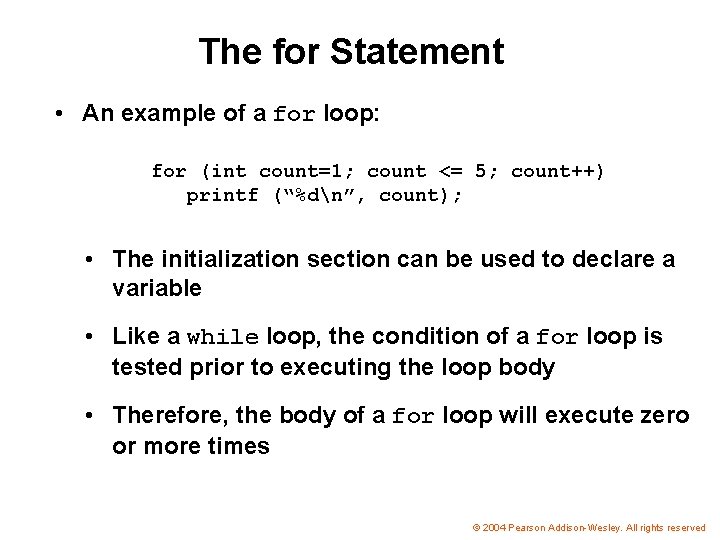
The for Statement • An example of a for loop: for (int count=1; count <= 5; count++) printf (“%dn”, count); • The initialization section can be used to declare a variable • Like a while loop, the condition of a for loop is tested prior to executing the loop body • Therefore, the body of a for loop will execute zero or more times © 2004 Pearson Addison-Wesley. All rights reserved
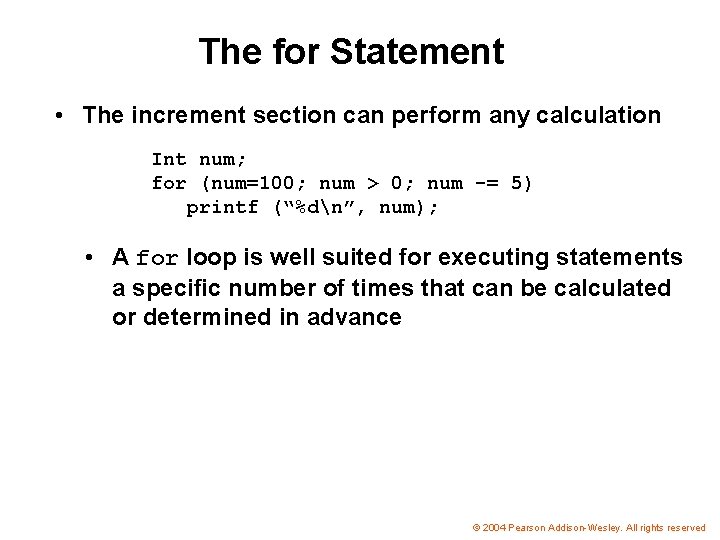
The for Statement • The increment section can perform any calculation Int num; for (num=100; num > 0; num -= 5) printf (“%dn”, num); • A for loop is well suited for executing statements a specific number of times that can be calculated or determined in advance © 2004 Pearson Addison-Wesley. All rights reserved
The for Statement • Each expression in the header of a for loop is optional • If the initialization is left out, no initialization is performed • If the condition is left out, it is always considered to be true, and therefore creates an infinite loop • If the increment is left out, no increment operation is performed © 2004 Pearson Addison-Wesley. All rights reserved

TO BE CONTINUED…
- Slides: 38