
CPECSC 481 KnowledgeBased Systems Franz J Kurfess Computer
CPE/CSC 481: Knowledge-Based Systems Franz J. Kurfess Computer Science Department California Polytechnic State University San Luis Obispo, CA, U. S. A.
Course Overview ❖ Introduction v v ❖ Knowledge Representation v ❖ Fuzzy Logic Knowledge Exchange v ❖ Probability, Bayesian Decision Making Approximate Reasoning v ❖ Predicate Logic, Description Logics, Inference Methods, Resolution Reasoning with Uncertainty v ❖ Semantic Nets, Rules, Frames, Scripts, Logic, RDF Reasoning and Inference v ❖ Knowledge-Based Systems (KBS), Expert Systems (ES) Data/Information/Knowledge Capture, Transfer, Distribution Knowledge Retrieval © Franz J. Kurfess 3
Overview Introduction ❖ Motivation ❖ Objectives ❖ What is a Knowledge-Based System (KBS)? v ❖ knowledge, reasoning General Concepts and Characteristics of KBSs v knowledge representation, inference, knowledge acquisition, explanation ❖ KBS Technology ❖ KBS Tools v shells, languages © Franz J. Kurfess 4
Motivation ❖ ❖ utilization of computers to deal with knowledge v quantity of knowledge available increases rapidly v relieve humans from tedious tasks computers have special requirements for dealing with knowledge v ❖ acquisition, representation, reasoning some knowledge-related tasks can be solved better by computers than by humans v cheaper, faster, easily accessible, reliable © Franz J. Kurfess 9
Objectives ❖ to know and comprehend the main principles, components, and application areas for Knowledge-Based Systems ❖ to understand the structure of Knowledge-Based Systems v knowledge base, inference engine ❖ to be familiar with frequently used methods for knowledge representation in computers ❖ to evaluate the suitability of computers for specific tasks v application of methods to scenarios or tasks © Franz J. Kurfess 10
Terminology ❖ Data ❖ Information ❖ Knowledge © Franz J. Kurfess 12
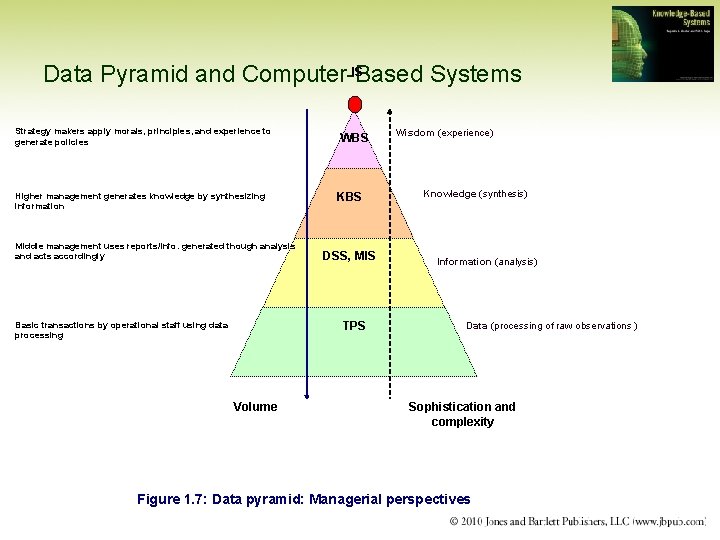
IS Data Pyramid and Computer-Based Systems Strategy makers apply morals, principles, and experience to generate policies Higher management generates knowledge by synthesizing information Middle management uses reports/info. generated though analysis and acts accordingly Basic transactions by operational staff using data processing WBS KBS DSS, MIS TPS Volume Wisdom (experience) Knowledge (synthesis) Information (analysis) Data (processing of raw observations ) Sophistication and complexity Figure 1. 7: Data pyramid: Managerial perspectives
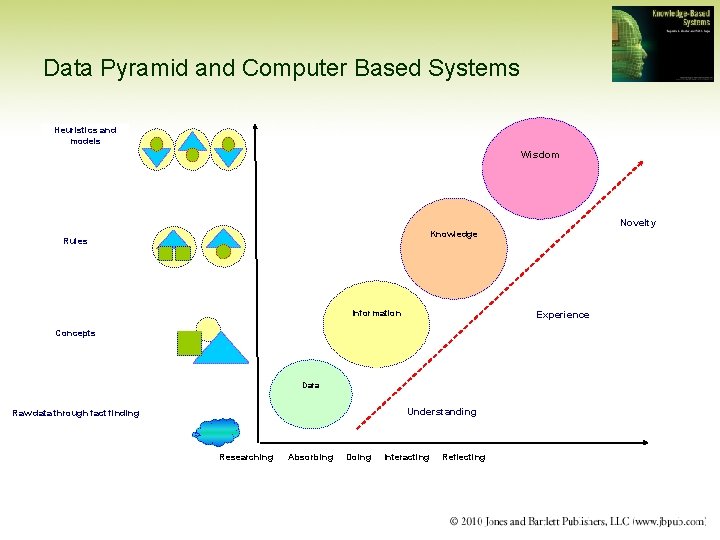
Data Pyramid and Computer Based Systems Heuristics and models Wisdom Novelty Knowledge Rules Information Experience Concepts Data Understanding Raw data through fact finding Researching Absorbing Doing Interacting Reflecting
What is an Knowledge-Based System (KBS)? ❖ relies on internally represented knowledge to perform tasks ❖ utilizes reasoning methods to derive appropriate new knowledge ❖ usually restricted to a specific problem domain ❖ some systems try to capture common-sense knowledge v v General Problem Solver (Newell, Shaw, Simon) Cyc (Lenat) © Franz J. Kurfess 15
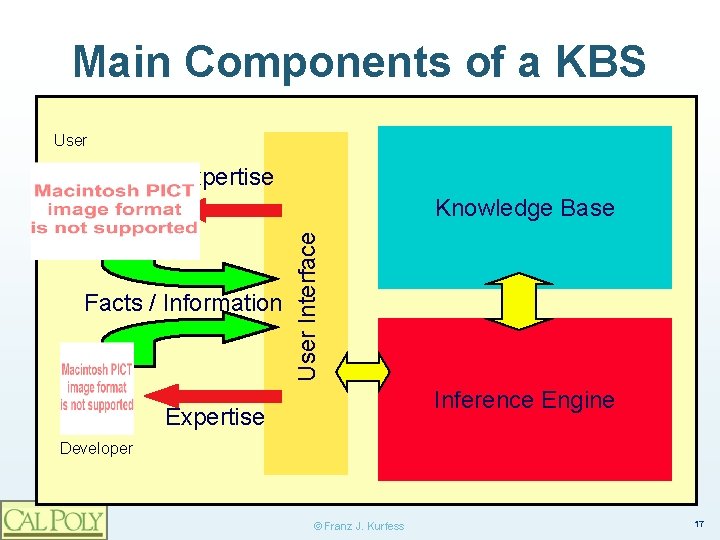
Main Components of a KBS User Expertise Facts / Information User Interface Knowledge Base Inference Engine Expertise Developer © Franz J. Kurfess 17
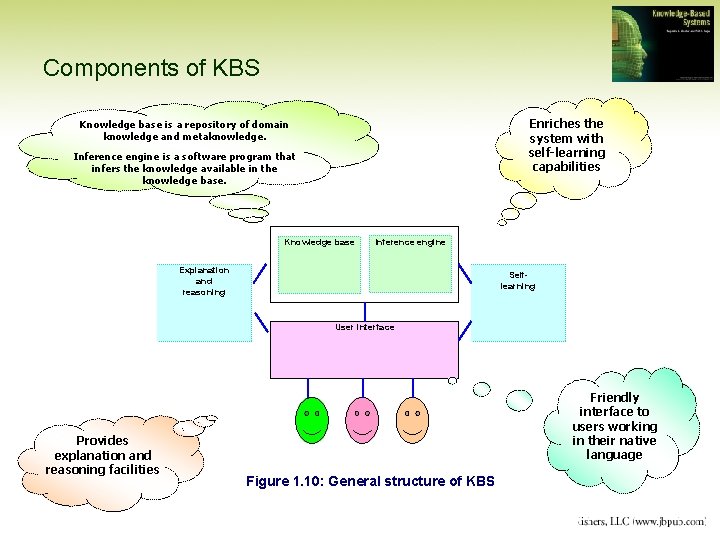
Components of KBS Enriches the system with self-learning capabilities Knowledge base is a repository of domain knowledge and metaknowledge. Inference engine is a software program that infers the knowledge available in the knowledge base. Knowledge base Inference engine Explanation and reasoning Selflearning User interface Provides explanation and reasoning facilities Friendly interface to users working in their native language Figure 1. 10: General structure of KBS
General Concepts and Characteristics of ES ❖ knowledge acquisition v transfer of knowledge from humans to computers v sometimes knowledge can be acquired directly from the environment v ❖ knowledge representation v ❖ suitable for storing and processing knowledge in computers inference v ❖ machine learning mechanism that allows the generation of new conclusions from existing knowledge in a computer explanation v illustrates to the user how and why a particular solution was generated © Franz J. Kurfess 20
Early KBS Success Stories ❖ DENDRAL v ❖ MYCIN v ❖ diagnosis of illnesses PROSPECTOR v v ❖ identification of chemical constituents analysis of geological data for minerals discovered a mineral deposit worth $100 million XCON/R 1 v v configuration of DEC VAX computer systems saved lots of time and millions of dollars © Franz J. Kurfess 22
Rules and Humans ❖ rules can be used to formulate a theory of human information processing (Newell & Simon) v v v ❖ rules are stored in long-term memory temporary knowledge is kept in short-term memory sensory input or thinking triggers the activation of rules activated rules may trigger further activation a cognitive processor combines evidence from currently active rules this model is the basis for the design of many rule-based systems v also called production systems © Franz J. Kurfess 23
Related Developments ❖ ❖ Semantic Web v extension of the World Wide Web v includes knowledge representation and reasoning capabilities Decision Support Systems v ❖ Data Mining v ❖ less emphasis on autonomy extraction of knowledge from large quantities of data Sensemaking v computer support for quicker, easier understanding of complex domains or situations © Franz J. Kurfess 27
Rule-Based ES ❖ knowledge is encoded as IF … THEN rules v ❖ these rules can also be written as production rules the inference engine determines which rule antecedents are satisfied v the left-hand side must “match” a fact in the working memory ❖ satisfied rules are placed on the agenda ❖ rules on the agenda can be activated (“fired”) v an activated rule may generate new facts through its right-hand side v the activation of one rule may subsequently cause the activation of other rules © Franz J. Kurfess 28
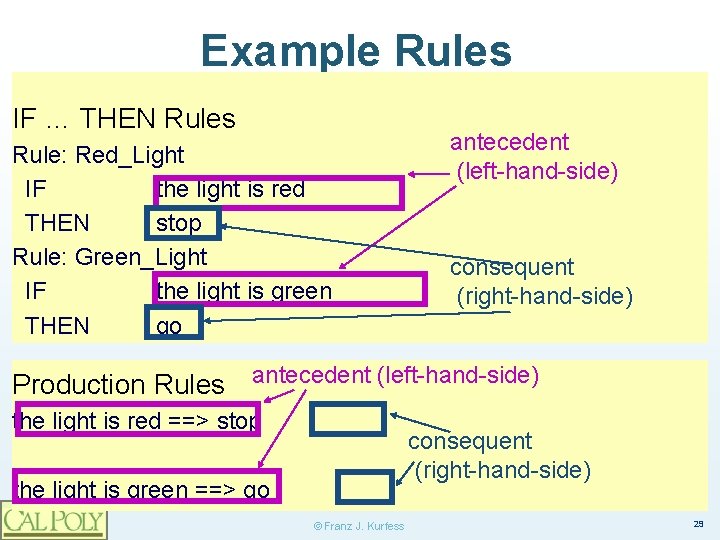
Example Rules IF … THEN Rules Rule: Red_Light IF the light is red THEN stop Rule: Green_Light IF the light is green THEN go antecedent (left-hand-side) consequent (right-hand-side) Production Rules antecedent (left-hand-side) the light is red ==> stop consequent (right-hand-side) the light is green ==> go © Franz J. Kurfess 29
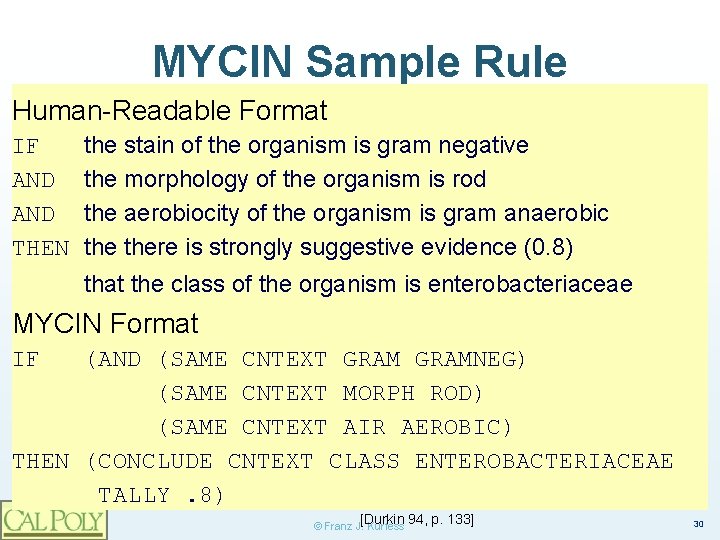
MYCIN Sample Rule Human-Readable Format IF AND THEN the stain of the organism is gram negative the morphology of the organism is rod the aerobiocity of the organism is gram anaerobic there is strongly suggestive evidence (0. 8) that the class of the organism is enterobacteriaceae MYCIN Format IF (AND (SAME CNTEXT GRAMNEG) (SAME CNTEXT MORPH ROD) (SAME CNTEXT AIR AEROBIC) THEN (CONCLUDE CNTEXT CLASS ENTEROBACTERIACEAE TALLY. 8) [Durkin 94, p. 133] © Franz J. Kurfess 30
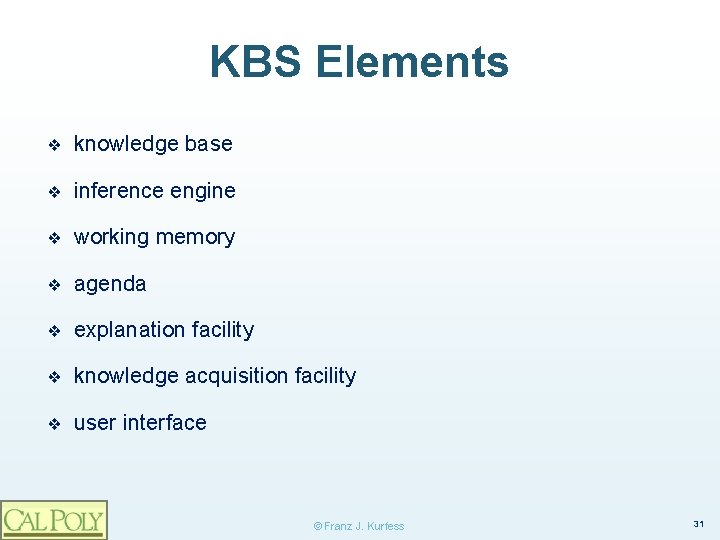
KBS Elements ❖ knowledge base ❖ inference engine ❖ working memory ❖ agenda ❖ explanation facility ❖ knowledge acquisition facility ❖ user interface © Franz J. Kurfess 31
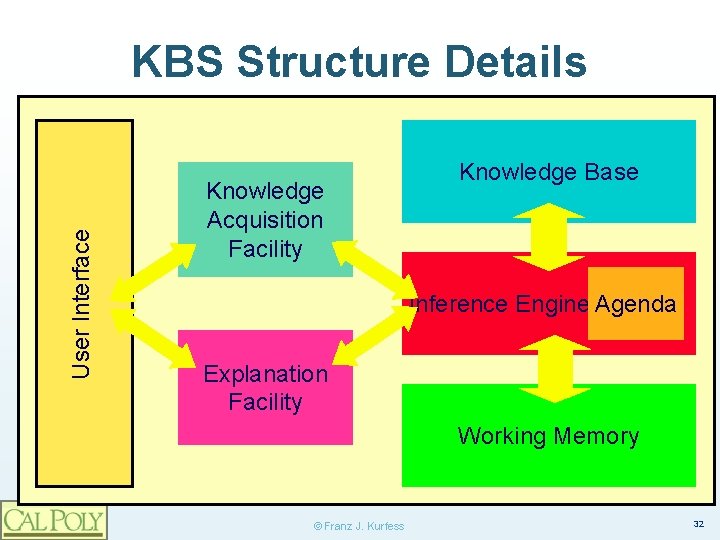
User Interface KBS Structure Details Knowledge Acquisition Facility Knowledge Base Inference Engine Agenda Explanation Facility Working Memory © Franz J. Kurfess 32
Inference Engine Cycle ❖ describes the execution of rules by the inference engine v conflict resolution v v v execution v perform the actions on the consequent of the selected rule v remove the rule from the agenda match v ❖ select the rule with the highest priority from the agenda update the agenda v add rules whose antecedents are satisfied to the agenda v remove rules with non-satisfied agendas the cycle ends v no more rules are on the agenda v explicit “stop” command © Franz J. Kurfess 33
Forward and Backward Chaining ❖ different methods of rule activation v v forward chaining (data-driven) v reasoning from facts to the conclusion v as soon as facts are available, they are used to match antecedents of rules v a rule can be activated if all parts of the antecedent are satisfied v often used for real-time expert systems in monitoring and control v examples: CLIPS, OPS 5 backward chaining (query-driven) v starting from a hypothesis (query), supporting rules and facts are sought until all parts of the antecedent of the hypothesis are satisfied v often used in diagnostic and consultation systems v examples: EMYCIN © Franz J. Kurfess 34
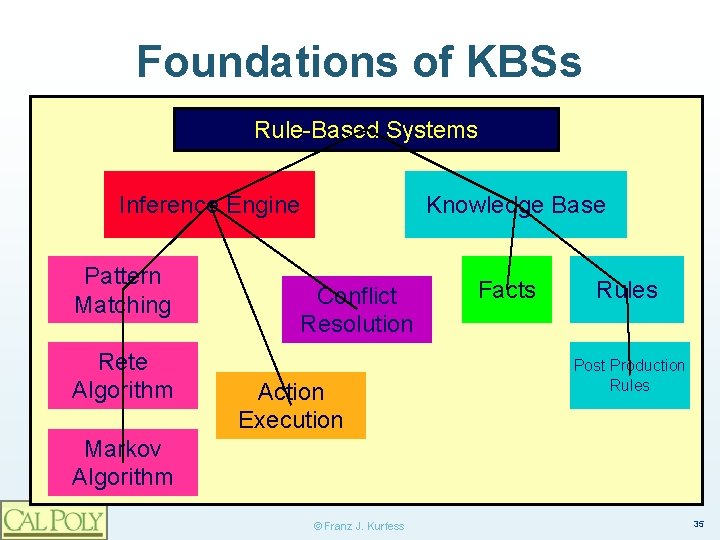
Foundations of KBSs Rule-Based Systems Inference Engine Pattern Matching Rete Algorithm Knowledge Base Conflict Resolution Action Execution Facts Rules Post Production Rules Markov Algorithm © Franz J. Kurfess 35
Post Production Systems ❖ production rules were used by the logician Emil L. Post in the early 40 s in symbolic logic ❖ Post’s theoretical result v ❖ any system in mathematics or logic can be written as a production system basic principle of production rules v a set of rules governs the conversion of a set of strings into another set of strings v these rules are also known as rewrite rules v simple syntactic string manipulation v no understanding or interpretation is required v also used to define grammars of languages v e. g. BNF grammars of programming languages © Franz J. Kurfess 36
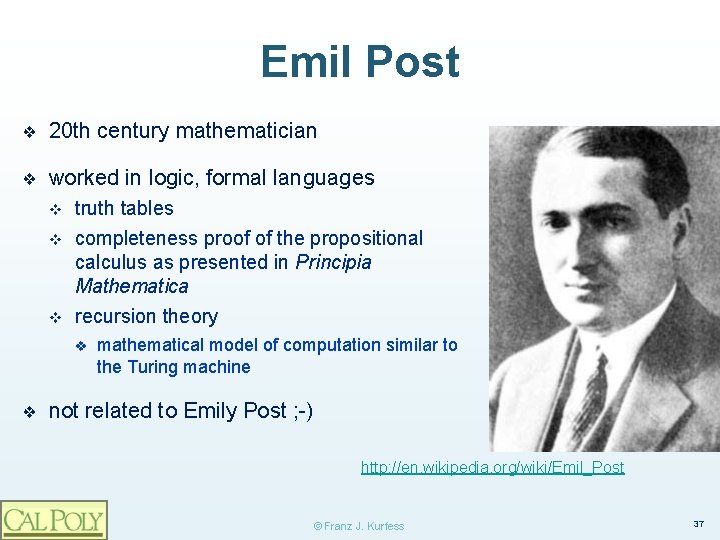
Emil Post ❖ 20 th century mathematician ❖ worked in logic, formal languages v v v truth tables completeness proof of the propositional calculus as presented in Principia Mathematica recursion theory v ❖ mathematical model of computation similar to the Turing machine not related to Emily Post ; -) http: //en. wikipedia. org/wiki/Emil_Post © Franz J. Kurfess 37
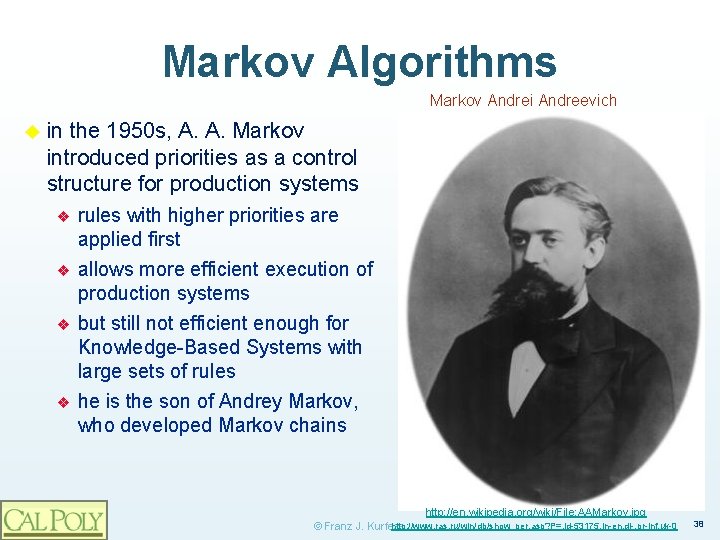
Markov Algorithms Markov Andrei Andreevich ◆ in the 1950 s, A. A. Markov introduced priorities as a control structure for production systems ❖ ❖ rules with higher priorities are applied first allows more efficient execution of production systems but still not efficient enough for Knowledge-Based Systems with large sets of rules he is the son of Andrey Markov, who developed Markov chains http: //en. wikipedia. org/wiki/File: AAMarkov. jpg http: //www. ras. ru/win/db/show_per. asp? P=. id-53175. ln-en. dl-. pr-inf. uk-0 © Franz J. Kurfess 38
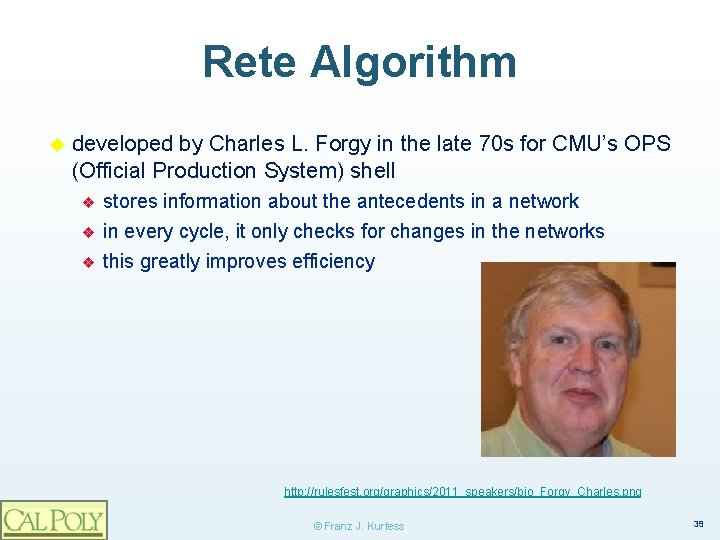
Rete Algorithm ◆ developed by Charles L. Forgy in the late 70 s for CMU’s OPS (Official Production System) shell ❖ ❖ ❖ stores information about the antecedents in a network in every cycle, it only checks for changes in the networks this greatly improves efficiency http: //rulesfest. org/graphics/2011_speakers/bio_Forgy_Charles. png © Franz J. Kurfess 39
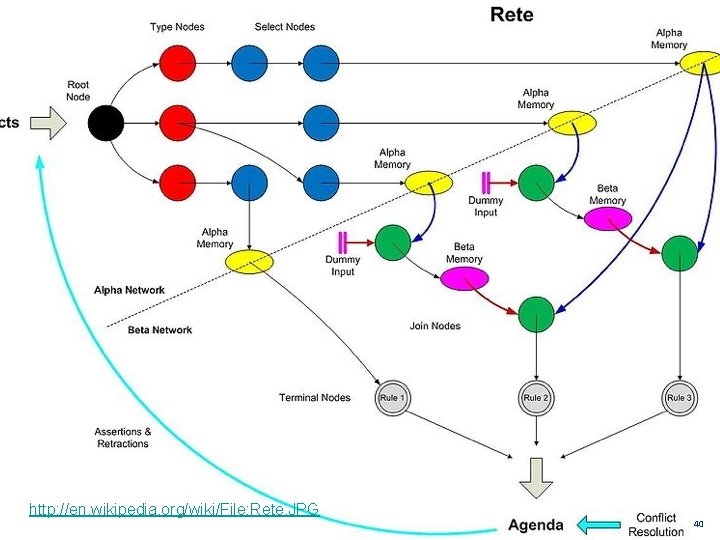
Rete Network http: //en. wikipedia. org/wiki/File: Rete. JPG © Franz J. Kurfess 40
KBS Advantages ❖ economical v ❖ availability v ❖ ❖ often faster than human experts reliability v can be greater than that of human experts v no distraction, fatigue, emotional involvement, … explanation v ❖ accessible anytime, almost anywhere response time v ❖ lower cost per user reasoning steps that lead to a particular conclusion intellectual property v can’t walk out of the door © Franz J. Kurfess 41
KBS Problems ❖ limited knowledge v “shallow” knowledge v ❖ ❖ no “deep” understanding of the concepts and their relationships v no “common-sense” knowledge v no knowledge from possibly relevant related domains v “closed world” v the ES knows only what it has been explicitly “told” v it doesn’t know what it doesn’t know mechanical reasoning v may not have or select the most appropriate method for a particular problem v some “easy” problems are computationally very expensive lack of trust v users may not want to leave critical decisions to machines © Franz J. Kurfess 42
Summary Introduction ❖ expert systems or knowledge based systems are used to represent and process in a format that is suitable for computers but still understandable by humans v ❖ If-Then rules are a popular format the main components of an Knowledge-Based System are v knowledge base v inference engine ❖ ES can be cheaper, faster, more accessible, and more reliable than humans ❖ ES have limited knowledge (especially “common-sense”), can be difficult and expensive to develop, and users may not trust them for critical decisions © Franz J. Kurfess 45
Important Concepts and Terms ❖ agenda ❖ backward chaining ❖ common-sense knowledge ❖ conflict resolution ❖ expert system (ES) ❖ expert system shell ❖ explanation ❖ forward chaining ❖ inference mechanism ❖ If-Then rules ❖ knowledge acquisition ❖ knowledge base © Franz J. Kurfess 46
- Slides: 32