
CPE 631 Lecture 24 Vector Processing Aleksandar Milenkovi

- Slides: 31
CPE 631 Lecture 24: Vector Processing Aleksandar Milenković, milenka@ece. uah. edu Electrical and Computer Engineering University of Alabama in Huntsville
CPE 631 AM Outline n n n Properties of Vector Processing Components of a Vector Processor Vector Execution Time Real World Problems: Vector Length and Stride Vector Optimizations: Chaining, Conditional Execution, Sparse Matrices 11/21/2020 UAH CPE 631 2
CPE 631 AM Why Vector Processors? n Instruction level parallelism (Ch 3&4) – Deeper pipeline and wider superscalar machines to extract more parallelism • more register file ports, more registers, more hazard interlock logic – In dynamically scheduled machines instruction window, reorder buffer, rename register files must grow to have enough capacity to keep relevant information about in flight instructions Difficult to build machines supporting large number of in flight instructions => limit the issue width and pipeline depths => limit the amount parallelism you can extract n Commercial versions long before ILP machines n 11/21/2020 UAH CPE 631 3
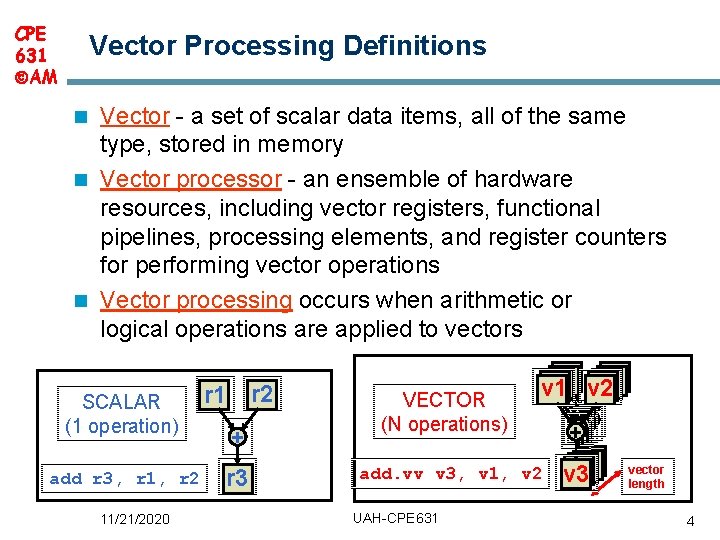
CPE 631 AM Vector Processing Definitions Vector a set of scalar data items, all of the same type, stored in memory n Vector processor an ensemble of hardware resources, including vector registers, functional pipelines, processing elements, and register counters for performing vector operations n Vector processing occurs when arithmetic or logical operations are applied to vectors n SCALAR (1 operation) add r 3, r 1, r 2 11/21/2020 r 2 r 1 + r 3 VECTOR (N operations) v 1 v 2 + ++++ add. vv v 3, v 1, v 2 UAH CPE 631 v 3 vector length 4
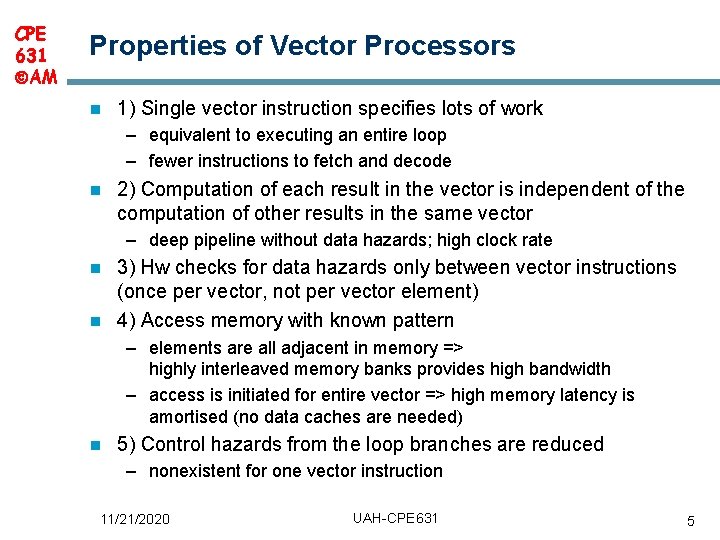
CPE 631 AM Properties of Vector Processors n 1) Single vector instruction specifies lots of work – equivalent to executing an entire loop – fewer instructions to fetch and decode n 2) Computation of each result in the vector is independent of the computation of other results in the same vector – deep pipeline without data hazards; high clock rate 3) Hw checks for data hazards only between vector instructions (once per vector, not per vector element) n 4) Access memory with known pattern n – elements are all adjacent in memory => highly interleaved memory banks provides high bandwidth – access is initiated for entire vector => high memory latency is amortised (no data caches are needed) n 5) Control hazards from the loop branches are reduced – nonexistent for one vector instruction 11/21/2020 UAH CPE 631 5
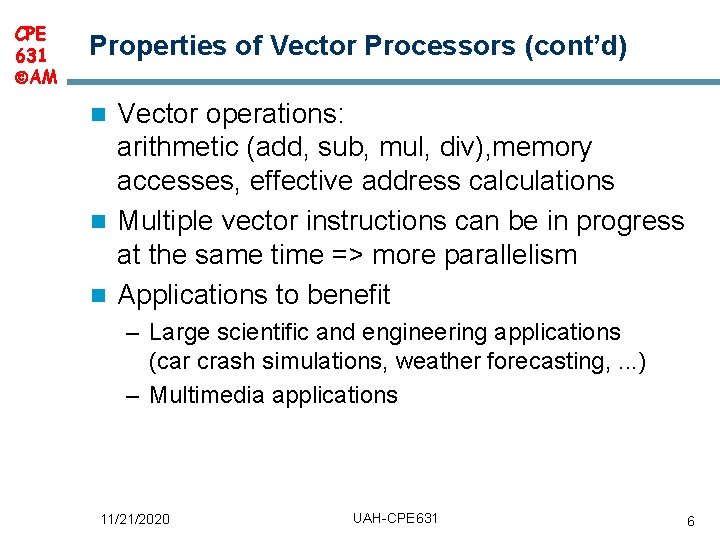
CPE 631 AM Properties of Vector Processors (cont’d) Vector operations: arithmetic (add, sub, mul, div), memory accesses, effective address calculations n Multiple vector instructions can be in progress at the same time => more parallelism n Applications to benefit n – Large scientific and engineering applications (car crash simulations, weather forecasting, . . . ) – Multimedia applications 11/21/2020 UAH CPE 631 6
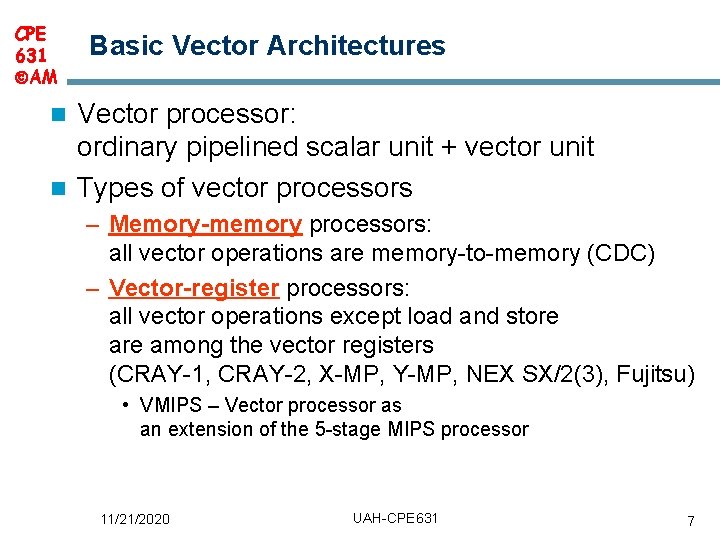
CPE 631 AM Basic Vector Architectures Vector processor: ordinary pipelined scalar unit + vector unit n Types of vector processors n – Memory-memory processors: all vector operations are memory to memory (CDC) – Vector-register processors: all vector operations except load and store among the vector registers (CRAY 1, CRAY 2, X MP, Y MP, NEX SX/2(3), Fujitsu) • VMIPS – Vector processor as an extension of the 5 stage MIPS processor 11/21/2020 UAH CPE 631 7
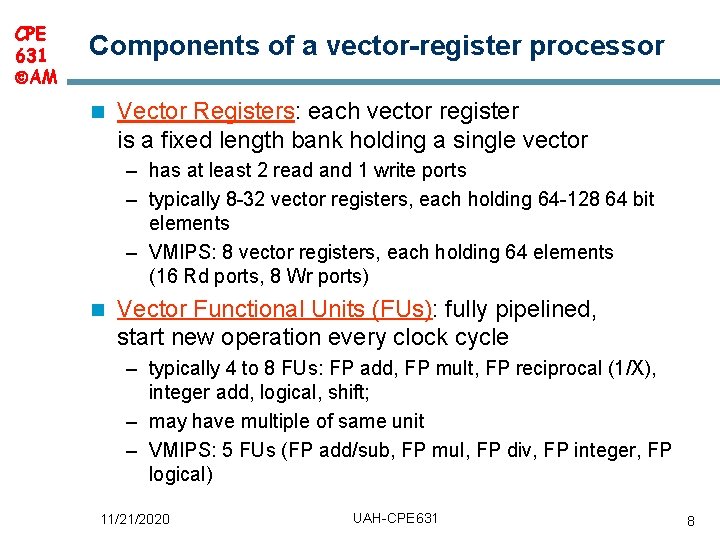
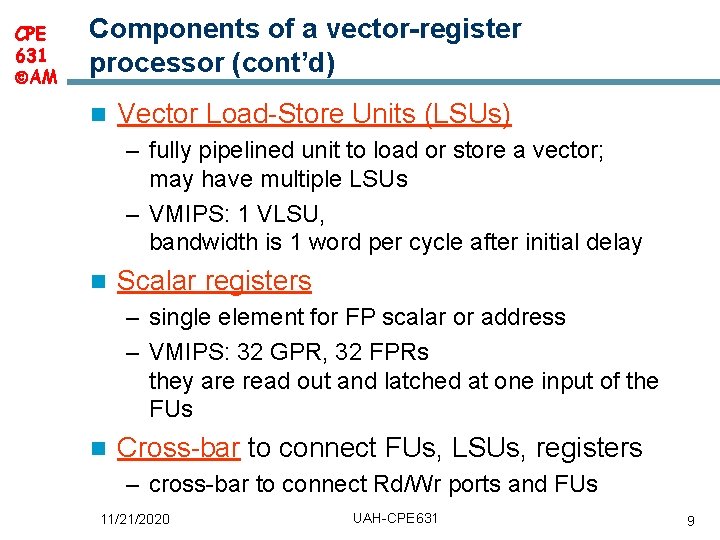
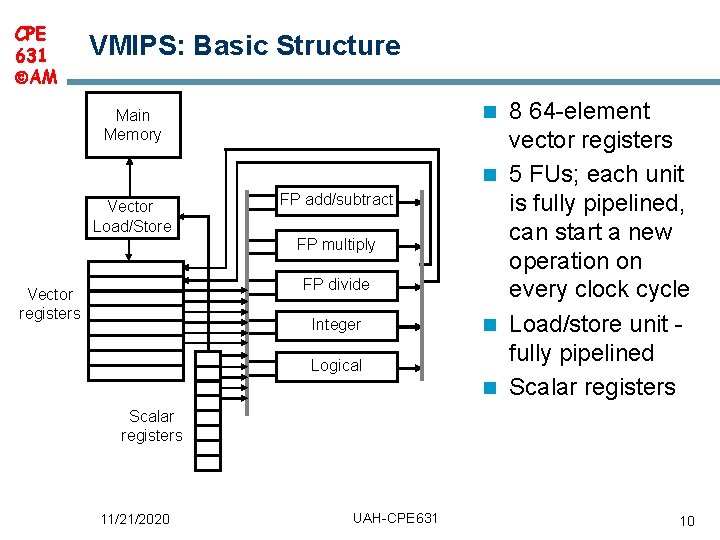
CPE 631 AM Components of a vector-register processor n Vector Registers: each vector register is a fixed length bank holding a single vector – has at least 2 read and 1 write ports – typically 8 32 vector registers, each holding 64 128 64 bit elements – VMIPS: 8 vector registers, each holding 64 elements (16 Rd ports, 8 Wr ports) n Vector Functional Units (FUs): fully pipelined, start new operation every clock cycle – typically 4 to 8 FUs: FP add, FP mult, FP reciprocal (1/X), integer add, logical, shift; – may have multiple of same unit – VMIPS: 5 FUs (FP add/sub, FP mul, FP div, FP integer, FP logical) 11/21/2020 UAH CPE 631 8
CPE 631 AM Components of a vector-register processor (cont’d) n Vector Load Store Units (LSUs) – fully pipelined unit to load or store a vector; may have multiple LSUs – VMIPS: 1 VLSU, bandwidth is 1 word per cycle after initial delay n Scalar registers – single element for FP scalar or address – VMIPS: 32 GPR, 32 FPRs they are read out and latched at one input of the FUs n Cross bar to connect FUs, LSUs, registers – cross bar to connect Rd/Wr ports and FUs 11/21/2020 UAH CPE 631 9
CPE 631 AM VMIPS: Basic Structure Vector Load/Store FP add/subtract FP multiply FP divide Vector registers 8 64 element vector registers n 5 FUs; each unit is fully pipelined, can start a new operation on every clock cycle n Load/store unit fully pipelined n Scalar registers n Main Memory Integer Logical Scalar registers 11/21/2020 UAH CPE 631 10
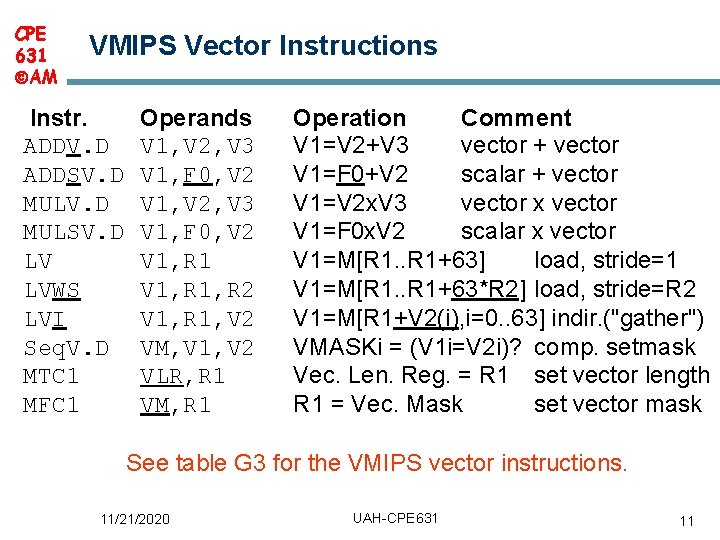
CPE 631 AM VMIPS Vector Instructions Instr. ADDV. D ADDSV. D MULSV. D LV LVWS LVI Seq. V. D MTC 1 MFC 1 Operands V 1, V 2, V 3 V 1, F 0, V 2 V 1, R 2 V 1, R 1, V 2 VM, V 1, V 2 VLR, R 1 VM, R 1 Operation Comment V 1=V 2+V 3 vector + vector V 1=F 0+V 2 scalar + vector V 1=V 2 x. V 3 vector x vector V 1=F 0 x. V 2 scalar x vector V 1=M[R 1. . R 1+63] load, stride=1 V 1=M[R 1. . R 1+63*R 2] load, stride=R 2 V 1=M[R 1+V 2(i), i=0. . 63] indir. ("gather") VMASKi = (V 1 i=V 2 i)? comp. setmask Vec. Len. Reg. = R 1 set vector length R 1 = Vec. Mask set vector mask See table G 3 for the VMIPS vector instructions. 11/21/2020 UAH CPE 631 11
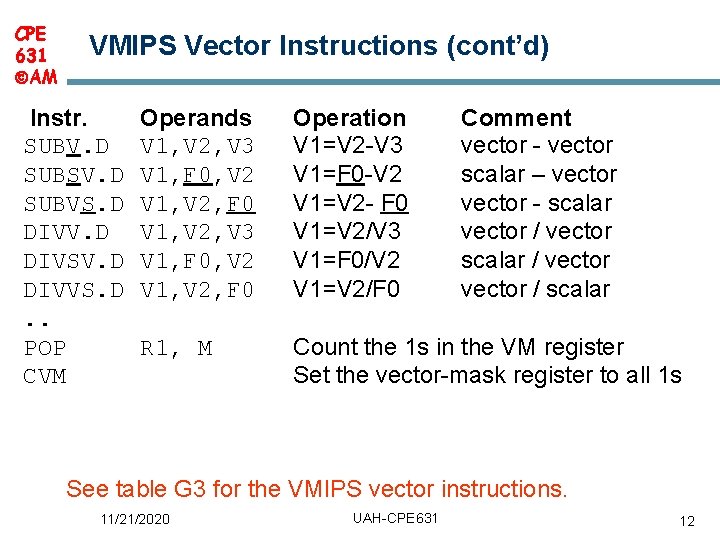
CPE 631 AM VMIPS Vector Instructions (cont’d) Instr. SUBV. D SUBSV. D SUBVS. D DIVV. D DIVSV. D DIVVS. D. . POP CVM Operands V 1, V 2, V 3 V 1, F 0, V 2 V 1, V 2, F 0 Operation V 1=V 2 V 3 V 1=F 0 V 2 V 1=V 2 F 0 V 1=V 2/V 3 V 1=F 0/V 2 V 1=V 2/F 0 Comment vector scalar – vector scalar vector / vector scalar / vector / scalar R 1, M Count the 1 s in the VM register Set the vector mask register to all 1 s See table G 3 for the VMIPS vector instructions. 11/21/2020 UAH CPE 631 12
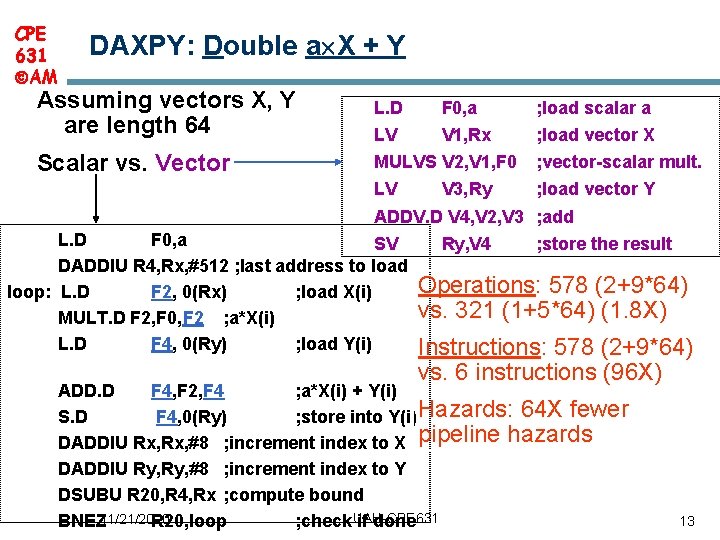
CPE 631 AM DAXPY: Double a X + Y Assuming vectors X, Y are length 64 L. D F 0, a ; load scalar a LV V 1, Rx ; load vector X Scalar vs. Vector MULVS V 2, V 1, F 0 ; vector-scalar mult. LV ; load vector Y V 3, Ry ADDV. D V 4, V 2, V 3 ; add L. D F 0, a SV DADDIU R 4, Rx, #512 ; last address to load loop: L. D F 2, 0(Rx) ; load X(i) MULT. D F 2, F 0, F 2 ; a*X(i) L. D F 4, 0(Ry) ; load Y(i) Ry, V 4 ; store the result Operations: 578 (2+9*64) vs. 321 (1+5*64) (1. 8 X) Instructions: 578 (2+9*64) vs. 6 instructions (96 X) ADD. D F 4, F 2, F 4 ; a*X(i) + Y(i) S. D F 4, 0(Ry) ; store into Y(i) Hazards: 64 X fewer DADDIU Rx, #8 ; increment index to X pipeline hazards DADDIU Ry, #8 ; increment index to Y DSUBU R 20, R 4, Rx ; compute bound BNEZ 11/21/2020 R 20, loop ; check UAH CPE 631 if done 13
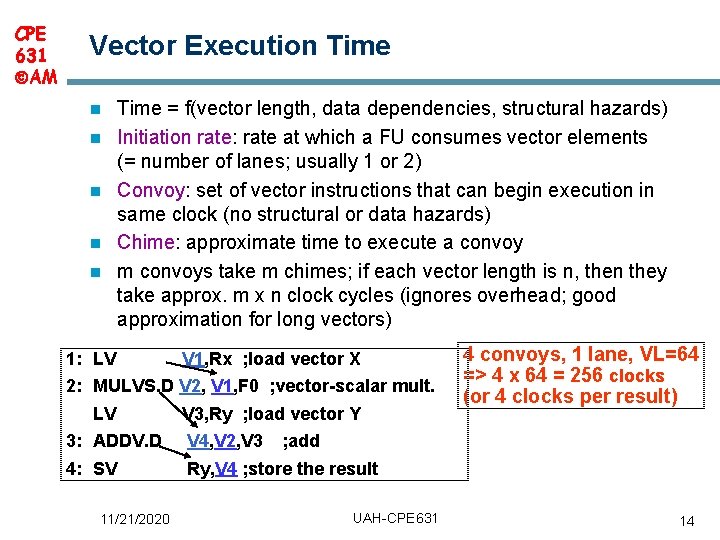
CPE 631 AM Vector Execution Time n n n Time = f(vector length, data dependencies, structural hazards) Initiation rate: rate at which a FU consumes vector elements (= number of lanes; usually 1 or 2) Convoy: set of vector instructions that can begin execution in same clock (no structural or data hazards) Chime: approximate time to execute a convoy m convoys take m chimes; if each vector length is n, then they take approx. m x n clock cycles (ignores overhead; good approximation for long vectors) 1: LV V 1, Rx ; load vector X 2: MULVS. D V 2, V 1, F 0 ; vector-scalar mult. LV V 3, Ry ; load vector Y 3: ADDV. D V 4, V 2, V 3 4: SV Ry, V 4 ; store the result 11/21/2020 4 convoys, 1 lane, VL=64 => 4 x 64 = 256 clocks (or 4 clocks per result) ; add UAH CPE 631 14
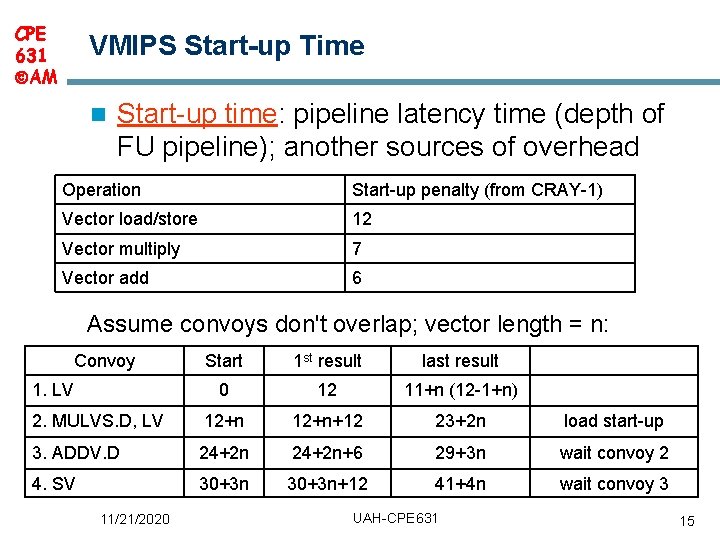
CPE 631 AM VMIPS Start-up Time n Start up time: pipeline latency time (depth of FU pipeline); another sources of overhead Operation Start up penalty (from CRAY 1) Vector load/store 12 Vector multiply 7 Vector add 6 Assume convoys don't overlap; vector length = n: Convoy Start 1 st result last result 0 12 11+n (12 1+n) 2. MULVS. D, LV 12+n+12 23+2 n load start up 3. ADDV. D 24+2 n+6 29+3 n wait convoy 2 4. SV 30+3 n+12 41+4 n wait convoy 3 1. LV 11/21/2020 UAH CPE 631 15
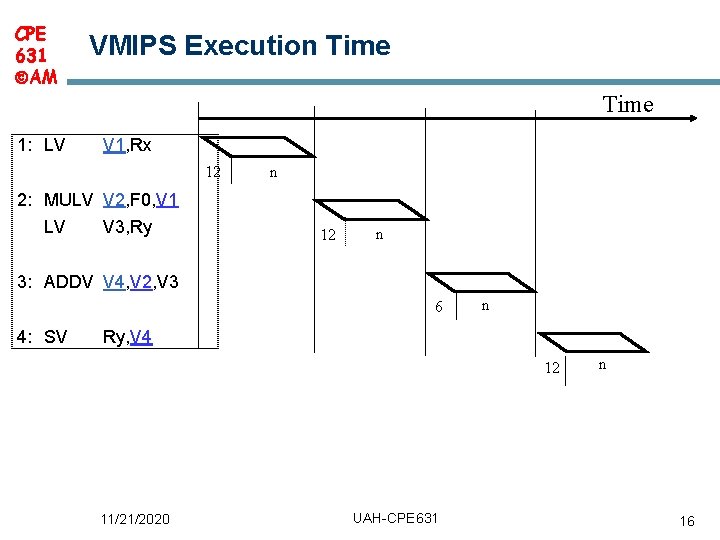
CPE 631 AM VMIPS Execution Time 1: LV V 1, Rx 12 n 2: MULV V 2, F 0, V 1 LV V 3, Ry 12 n 3: ADDV V 4, V 2, V 3 6 4: SV n Ry, V 4 12 11/21/2020 UAH CPE 631 n 16
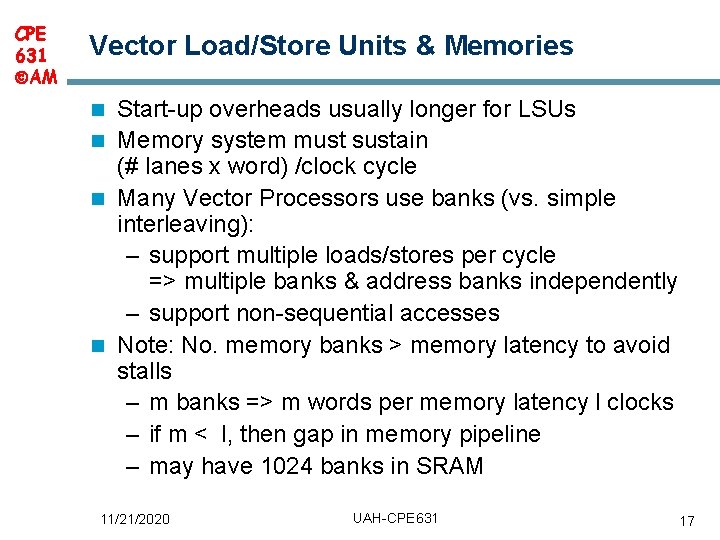
CPE 631 AM Vector Load/Store Units & Memories Start up overheads usually longer for LSUs n Memory system must sustain (# lanes x word) /clock cycle n Many Vector Processors use banks (vs. simple interleaving): – support multiple loads/stores per cycle => multiple banks & address banks independently – support non sequential accesses n Note: No. memory banks > memory latency to avoid stalls – m banks => m words per memory latency l clocks – if m < l, then gap in memory pipeline – may have 1024 banks in SRAM n 11/21/2020 UAH CPE 631 17
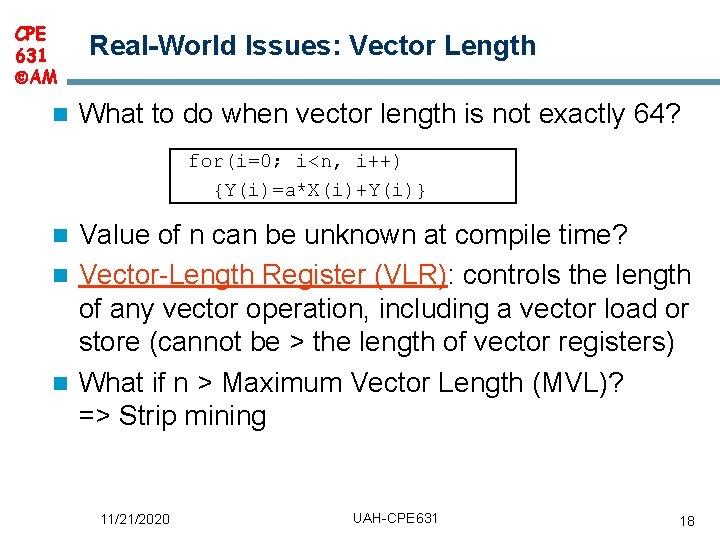
CPE 631 AM n Real-World Issues: Vector Length What to do when vector length is not exactly 64? for(i=0; i<n, i++) {Y(i)=a*X(i)+Y(i)} Value of n can be unknown at compile time? n Vector Length Register (VLR): controls the length of any vector operation, including a vector load or store (cannot be > the length of vector registers) n What if n > Maximum Vector Length (MVL)? => Strip mining n 11/21/2020 UAH CPE 631 18
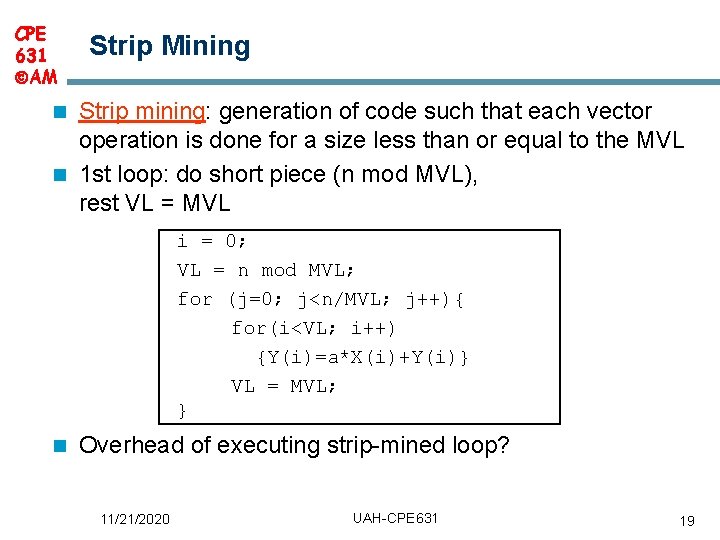
CPE 631 AM Strip Mining Strip mining: generation of code such that each vector operation is done for a size less than or equal to the MVL n 1 st loop: do short piece (n mod MVL), rest VL = MVL n i = 0; VL = n mod MVL; for (j=0; j<n/MVL; j++){ for(i<VL; i++) {Y(i)=a*X(i)+Y(i)} VL = MVL; } n Overhead of executing strip mined loop? 11/21/2020 UAH CPE 631 19
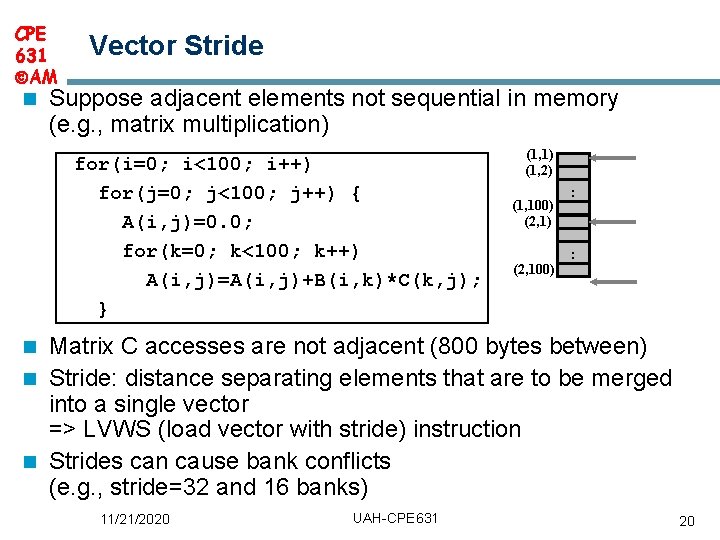
CPE 631 AM n Vector Stride Suppose adjacent elements not sequential in memory (e. g. , matrix multiplication) for(i=0; i<100; i++) for(j=0; j<100; j++) { A(i, j)=0. 0; for(k=0; k<100; k++) A(i, j)=A(i, j)+B(i, k)*C(k, j); } (1, 1) (1, 2) (1, 100) (2, 100) : : Matrix C accesses are not adjacent (800 bytes between) n Stride: distance separating elements that are to be merged into a single vector => LVWS (load vector with stride) instruction n Strides can cause bank conflicts (e. g. , stride=32 and 16 banks) n 11/21/2020 UAH CPE 631 20
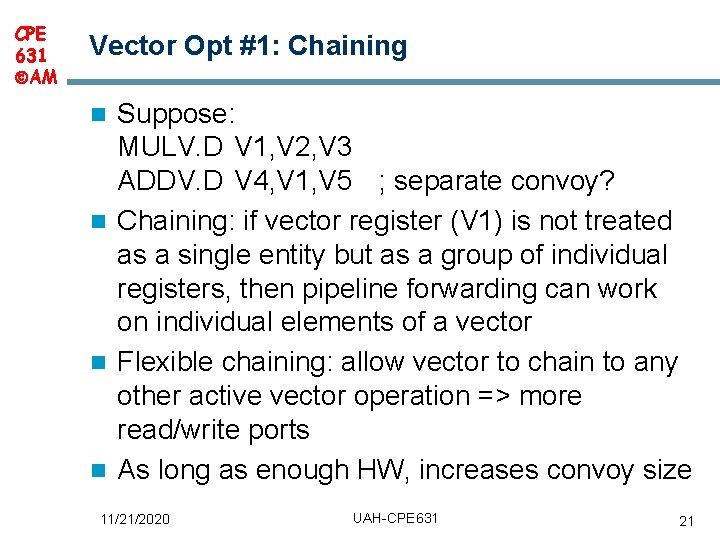
CPE 631 AM Vector Opt #1: Chaining Suppose: MULV. D V 1, V 2, V 3 ADDV. D V 4, V 1, V 5 ; separate convoy? n Chaining: if vector register (V 1) is not treated as a single entity but as a group of individual registers, then pipeline forwarding can work on individual elements of a vector n Flexible chaining: allow vector to chain to any other active vector operation => more read/write ports n As long as enough HW, increases convoy size n 11/21/2020 UAH CPE 631 21
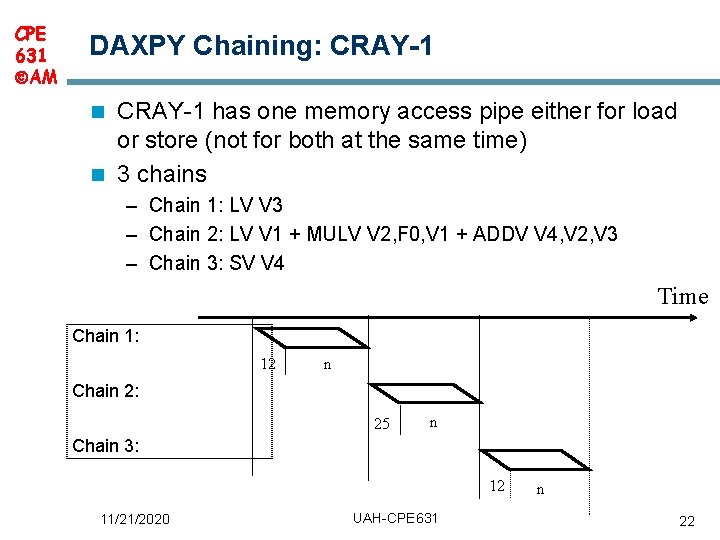
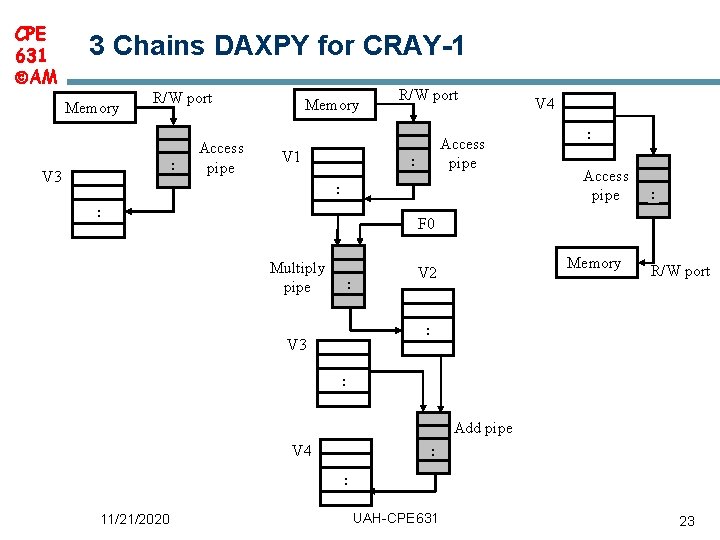
CPE 631 AM DAXPY Chaining: CRAY-1 CRAY 1 has one memory access pipe either for load or store (not for both at the same time) n 3 chains n – Chain 1: LV V 3 – Chain 2: LV V 1 + MULV V 2, F 0, V 1 + ADDV V 4, V 2, V 3 – Chain 3: SV V 4 Time Chain 1: 12 n Chain 2: 25 n Chain 3: 12 11/21/2020 UAH CPE 631 n 22
CPE 631 AM 3 Chains DAXPY for CRAY-1 Memory R/W port : V 3 Access pipe Memory V 1 R/W port Access pipe : : : V 4 : Access pipe : F 0 Multiply pipe : Memory V 2 R/W port : V 3 : Add pipe V 4 : : 11/21/2020 UAH CPE 631 23
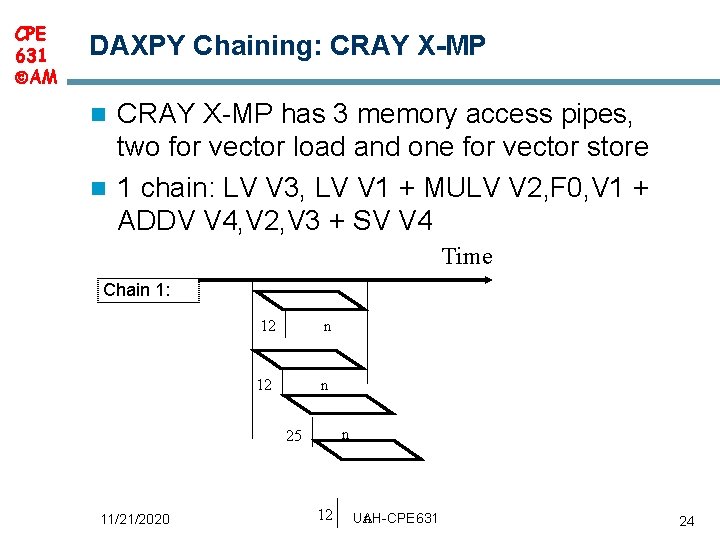
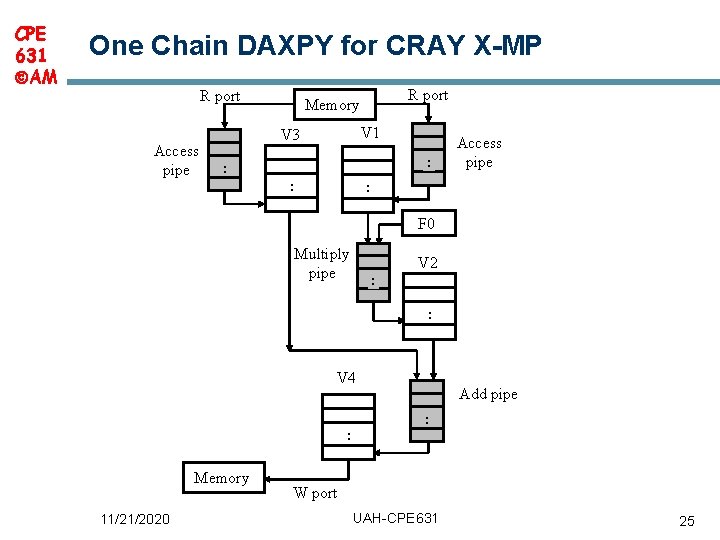
CPE 631 AM DAXPY Chaining: CRAY X-MP CRAY X MP has 3 memory access pipes, two for vector load and one for vector store n 1 chain: LV V 3, LV V 1 + MULV V 2, F 0, V 1 + ADDV V 4, V 2, V 3 + SV V 4 n Time Chain 1: 12 n n 25 11/21/2020 12 n UAH CPE 631 24
CPE 631 AM One Chain DAXPY for CRAY X-MP R port Access pipe R port Memory V 1 V 3 : : : Access pipe : F 0 Multiply pipe V 2 : : V 4 Add pipe : : Memory 11/21/2020 W port UAH CPE 631 25
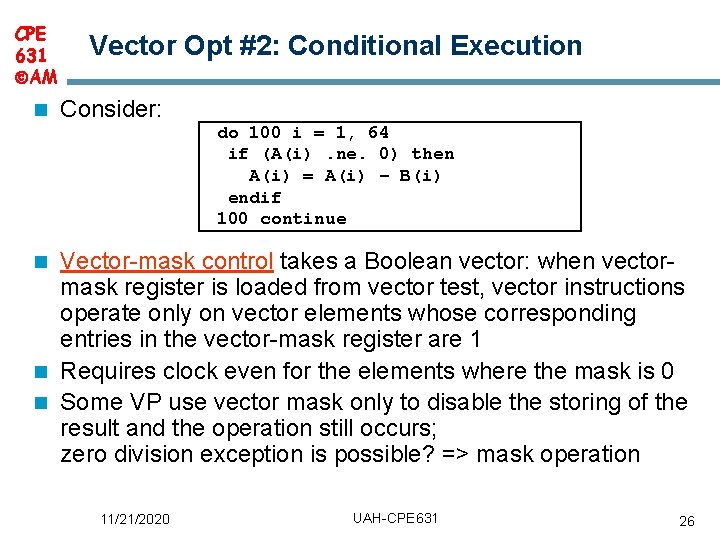
CPE 631 AM n Vector Opt #2: Conditional Execution Consider: do 100 i = 1, 64 if (A(i). ne. 0) then A(i) = A(i) – B(i) endif 100 continue Vector mask control takes a Boolean vector: when vector mask register is loaded from vector test, vector instructions operate only on vector elements whose corresponding entries in the vector mask register are 1 n Requires clock even for the elements where the mask is 0 n Some VP use vector mask only to disable the storing of the result and the operation still occurs; zero division exception is possible? => mask operation n 11/21/2020 UAH CPE 631 26
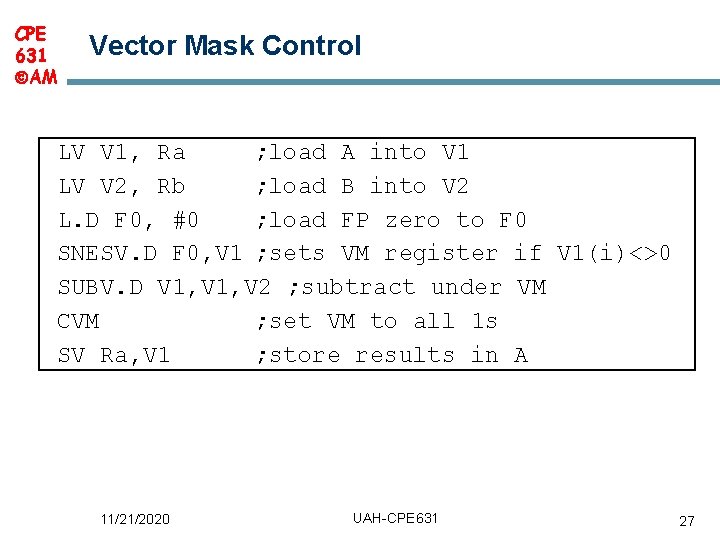
CPE 631 AM Vector Mask Control LV V 1, Ra ; load A into V 1 LV V 2, Rb ; load B into V 2 L. D F 0, #0 ; load FP zero to F 0 SNESV. D F 0, V 1 ; sets VM register if V 1(i)<>0 SUBV. D V 1, V 2 ; subtract under VM CVM ; set VM to all 1 s SV Ra, V 1 ; store results in A 11/21/2020 UAH CPE 631 27
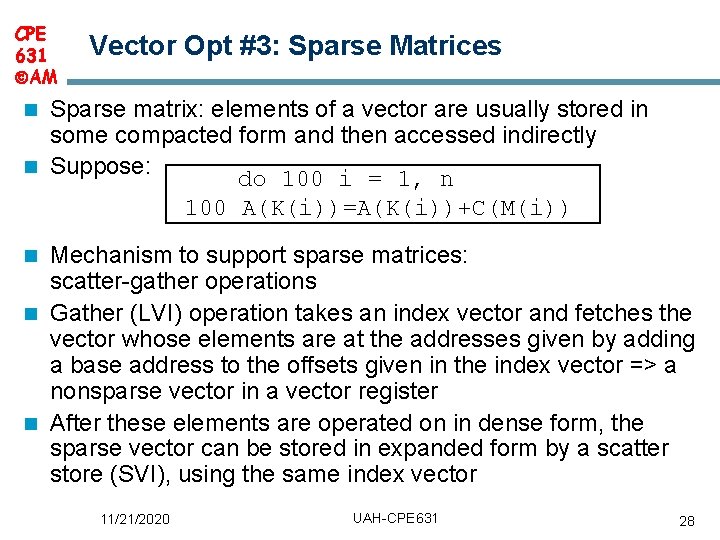
CPE 631 AM Vector Opt #3: Sparse Matrices Sparse matrix: elements of a vector are usually stored in some compacted form and then accessed indirectly n Suppose: do 100 i = 1, n n 100 A(K(i))=A(K(i))+C(M(i)) Mechanism to support sparse matrices: scatter gather operations n Gather (LVI) operation takes an index vector and fetches the vector whose elements are at the addresses given by adding a base address to the offsets given in the index vector => a nonsparse vector in a vector register n After these elements are operated on in dense form, the sparse vector can be stored in expanded form by a scatter store (SVI), using the same index vector n 11/21/2020 UAH CPE 631 28
CPE 631 AM Sparse Matrices Example do 100 i = 1, n 100 A(K(i))=A(K(i))+C(M(i)) LV Vk, Rk LVI Va, (Ra+Vk) LV Vm, Rm LVI Vc, (Rc+Vm) ADDV. D Va, Vc SVI (Ra+Vk), Va n ; ; ; load K load A(K(i)) load M load C(M(i)) add them store A(K(i)) Can't be done by compiler since can't know Ki elements distinct 11/21/2020 UAH CPE 631 29
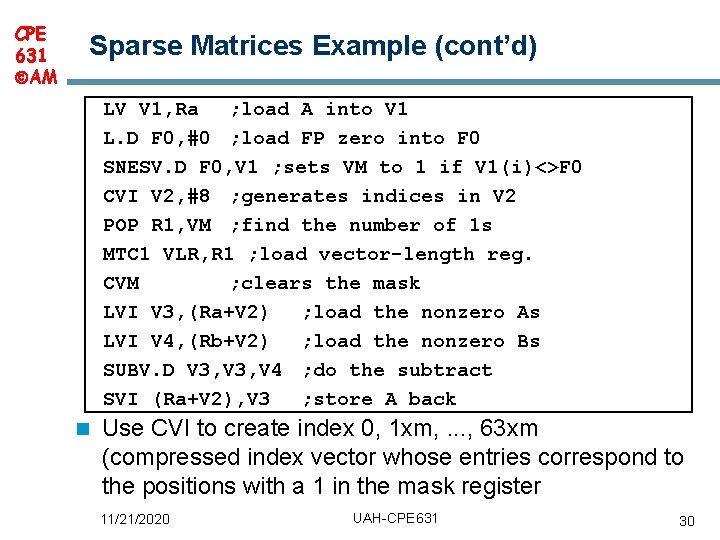
CPE 631 AM Sparse Matrices Example (cont’d) LV V 1, Ra ; load A into V 1 L. D F 0, #0 ; load FP zero into F 0 SNESV. D F 0, V 1 ; sets VM to 1 if V 1(i)<>F 0 CVI V 2, #8 ; generates indices in V 2 POP R 1, VM ; find the number of 1 s MTC 1 VLR, R 1 ; load vector-length reg. CVM ; clears the mask LVI V 3, (Ra+V 2) ; load the nonzero As LVI V 4, (Rb+V 2) ; load the nonzero Bs SUBV. D V 3, V 4 ; do the subtract SVI (Ra+V 2), V 3 ; store A back n Use CVI to create index 0, 1 xm, . . . , 63 xm (compressed index vector whose entries correspond to the positions with a 1 in the mask register 11/21/2020 UAH CPE 631 30
CPE 631 AM n Things to Remember Properties of vector processing – – Each result independent of previous result Vector instructions access memory with known pattern Reduces branches and branch problems in pipelines Single vector instruction implies lots of work ( loop) Components of a vector processor: vector registers, functional units, load/store, crossbar. . n Strip mining technique for long vectors n Optimisation techniques: chaining, conditional execution, sparse matrices n 11/21/2020 UAH CPE 631 31