
CPE 631 Lecture 02 Fundamentals of Computer Design



![An Example CPE 631 AM Plane DC to Paris [hour] Top Speed [mph] Passe](https://slidetodoc.com/presentation_image_h/0fe0bcbb20e490091f3526d0d7aec92d/image-8.jpg "An Example CPE 631 AM Plane DC to Paris [hour] Top Speed [mph] Passe")
- Slides: 35
CPE 631 Lecture 02: Fundamentals of Computer Design (part 2) Electrical and Computer Engineering University of Alabama in Huntsville UAH-CPE 631
Before we start CPE 631 AM “What is man in nature? Nothing in relation to the infinite, everything in relation to nothing, a mean between nothing and everything. ” Blaise Pascal, 1670 2/24/2021 UAH-CPE 631 2
Outline CPE 631 AM ® Review ® Measuring and Reporting Performance ® Quantitative Principles of Computer Design ® Things to Remember 2/24/2021 UAH-CPE 631 3
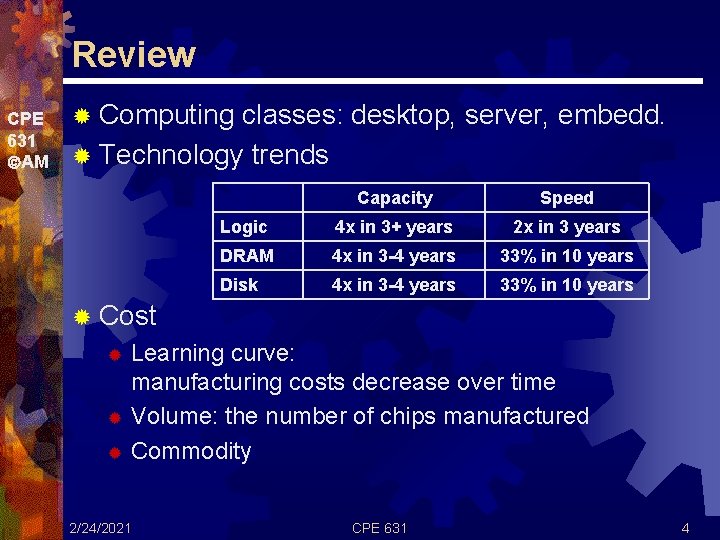
Review CPE 631 AM ® Computing classes: desktop, server, embedd. ® Technology trends Capacity Speed Logic 4 x in 3+ years 2 x in 3 years DRAM 4 x in 3 -4 years 33% in 10 years Disk 4 x in 3 -4 years 33% in 10 years ® Cost Learning curve: manufacturing costs decrease over time ® Volume: the number of chips manufactured ® Commodity ® 2/24/2021 CPE 631 4
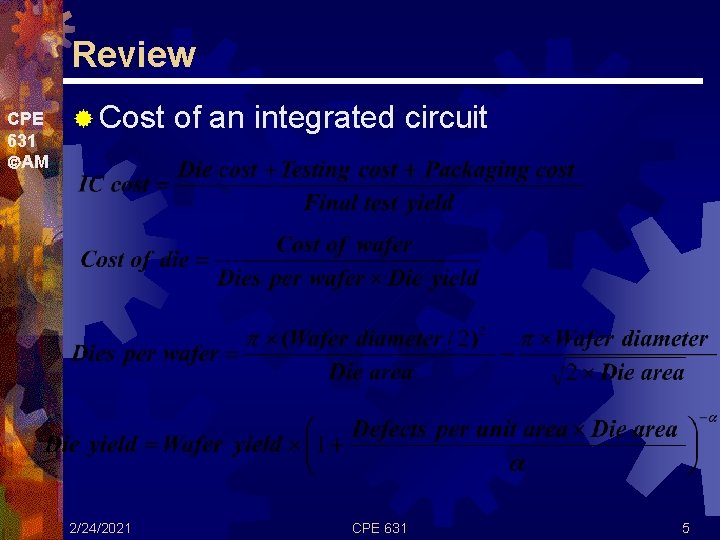
Review CPE 631 AM ® Cost 2/24/2021 of an integrated circuit CPE 631 5
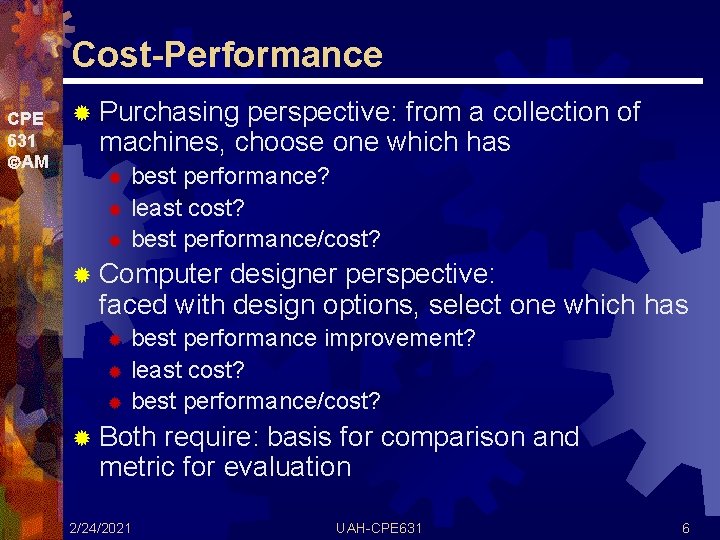
Cost-Performance CPE 631 AM ® Purchasing perspective: from a collection of machines, choose one which has best performance? ® least cost? ® best performance/cost? ® ® Computer designer perspective: faced with design options, select one which has best performance improvement? ® least cost? ® best performance/cost? ® ® Both require: basis for comparison and metric for evaluation 2/24/2021 UAH-CPE 631 6
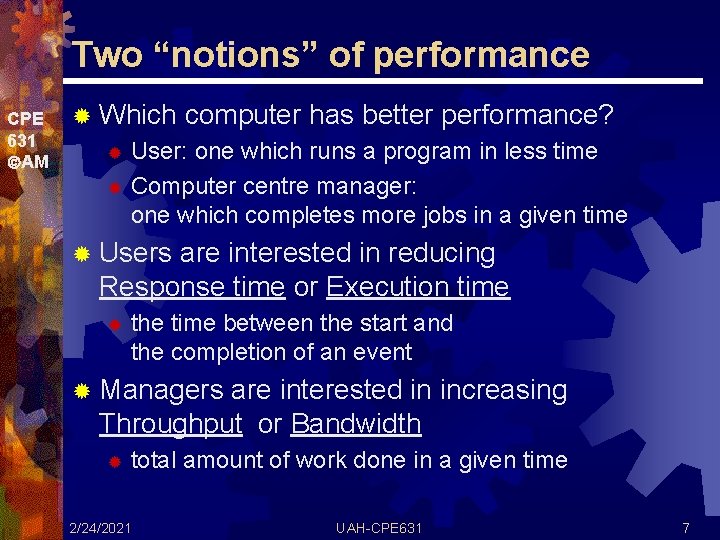
Two “notions” of performance CPE 631 AM ® Which computer has better performance? User: one which runs a program in less time ® Computer centre manager: one which completes more jobs in a given time ® ® Users are interested in reducing Response time or Execution time ® the time between the start and the completion of an event ® Managers are interested in increasing Throughput or Bandwidth ® total amount of work done in a given time 2/24/2021 UAH-CPE 631 7
An Example CPE 631 AM Plane DC to Paris [hour] Top Speed [mph] Passe -ngers Throughput [p/h] Boeing 747 6. 5 610 470 72 (=470/6. 5) Concorde 3 1350 132 44 (=132/3) ® Which ® Time ® 2/24/2021 to deliver 1 passenger? Concord is 6. 5/3 = 2. 2 times faster (120%) ® Time ® has higher performance? to deliver 400 passengers? Boeing is 72/44 = 1. 6 times faster (60%) UAH-CPE 631 8
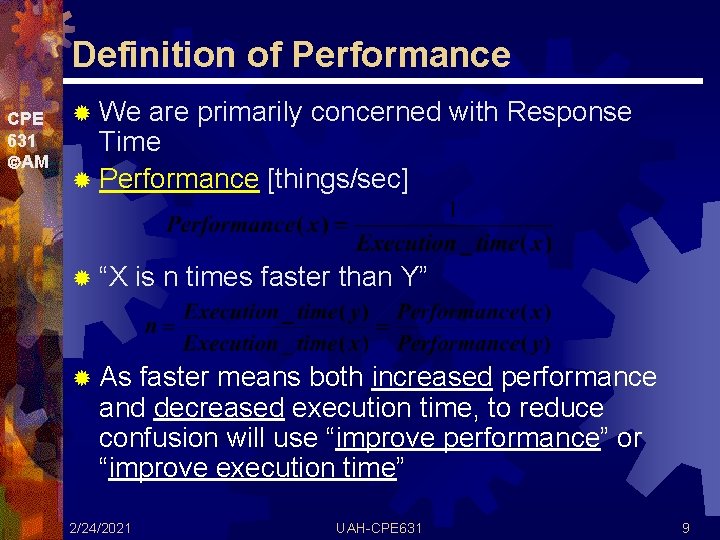
Definition of Performance CPE 631 AM ® We are primarily concerned with Response Time ® Performance [things/sec] ® “X is n times faster than Y” ® As faster means both increased performance and decreased execution time, to reduce confusion will use “improve performance” or “improve execution time” 2/24/2021 UAH-CPE 631 9
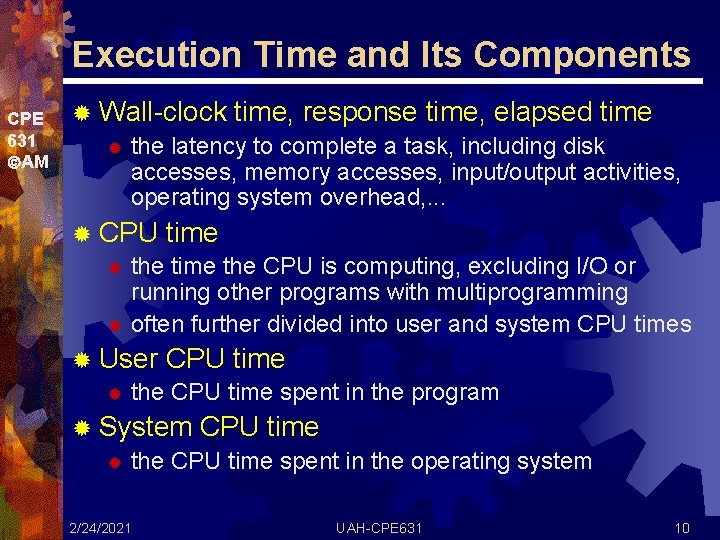
Execution Time and Its Components CPE 631 AM ® Wall-clock time, response time, elapsed time ® the latency to complete a task, including disk accesses, memory accesses, input/output activities, operating system overhead, . . . ® CPU time ® the time the CPU is computing, excluding I/O or running other programs with multiprogramming ® often further divided into user and system CPU times ® User CPU time ® the CPU time spent in the program ® System CPU time ® the CPU time spent in the operating system 2/24/2021 UAH-CPE 631 10
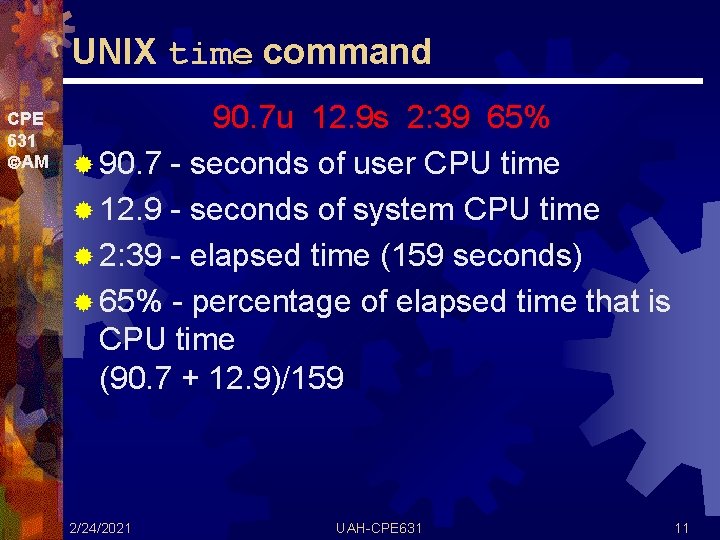
UNIX time command CPE 631 AM 90. 7 u 12. 9 s 2: 39 65% ® 90. 7 - seconds of user CPU time ® 12. 9 - seconds of system CPU time ® 2: 39 - elapsed time (159 seconds) ® 65% - percentage of elapsed time that is CPU time (90. 7 + 12. 9)/159 2/24/2021 UAH-CPE 631 11
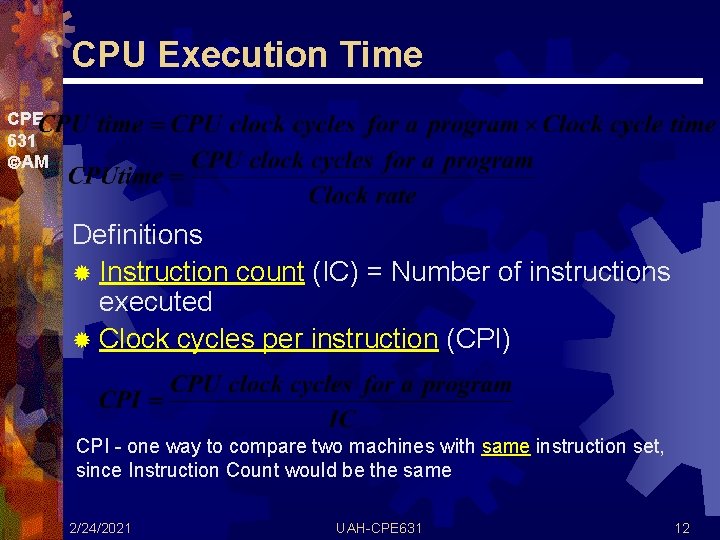
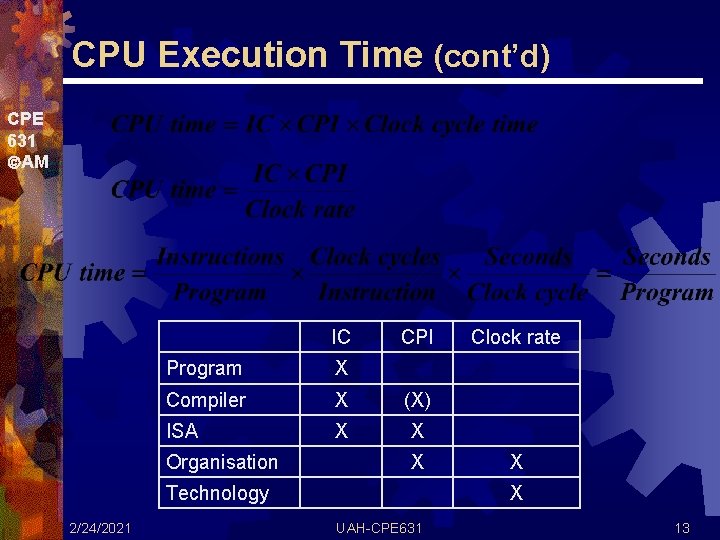
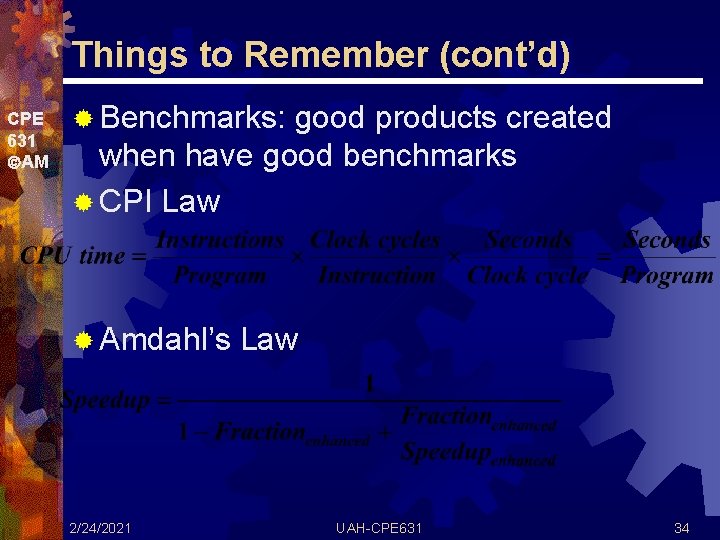
CPU Execution Time CPE 631 AM Definitions ® Instruction count (IC) = Number of instructions executed ® Clock cycles per instruction (CPI) CPI - one way to compare two machines with same instruction set, since Instruction Count would be the same 2/24/2021 UAH-CPE 631 12
CPU Execution Time (cont’d) CPE 631 AM IC CPI Program X Compiler X (X) ISA X X Organisation X Technology 2/24/2021 Clock rate X X UAH-CPE 631 13
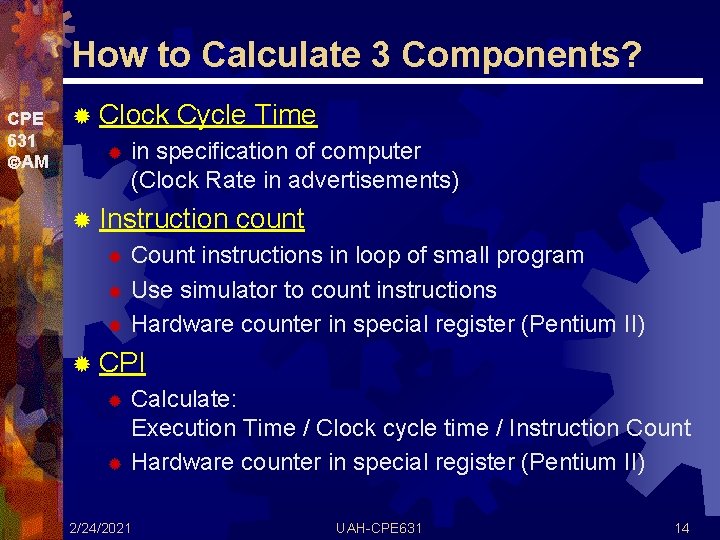
How to Calculate 3 Components? CPE 631 AM ® Clock ® Cycle Time in specification of computer (Clock Rate in advertisements) ® Instruction count Count instructions in loop of small program ® Use simulator to count instructions ® Hardware counter in special register (Pentium II) ® ® CPI Calculate: Execution Time / Clock cycle time / Instruction Count ® Hardware counter in special register (Pentium II) ® 2/24/2021 UAH-CPE 631 14
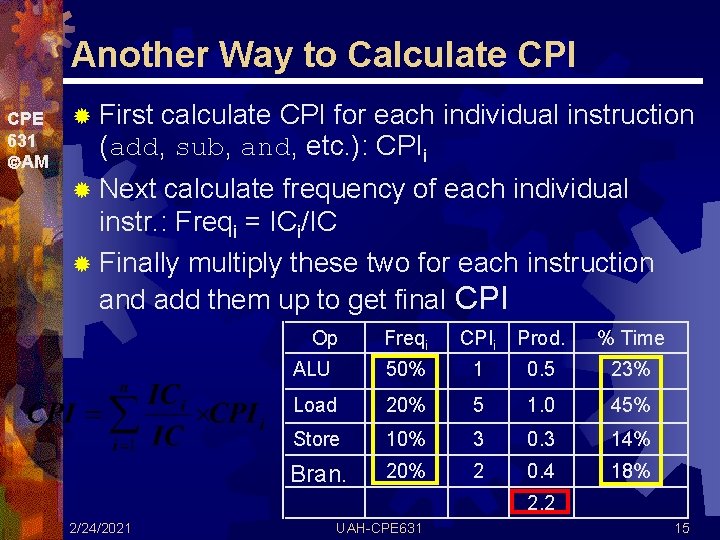
Another Way to Calculate CPI CPE 631 AM ® First calculate CPI for each individual instruction (add, sub, and, etc. ): CPIi ® Next calculate frequency of each individual instr. : Freqi = ICi/IC ® Finally multiply these two for each instruction and add them up to get final CPI Op Freqi CPIi Prod. % Time ALU 50% 1 0. 5 23% Load 20% 5 1. 0 45% Store 10% 3 0. 3 14% Bran. 20% 2 0. 4 18% 2. 2 2/24/2021 UAH-CPE 631 15
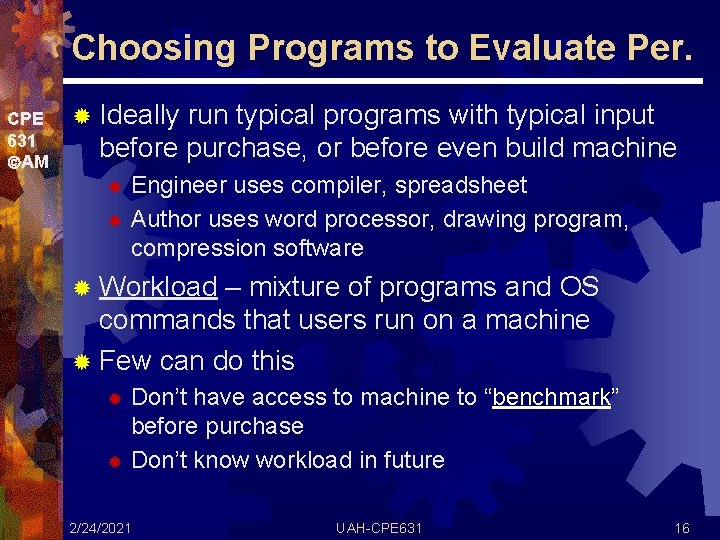
Choosing Programs to Evaluate Per. CPE 631 AM ® Ideally run typical programs with typical input before purchase, or before even build machine Engineer uses compiler, spreadsheet ® Author uses word processor, drawing program, compression software ® ® Workload – mixture of programs and OS commands that users run on a machine ® Few can do this Don’t have access to machine to “benchmark” before purchase ® Don’t know workload in future ® 2/24/2021 UAH-CPE 631 16
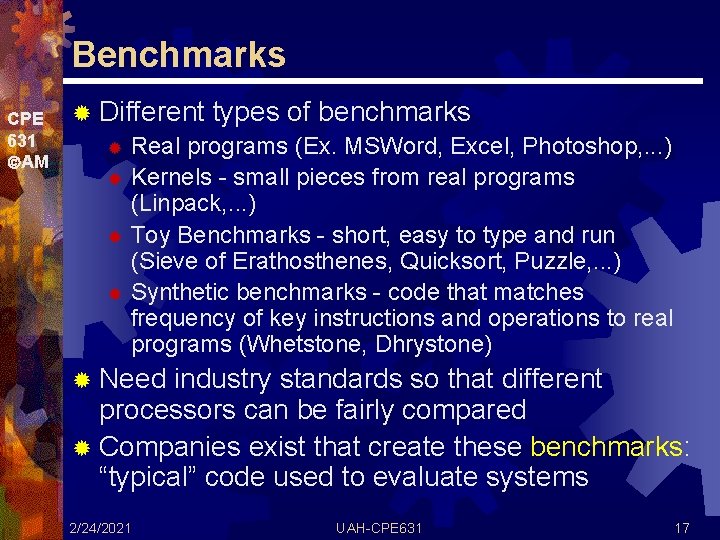
Benchmarks CPE 631 AM ® Different types of benchmarks ® Real programs (Ex. MSWord, Excel, Photoshop, . . . ) ® Kernels - small pieces from real programs (Linpack, . . . ) ® Toy Benchmarks - short, easy to type and run (Sieve of Erathosthenes, Quicksort, Puzzle, . . . ) ® Synthetic benchmarks - code that matches frequency of key instructions and operations to real programs (Whetstone, Dhrystone) ® Need industry standards so that different processors can be fairly compared ® Companies exist that create these benchmarks: “typical” code used to evaluate systems 2/24/2021 UAH-CPE 631 17
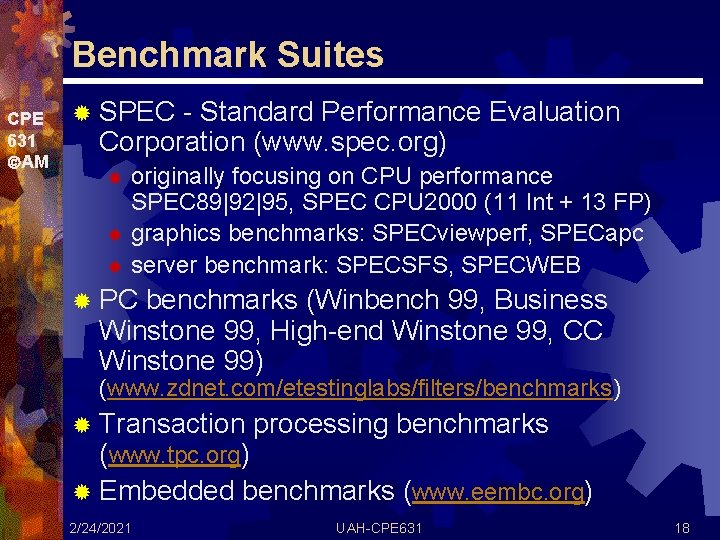
Benchmark Suites CPE 631 AM ® SPEC - Standard Performance Evaluation Corporation (www. spec. org) originally focusing on CPU performance SPEC 89|92|95, SPEC CPU 2000 (11 Int + 13 FP) ® graphics benchmarks: SPECviewperf, SPECapc ® server benchmark: SPECSFS, SPECWEB ® ® PC benchmarks (Winbench 99, Business Winstone 99, High-end Winstone 99, CC Winstone 99) (www. zdnet. com/etestinglabs/filters/benchmarks) ® Transaction processing (www. tpc. org) ® Embedded 2/24/2021 benchmarks (www. eembc. org) UAH-CPE 631 18
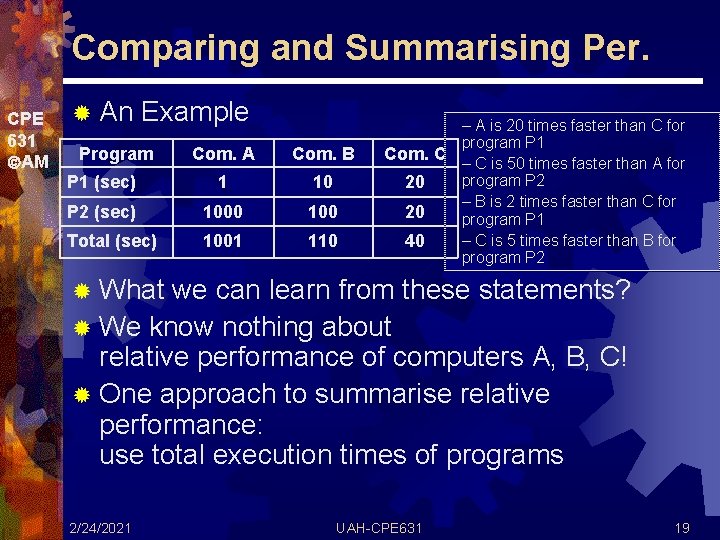
Comparing and Summarising Per. CPE 631 AM ® An Example Program Com. A Com. B P 1 (sec) 1 10 P 2 (sec) 1000 100 Total (sec) 1001 110 – A is 20 times faster than C for program P 1 Com. C – C is 50 times faster than A for program P 2 20 – B is 2 times faster than C for 20 program P 1 – C is 5 times faster than B for 40 program P 2 ® What we can learn from these statements? ® We know nothing about relative performance of computers A, B, C! ® One approach to summarise relative performance: use total execution times of programs 2/24/2021 UAH-CPE 631 19
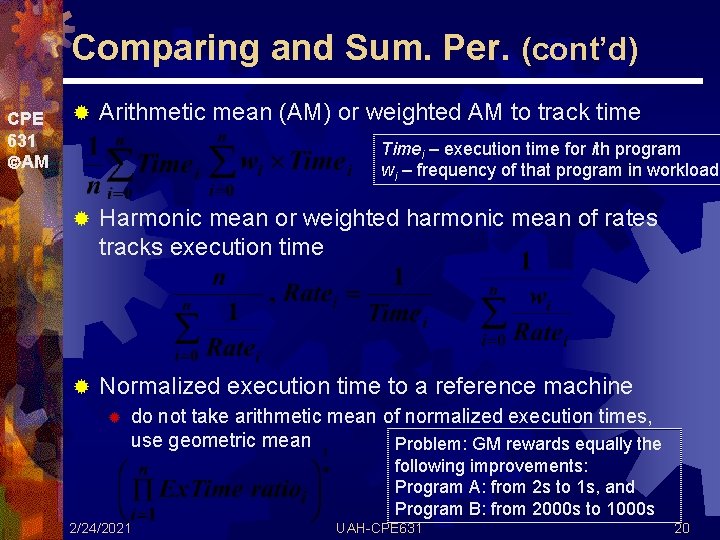
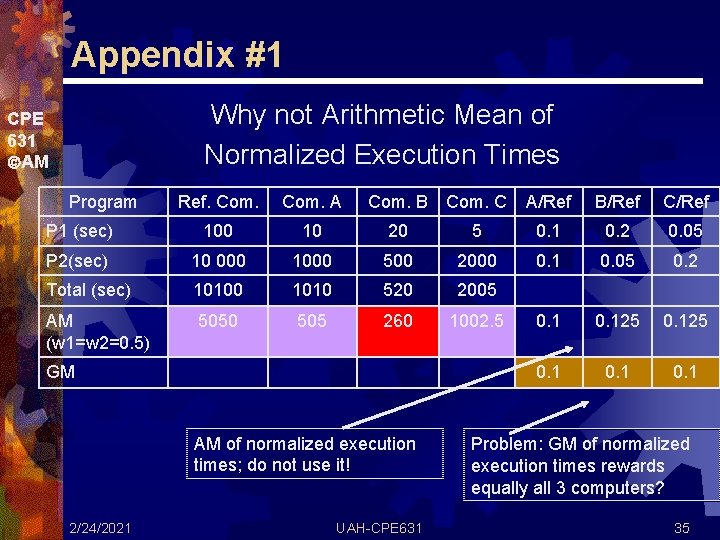
Comparing and Sum. Per. (cont’d) CPE 631 AM ® Arithmetic mean (AM) or weighted AM to track time Timei – execution time for ith program wi – frequency of that program in workload ® Harmonic mean or weighted harmonic mean of rates tracks execution time ® Normalized execution time to a reference machine ® do not take arithmetic mean of normalized execution times, use geometric mean Problem: GM rewards equally the following improvements: Program A: from 2 s to 1 s, and Program B: from 2000 s to 1000 s 2/24/2021 UAH-CPE 631 20
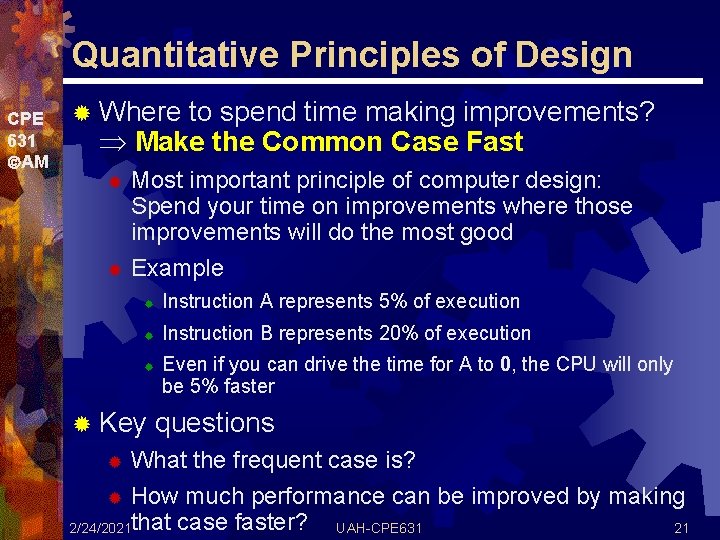
Quantitative Principles of Design CPE 631 AM ® Where to spend time making improvements? Make the Common Case Fast Most important principle of computer design: Spend your time on improvements where those improvements will do the most good ® Example ® ® Instruction A represents 5% of execution ® Instruction B represents 20% of execution ® ® Key Even if you can drive the time for A to 0, the CPU will only be 5% faster questions What the frequent case is? ® How much performance can be improved by making 2/24/2021 that case faster? UAH-CPE 631 21 ®
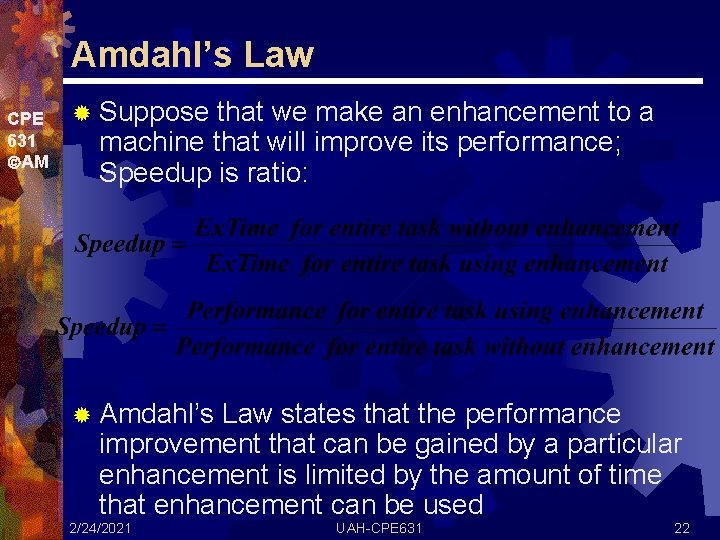
Amdahl’s Law CPE 631 AM ® Suppose that we make an enhancement to a machine that will improve its performance; Speedup is ratio: ® Amdahl’s Law states that the performance improvement that can be gained by a particular enhancement is limited by the amount of time that enhancement can be used 2/24/2021 UAH-CPE 631 22
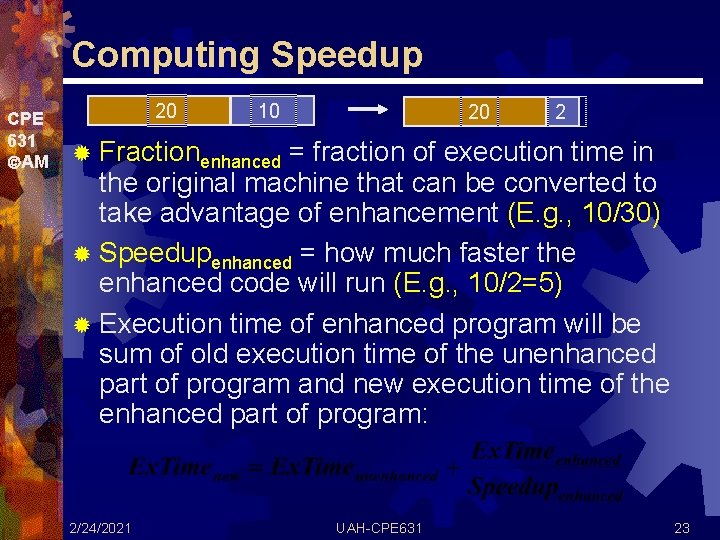
Computing Speedup CPE 631 AM 20 10 20 2 ® Fractionenhanced = fraction of execution time in the original machine that can be converted to take advantage of enhancement (E. g. , 10/30) ® Speedupenhanced = how much faster the enhanced code will run (E. g. , 10/2=5) ® Execution time of enhanced program will be sum of old execution time of the unenhanced part of program and new execution time of the enhanced part of program: 2/24/2021 UAH-CPE 631 23
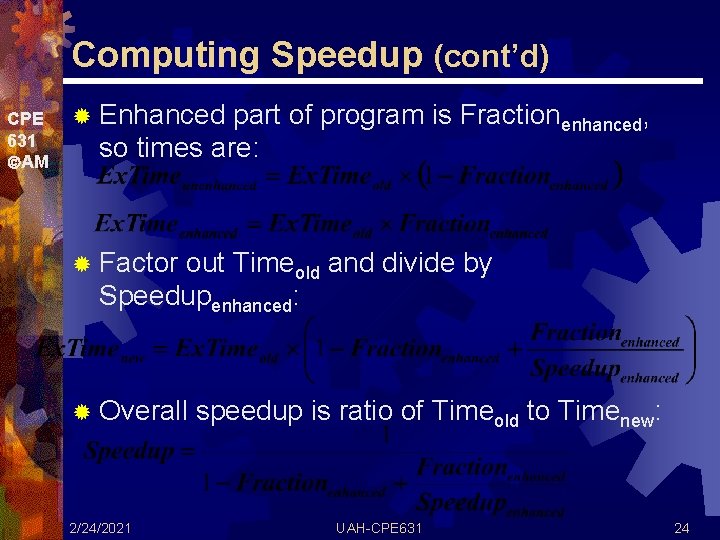
Computing Speedup (cont’d) CPE 631 AM ® Enhanced part of program is Fractionenhanced, so times are: ® Factor out Timeold and divide by Speedupenhanced: ® Overall 2/24/2021 speedup is ratio of Timeold to Timenew: UAH-CPE 631 24
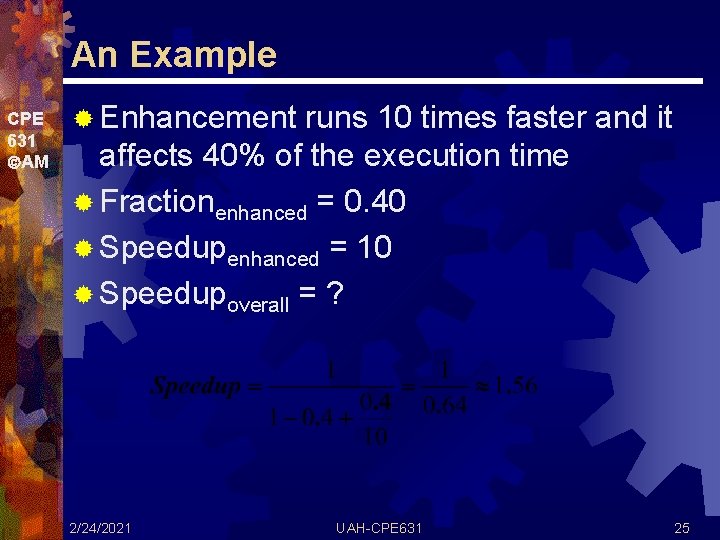
An Example CPE 631 AM ® Enhancement runs 10 times faster and it affects 40% of the execution time ® Fractionenhanced = 0. 40 ® Speedupenhanced = 10 ® Speedupoverall = ? 2/24/2021 UAH-CPE 631 25
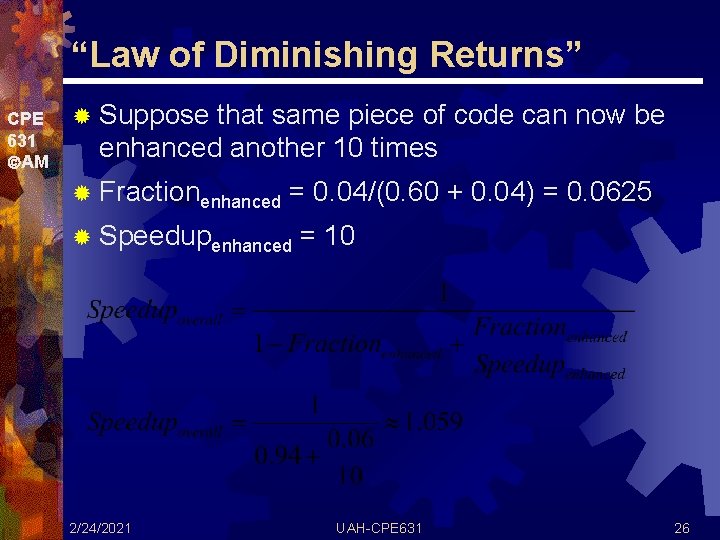
“Law of Diminishing Returns” CPE 631 AM ® Suppose that same piece of code can now be enhanced another 10 times ® Fractionenhanced = 0. 04/(0. 60 + 0. 04) = 0. 0625 ® Speedupenhanced 2/24/2021 = 10 UAH-CPE 631 26
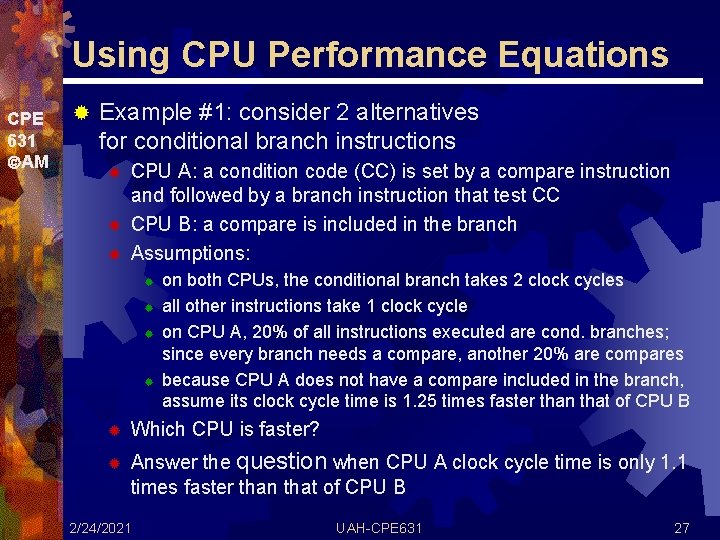
Using CPU Performance Equations CPE 631 AM ® Example #1: consider 2 alternatives for conditional branch instructions ® ® ® CPU A: a condition code (CC) is set by a compare instruction and followed by a branch instruction that test CC CPU B: a compare is included in the branch Assumptions: ® ® ® on both CPUs, the conditional branch takes 2 clock cycles all other instructions take 1 clock cycle on CPU A, 20% of all instructions executed are cond. branches; since every branch needs a compare, another 20% are compares because CPU A does not have a compare included in the branch, assume its clock cycle time is 1. 25 times faster than that of CPU B Which CPU is faster? Answer the question when CPU A clock cycle time is only 1. 1 times faster than that of CPU B 2/24/2021 UAH-CPE 631 27
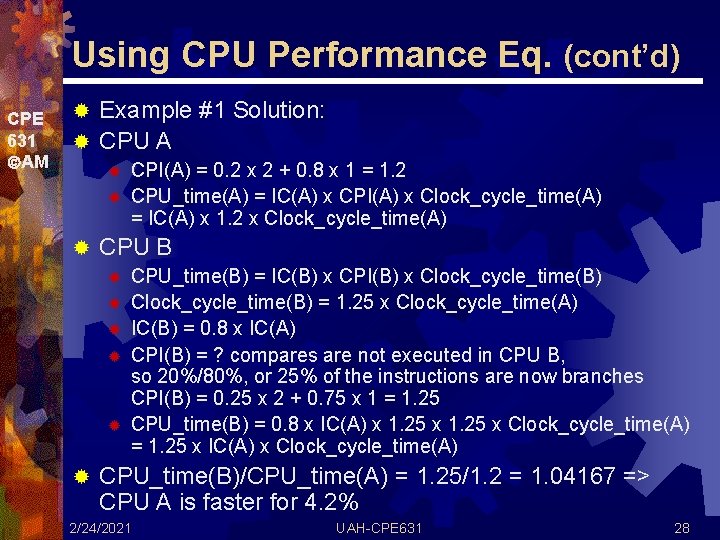
Using CPU Performance Eq. (cont’d) CPE 631 AM Example #1 Solution: ® CPU A ® ® CPU B ® ® ® CPI(A) = 0. 2 x 2 + 0. 8 x 1 = 1. 2 CPU_time(A) = IC(A) x CPI(A) x Clock_cycle_time(A) = IC(A) x 1. 2 x Clock_cycle_time(A) CPU_time(B) = IC(B) x CPI(B) x Clock_cycle_time(B) = 1. 25 x Clock_cycle_time(A) IC(B) = 0. 8 x IC(A) CPI(B) = ? compares are not executed in CPU B, so 20%/80%, or 25% of the instructions are now branches CPI(B) = 0. 25 x 2 + 0. 75 x 1 = 1. 25 CPU_time(B) = 0. 8 x IC(A) x 1. 25 x Clock_cycle_time(A) = 1. 25 x IC(A) x Clock_cycle_time(A) CPU_time(B)/CPU_time(A) = 1. 25/1. 2 = 1. 04167 => CPU A is faster for 4. 2% 2/24/2021 UAH-CPE 631 28
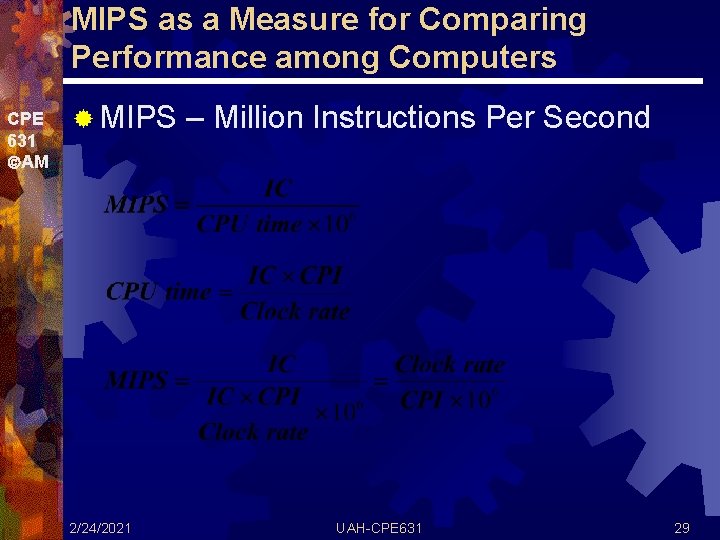
MIPS as a Measure for Comparing Performance among Computers CPE 631 AM ® MIPS 2/24/2021 – Million Instructions Per Second UAH-CPE 631 29
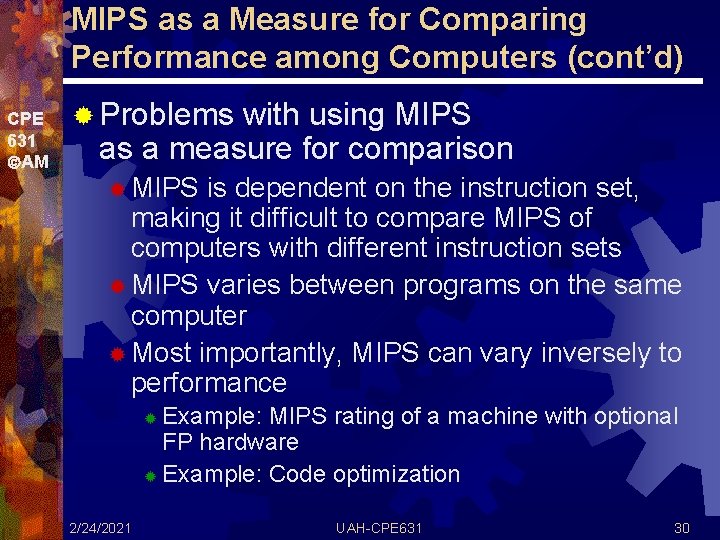
MIPS as a Measure for Comparing Performance among Computers (cont’d) CPE 631 AM ® Problems with using MIPS as a measure for comparison ® MIPS is dependent on the instruction set, making it difficult to compare MIPS of computers with different instruction sets ® MIPS varies between programs on the same computer ® Most importantly, MIPS can vary inversely to performance Example: MIPS rating of a machine with optional FP hardware ® Example: Code optimization ® 2/24/2021 UAH-CPE 631 30
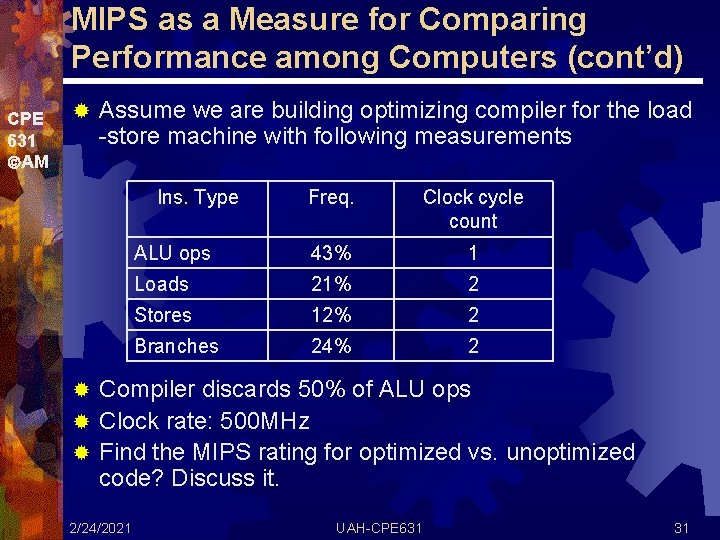
MIPS as a Measure for Comparing Performance among Computers (cont’d) CPE 631 AM ® Assume we are building optimizing compiler for the load -store machine with following measurements Ins. Type Freq. Clock cycle count ALU ops 43% 1 Loads 21% 2 Stores 12% 2 Branches 24% 2 Compiler discards 50% of ALU ops ® Clock rate: 500 MHz ® Find the MIPS rating for optimized vs. unoptimized code? Discuss it. ® 2/24/2021 UAH-CPE 631 31
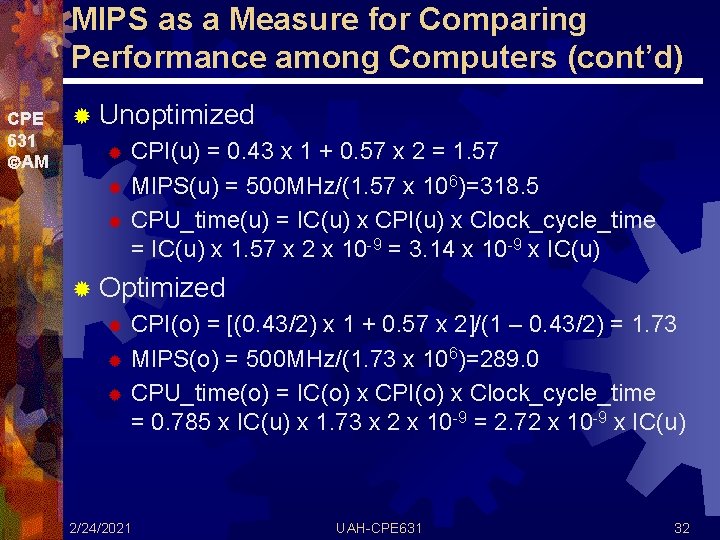
MIPS as a Measure for Comparing Performance among Computers (cont’d) CPE 631 AM ® Unoptimized CPI(u) = 0. 43 x 1 + 0. 57 x 2 = 1. 57 ® MIPS(u) = 500 MHz/(1. 57 x 106)=318. 5 ® CPU_time(u) = IC(u) x CPI(u) x Clock_cycle_time = IC(u) x 1. 57 x 2 x 10 -9 = 3. 14 x 10 -9 x IC(u) ® ® Optimized CPI(o) = [(0. 43/2) x 1 + 0. 57 x 2]/(1 – 0. 43/2) = 1. 73 ® MIPS(o) = 500 MHz/(1. 73 x 106)=289. 0 ® CPU_time(o) = IC(o) x CPI(o) x Clock_cycle_time = 0. 785 x IC(u) x 1. 73 x 2 x 10 -9 = 2. 72 x 10 -9 x IC(u) ® 2/24/2021 UAH-CPE 631 32
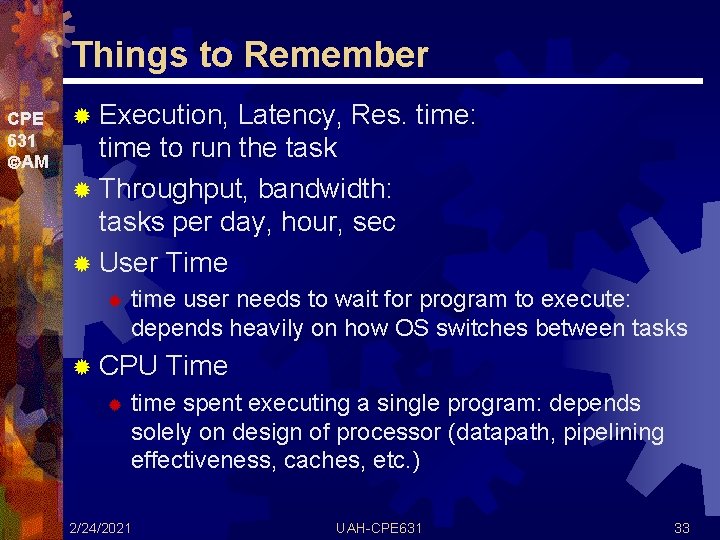
Things to Remember CPE 631 AM ® Execution, Latency, Res. time: time to run the task ® Throughput, bandwidth: tasks per day, hour, sec ® User Time ® time user needs to wait for program to execute: depends heavily on how OS switches between tasks ® CPU ® Time time spent executing a single program: depends solely on design of processor (datapath, pipelining effectiveness, caches, etc. ) 2/24/2021 UAH-CPE 631 33
Things to Remember (cont’d) CPE 631 AM ® Benchmarks: good products created when have good benchmarks ® CPI Law ® Amdahl’s 2/24/2021 Law UAH-CPE 631 34
Appendix #1 Why not Arithmetic Mean of Normalized Execution Times CPE 631 AM Program Ref. Com. A Com. B Com. C A/Ref B/Ref C/Ref P 1 (sec) 100 10 20 5 0. 1 0. 2 0. 05 P 2(sec) 10 000 1000 500 2000 0. 1 0. 05 0. 2 Total (sec) 10100 1010 520 2005 AM (w 1=w 2=0. 5) 5050 505 260 1002. 5 0. 125 0. 1 GM AM of normalized execution times; do not use it! 2/24/2021 UAH-CPE 631 Problem: GM of normalized execution times rewards equally all 3 computers? 35