
CPDLC Build 1 A and CPDLC Benefits ATN
CPDLC Build 1 A and CPDLC Benefits ATN 2002 London, England September 24, 2002 Timothy R. Hancock CPDLC Operations Lead FAA Free Flight Program Office
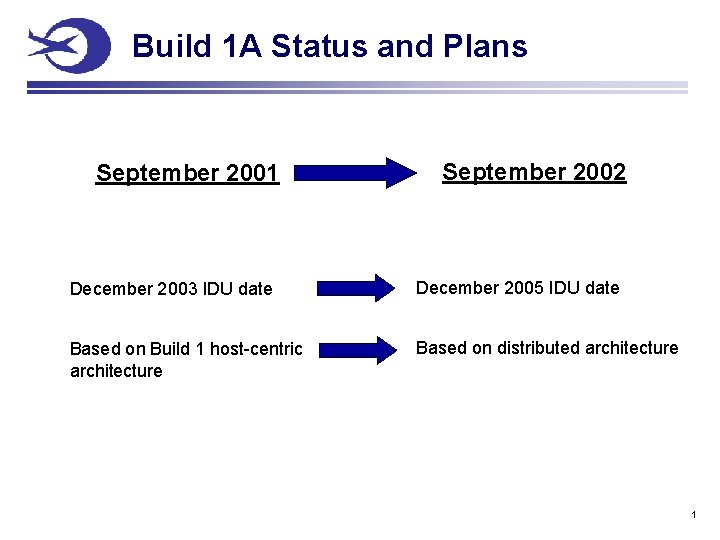
Build 1 A Status and Plans September 2001 September 2002 December 2003 IDU date December 2005 IDU date Based on Build 1 host-centric architecture Based on distributed architecture 1
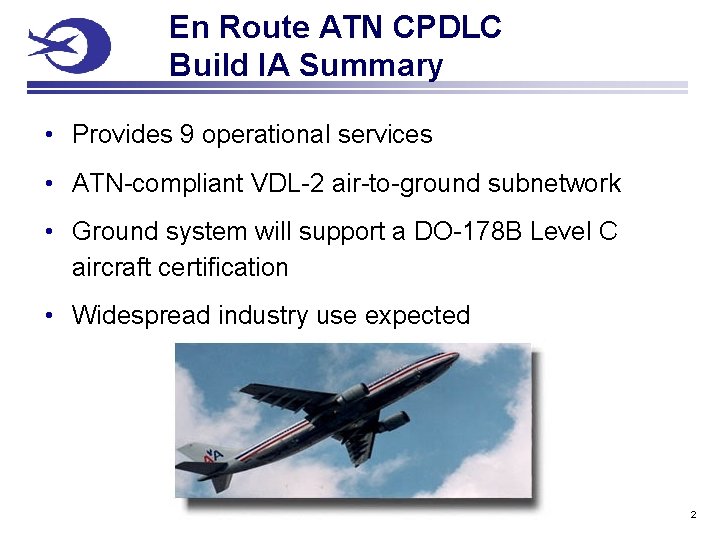
En Route ATN CPDLC Build IA Summary • Provides 9 operational services • ATN-compliant VDL-2 air-to-ground subnetwork • Ground system will support a DO-178 B Level C aircraft certification • Widespread industry use expected 2
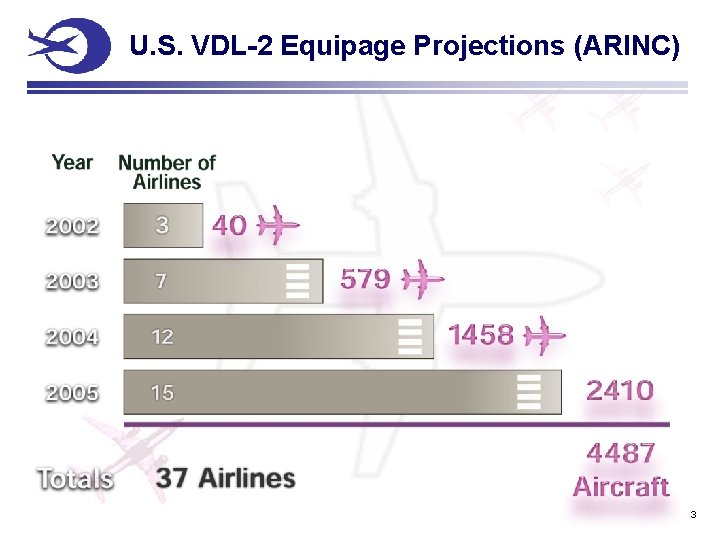
U. S. VDL-2 Equipage Projections (ARINC) 3
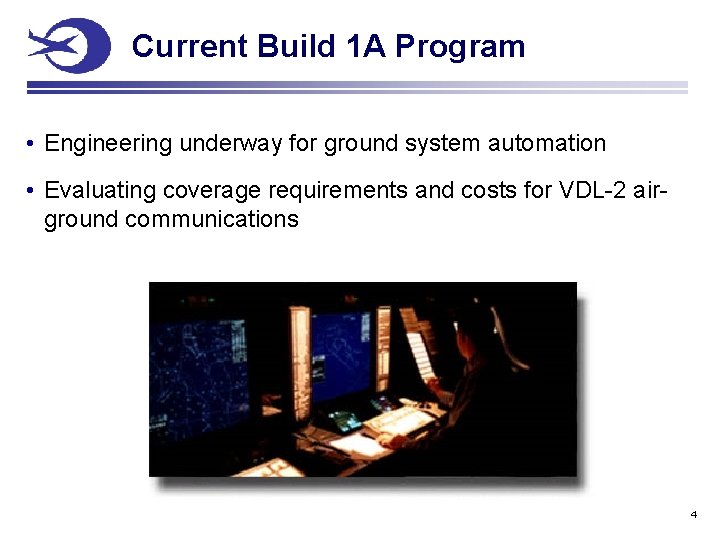
Current Build 1 A Program • Engineering underway for ground system automation • Evaluating coverage requirements and costs for VDL-2 airground communications 4
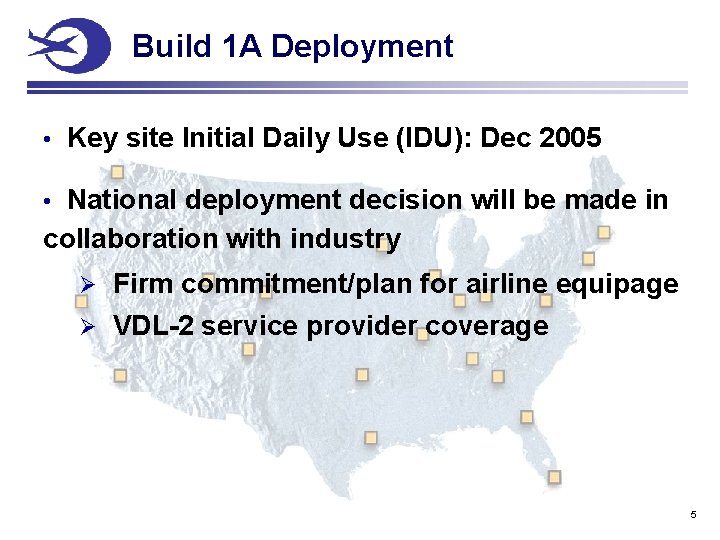
Build 1 A Deployment • Key site Initial Daily Use (IDU): Dec 2005 National deployment decision will be made in collaboration with industry • Firm commitment/plan for airline equipage Ø VDL-2 service provider coverage Ø 5
Build 1 Operational Services • Transfer of Communication (TOC) – service to direct the pilot to change the assigned voice radio frequency. The TOC message may be automatically or manually initiated as selected at the controlling air traffic sector. • Initial Contact (IC) – service to support the pilot “check-in” procedure with the next air traffic sector. The IC service verifies the assigned altitude and provides an indication to the controller if a mismatch is detected. • Altimeter Setting (AS) – service that will support an automatic and manual means for uplinking altimeter setting data to an aircraft. The altimeter setting will be automatically, or manually, uplinked to an aircraft based on the aircraft’s altitude and position. • Menu Text (MT) – service that will permit the controller to uplink a predefined set of messages to pilots. The MT will permit the controller to direct a message either to one aircraft or to all aircraft with which the controller is communicating via CPDLC services. 6
Build 1 A Operational Services • Assigned Altitude (AA) – service that is manually initiated that allows the controller to uplink a message directing the pilot to either maintain, climb to, or descend to a specified level. • Speed (SP) – service that is manually initiated that allows the controller to uplink a message directing the pilot to either maintain, increase to, or decrease to a specified speed. • Heading (HD) – service that is manually initiated that allows the controller to uplink a message directing the pilot to fly a specified heading. • Route Clearance (RC) – service that is manually initiated that allows the controller to uplink a message directing the pilot to proceed via a specified routing to a specified position and a message to proceed ‘direct’ to a position. • Pilot Downlinks (PD) – service that supports downlinks of pilotinitiated altitude requests. 7
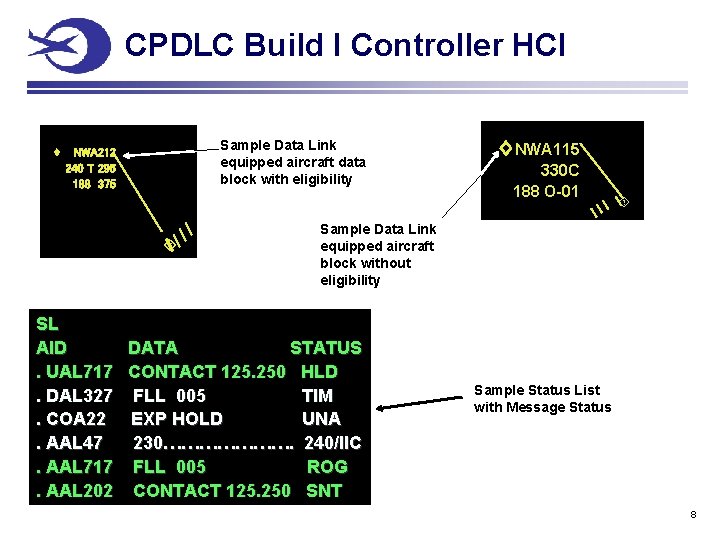
CPDLC Build I Controller HCI Sample Data Link equipped aircraft data block with eligibility NWA 212 240 T 295 188 375 NWA 115 330 C 188 O-01 Sample Data Link equipped aircraft block without eligibility SL AID DATA STATUS. UAL 717 CONTACT 125. 250 HLD. DAL 327 FLL 005 TIM. COA 22 EXP HOLD UNA. AAL 47 230…………………. 240/IIC. AAL 717 FLL 005 ROG. AAL 202 CONTACT 125. 250 SNT Sample Status List with Message Status 8
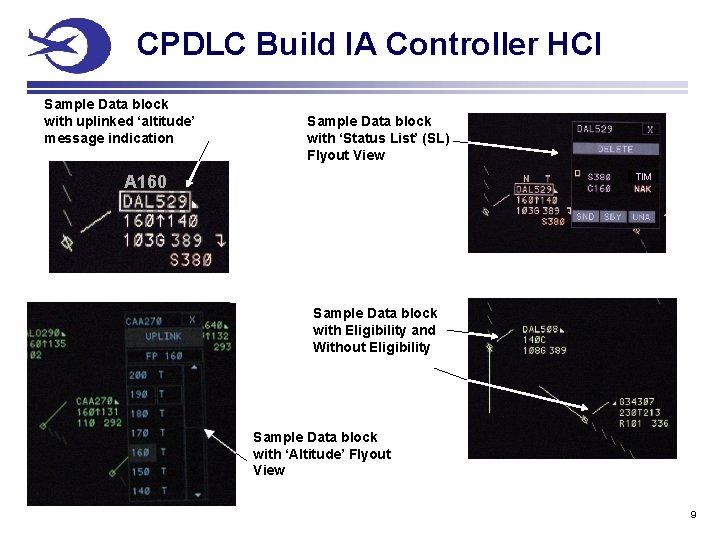
CPDLC Build IA Controller HCI Sample Data block with uplinked ‘altitude’ message indication Sample Data block with ‘Status List’ (SL) Flyout View TIM A 160 Sample Data block with Eligibility and Without Eligibility Sample Data block with ‘Altitude’ Flyout View 9
Why CPDLC Build 1 A? • Delays and congestion are still a problem Ø Voice congestion reduces capacity and increases delay • Communication errors still a problem Ø Over 25% of US operational errors related to communications* • ICAO, RTCA, FAA concepts of operations for the future require data link 1. CPDLC’s ATN implementation plus FAA’s Next Generation Air/Ground Communication (NEXCOM) provide the infrastructure *FAA 1998 -1999 data 10
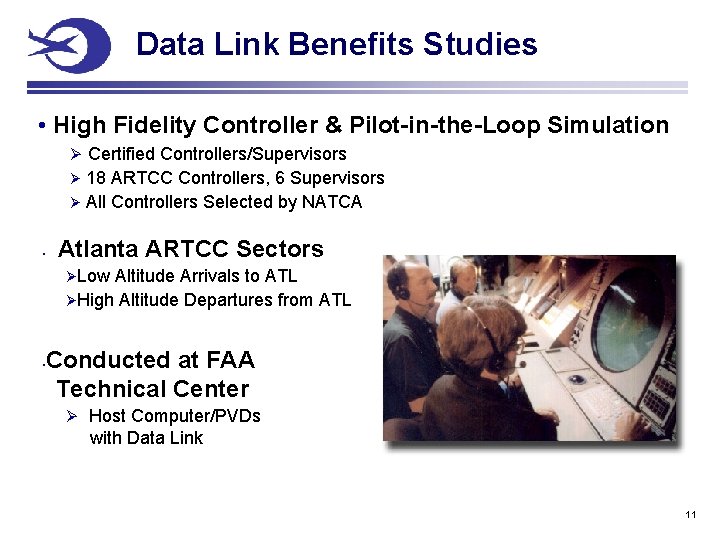
Data Link Benefits Studies • High Fidelity Controller & Pilot-in-the-Loop Simulation Ø Certified Controllers/Supervisors 18 ARTCC Controllers, 6 Supervisors Ø All Controllers Selected by NATCA Ø Atlanta ARTCC Sectors • ØLow Altitude Arrivals to ATL ØHigh Altitude Departures from ATL Conducted at FAA Technical Center • Ø Host Computer/PVDs with Data Link 11
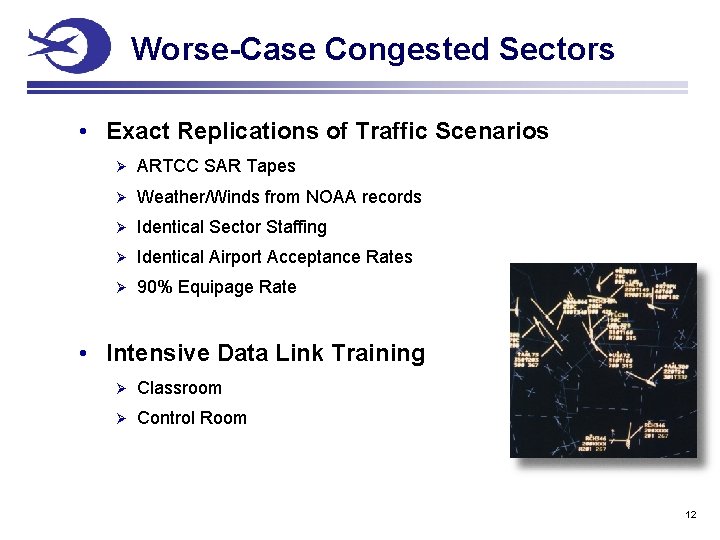
Worse-Case Congested Sectors • Exact Replications of Traffic Scenarios Ø ARTCC SAR Tapes Ø Weather/Winds from NOAA records Ø Identical Sector Staffing Ø Identical Airport Acceptance Rates Ø 90% Equipage Rate • Intensive Data Link Training Ø Classroom Ø Control Room 12
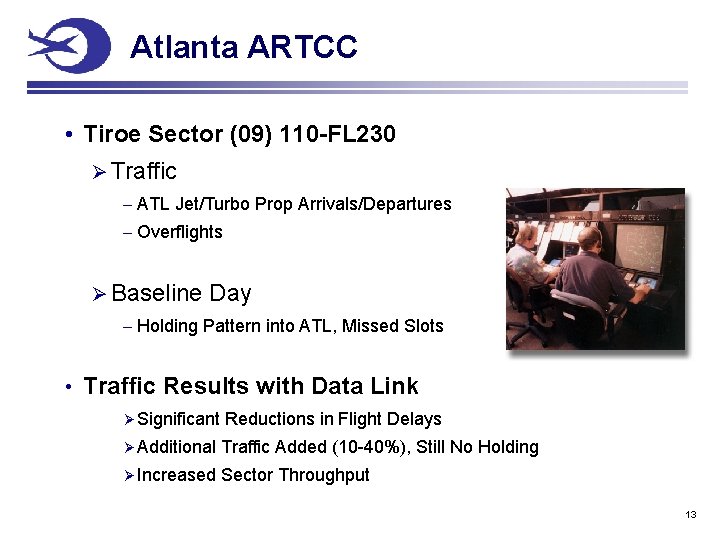
Atlanta ARTCC • Tiroe Sector (09) 110 -FL 230 Ø Traffic – ATL Jet/Turbo Prop Arrivals/Departures – Overflights Ø Baseline Day – Holding Pattern into ATL, Missed Slots • Traffic Results with Data Link Ø Significant Reductions in Flight Delays Ø Additional Traffic Added (10 -40%), Still No Holding Ø Increased Sector Throughput 13
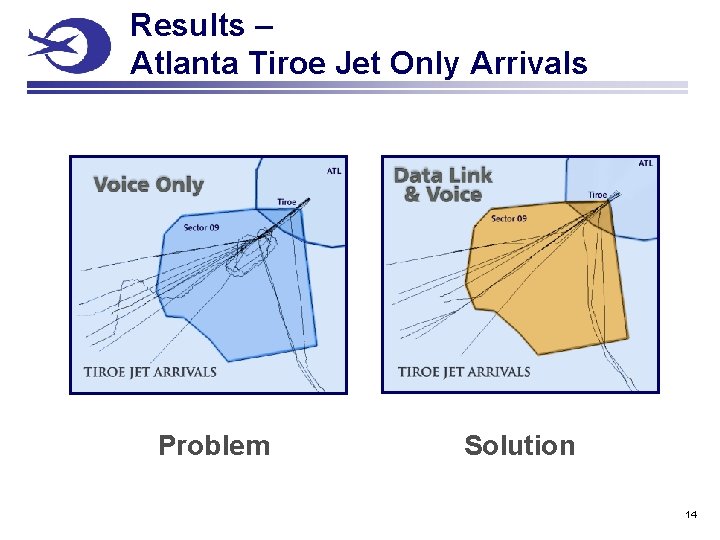
Results – Atlanta Tiroe Jet Only Arrivals Problem Solution 14
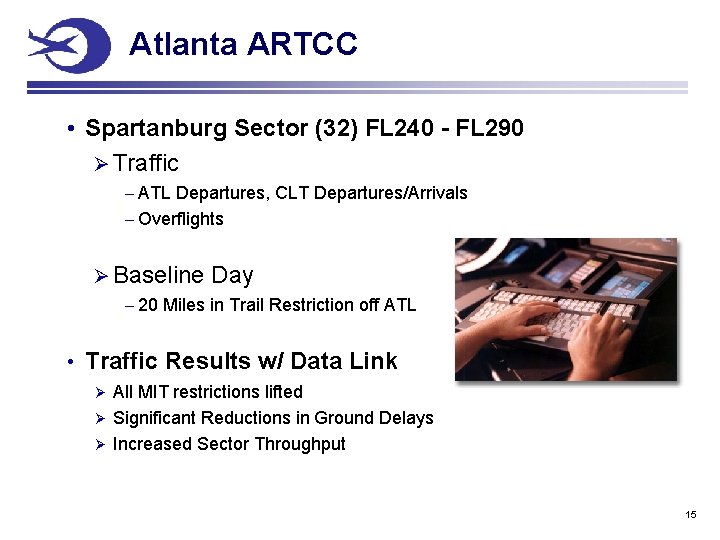
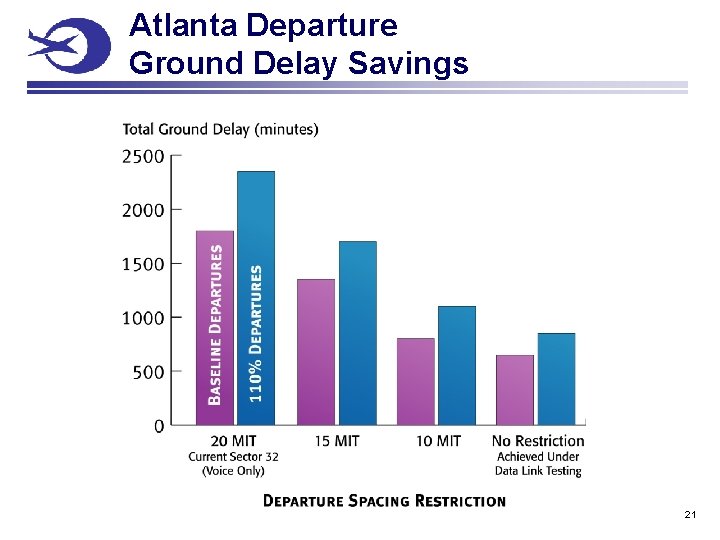
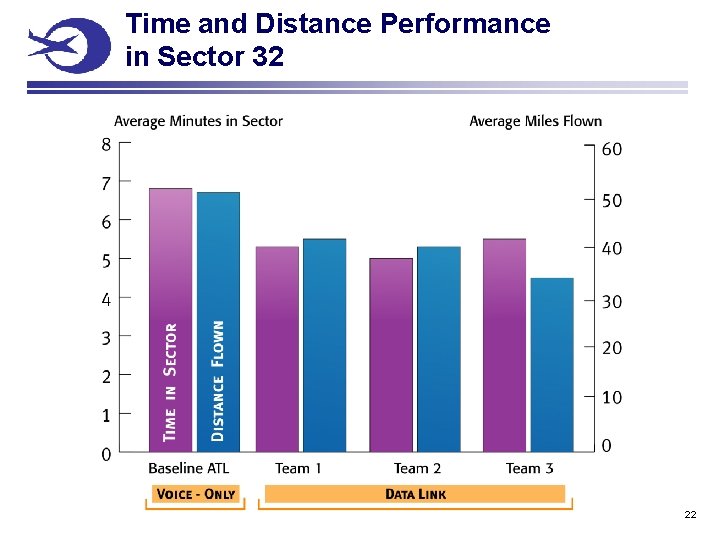
Atlanta ARTCC • Spartanburg Sector (32) FL 240 - FL 290 Ø Traffic – ATL Departures, CLT Departures/Arrivals – Overflights Ø Baseline Day – 20 Miles in Trail Restriction off ATL • Traffic Results w/ Data Link All MIT restrictions lifted Ø Significant Reductions in Ground Delays Ø Increased Sector Throughput Ø 15
16
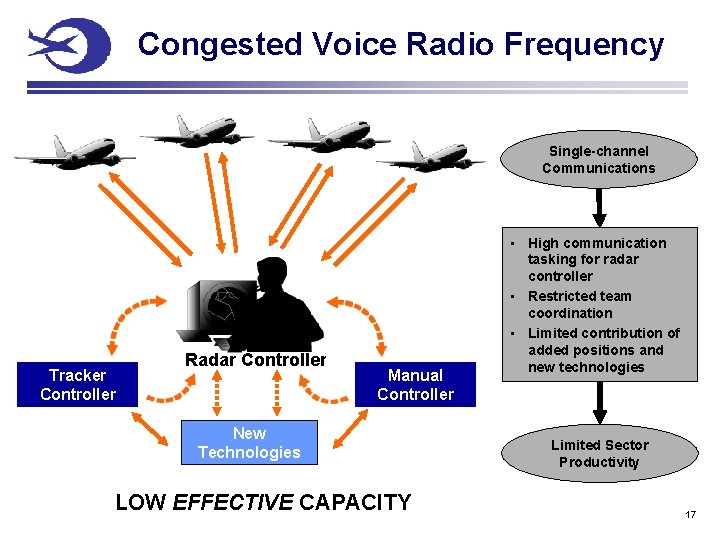
Congested Voice Radio Frequency Single-channel Communications Tracker Controller Radar Controller Manual Controller New Technologies LOW EFFECTIVE CAPACITY • High communication tasking for radar controller • Restricted team coordination • Limited contribution of added positions and new technologies Limited Sector Productivity 17
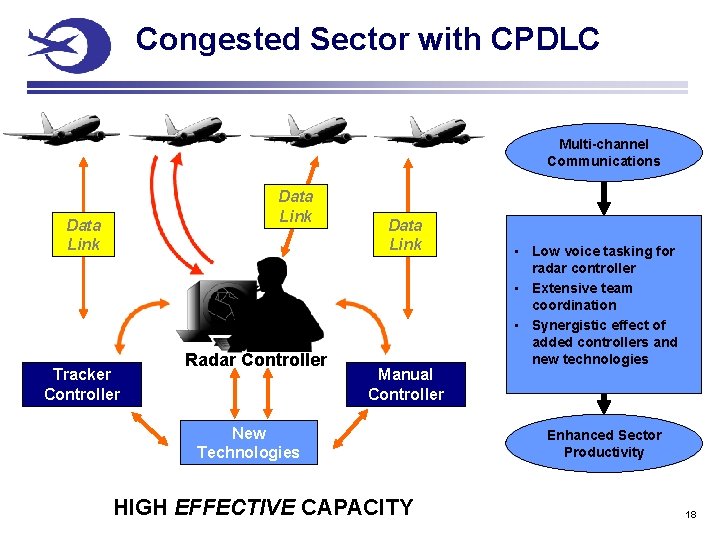
Congested Sector with CPDLC Multi-channel Communications Data Link Tracker Controller Radar Controller Data Link Manual Controller New Technologies HIGH EFFECTIVE CAPACITY • Low voice tasking for radar controller • Extensive team coordination • Synergistic effect of added controllers and new technologies Enhanced Sector Productivity 18
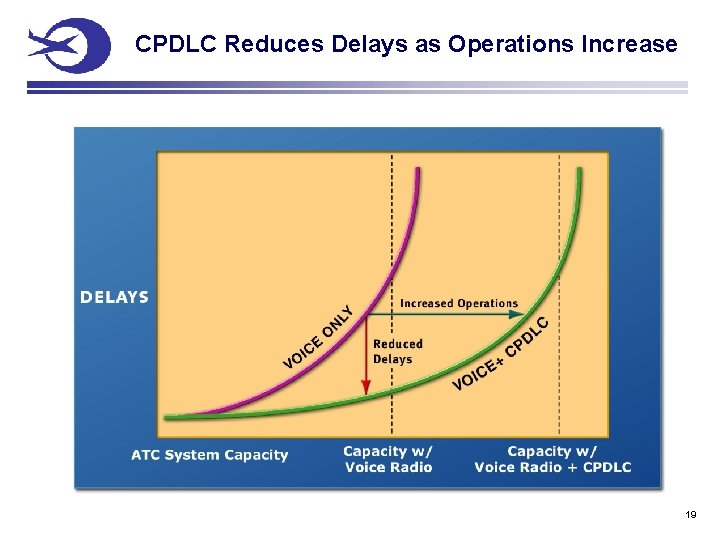
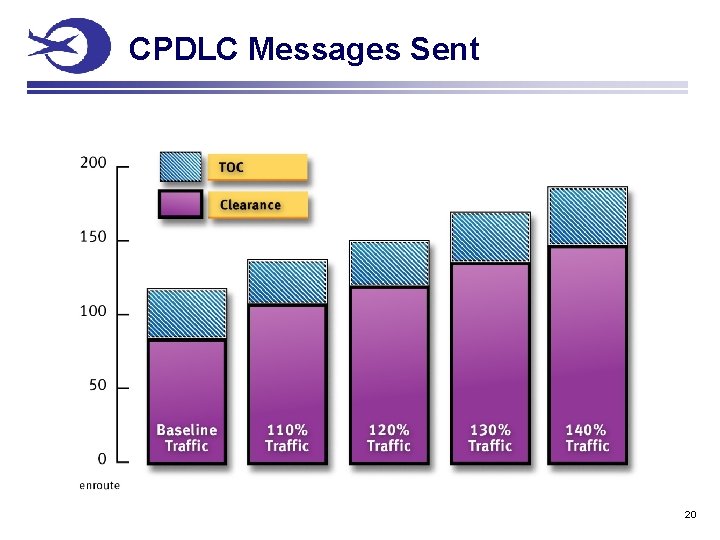
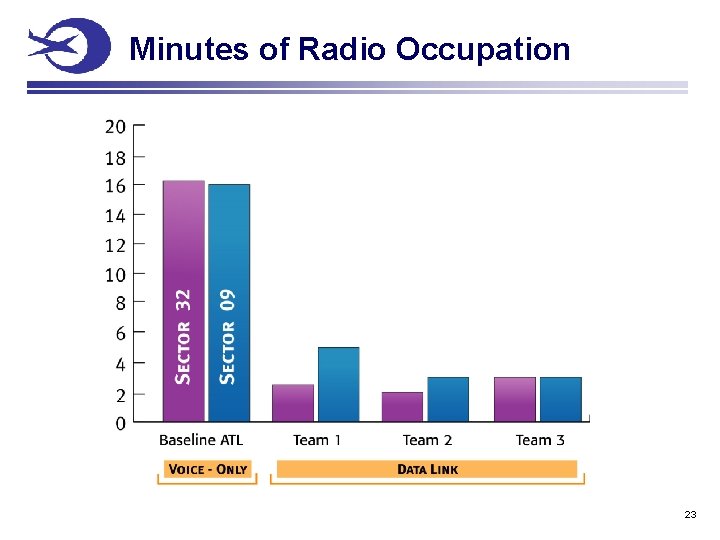
CPDLC Reduces Delays as Operations Increase 19
CPDLC Messages Sent 20
Atlanta Departure Ground Delay Savings 21
Time and Distance Performance in Sector 32 22
Minutes of Radio Occupation 23
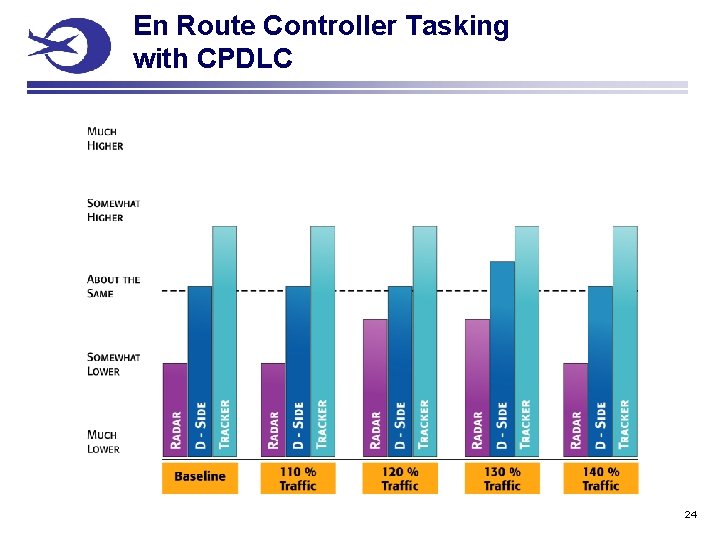
En Route Controller Tasking with CPDLC 24
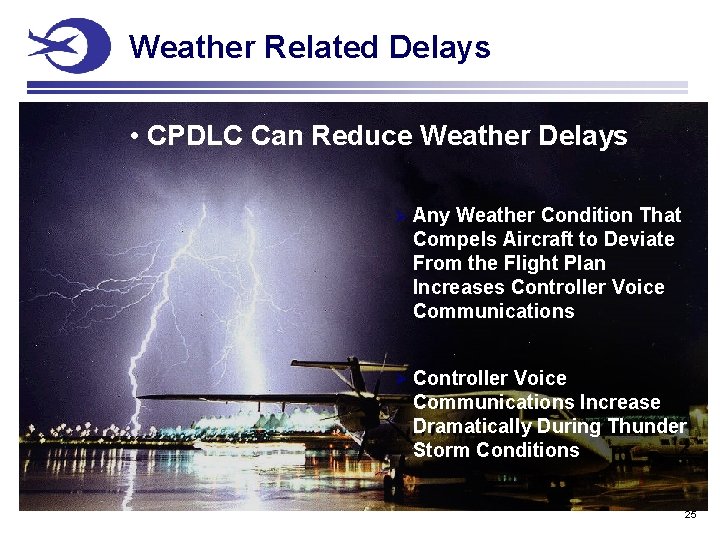
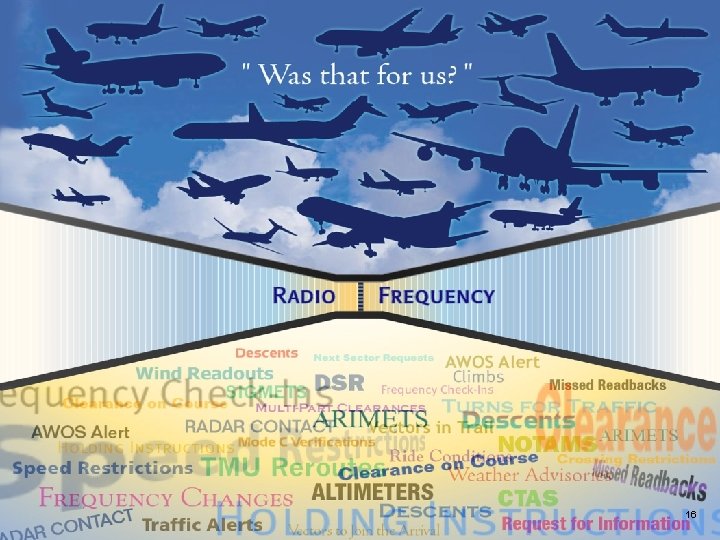
Weather Related Delays • CPDLC Can Reduce Weather Delays Ø Any Weather Condition That Compels Aircraft to Deviate From the Flight Plan Increases Controller Voice Communications Ø Controller Voice Communications Increase Dramatically During Thunder Storm Conditions 25
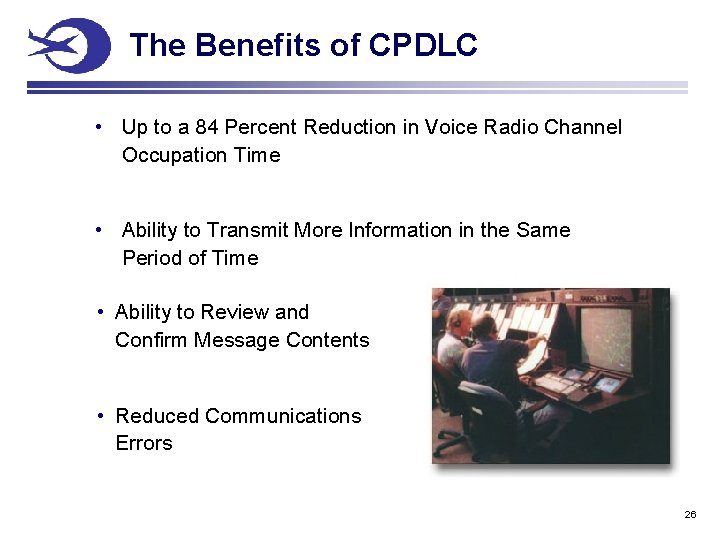
The Benefits of CPDLC • Up to a 84 Percent Reduction in Voice Radio Channel Occupation Time • Ability to Transmit More Information in the Same Period of Time • Ability to Review and Confirm Message Contents • Reduced Communications Errors 26
The Benefits of CPDLC • Significant Reductions in Ground Delays • Increased Sector Throughput • More Timely and Effective Clearances • More Time to Think and Select Appropriate Actions 27
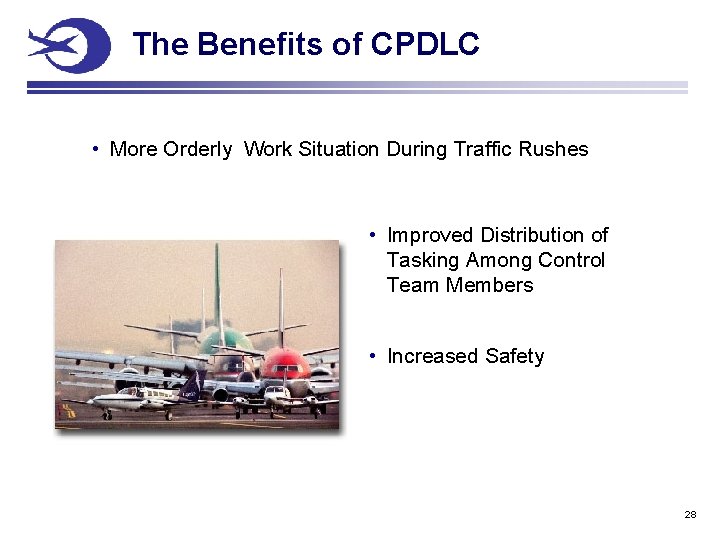
The Benefits of CPDLC • More Orderly Work Situation During Traffic Rushes • Improved Distribution of Tasking Among Control Team Members • Increased Safety 28
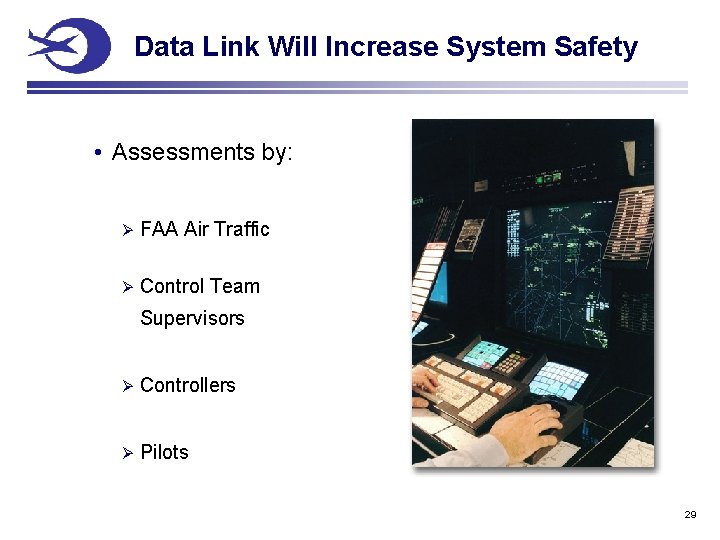
Data Link Will Increase System Safety • Assessments by: Ø FAA Air Traffic Ø Control Team Supervisors Ø Controllers Ø Pilots 29
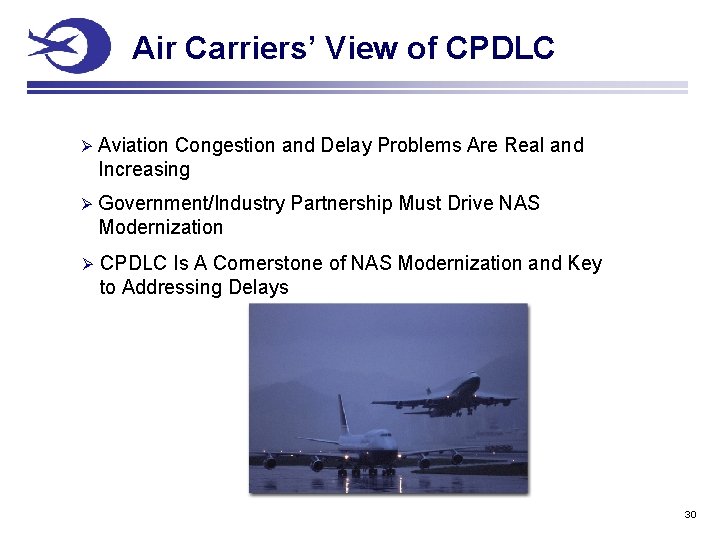
Air Carriers’ View of CPDLC Ø Aviation Congestion and Delay Problems Are Real and Increasing Ø Government/Industry Partnership Must Drive NAS Modernization Ø CPDLC Is A Cornerstone of NAS Modernization and Key to Addressing Delays 30
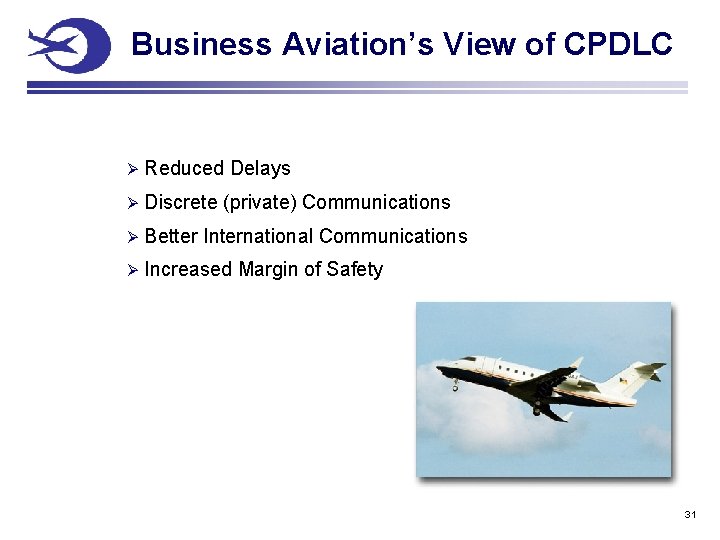
Business Aviation’s View of CPDLC Ø Reduced Delays Ø Discrete (private) Communications Ø Better International Communications Ø Increased Margin of Safety 31
NATCA Support for CPDLC “CPDLC represents the most significant change in ATC operations since the advent of Radar. Frequency congestion is the limiting factor in sector operations and this equipment will allow controllers to work significantly more traffic within a sector. As higher numbers of aircraft are equipped to participate this will lead to fewer delays and more capacity throughout the en route environment. ” Ruth Marlin, Executive Vice President National Air Traffic Controllers Association 32
Mitre CAASD and FAA Benefits Updates • Mitre CAASD Update: Ø Recalculated and updated airline benefits in conjunction with the RTCA Select Committee Ø Recalculations based on expected equipage levels and airline hub operations Ø Conclusions: Ø • Numerous benefits of CPDLC Build 1 A to airlines and controllers • Preliminary cost data indicates that the financial benefits to airlines outweigh the cost to equip • Even a small number of CPDLC-equipped aircraft can provide system-wide benefits • More study needed to determine actual costs for fully integrating CPDLC into new aircraft Study available from Mitre by contacting Frank Buck at fbuck@mitre. org • FAA Benefits Update: Ø Benefits analysis being conducted to support FAA CPDLC investment decision 33

Timothy. Hancock@FAA. gov 34
- Slides: 35