
Cp E 442 Computer Architecture and Engineering MIPS
![Example in C: swap(int v[], int k) { int temp; temp = v[k]; v[k]](https://slidetodoc.com/presentation_image_h2/563cf5ef73cc78632d9ee4f2646bf058/image-18.jpg "Example in C: swap(int v[], int k) { int temp; temp = v[k]; v[k]")
- Slides: 28
Cp. E 442 Computer Architecture and Engineering MIPS Instruction Set Architecture CPE 442 Lec 4. 1 Intro Computer Architectures
Overview of Today’s Lecture: MIPS et al ° Review from Last Lecture (3 minutes) ° MIPS ISA (20 minutes) ° More MIPS (25 minutes) ° MIPS (VAX, 80 x 86? ) (25 minutes) CPE 442 Lec 4. 2 Intro Computer Architectures
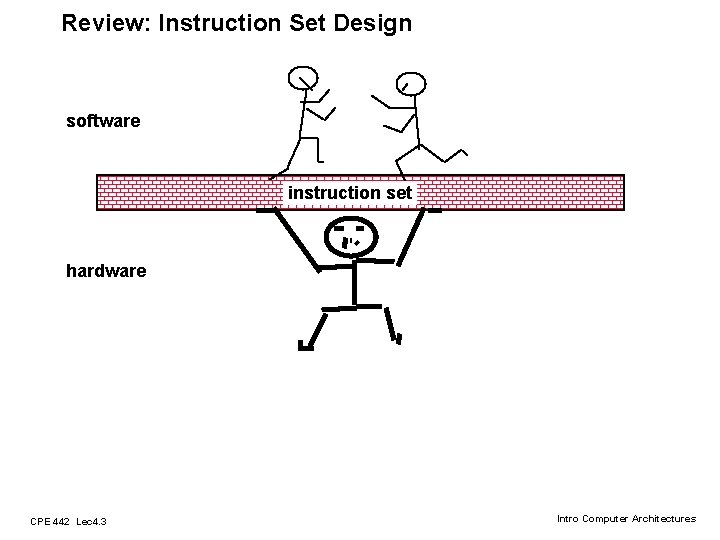
Review: Instruction Set Design software instruction set hardware CPE 442 Lec 4. 3 Intro Computer Architectures
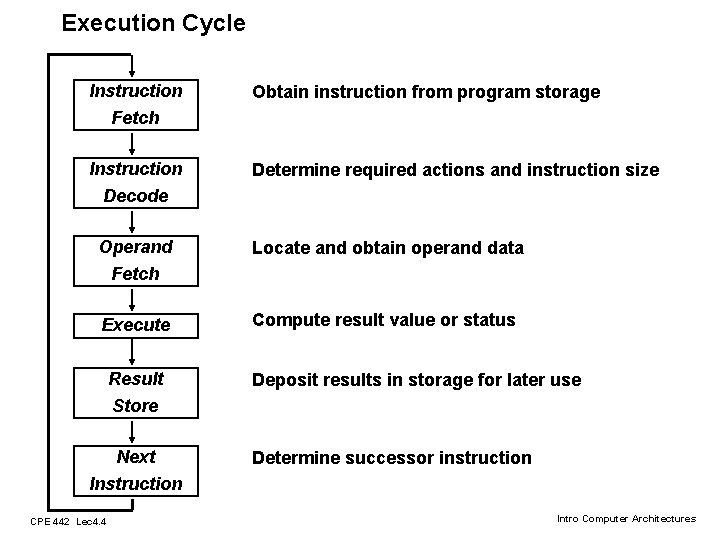
Execution Cycle Instruction Obtain instruction from program storage Fetch Instruction Determine required actions and instruction size Decode Operand Locate and obtain operand data Fetch Execute Result Compute result value or status Deposit results in storage for later use Store Next Determine successor instruction Instruction CPE 442 Lec 4. 4 Intro Computer Architectures
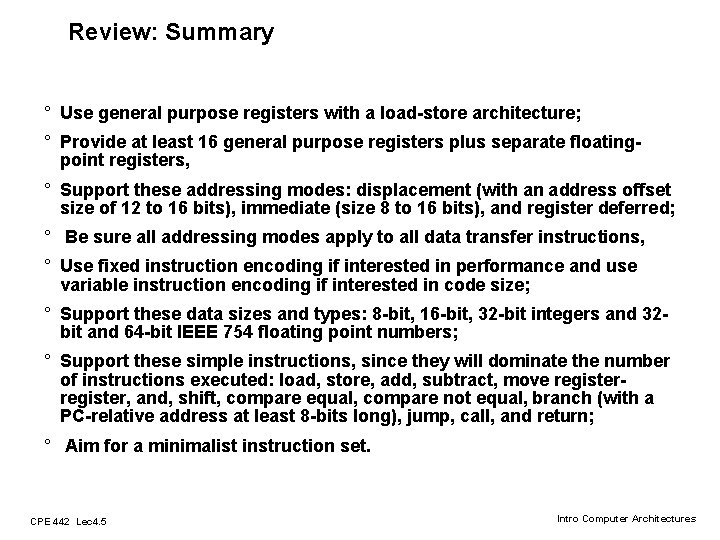
Review: Summary ° Use general purpose registers with a load-store architecture; ° Provide at least 16 general purpose registers plus separate floatingpoint registers, ° Support these addressing modes: displacement (with an address offset size of 12 to 16 bits), immediate (size 8 to 16 bits), and register deferred; ° Be sure all addressing modes apply to all data transfer instructions, ° Use fixed instruction encoding if interested in performance and use variable instruction encoding if interested in code size; ° Support these data sizes and types: 8 -bit, 16 -bit, 32 -bit integers and 32 bit and 64 -bit IEEE 754 floating point numbers; ° Support these simple instructions, since they will dominate the number of instructions executed: load, store, add, subtract, move register, and, shift, compare equal, compare not equal, branch (with a PC-relative address at least 8 -bits long), jump, call, and return; ° Aim for a minimalist instruction set. CPE 442 Lec 4. 5 Intro Computer Architectures
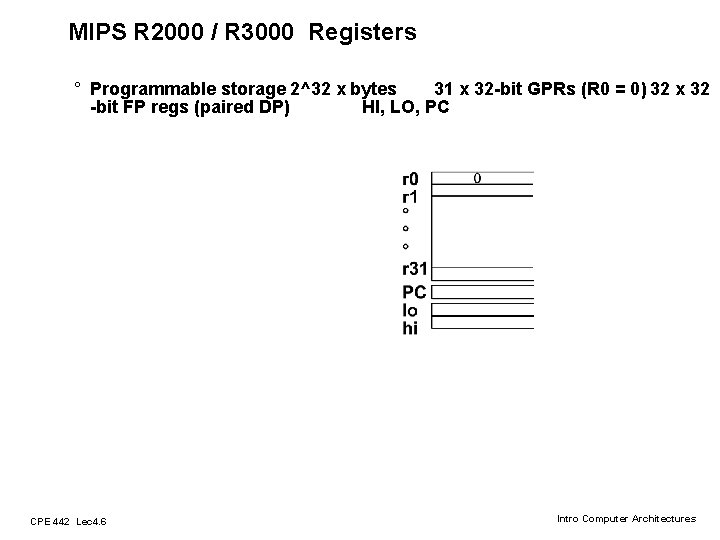
MIPS R 2000 / R 3000 Registers ° Programmable storage 2^32 x bytes 31 x 32 -bit GPRs (R 0 = 0) 32 x 32 -bit FP regs (paired DP) HI, LO, PC CPE 442 Lec 4. 6 Intro Computer Architectures
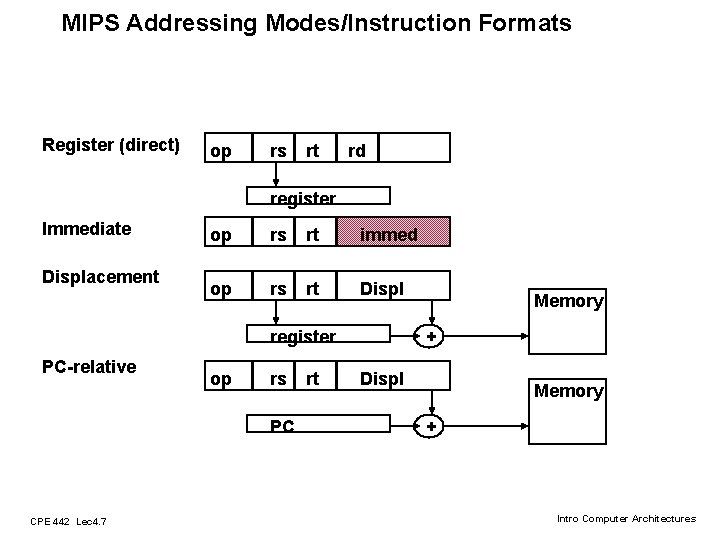
MIPS Addressing Modes/Instruction Formats Register (direct) op rs rt rd register Immediate Displacement op rs rt immed op rs rt Displ register PC-relative op rs PC CPE 442 Lec 4. 7 rt Memory + Displ Memory + Intro Computer Architectures
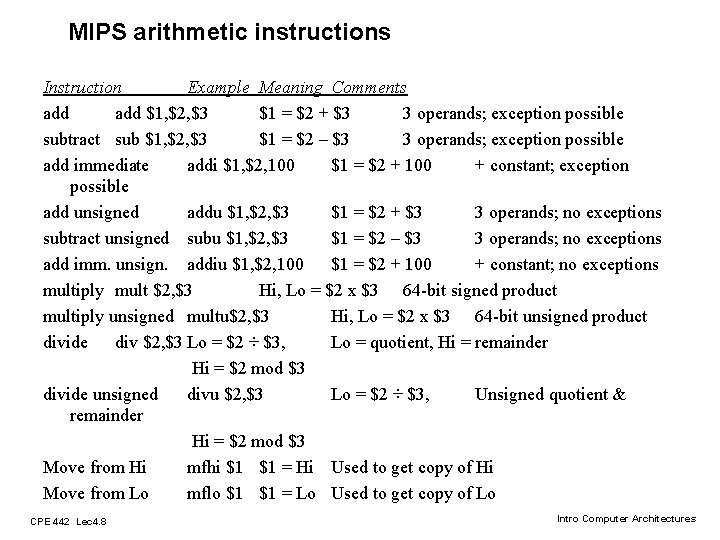
MIPS arithmetic instructions Instruction Example Meaning Comments add $1, $2, $3 $1 = $2 + $3 3 operands; exception possible subtract sub $1, $2, $3 $1 = $2 – $3 3 operands; exception possible add immediate addi $1, $2, 100 $1 = $2 + 100 + constant; exception possible add unsigned addu $1, $2, $3 $1 = $2 + $3 3 operands; no exceptions subtract unsigned subu $1, $2, $3 $1 = $2 – $3 3 operands; no exceptions add imm. unsign. addiu $1, $2, 100 $1 = $2 + 100 + constant; no exceptions multiply mult $2, $3 Hi, Lo = $2 x $3 64 -bit signed product multiply unsigned multu$2, $3 Hi, Lo = $2 x $3 64 -bit unsigned product divide div $2, $3 Lo = $2 ÷ $3, Lo = quotient, Hi = remainder Hi = $2 mod $3 divide unsigned divu $2, $3 Lo = $2 ÷ $3, Unsigned quotient & remainder Hi = $2 mod $3 Move from Hi mfhi $1 $1 = Hi Used to get copy of Hi Move from Lo mflo $1 $1 = Lo Used to get copy of Lo CPE 442 Lec 4. 8 Intro Computer Architectures
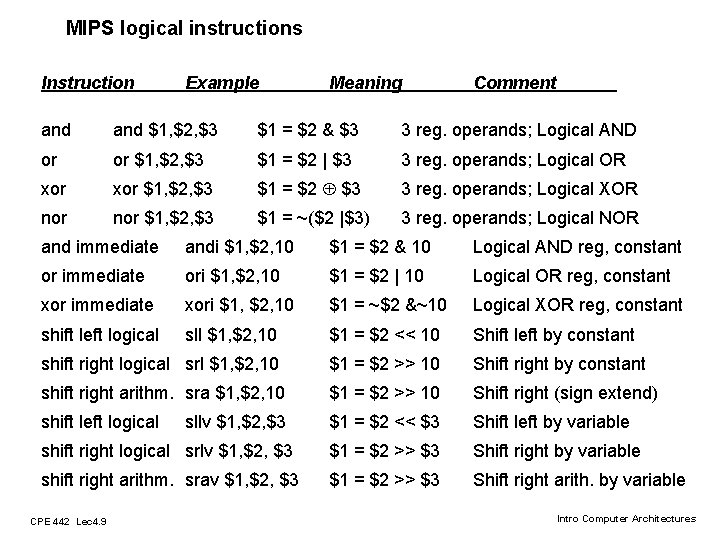
MIPS logical instructions Instruction Example Meaning Comment and $1, $2, $3 $1 = $2 & $3 3 reg. operands; Logical AND or or $1, $2, $3 $1 = $2 | $3 3 reg. operands; Logical OR xor $1, $2, $3 $1 = $2 $3 3 reg. operands; Logical XOR nor $1, $2, $3 $1 = ~($2 |$3) 3 reg. operands; Logical NOR and immediate andi $1, $2, 10 $1 = $2 & 10 Logical AND reg, constant or immediate ori $1, $2, 10 $1 = $2 | 10 Logical OR reg, constant xor immediate xori $1, $2, 10 $1 = ~$2 &~10 Logical XOR reg, constant shift left logical sll $1, $2, 10 $1 = $2 << 10 Shift left by constant shift right logical srl $1, $2, 10 $1 = $2 >> 10 Shift right by constant shift right arithm. sra $1, $2, 10 $1 = $2 >> 10 Shift right (sign extend) shift left logical $1 = $2 << $3 Shift left by variable shift right logical srlv $1, $2, $3 $1 = $2 >> $3 Shift right by variable shift right arithm. srav $1, $2, $3 $1 = $2 >> $3 Shift right arith. by variable CPE 442 Lec 4. 9 sllv $1, $2, $3 Intro Computer Architectures
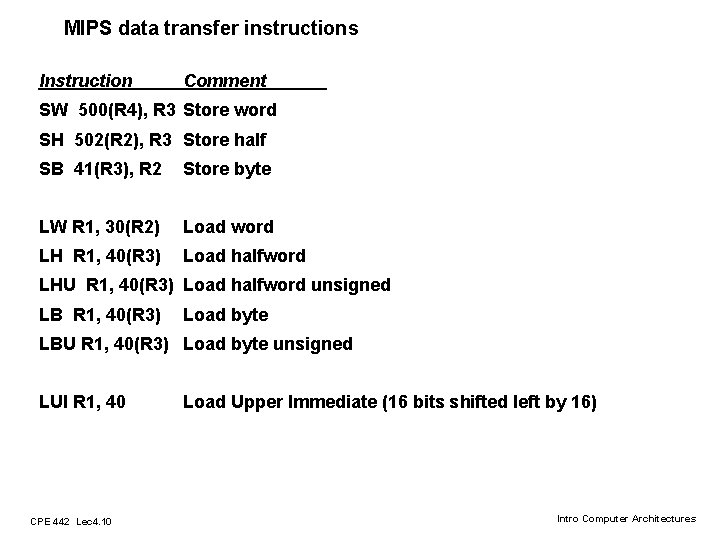
MIPS data transfer instructions Instruction Comment SW 500(R 4), R 3 Store word SH 502(R 2), R 3 Store half SB 41(R 3), R 2 Store byte LW R 1, 30(R 2) Load word LH R 1, 40(R 3) Load halfword LHU R 1, 40(R 3) Load halfword unsigned LB R 1, 40(R 3) Load byte LBU R 1, 40(R 3) Load byte unsigned LUI R 1, 40 CPE 442 Lec 4. 10 Load Upper Immediate (16 bits shifted left by 16) Intro Computer Architectures
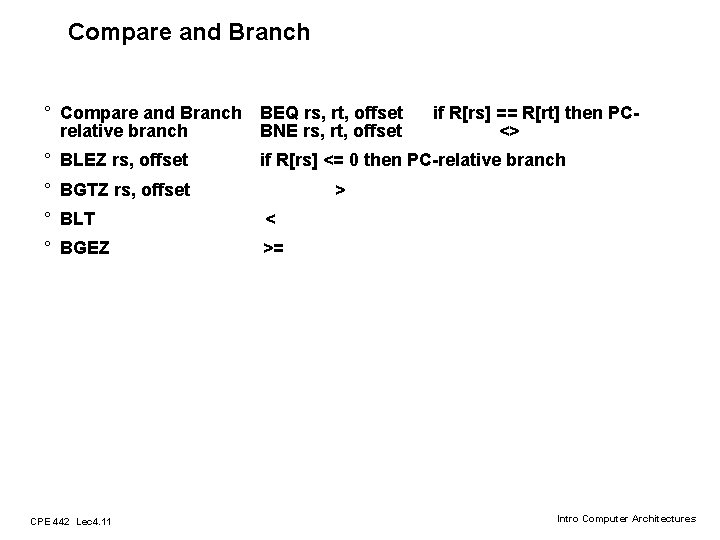
Compare and Branch ° Compare and Branch BEQ rs, rt, offset relative branch BNE rs, rt, offset ° BLEZ rs, offset if R[rs] <= 0 then PC-relative branch ° BGTZ rs, offset > ° BLT < ° BGEZ >= CPE 442 Lec 4. 11 if R[rs] == R[rt] then PC<> Intro Computer Architectures
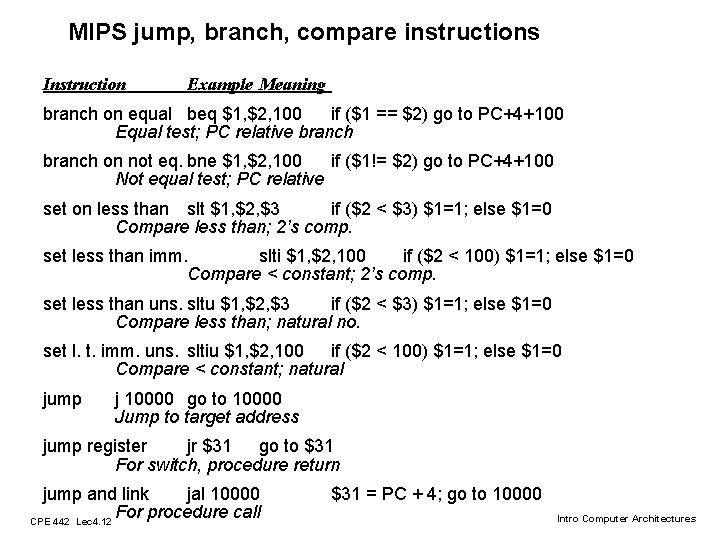
MIPS jump, branch, compare instructions Instruction Example Meaning branch on equal beq $1, $2, 100 if ($1 == $2) go to PC+4+100 Equal test; PC relative branch on not eq. bne $1, $2, 100 if ($1!= $2) go to PC+4+100 Not equal test; PC relative set on less than slt $1, $2, $3 if ($2 < $3) $1=1; else $1=0 Compare less than; 2’s comp. set less than imm. slti $1, $2, 100 if ($2 < 100) $1=1; else $1=0 Compare < constant; 2’s comp. set less than uns. sltu $1, $2, $3 if ($2 < $3) $1=1; else $1=0 Compare less than; natural no. set l. t. imm. uns. sltiu $1, $2, 100 if ($2 < 100) $1=1; else $1=0 Compare < constant; natural jump j 10000 go to 10000 Jump to target address jump register jr $31 go to $31 For switch, procedure return jump and link jal 10000 For procedure call CPE 442 Lec 4. 12 $31 = PC + 4; go to 10000 Intro Computer Architectures
Assignment 2 Text, Chapter 2 Exercises section, work out and submit the solutions of the following problems 2. 29, 2. 34, , 2. 49, 2. 51 Due: Sept. 22, 2009 CPE 442 Lec 4. 13 Intro Computer Architectures
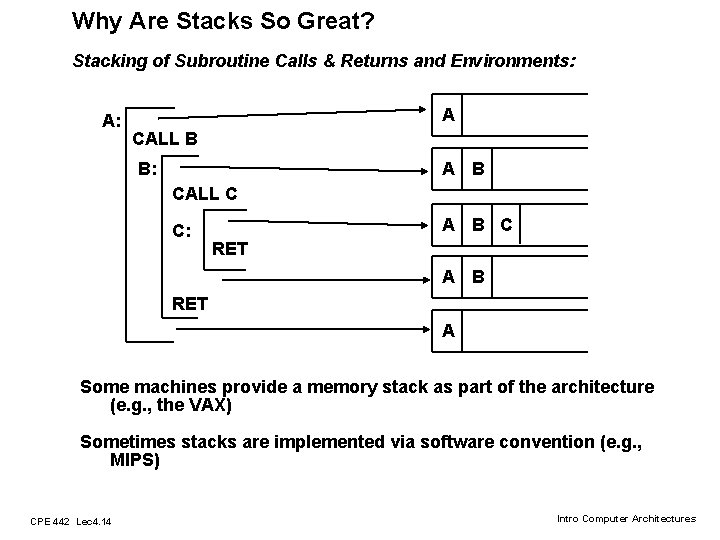
Why Are Stacks So Great? Stacking of Subroutine Calls & Returns and Environments: A: A CALL B B: A B CALL C C: A B C RET A B RET A Some machines provide a memory stack as part of the architecture (e. g. , the VAX) Sometimes stacks are implemented via software convention (e. g. , MIPS) CPE 442 Lec 4. 14 Intro Computer Architectures
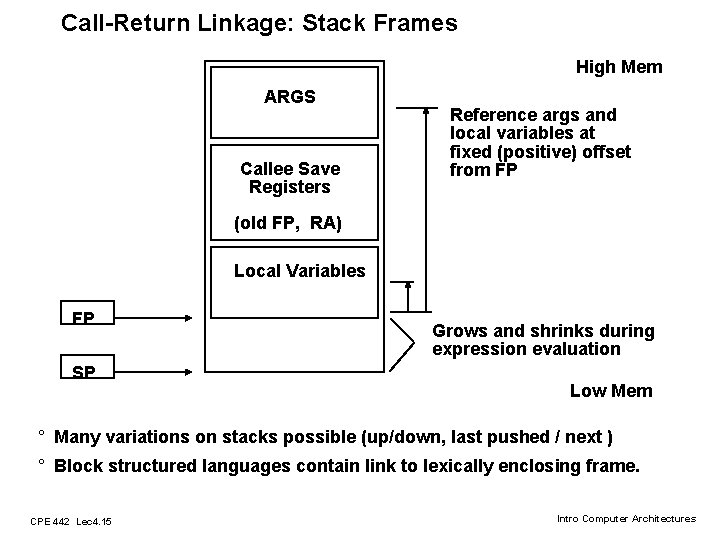
Call-Return Linkage: Stack Frames High Mem ARGS Callee Save Registers Reference args and local variables at fixed (positive) offset from FP (old FP, RA) Local Variables FP SP Grows and shrinks during expression evaluation Low Mem ° Many variations on stacks possible (up/down, last pushed / next ) ° Block structured languages contain link to lexically enclosing frame. CPE 442 Lec 4. 15 Intro Computer Architectures
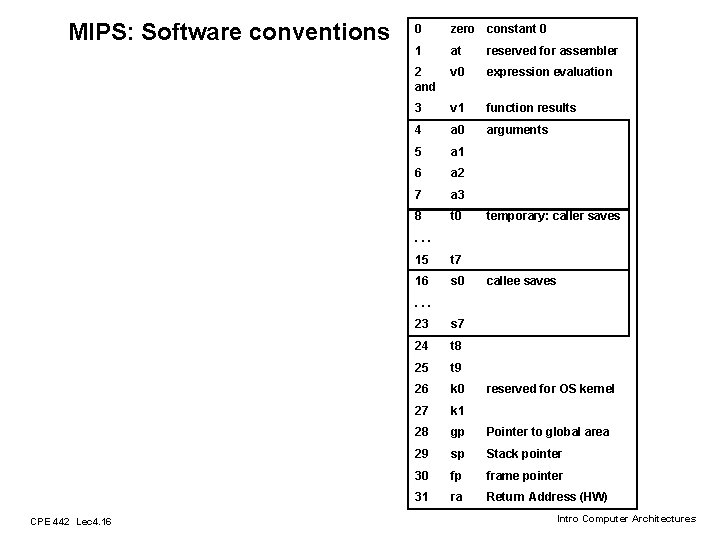
MIPS: Software conventions 0 zero constant 0 1 at reserved for assembler 2 and v 0 expression evaluation 3 v 1 function results 4 a 0 arguments 5 a 1 6 a 2 7 a 3 8 t 0 temporary: caller saves . . . 15 t 7 16 s 0 callee saves . . . CPE 442 Lec 4. 16 23 s 7 24 t 8 25 t 9 26 k 0 27 k 1 28 gp Pointer to global area 29 sp Stack pointer 30 fp frame pointer 31 ra Return Address (HW) reserved for OS kernel Intro Computer Architectures
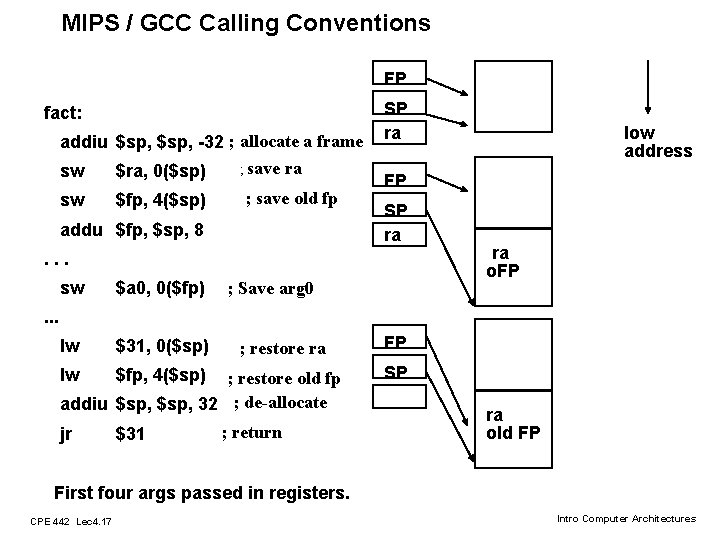
MIPS / GCC Calling Conventions FP fact: addiu $sp, -32 ; allocate a frame ; save ra sw $ra, 0($sp) sw $fp, 4($sp) ; save old fp addu $fp, $sp, 8 SP ra FP SP ra . . . sw $a 0, 0($fp) lw $31, 0($sp) lw $fp, 4($sp) low address ; Save arg 0 ra o. FP . . . ; restore ra ; restore old fp addiu $sp, 32 ; de-allocate jr $31 ; return FP SP ra old FP First four args passed in registers. CPE 442 Lec 4. 17 Intro Computer Architectures
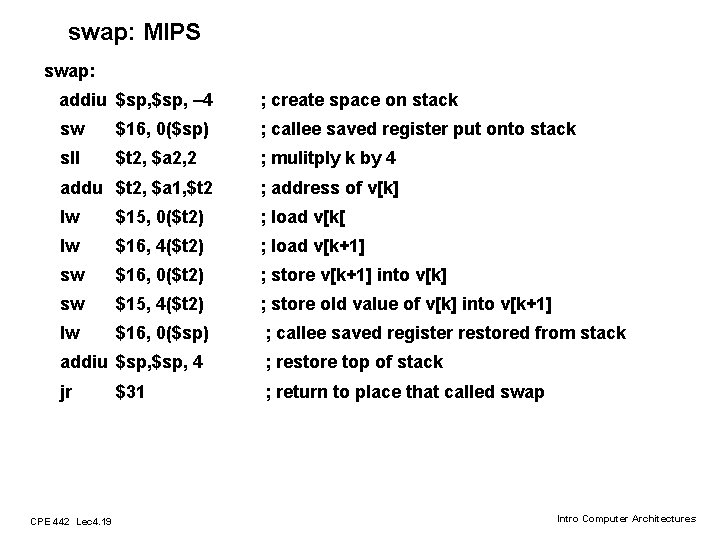
Example in C: swap(int v[], int k) { int temp; temp = v[k]; v[k] = v[k+1]; v[k+1] = temp; } ° Assume swap is called as a procedure ° Assume temp is register $15; arguments in $a 1, $a 2; $16 is scratch reg: ° Write MIPS code CPE 442 Lec 4. 18 Intro Computer Architectures
swap: MIPS swap: addiu $sp, – 4 ; create space on stack sw $16, 0($sp) ; callee saved register put onto stack sll $t 2, $a 2, 2 ; mulitply k by 4 addu $t 2, $a 1, $t 2 ; address of v[k] lw $15, 0($t 2) ; load v[k[ lw $16, 4($t 2) ; load v[k+1] sw $16, 0($t 2) ; store v[k+1] into v[k] sw $15, 4($t 2) ; store old value of v[k] into v[k+1] lw $16, 0($sp) ; callee saved register restored from stack addiu $sp, 4 ; restore top of stack jr ; return to place that called swap CPE 442 Lec 4. 19 $31 Intro Computer Architectures
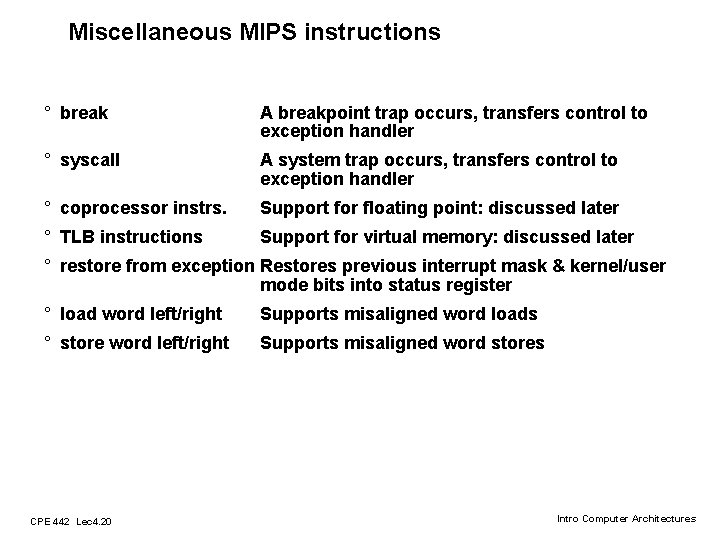
Miscellaneous MIPS instructions ° break A breakpoint trap occurs, transfers control to exception handler ° syscall A system trap occurs, transfers control to exception handler ° coprocessor instrs. Support for floating point: discussed later ° TLB instructions Support for virtual memory: discussed later ° restore from exception Restores previous interrupt mask & kernel/user mode bits into status register ° load word left/right Supports misaligned word loads ° store word left/right Supports misaligned word stores CPE 442 Lec 4. 20 Intro Computer Architectures
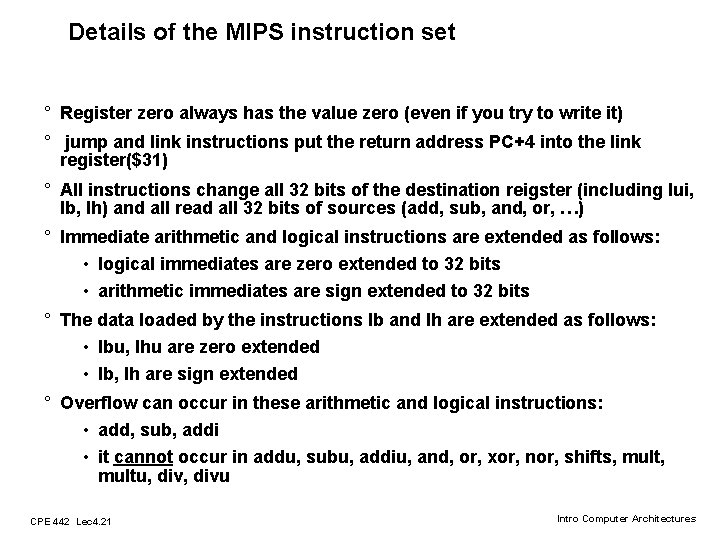
Details of the MIPS instruction set ° Register zero always has the value zero (even if you try to write it) ° jump and link instructions put the return address PC+4 into the link register($31) ° All instructions change all 32 bits of the destination reigster (including lui, lb, lh) and all read all 32 bits of sources (add, sub, and, or, …) ° Immediate arithmetic and logical instructions are extended as follows: • logical immediates are zero extended to 32 bits • arithmetic immediates are sign extended to 32 bits ° The data loaded by the instructions lb and lh are extended as follows: • lbu, lhu are zero extended • lb, lh are sign extended ° Overflow can occur in these arithmetic and logical instructions: • add, sub, addi • it cannot occur in addu, subu, addiu, and, or, xor, nor, shifts, multu, divu CPE 442 Lec 4. 21 Intro Computer Architectures
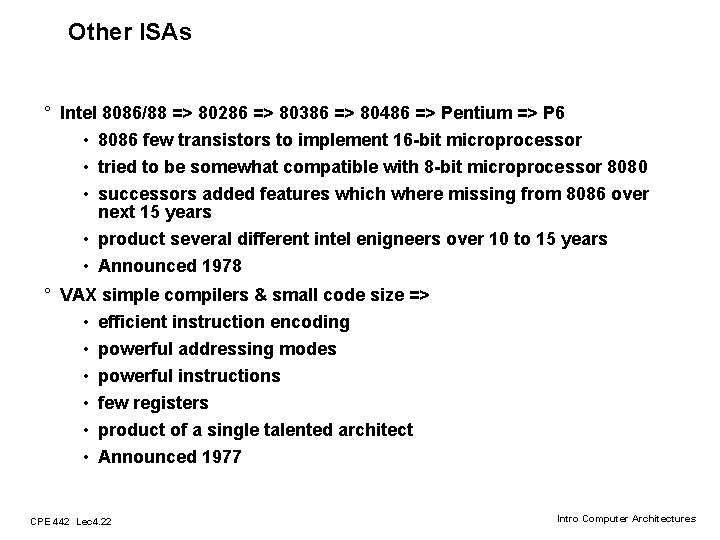
Other ISAs ° Intel 8086/88 => 80286 => 80386 => 80486 => Pentium => P 6 • 8086 few transistors to implement 16 -bit microprocessor • tried to be somewhat compatible with 8 -bit microprocessor 8080 • successors added features which where missing from 8086 over next 15 years • product several different intel enigneers over 10 to 15 years • Announced 1978 ° VAX simple compilers & small code size => • efficient instruction encoding • powerful addressing modes • powerful instructions • few registers • product of a single talented architect • Announced 1977 CPE 442 Lec 4. 22 Intro Computer Architectures
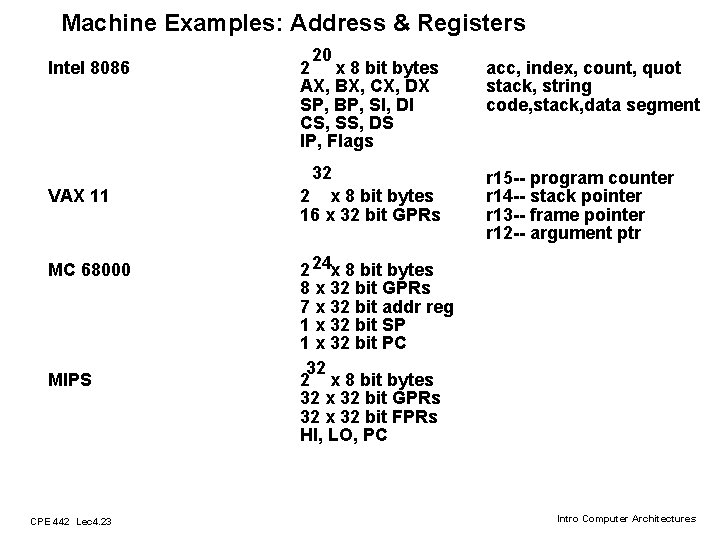
Machine Examples: Address & Registers Intel 8086 VAX 11 MC 68000 MIPS CPE 442 Lec 4. 23 20 2 x 8 bit bytes AX, BX, CX, DX SP, BP, SI, DI CS, SS, DS IP, Flags 32 2 x 8 bit bytes 16 x 32 bit GPRs acc, index, count, quot stack, string code, stack, data segment r 15 -- program counter r 14 -- stack pointer r 13 -- frame pointer r 12 -- argument ptr 2 24 x 8 bit bytes 8 x 32 bit GPRs 7 x 32 bit addr reg 1 x 32 bit SP 1 x 32 bit PC 32 2 x 8 bit bytes 32 x 32 bit GPRs 32 x 32 bit FPRs HI, LO, PC Intro Computer Architectures
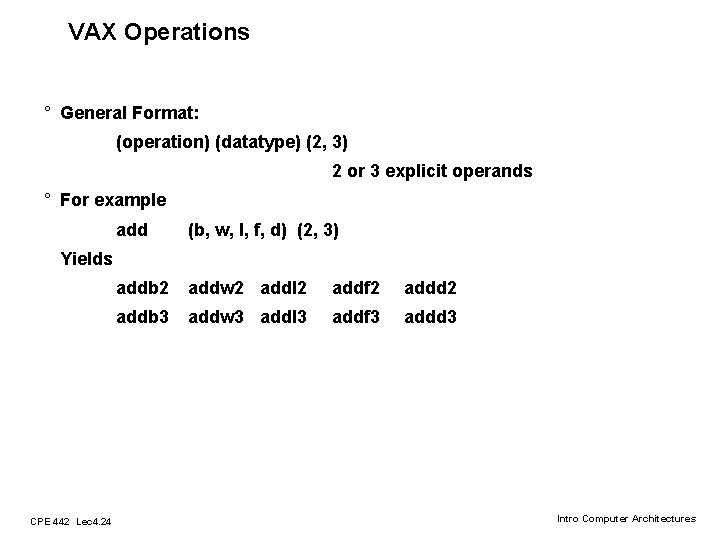
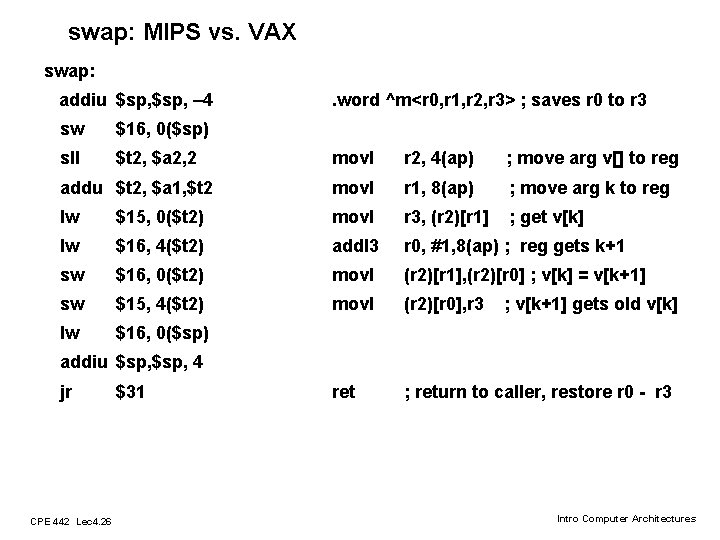
VAX Operations ° General Format: (operation) (datatype) (2, 3) 2 or 3 explicit operands ° For example add (b, w, l, f, d) (2, 3) addb 2 addw 2 addl 2 addf 2 addd 2 addb 3 addw 3 addl 3 addf 3 addd 3 Yields CPE 442 Lec 4. 24 Intro Computer Architectures
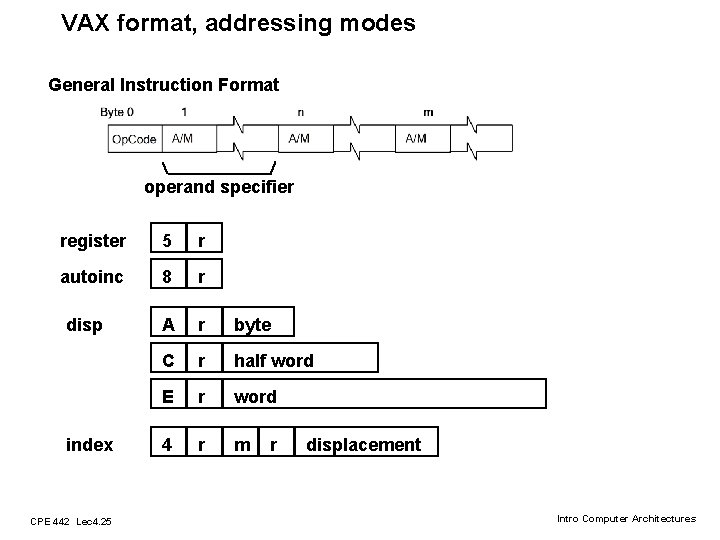
VAX format, addressing modes General Instruction Format operand specifier register 5 r autoinc 8 r A r byte C r half word E r word 4 r m disp index CPE 442 Lec 4. 25 r displacement Intro Computer Architectures
swap: MIPS vs. VAX swap: addiu $sp, – 4 sw $16, 0($sp) sll $t 2, $a 2, 2 . word ^m<r 0, r 1, r 2, r 3> ; saves r 0 to r 3 movl r 2, 4(ap) ; move arg v[] to reg addu $t 2, $a 1, $t 2 movl r 1, 8(ap) ; move arg k to reg lw $15, 0($t 2) movl r 3, (r 2)[r 1] ; get v[k] lw $16, 4($t 2) addl 3 r 0, #1, 8(ap) ; reg gets k+1 sw $16, 0($t 2) movl (r 2)[r 1], (r 2)[r 0] ; v[k] = v[k+1] sw $15, 4($t 2) movl (r 2)[r 0], r 3 lw $16, 0($sp) ret ; return to caller, restore r 0 - r 3 ; v[k+1] gets old v[k] addiu $sp, 4 jr CPE 442 Lec 4. 26 $31 Intro Computer Architectures
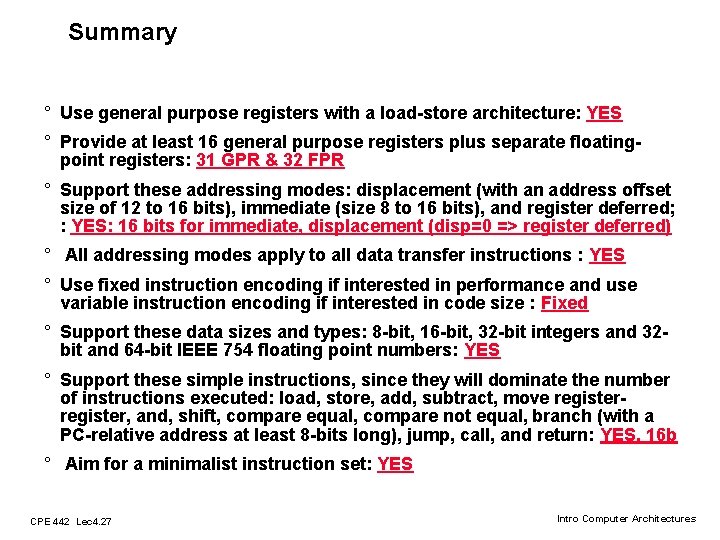
Summary ° Use general purpose registers with a load-store architecture: YES ° Provide at least 16 general purpose registers plus separate floatingpoint registers: 31 GPR & 32 FPR ° Support these addressing modes: displacement (with an address offset size of 12 to 16 bits), immediate (size 8 to 16 bits), and register deferred; : YES: 16 bits for immediate, displacement (disp=0 => register deferred) ° All addressing modes apply to all data transfer instructions : YES ° Use fixed instruction encoding if interested in performance and use variable instruction encoding if interested in code size : Fixed ° Support these data sizes and types: 8 -bit, 16 -bit, 32 -bit integers and 32 bit and 64 -bit IEEE 754 floating point numbers: YES ° Support these simple instructions, since they will dominate the number of instructions executed: load, store, add, subtract, move register, and, shift, compare equal, compare not equal, branch (with a PC-relative address at least 8 -bits long), jump, call, and return: YES, 16 b ° Aim for a minimalist instruction set: YES CPE 442 Lec 4. 27 Intro Computer Architectures
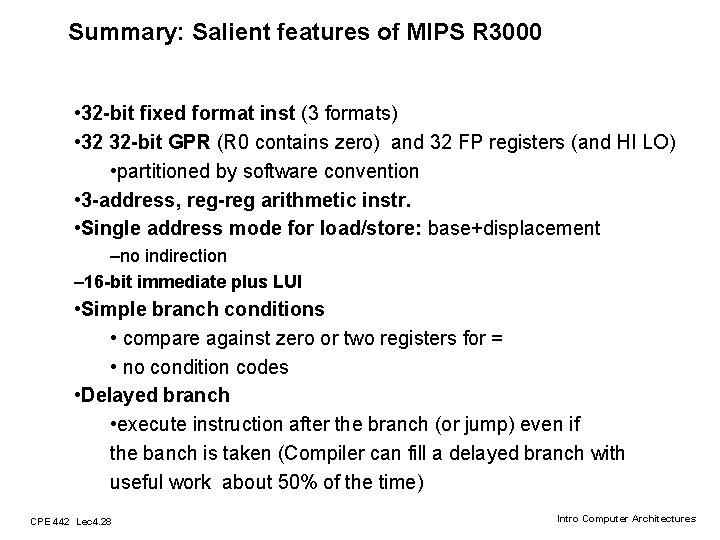
Summary: Salient features of MIPS R 3000 • 32 -bit fixed format inst (3 formats) • 32 32 -bit GPR (R 0 contains zero) and 32 FP registers (and HI LO) • partitioned by software convention • 3 -address, reg-reg arithmetic instr. • Single address mode for load/store: base+displacement –no indirection – 16 -bit immediate plus LUI • Simple branch conditions • compare against zero or two registers for = • no condition codes • Delayed branch • execute instruction after the branch (or jump) even if the banch is taken (Compiler can fill a delayed branch with useful work about 50% of the time) CPE 442 Lec 4. 28 Intro Computer Architectures