
CP 502 Advanced Fluid Mechanics Compressible Flow Part
CP 502 Advanced Fluid Mechanics Compressible Flow Part 01_Set 02: Steady, quasi one-dimensional, isothermal, compressible flow of an ideal gas in a constant area duct with wall friction (continued)
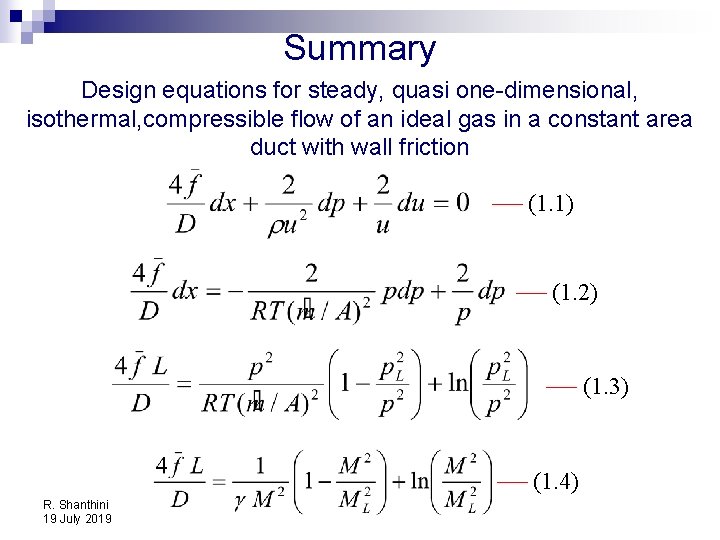
Summary Design equations for steady, quasi one-dimensional, isothermal, compressible flow of an ideal gas in a constant area duct with wall friction (1. 1) (1. 2) (1. 3) (1. 4) R. Shanthini 19 July 2019
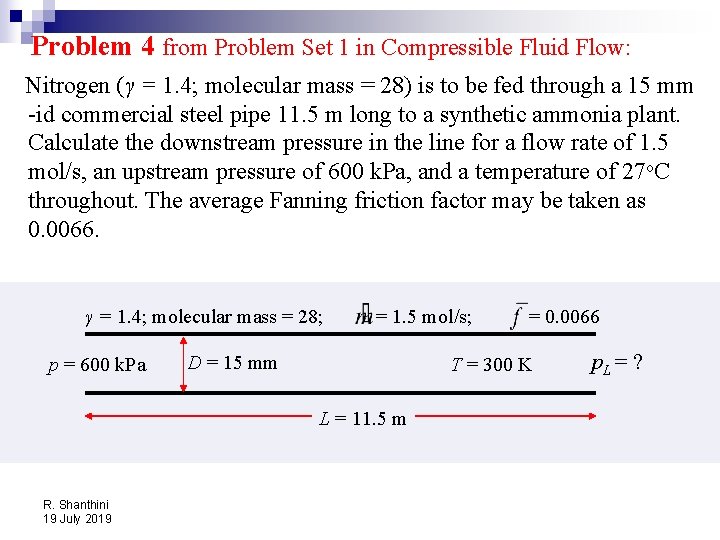
Problem 4 from Problem Set 1 in Compressible Fluid Flow: Nitrogen (γ = 1. 4; molecular mass = 28) is to be fed through a 15 mm -id commercial steel pipe 11. 5 m long to a synthetic ammonia plant. Calculate the downstream pressure in the line for a flow rate of 1. 5 mol/s, an upstream pressure of 600 k. Pa, and a temperature of 27 o. C throughout. The average Fanning friction factor may be taken as 0. 0066. γ = 1. 4; molecular mass = 28; p = 600 k. Pa = 1. 5 mol/s; D = 15 mm T = 300 K L = 11. 5 m R. Shanthini 19 July 2019 = 0. 0066 p. L = ?
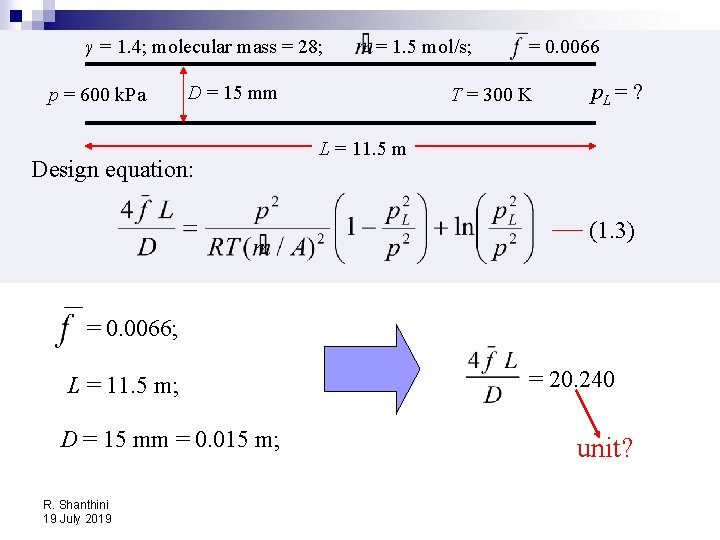
γ = 1. 4; molecular mass = 28; p = 600 k. Pa = 1. 5 mol/s; D = 15 mm Design equation: = 0. 0066 T = 300 K p. L = ? L = 11. 5 m (1. 3) = 0. 0066; L = 11. 5 m; D = 15 mm = 0. 015 m; R. Shanthini 19 July 2019 = 20. 240 unit?
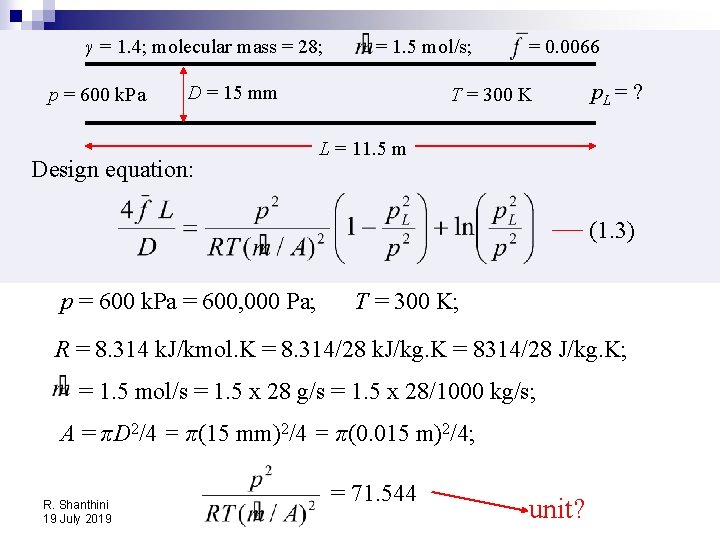
γ = 1. 4; molecular mass = 28; p = 600 k. Pa = 1. 5 mol/s; D = 15 mm Design equation: = 0. 0066 T = 300 K p. L = ? L = 11. 5 m (1. 3) p = 600 k. Pa = 600, 000 Pa; T = 300 K; R = 8. 314 k. J/kmol. K = 8. 314/28 k. J/kg. K = 8314/28 J/kg. K; = 1. 5 mol/s = 1. 5 x 28 g/s = 1. 5 x 28/1000 kg/s; A = πD 2/4 = π(15 mm)2/4 = π(0. 015 m)2/4; R. Shanthini 19 July 2019 = 71. 544 unit?
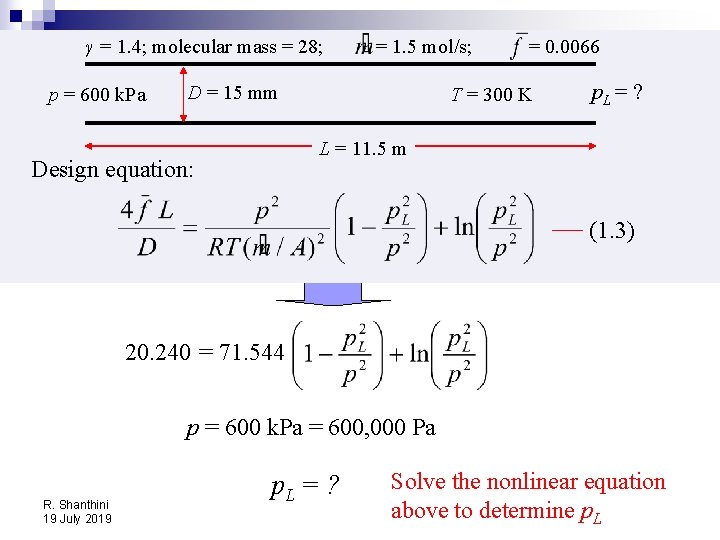
γ = 1. 4; molecular mass = 28; p = 600 k. Pa = 1. 5 mol/s; D = 15 mm = 0. 0066 T = 300 K p. L = ? L = 11. 5 m Design equation: (1. 3) 20. 240 = 71. 544 p = 600 k. Pa = 600, 000 Pa R. Shanthini 19 July 2019 p. L = ? Solve the nonlinear equation above to determine p. L
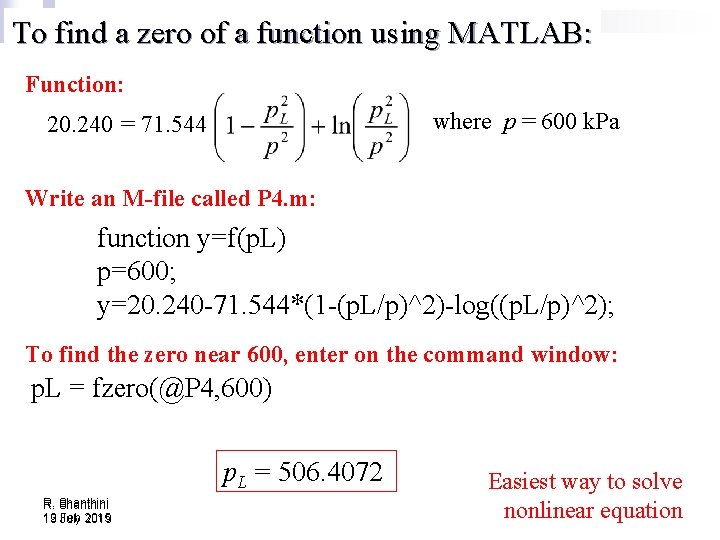
To find a zero of a function using MATLAB: Function: where p = 600 k. Pa 20. 240 = 71. 544 Write an M-file called P 4. m: function y=f(p. L) p=600; y=20. 240 -71. 544*(1 -(p. L/p)^2)-log((p. L/p)^2); To find the zero near 600, enter on the command window: p. L = fzero(@P 4, 600) p. L = 506. 4072 R. Shanthini 13 July Feb 2015 19 2019 Easiest way to solve nonlinear equation
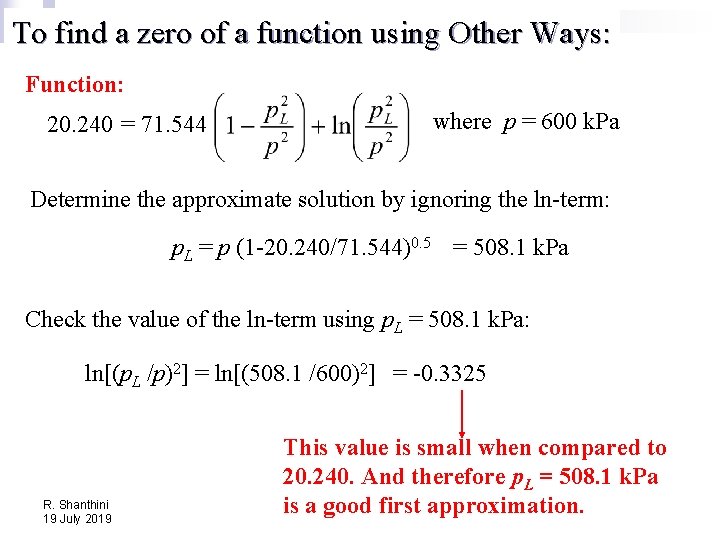
To find a zero of a function using Other Ways: Function: 20. 240 = 71. 544 where p = 600 k. Pa Determine the approximate solution by ignoring the ln-term: p. L = p (1 -20. 240/71. 544)0. 5 = 508. 1 k. Pa Check the value of the ln-term using p. L = 508. 1 k. Pa: ln[(p. L /p)2] = ln[(508. 1 /600)2] = -0. 3325 R. Shanthini 19 July 2019 This value is small when compared to 20. 240. And therefore p. L = 508. 1 k. Pa is a good first approximation.
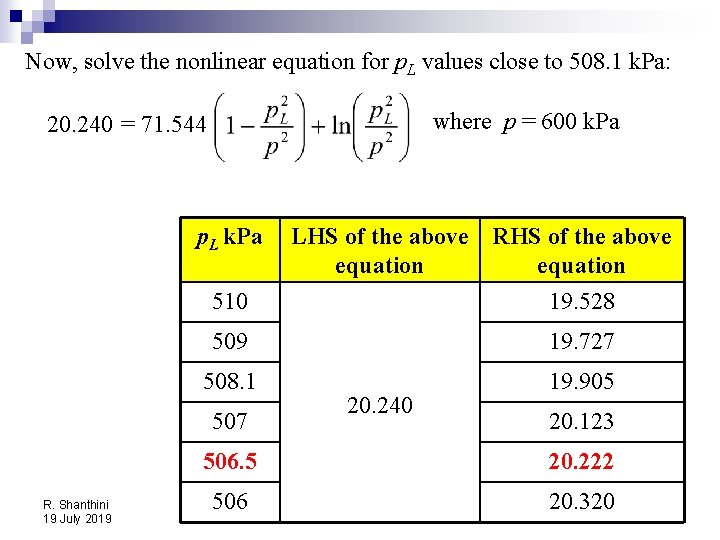
Now, solve the nonlinear equation for p. L values close to 508. 1 k. Pa: where p = 600 k. Pa 20. 240 = 71. 544 p. L k. Pa 510 19. 528 509 19. 727 508. 1 19. 905 507 R. Shanthini 19 July 2019 LHS of the above RHS of the above equation 20. 240 20. 123 506. 5 20. 222 506 20. 320
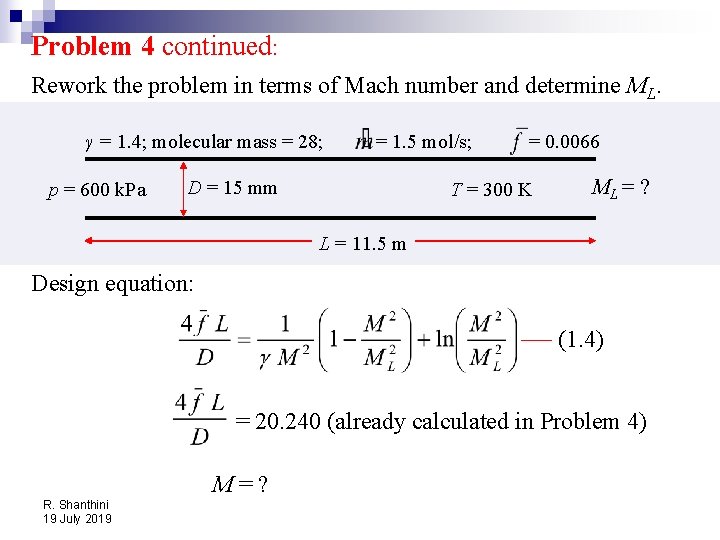
Problem 4 continued: Rework the problem in terms of Mach number and determine ML. γ = 1. 4; molecular mass = 28; p = 600 k. Pa = 1. 5 mol/s; D = 15 mm = 0. 0066 T = 300 K ML = ? L = 11. 5 m Design equation: (1. 4) = 20. 240 (already calculated in Problem 4) M=? R. Shanthini 19 July 2019
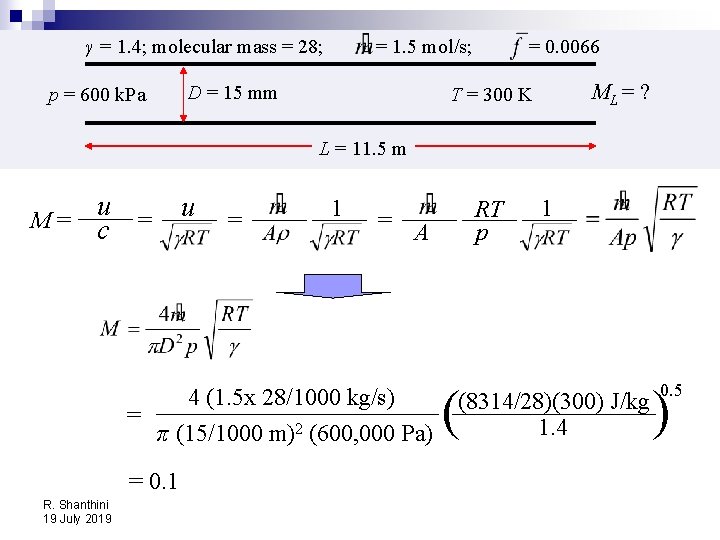
γ = 1. 4; molecular mass = 28; p = 600 k. Pa = 1. 5 mol/s; D = 15 mm = 0. 0066 ML = ? T = 300 K L = 11. 5 m M= u = c u = 1 4 (1. 5 x 28/1000 kg/s) = π (15/1000 m)2 (600, 000 Pa) = 0. 1 R. Shanthini 19 July 2019 RT p = A ( 1 (8314/28)(300) J/kg 1. 4 ) 0. 5
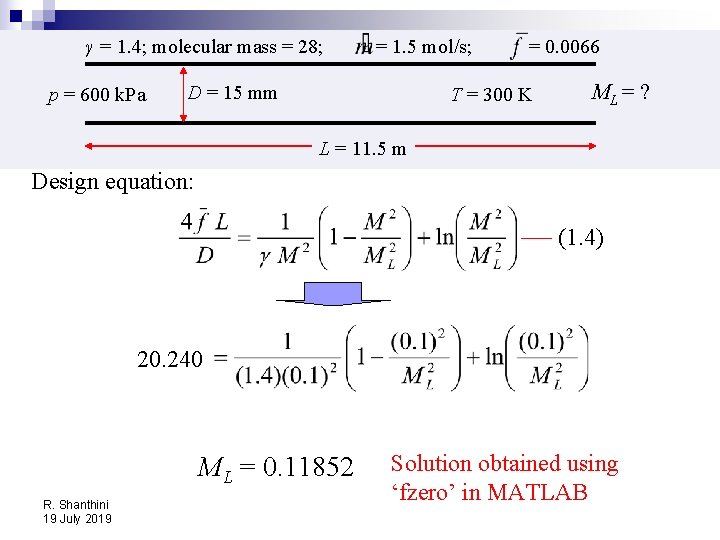
γ = 1. 4; molecular mass = 28; p = 600 k. Pa = 1. 5 mol/s; D = 15 mm = 0. 0066 T = 300 K ML = ? L = 11. 5 m Design equation: (1. 4) 20. 240 ML = 0. 11852 R. Shanthini 19 July 2019 Solution obtained using ‘fzero’ in MATLAB
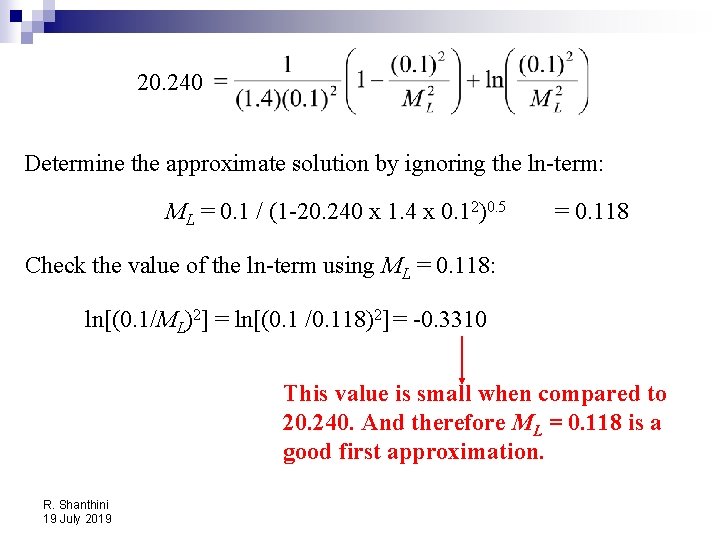
20. 240 Determine the approximate solution by ignoring the ln-term: ML = 0. 1 / (1 -20. 240 x 1. 4 x 0. 12)0. 5 = 0. 118 Check the value of the ln-term using ML = 0. 118: ln[(0. 1/ML)2] = ln[(0. 1 /0. 118)2] = -0. 3310 This value is small when compared to 20. 240. And therefore ML = 0. 118 is a good first approximation. R. Shanthini 19 July 2019
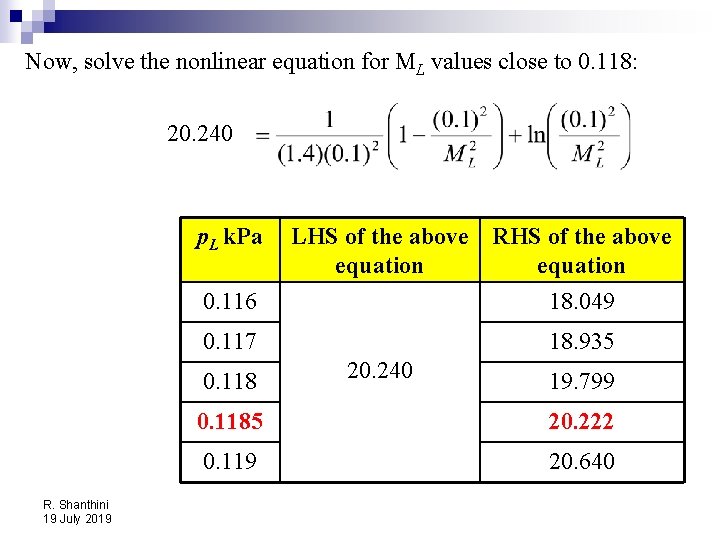
Now, solve the nonlinear equation for ML values close to 0. 118: 20. 240 p. L k. Pa 0. 116 18. 049 0. 117 18. 935 0. 118 R. Shanthini 19 July 2019 LHS of the above RHS of the above equation 20. 240 19. 799 0. 1185 20. 222 0. 119 20. 640
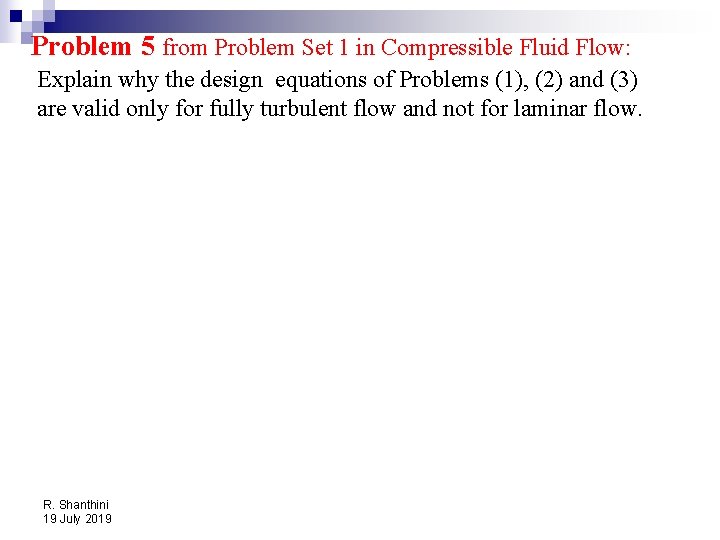
Problem 5 from Problem Set 1 in Compressible Fluid Flow: Explain why the design equations of Problems (1), (2) and (3) are valid only for fully turbulent flow and not for laminar flow. R. Shanthini 19 July 2019
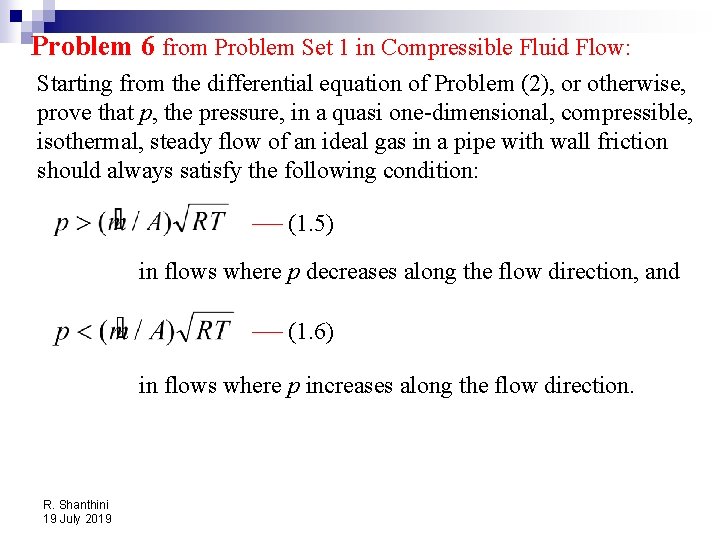
Problem 6 from Problem Set 1 in Compressible Fluid Flow: Starting from the differential equation of Problem (2), or otherwise, prove that p, the pressure, in a quasi one-dimensional, compressible, isothermal, steady flow of an ideal gas in a pipe with wall friction should always satisfy the following condition: (1. 5) in flows where p decreases along the flow direction, and (1. 6) in flows where p increases along the flow direction. R. Shanthini 19 July 2019
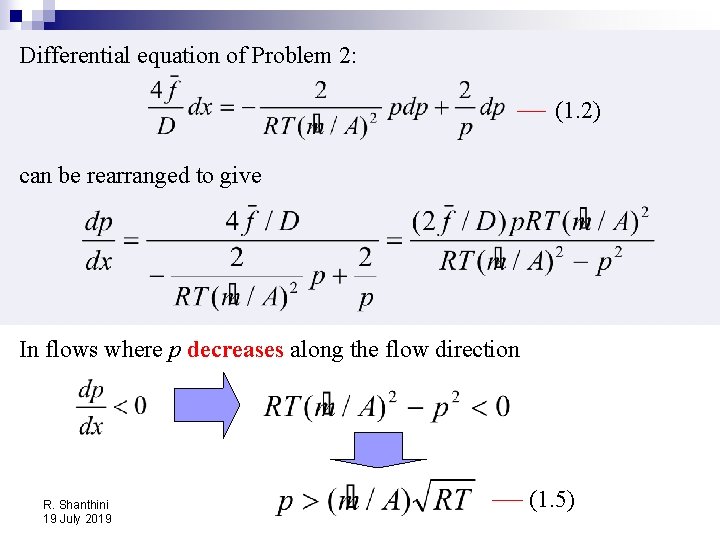
Differential equation of Problem 2: (1. 2) can be rearranged to give In flows where p decreases along the flow direction R. Shanthini 19 July 2019 (1. 5)
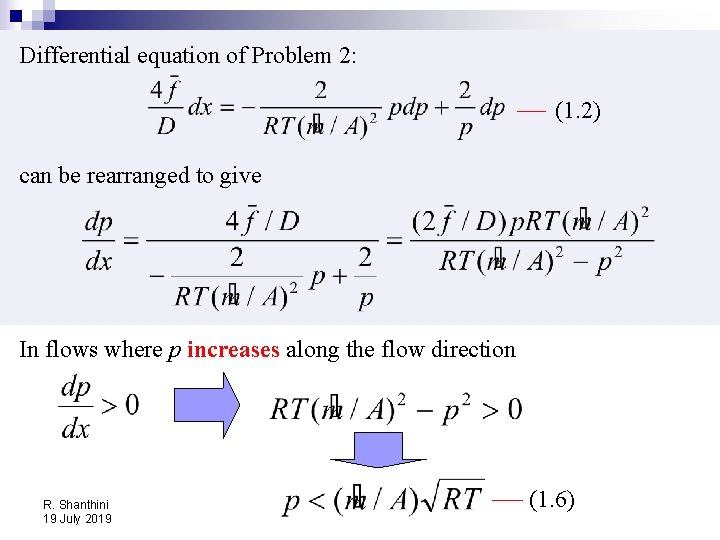
Differential equation of Problem 2: (1. 2) can be rearranged to give In flows where p increases along the flow direction R. Shanthini 19 July 2019 (1. 6)
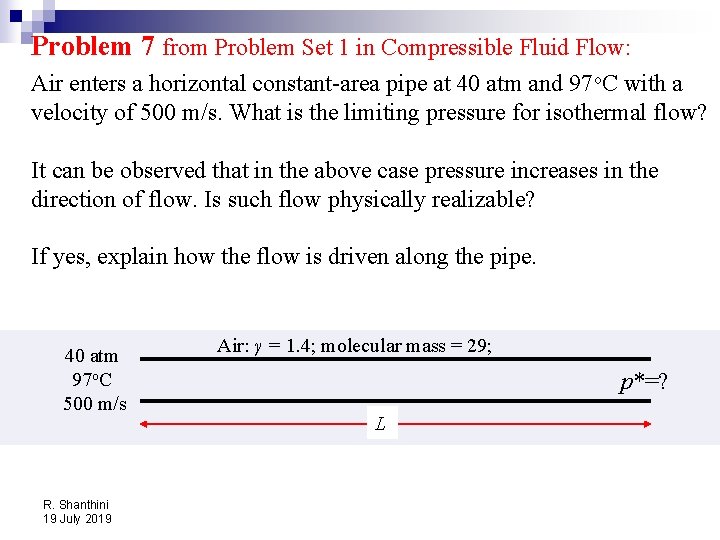
Problem 7 from Problem Set 1 in Compressible Fluid Flow: Air enters a horizontal constant-area pipe at 40 atm and 97 o. C with a velocity of 500 m/s. What is the limiting pressure for isothermal flow? It can be observed that in the above case pressure increases in the direction of flow. Is such flow physically realizable? If yes, explain how the flow is driven along the pipe. 40 atm 97 o. C 500 m/s R. Shanthini 19 July 2019 Air: γ = 1. 4; molecular mass = 29; p*=? L

40 atm 97 o. C 500 m/s Air: γ = 1. 4; molecular mass = 29; p*=? L Limiting pressure: R. Shanthini 19 July 2019

Air: γ = 1. 4; molecular mass = 29; 40 atm 97 o. C 500 m/s p*=? L = R. Shanthini 19 July 2019 (40 atm) (500 m/s) [(8314/29)(273+97) J/kg]0. 5 = 61. 4 atm
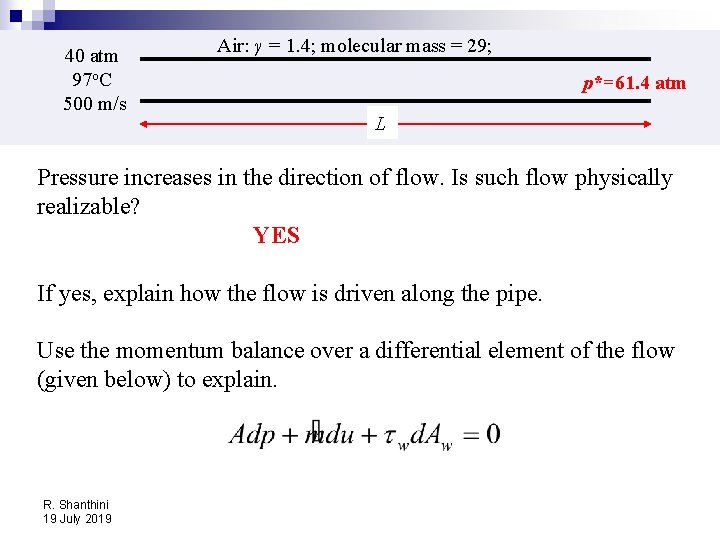
40 atm 97 o. C 500 m/s Air: γ = 1. 4; molecular mass = 29; p*=61. 4 atm L Pressure increases in the direction of flow. Is such flow physically realizable? YES If yes, explain how the flow is driven along the pipe. Use the momentum balance over a differential element of the flow (given below) to explain. R. Shanthini 19 July 2019
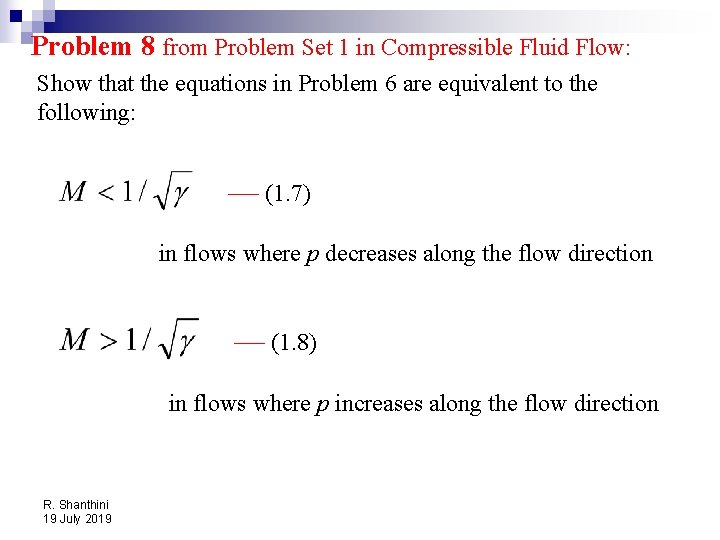
Problem 8 from Problem Set 1 in Compressible Fluid Flow: Show that the equations in Problem 6 are equivalent to the following: (1. 7) in flows where p decreases along the flow direction (1. 8) in flows where p increases along the flow direction R. Shanthini 19 July 2019
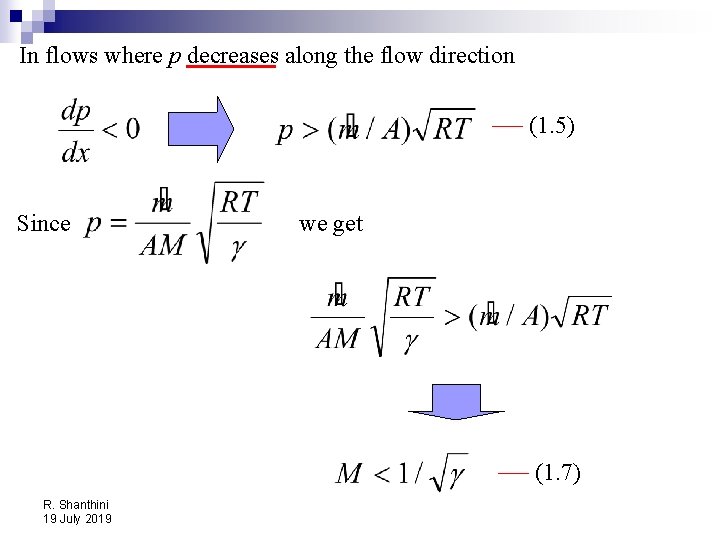
In flows where p decreases along the flow direction (1. 5) Since we get (1. 7) R. Shanthini 19 July 2019
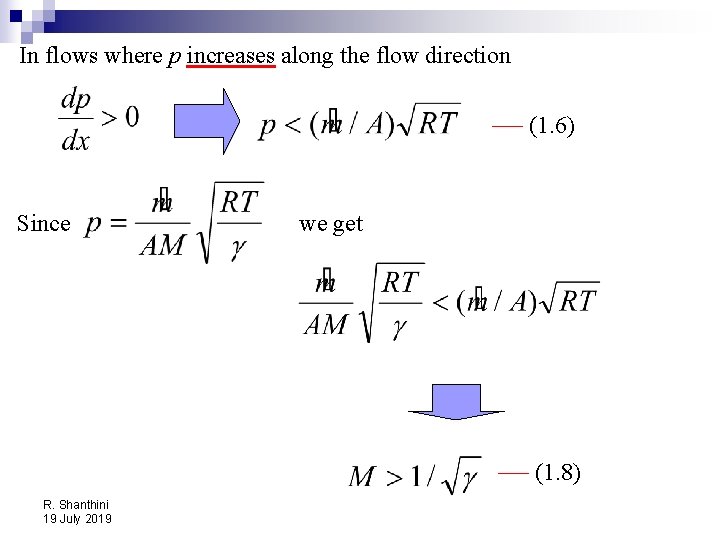
In flows where p increases along the flow direction (1. 6) Since we get (1. 8) R. Shanthini 19 July 2019
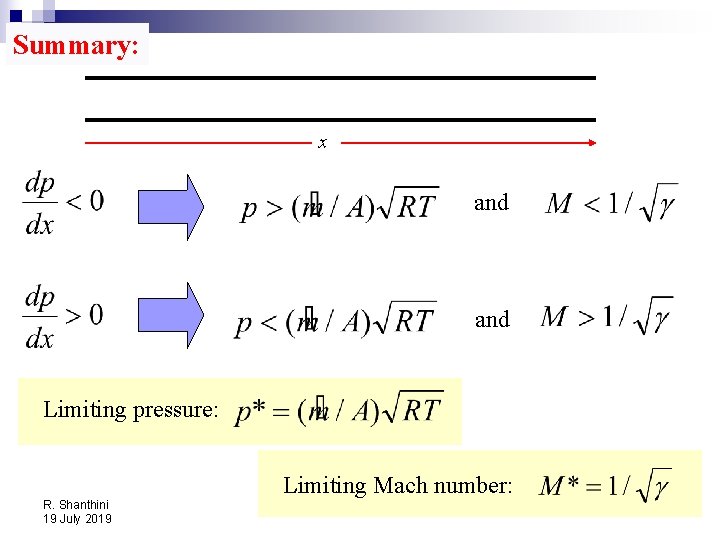
Summary: x and Limiting pressure: R. Shanthini 19 July 2019 Limiting Mach number:
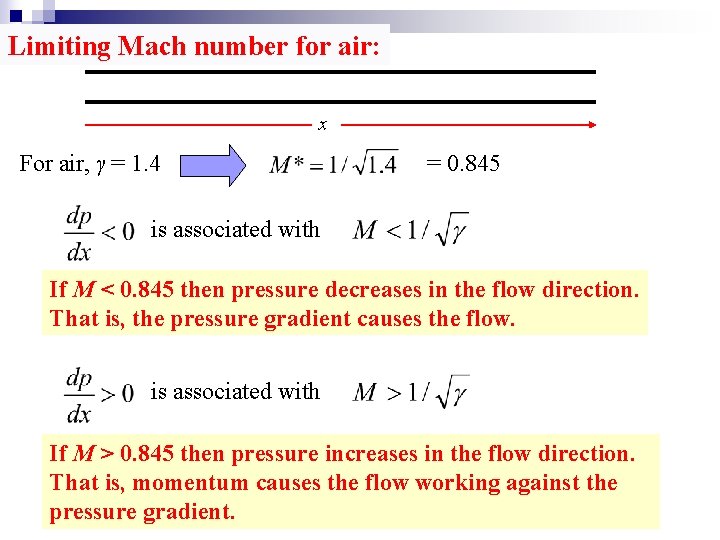
Limiting Mach number for air: x For air, γ = 1. 4 = 0. 845 is associated with If M < 0. 845 then pressure decreases in the flow direction. That is, the pressure gradient causes the flow. is associated with If M > 0. 845 then pressure increases in the flow direction. That is, momentum causes the flow working against the R. Shanthini pressure gradient. 19 July 2019

Problem 9 from Problem Set 1 in Compressible Fluid Flow: Show that when the flow has reached the limiting pressure or the limiting Mach number the length of the pipe across which such conditions are reached, denoted by Lmax, shall satisfy the following equation: where pressure p and Mach number M are the conditions of the flow at the entrance of the pipe. R. Shanthini 19 July 2019
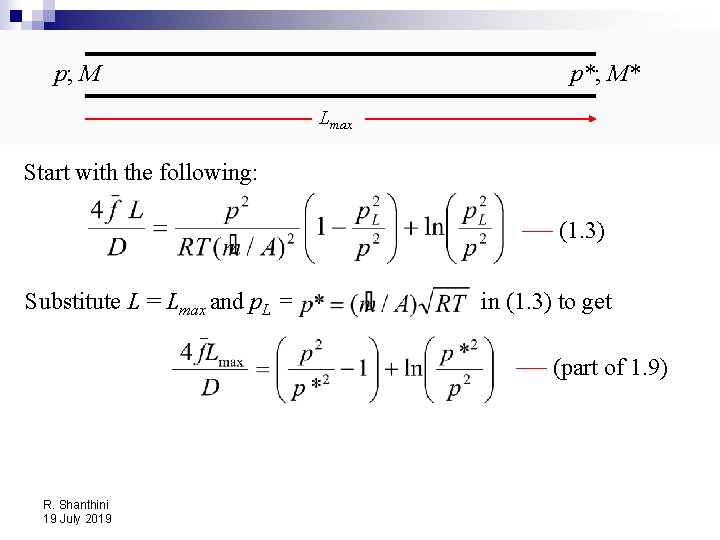
p; M p*; M* Lmax Start with the following: (1. 3) Substitute L = Lmax and p. L = in (1. 3) to get (part of 1. 9) R. Shanthini 19 July 2019
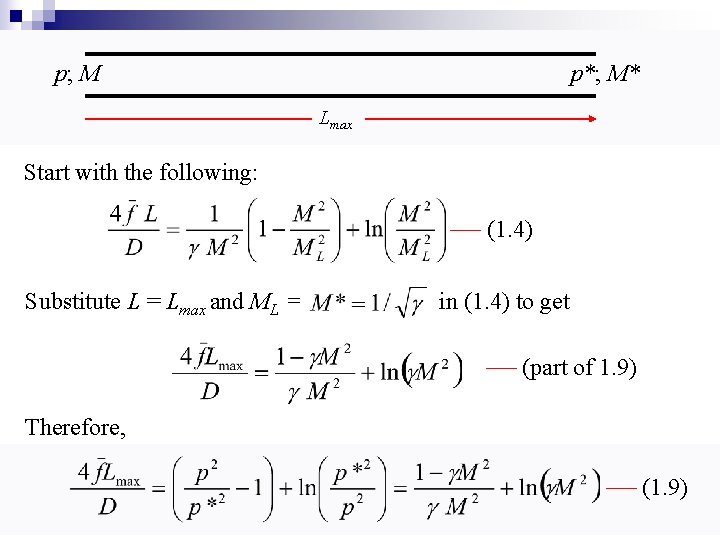
p; M p*; M* Lmax Start with the following: (1. 4) Substitute L = Lmax and ML = in (1. 4) to get (part of 1. 9) Therefore, R. Shanthini 19 July 2019 (1. 9)
- Slides: 30