
COYOTE AND THE BUFFALO MORNING DOVE SILLY QUIZ
COYOTE AND THE BUFFALO MORNING DOVE
SILLY QUIZ #7 What did Buffalo Bull give the coyote in return for fixing his horns?
OBJECTIVES • Recognize different types of characters or stereotypes in a text. • Analyze the impact of the author’s choices regarding how to develop and relate elements of a text.
ABOUT THE AUTHOR • Christine Quintasket wrote under the pen name of Morning Dove and belonged to the Okanogan tribe. • This Folk tale was published in 1933. • She was one of the first female Native American novelists. She overcame quite a lot of adversity. • She fought for the rights of the Native Americans in court as well as attempting to preserve their culture through writing. • She was determined to learn to write in English and so went to several schools to learn to write English correctly.
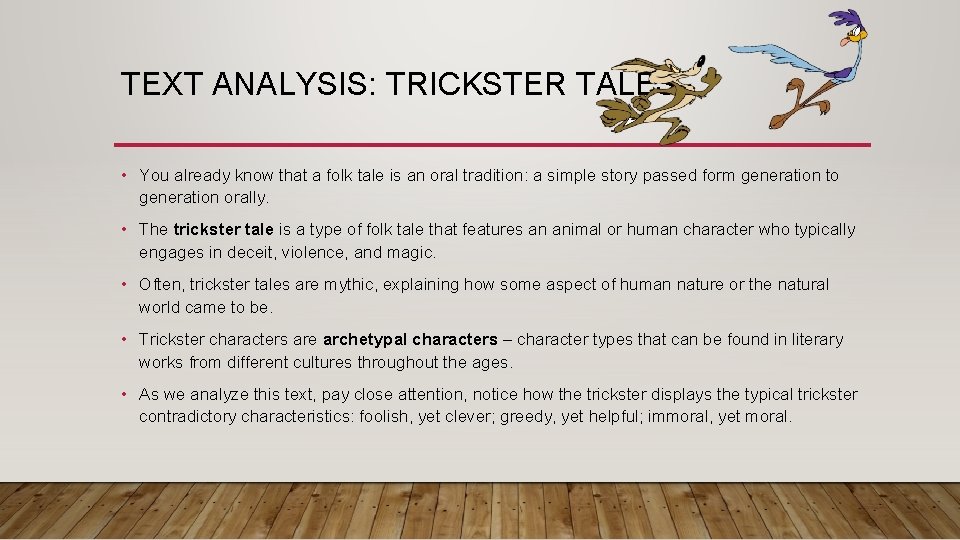
TEXT ANALYSIS: TRICKSTER TALES • You already know that a folk tale is an oral tradition: a simple story passed form generation to generation orally. • The trickster tale is a type of folk tale that features an animal or human character who typically engages in deceit, violence, and magic. • Often, trickster tales are mythic, explaining how some aspect of human nature or the natural world came to be. • Trickster characters are archetypal characters – character types that can be found in literary works from different cultures throughout the ages. • As we analyze this text, pay close attention, notice how the trickster displays the typical trickster contradictory characteristics: foolish, yet clever; greedy, yet helpful; immoral, yet moral.
READING STRATEGIES • Lines 1 -13: According to the opening lines of the story, what was Coyote’s fault? What qualities of Coyote made this problem happen? • Lines 55 – 61: Consider what you know about the archetypal trickster character and think about coyote’s behavior thus far. How do you think Coyote will respond to Buffalo Bull’s instructions? Give reasons. • Lines 36 -46: This trickster tale is mythic in that it explains how something came to be – in this • Lines 66 – 81: Coyote is not the only trickster case, the lack of buffalo in a certain character in this tale. What is the other one? geographic area. What second mythic • Lines 37 -40: How does Coyote gain the explanation is offered in lines 39 – 46? friendship of Buffalo Bull? Why does Buffalo Bull want revenge against Young Buffalo?
DISCUSSION • Analyze tone: discuss the tone of the story. Why did the author choose this tone? Does this tone help or hinder the purpose of this text. • Compare to The World on a Turtle’s Back. Do both have the similar language? Do they have similar purposes? • Interpret trickster tales: trickster tales endure, in part, simply because they are fun to read. But they also often serve to teach a lesson or a moral. What does Coyote and the Buffalo teach or explain? Support your answer.
CULTURAL INTERPRETATIONS • Trickster tales, like other forms of folk literature, offer readers insight into a society’s way of life. What information about the following aspects of Okanogan culture did you glean from this tale? • Traits or qualities the Okanogan admired as well as disapproved of • The traditional role of women in Okanogan society • Okanogan rituals and religious beliefs
TEXT CRITICISM • Critic Paul Rodin has argued that a trickster “is at one and the same time creator and destroyer, giver and negator, he who dupes other and who is always duped himself. . . He posses no values, moral or social, is at the mercy of his passions and appetites. ” identify the ways in which Coyote fits this definition of a trickster. Cite evidence.
- Slides: 9