
Coyle and Castellos Method for Estimating Qp in


- Slides: 11
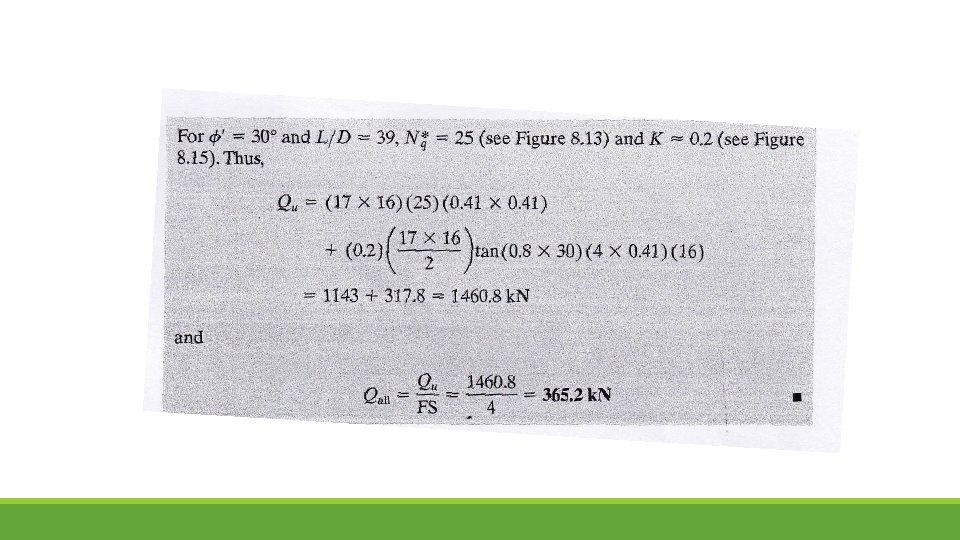
Coyle and Castello’s Method for Estimating Qp in sand
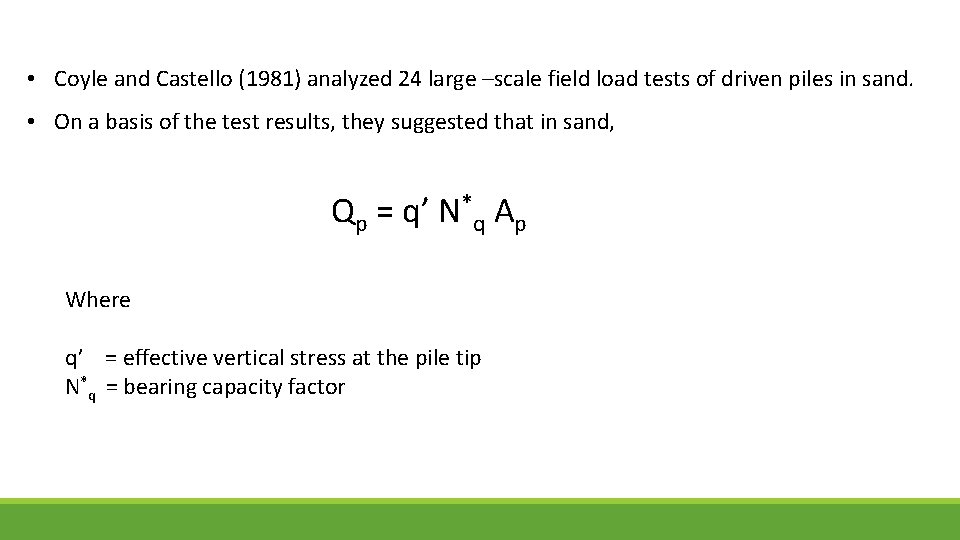
• Coyle and Castello (1981) analyzed 24 large –scale field load tests of driven piles in sand. • On a basis of the test results, they suggested that in sand, Qp = q’ N*q Ap Where q’ = effective vertical stress at the pile tip N*q = bearing capacity factor
Other Correlations for Calculating Qp with SPT and CPT Results
Frictional Resistance (Qs) in Sand
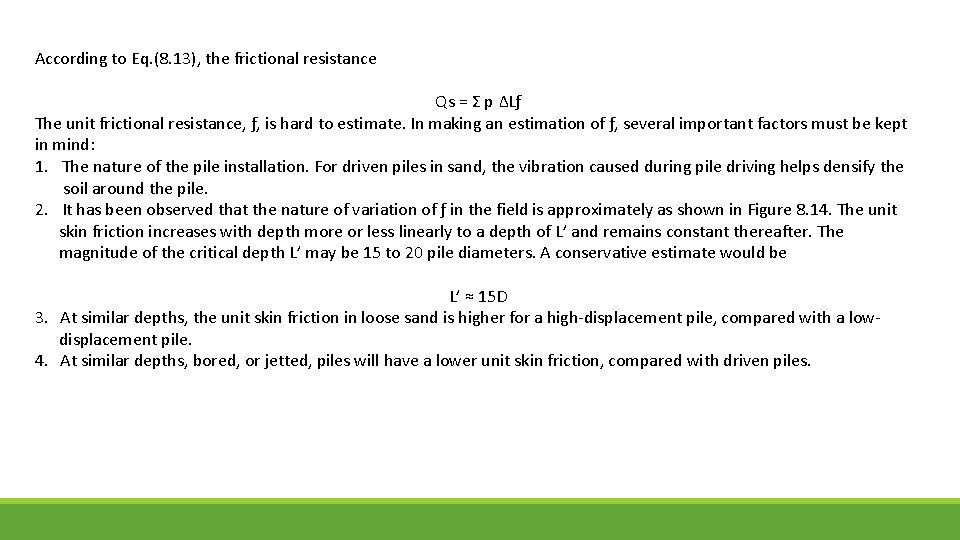
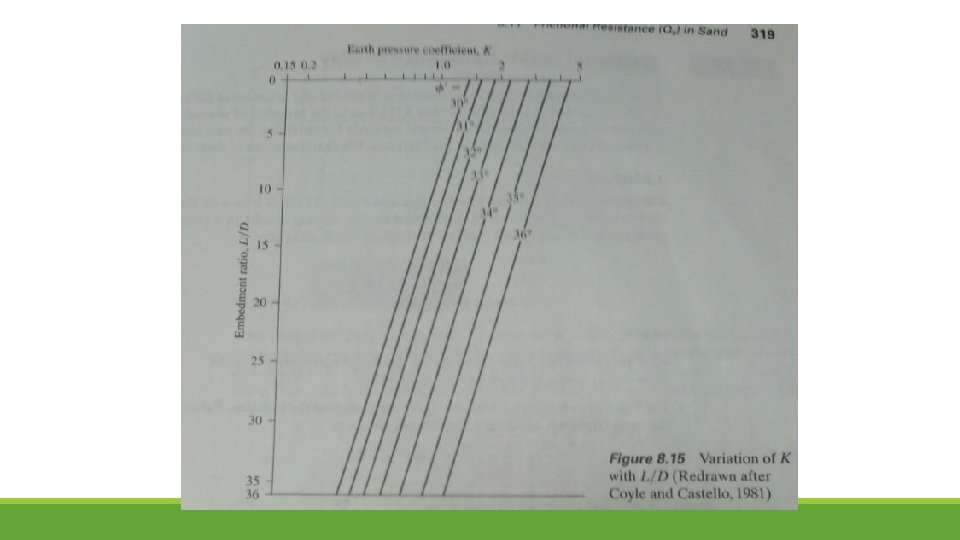
According to Eq. (8. 13), the frictional resistance Qs = Σ p ∆Lƒ The unit frictional resistance, ƒ, is hard to estimate. In making an estimation of ƒ, several important factors must be kept in mind: 1. The nature of the pile installation. For driven piles in sand, the vibration caused during pile driving helps densify the soil around the pile. 2. It has been observed that the nature of variation of ƒ in the field is approximately as shown in Figure 8. 14. The unit skin friction increases with depth more or less linearly to a depth of L’ and remains constant thereafter. The magnitude of the critical depth L’ may be 15 to 20 pile diameters. A conservative estimate would be L’ ≈ 15 D 3. At similar depths, the unit skin friction in loose sand is higher for a high-displacement pile, compared with a lowdisplacement pile. 4. At similar depths, bored, or jetted, piles will have a lower unit skin friction, compared with driven piles.
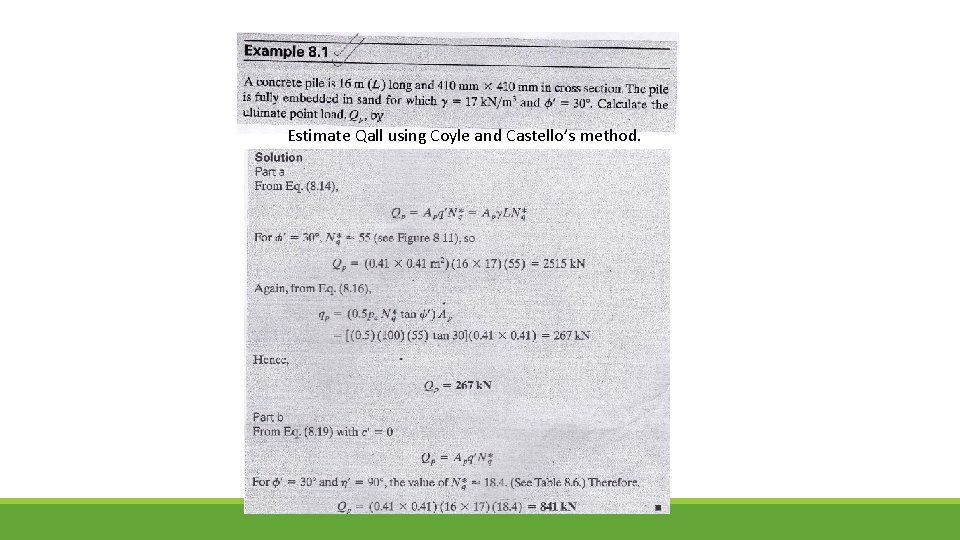
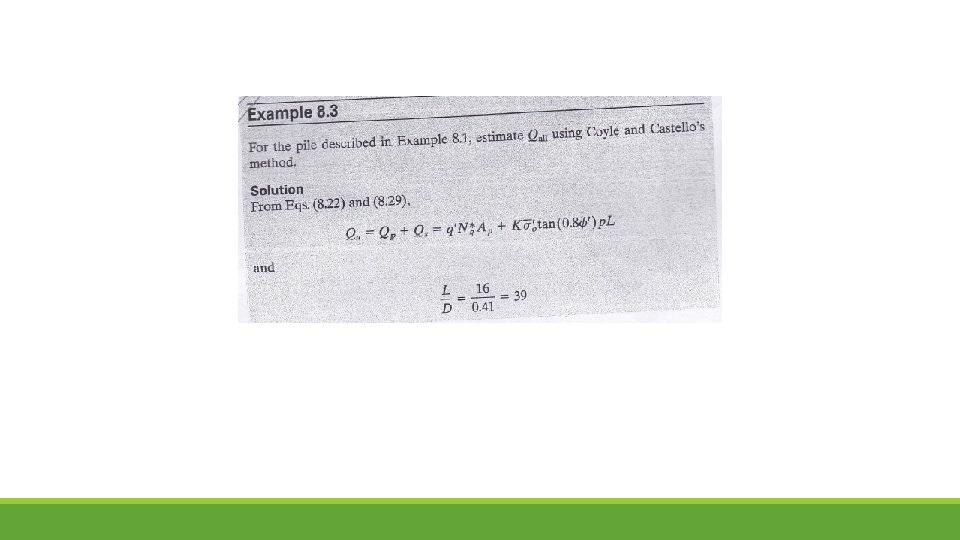
Estimate Qall using Coyle and Castello’s method.