
COVID19 Effective Absence Management Webinar WELCOME AND AGENDA
COVID-19: Effective Absence Management Webinar
WELCOME AND AGENDA • • • The absence management process The legalities around absence management Absence management health & safety considerations Implementing the Bradford Factor Short and long-term absences and how they affect your business Written warnings, disciplinaries and dismissals Coronavirus and absenteeism Presenteeism Absence management software 08450 50 40 60 www. elas. uk. com info@elas. uk. com
IMPACT ON BUSINESS Sickness absence has numerous impacts on businesses and other organisations, both direct and indirect. These include: • • • Reduction in productivity due to less workers Obligations to pay the salary or sick pay of absent workers Having to find, train and pay for temporary cover The possibility of reduced customer satisfaction Reduction in motivation and morale from the other staff. 08450 50 40 60 www. elas. uk. com info@elas. uk. com
THE ABSENCE MANAGEMENT PROCESS: WHAT SHOULD IT INCLUDE? • Absence policies should be fair, consistent and consider sickness and other unforeseen circumstances that may prompt employees to miss work. • A typical staff absence policy will usually outline the procedure an employee is expected to follow when he or she must miss work. This may include details such as who to inform, how, and when. • In addition, employees should know how absence data is recorded and measured, as well as their return to work process. This might include an interview, questionnaires, discussions and how to reintegrate and catch up with the current workload. 08450 50 40 60 www. elas. uk. com info@elas. uk. com

THE ABSENCE MANAGEMENT PROCESS: WHAT SHOULD IT INCLUDE? • Absence policies should also include a statement regarding pay for missed days of work. You must outline how many sick or personal days an employee can take before they are no longer eligible for paid time off. • In the occasion that sickness absence becomes an ongoing problem for an employee, there should be a plan for disciplinary action. 08450 50 40 60 www. elas. uk. com info@elas. uk. com
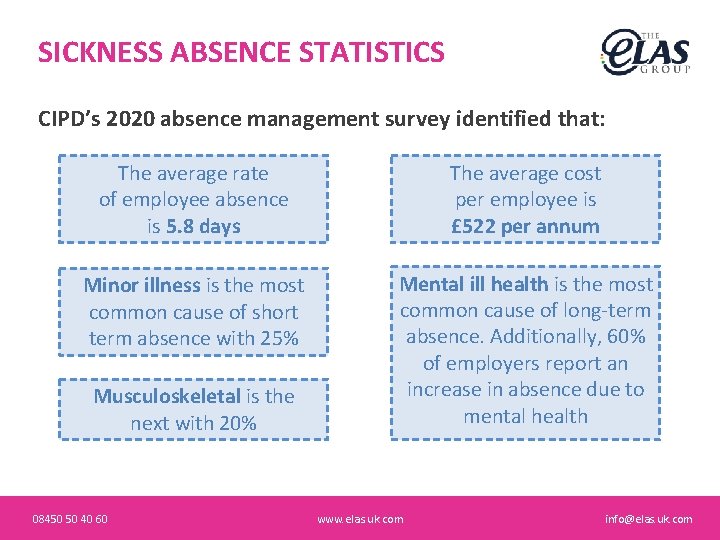
SICKNESS ABSENCE STATISTICS CIPD’s 2020 absence management survey identified that: The average rate of employee absence is 5. 8 days The average cost per employee is £ 522 per annum Minor illness is the most common cause of short term absence with 25% Mental ill health is the most common cause of long-term absence. Additionally, 60% of employers report an increase in absence due to mental health Musculoskeletal is the next with 20% 08450 50 40 60 www. elas. uk. com info@elas. uk. com

TYPES OF ABSENCE • Short or long-term sickness • Other authorised absences, including annual leave; maternity, paternity, adoption • Parental leave; time off for public or trade union duties • Care of dependents; compassionate leave; educational leave • Unauthorised absence or persistent lateness • Minor illness (includes colds/flu, stomach upsets, headaches and migraines) • Musculoskeletal injuries, including back pain • Stress • Mental ill health (for example depression and anxiety) • Caring responsibilities for children 08450 50 40 60 www. elas. uk. com info@elas. uk. com

LEGALITIES AROUND ABSENCE MANAGEMENT • Employment Rights Act 1996 • Health and Safety at Work 1974 • The Management of Health and Safety at Work Regulations 1999 • Equality Act 2010 • GDPR All processing of health information must meet the GDPR requirements for special category data 08450 50 40 60 www. elas. uk. com info@elas. uk. com
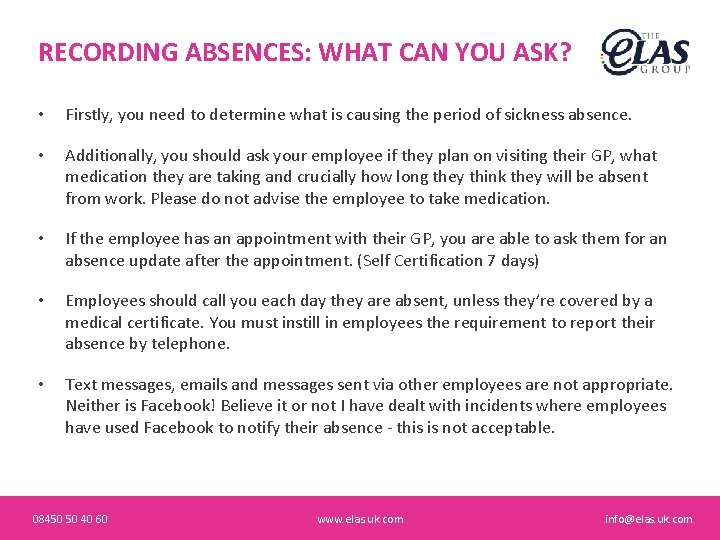
RECORDING ABSENCES: WHAT CAN YOU ASK? • Firstly, you need to determine what is causing the period of sickness absence. • Additionally, you should ask your employee if they plan on visiting their GP, what medication they are taking and crucially how long they think they will be absent from work. Please do not advise the employee to take medication. • If the employee has an appointment with their GP, you are able to ask them for an absence update after the appointment. (Self Certification 7 days) • Employees should call you each day they are absent, unless they’re covered by a medical certificate. You must instill in employees the requirement to report their absence by telephone. • Text messages, emails and messages sent via other employees are not appropriate. Neither is Facebook! Believe it or not I have dealt with incidents where employees have used Facebook to notify their absence - this is not acceptable. 08450 50 40 60 www. elas. uk. com info@elas. uk. com

ABSENCE MANAGEMENT AND YOUR HEALTH & SAFETY RESPONSIBILITIES • Record and monitor sickness absence to help you identify trends and manage risk • Train your managers in how to effectively manage sick leave and the return-to-work process • Stay connected with workers who are off sick, ensuring the conversation remains focused on their health, safety and wellbeing and their return to work • Consider making workplace adjustments to help workers return to work. This could include shorter hours, flexible or part-time working, or adapting work equipment. • Upon your employee’s return to work, you should review your health and safety risk assessment if: • • • a worker’s health condition makes them or others more vulnerable to workplace risks the impact of the workplace adjustments could affect the work and health of others Refer to professional advice on issues such as fitness to work or workplace adjustments. Occupational health can help. 08450 50 40 60 www. elas. uk. com info@elas. uk. com
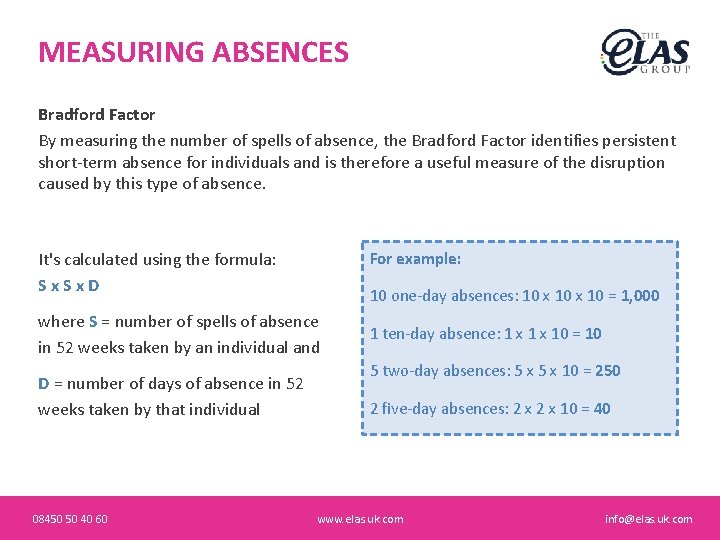
MEASURING ABSENCES Bradford Factor By measuring the number of spells of absence, the Bradford Factor identifies persistent short-term absence for individuals and is therefore a useful measure of the disruption caused by this type of absence. For example: It's calculated using the formula: Sx. D 10 one-day absences: 10 x 10 = 1, 000 where S = number of spells of absence in 52 weeks taken by an individual and D = number of days of absence in 52 weeks taken by that individual 08450 50 40 60 1 ten-day absence: 1 x 10 = 10 5 two-day absences: 5 x 10 = 250 2 five-day absences: 2 x 10 = 40 www. elas. uk. com info@elas. uk. com
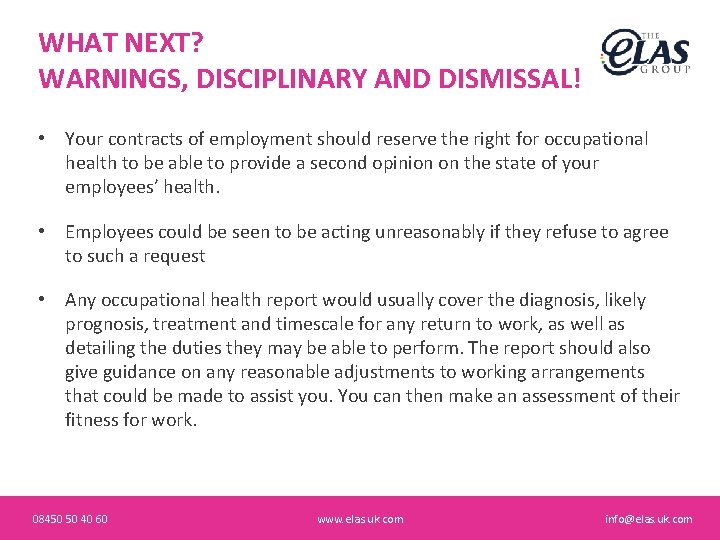
WHAT NEXT? WARNINGS, DISCIPLINARY AND DISMISSAL! • Your contracts of employment should reserve the right for occupational health to be able to provide a second opinion on the state of your employees’ health. • Employees could be seen to be acting unreasonably if they refuse to agree to such a request • Any occupational health report would usually cover the diagnosis, likely prognosis, treatment and timescale for any return to work, as well as detailing the duties they may be able to perform. The report should also give guidance on any reasonable adjustments to working arrangements that could be made to assist you. You can then make an assessment of their fitness for work. 08450 50 40 60 www. elas. uk. com info@elas. uk. com
WHAT NEXT? WARNINGS, DISCIPLINARY AND DISMISSAL! • If all else fails, follow the process set out in your absence management policy • Investigate, invite and follow your disciplinary process • Bradford factor trigger points: 51 points – informal verbal warning. 201 points – formal written warning. 401 points – final written warning. 601 points – dismissal • Always consult with your HR department / ELAS prior to action to protect any indemnity 08450 50 40 60 www. elas. uk. com info@elas. uk. com
SICKNESS ABSENCE IN THE TIME OF CORONAVIRUS • New legislation relating to COVID-19 means that Statutory Sick Pay (SSP) is available from day one (instead of day four) for those affected by coronavirus when self-isolating. • Employers with fewer than 250 employees can also claim a refund for COVID-19 related SSP costs (up to two weeks per employee). • Employees can self-certify for the first seven days, as normal. Government advice is that employers should use discretion around the need for medical evidence beyond that for absence where an employee has to self-isolate in the current exceptional circumstances. 08450 50 40 60 www. elas. uk. com info@elas. uk. com
SICKNESS ABSENCE IN THE TIME OF CORONAVIRUS • The Government has introduced a temporary alternative to the fit note for the duration of the COVID-19 outbreak whereby those in self-isolation can obtain a notification via NHS 111 to use as evidence for absence from work. • An alternative option to providing sick pay is to allow people who are asked to self-isolate, but are not unwell, to work from home wherever possible, and continue to pay as normal. • Many organisations are treating sickness absence related to COVID-19 (including that due to people self-isolating) outside of their normal sickness absence reporting system. 08450 50 40 60 www. elas. uk. com info@elas. uk. com
THE COST OF PRESENTEEISM • According to one report, for every £ 1 cost to business of absenteeism, there is estimated to be an additional cost of £ 2. 50 due to presenteeism • Presenteeism occurs when employees turn up to work despite being unwell. While employees may think that being present at work is more beneficial to the business and their colleagues than if they stayed at home to rest and recuperate, the opposite is quite often the case • It’s likely your employee won’t be able to perform at their best while they’re feeling unwell meaning that their productivity may suffer as a result • A recent CIPD report reveals that 86% of respondents had observed presenteeism within their organisation over the last 12 months, compared with 72% in 2017 and 26% in 2010. 08450 50 40 60 www. elas. uk. com info@elas. uk. com
SOLUTIONS • Occupational Health and Wellbeing • First Aid Mental health • Regular Training • Management Training 08450 50 40 60 www. elas. uk. com info@elas. uk. com
ATTENDANCE PRO • 24 hour absence management line and software • Employees report their absence to our absence advisors who open, record, update and close absences accordingly. • We follow up with the employee until they return to work • All absence information is automatically emailed to your designated manager. • This absence information can also be viewed on the secure Attendance Pro portal • Upon closure of absence, your company’s return to work form is automatically emailed for your employee to complete • Tailor the absence questions/information you would like us to ask your unwell employees 08450 50 40 60 www. elas. uk. com info@elas. uk. com
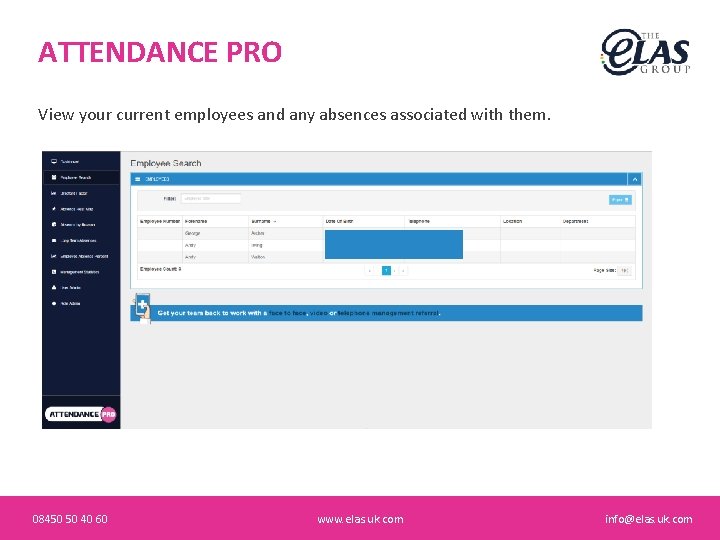
ATTENDANCE PRO View your current employees and any absences associated with them. 08450 50 40 60 www. elas. uk. com info@elas. uk. com
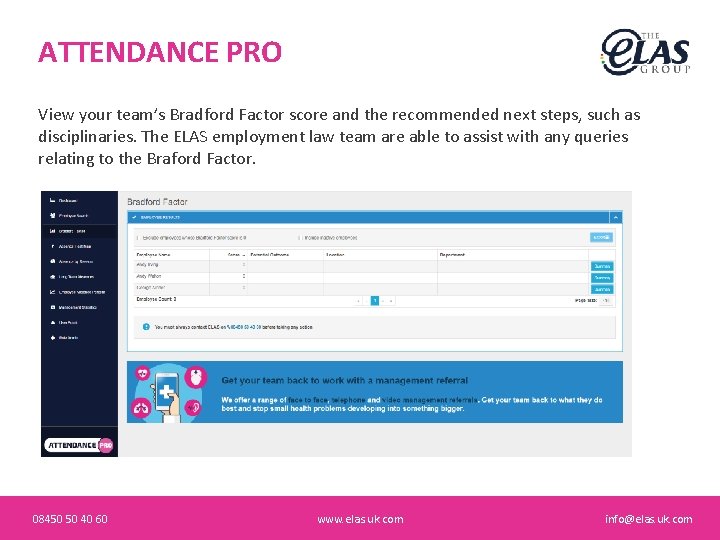
ATTENDANCE PRO View your team’s Bradford Factor score and the recommended next steps, such as disciplinaries. The ELAS employment law team are able to assist with any queries relating to the Braford Factor. 08450 50 40 60 www. elas. uk. com info@elas. uk. com
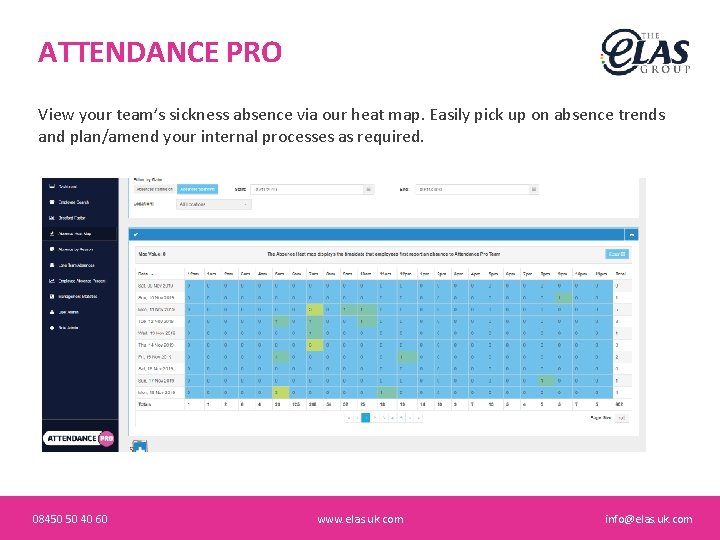
ATTENDANCE PRO View your team’s sickness absence via our heat map. Easily pick up on absence trends and plan/amend your internal processes as required. 08450 50 40 60 www. elas. uk. com info@elas. uk. com
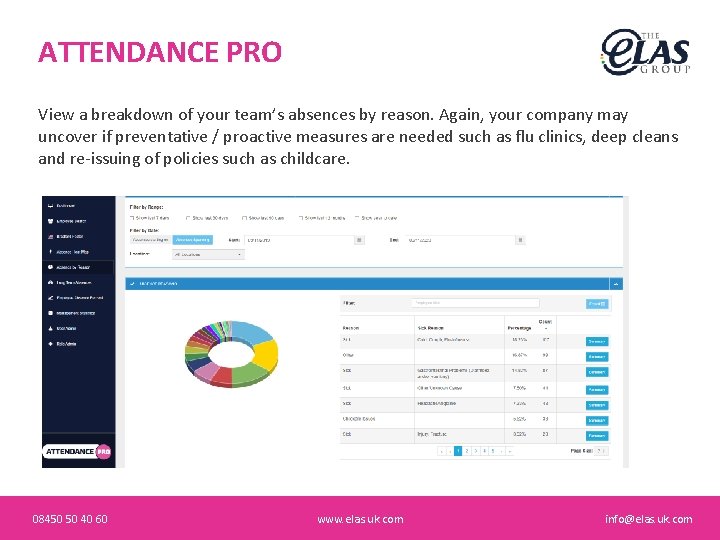
ATTENDANCE PRO View a breakdown of your team’s absences by reason. Again, your company may uncover if preventative / proactive measures are needed such as flu clinics, deep cleans and re-issuing of policies such as childcare. 08450 50 40 60 www. elas. uk. com info@elas. uk. com
ATTENDANCE PRO Benefits include: • Save HR resource time • Detailed absence recordings and notes that can be tailored to your business • Secure online storage of your team’s absence records • Automatic calculation of Bradford Factor scores and recommended follow up action • 24 hour manned phoneline • Cost savings – start from as little as £ 2. 50 person per month • Organise occupational health referrals • Employment law support 08450 50 40 60 www. elas. uk. com info@elas. uk. com
ATTENDEE SPECIAL OFFER! We are offering you all a 30 day trial of Attendance Pro, our 24/7 absence management service and software. The team will be in touch with you all for feedback and questions to see if we can help with anything else. 08450 50 40 60 www. elas. uk. com info@elas. uk. com
THANKS FOR YOUR TIME Questions ? 08450 50 40 60 www. elas. uk. com info@elas. uk. com

T: 08450 50 40 60 W: www. elas. uk. com E: info@elas. uk. com
- Slides: 26