
COVID19 Coping with the Stress By Emily Burkey
COVID-19: Coping with the Stress By: Emily Burkey, PLMHP, PCMSW
Taking Care of Yourself • We are in the midst of an unprecedented time in history with a pandemic illness, restrictions, and constant access to media and information that can be very overwhelming. • Knowing and following all the proper precautions and focusing on how to maintain your physical health are of utmost importance, but your mental health and wellbeing are also important factors. • If you’re mentally and emotionally exhausted, this can make you more susceptible to illness. • It’s normal to have feelings of worry, anxiety or fear when you have to consider your own health, the health of your loved ones and the staff who care for you, the possibility of exposing others to illness, the challenge of getting needed items, social distancing, being self-isolated or self-quarantined, etc. • When things start to feel out of control, there are several things you can do to help manage that stress.
Improve Your Sense of Safety You can improve your own sense of safety and well-being by taking these steps to keep you and those you care about safe: v Wash your hands frequently! Use soap and water whenever possible and wash for at least 20 seconds. v Cough or sneeze into a tissue or your folded elbow. Properly dispose of used tissues. v Stay in your room if you are sick and alert staff if you’re having any symptoms. v Avoid touching your face (mouth, nose, eyes) with unwashed hands. v Avoid close contact with those who are sick. v Follow all recommendations staff give you. We want to keep you safe!
Unplug and Trust Your Resources • Do you find that your anxiety is increasing when you watch the news and read media articles? • Repeatedly seeing images and reading about the crisis can be very upsetting and overwhelming. • Try to set limits or take breaks to avoid too much exposure. Consider checking the news only at certain times each day, and focus on doing normal activities as much as possible or focus on more uplifting, positive images and stories to take a mental break. • If you have a question about a current procedure or rule in the facility, ask the management staff. The NDVA is in contact with the governor’s task force regularly and is following all directives from the government and the CDC. • Please be patient with the staff, as this is a new situation for the country and we are working diligently to keep the members, staff, and all of our loved ones safe.
Improve Your Sense of Control • Even though you can’t control the virus or the situation around you, focus on ways you can improve your own sense of control which will help reduce your stress. • Reflect on what can and cannot be changed in your situation. Accept what cannot be changed, and adjust your internal definition of what a “good day” is, considering your current situation. • Focus on setting achievable, realistic goals within the new circumstances. • Get organized and prepare as much as possible. Think through potential scenarios and have a plan for how you will handle each scenario. • Avoid acting on impulse. • Continue to use positive coping skills you have used in the past. • Remember to take care of your body by getting adequate sleep, nutrition, and exercise.
Find a Balance § Finding balance in a crisis can be difficult. You want to know what is happening, but it can be stressful and overwhelming. § Take breaks from talking about COVID-19. Instead, talk with others about fun memories, funny stories, the weather, your favorite TV show, etc. without focusing on the current issues. § Stay connected to your loved ones. Staff will assist you if you need help to connect virtually, such as using Skype, Face. Time, or Facebook Messenger video calls to contact your loved ones. There also several facility phones available that you can use.
Relaxation Techniques • There are many therapeutic relaxation techniques one can try in order to relax the mind and body and reduce tension that has built up. While some of these techniques may seem a little odd the first time you try them, they are reliable, valid tools that can really be helpful in times of increased stress. • Give them a try and see which ones work best for you. Consider rating how anxious/stressed you feel on a scale of 1 to 10 prior to starting one of these techniques, and then rate yourself again after completing the technique to see if it was helpful to you. • Some of these might take some practice, but they should get easier each time. Mindfulness: Watch this short video to learn about the 4 ways to cultivate mindfulness from the VA of Greater Los Angeles https: //www. youtube. com/watch? v=s. U-x. RVB 7 r. VE 1. Grounding (Focusing on the sensations from all 5 senses) 2. STOP acronym (Stop, Take a breath, Observe your sensations/thoughts/feelings, Proceed) 3. Anchor phrase (i. e. This too shall pass, It will be okay, etc. ) 4. 3 P’s (Pause, be Present, Proceed)
Relaxation Techniques Progressive Muscle Relaxation and Progressive Relaxation: A two-step practice in which you tighten and then relax certain groups of muscles in a sequence. • This link takes you to a printout to walk you through Progressive Muscle Relaxation. https: //www. va. gov/WHOLEHEALTH/Veteran-Handouts/docs/Progress. Muscle. Relax__Final 508_1113 -2018. pdf • This link is a video walking you through PMR https: //www. youtube. com/watch? v=Clq. Pt. Wzoz. Xs
Relaxation Techniques Continued Guided Meditation/Relaxation: You. Tube has any type of guided meditation, ranging in time from a couple of minutes to over an hour. Find one that is relaxing to you. Some have calming music in the background, some have the sound of the beach, ocean waves, or rain. Some simply have a quiet voice guiding you through the meditation. Guided Imagery is a similar tool, in which they walk you through a peaceful place or scenario verbally while you visualize it or they may show pictures of the scenery. Here a couple short examples you can try: https: //www. youtube. com/watch? v=i 50 ZAs 7 v 9 es https: //www. youtube. com/watch? v=Y 7 v. OFq 9 y 6 e. M Guided imagery video: https: //www. youtube. com/watch? v=_6 af. FD-a 7 x 0
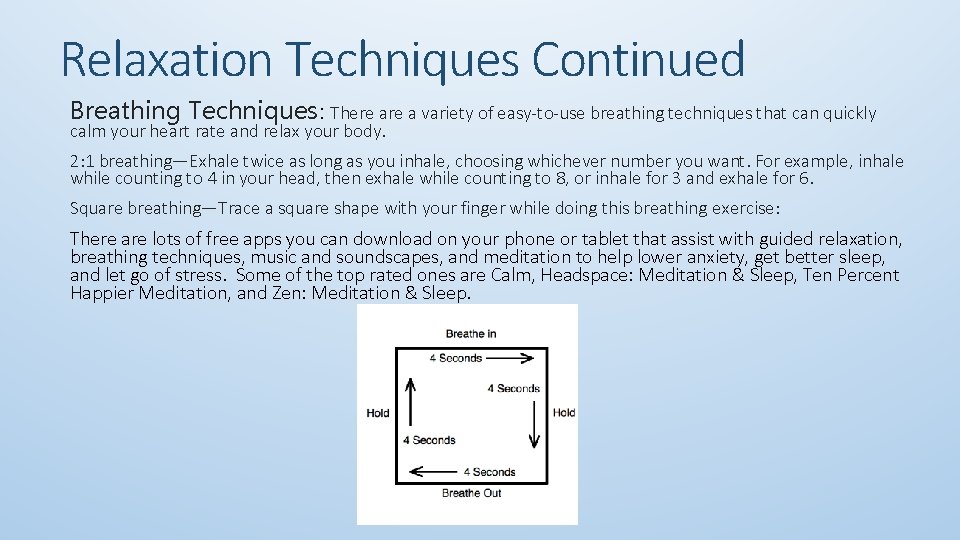
Relaxation Techniques Continued Breathing Techniques: There a variety of easy-to-use breathing techniques that can quickly calm your heart rate and relax your body. 2: 1 breathing—Exhale twice as long as you inhale, choosing whichever number you want. For example, inhale while counting to 4 in your head, then exhale while counting to 8, or inhale for 3 and exhale for 6. Square breathing—Trace a square shape with your finger while doing this breathing exercise: There are lots of free apps you can download on your phone or tablet that assist with guided relaxation, breathing techniques, music and soundscapes, and meditation to help lower anxiety, get better sleep, and let go of stress. Some of the top rated ones are Calm, Headspace: Meditation & Sleep, Ten Percent Happier Meditation, and Zen: Meditation & Sleep.
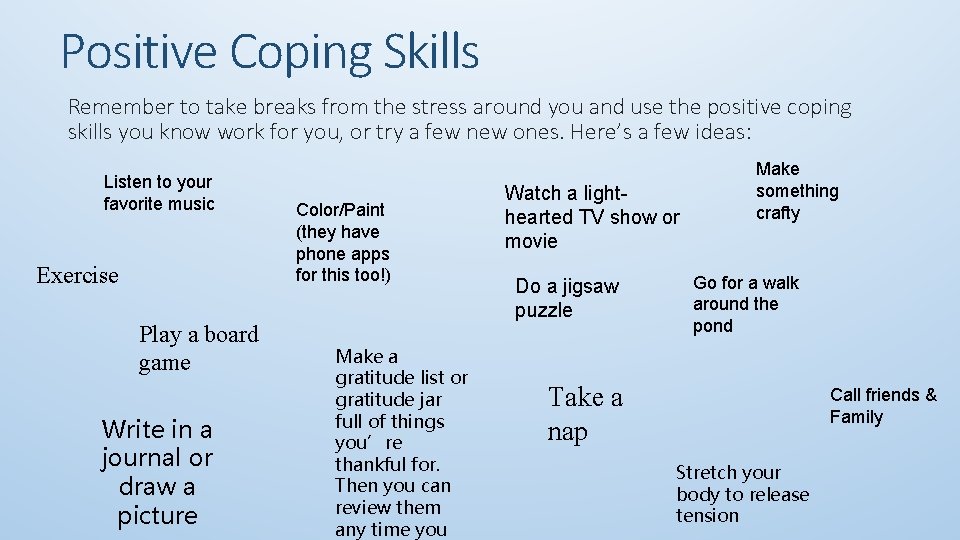
Positive Coping Skills Remember to take breaks from the stress around you and use the positive coping skills you know work for you, or try a few new ones. Here’s a few ideas: Listen to your favorite music Exercise Play a board game Write in a journal or draw a picture Color/Paint (they have phone apps for this too!) Make a gratitude list or gratitude jar full of things you’re thankful for. Then you can review them any time you Watch a lighthearted TV show or movie Do a jigsaw puzzle Make something crafty Go for a walk around the pond Take a nap Call friends & Family Stretch your body to release tension
Sleep § Adequate sleep is very important for health, especially during times that are particularly mentally, emotionally, or physically difficult. § Sleep can be disrupted by stress and anxiety, and lack of sleep can negatively impact how well you can think, react, work, and learn. It can also raise your risk of chronic health problems such as high blood pressure, heart disease, stroke, among others. § If sleep problems start to become a chronic issue, consider keeping a sleep diary to track your sleeping patterns and talk to your doctor. § Relaxing before going to bed or while in bed can help your body let go of tension and naturally fall into a state of rest.
Sleep § Consider developing a bedtime routine that will signal your body and mind it’s time to go to bed. (i. e. change into pajamas, have some hot tea, read a chapter of a book before bed, etc. ) Find what works for you. § Avoid electronics immediately before bed. The light they put off can be very stimulating for your brain and may keep you awake longer. § Consider limiting your caffeine use later in the day or reducing how much caffeine you drink. § Try relaxation methods such as guided imagery, controlled breathing exercises, guided relaxation, progressive muscle relaxation, calming soundscapes or music, etc.
Maintain a Sense of Hope v. Spirituality focuses on connecting with something that is greater than yourself, connecting with others, and it gives your life a sense of meaning. v. Spirituality is a unique experience to each person and can look many different ways. v. Focus on those things that give you a sense of purpose and meaning—reflect on your actions for the day and how you have served a greater purpose, such as by spreading joy to another member or a staff member. v. Pray or spend time reading a spiritual text that is important to you. v. Watch an inspirational talk, sermon, or video. Talk with a clergy person over the phone or talk with a staff member.
Maintain a Sense of Hope v. Practice gratitude—every day think of or write down several things you are grateful or thankful for. v. Practice self-compassion—be kind to yourself and celebrate your successes. Take satisfaction in completing tasks, even the small ones. It may help to write down all the things you’ve accomplished for the day. v. Remember to be patient with yourself and others and to look at this situation as an opportunity to grow and learn. v. Spread joy and encourage others around you with a smile or kind word. We’re all in this together. v. Look at the situation in its broader context. Instead of negative self-talk such as “This is such a hard time, ” try to add a positive note such as “This is such a hard time, but we’ll get through it together. ” v. Identify and acknowledge your feelings and emotions. It’s okay to get upset, but remember that feelings change and you aren’t going to feel like this forever. Find a positive way to work through those feelings, such as speaking to someone you trust or writing in a journal.
When to Seek Professional Help If you are experiencing these distress symptoms for several days in a row and it is impacting your ability to carry out your normal responsibilities, talk to a staff member or one of the social workers. Look out for these common signs of distress: q. Feelings of numbness, disbelief, anxiety or fear q. Changes in appetite, energy, and activity levels q. Difficulty concentrating q. Difficulty sleeping or nightmares and upsetting thoughts and images q. Physical reactions, such as headaches, body pains, stomach problems, and skin rashes q. Worsening of chronic health problems q. Anger or short-temper https: //emergency. cdc. gov/coping/selfcare. asp
References Centers for Disease Control and Prevention. (2019, September 13). Emergency Preparedness and Response: Coping with a Disaster or Traumatic Event. https: //emergency. cdc. gov/coping/index. asp Christopher, Ariel. (2016, June 29). Guided Imagery Meditation Short walk in Nature [Video]. Youtube. https: //www. youtube. com/watch? v=_6 af. FD-a 7 x 0 Deer Oaks EAP Services. (2020, April). The Employee Enhancement Newsletter: Helpful Resources From Your Employee Assistance Program. Johns Hopkins Rheumatology. (2018, February 7). Reduce Stress through Progressive Muscle Relaxation (3 of 3)[Video]. Youtube. https: //www. youtube. com/watch? v=Clq. Pt. Wzoz. Xs Soul Calm. (2016, April 22). Guided Meditation Beach (5 minutes to Inner Calm) [Video]. Youtube. https: //www. youtube. com/watch? v=Y 7 v. OFq 9 y 6 e. M Substance Abuse and Mental Health Services Administration. (2014). Taking Care of Your Behavioral Health: Tips for Social Distancing, Quarantine, and Isolation During an Infectious Disease Outbreak. http: //store. samhsa. gov/product/Taking-Care-of. Your-Behavioral-Health-During-an-Infectious-Disease-Outbreak/sma 14 -4894? referer=from_search_result The Honest Guys. (2014, October 7). 5 MINUTE Calming Meditation (With Guiding Voice) [Video]. Youtube. https: //www. youtube. com/watch? v=i 50 ZAs 7 v 9 es U. S. Department of Veterans Affairs. (2018, August 1). Whole Health: Information for Veterans: Progressive Muscle Relaxation and Progressive Relaxation. https: //www. va. gov/WHOLEHEALTH/Veteran-Handouts/docs/Progress. Muscle. Relax__Final 508_11 -132018. pdf U. S. Department of Veterans Affairs. (2019, November 1). Whole Health: The Circle of Health. https: //www. va. gov/WHOLEHEALTH/circle-of-health/index. asp Veterans Health Administration. (2014, September 16). Four Ways to Cultivate Mindfulness [Video]. Youtube. https: //www. youtube. com/watch? v=s. U-x. RVB 7 r. VE
- Slides: 17