
Covid19 and football club insolvency 1 2 3

Covid-19 and football club insolvency 1. 2. 3. 4. 5. 6. Insolvency in England Football insolvency The financial position of English football before the crisis The long term risks A solution
1. Insolvency in England
Bankruptcy/insolvency definition • In the UK, bankruptcy relates to (real) persons, insolvency relates to (limited liability) companies • Insolvency is defined in English law as the situation where a company is unable to pay its debts, which is when • Either, payment by a creditor is requested but not made (cash-flow insolvency) • Or, the value of the assets owned by a business is less than the value of the liabilities (balance sheet insolvency) NB: Bankruptcy laws vary significantly by jurisdiction
Evolution of the law • Before 1985, unpaid creditors applied to a court to have a company liquidated if debts were unpaid. Liquidation entailed selling all of the assets of the company to repay as much of the debt as possible, and then close the company • After 1985 English law changed to allow companies threatened with liquidation to • Either, appoint an independent administrator to manage the company with a view to reaching a settlement with creditors while preserving the business • Or, to propose a Creditor Voluntary Arrangement (CVA) to write of some debt with a view to preserving the business
What triggers insolvency? • If a company directors knows that the company is insolvent – meaning that creditors will not be able to be repaid in full – then they should start an insolvency proceeding • Creditors can also petition the courts to start insolvency proceedings
What is the outcome of the insolvency process? • Most businesses entering insolvency are liquidated – assets sold and the company shut down • Football clubs are unusual in that most clubs survive, and most of the businesses that own the clubs survive- although typically under new ownership
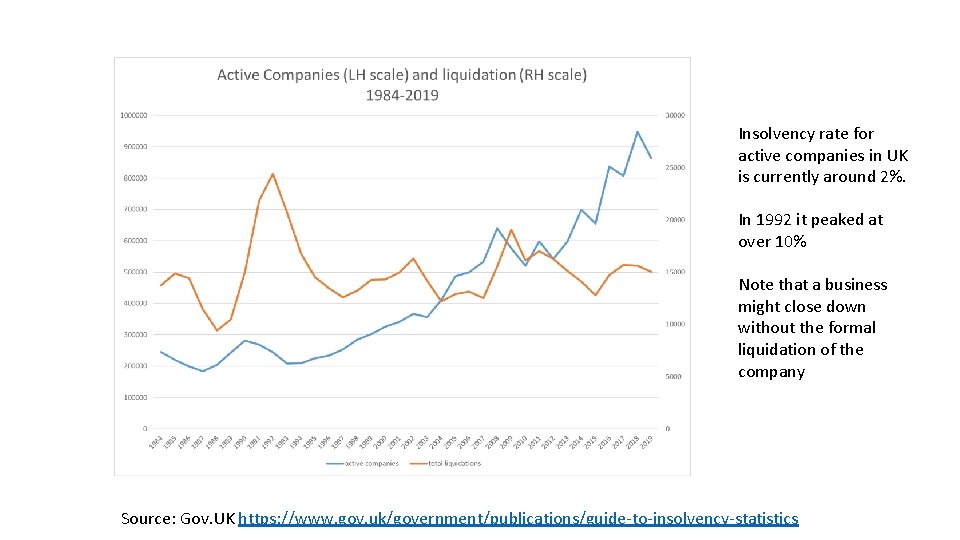
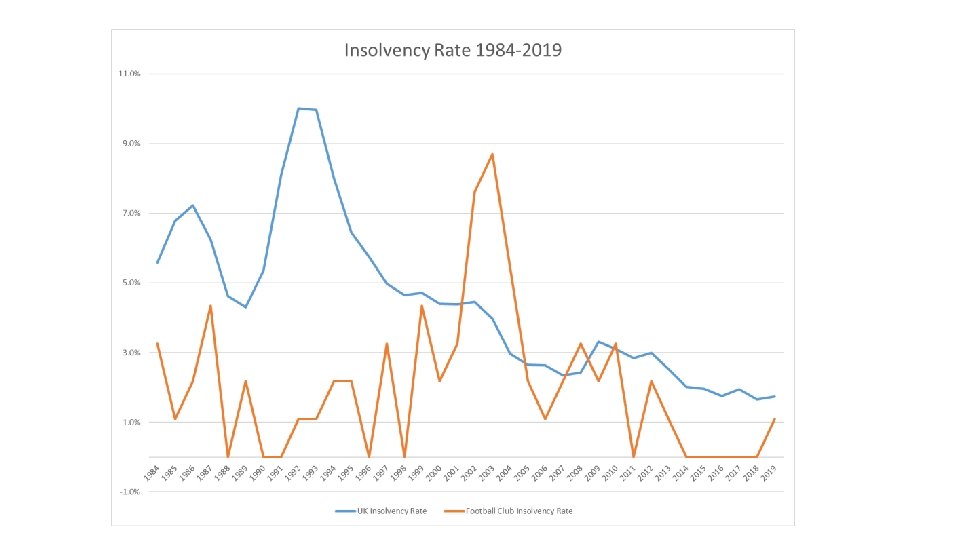
Insolvency rate for active companies in UK is currently around 2%. In 1992 it peaked at over 10% Note that a business might close down without the formal liquidation of the company Source: Gov. UK https: //www. gov. uk/government/publications/guide-to-insolvency-statistics
2. Football insolvency
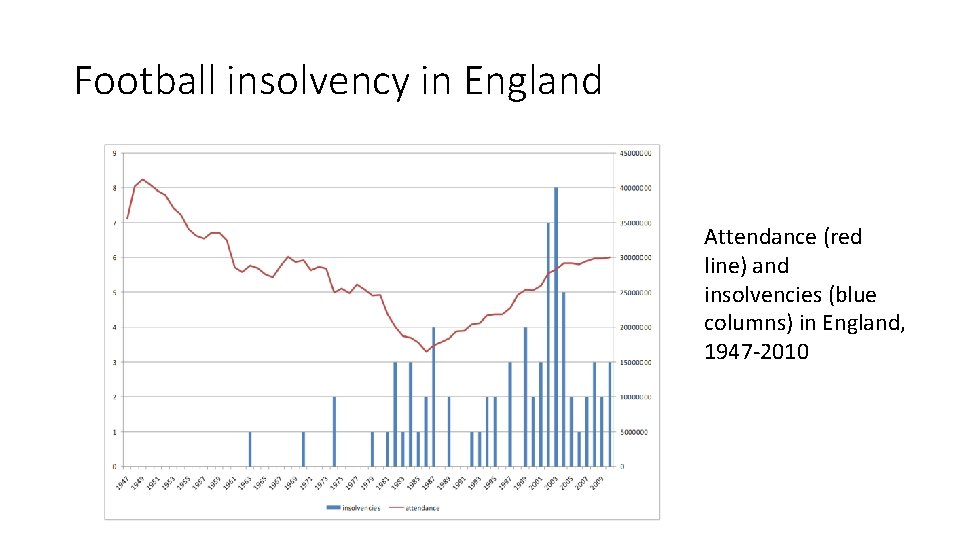
Football insolvency in England Attendance (red line) and insolvencies (blue columns) in England, 1947 -2010
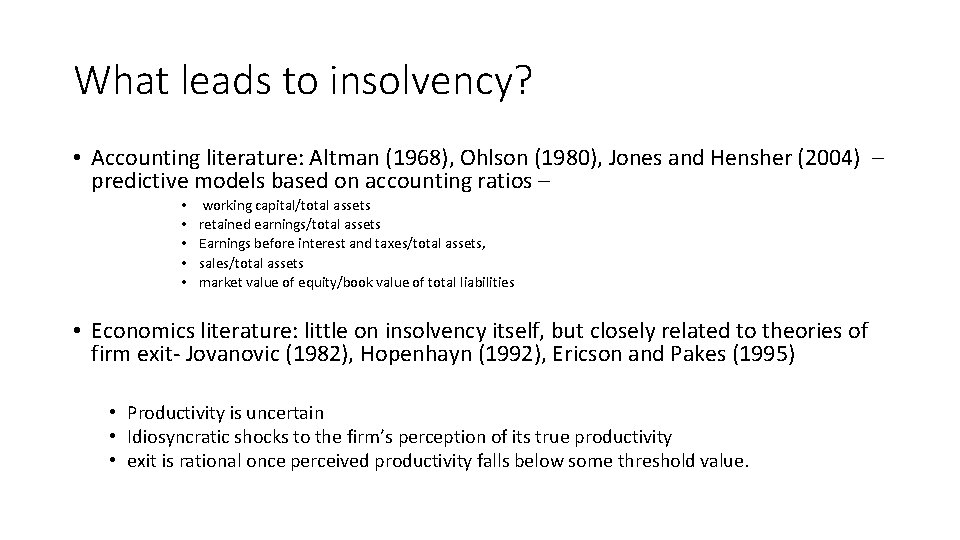
What leads to insolvency? • Accounting literature: Altman (1968), Ohlson (1980), Jones and Hensher (2004) – predictive models based on accounting ratios – • • • working capital/total assets retained earnings/total assets Earnings before interest and taxes/total assets, sales/total assets market value of equity/book value of total liabilities • Economics literature: little on insolvency itself, but closely related to theories of firm exit- Jovanovic (1982), Hopenhayn (1992), Ericson and Pakes (1995) • Productivity is uncertain • Idiosyncratic shocks to the firm’s perception of its true productivity • exit is rational once perceived productivity falls below some threshold value.
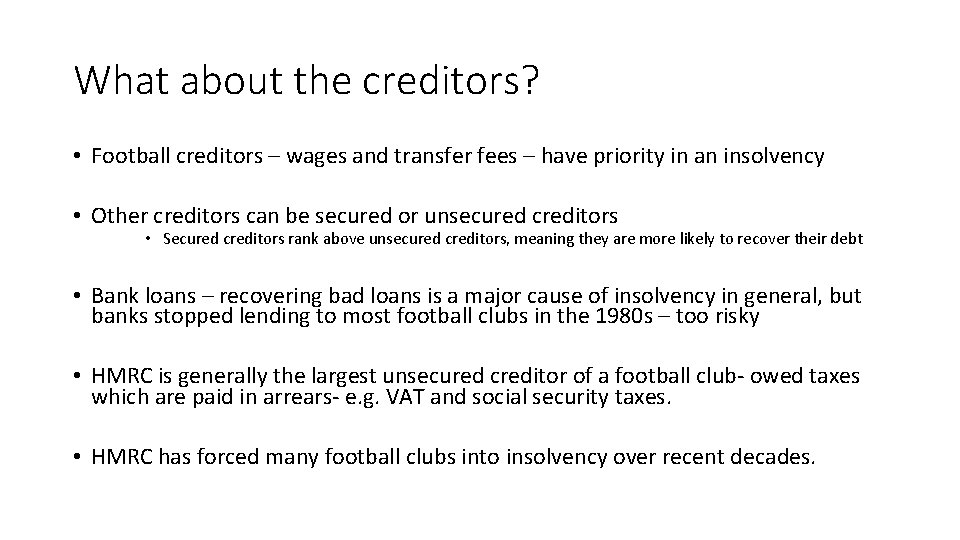
What about the creditors? • Football creditors – wages and transfer fees – have priority in an insolvency • Other creditors can be secured or unsecured creditors • Secured creditors rank above unsecured creditors, meaning they are more likely to recover their debt • Bank loans – recovering bad loans is a major cause of insolvency in general, but banks stopped lending to most football clubs in the 1980 s – too risky • HMRC is generally the largest unsecured creditor of a football club- owed taxes which are paid in arrears- e. g. VAT and social security taxes. • HMRC has forced many football clubs into insolvency over recent decades.
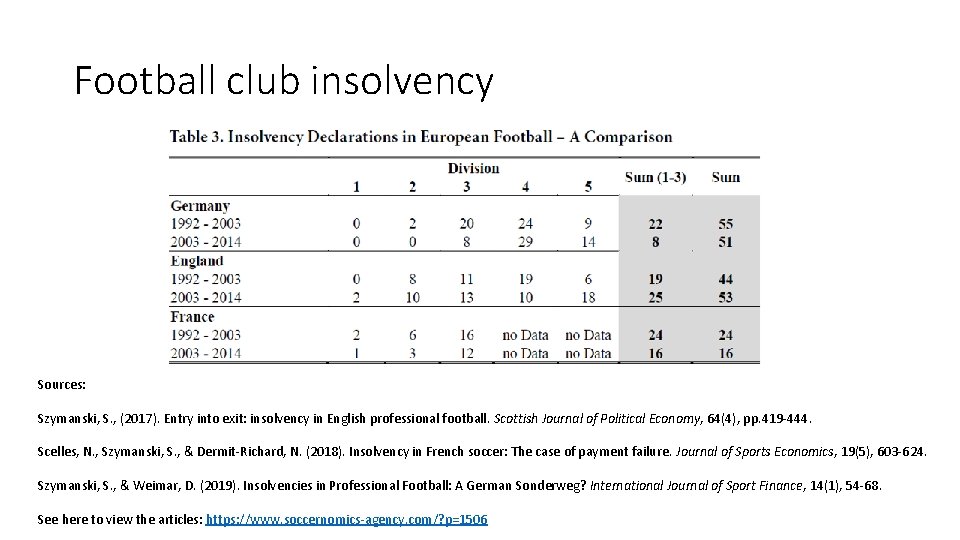
Football club insolvency Sources: Szymanski, S. , (2017). Entry into exit: insolvency in English professional football. Scottish Journal of Political Economy, 64(4), pp. 419 -444. Scelles, N. , Szymanski, S. , & Dermit-Richard, N. (2018). Insolvency in French soccer: The case of payment failure. Journal of Sports Economics, 19(5), 603 -624. Szymanski, S. , & Weimar, D. (2019). Insolvencies in Professional Football: A German Sonderweg? International Journal of Sport Finance, 14(1), 54 -68. See here to view the articles: https: //www. soccernomics-agency. com/? p=1506
What leads to football club insolvency? • Irrationality and indiscipline: see preamble to UEFA Financial Fair Play Regulations • Soft budget constraint: Andreff (2007), Storm and Nielsen (2012) • Adverse shocks associated with relegation: Szymanski (2017)
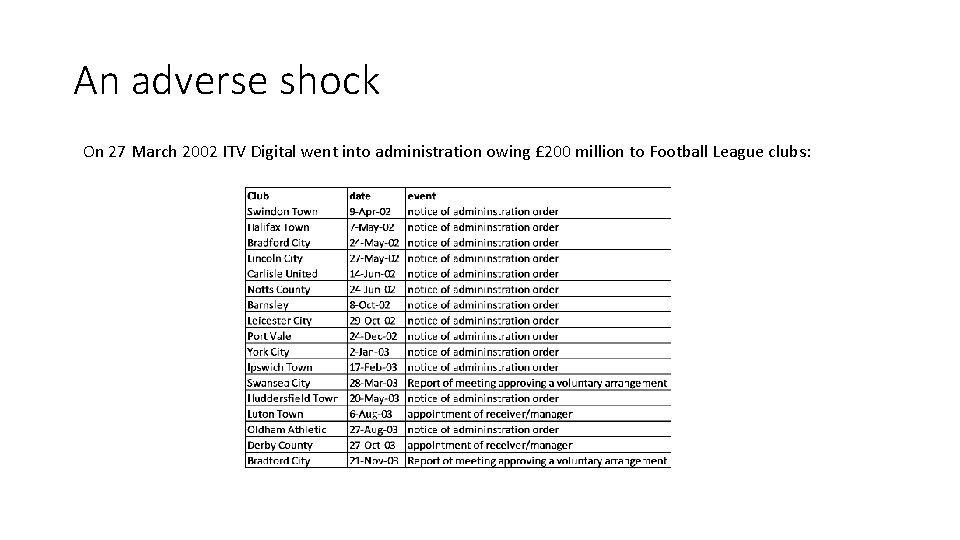
An adverse shock On 27 March 2002 ITV Digital went into administration owing £ 200 million to Football League clubs:
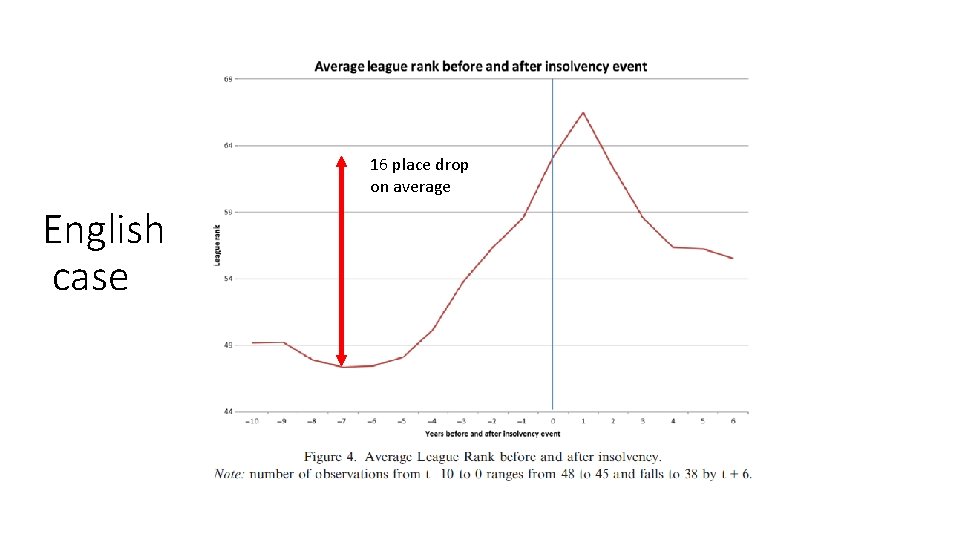
16 place drop on average English case
Insolvencies are messy • There are many creditors • Mostly these are small businesses • The costs of running an insolvency are high (legal costs) • Most creditors receive only a small percentage of what they are owed - and this may force them into insolvency in their turn
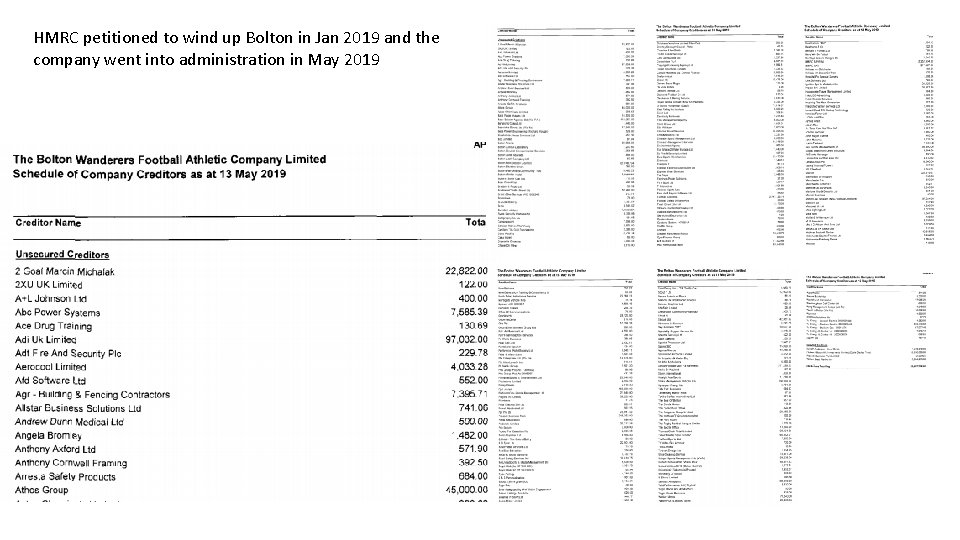
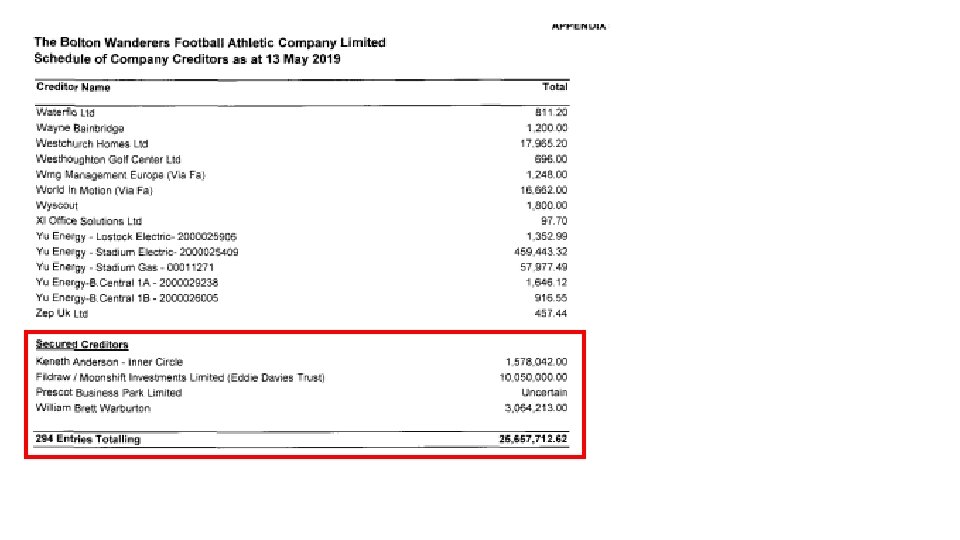
HMRC petitioned to wind up Bolton in Jan 2019 and the company went into administration in May 2019
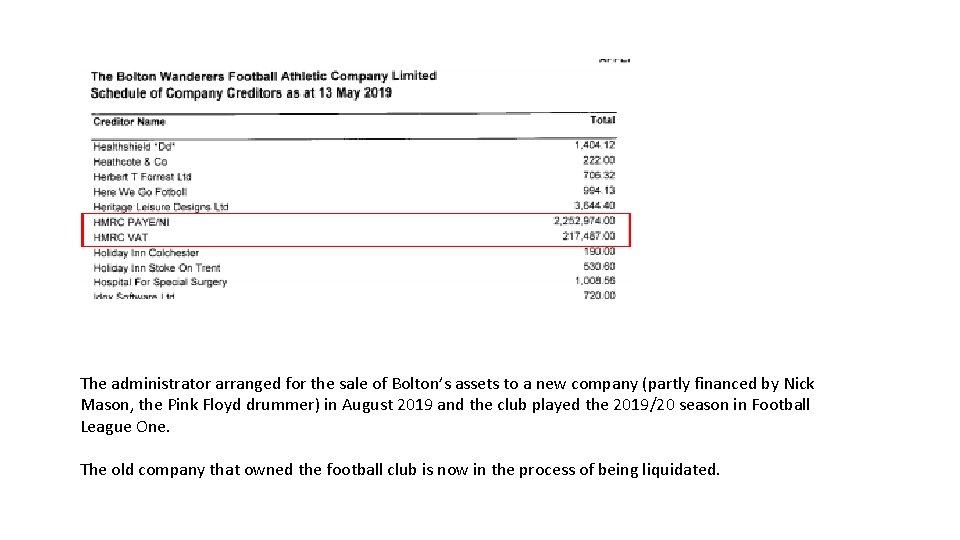
The administrator arranged for the sale of Bolton’s assets to a new company (partly financed by Nick Mason, the Pink Floyd drummer) in August 2019 and the club played the 2019/20 season in Football League One. The old company that owned the football club is now in the process of being liquidated.
3. The financial position of English football before the crisis
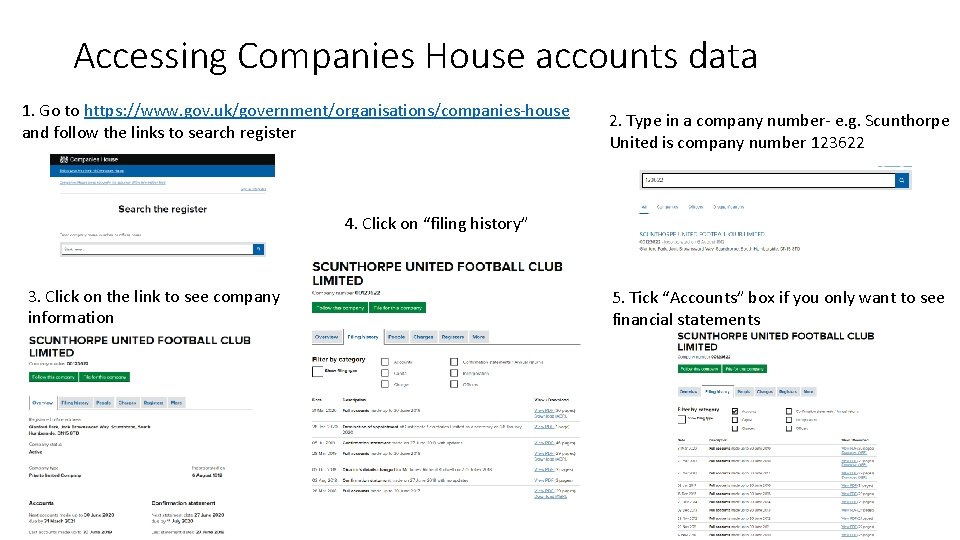
Accessing Companies House accounts data 1. Go to https: //www. gov. uk/government/organisations/companies-house and follow the links to search register 2. Type in a company number- e. g. Scunthorpe United is company number 123622 4. Click on “filing history” 3. Click on the link to see company information 5. Tick “Accounts” box if you only want to see financial statements
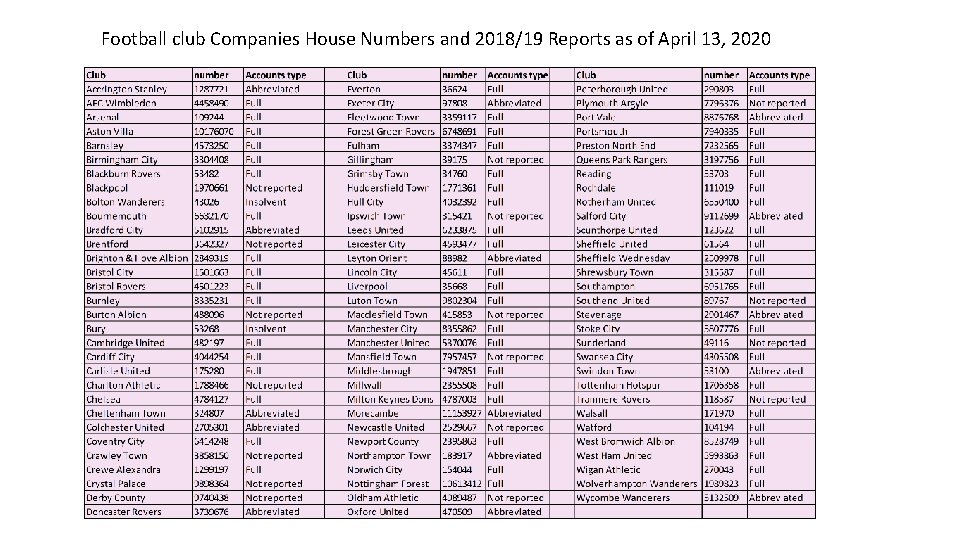
Football club Companies House Numbers and 2018/19 Reports as of April 13, 2020
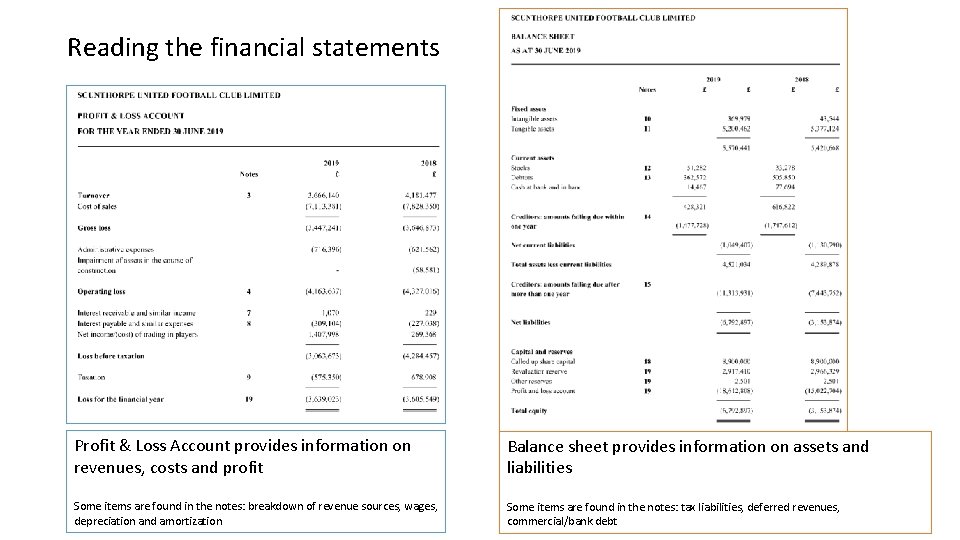
Reading the financial statements Profit & Loss Account provides information on revenues, costs and profit Balance sheet provides information on assets and liabilities Some items are found in the notes: breakdown of revenue sources, wages, depreciation and amortization Some items are found in the notes: tax liabilities, deferred revenues, commercial/bank debt
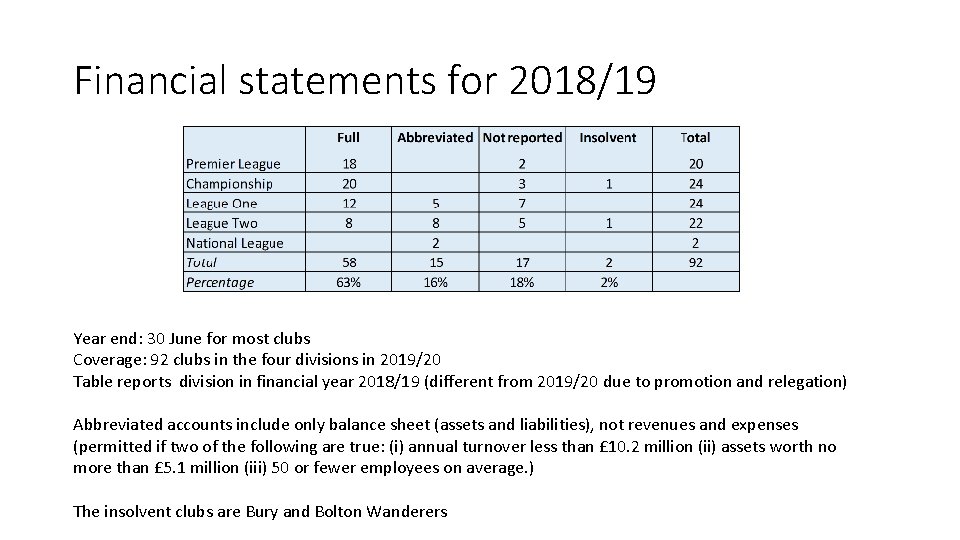
Financial statements for 2018/19 Year end: 30 June for most clubs Coverage: 92 clubs in the four divisions in 2019/20 Table reports division in financial year 2018/19 (different from 2019/20 due to promotion and relegation) Abbreviated accounts include only balance sheet (assets and liabilities), not revenues and expenses (permitted if two of the following are true: (i) annual turnover less than £ 10. 2 million (ii) assets worth no more than £ 5. 1 million (iii) 50 or fewer employees on average. ) The insolvent clubs are Bury and Bolton Wanderers
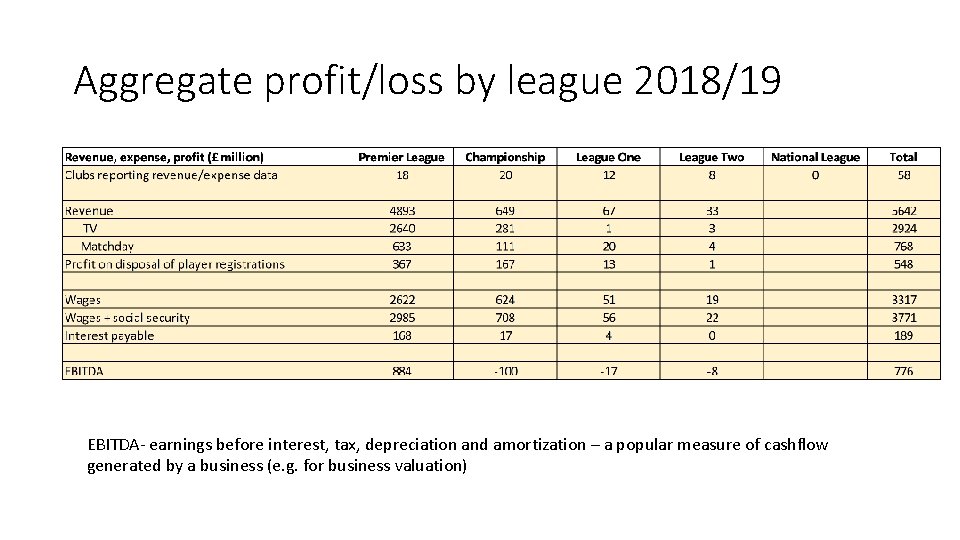
Aggregate profit/loss by league 2018/19 EBITDA- earnings before interest, tax, depreciation and amortization – a popular measure of cashflow generated by a business (e. g. for business valuation)
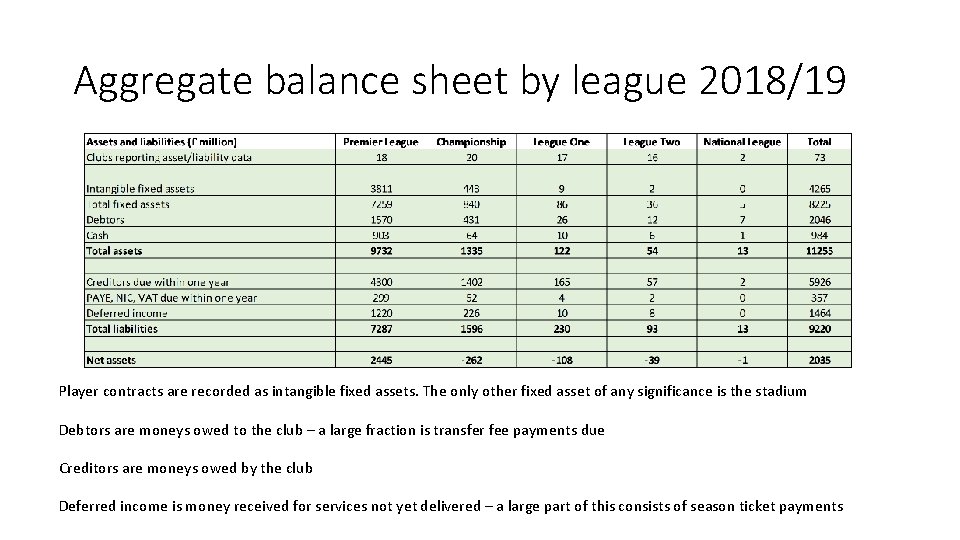
Aggregate balance sheet by league 2018/19 Player contracts are recorded as intangible fixed assets. The only other fixed asset of any significance is the stadium Debtors are moneys owed to the club – a large fraction is transfer fee payments due Creditors are moneys owed by the club Deferred income is money received for services not yet delivered – a large part of this consists of season ticket payments
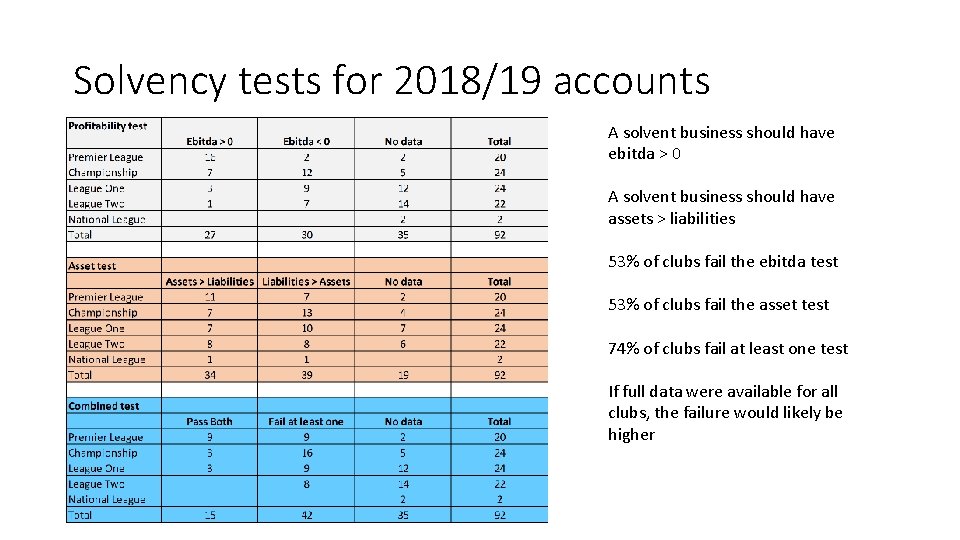
Solvency tests for 2018/19 accounts A solvent business should have ebitda > 0 A solvent business should have assets > liabilities 53% of clubs fail the ebitda test 53% of clubs fail the asset test 74% of clubs fail at least one test If full data were available for all clubs, the failure would likely be higher
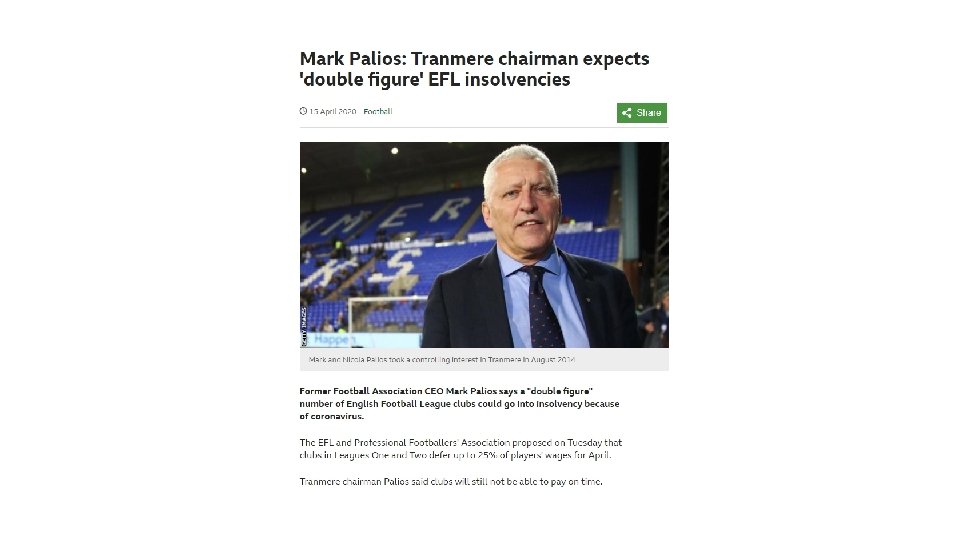
How did football survive before Covid-19? • If liabilities were in the form of commercial/bank debt, the debt holders would call in their loans and have the businesses wound up • But there is almost no commercial/bank debt in English football (too risky!) • Most loans are “soft” – extended by owners (demanding repayment would destroy the business they own) • Insolvencies generally occur when tax liabilities to HMRC are unpaid • tax liabilities to HMRC around 2 -5% of total liabilities on average – generally clubs can meet this cost

4. The crisis
The Covid-19 crisis • All games called off in mid-March, most clubs have lost 4 -5 home games. If refunded in full this would amount to about 20 -25% of matchday revenues lost (around £ 150 million) • Reports in March said the Premier League would lose £ 762 million in broadcast revenue if the season were not completed • @Swiss. Ramble (essential source for analysis of football club finances) estimates PL clubs would lose £ 249 million in commercial revenues (e. g. sponsorships) • That adds up to £ 1161 million, equal to around 20% of 2018/19 revenues and 25% below budgeted revenues for 2019/20
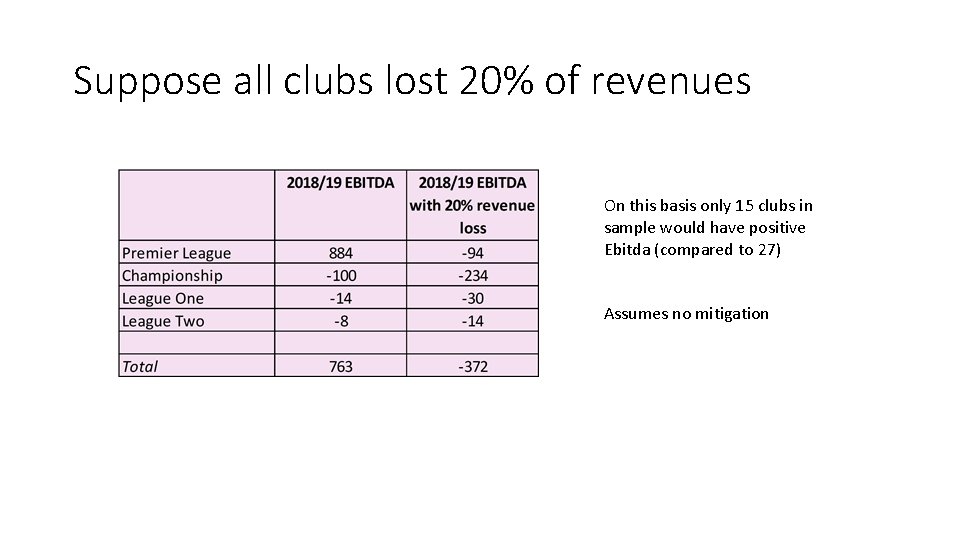
Suppose all clubs lost 20% of revenues On this basis only 15 clubs in sample would have positive Ebitda (compared to 27) Assumes no mitigation
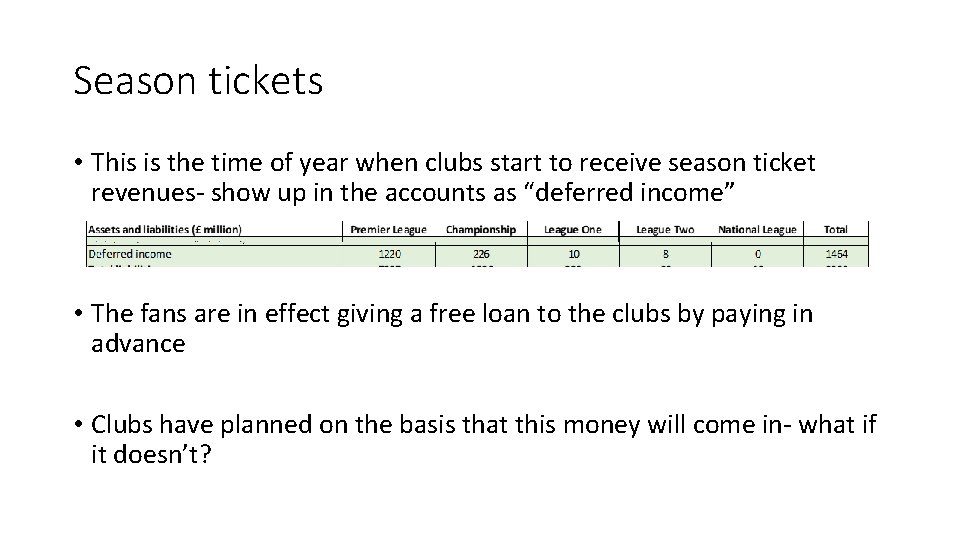
Season tickets • This is the time of year when clubs start to receive season ticket revenues- show up in the accounts as “deferred income” • The fans are in effect giving a free loan to the clubs by paying in advance • Clubs have planned on the basis that this money will come in- what if it doesn’t?
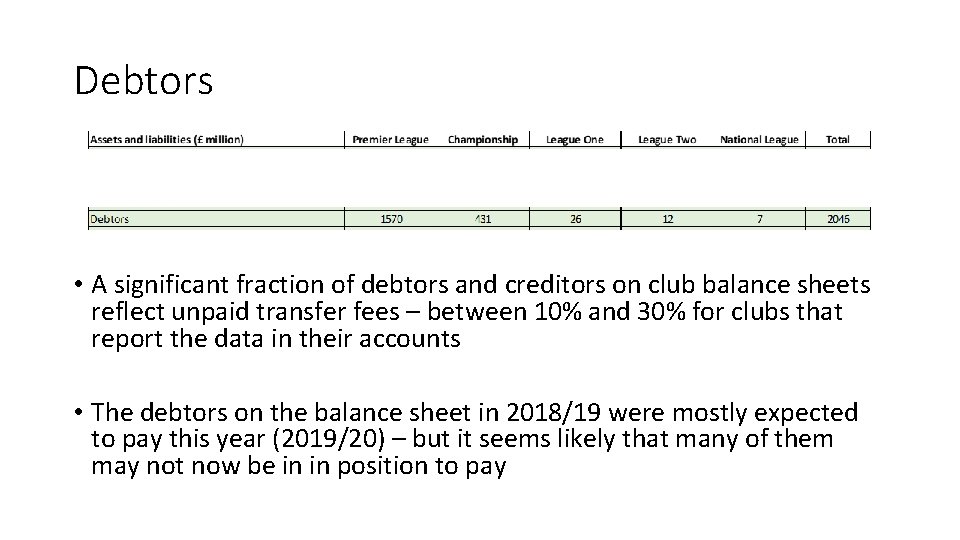
Debtors • A significant fraction of debtors and creditors on club balance sheets reflect unpaid transfer fees – between 10% and 30% for clubs that report the data in their accounts • The debtors on the balance sheet in 2018/19 were mostly expected to pay this year (2019/20) – but it seems likely that many of them may not now be in in position to pay
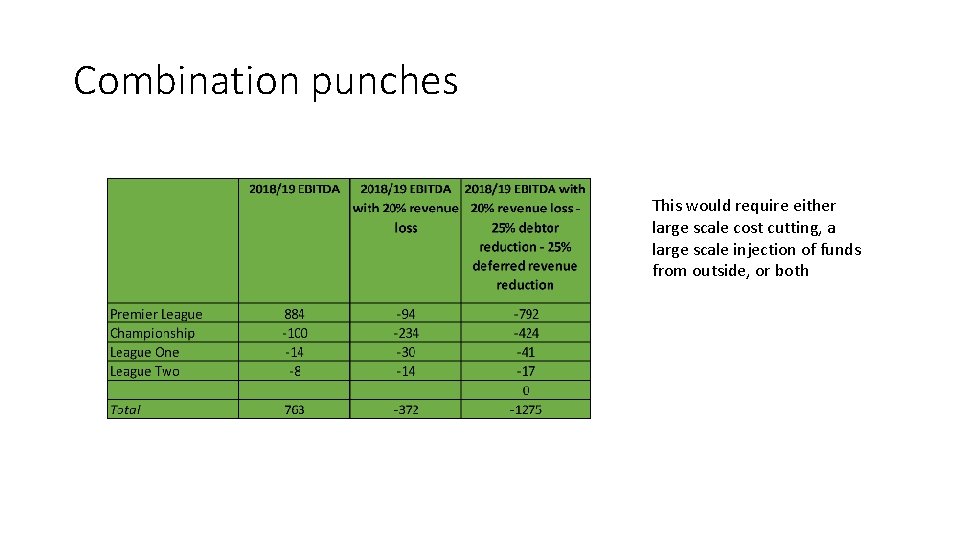
Combination punches This would require either large scale cost cutting, a large scale injection of funds from outside, or both
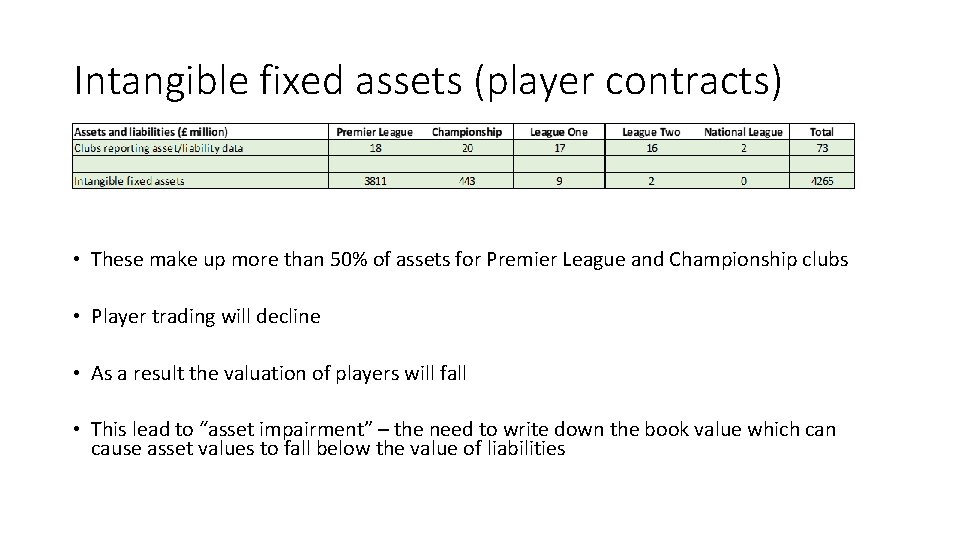
Intangible fixed assets (player contracts) • These make up more than 50% of assets for Premier League and Championship clubs • Player trading will decline • As a result the valuation of players will fall • This lead to “asset impairment” – the need to write down the book value which can cause asset values to fall below the value of liabilities
Mitigation: reduced operating costs • Matchday costs reduced • However, this is likely to be a limited benefit - most football club costs are fixed in advance • Operating costs of broadcasting to the clubs is close to zero
Mitigation: from government 1. Government bailout • • Coronavirus Job Retention Scheme -furlough pay: 80% of wages up to a maximum of £ 2, 500 per month deferred taxes: VAT and property leases [The Coronavirus Business Interruption Loan Scheme (CBILS) supports businesses with an annual turnover of up to £ 45 million, to access loans, overdrafts, invoice finance and asset finance of up to £ 5 million for up to 6 years - The government will provide lenders with a guarantee of 80% on each loan The Coronavirus Large Business Interruption Loan Scheme (CLBILS) will support large businesses, with an annual turnover of between £ 45 million and £ 500 million, to access loans of up to £ 25 million. ] The typical club employs only 200 -400 people, so the value of Coronavirus Job Retention Scheme is worth around £ 0. 5 million - £ 1 million per month. Little value to PL and Championship clubs, could be very valuable to Leagues One and Two clubs 2. Temporary changes to insolvency law Trading while insolvent (wrongful trading)
Mitigation: Players • Player pay cuts could reduce losses • Players are under contracts – which do not allow them to move jobs – so not like a typical employee • Without pay, what are they supposed to do about their mortgages? • Players could agree to defer payment until the future • But players in lower leagues on low wages anyway
5. The long term risks
The Longer term risks • Some of this season’s losses could be recovered if the economy re-opened soon, the season was finished, even if behind closed doors, and next season resumed on pre-Covid-19 lines • But this seems unlikely- UK is in lockdown until mid-May at least, and June sounds more likely • Lifting restrictions on gatherings of even 50 people seems unlikely in June – possible a short window in July, but this could start to creep into next season • With the threat of a second surge, crowds of 10, 000 seem unlikely to be allowed before the end of the year, and possibly not before a vaccine is proven • Even when that happens, fans may be shy of returning to stadiums • Long term demand for games without a crowd unproven – rights values can be expected to fall
Systemic risk • Clubs accounts show both debtors (owed money = an asset) and creditors (owe money = a liability) • If debts are not paid, but creditors retain their rights to payments, the danger is that the balance sheet collapses • E. g. I owe you £ 1 million and you owe me £ 1 million: creditors = debtors for both of us; now suppose neither of us can pay, but we both claim we are owed £ 1 million still, then for each of us the balance sheet shows liabilities > assets by £ 1 million – we are both insolvent! • Imagine this is true for dozens of businesses, each of whom owes money to another
“sugar daddies” not debt • As we saw, the finances of clubs have been underwritten largely through soft loans from their owners, rather than conventional bank lending • It is unlikely that banks will now start to lend to football clubs • The problem with the soft loans is that the owner generally did not need to call it in – e. g. Chelsea owes Roman Abramovitch £ 1167 million – but rich individuals will be squeezed in their other businesses • They may not be able to call in their soft loans, but they also may not have funds to shore up the clubs

6. A solution
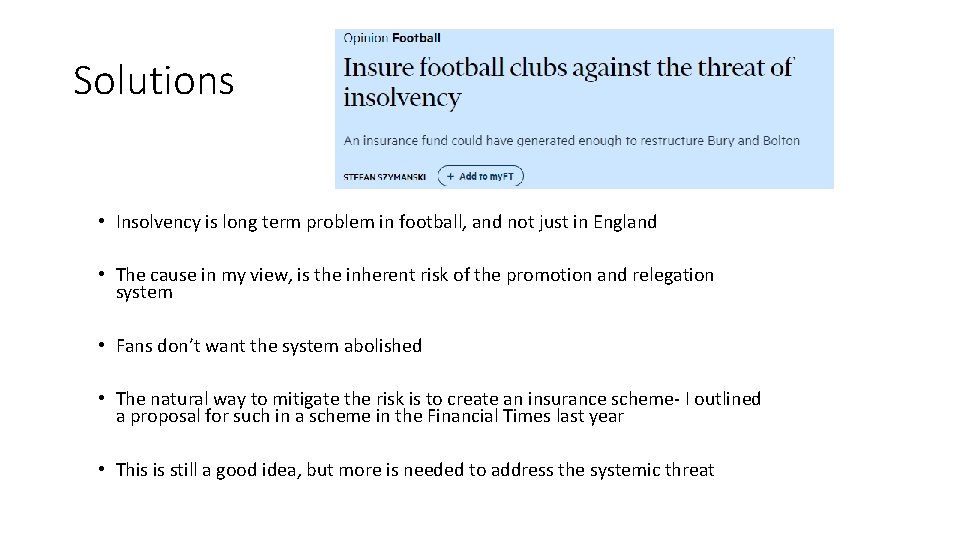
Solutions • Insolvency is long term problem in football, and not just in England • The cause in my view, is the inherent risk of the promotion and relegation system • Fans don’t want the system abolished • The natural way to mitigate the risk is to create an insurance scheme- I outlined a proposal for such in a scheme in the Financial Times last year • This is still a good idea, but more is needed to address the systemic threat
Solution to systemic crisis • Defending the system requires consolidation – because much of club debt is to other clubs, the net indebtedness of the system is much smaller • Likewise, player have an incentive to negotiate over the liability to pay contracted wages rather than see the system collapse (the Football Creditor Rule serves them less well when the system is under threat) • But there has to be a negotiation
Consolidation Scheme • Create a consolidation fund – either for England on its own or for Europe • Assign all future broadcast rights (not existing contracts, since these revenue streams also underpin the value of the clubs) to the fund- these assets have value, even if they diminish • Issue claims to all clubs with a deficit on transfer fees, which can be redeemed within five years • Negotiate with players to accept claims on the fund equal to the value of unpaid wages, also redeemable within five years • The concept is to employ the future value of football to save football today
Management of the Scheme • This would require joint representation of the players and clubs • It would necessitate collective bargaining • The scheme would have to manage and decide upon hardship cases • Within a few years, if life returned to something like normal, the Scheme would unwind (the terms on which this would happen would also have to be negotiated) • An insolvency insurance fund would be a useful legacy
- Slides: 50