
COVID19 and Child Labour in India Technical analysis
COVID-19 and Child Labour in India Technical analysis by CRY in collaboration with Dr. Rahul Sapkal, Tata Institute of Social Sciences 11 th June, 2020 1
Outline of Presentation • Magnitude of Child and Adolescent labour in India • COVID-19 and the recent labour law relaxations • Labour Law Relaxations and its implications – Overall Impact – Child and Adolescent labour in Factories and Industries – Children helping family and in family enterprises • Deriving the List of Hazardous Work under the Child and Adolescent Labour (Prohibition and Regulation Act), 1986 • Ways to Strengthen Child Labour Legislation in India 2
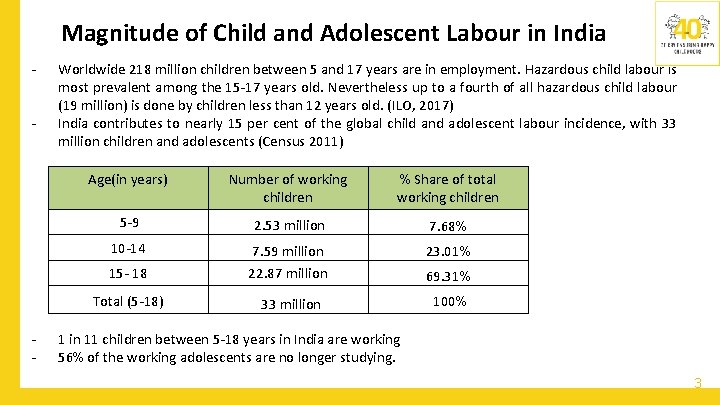
Magnitude of Child and Adolescent Labour in India - - Worldwide 218 million children between 5 and 17 years are in employment. Hazardous child labour is most prevalent among the 15 -17 years old. Nevertheless up to a fourth of all hazardous child labour (19 million) is done by children less than 12 years old. (ILO, 2017) India contributes to nearly 15 per cent of the global child and adolescent labour incidence, with 33 million children and adolescents (Census 2011) Age(in years) Number of working children % Share of total working children 5 -9 2. 53 million 7. 68% 10 -14 23. 01% 15 - 18 7. 59 million 22. 87 million Total (5 -18) 33 million 100% 69. 31% 1 in 11 children between 5 -18 years in India are working 56% of the working adolescents are no longer studying. 3
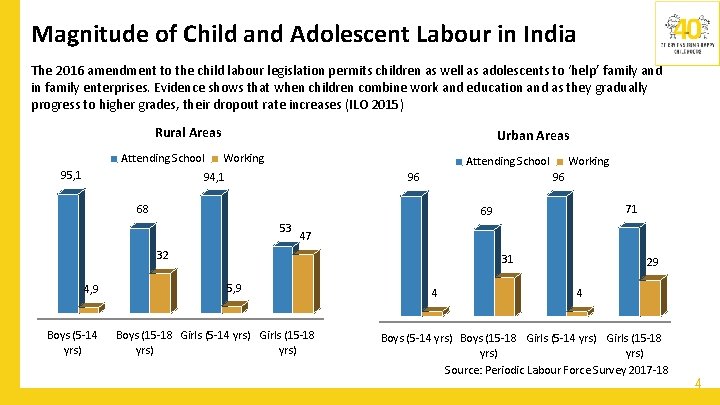
Magnitude of Child and Adolescent Labour in India The 2016 amendment to the child labour legislation permits children as well as adolescents to ‘help’ family and in family enterprises. Evidence shows that when children combine work and education and as they gradually progress to higher grades, their dropout rate increases (ILO 2015) Rural Areas Attending School 95, 1 Urban Areas Working Attending School 94, 1 96 96 68 47 32 Boys (5 -14 yrs) 71 69 53 4, 9 Working 31 5, 9 Boys (15 -18 Girls (5 -14 yrs) Girls (15 -18 yrs) 4 29 4 Boys (5 -14 yrs) Boys (15 -18 Girls (5 -14 yrs) Girls (15 -18 yrs) Source: Periodic Labour Force Survey 2017 -18 4
COVID-19 and the recent labour law relaxations • States that have granted relaxations to Factories Act, 1948 – – Rajasthan, Gujarat, Punjab, Himachal Pradesh, Uttar Pradesh, Maharashtra, Karnataka, Andhra Pradesh, Madhya Pradesh, Odisha and Assam • The key relaxations include– Extension of a factory worker’s daily shift to 12 hours per day and six days a week (72 hours) from the existing eight hours per day, six days a week (48 hours) • The International Labour Organisation (ILO) has expressed “deep concern” since these relaxations violate ILO convention No 144 which calls for tripartite consultations among government, employers and workers • 3 of these states have highest number of interstate migrant workers, namely, Gujarat (15. 71 lakhs), Madhya Pradesh (29. 79 lakhs) and Uttar Pradesh (1. 23 crores) (Census 2011). • In Gujarat all new industrial units will be exempt from all related laws and provisions except : – Minimum wages – Industrial safety and – Employees' compensation 5
COVID-19 and the recent labour law relaxations • Madhya Pradesh: In addition to relaxations to the Factories Act, 1948, – Has allowed factories employing less than 50 workers and engaging in hazardous and nonhazardous processes to use third-party certification in lieu of routine inspections – Exempted industries from the provisions of the Industrial Disputes Act, 1947 (IDA) except Chapter V-A, Sections 25 -N and 25 -O (restrictions on retrenchment and closure respectively), 25 -Q and 25 -R (penalty for illegal retrenchment and closure) for new registered for next 1, 000 days. – Exempted 11 industries from Madhya Pradesh Industrial Relations Act, 1960 as well as all registered factories from all provisions of the Factories Act, 1948. • Uttar Pradesh: Exempted all factories from all essential labour laws except: – All factories comply with timely and bank payment of wages; payment of minimum wages, – Adhere to provisions relating to safety and security in the Factories Act and the Building and Other Constructions Workers act, 1996, – Provide compensation for death/disability as per Employees’ Compensation Act, 1923, – Adhere to the legal provisions relating to employment of women and children 6
Labour Law Relaxations and its Implications 8 out of top 10 States with high burden of child & adolescent labour (barring West Bengal and Bihar) have also relaxed their labour laws. • Overall impact: – Increased insecurity and informalization of labour – Loss of bargaining power among labourers – Deterioration in working conditions • For children / adolescents working in factories and industrial setups: – May lead to increase in hazardous work and other worst forms of child labour, including forced labour, debt bondage and human trafficking. – 2. 7 million adolescent labourers are engaged in hazardous processes that contribute to scheduled hazardous industries listed under Factories Act, 1948. However, they are not recognized due to restrictive employee threshold criteria and definitions under the said Act • For children helping family or in family enterprises: – Increase opportunities for high value, export intensive, low-wage-low-productive sectors, which are typically run as small family enterprises. Thus, the possibilities of increase in child and adolescent labour. – Some of these activities are also ‘hazardous’, but remain as ‘peripheral’ activities 7
Deriving the List of Hazardous Work under the Child and Adolescent Labour (Prohibition and Regulation Act), 1986 Child Labour Legislation Draws its definition of Hazardous Processes from the Factories Act, 1948: hazardous processes refers to ‘any activity or process involving the handling of raw materials, finished products, by-products, wastes can directly affect the health of the worker or the environment. Therefore, special care needs to be taken by workers engaged in these activities or processes. Limited definition. Lists 29 processes to be hazardous Environment Protection Act, 1986: ‘hazardous substance’ means any substance or preparation which, by reason of its chemical or physico-chemical properties or handling, is liable to cause harm to human beings, other living creatures, plant, microorganism, property or the environment. More expansive definition. Lists 104 substances and processes to be hazardous Neither of the above legislations and their definitions were framed keeping children in mind. The list of hazardous occupations and processes in the child labour legislation reduced from 83 to 38 after the amendment of 2016. 66 hazardous processes and occupations are left out of the core list as they are considered to be ‘peripheral’ activities 8
Strengthening India’s response to Child and Adolescent Labour • • • Revisiting the definition of ‘hazardous’ occupations and processes from a child-rights perspective considering – – The indivisibility of children’s right to survival, development, protection and participation – Further corroboration with u/s 2 (e) of Environment Protection Act of 1986 so to regulate the entry and exit of firms that are engaged in the hazardous processes and outputs (for table from CRY Legal Analysis see Appendix A). This will help us to minimise the risk of potential child labour entrant into these factories – Gathering of data on embedded labour processes to identify involvement of children at each step and the dangers vis-à-vis their physical, psychosocial and cognitive development Annual data collection on child and adolescent labour across hazardous occupations and processes mentioned in part A of the Schedule as well as those included Part B where adolescents are permitted to work Strengthening Child Protection Mechanisms Extending the ambit of the Right to Education Act to include pre-school as well as secondary and higher secondary education Increasing budgets for children , especially in education and child protection 9
THANK YOU FOR YOUR TIME 10
- Slides: 10