
COVID 19 Resumption of Services Dublin North City
COVID - 19 Resumption of Services Dublin North City & County Infection Prevention & Control Team 12. 05. 2020
Programme Contents • Current situation • Chain of Infection / Standard Precautions • Government Roadmap • Health & Safety • Specific Concerns – home visiting / clinics / office settings / Group therapies
Background to Current Situation • End of December 2019, Chinese public health authorities reported several cases of acute respiratory syndrome in Wuhan City, Hubei province, China – novel coronavirus • The disease is now referred to as coronavirus disease 2019 (COVID-19), and the causative virus is called severe acute respiratory syndrome coronavirus 2 (SARS-Co. V-2). • It is a new strain of coronavirus that has not been previously identified in humans.
Irish Situation • Containment Phase – 27 th January – 12 March • Feb 29 th first case in Republic • 5 th March first community acquired case • 11 th March first death in the Republic • Delay Phase 12 th – 27 th March • Stay at home phase – 27 th March – 18 th May • 12 th May – 23, 242 cases, 1488 deaths (approx. 260, 000 tests) • Government Roadmap 18 th May
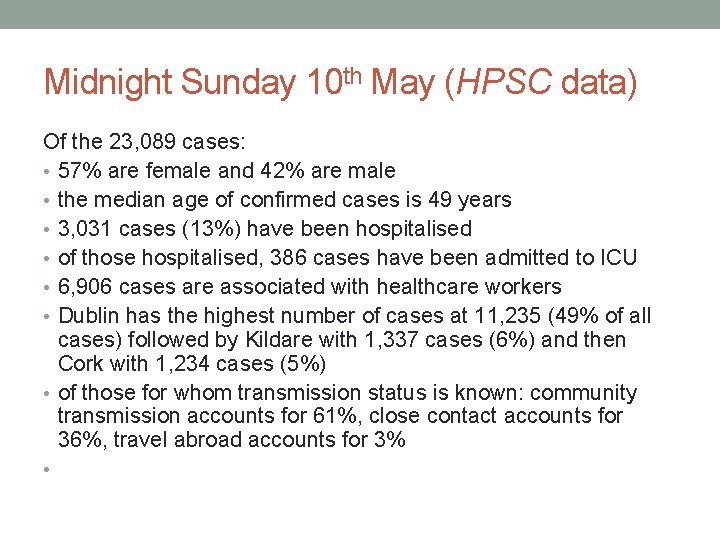
Midnight Sunday 10 th May (HPSC data) Of the 23, 089 cases: • 57% are female and 42% are male • the median age of confirmed cases is 49 years • 3, 031 cases (13%) have been hospitalised • of those hospitalised, 386 cases have been admitted to ICU • 6, 906 cases are associated with healthcare workers • Dublin has the highest number of cases at 11, 235 (49% of all cases) followed by Kildare with 1, 337 cases (6%) and then Cork with 1, 234 cases (5%) • of those for whom transmission status is known: community transmission accounts for 61%, close contact accounts for 36%, travel abroad accounts for 3% •
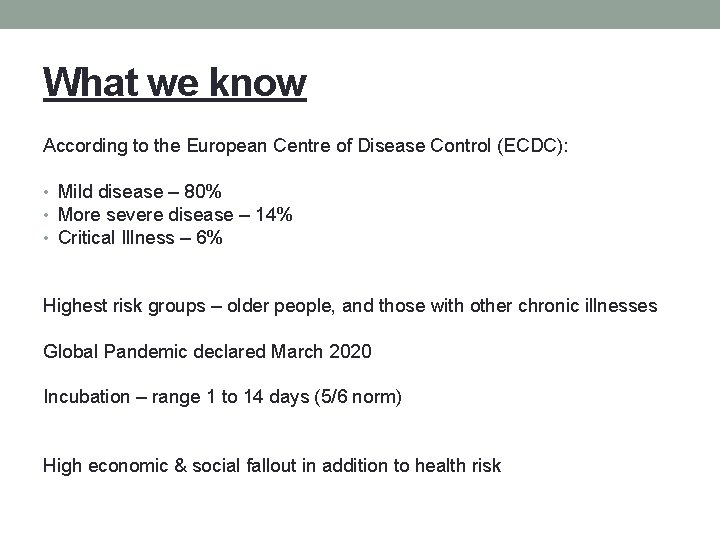
What we know According to the European Centre of Disease Control (ECDC): • Mild disease – 80% • More severe disease – 14% • Critical Illness – 6% Highest risk groups – older people, and those with other chronic illnesses Global Pandemic declared March 2020 Incubation – range 1 to 14 days (5/6 norm) High economic & social fallout in addition to health risk
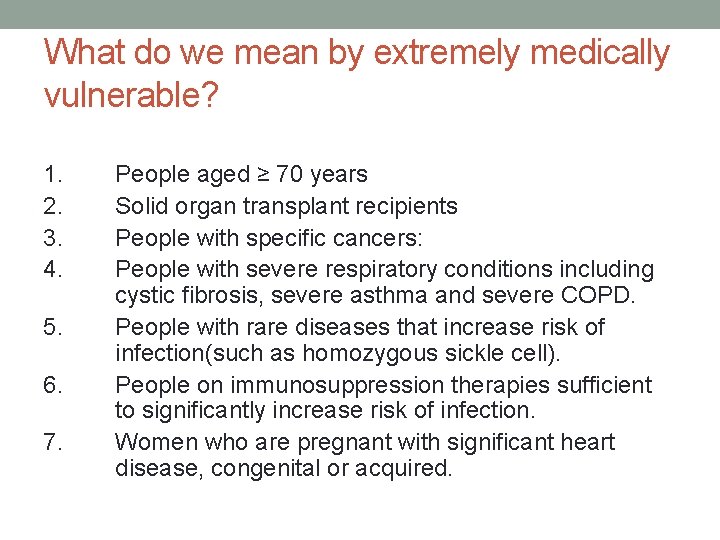
What do we mean by extremely medically vulnerable? 1. 2. 3. 4. 5. 6. 7. People aged ≥ 70 years Solid organ transplant recipients People with specific cancers: People with severe respiratory conditions including cystic fibrosis, severe asthma and severe COPD. People with rare diseases that increase risk of infection(such as homozygous sickle cell). People on immunosuppression therapies sufficient to significantly increase risk of infection. Women who are pregnant with significant heart disease, congenital or acquired.
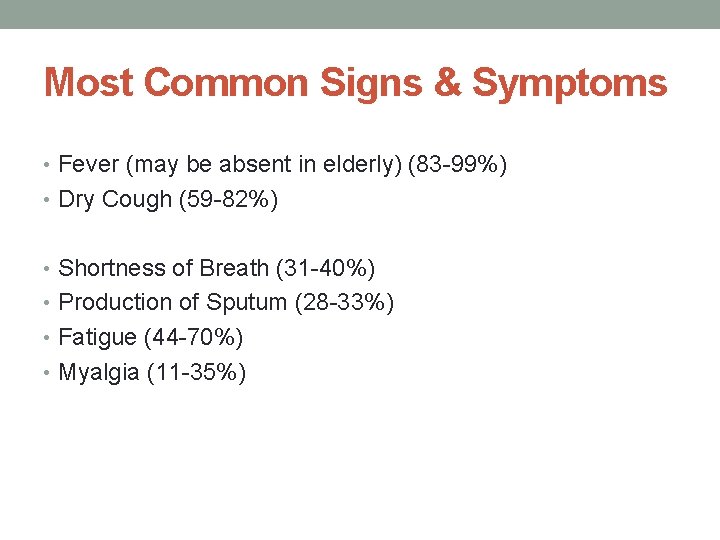
Most Common Signs & Symptoms • Fever (may be absent in elderly) (83 -99%) • Dry Cough (59 -82%) • Shortness of Breath (31 -40%) • Production of Sputum (28 -33%) • Fatigue (44 -70%) • Myalgia (11 -35%)
Other Symptoms (less common) • Sore throat • Headache • Myalgia/arthralgia • Chills • Nausea or vomiting • Nasal / Conjunctival congestion • Diarrhoea • Haemoptysis • Older persons may experience increased confusion / worsening chronic conditions of the lungs / loss of appetite / diarrhoea
What has the being done? While it is not feasible to stop the spread of COVID-19 in the EU, measures have been introduced to slow down the spread of the virus in the population in order to allow healthcare systems to put in place surge capacity measures to absorb more severe COVID-19 cases. • Social Distancing / Stay at home measures • Cocooning of Older and vulnerable persons • Isolation Beds • Screening of Health Care Workers • Increased capacity ICU – private hospitals • National Procurement of PPE • Community Assessment Hubs • Community Testing Centres • Education/Training/Helplines/Webinars
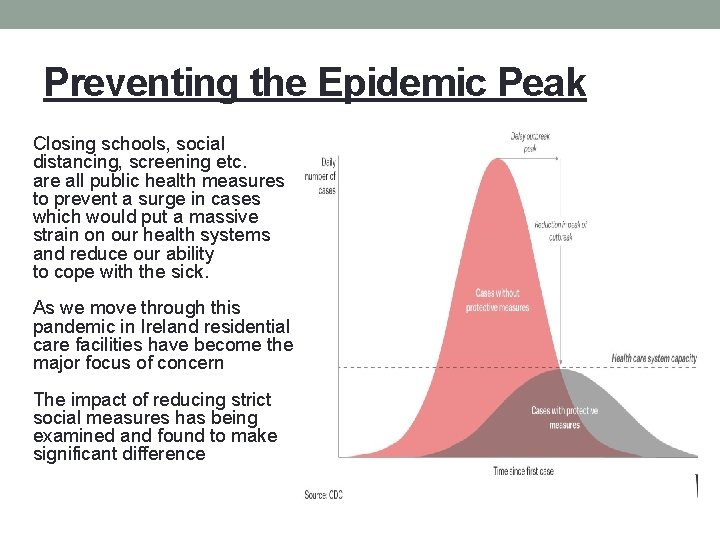
Preventing the Epidemic Peak Closing schools, social distancing, screening etc. are all public health measures to prevent a surge in cases which would put a massive strain on our health systems and reduce our ability to cope with the sick. As we move through this pandemic in Ireland residential care facilities have become the major focus of concern The impact of reducing strict social measures has being examined and found to make significant difference
Route of Transmission COVID-19 is transmitted through transfer to the mouth, nose or eyes on hands following contact with contaminated surfaces contaminated with droplets, oral secretions or nasals secretions. It is also transmitted by direct droplet transmission to the mouth, nose or eyes during close unprotected contact with an infected person. Airborne spread not a concern in most settings however it is a concern in the context of certain aerosol-generating procedures conducted in health care settings (https: //www. hpsc. ie/az/respiratory/coronavirus/novelcoronavirus/guidance/infectionpreventionandcontrolg uidance/aerosolgeneratingprocedures/AGPs%20 for%20 confirmed%20 or%20 possibl e%20 COVID 19_v 2. 0_23032020. pdf). Individuals most infectious when they have symptoms Extent of transmission from pre-symptomatic or asymptomatic people unclear
Transmission Symptomatic transmission Refers to transmission from a person while they are experiencing symptoms. COVID-19 is primarily transmitted from symptomatic people to others who are in close contact through respiratory droplets, by direct contact with infected persons, or by contact with contaminated objects and surfaces. Shedding of the COVID-19 virus is highest in upper respiratory tract (nose and throat) early in the course of the disease (within the first 3 days from onset of symptoms). Preliminary data suggests that people may be more contagious around the time of symptom onset as compared to later on in the disease. Pre-symptomatic transmission Incubation period for COVID-19, which is the time between exposure to the virus (becoming infected) and symptom onset, is on average 5 -6 days (up to 14 days). During this period some infected persons can be contagious (before symptom onset). In a small number of case reports and studies, pre-symptomatic transmission has been documented through contact tracing efforts and enhanced investigation of clusters of confirmed cases. This is supported by data suggesting that some people can test positive for COVID-19 from 1 -3 days before they develop symptoms. Thus, it is possible that people infected with COVID-19 could transmit the virus before significant symptoms develop. It is important to recognize that pre-symptomatic transmission still requires the virus to be spread via infectious droplets or through touching contaminated surfaces. Asymptomatic transmission An asymptomatic laboratory-confirmed case is a person infected with COVID-19 who does not develop symptoms. Asymptomatic transmission refers to transmission of the virus from a person, who does not develop symptoms. There are few reports of laboratory-confirmed cases who are truly asymptomatic, and to date, there has been no documented asymptomatic transmission. This does not exclude the possibility that it may occur. Asymptomatic cases have been reported as part of contact tracing efforts in some countries. https: //www. who. int/docs/default-source/coronaviruse/situation-reports/20200402 -sitrep-73 -covid-19. pdf https: //www. hiqa. ie/sites/default/files/2020 -04/Evidence-summary-for-asymptomatic-transmission-of-COVID-19. pdf
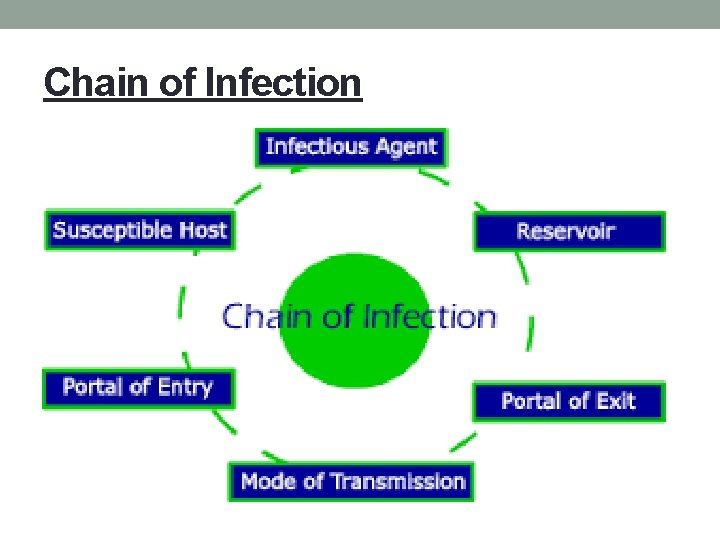
Chain of Infection
Standard Precautions • Standard Precautions are the foundation for preventing transmission of infection when providing healthcare and when consistently implemented the risk of infection to clients and the Healthcare worker (HCW) is minimized (Siegel et al, 2007). Standard Precautions apply to situations where there is a risk of contact with: Øblood Øall body fluids, secretions and excretions (except sweat), regardless of whether or not they contain visible blood Ønon-intact skin and mucous membranes Standard Precautions should be applied as standard principles by • ALL healthcare practitioners for the care of • ALL residents and patients • ALL the time
Standard Precautions & Covid 1. 2. 3. 4. 5. 6. 7. 8. 9. 10. 11. 12. 13. Occupational Health Programme Hand Hygiene Personal Protective Equipment Respiratory Hygiene and Cough Etiquette Safe Use and Disposal of Sharps Management of a Blood and/or Body Fluid Spillage Management of Blood and Body Fluid Exposures Management of Laundry & Linen Environmental Hygiene Client-Care Equipment / Medical Devices Resident / Patient Placement, Movement and Transfer Safe Injection Practices Infection Control Practices for Lumbar Puncture
1. Occupational Health • Referrals to occupational health • Criteria for testing - results • Contact tracing • Derogations • Advise staff to register with GP if not already registered (COVID treatment and referral free of charge)
2. Hand Hygiene • COVID-19 can be spread by contaminated hands, hence frequent hand hygiene is important. • Hand hygiene refers to any action of hand cleansing, such as hand washing with soap and water or hand rubbing with an alcohol based hand rub. • Alcohol based hand rubs are the gold standard for hand hygiene practice in healthcare settings when hands are not visibly soiled. • However, if hands are visibly soiled or have had direct contact with body fluids they should be washed with liquid soap and running water then dried thoroughly with disposable paper towels The use of gloves should never be considered an alternative to hand hygiene. Hand hygiene is required before putting on gloves and immediately after they have been removed.
Hand Hygiene • What hand hygiene facilities are available – alcohol hand gel / liquid soap and disposable paper towels • Adhere to 5 moments of hand hygiene • Hand hygiene training (HSEland) – if staff have not done any training start here • Bare below elbows, remove jewellery, short clean nails – role modelling by managers • Patients should be encouraged to wash hands after toileting, blowing their nose, before and after eating etc. • There are other infections patients/staff are vulnerable to…
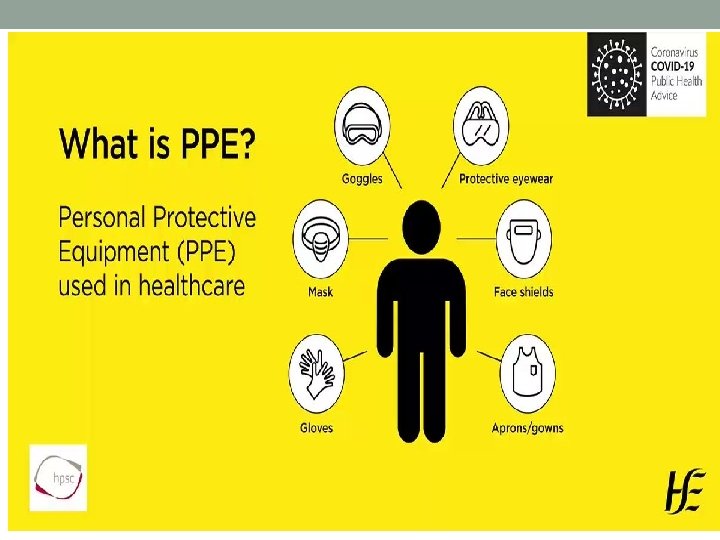
Personal Protective Equipment • In a pandemic situation, where stock shortages may be anticipated, new or different PPE items may need to be procured. • PPE use is based on a clinical risk assessment of the healthcare environment and client to ensure appropriate PPE is used for the task involved • Ensure ‘clean’ zones in facility where PPE is not worn • PPE worn for extended periods of time presents risk – staff walking through clean areas / answering phones / using staff toilets etc. All staff should remind each other to use PPE appropriately • Shoe/Hair covers are not recommended.
Gloves • Wear appropriate gloves for task (sterile/non-sterile) • Clean hands before putting on gloves and after removing them • Change gloves between tasks – not included in PPE for extended use • Don’t wear if not needed – can be harsh on skin when worn for long periods • Always, always prioritise hand-washing
Aprons / Gowns • Worn when there is risk of contact with blood or body fluids • When caring for a COVID positive or suspected patient gown/apron will be worn for all care activities within 2 metres of patient • Be very careful when removing to not touch the outside of the gown • Disposable gloves and a plastic apron are recommended for certain tasks including contact with body fluids such as bathing a person who is incontinent, handling soiled personal clothing and bed linen and clearing up spills of urine, faeces, vomit and handling waste – this is standard precautions regardless of COVID status
Masks • Surgical masks should be worn by healthcare workers when providing care to patients within 2 m of a patient, regardless of the COVID-19 status of the patient. • Surgical masks should be worn by all healthcare workers for all encounters, of 15 minutes or more, with other healthcare workers in the workplace where a distance of 2 m cannot be maintained • FFP 2 masks are required for Aerosol Generating Procedures – dentistry, CPR, intubation etc.
Goggles • Worn if there is a risk of splashing of blood or body fluids • May be goggles or face visor • Are not needed in all cases – assess the patient. If patient is coughing and you are within 2 m of them goggles are advised
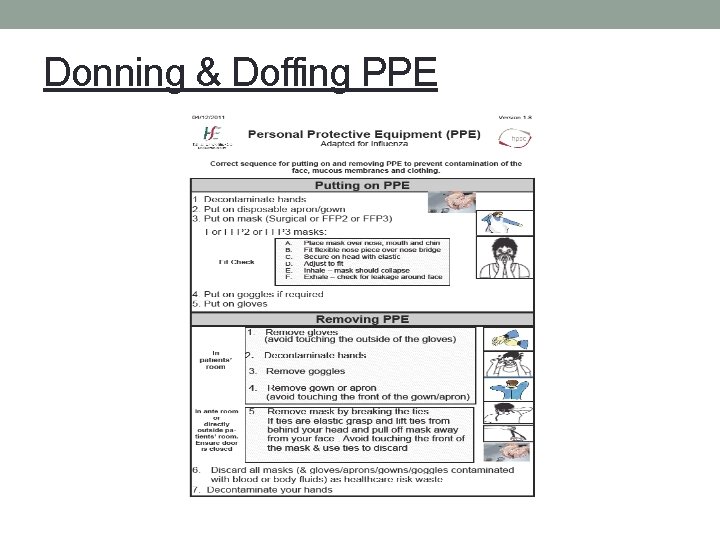
Donning & Doffing PPE
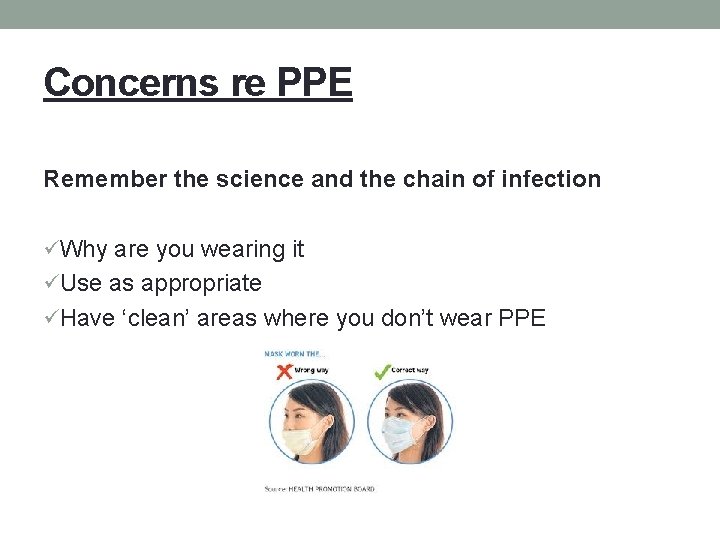
Concerns re PPE Remember the science and the chain of infection üWhy are you wearing it üUse as appropriate üHave ‘clean’ areas where you don’t wear PPE
Learning Videos COVID 19 page www. hseland. ie PPE donning and doffing videos training programme https: //www. hpsc. ie/az/respiratory/coronavirus/novelcoronavirus/ guidance/primary areguidance/videoresources/ https: //www. hpsc. ie/az/respiratory/coronavirus/novelcoronavirus/ videoresources/htps: //www. hpsc. ie/a/respiratory/coronavirus/nov elcoronavirus/guidance/infectionpreentionandcontrolguidance/vid eoresourcesforipc/ Doffing ear looped surgical masks: https: //www. hpsc. ie/az/respiratory/coronavirus/novelcoronavirus/videoresources/ https: //www. hpsc. ie/az/respiratory/coronavirus/novelcoronavirus/ guidance/infectionreventionandcontrolguidance/videoresourcesfo ripc/
Respiratory Hygiene • Cover your mouth and nose when coughing and/or sneezing • Turn your head away from others when coughing and/or sneezing • Using disposable tissues / coughing into sleeve • Wash hands after coughing/sneezing • HCWs who must undertake activities within 1 metre of patient observant of possible coughing/sneezing
Patient Equipment • Single use or single patient use ideally • Multi-patient use • Decontaminate between clients– wash with detergent and warm water, followed by disinfectant or use multi-purpose cleaning/disinfectant wipes. Normal standard precautions already done by staff for all clients • Where are patients notes kept?
Waste Management • All waste from patients with confirmed or suspected COVID-19 is considered healthcare risk waste • In homecare Covid positive/suspected - all items that have been in contact with client should be put in plastic rubbish bag, tied, second bag, left for 72 hours in secure location • Waste must never be carried in cars to ‘return’ to health centre or other facility
Laundry / Staff clothing • All patient laundry of suspected and confirmed cases should be managed as ‘infectious’ • Linen handled, transported and processed in a manner that prevents exposure to the skin and mucous membranes of staff, contamination of their clothing and environment • Laundry / staff clothing – ideally wash at 60◦C for 10 mins, or highest setting, use detergent
Environmental Hygiene • Survival on surfaces – depends on type of surface and the environmental conditions – plastic 72 hours, stainless steel 48 hours, copper 8 hours – level of virus declines very quickly • Combined detergent/disinfectant solution at a dilution of 1, 000 parts per million available chlorine or general purpose neutral detergent in a solution of warm water, followed by a disinfectant solution of 1, 000 ppm av. cl • Follow manufacturers instructions and recommended product contact times • Guidance on roles and responsibilities
Specific Issues • Home Visiting • Health Centre Clinics • Group Therapy • Office Space
Before going into the home… • Ring first – only home visit for task required • Check your supplies • Minimise visit time if possible • Only bring into house what you need – don’t stockpile in houses • Try to avoid engaging with other members of the household whilst in the home • This is a very clinical environment – hopefully after 14 days the patient will have recovered and normality will resume
Leaving the house • Remove PPE safely and dispose • Perform hand hygiene • Do not bring anything out of the house into your car • Do not wear any PPE outside of the house (patient confidentiality and contamination risk)
Homecare Guidelines • https: //www. hpsc. ie/a- z/respiratory/coronavirus/novelcoronavirus/guidance/infect ionpreventionandcontrolguidance/healthandsocialcarewor kers/Guidance. Health. Social. Care. Workers. Who. Visit. Homes. pdf
Health Centre Clinics • Patient Flow through building • Appointment times • Phone assessment • Workflow • Community Assessment Hubs
Group Therapy • Risk Assessment • Government restrictions • Video / Group calling
Keeping Staff Well • Self monitoring and report at start of shift Advise staff: • Confirm with line manager at start of shift that you do not have any symptoms of respiratory illness, e. g. fever, cough, SOB, aches & pains • If a household contact has any symptoms let your manager know before starting work • If you become unwell during shift – go home, contact GP, let GP know you are a healthcare worker • No return to work until 14 days post first symptom/date of diagnosis provided they have no fever during the last 5 days • If a contact in your house is unwell but you are well you may be asked to work under a process called derogation
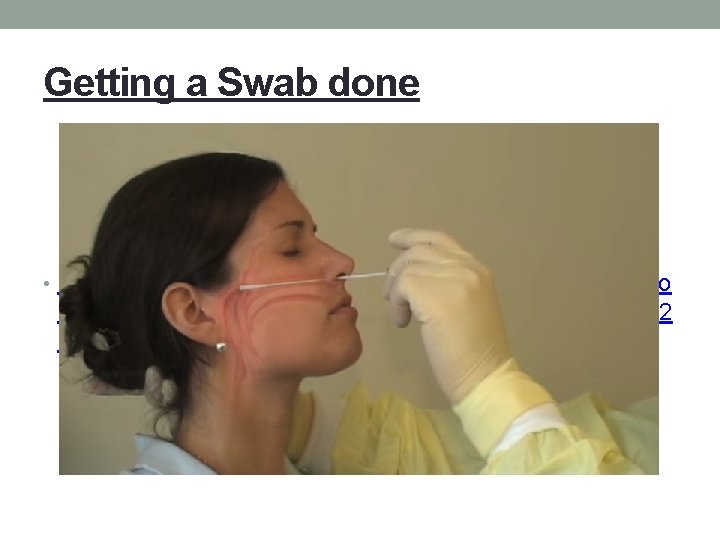
Getting a Swab done • https: //nasceducation. com/pluginfile. php/17526/mod_reso urce/content/4/Procedure%20 for%20 Swab%20 Testing%2 0 v. 2. mp 4
Reporting Suspicion It is difficult to differentiate between COVID-19 and other common respiratory infections based on symptoms alone Most common signs & symptoms of COVID-19 illness: • Cough • Shortness of breath • Fatigue • Myalgia (Aches & Pains) • Fever>/=38◦C Red flags: Call Ambulance and report to manager immediately • RR > 30 breathes/min • Severe respiratory distress • New onset Sp. O 2 < 90% on room air • New onset confusion • Hypotension • Oliguria (no urine) for more than 12 hours We are seeing common symptoms such as diarrhoea / patients who are usually active ‘taking to the bed’ / loss of appetite
When is it over? • Patient is 14 days post first symptom / fever free for 5 days • Celebrate the end of isolation / return to work of staff who have been unwell • Debriefing of staff / staff support / support for managers
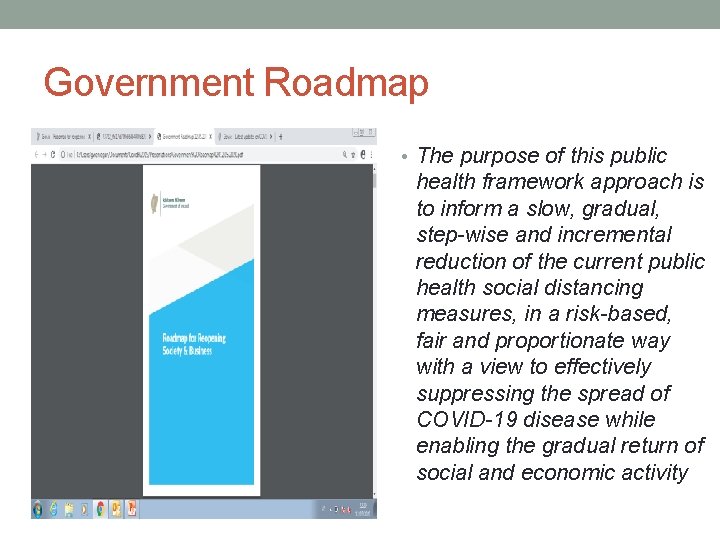
Government Roadmap • The purpose of this public health framework approach is to inform a slow, gradual, step-wise and incremental reduction of the current public health social distancing measures, in a risk-based, fair and proportionate way with a view to effectively suppressing the spread of COVID-19 disease while enabling the gradual return of social and economic activity
5 Phases Based on a 3 week review process, the current phases would commence on the following dates: • • • Phase 1 Phase 2 Phase 3 Phase 4 Phase 5 18 th May 8 th June 29 th June 20 th July 10 th August Disease indicators* 1. Trajectory in incidence of disease 2. Trajectory in number of cases and clusters in residential healthcare settings 3. Trajectory in number of deaths 4. Hospitalisation and ICU occupancy 5. Programme to consistently sample, test and contact trace *other criteria as may arise in the future
Healthcare Phase 1 & 2 (18 th May – 29 th June) - Increasing delivery of “non. COVID-19” care and services alongside COVID-19 -care to meet demand through: • Capacity planning for on-going delivery of COVID-19 and non-COVID-19 care and services • • • side by side, utilising modelling capability to assist in predicting demand for: primary, acute (including ICU), community, social care, mental health, disabilities and other services along the continuum of care. Implement measures to ensure safe delivery of COVID 19 and non-COVID-19 care and services side by side. Continue to deliver care and services in new ways (e. g. through telephone, online, virtual clinics etc) and new models of care to meet demand to alleviate concerns of patients, service users and healthcare workers. Communication campaign with public to: - encourage people to present for care when they need it, - advise of health and social care services initiatives to reduce risk of contracting COVID-19, and - what to expect in regard to non-COVID-19 care access. Implement activities to mitigate risk in the provision of care and services (in addition to social distancing. measures) such as the use of masks, personal protective equipment, testing and other measures that may emerge over time. Continue to support the mental health and wellbeing initiatives directed to meeting the diverse mental health and resilience needs of the public during these times. Continue to maintain mechanisms to provide community support to those in vulnerable groups
Healthcare Phase 3 – 29 th June Commence a phased approach to visiting at hospital / residential healthcare centre / other residential settings / prisons etc. , bearing in mind the particular features of types of settings and each individual centre, also considering personal protective equipment availability and other protections Phase 5 - 10 th August Return to normal visiting for hospital / residential healthcare centre / other residential settings / prisons
- Slides: 48