
Covered California Programs and Benefits for American Indians
Covered California Programs and Benefits for American Indians and Alaska Natives
COVERED CALIFORNIA OVERVIEW 1
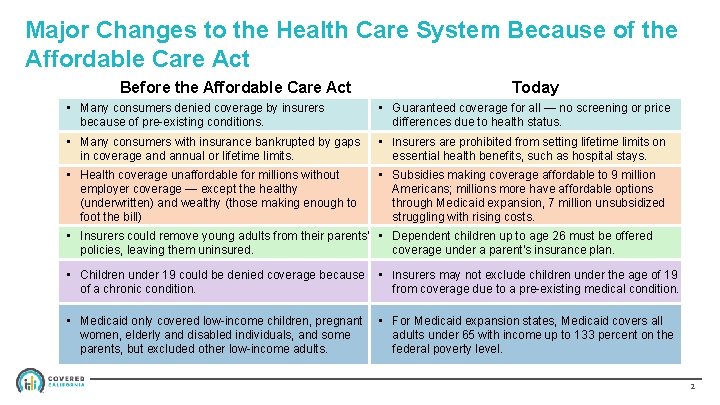
Major Changes to the Health Care System Because of the Affordable Care Act Before the Affordable Care Act Today • Many consumers denied coverage by insurers because of pre-existing conditions. • Guaranteed coverage for all — no screening or price differences due to health status. • Many consumers with insurance bankrupted by gaps in coverage and annual or lifetime limits. • Insurers are prohibited from setting lifetime limits on essential health benefits, such as hospital stays. • Health coverage unaffordable for millions without employer coverage — except the healthy (underwritten) and wealthy (those making enough to foot the bill) • Subsidies making coverage affordable to 9 million Americans; millions more have affordable options through Medicaid expansion, 7 million unsubsidized struggling with rising costs. • Insurers could remove young adults from their parents’ • Dependent children up to age 26 must be offered policies, leaving them uninsured. coverage under a parent’s insurance plan. • Children under 19 could be denied coverage because of a chronic condition. • Insurers may not exclude children under the age of 19 from coverage due to a pre-existing medical condition. • Medicaid only covered low-income children, pregnant women, elderly and disabled individuals, and some parents, but excluded other low-income adults. • For Medicaid expansion states, Medicaid covers all adults under 65 with income up to 133 percent on the federal poverty level. 2
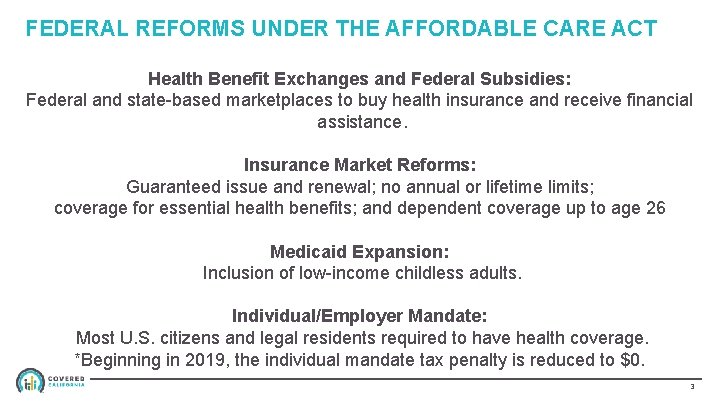
FEDERAL REFORMS UNDER THE AFFORDABLE CARE ACT Health Benefit Exchanges and Federal Subsidies: Federal and state-based marketplaces to buy health insurance and receive financial assistance. Insurance Market Reforms: Guaranteed issue and renewal; no annual or lifetime limits; coverage for essential health benefits; and dependent coverage up to age 26 Medicaid Expansion: Inclusion of low-income childless adults. Individual/Employer Mandate: Most U. S. citizens and legal residents required to have health coverage. *Beginning in 2019, the individual mandate tax penalty is reduced to $0. 3
ESTABLISHMENT OF THE CALIFORNIA HEALTH BENEFIT EXCHANGE (COVERED CALIFORNIA) • California was first state in nation to enact legislation creating a health benefit exchange under the Affordable Care Act o o • Independent public entity, governed by a five-member Board: o o • Assembly Bill 1602 (Pérez, 2010) - California Patient Protection and Affordable Care Act in California Senate Bill 900 (Alquist, 2010) established structure and requirements for the state’s health benefit exchange Two members appointed by the Governor One member appointed by Senate Rules Committee One member appointed by Speaker of the Assembly Secretary of the California Health and Human Services Agency - ex-officio, voting member Self-sustaining entity – no monies from the state General Fund 4
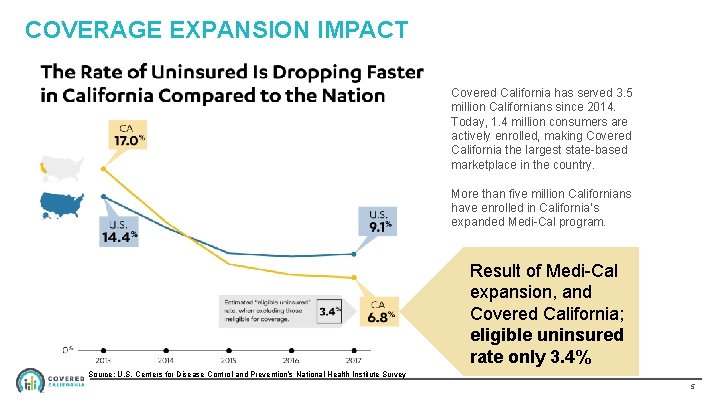
COVERAGE EXPANSION IMPACT Covered California has served 3. 5 million Californians since 2014. Today, 1. 4 million consumers are actively enrolled, making Covered California the largest state-based marketplace in the country. More than five million Californians have enrolled in California’s expanded Medi-Cal program. Result of Medi-Cal expansion, and Covered California; eligible uninsured rate only 3. 4% Source: U. S. Centers for Disease Control and Prevention’s National Health Institute Survey 5

CALIFORNIAN’S OPPORTUNITIES FOR COVERAGE The Affordable Care Act has dramatically changed the health insurance landscape in California with the expansion of Medicaid, Covered California and new protections for all Californians. California’s 2017 Health Care Market (in millions — ages 0 -64) • As of June 2018, Covered California had approximately 1. 4 million members who have active health insurance. California has also enrolled nearly 4 million more into Medi-Cal. • Consumers in the individual market (off-exchange) can get identical price and benefits as Covered California enrollees. • From 2013 to 2017, the U. S. Census Bureau states California cut its uninsured rate by 58 percent. Accounting for those ineligible because of their immigration status, California’s eligible uninsured population is 1 million. California administrative data sources are used for enrollment totals when possible. All other enrollment estimates are from the 2017 American Community Survey. The total enrollment population sums to more than California’s total population as some Californians were covered by more than one type of insurance during the same year. 6
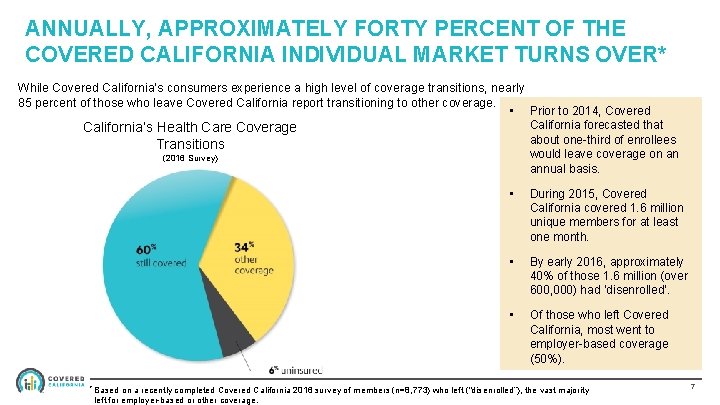
ANNUALLY, APPROXIMATELY FORTY PERCENT OF THE COVERED CALIFORNIA INDIVIDUAL MARKET TURNS OVER* While Covered California’s consumers experience a high level of coverage transitions, nearly 85 percent of those who leave Covered California report transitioning to other coverage. • Prior to 2014, Covered California forecasted that California’s Health Care Coverage about one-third of enrollees Transitions would leave coverage on an (2016 Survey) annual basis. * Based • During 2015, Covered California covered 1. 6 million unique members for at least one month. • By early 2016, approximately 40% of those 1. 6 million (over 600, 000) had ‘disenrolled’. • Of those who left Covered California, most went to employer-based coverage (50%). on a recently completed Covered California 2016 survey of members (n=8, 773) who left (“disenrolled”), the vast majority left for employer-based or other coverage. 7
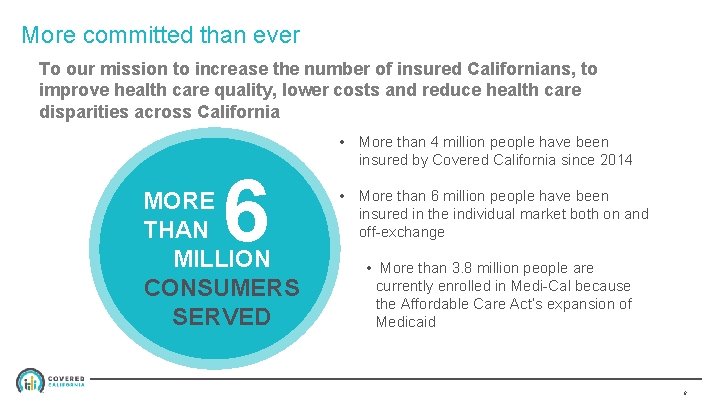
More committed than ever To our mission to increase the number of insured Californians, to improve health care quality, lower costs and reduce health care disparities across California 6 MORE THAN MILLION CONSUMERS SERVED • More than 4 million people have been insured by Covered California since 2014 • More than 6 million people have been insured in the individual market both on and off-exchange • More than 3. 8 million people are currently enrolled in Medi-Cal because the Affordable Care Act’s expansion of Medicaid 8
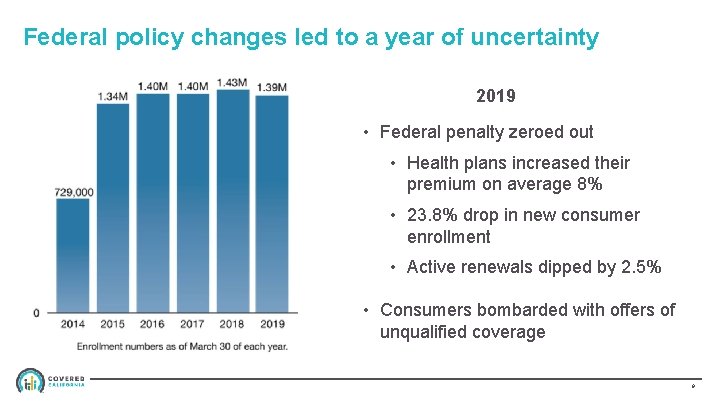
Federal policy changes led to a year of uncertainty 2019 • Federal penalty zeroed out • Health plans increased their premium on average 8% • 23. 8% drop in new consumer enrollment • Active renewals dipped by 2. 5% • Consumers bombarded with offers of unqualified coverage 9
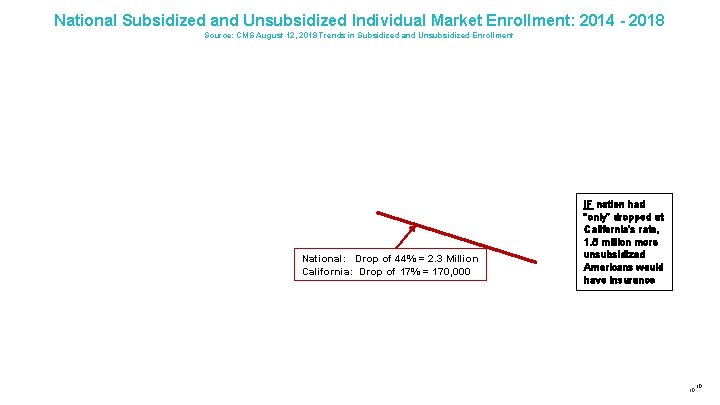
National Subsidized and Unsubsidized Individual Market Enrollment: 2014 - 2018 Source: CMS August 12, 2019 Trends in Subsidized and Unsubsidized Enrollment National: Drop of 44% = 2. 3 Million California: Drop of 17% = 170, 000 IF nation had “only” dropped at California’s rate, 1. 5 million more unsubsidized Americans would have insurance 10 10
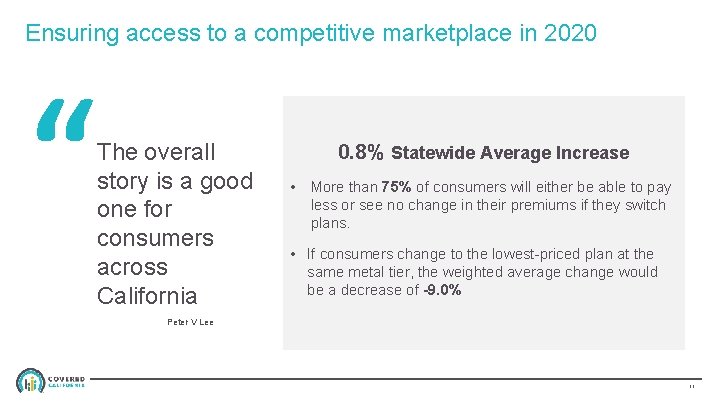
Ensuring access to a competitive marketplace in 2020 “ The overall story is a good one for consumers across California 0. 8% Statewide Average Increase • More than 75% of consumers will either be able to pay less or see no change in their premiums if they switch plans. • If consumers change to the lowest-priced plan at the same metal tier, the weighted average change would be a decrease of -9. 0% Peter V Lee 11
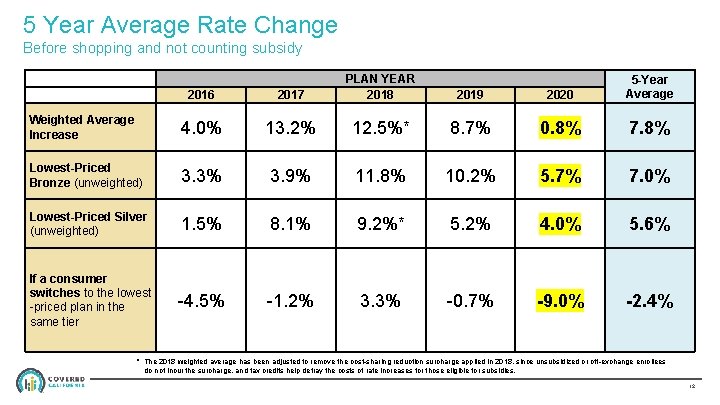
5 Year Average Rate Change Before shopping and not counting subsidy 2016 2017 PLAN YEAR 2018 Weighted Average Increase 4. 0% 13. 2% 12. 5%* 8. 7% 0. 8% 7. 8% Lowest-Priced Bronze (unweighted) 3. 3% 3. 9% 11. 8% 10. 2% 5. 7% 7. 0% Lowest-Priced Silver (unweighted) 1. 5% 8. 1% 9. 2%* 5. 2% 4. 0% 5. 6% If a consumer switches to the lowest -priced plan in the same tier -4. 5% -1. 2% 3. 3% -0. 7% -9. 0% -2. 4% 2019 2020 5 -Year Average * The 2018 weighted average has been adjusted to remove the cost-sharing reduction surcharge applied in 2018, since unsubsidized or off-exchange enrollees do not incur the surcharge, and tax credits help defray the costs of rate increases for those eligible for subsidies. 12
OVERVIEW: BENEFITS FOR AMERICAN INDIANS IN COVERED CALIFORNIA 13
BENEFITS FOR AMERICAN INDIANS/ALASKAN NATIVE (AI/AN) • Many AI/ANs currently receive health care from Indian health care providers, which include health programs operated by the Indian Health Service (IHS), tribes and tribal organizations, and urban Indian organizations. • If AI/ANs enroll in a plan through Covered California, they can continue to receive services from their local Indian health care provider. • AI/ANs can enroll or switch plans in Covered California throughout the year, not just during the annual open enrollment period. • Depending on income, AI/ANs can enroll in a zero cost or limited cost sharing plan. 14
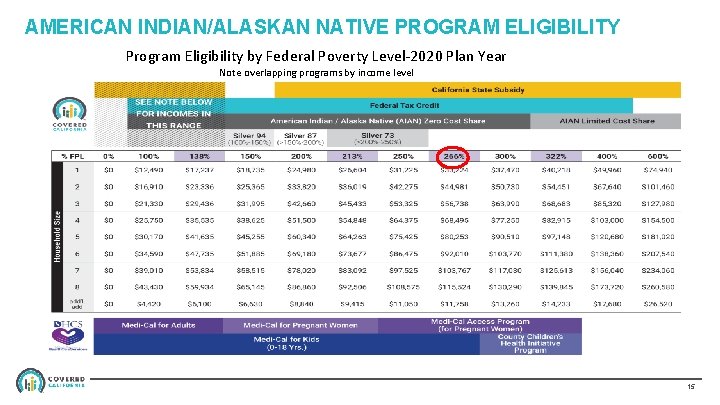
AMERICAN INDIAN/ALASKAN NATIVE PROGRAM ELIGIBILITY Program Eligibility by Federal Poverty Level-2020 Plan Year Note overlapping programs by income level 15
AI/AN ELIGIBILITY: ZERO COST SHARE PLANS • AI/AN applicants are eligible for a zero cost sharing qualified health plan (QHP) if the applicants: • Meet the eligibility requirements for APTC (Advance Premium Tax Credit) and CSR (Cost-Sharing Reduction) • Are expected to have a household income that does not exceed 300 percent of the federal poverty level (FPL) for the benefit year for which coverage is requested • If the AI/AN applicant meets the above eligibility requirements for zero cost sharing plans, that applicant must be treated as an eligible insured and the QHP must eliminate any cost sharing • AI/AN consumers can only access these benefits if enrolled in a zero cost sharing plan through Covered California • Consumers can enroll in a non zero cost sharing plan, but will not receive the zero cost sharing benefit 16
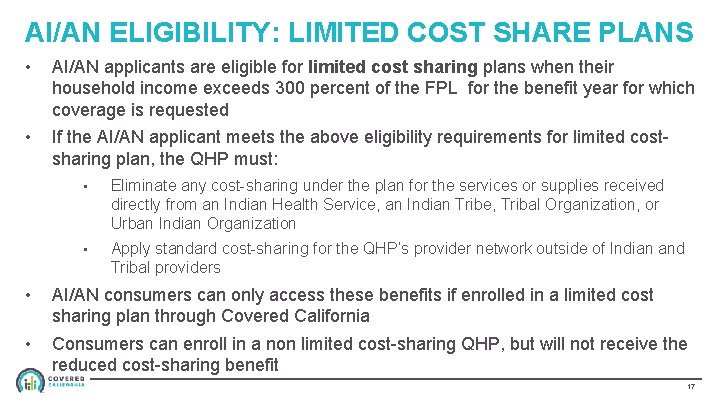
AI/AN ELIGIBILITY: LIMITED COST SHARE PLANS • AI/AN applicants are eligible for limited cost sharing plans when their household income exceeds 300 percent of the FPL for the benefit year for which coverage is requested • If the AI/AN applicant meets the above eligibility requirements for limited costsharing plan, the QHP must: • Eliminate any cost-sharing under the plan for the services or supplies received directly from an Indian Health Service, an Indian Tribe, Tribal Organization, or Urban Indian Organization • Apply standard cost-sharing for the QHP’s provider network outside of Indian and Tribal providers • AI/AN consumers can only access these benefits if enrolled in a limited cost sharing plan through Covered California • Consumers can enroll in a non limited cost-sharing QHP, but will not receive the reduced cost-sharing benefit 17
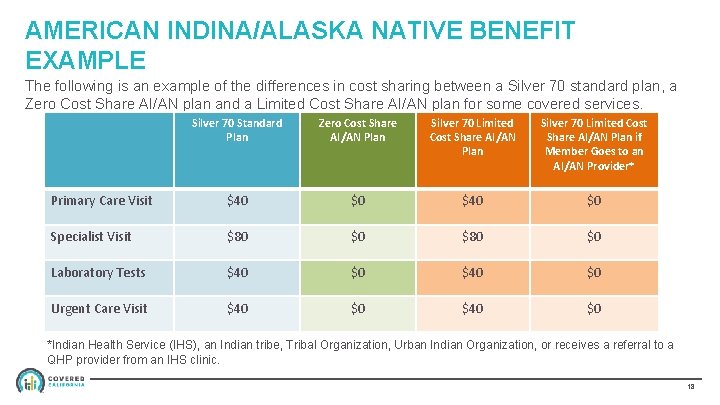
AMERICAN INDINA/ALASKA NATIVE BENEFIT EXAMPLE The following is an example of the differences in cost sharing between a Silver 70 standard plan, a Zero Cost Share AI/AN plan and a Limited Cost Share AI/AN plan for some covered services. Silver 70 Standard Plan Zero Cost Share AI/AN Plan Silver 70 Limited Cost Share AI/AN Plan if Member Goes to an AI/AN Provider* Primary Care Visit $40 $0 Specialist Visit $80 $0 Laboratory Tests $40 $0 Urgent Care Visit $40 $0 *Indian Health Service (IHS), an Indian tribe, Tribal Organization, Urban Indian Organization, or receives a referral to a QHP provider from an IHS clinic. 18
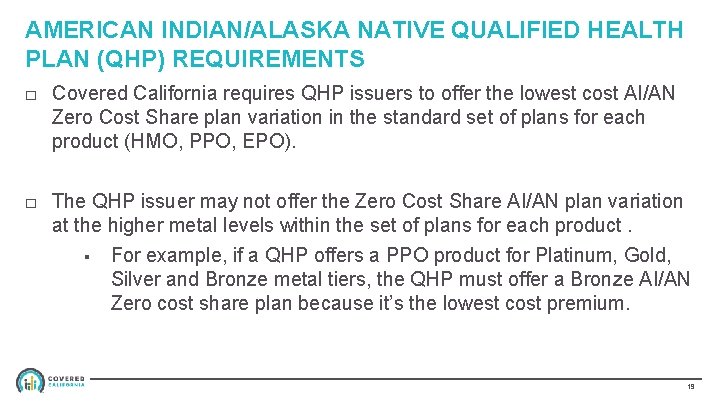
AMERICAN INDIAN/ALASKA NATIVE QUALIFIED HEALTH PLAN (QHP) REQUIREMENTS □ Covered California requires QHP issuers to offer the lowest cost AI/AN Zero Cost Share plan variation in the standard set of plans for each product (HMO, PPO, EPO). □ The QHP issuer may not offer the Zero Cost Share AI/AN plan variation at the higher metal levels within the set of plans for each product. § For example, if a QHP offers a PPO product for Platinum, Gold, Silver and Bronze metal tiers, the QHP must offer a Bronze AI/AN Zero cost share plan because it’s the lowest cost premium. 19
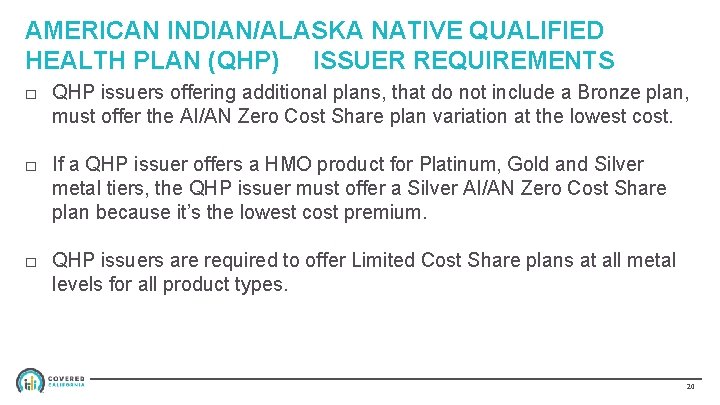
AMERICAN INDIAN/ALASKA NATIVE QUALIFIED HEALTH PLAN (QHP) ISSUER REQUIREMENTS □ QHP issuers offering additional plans, that do not include a Bronze plan, must offer the AI/AN Zero Cost Share plan variation at the lowest cost. □ If a QHP issuer offers a HMO product for Platinum, Gold and Silver metal tiers, the QHP issuer must offer a Silver AI/AN Zero Cost Share plan because it’s the lowest cost premium. □ QHP issuers are required to offer Limited Cost Share plans at all metal levels for all product types. 20
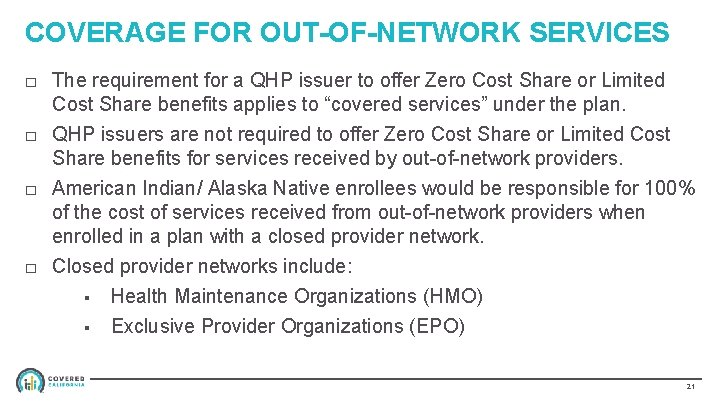
COVERAGE FOR OUT-OF-NETWORK SERVICES □ The requirement for a QHP issuer to offer Zero Cost Share or Limited Cost Share benefits applies to “covered services” under the plan. □ QHP issuers are not required to offer Zero Cost Share or Limited Cost Share benefits for services received by out-of-network providers. □ American Indian/ Alaska Native enrollees would be responsible for 100% of the cost of services received from out-of-network providers when enrolled in a plan with a closed provider network. □ Closed provider networks include: § Health Maintenance Organizations (HMO) § Exclusive Provider Organizations (EPO) 21
AI/AN ENROLLMENT IN COVERED CALIFORNIA 22
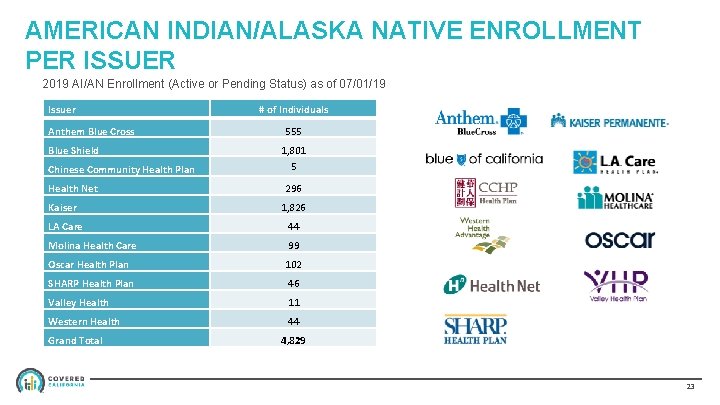
AMERICAN INDIAN/ALASKA NATIVE ENROLLMENT PER ISSUER 2019 AI/AN Enrollment (Active or Pending Status) as of 07/01/19 Issuer Anthem Blue Cross Blue Shield Chinese Community Health Plan Health Net # of Individuals 555 1, 801 5 296 Kaiser 1, 826 LA Care 44 Molina Health Care 99 Oscar Health Plan 102 SHARP Health Plan 46 Valley Health 11 Western Health 44 Grand Total 4, 829 23
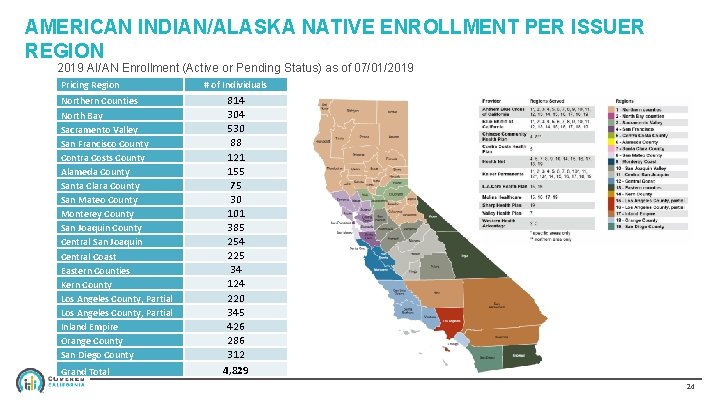
AMERICAN INDIAN/ALASKA NATIVE ENROLLMENT PER ISSUER REGION 2019 AI/AN Enrollment (Active or Pending Status) as of 07/01/2019 Pricing Region Northern Counties North Bay Sacramento Valley San Francisco County Contra Costs County Alameda County Santa Clara County San Mateo County Monterey County San Joaquin County Central San Joaquin Central Coast Eastern Counties Kern County Los Angeles County, Partial Inland Empire Orange County San Diego County Grand Total # of Individuals 814 304 530 88 121 155 75 30 101 385 254 225 34 124 220 345 426 286 312 4, 829 24
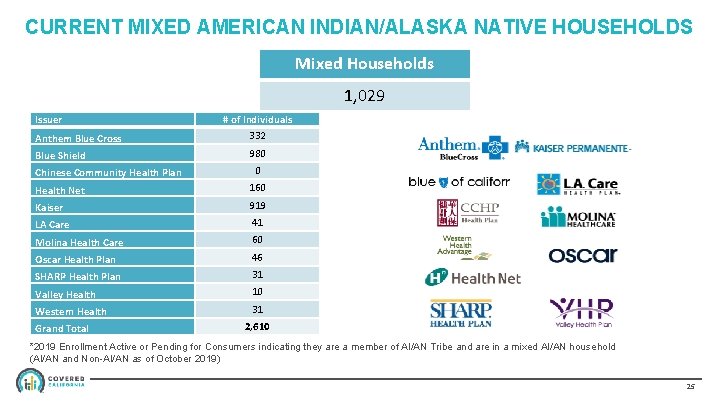
CURRENT MIXED AMERICAN INDIAN/ALASKA NATIVE HOUSEHOLDS Mixed Households 1, 029 Issuer Anthem Blue Cross Blue Shield Chinese Community Health Plan # of Individuals 332 980 0 Health Net 160 Kaiser 919 LA Care 41 Molina Health Care 60 Oscar Health Plan 46 SHARP Health Plan 31 Valley Health 10 Western Health 31 Grand Total 2, 610 *2019 Enrollment Active or Pending for Consumers indicating they are a member of AI/AN Tribe and are in a mixed AI/AN household (AI/AN and Non-AI/AN as of October 2019) 25
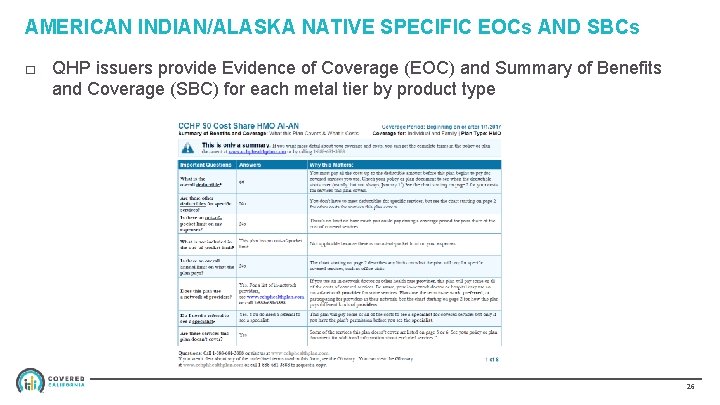
AMERICAN INDIAN/ALASKA NATIVE SPECIFIC EOCs AND SBCs □ QHP issuers provide Evidence of Coverage (EOC) and Summary of Benefits and Coverage (SBC) for each metal tier by product type 26
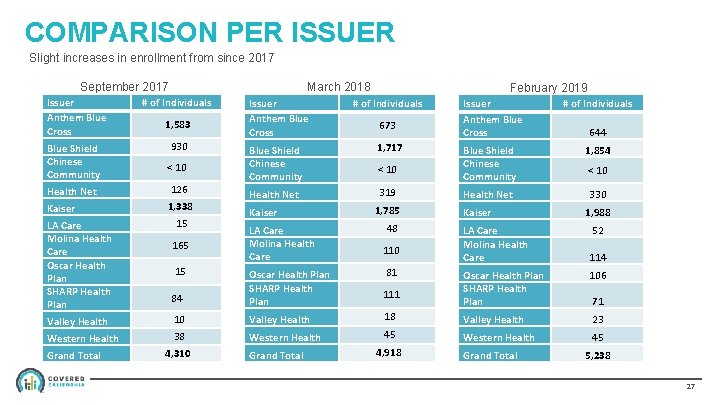
COMPARISON PER ISSUER Slight increases in enrollment from since 2017 March 2018 September 2017 Issuer Anthem Blue Cross # of Individuals Blue Shield Chinese Community 930 1, 583 < 10 Health Net 126 Kaiser 1, 338 LA Care Molina Health Care Oscar Health Plan SHARP Health Plan 15 165 15 February 2019 Issuer Anthem Blue Cross # of Individuals Blue Shield Chinese Community 1, 717 Health Net 319 Kaiser LA Care Molina Health Care 673 < 10 1, 785 48 110 81 Issuer Anthem Blue Cross # of Individuals Blue Shield Chinese Community 1, 854 Health Net 330 Kaiser LA Care Molina Health Care 644 < 10 1, 988 52 114 84 Oscar Health Plan SHARP Health Plan Valley Health 10 Valley Health 18 Valley Health 23 Western Health 38 Western Health 45 Grand Total 4, 310 Grand Total 111 4, 918 Oscar Health Plan SHARP Health Plan 106 Grand Total 71 5, 238 27
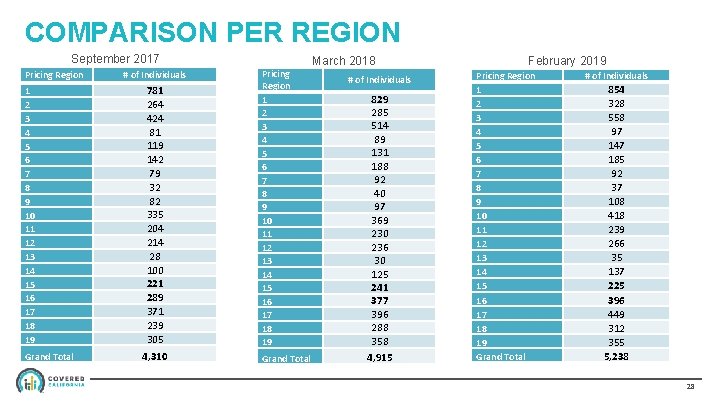
COMPARISON PER REGION September 2017 Pricing Region 1 2 3 4 5 6 7 8 9 10 11 12 13 14 15 16 17 18 19 Grand Total # of Individuals 781 264 424 81 119 142 79 32 82 335 204 214 28 100 221 289 371 239 305 4, 310 March 2018 Pricing Region 1 2 3 4 5 6 7 8 9 10 11 12 13 14 15 16 17 18 19 Grand Total # of Individuals 829 285 514 89 131 188 92 40 97 369 230 236 30 125 241 377 396 288 358 4, 915 February 2019 Pricing Region 1 2 3 4 5 6 7 8 9 10 11 12 13 14 15 16 17 18 19 Grand Total # of Individuals 854 328 558 97 147 185 92 37 108 418 239 266 35 137 225 396 449 312 355 5, 238 28
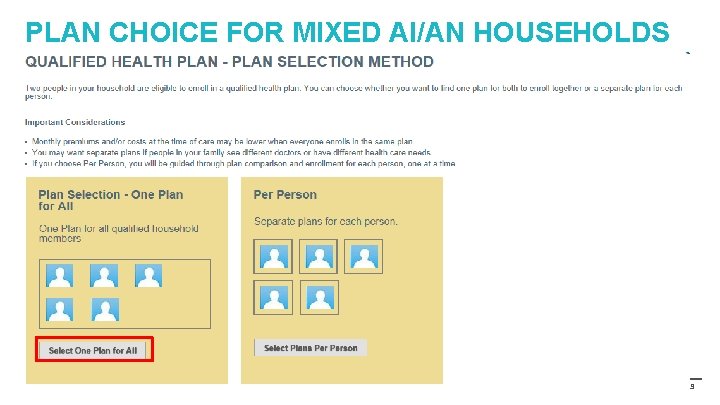
PLAN CHOICE FOR MIXED AI/AN HOUSEHOLDS 29
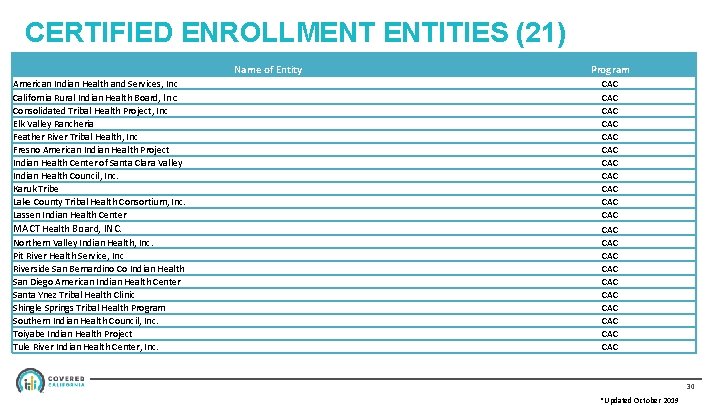
CERTIFIED ENROLLMENT ENTITIES (21) Name of Entity American Indian Health and Services, Inc California Rural Indian Health Board, Inc Consolidated Tribal Health Project, Inc Elk Valley Rancheria Feather River Tribal Health, Inc Fresno American Indian Health Project Indian Health Center of Santa Clara Valley Indian Health Council, Inc. Karuk Tribe Lake County Tribal Health Consortium, Inc. Lassen Indian Health Center MACT Health Board, INC. Northern Valley Indian Health, Inc. Pit River Health Service, Inc Riverside San Bernardino Co Indian Health San Diego American Indian Health Center Santa Ynez Tribal Health Clinic Shingle Springs Tribal Health Program Southern Indian Health Council, Inc. Toiyabe Indian Health Project Tule River Indian Health Center, Inc. Program CAC CAC CAC CAC CAC CAC 30 *Updated October 2019
California State Affordability Initiatives 31
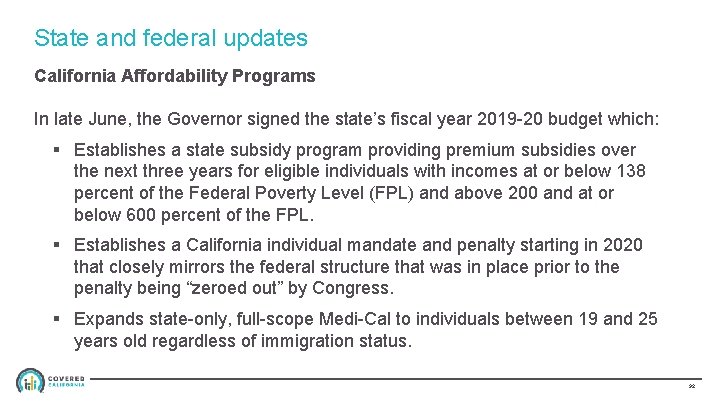
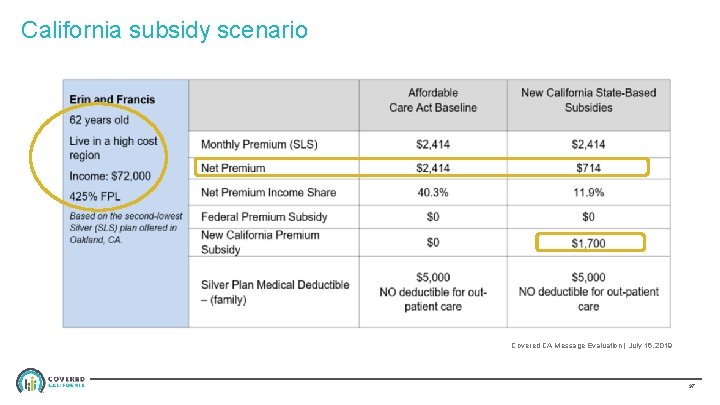
State and federal updates California Affordability Programs In late June, the Governor signed the state’s fiscal year 2019 -20 budget which: § Establishes a state subsidy program providing premium subsidies over the next three years for eligible individuals with incomes at or below 138 percent of the Federal Poverty Level (FPL) and above 200 and at or below 600 percent of the FPL. § Establishes a California individual mandate and penalty starting in 2020 that closely mirrors the federal structure that was in place prior to the penalty being “zeroed out” by Congress. § Expands state-only, full-scope Medi-Cal to individuals between 19 and 25 years old regardless of immigration status. 32
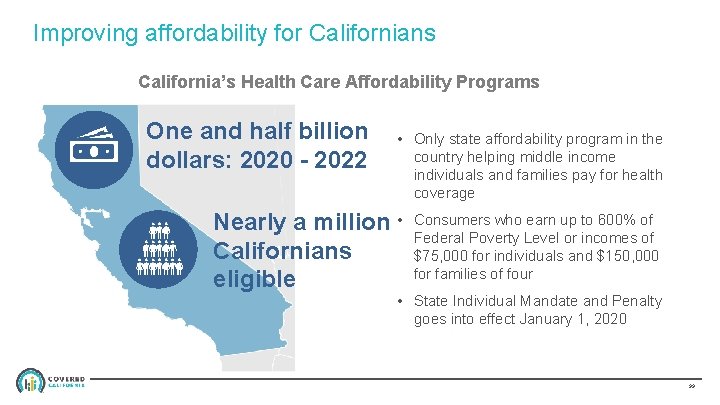
Improving affordability for Californians California’s Health Care Affordability Programs One and half billion dollars: 2020 - 2022 • Only state affordability program in the country helping middle income individuals and families pay for health coverage Nearly a million • Californians eligible Consumers who earn up to 600% of Federal Poverty Level or incomes of $75, 000 for individuals and $150, 000 for families of four • State Individual Mandate and Penalty goes into effect January 1, 2020 33
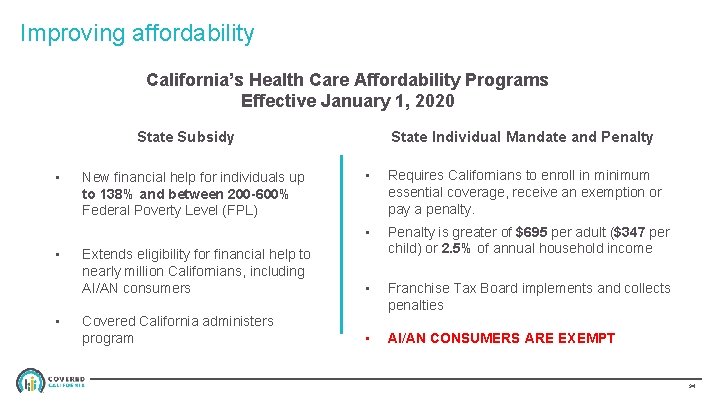
Improving affordability California’s Health Care Affordability Programs Effective January 1, 2020 State Individual Mandate and Penalty State Subsidy • • Requires Californians to enroll in minimum essential coverage, receive an exemption or pay a penalty. • Extends eligibility for financial help to nearly million Californians, including AI/AN consumers Penalty is greater of $695 per adult ($347 per child) or 2. 5% of annual household income • Franchise Tax Board implements and collects penalties Covered California administers program • AI/AN CONSUMERS ARE EXEMPT New financial help for individuals up to 138% and between 200 -600% Federal Poverty Level (FPL) 34
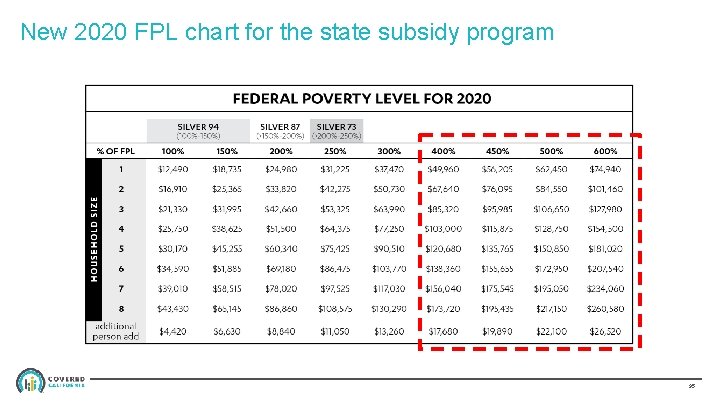
New 2020 FPL chart for the state subsidy program 35
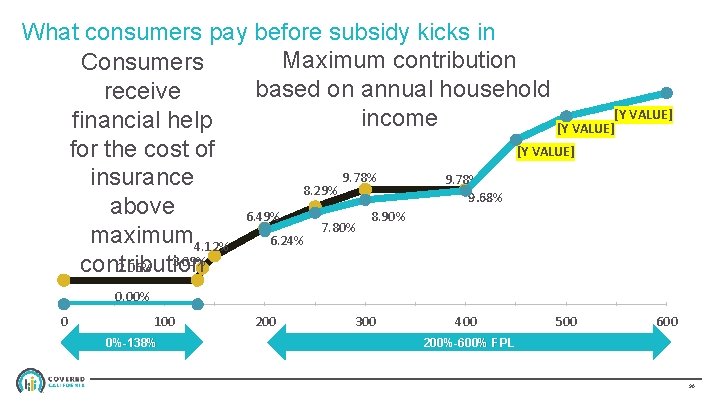
What consumers pay before subsidy kicks in Maximum contribution Consumers based on annual household receive [Y VALUE] income financial help [Y VALUE] for the cost of 9. 78% insurance 8. 29% 9. 68% above 8. 90% 6. 49% 7. 80% maximum 4. 12% 6. 24% contribution 2. 06% 3. 09% 0. 00% 0 100 0%-138% 200 300 400 Federal Poverty Level 200%-600% FPL 500 600 36
California subsidy scenario Covered CA Message Evaluation | July 16, 2019 37
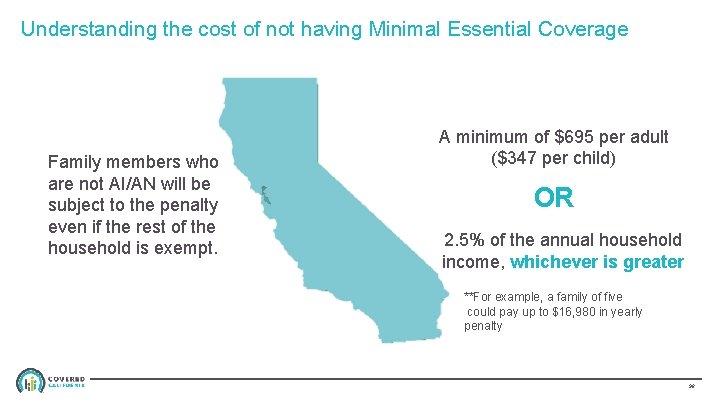
Understanding the cost of not having Minimal Essential Coverage Family members who are not AI/AN will be subject to the penalty even if the rest of the household is exempt. A minimum of $695 per adult ($347 per child) OR 2. 5% of the annual household income, whichever is greater **For example, a family of five could pay up to $16, 980 in yearly penalty 38
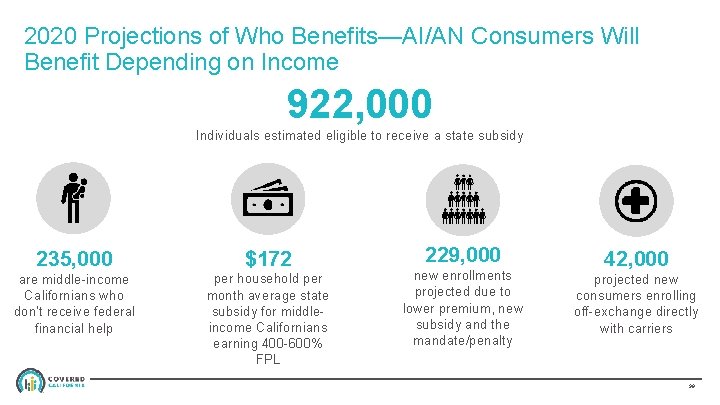
2020 Projections of Who Benefits—AI/AN Consumers Will Benefit Depending on Income 922, 000 Individuals estimated eligible to receive a state subsidy 235, 000 $172 are middle-income Californians who don’t receive federal financial help per household per month average state subsidy for middleincome Californians earning 400 -600% FPL 229, 000 new enrollments projected due to lower premium, new subsidy and the mandate/penalty 42, 000 projected new consumers enrolling off-exchange directly with carriers 39
TRIBAL CLINIC REFERRALS BACKGROUND AND UPDATE 40
BACKGROUND □ At the last Tribal Consultation Meeting in 2018, Covered California agreed to further investigate possible gaps in the process by which American Indian/Alaska Native (AI/AN) enrollees are referred by Indian Health Clinics to Qualified Health Plan (QHP) providers for covered health care services. 41
IDENTIFIED CHALLENGES □ More information and assistance with Indian Health Clinic referrals to QHP issuers is needed. □ Indian Health Clinic referrals vary and QHP issuers need specified information to process referrals. □ There is not a standard process flow for referrals between all QHP issuers. □ Process is needed to obtain refund for any incorrect charges for health care services. 42
AMERICAN INDIAN/ALASKAN NATIVE ZERO-COST AND LIMITED-COST SHARING PLANS • Zero-cost sharing plans: If below 300 percent federal poverty level (FPL), consumer is eligible for AI/AN plan that is not subject to deductible, coinsurance and cost sharing. Does not need a referral from an Indian Health Clinic. • Limited-cost sharing plans: If above 300 percent FPL, consumer is not subject to deductible, coinsurance and cost sharing if receiving health care services from an Indian Health Clinic or with a referral to a QHP provider from an Indian Health Clinic. 43
WORK IN PROGRESS □ Reaching out to several QHP issuers § § Gathering information on the current status of Indian Health Clinic referrals and their internal processes Shared draft Indian Health Clinic referral form template for review and feedback with carriers and Tribal partners □ Creating model referral form 44
PROPOSED NEXT STEPS • Review, edit and finalize Indian Health Clinic suggested referral form template. The final document will be posted on the Covered California website with use instructions. • What other means should Covered California use to share materials and information with AI/AN consumers and providers? 45
THANK YOU! Kelly Bradfield, Interim Tribal Liaison Kelly. Bradfield@covered. ca. gov (916) 228 -8832 46
APPENDIX 47
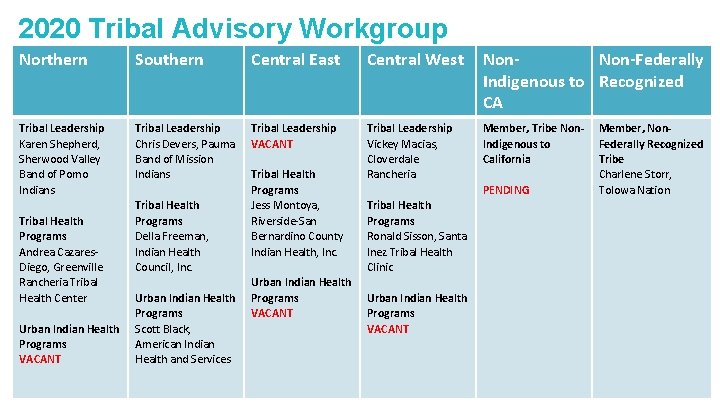
2020 Tribal Advisory Workgroup Northern Southern Central East Central West Non-Federally Indigenous to Recognized CA Tribal Leadership Karen Shepherd, Sherwood Valley Band of Pomo Indians Tribal Leadership Chris Devers, Pauma Band of Mission Indians Tribal Leadership VACANT Tribal Leadership Vickey Macias, Cloverdale Rancheria Member, Tribe Non. Indigenous to California Tribal Health Programs Andrea Cazares. Diego, Greenville Rancheria Tribal Health Center Urban Indian Health Programs VACANT Tribal Health Programs Della Freeman, Indian Health Council, Inc. Urban Indian Health Programs Scott Black, American Indian Health and Services Tribal Health Programs Jess Montoya, Riverside-San Bernardino County Indian Health, Inc. Urban Indian Health Programs VACANT PENDING Member, Non. Federally Recognized Tribe Charlene Storr, Tolowa Nation Tribal Health Programs Ronald Sisson, Santa Inez Tribal Health Clinic Urban Indian Health Programs VACANT 48
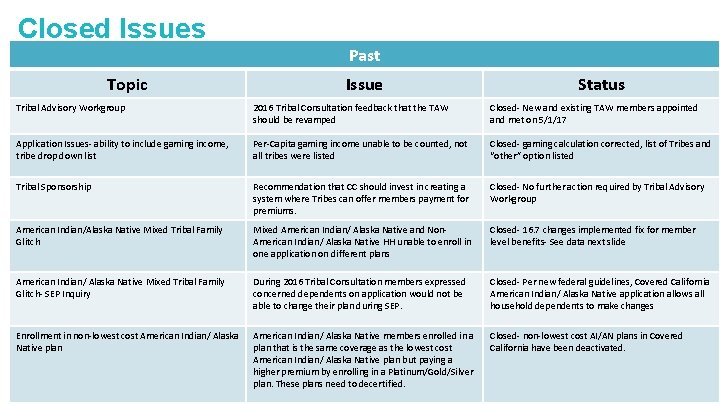
Closed Issues Topic Past Issue Status Tribal Advisory Workgroup 2016 Tribal Consultation feedback that the TAW should be revamped Closed- New and existing TAW members appointed and met on 5/1/17 Application Issues- ability to include gaming income, tribe drop down list Per-Capita gaming income unable to be counted, not all tribes were listed Closed- gaming calculation corrected, list of Tribes and “other” option listed Tribal Sponsorship Recommendation that CC should invest in creating a system where Tribes can offer members payment for premiums. Closed- No further action required by Tribal Advisory Workgroup American Indian/Alaska Native Mixed Tribal Family Glitch Mixed American Indian/ Alaska Native and Non. American Indian/ Alaska Native HH unable to enroll in one application on different plans Closed- 16. 7 changes implemented fix for member level benefits- See data next slide American Indian/ Alaska Native Mixed Tribal Family Glitch- SEP Inquiry During 2016 Tribal Consultation members expressed concerned dependents on application would not be able to change their plan during SEP. Closed- Per new federal guidelines, Covered California American Indian/ Alaska Native application allows all household dependents to make changes Enrollment in non-lowest cost American Indian/ Alaska Native plan American Indian/ Alaska Native members enrolled in a plan that is the same coverage as the lowest cost American Indian/ Alaska Native plan but paying a higher premium by enrolling in a Platinum/Gold/Silver plan. These plans need to decertified. Closed- non-lowest cost AI/AN plans in Covered California have been deactivated. 49
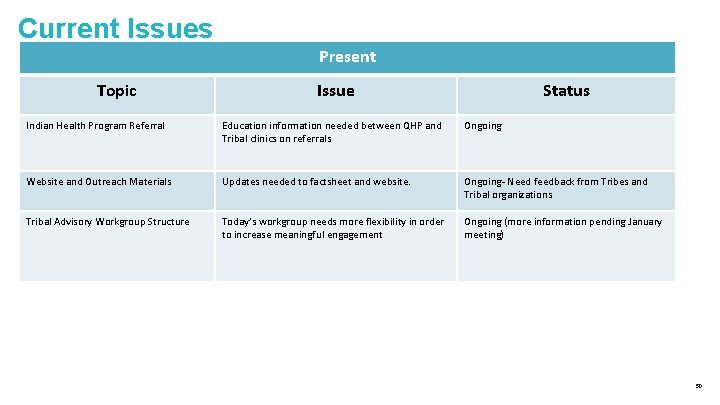
Current Issues Present Topic Issue Status Indian Health Program Referral Education information needed between QHP and Tribal clinics on referrals Ongoing Website and Outreach Materials Updates needed to factsheet and website. Ongoing- Need feedback from Tribes and Tribal organizations Tribal Advisory Workgroup Structure Today’s workgroup needs more flexibility in order to increase meaningful engagement Ongoing (more information pending January meeting) 50
- Slides: 51