
Cover Letters 101 ENG 108 Technical Writing Overview
- Slides: 10
Cover Letters 101 ENG 108: Technical Writing
Overview of Presentation • Goals of a cover letter • A sample outline • Show, don’t tell • Other considerations
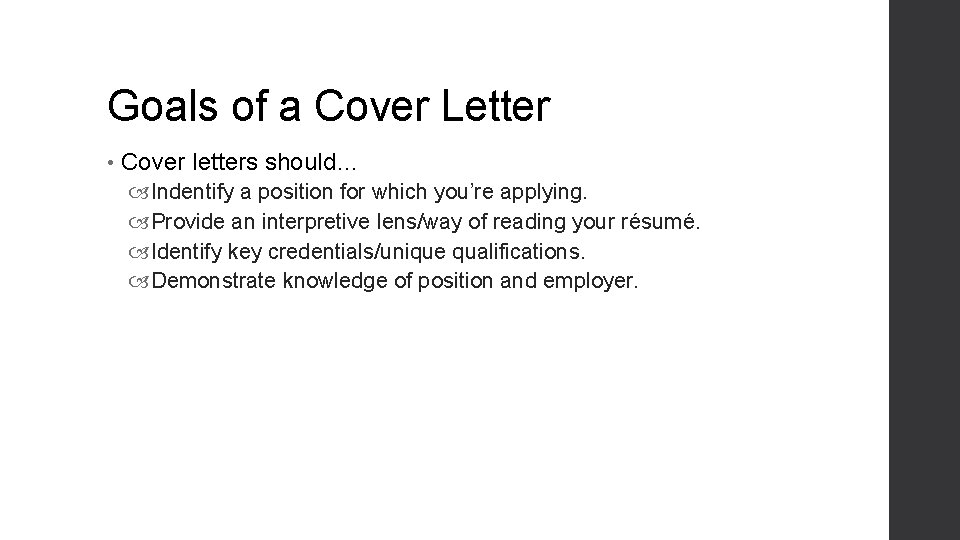
Goals of a Cover Letter • Cover letters should… Indentify a position for which you’re applying. Provide an interpretive lens/way of reading your résumé. Identify key credentials/unique qualifications. Demonstrate knowledge of position and employer.
A sample outline • Cover letters have general parts, but can be constructed in an infinite number of ways. What’s most important is that you keep the goals from the previous slide in mind as well as your audience. • Over time, the following outline has worked well for my students and me:
Paragraph #1: Announcing Candidacy • Paragraph #1: Identify position applying for and where you heard about it. This is your chance, also, to mention any personal referrals.
Paragraph #2: The Nutshell Paragraph • Paragraph #2: I call this the “nutshell paragraph” where you explain and forecast why you’re a strong candidate in a sentence or two. This is a place to be creative and precise with your language! This is your chance to make a few key claims about yourself and what makes you exceptional and unique. These claims could center on your experience, your education, particular skill set(s) you possess, etc. This is also your chance to provide an interpret lens – or set of language – for your résumé.
Paragraphs #3 -5: Supporting your claims Here’s where it’s important to show, don’t tell. Leveraging the most specific and most compelling evidence you can muster, SHOW the reader that the claims you made in your nut paragraph are true! Don’t get bogged down in duties and responsibilities. Focus your energy on accomplishments, achievements, successes, etc. Generally speaking, the more specific you can be, the better!
Paragraphs #6: Encouraging Follow Up • Once you’ve finished showing the reader your exceptional and unique qualifications, thank them and give them methods to follow up for an interview!
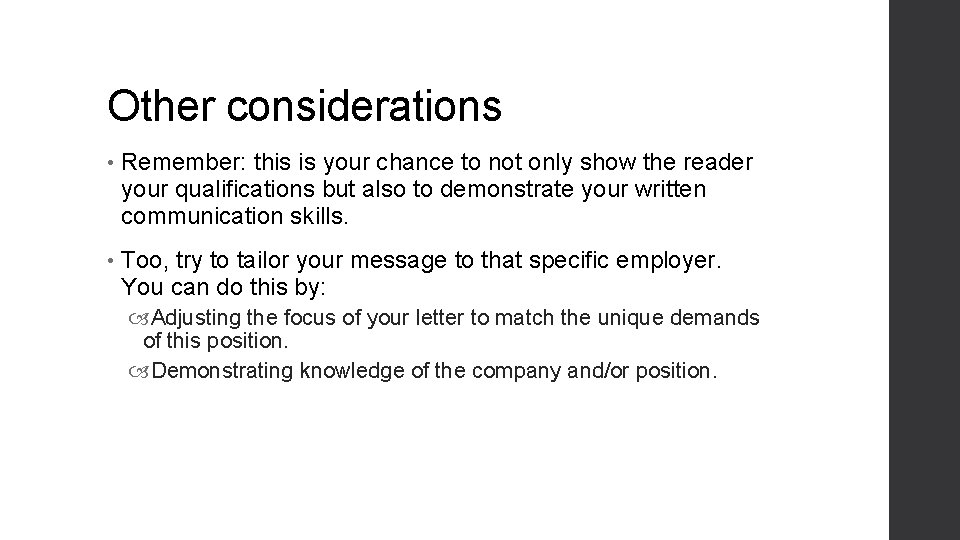
Other considerations • Remember: this is your chance to not only show the reader your qualifications but also to demonstrate your written communication skills. • Too, try to tailor your message to that specific employer. You can do this by: Adjusting the focus of your letter to match the unique demands of this position. Demonstrating knowledge of the company and/or position.
Works Cited • Anderson, P. V. (2013). Technical communication. Cengage Learning. This workforce product was funded by a grant awarded by the U. S. Department of Labor’s Employment and Training Administration. The product was created by the grantee and does not necessarily reflect the official position of the U. S. Department of Labor. The U. S. Department of Labor makes no guarantees, warranties, or assurances of any kind, express or implied, with respect to such information, including any information on linked sites and including, but not limited to, accuracy of the information or its completeness, timeliness, usefulness, adequacy, continued availability, or ownership. This work by Kennebec Valley Community College is licensed under a Creative Commons Attribution 4. 0 International License.