
Coventry University Curriculum Framework for Ph D students



- Slides: 39
Coventry University Curriculum Framework for Ph. D students Prof Dobrila Petrovic Philip Lewis Luke Rhys Hicks Coventry University, UK, 15 and 16 Dec, 2016
Part 1: Understanding the Progress Review Panel PRP Part 2: Chairing a PRP
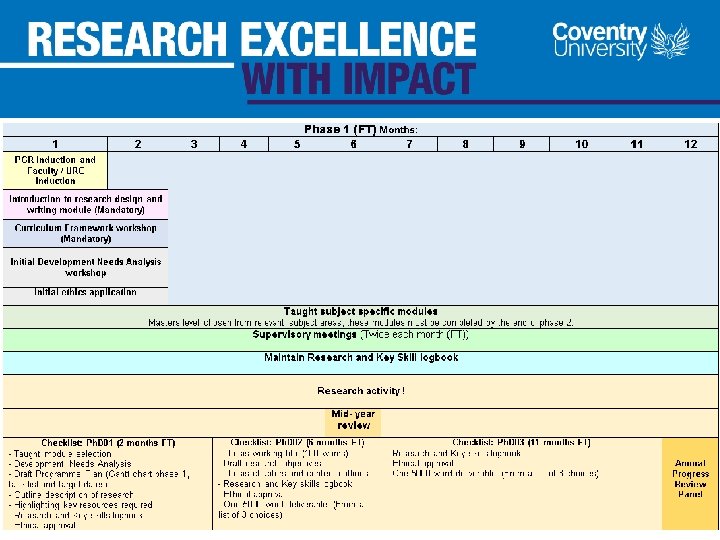
What does the ‘Coventry research programme’ look like?
Curriculum Framework • • • Defines every research degree programme Monitored via linked checklists Checklists define deliverables Progression reviewed annually via a Progress Review Panel For more information on the phases and checklists go to: https: //share. coventry. ac. uk/students/Research. Degrees/Pages/The. Research-Student-Lifecycle. aspx
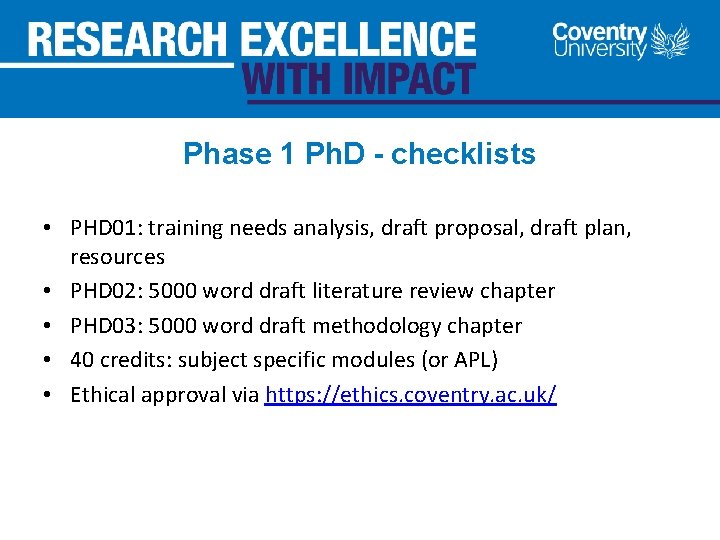
Phase 1 Ph. D - checklists • PHD 01: training needs analysis, draft proposal, draft plan, resources • PHD 02: 5000 word draft literature review chapter • PHD 03: 5000 word draft methodology chapter • 40 credits: subject specific modules (or APL) • Ethical approval via https: //ethics. coventry. ac. uk/
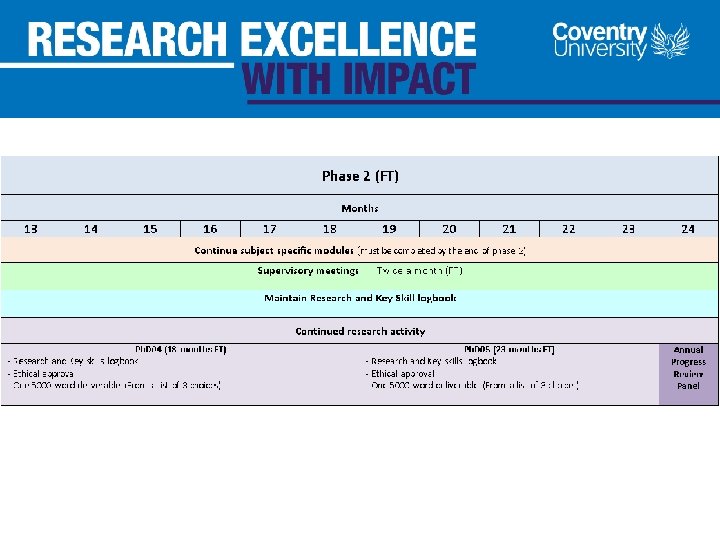
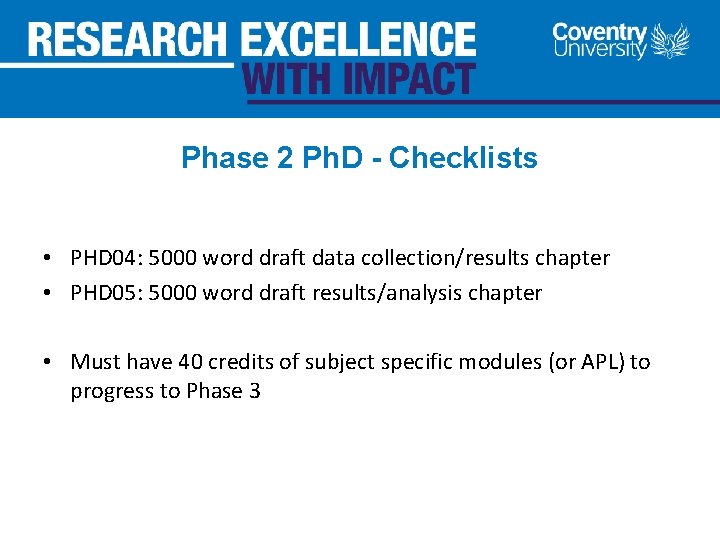
Phase 2 Ph. D - Checklists • PHD 04: 5000 word draft data collection/results chapter • PHD 05: 5000 word draft results/analysis chapter • Must have 40 credits of subject specific modules (or APL) to progress to Phase 3
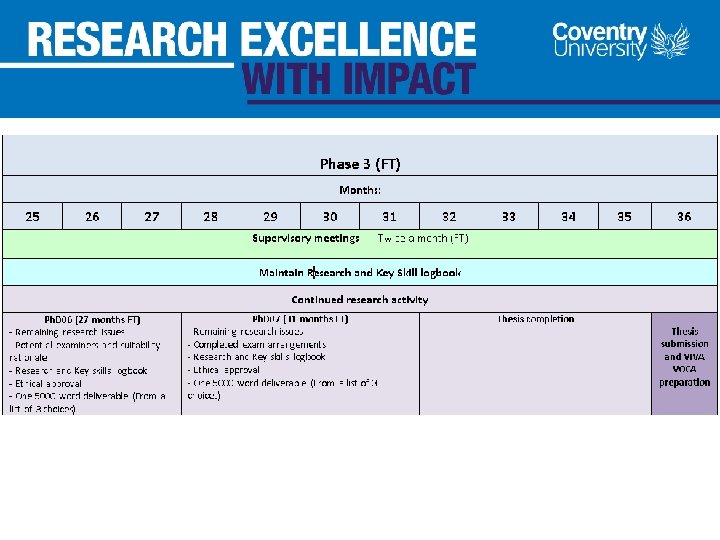
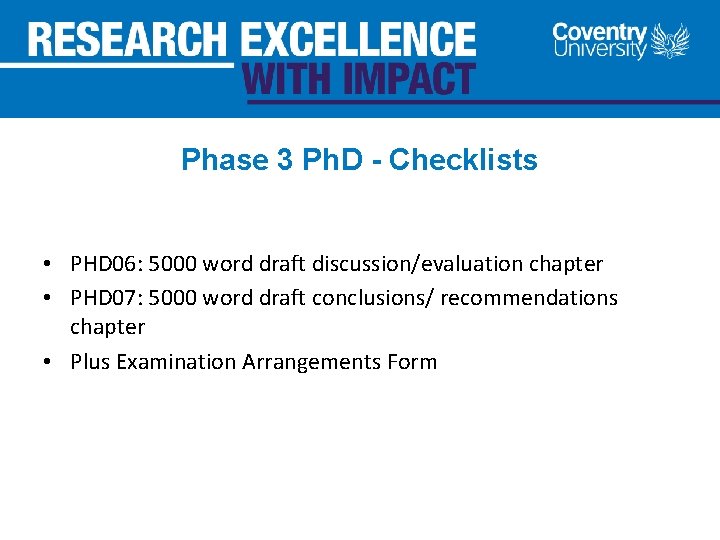
Phase 3 Ph. D - Checklists • PHD 06: 5000 word draft discussion/evaluation chapter • PHD 07: 5000 word draft conclusions/ recommendations chapter • Plus Examination Arrangements Form
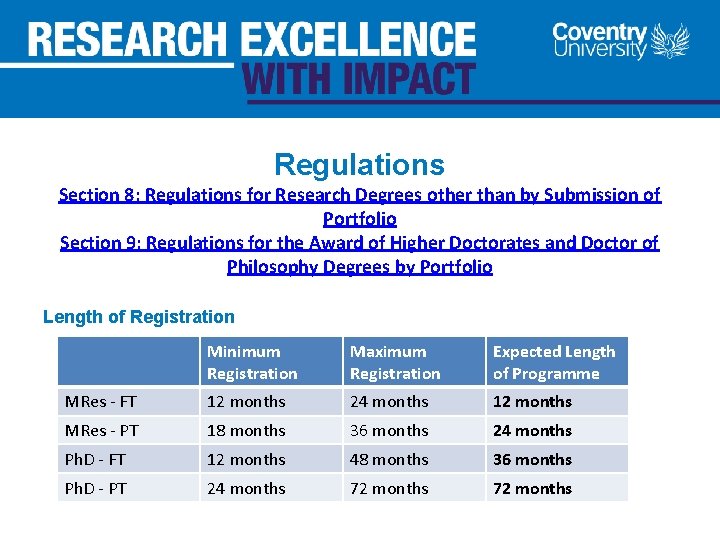
Regulations Section 8: Regulations for Research Degrees other than by Submission of Portfolio Section 9: Regulations for the Award of Higher Doctorates and Doctor of Philosophy Degrees by Portfolio Length of Registration Minimum Registration Maximum Registration Expected Length of Programme MRes - FT 12 months 24 months 12 months MRes - PT 18 months 36 months 24 months Ph. D - FT 12 months 48 months 36 months Ph. D - PT 24 months 72 months
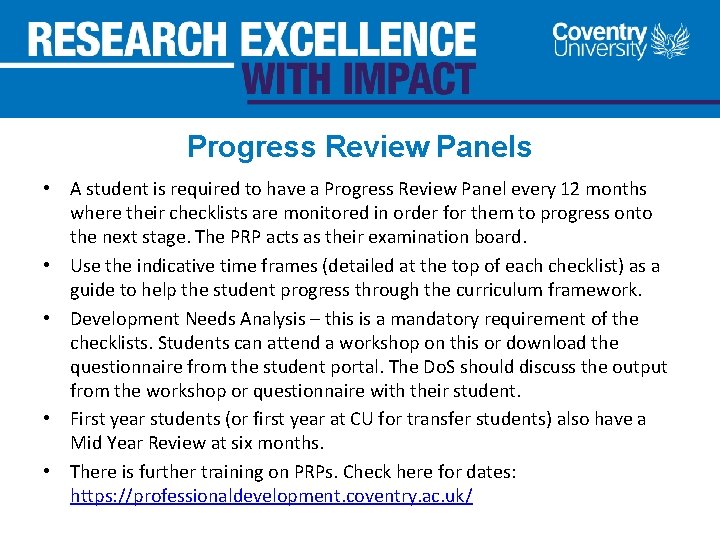
Progress Review Panels • A student is required to have a Progress Review Panel every 12 months where their checklists are monitored in order for them to progress onto the next stage. The PRP acts as their examination board. • Use the indicative time frames (detailed at the top of each checklist) as a guide to help the student progress through the curriculum framework. • Development Needs Analysis – this is a mandatory requirement of the checklists. Students can attend a workshop on this or download the questionnaire from the student portal. The Do. S should discuss the output from the workshop or questionnaire with their student. • First year students (or first year at CU for transfer students) also have a Mid Year Review at six months. • There is further training on PRPs. Check here for dates: https: //professionaldevelopment. coventry. ac. uk/
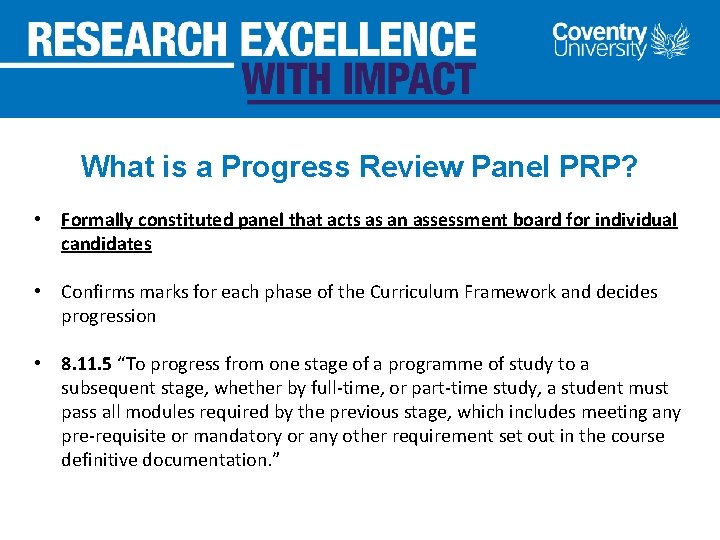
What is a Progress Review Panel PRP? • Formally constituted panel that acts as an assessment board for individual candidates • Confirms marks for each phase of the Curriculum Framework and decides progression • 8. 11. 5 “To progress from one stage of a programme of study to a subsequent stage, whether by full-time, or part-time study, a student must pass all modules required by the previous stage, which includes meeting any pre-requisite or mandatory or any other requirement set out in the course definitive documentation. ”
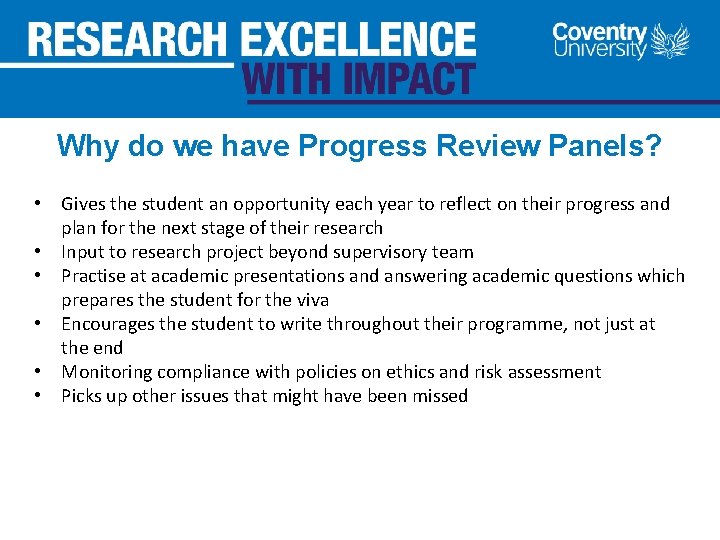
Why do we have Progress Review Panels? • Gives the student an opportunity each year to reflect on their progress and plan for the next stage of their research • Input to research project beyond supervisory team • Practise at academic presentations and answering academic questions which prepares the student for the viva • Encourages the student to write throughout their programme, not just at the end • Monitoring compliance with policies on ethics and risk assessment • Picks up other issues that might have been missed
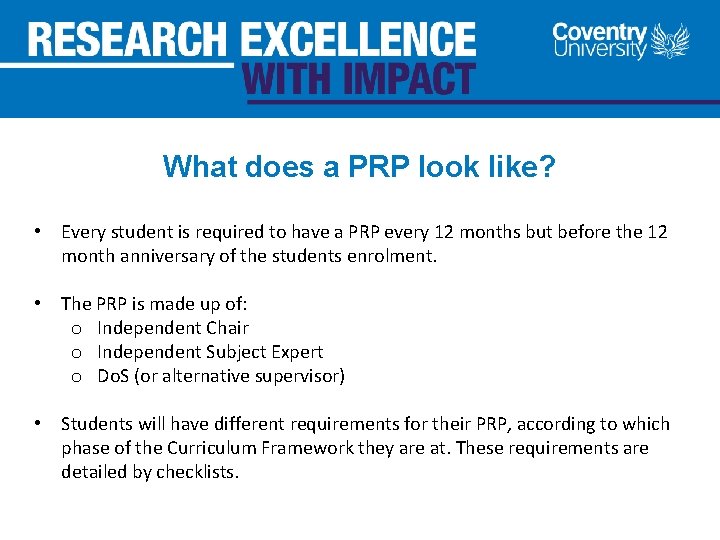
What does a PRP look like? • Every student is required to have a PRP every 12 months but before the 12 month anniversary of the students enrolment. • The PRP is made up of: o Independent Chair o Independent Subject Expert o Do. S (or alternative supervisor) • Students will have different requirements for their PRP, according to which phase of the Curriculum Framework they are at. These requirements are detailed by checklists.
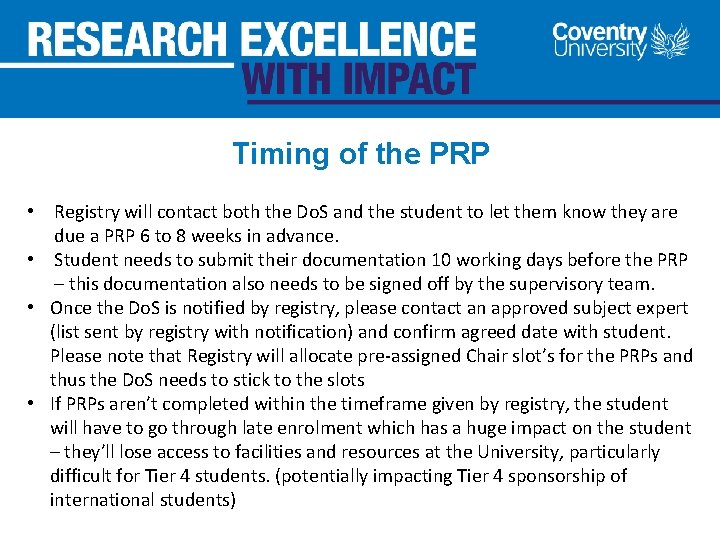
Timing of the PRP • Registry will contact both the Do. S and the student to let them know they are due a PRP 6 to 8 weeks in advance. • Student needs to submit their documentation 10 working days before the PRP – this documentation also needs to be signed off by the supervisory team. • Once the Do. S is notified by registry, please contact an approved subject expert (list sent by registry with notification) and confirm agreed date with student. Please note that Registry will allocate pre-assigned Chair slot’s for the PRPs and thus the Do. S needs to stick to the slots • If PRPs aren’t completed within the timeframe given by registry, the student will have to go through late enrolment which has a huge impact on the student – they’ll lose access to facilities and resources at the University, particularly difficult for Tier 4 students. (potentially impacting Tier 4 sponsorship of international students)
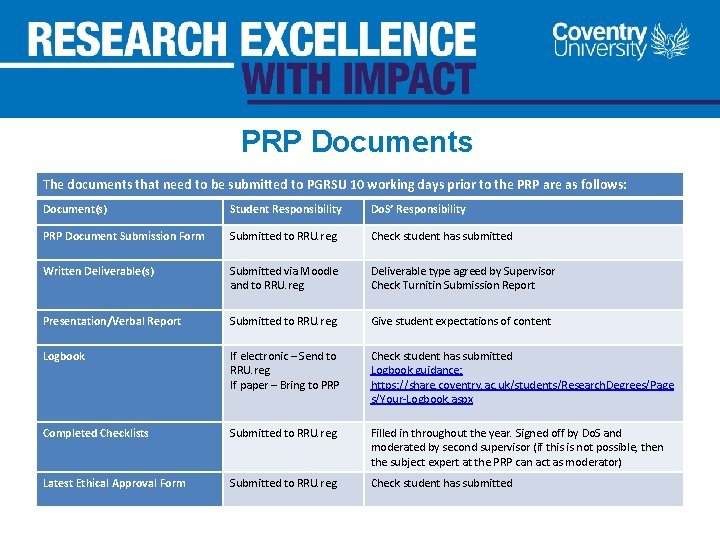
PRP Documents The documents that need to be submitted to PGRSU 10 working days prior to the PRP are as follows: Document(s) Student Responsibility Do. S’ Responsibility PRP Document Submission Form Submitted to RRU. reg Check student has submitted Written Deliverable(s) Submitted via Moodle and to RRU. reg Deliverable type agreed by Supervisor Check Turnitin Submission Report Presentation/Verbal Report Submitted to RRU. reg Give student expectations of content Logbook If electronic – Send to RRU. reg If paper – Bring to PRP Check student has submitted Logbook guidance: https: //share. coventry. ac. uk/students/Research. Degrees/Page s/Your-Logbook. aspx Completed Checklists Submitted to RRU. reg Filled in throughout the year. Signed off by Do. S and moderated by second supervisor (if this is not possible, then the subject expert at the PRP can act as moderator) Latest Ethical Approval Form Submitted to RRU. reg Check student has submitted
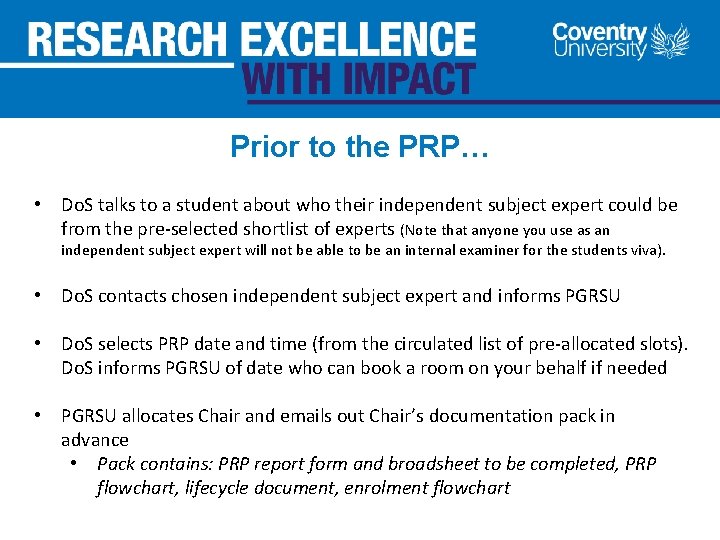
Prior to the PRP… • Do. S talks to a student about who their independent subject expert could be from the pre-selected shortlist of experts (Note that anyone you use as an independent subject expert will not be able to be an internal examiner for the students viva). • Do. S contacts chosen independent subject expert and informs PGRSU • Do. S selects PRP date and time (from the circulated list of pre-allocated slots). Do. S informs PGRSU of date who can book a room on your behalf if needed • PGRSU allocates Chair and emails out Chair’s documentation pack in advance • Pack contains: PRP report form and broadsheet to be completed, PRP flowchart, lifecycle document, enrolment flowchart
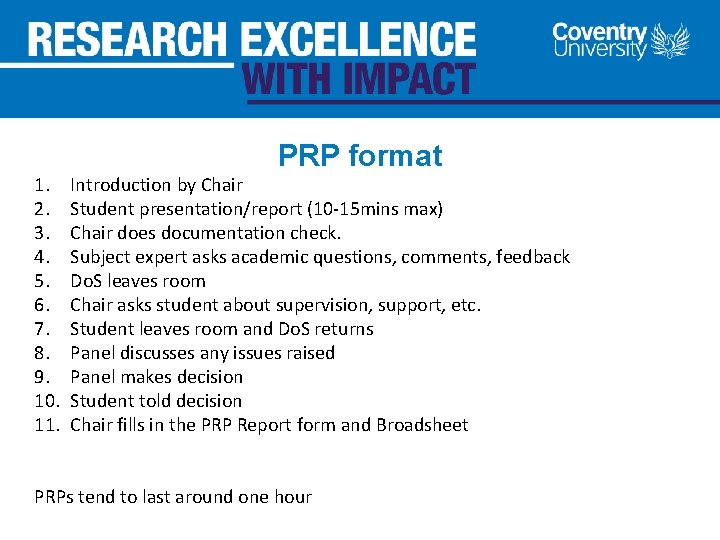
1. 2. 3. 4. 5. 6. 7. 8. 9. 10. 11. PRP format Introduction by Chair Student presentation/report (10 -15 mins max) Chair does documentation check. Subject expert asks academic questions, comments, feedback Do. S leaves room Chair asks student about supervision, support, etc. Student leaves room and Do. S returns Panel discusses any issues raised Panel makes decision Student told decision Chair fills in the PRP Report form and Broadsheet PRPs tend to last around one hour
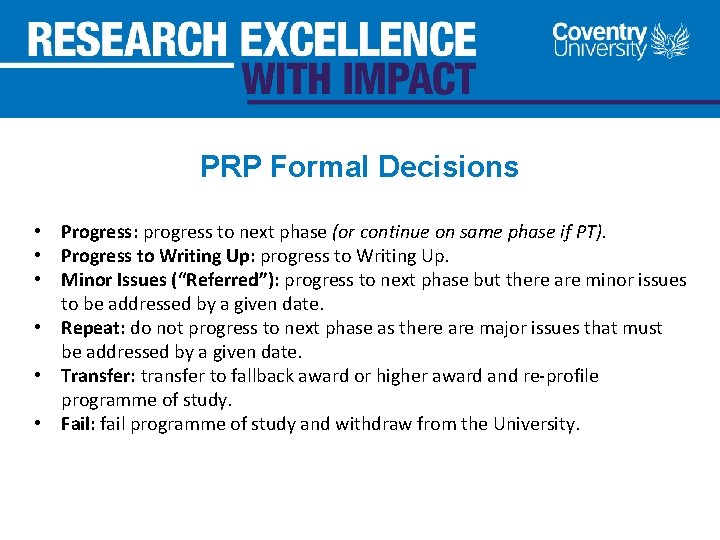
PRP Formal Decisions • Progress: progress to next phase (or continue on same phase if PT). • Progress to Writing Up: progress to Writing Up. • Minor Issues (“Referred”): progress to next phase but there are minor issues to be addressed by a given date. • Repeat: do not progress to next phase as there are major issues that must be addressed by a given date. • Transfer: transfer to fallback award or higher award and re-profile programme of study. • Fail: fail programme of study and withdraw from the University.
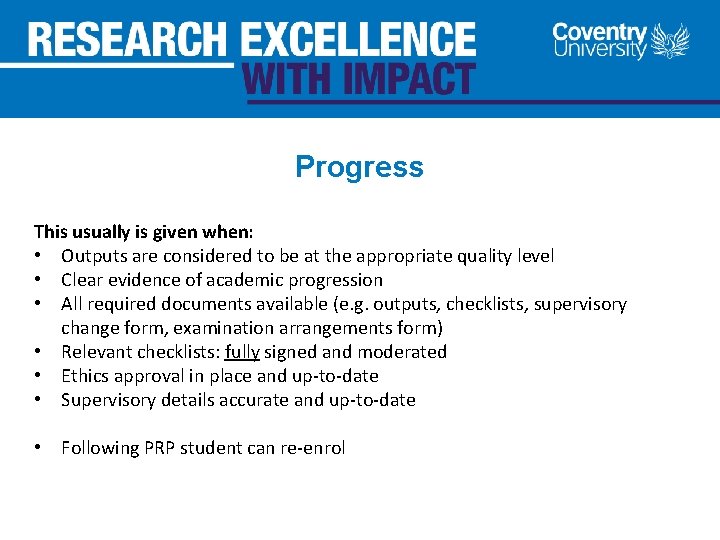
Progress This usually is given when: • Outputs are considered to be at the appropriate quality level • Clear evidence of academic progression • All required documents available (e. g. outputs, checklists, supervisory change form, examination arrangements form) • Relevant checklists: fully signed and moderated • Ethics approval in place and up-to-date • Supervisory details accurate and up-to-date • Following PRP student can re-enrol
Progress to ‘Writing Up’ • If a student has completed all the requirements of the Curriculum Framework (the checklists, passed all their subject specific modules, their written outputs) but are not in a position to hand in their thesis they will be allowed a writing up year. Writing up phase has reduced flat fee Only one year per student (unless approved by the Chair of the Research Degrees Sub Committee ) Typically 4 th year FT or 6 th/7 th year PT • • Following PRP student can re-enrol Note: student can only move onto writing up at the point of re-enrolment • • •
Minor Issues (“Referred”) This usually is given when: • Documents are missing (e. g. checklists, supervisory change form, examination arrangements form) • Note: this does not include for missing outputs • Checklists: must be fully completed (signatures) • Ethics: None or out of date (Ethics needs to be updated regularly with changes to the project, all students are required to do an ethics application). • A timeframe needs to be given for when these minor issues need to be resolved, this is typically one month. Once these documents are received by PGRSU, these are then circulated to the PRP panel for re-approval. No changes need to be made to the PRP Report. • Following PRP student can re-enrol
Repeat This usually is given for: • Academic issues o Quality of deliverable(s) o Quality of responses to questions, comments, etc. o Failure of mandatory/subject specific modules o Failure to submit relevant outputs • A clear action plan with associated support needs to be agreed • Following PRP student can re-enrol but will remain on the same ‘phase’ • Typical time for a student to repeat is three months • Student’s next annual PRP takes place as normal
Transfer • Transfers require careful consideration. For example, Master by Research to Ph. D or Ph. D to MPhil • Chair must be informed of intended transfer up prior to the PRP • A ‘PRP Transfer Form’ must be completed by the Chair during the PRP • Possible registration period implications – please refer to PGRSU (Registry) if unsure • Following PRP student can re-enrol
Fail • Decision usually arises after two “repeat” PRPs if student has failed to show sufficient progress and has not met the requirements of the framework • Student is withdrawn but has the right to appeal • Rationale for a fail outcome needs to be documented in detail on the PRP Report Form
PRP Following Suspensions • Usually chaired by the Research Degree Leader • Main purpose of the PRP: • Assess progress made before suspension started • Ascertain future research plans and expected progress • Assess any additional support required • Following PRP student can re-enrol
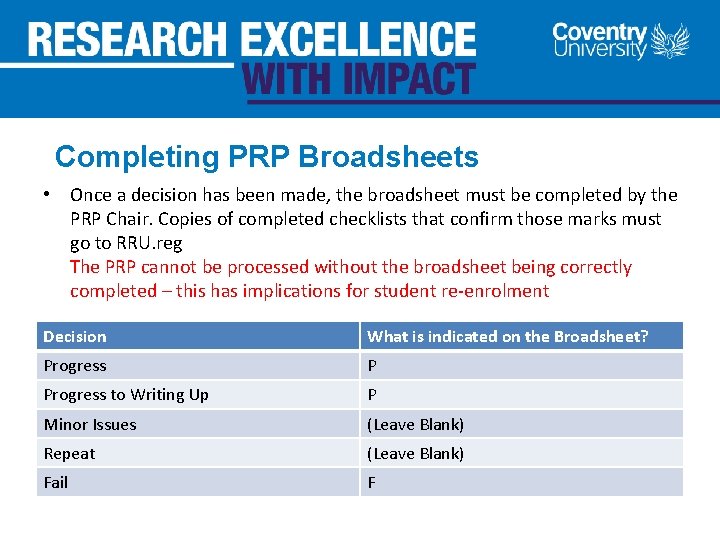
Completing PRP Broadsheets • Once a decision has been made, the broadsheet must be completed by the PRP Chair. Copies of completed checklists that confirm those marks must go to RRU. reg The PRP cannot be processed without the broadsheet being correctly completed – this has implications for student re-enrolment Decision What is indicated on the Broadsheet? Progress P Progress to Writing Up P Minor Issues (Leave Blank) Repeat (Leave Blank) Fail F
Overall PRP Remarks As a Do. S or Supervisor • It’s important to make sure your student is using their checklists as a guide throughout their programme • Make sure all PRP documentation is signed off well in advance to the PRP to ensure the student is ready for the PRP As a PRP Panel Member • Know your role and what is expected of you • Follow the regulations and if unsure seek advice from PGRSU Registry • Ensure correct procedure is followed prior to, during and after the PRP
Questions…?
Part 2: Chairing a PRP
Aims of Session • To build upon the knowledge gained in the ‘Understanding the PRP’ workshop • To provide practical guidelines on chairing a PRP • To use case studies/scenarios to demonstrate potential issues that may arise in a PRP
PRP Panel Roles: Independent Chair • Chairs panel, assures correct procedures, listens to presentation, can ask student (and Do. S if required), questions to clarify (non-academic questions), involved in final decision • Writes up the PRP report form • Completes broadsheet confirming pass “P” as appropriate and signs • Main roles: regulations, pastoral, academic
PRP Panel Roles: Independent Subject Expert • Reads deliverable(s) in advance of the PRP, listens to presentation, asks student academic questions, may ask Do. S questions (subject to chair approval), involved in final decision • Main role: academic Remember that the subject expert cannot be part of the students Viva as an examiner.
PRP Panel Roles: Director of Studies (or alternate) • Currently involved in final decision, can’t ask student questions, may be asked questions by rest of panel (as approved by Chair) • Ensures checklists have been signed off and completed in a timely manner. • Main roles: academic, pastoral
Chair Activity- Pre PRP • Before commencing the PRP the Chair should: – Check what stage student is at – Check paperwork submitted – Begin completion of PRP Report Form
Final Result • If no administrative or academic issues student can progress (or continue) • If administrative issues need resolving student may be given Minor Issues (typically one month to resolve) – Missing documentation, signatures etc • If academic issues need resolving a Repeat PRP may be given (typically within three months) – Quality of outputs, response to questioning, failure to submit outputs etc
Final Remarks • Supervisory team issues – deal with these in advance; discuss with experienced member of team • Be clear about the roles of each person at the PRP • If in doubt suspend the PRP and phone PGRSU (Registry)
Questions…?