
Covalent Compounds Molecular Compounds Compounds vs Molecules A
- Slides: 23
Covalent Compounds Molecular Compounds
Compounds vs Molecules • A Compound is any substance composed of two or more DIFFERENT elements. • A Molecule is any substance composed of two or more atoms COVALENTLY BONDED.
Properties of Covalent Compounds • Generally Low Melting and Boiling Points • Generally Soft and Flexible • Tend to be Flammable • Don’t conduct electricity • Normally won’t dissolve in water
Covalent Bonds formed between two nonmetals in Groups 14, 15, 16, and 17 Forms bonds where electrons are shared single bond shares one pair electrons double bond shares two pairs electrons triple bond shares three pairs electrons
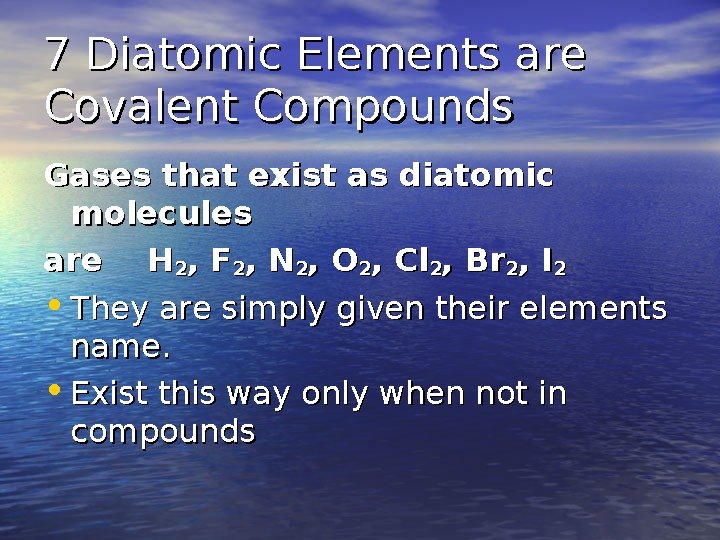
7 Diatomic Elements are Covalent Compounds Gases that exist as diatomic molecules are H 2, F 2, N 2, O 2, Cl 2, Br 2, I 2 • They are simply given their elements name. • Exist this way only when not in compounds
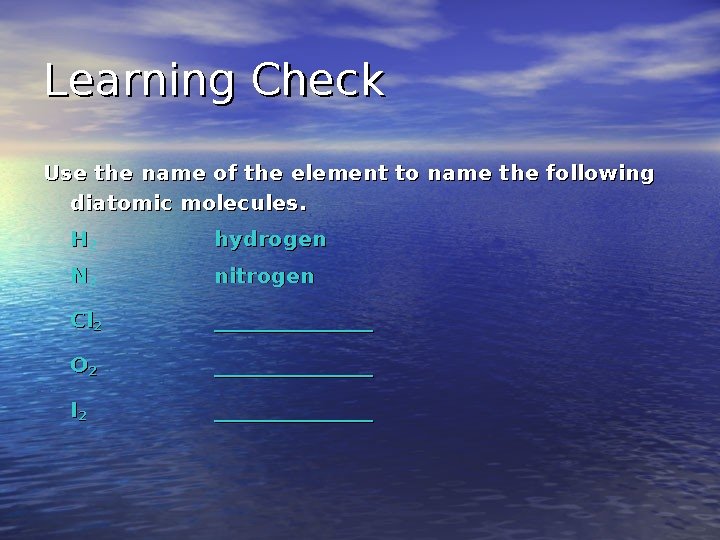
Learning Check Use the name of the element to name the following diatomic molecules. H 2 hydrogen N 2 nitrogen Cl 2 ________ O 2 ________ I 2 ________
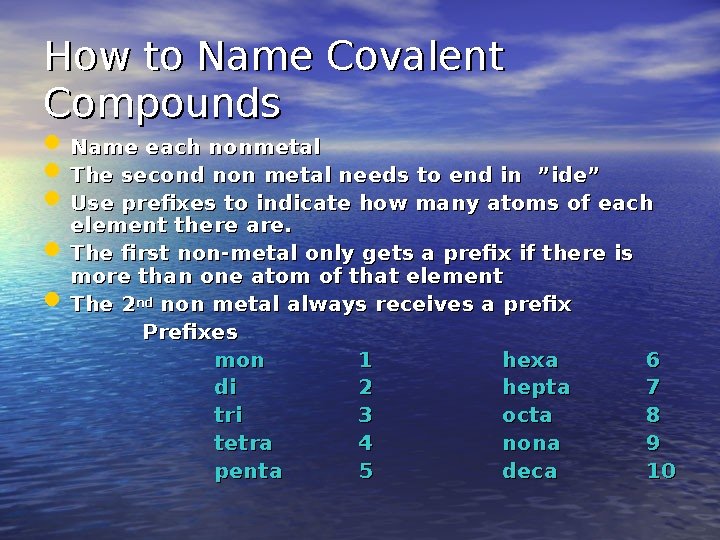
How to Name Covalent Compounds Name each nonmetal The second non metal needs to end in ”ide” Use prefixes to indicate how many atoms of each element there are. The first non-metal only gets a prefix if there is more than one atom of that element The 2 nd non metal always receives a prefix Prefixes mon 1 hexa 6 di 2 hepta 7 tri 3 octa 8 tetra 4 nona 9 penta 5 deca 10
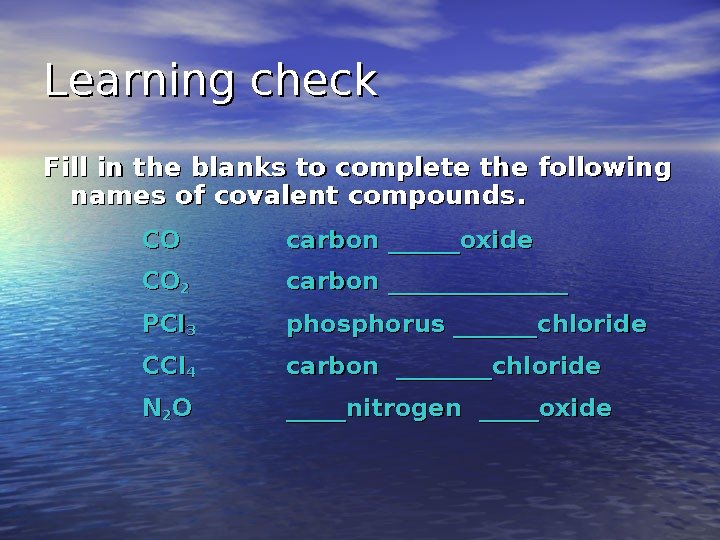
Learning check Fill in the blanks to complete the following names of covalent compounds. CO carbon ______oxide CO 2 carbon ________ PCl 3 phosphorus _______chloride CCl 4 carbon ____chloride N 2 O _____nitrogen _____oxide
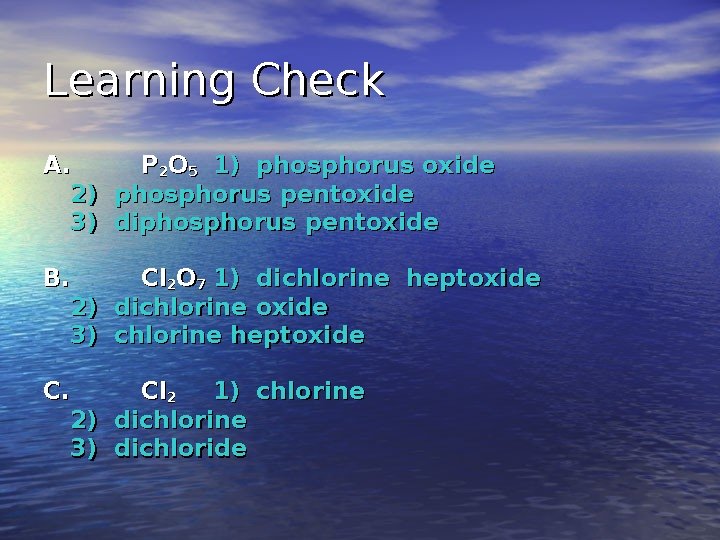
Learning Check A. P 2 O 5 1) phosphorus oxide 2) phosphorus pentoxide 3) diphosphorus pentoxide B. Cl 2 O 7 1) dichlorine heptoxide 2) dichlorine oxide 3) chlorine heptoxide C. Cl 2 1) chlorine 2) dichlorine 3) dichloride
Lewis Structures • Drawings of covalent compounds • Dots are used for unshared electrons • Lines are used for shared pairs of electrons • All atoms must have 8 electrons in some combination except H and He, which are both stable with 2 valence electrons.
Lone (unshared) pairs versus shared pairs of electrons • Lone pairs are pairs of electrons that are not being shared between two elements. • Shared pairs are pairs of electrons that are being shared between two elements.
Steps to drawing Lewis Structures 1. Decide on the central atom; never H. Why? If there is a choice, the central atom is the atom of lowest affinity for electrons. (Most of the time, this is the least electronegative atom…the single atom is normally the lowest or the one furthest to the left on the Periodic Table. ) 2. Add up the number of valence electrons that can be used.
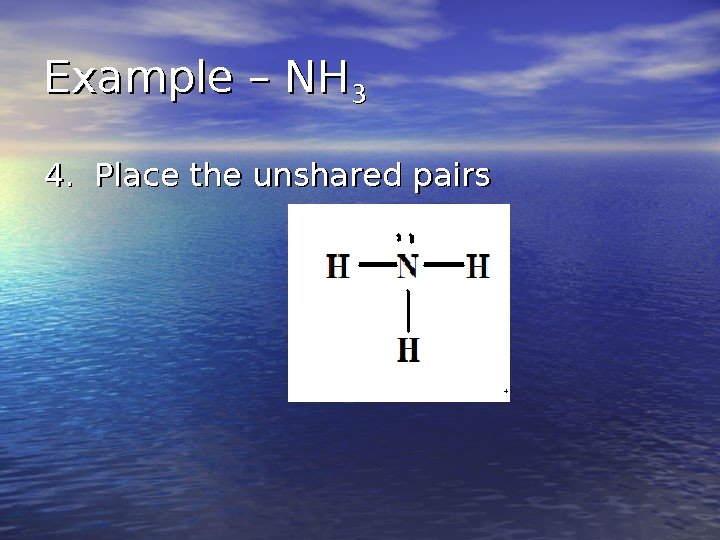
Lewis Structures (cont) 3. Form a single bond between the central atom and each surrounding atom (each bond takes 2 electrons!) 4. Remaining electrons form LONE PAIRS to complete the octet as needed (or duet in the case of H).
Lewis Structures (cont) • 5. Check to make sure there are 8 • electrons around each atom except H and He. They should only have 2 electrons. This includes SHARED pairs. 6. Move unshared (lone) pairs if necessary to make double or triple bonds to insure the octet rule
Example – NH 3 1. Central Atom. In this case it would 2. have to be N, because H can NEVER be the central atom. Count the total number of valence electrons. 1. 2. 3. N=5 H = 3 (1) = 3 5+3=8
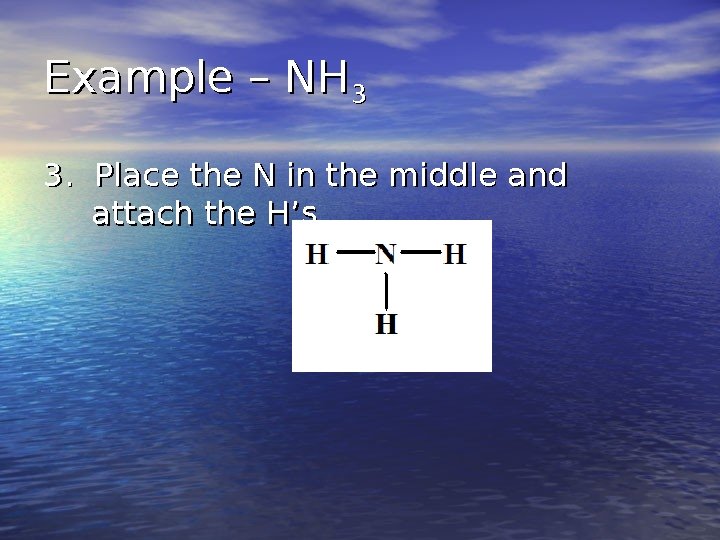
Example – NH 3 3. Place the N in the middle and attach the H’s
Example – NH 3 4. Place the unshared pairs
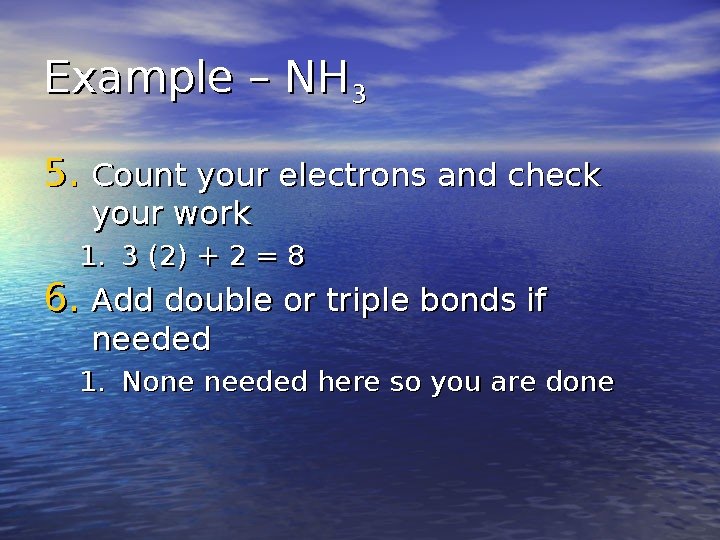
Example – NH 3 5. Count your electrons and check your work 1. 3 (2) + 2 = 8 6. Add double or triple bonds if needed 1. None needed here so you are done
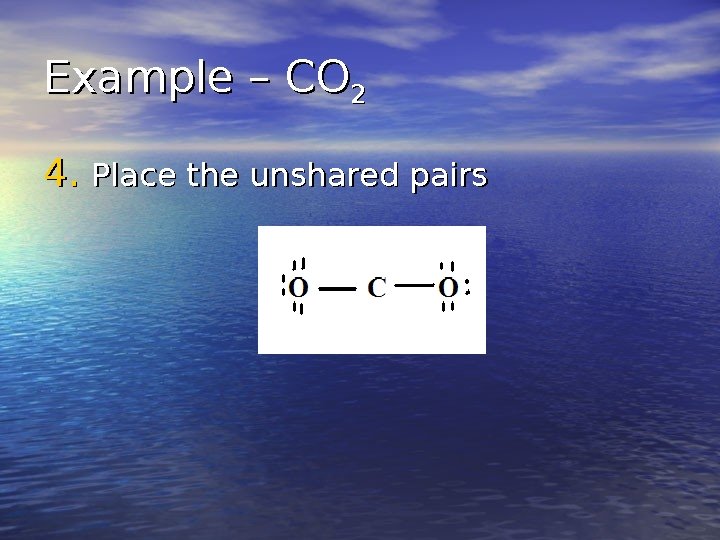
Example – CO 2 1. Central Atom: C is the least 2. electronegative atom. Count the total number of valence electrons 1. C = 4 and O = 6 x 2 2. 16 electrons total
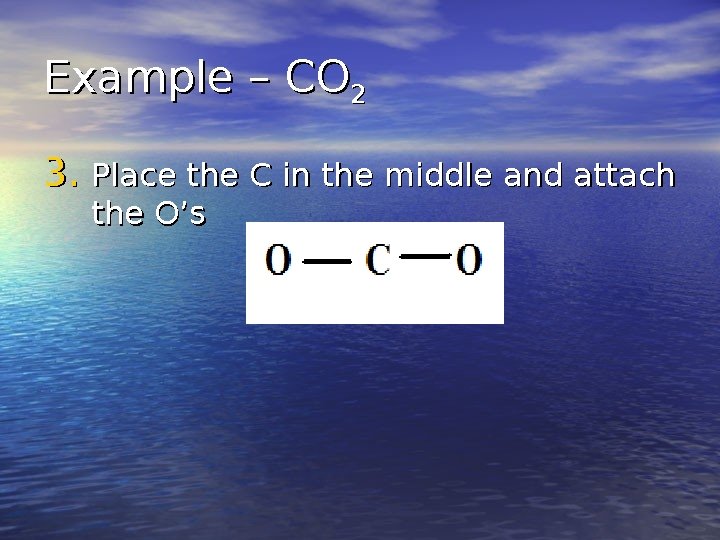
Example – CO 2 3. Place the C in the middle and attach the O’s
Example – CO 2 4. Place the unshared pairs
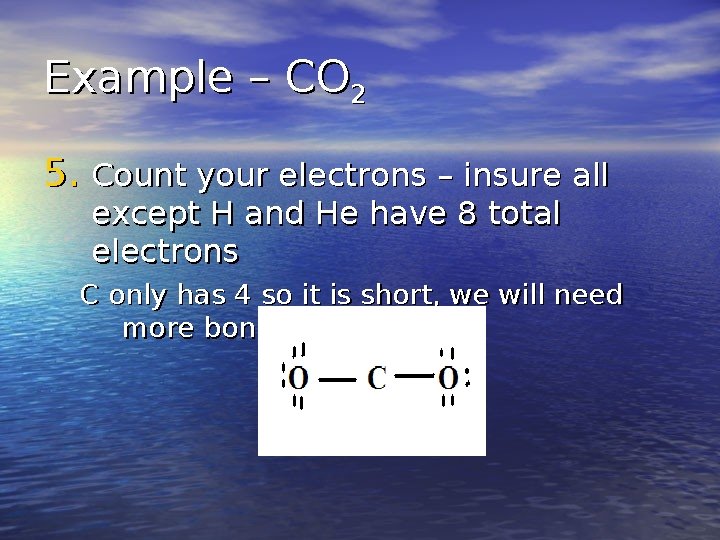
Example – CO 2 5. Count your electrons – insure all except H and He have 8 total electrons C only has 4 so it is short, we will need more bonds
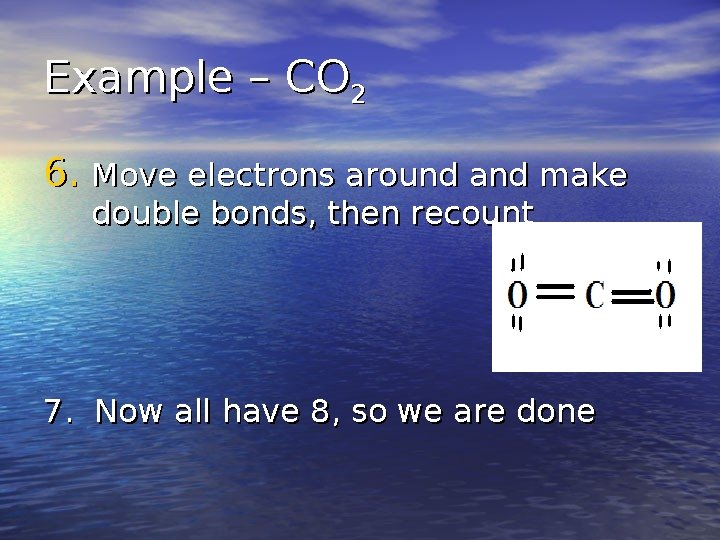
Example – CO 2 6. Move electrons around and make double bonds, then recount 7. Now all have 8, so we are done