
Covalent Bonds Forming single double and triple bonds
Covalent Bonds Forming single, double, and triple bonds
Covalent Bonding Remember, when atoms bond covalently, there is a sharing of electrons between the two atoms. However, not all of the electrons are involved in the bond, so there are two different types of electron pairs. n n Bonding Pair: Shared (shown by lines) Lone Pairs: Unshared (shown by pairs of dots)
There also a few types of covalent bonds and the type of covalent bond depends on how many pairs of electrons are shared.
Single Covalent Bonds 1 pair of electrons The sharing of ______ Double Covalent Bonds 2 The sharing of ______ pair of electrons Triple Covalent Bonds 3 The sharing of ______ pair of electrons
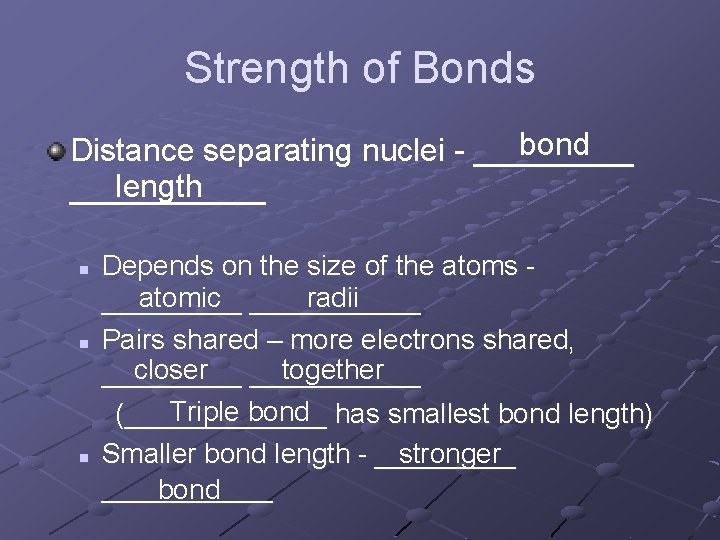
Strength of Bonds bond Distance separating nuclei _____ length ______ n n n Depends on the size of the atoms atomic ______ radii _____ Pairs shared – more electrons shared, closer ______ together _____ Triple bond has smallest bond length) (_______ stronger Smaller bond length ___________ bond
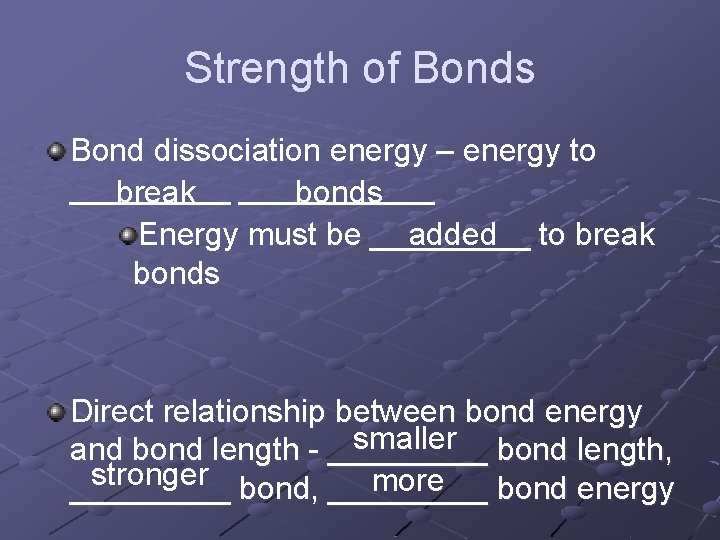
Strength of Bonds Bond dissociation energy – energy to _____ break ______ bonds added to break Energy must be _____ bonds Direct relationship between bond energy smaller bond length, and bond length _____ stronger bond, _____ more _____ bond energy
So, how do scientists decide how many electrons are shared? One way is by drawing Structural Formulas a. k. a. Lewis Formulas
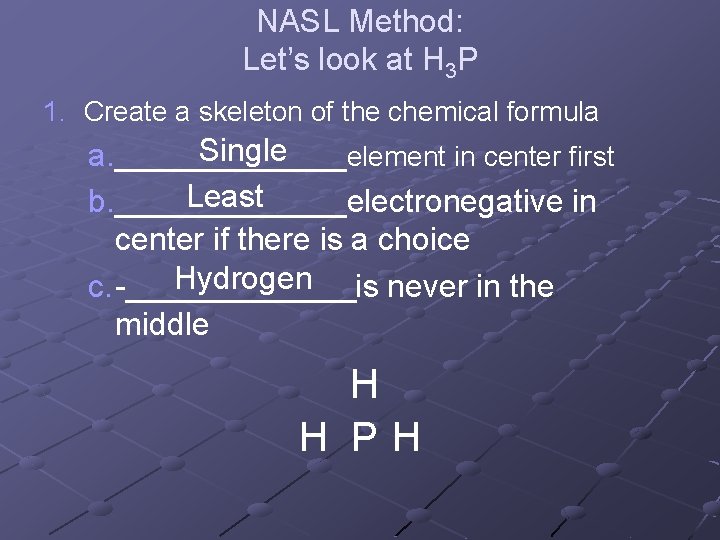
NASL Method: Let’s look at H 3 P 1. Create a skeleton of the chemical formula Single a. _______ element in center first Least b. _______electronegative in center if there is a choice Hydrogen is never in the c. _______ middle H H PH
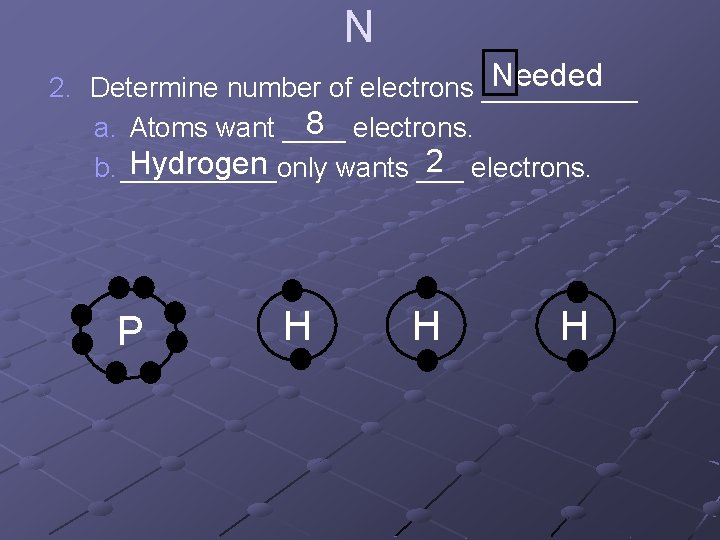
N Needed 2. Determine number of electrons _____ 8 electrons. a. Atoms want ____ 2 electrons. Hydrogen b. _____only wants ___ electrons P H H H
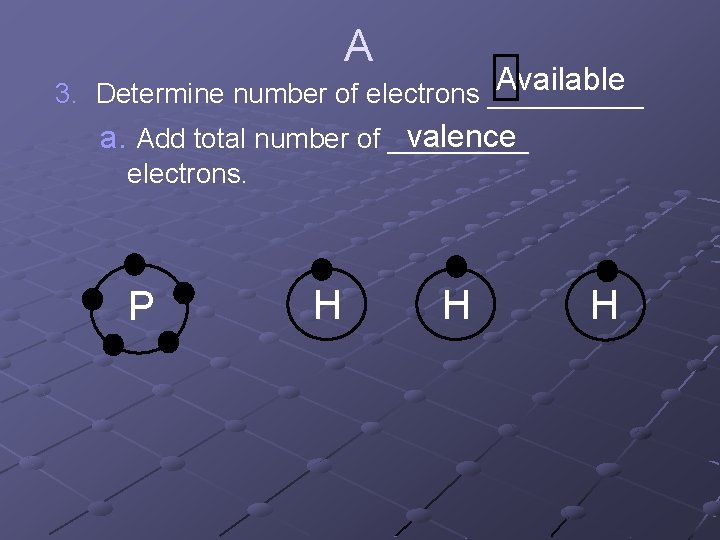
A Available 3. Determine number of electrons _____ valence a. Add total number of _____ electrons. P H H H
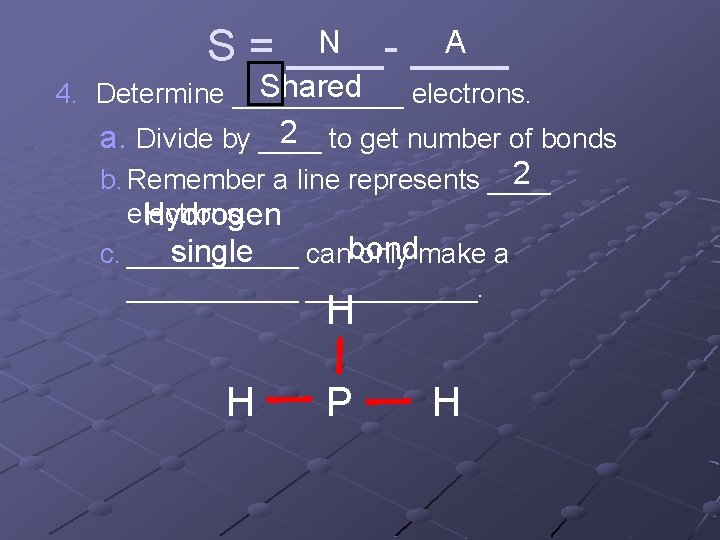
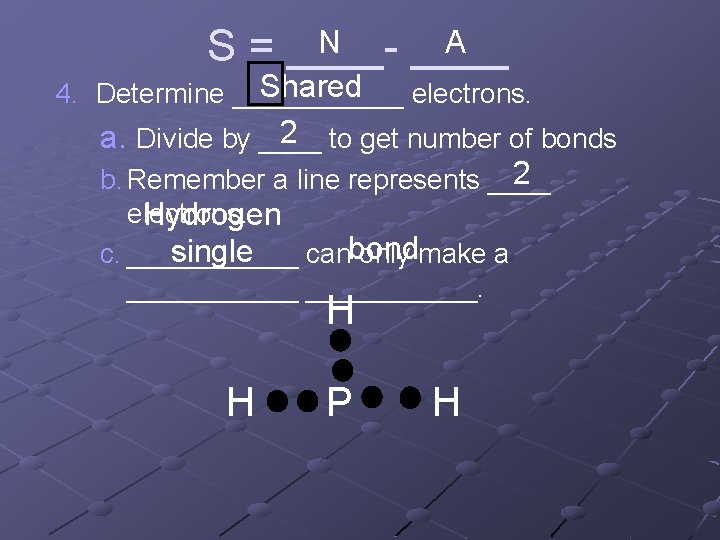
N A S = ____ Shared 4. Determine ______ electrons. 2 to get number of bonds a. Divide by ____ 2 b. Remember a line represents ____ electrons. Hydrogen single c. ______ canbond only make a ___________. H H P H
N A S = ____ Shared 4. Determine ______ electrons. 2 to get number of bonds a. Divide by ____ 2 b. Remember a line represents ____ electrons. Hydrogen single c. ______ canbond only make a ___________. H H P H
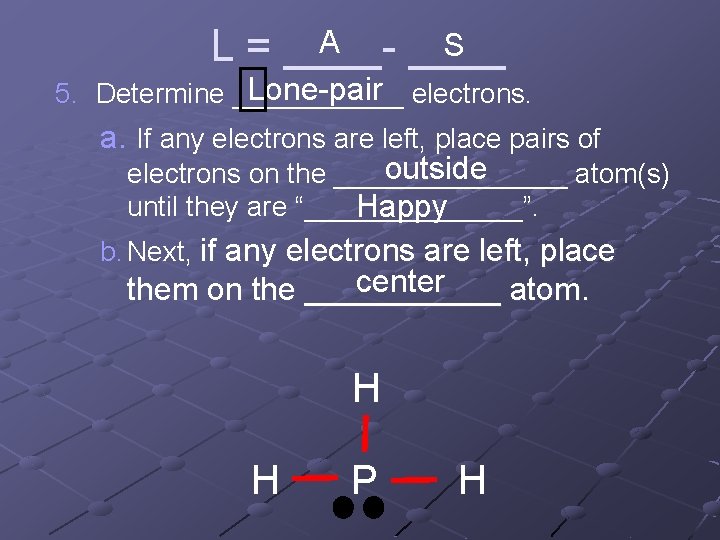
A S L = ____ Lone pair electrons. 5. Determine ______ a. If any electrons are left, place pairs of outside electrons on the ________ atom(s) until they are “_______”. Happy b. Next, if any electrons are left, place center them on the ______ atom. H H P H
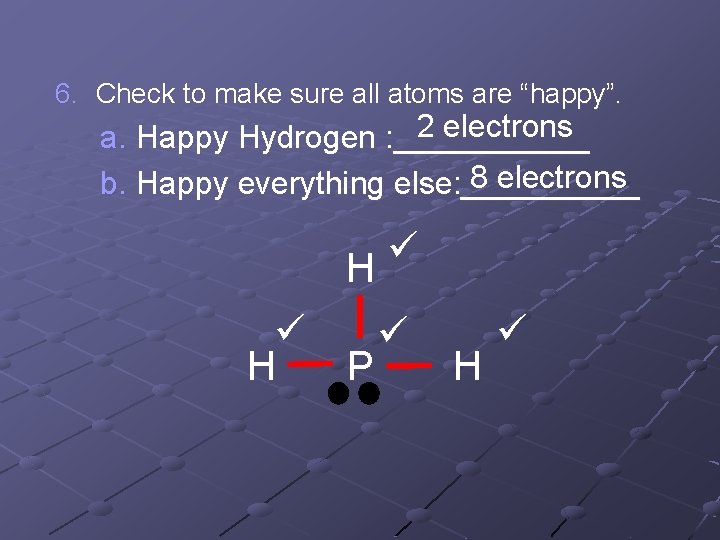
6. Check to make sure all atoms are “happy”. 2 electrons a. Happy Hydrogen : ______ 8 electrons b. Happy everything else: _____ H H P H
Let’s try some examples H 2 O CF 4
NCl 2 Br CO 2
Polyatomic Ions 1. Take charge into consideration. (Add negative to total, subtract positive from total of electrons. ) 2. Put brackets around structure with charge on outside right corner
Let’s look at CO 32 and NH 4+1
- Slides: 18