
Covalent Bonds and Compounds Molecules Three Kinds of
Covalent Bonds and Compounds Molecules
Three Kinds of Bonds 1. 2. 3. Non-metal to non-metal to metal l Covalent Ionic Metallic
Bonds and Electronegativity Electrons are transferred between atoms when the difference in electronegativity between the atoms is quite high. l The amount of transfer depends on the electronegativity difference. l
Bonds and Electronegativity The number 1. 67 seems to be the magic number. (Note: 1. 67 rounds to 1. 7) l If the electronegativity difference is less than 1. 67, the bond is more covalent than ionic. l If the electronegativity difference is greater than 1. 67, the bond is more ionic than covalent. l
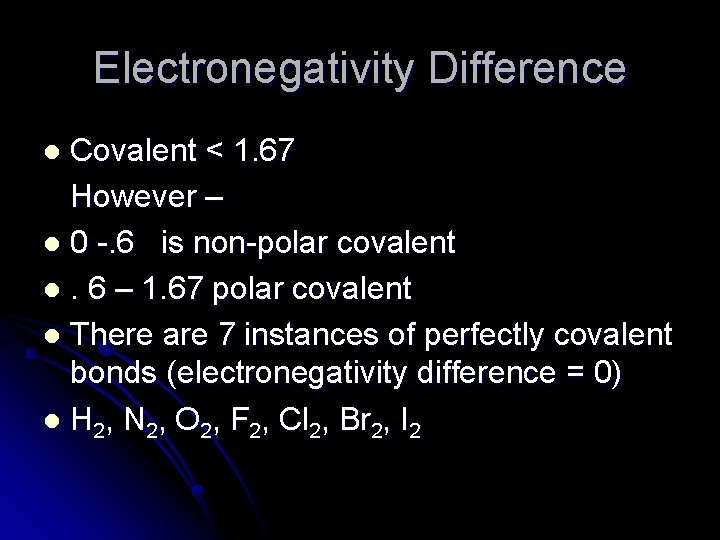
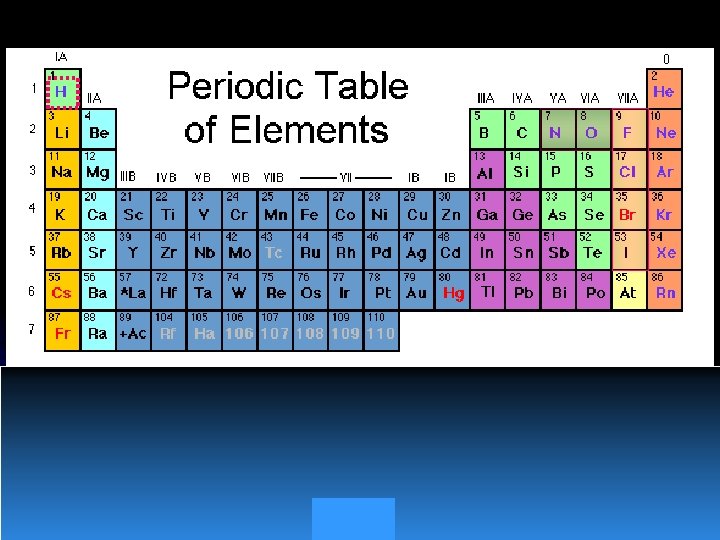
Electronegativity Difference Covalent < 1. 67 However – l 0 -. 6 is non-polar covalent l. 6 – 1. 67 polar covalent l There are 7 instances of perfectly covalent bonds (electronegativity difference = 0) l H 2, N 2, O 2, F 2, Cl 2, Br 2, I 2 l
Nomenclature (naming) l Covalent bonds are generally between two non-metals. l CO - Carbon monoxide l CO 2 - Carbon dioxide
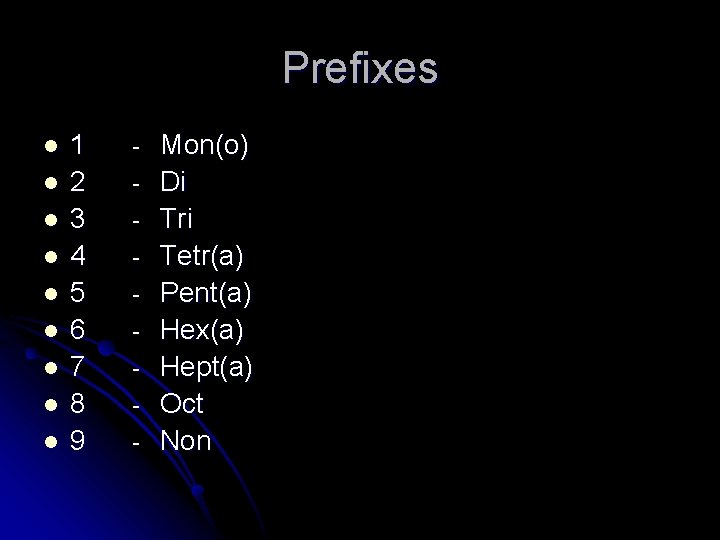
Prefixes l l l l l 1 2 3 4 5 6 7 8 9 - Mon(o) Di Tri Tetr(a) Pent(a) Hex(a) Hept(a) Oct Non
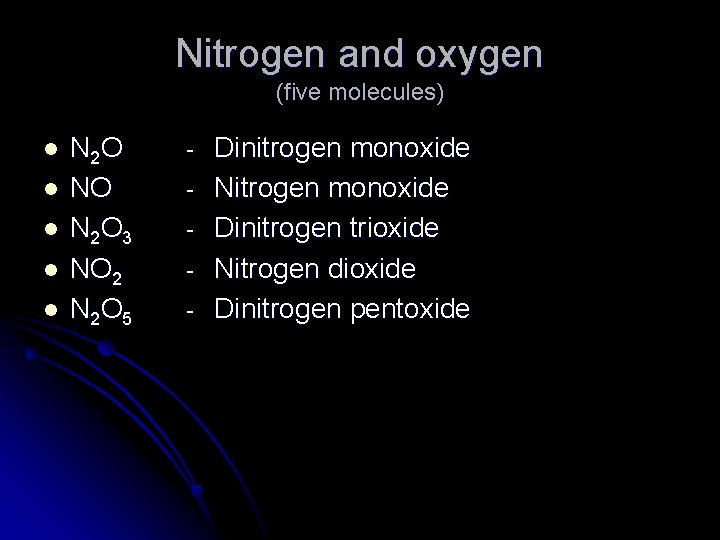
Nitrogen and oxygen (five molecules) l l l N 2 O NO N 2 O 3 NO 2 N 2 O 5 - Dinitrogen monoxide Nitrogen monoxide Dinitrogen trioxide Nitrogen dioxide Dinitrogen pentoxide
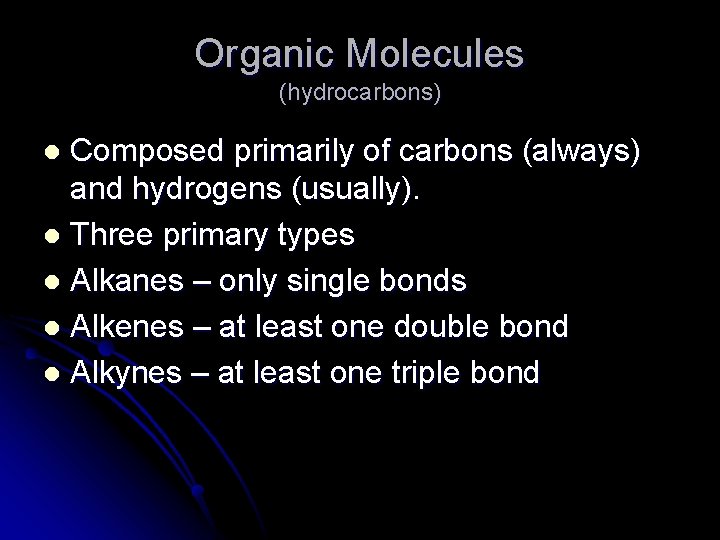
Organic Molecules (hydrocarbons) Composed primarily of carbons (always) and hydrogens (usually). l Three primary types l Alkanes – only single bonds l Alkenes – at least one double bond l Alkynes – at least one triple bond l
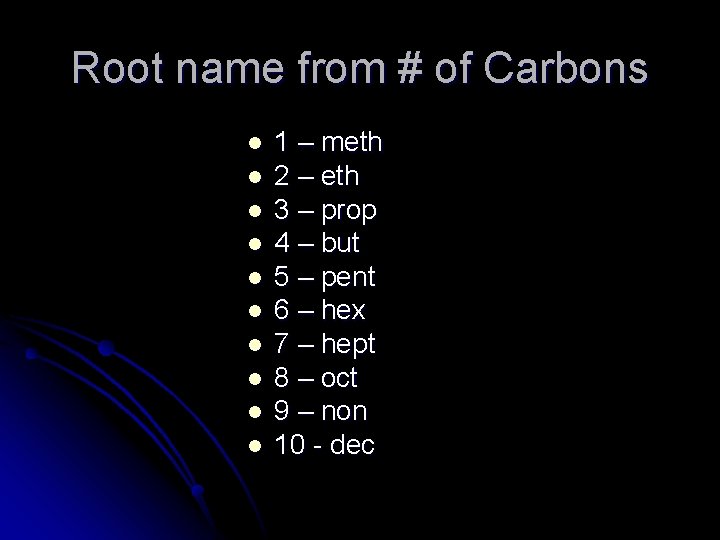
Root name from # of Carbons l l l l l 1 – meth 2 – eth 3 – prop 4 – but 5 – pent 6 – hex 7 – hept 8 – oct 9 – non 10 - dec
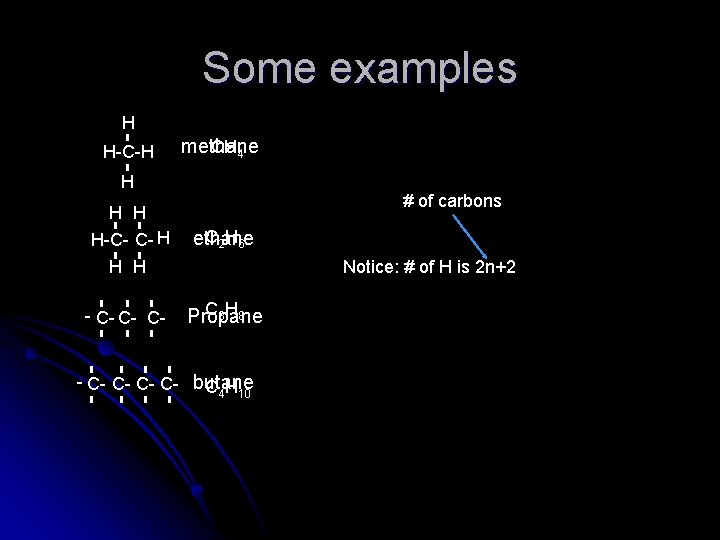
Some examples H H-C-H methane CH 4 H H-C- C- H # of carbons C 2 H 6 ethane H H - C- C- C- Notice: # of H is 2 n+2 C 3 H 8 Propane - C- C- butane C 4 H 10
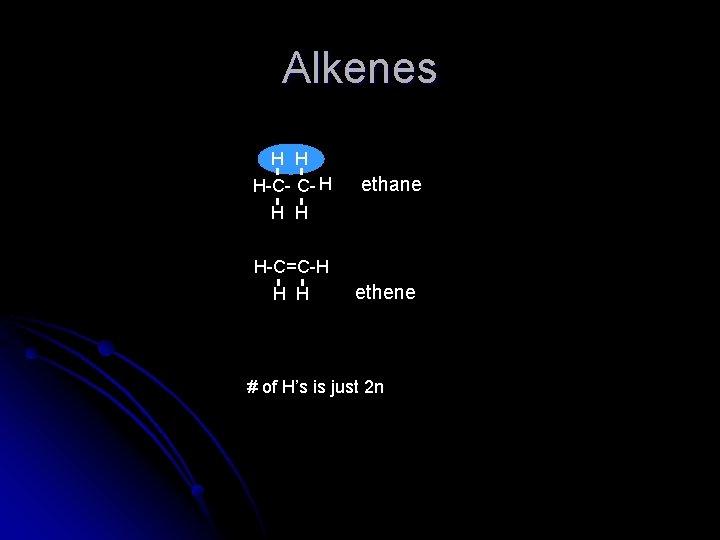
Alkenes H H H-C- C- H ethane H H H-C=C-H H H ethene # of H’s is just 2 n
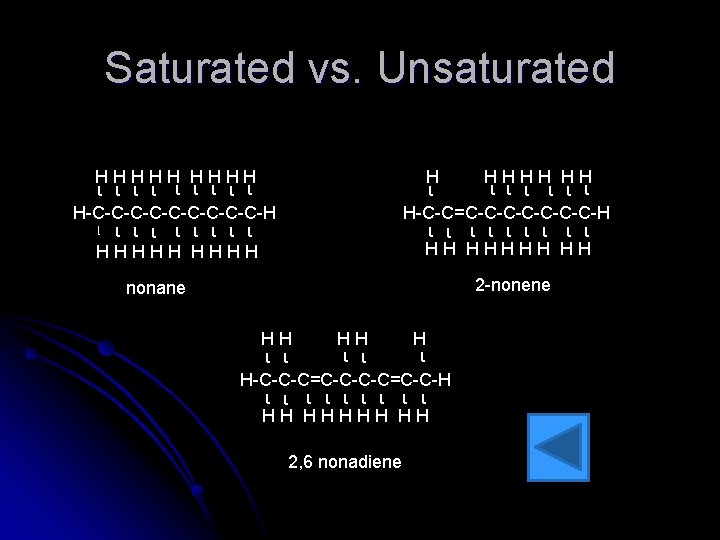
Saturated vs. Unsaturated HHHHH ɩ ɩ ɩ ɩ ɩ H-C-C-C-C-C-H ɩ ɩ ɩ ɩ ɩ HHHHH HH ɩ ɩ ɩ ɩ H-C-C=C-C-C-C-H ɩ ɩ ɩ ɩ ɩ HH HHHHH HH 2 -nonene nonane HH HH H ɩ ɩ ɩ H-C-C-C=C-C-H ɩ ɩ ɩ ɩ ɩ HH HHHHH HH 2, 6 nonadiene
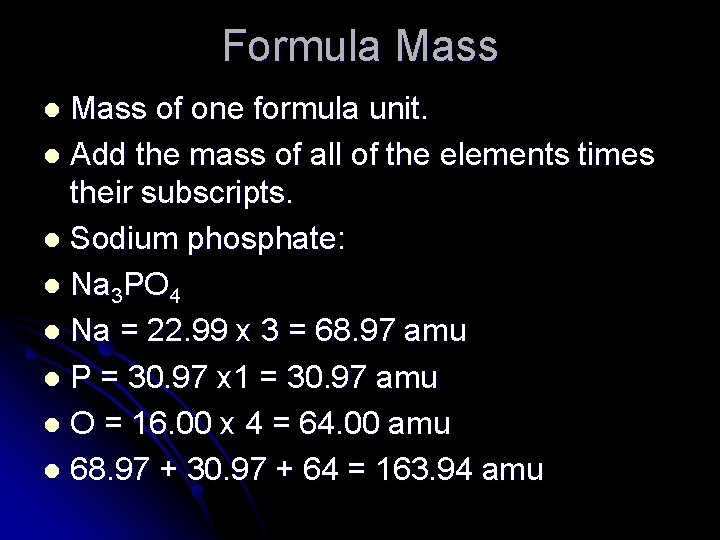
Formula Mass of one formula unit. l Add the mass of all of the elements times their subscripts. l Sodium phosphate: l Na 3 PO 4 l Na = 22. 99 x 3 = 68. 97 amu l P = 30. 97 x 1 = 30. 97 amu l O = 16. 00 x 4 = 64. 00 amu l 68. 97 + 30. 97 + 64 = 163. 94 amu l
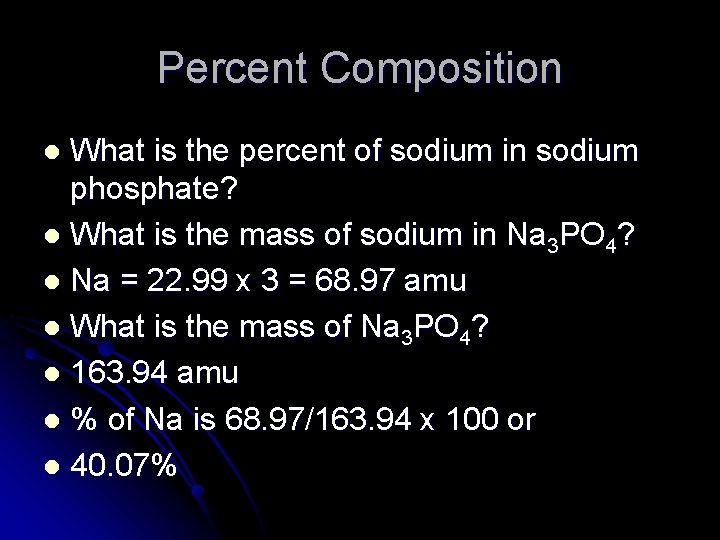
Percent Composition What is the percent of sodium in sodium phosphate? l What is the mass of sodium in Na 3 PO 4? l Na = 22. 99 x 3 = 68. 97 amu l What is the mass of Na 3 PO 4? l 163. 94 amu l % of Na is 68. 97/163. 94 x 100 or l 40. 07% l
Empirical Formulas A formula in lowest terms. (Use the GCF) l Greatest Common Factor l The empirical formula for C 2 H 6 is l CH 3 l What is the formula mass for C 2 H 6? l What is the formula mass for CH 3? l What is 30 ÷ 15? l
Determining Empirical Formula from Percent composition. A certain compound contains 32. 38% sodium, 22. 65% sulfur, and 44. 99% oxygen. Find the empirical formula. l We’re going to do percent composition in reverse… l Assume a 100 g sample – therefore 32. 38 g of sodium etc. l
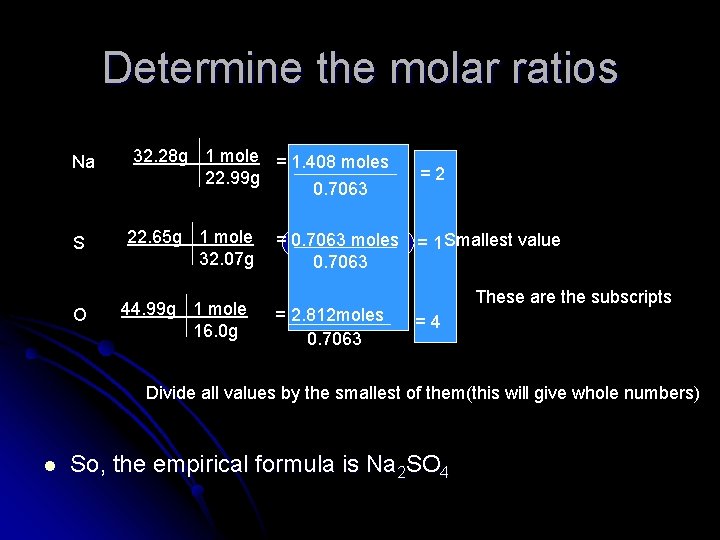
Determine the molar ratios Na S O 32. 28 g 1 mole = 1. 408 moles 22. 99 g 0. 7063 22. 65 g 1 mole 32. 07 g 44. 99 g 1 mole 16. 0 g =2 = 0. 7063 moles = 1 Smallest value 0. 7063 = 2. 812 moles 0. 7063 These are the subscripts =4 Divide all values by the smallest of them(this will give whole numbers) l So, the empirical formula is Na 2 SO 4
Actual Formula from Empirical Formula If you know the empirical formula and the formula mass of the actual formula, you can determine actual formula by finding the formula mass of the empirical formula and dividing it into the formula mass of the actual formula. This will give you the GCF. l Multiply the subscripts of the empirical formula by the GCF. l
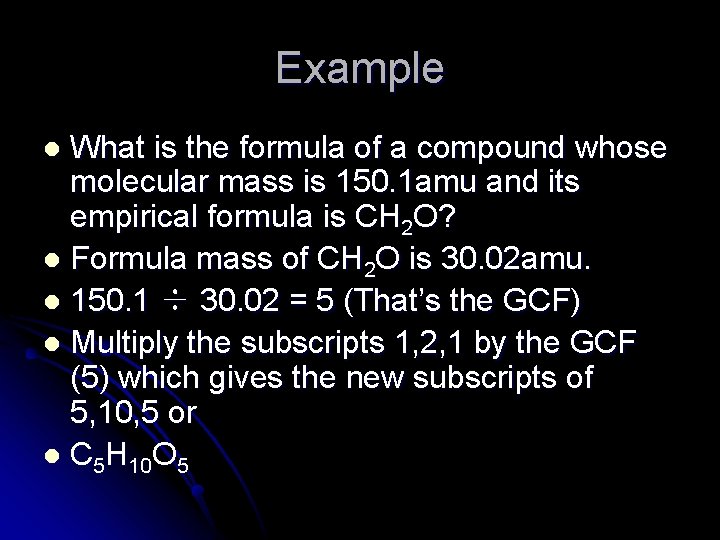
Example What is the formula of a compound whose molecular mass is 150. 1 amu and its empirical formula is CH 2 O? l Formula mass of CH 2 O is 30. 02 amu. l 150. 1 ÷ 30. 02 = 5 (That’s the GCF) l Multiply the subscripts 1, 2, 1 by the GCF (5) which gives the new subscripts of 5, 10, 5 or l C 5 H 10 O 5 l
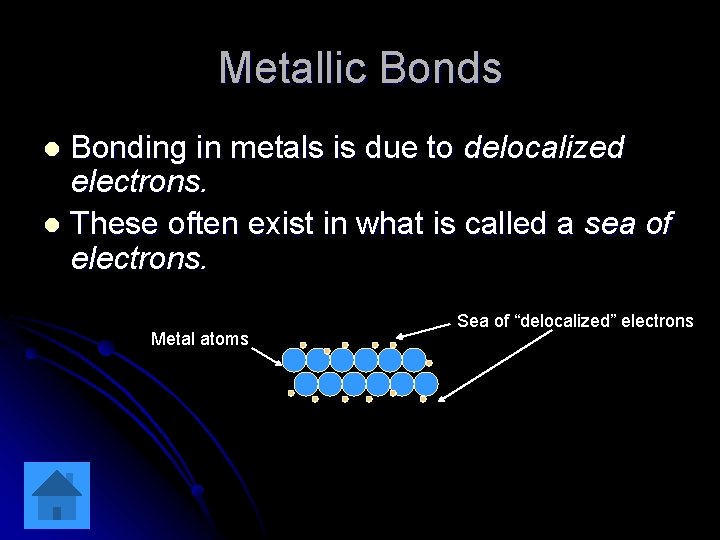
Metallic Bonds Bonding in metals is due to delocalized electrons. l These often exist in what is called a sea of electrons. l Metal atoms Sea of “delocalized” electrons
Metallic Bonds This explains many of the properties of metals: l Malleable l Ductile l Conducts electricity well l
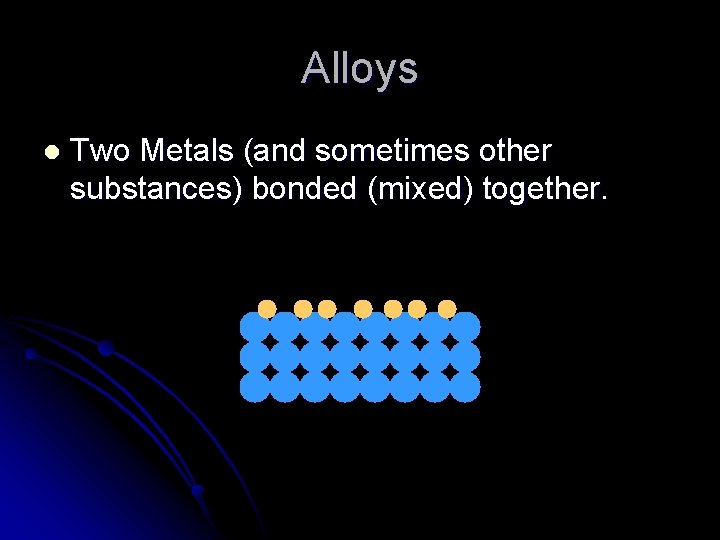
Alloys l Two Metals (and sometimes other substances) bonded (mixed) together.
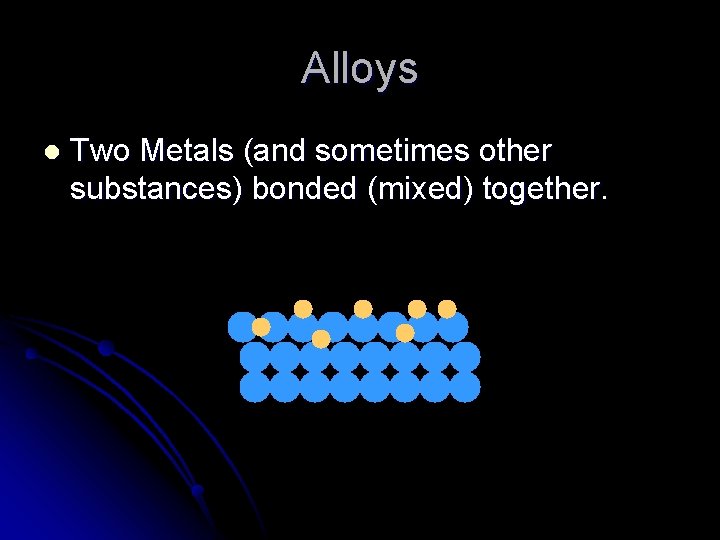
Alloys l Two Metals (and sometimes other substances) bonded (mixed) together.
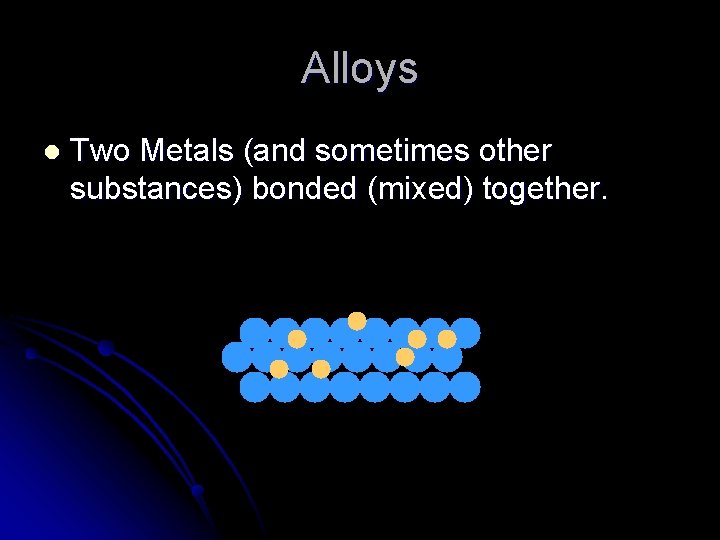
Alloys l Two Metals (and sometimes other substances) bonded (mixed) together.
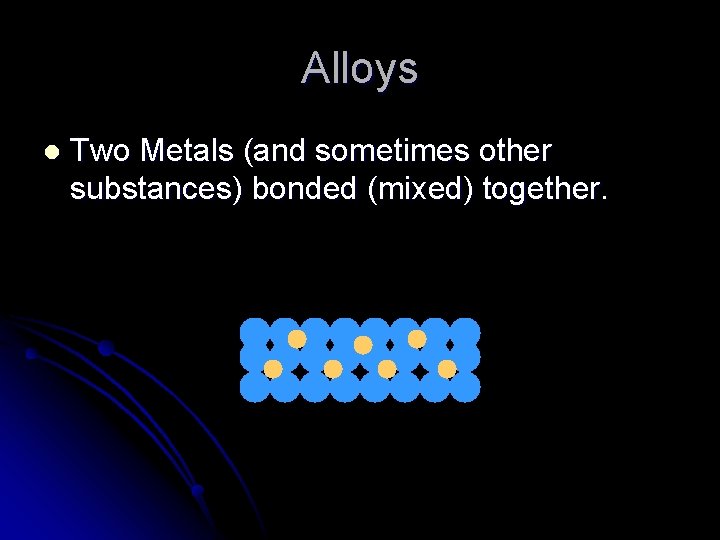
Alloys l Two Metals (and sometimes other substances) bonded (mixed) together.
- Slides: 27