
COVALENT BONDING STRUCTURE AND BONDING The physical properties
COVALENT BONDING
STRUCTURE AND BONDING The physical properties of a substance depend on its structure and type of bonding present. Bonding determines the type of structure. Basic theory • noble gases (He, Ne, Ar, Kr, Xe and Rn) are all relatively, or totally, inert • this is due to their electronic structure which appears to confer stability • atoms without the electronic structure of a noble gas try to gain one • various ways are available according to an element’s position in the periodic table
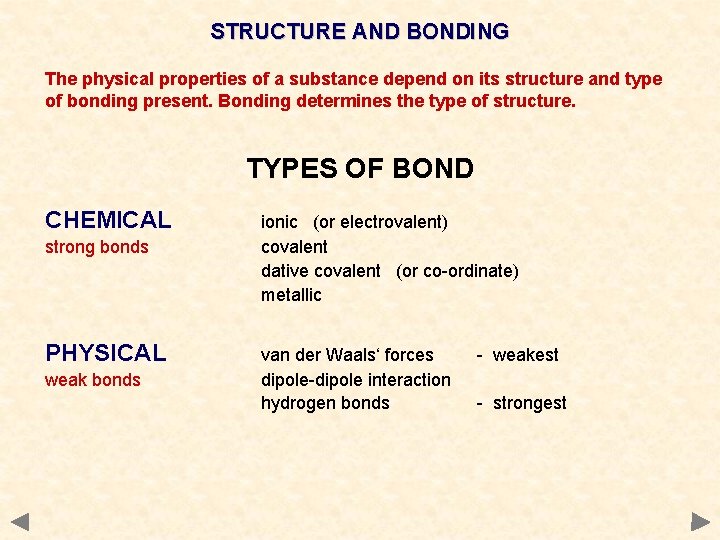
STRUCTURE AND BONDING The physical properties of a substance depend on its structure and type of bonding present. Bonding determines the type of structure. TYPES OF BOND CHEMICAL strong bonds PHYSICAL weak bonds ionic (or electrovalent) covalent dative covalent (or co-ordinate) metallic van der Waals‘ forces dipole-dipole interaction hydrogen bonds - weakest - strongest
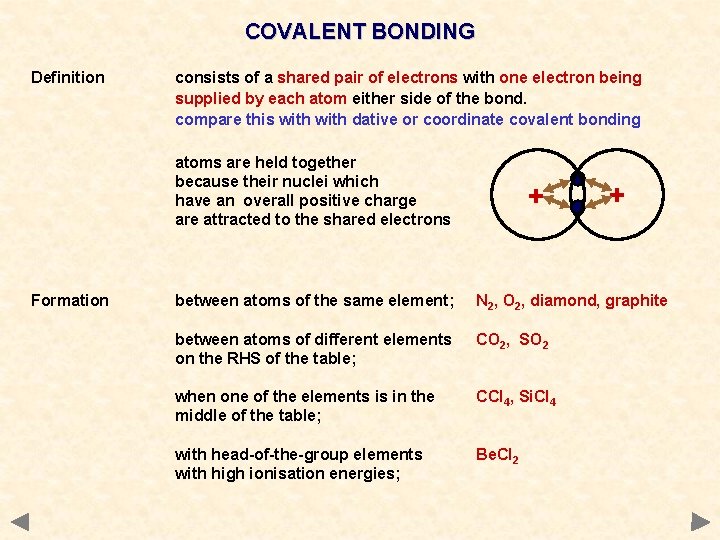
COVALENT BONDING Definition consists of a shared pair of electrons with one electron being supplied by each atom either side of the bond. compare this with dative or coordinate covalent bonding atoms are held together because their nuclei which have an overall positive charge are attracted to the shared electrons Formation + + between atoms of the same element; N 2, O 2, diamond, graphite between atoms of different elements on the RHS of the table; CO 2, SO 2 when one of the elements is in the middle of the table; CCl 4, Si. Cl 4 with head-of-the-group elements with high ionisation energies; Be. Cl 2
COVALENT BONDING • atoms share electrons to get the nearest noble gas electronic configuration • some don’t achieve an “octet” as they haven’t got enough electrons Al in Al. Cl 3 • others share only some - if they share all they will exceed their “octet” NH 3 and H 2 O • atoms of elements in the 3 rd period onwards can exceed their “octet” if they wish a they are not restricted to eight electrons in their “outer shell”
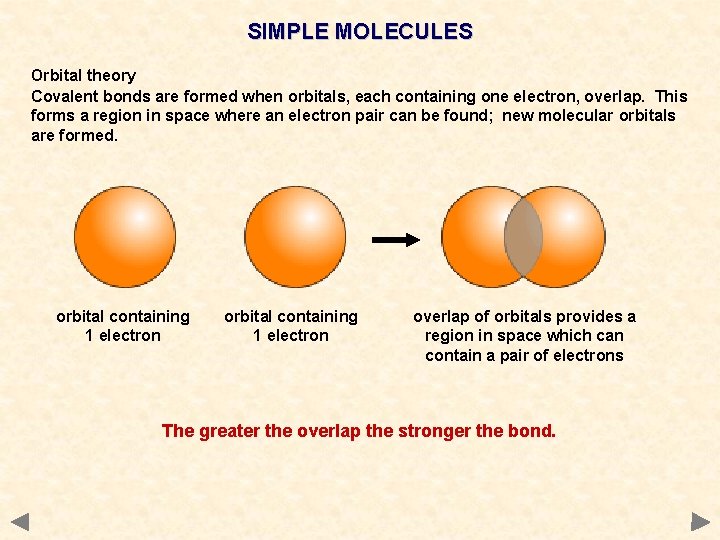
SIMPLE MOLECULES Orbital theory Covalent bonds are formed when orbitals, each containing one electron, overlap. This forms a region in space where an electron pair can be found; new molecular orbitals are formed. orbital containing 1 electron overlap of orbitals provides a region in space which can contain a pair of electrons The greater the overlap the stronger the bond.
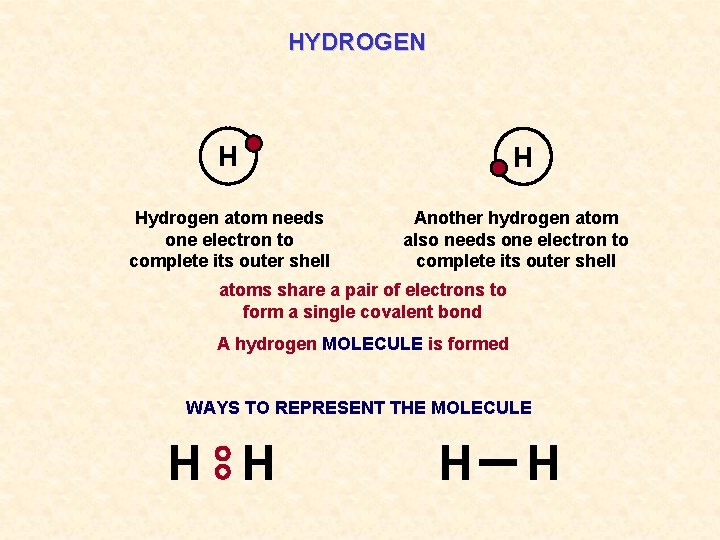
HYDROGEN H Hydrogen atom needs one electron to complete its outer shell H Another hydrogen atom also needs one electron to complete its outer shell atoms share a pair of electrons to form a single covalent bond A hydrogen MOLECULE is formed WAYS TO REPRESENT THE MOLECULE H H
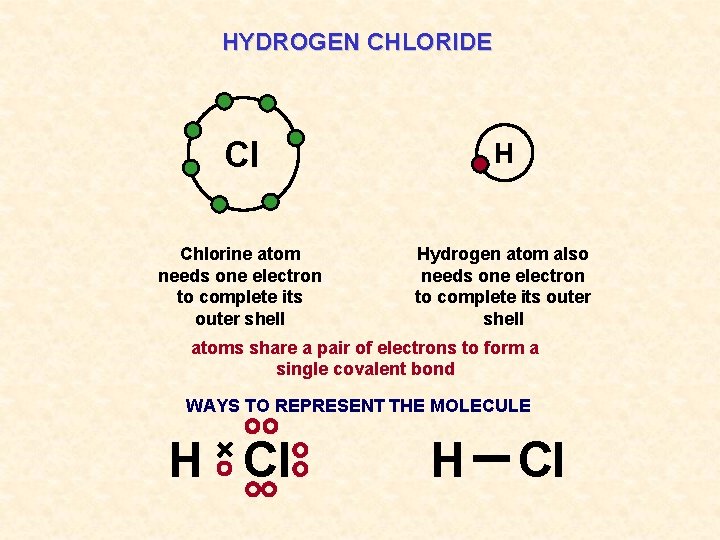
HYDROGEN CHLORIDE Cl H Chlorine atom needs one electron to complete its outer shell Hydrogen atom also needs one electron to complete its outer shell atoms share a pair of electrons to form a single covalent bond WAYS TO REPRESENT THE MOLECULE H Cl
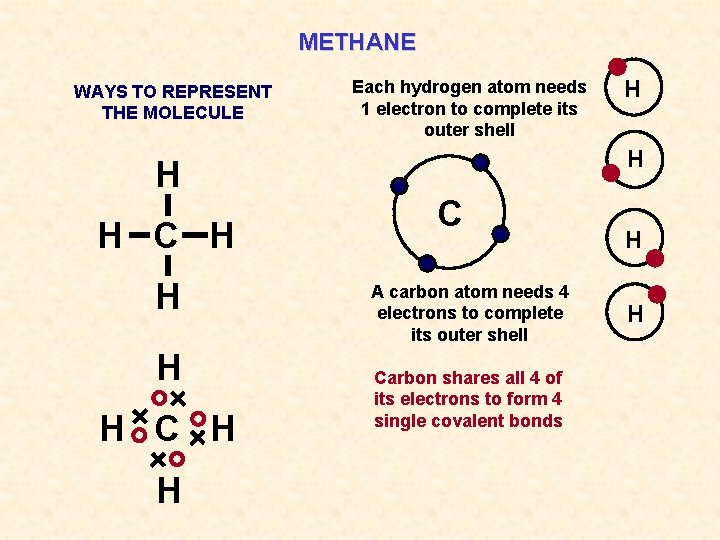
METHANE WAYS TO REPRESENT THE MOLECULE H H C H H Each hydrogen atom needs 1 electron to complete its outer shell H H C A carbon atom needs 4 electrons to complete its outer shell Carbon shares all 4 of its electrons to form 4 single covalent bonds H H
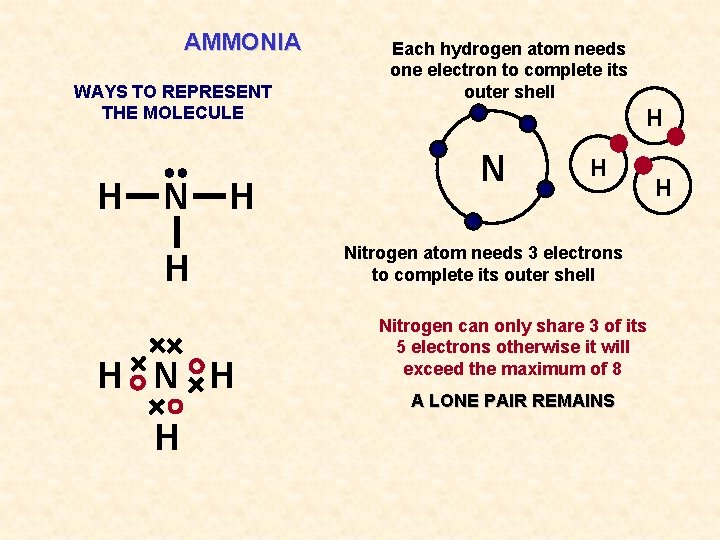
AMMONIA WAYS TO REPRESENT THE MOLECULE H N H H Each hydrogen atom needs one electron to complete its outer shell H Nitrogen atom needs 3 electrons to complete its outer shell Nitrogen can only share 3 of its 5 electrons otherwise it will exceed the maximum of 8 A LONE PAIR REMAINS H
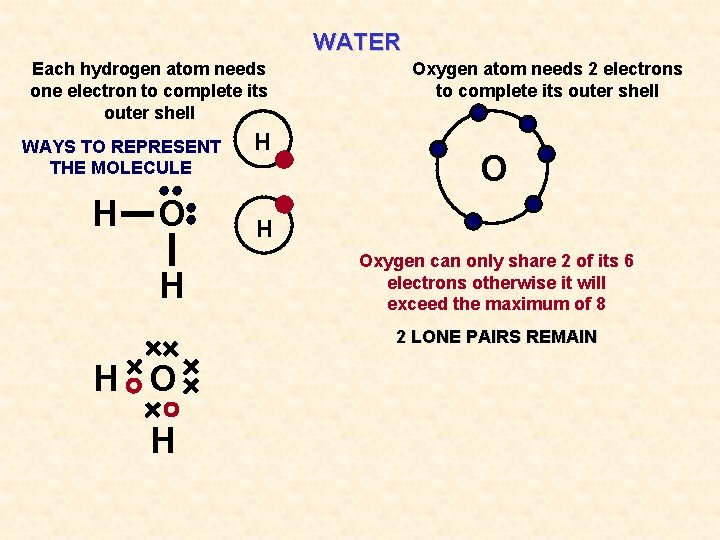
WATER Each hydrogen atom needs one electron to complete its outer shell WAYS TO REPRESENT THE MOLECULE H O H H Oxygen atom needs 2 electrons to complete its outer shell O H Oxygen can only share 2 of its 6 electrons otherwise it will exceed the maximum of 8 2 LONE PAIRS REMAIN H O H
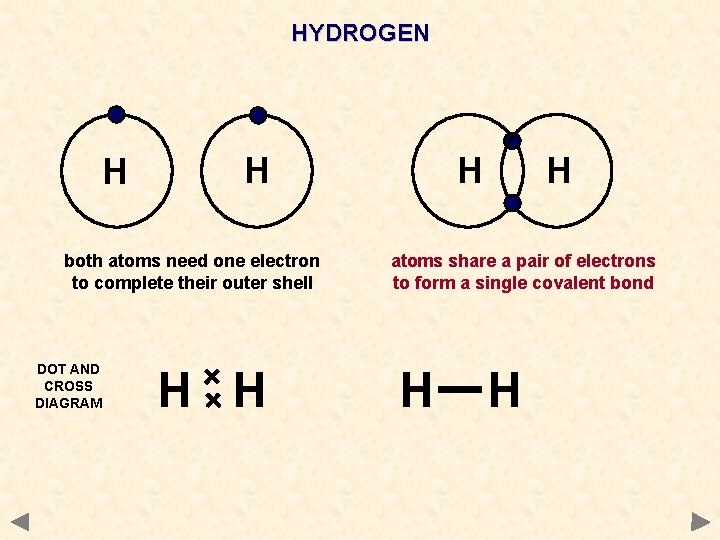
HYDROGEN H H both atoms need one electron to complete their outer shell DOT AND CROSS DIAGRAM H H atoms share a pair of electrons to form a single covalent bond H H
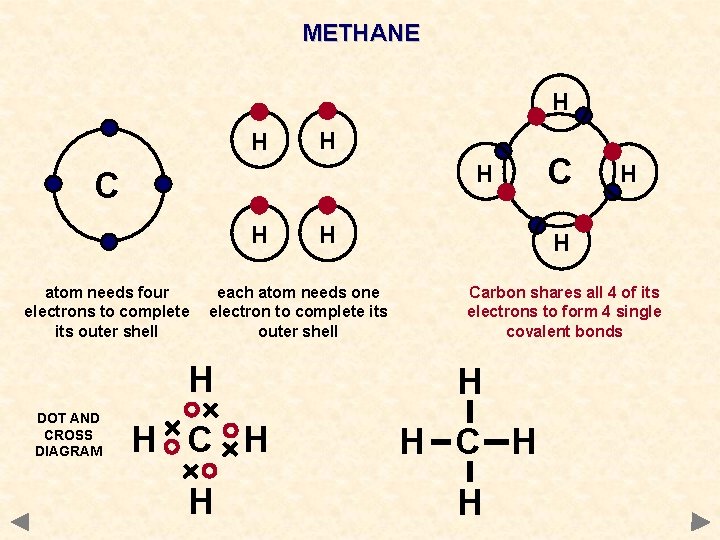
METHANE H H C H atom needs four electrons to complete its outer shell DOT AND CROSS DIAGRAM H each atom needs one electron to complete its outer shell C H H Carbon shares all 4 of its electrons to form 4 single covalent bonds H H H C H H H
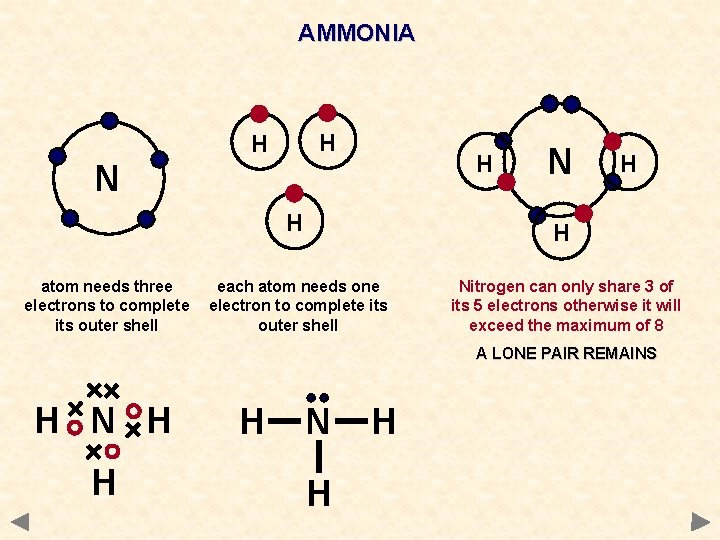
AMMONIA H H H N H atom needs three electrons to complete its outer shell N H H each atom needs one electron to complete its outer shell Nitrogen can only share 3 of its 5 electrons otherwise it will exceed the maximum of 8 A LONE PAIR REMAINS H N H H
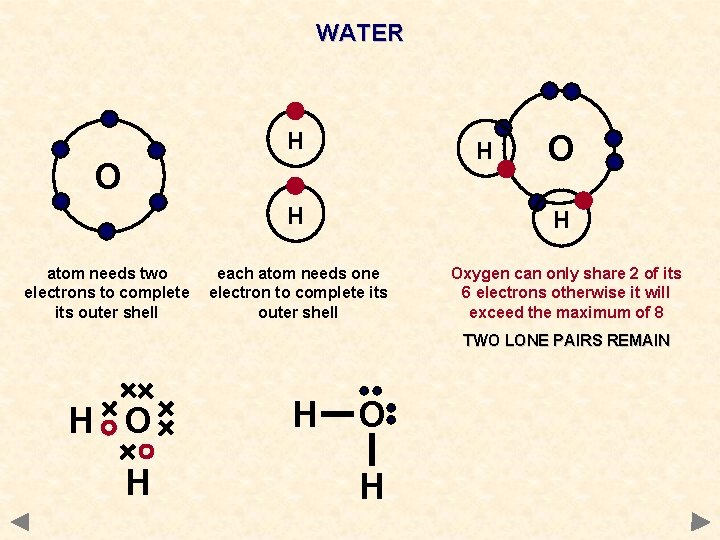
WATER H H O atom needs two electrons to complete its outer shell O H H each atom needs one electron to complete its outer shell Oxygen can only share 2 of its 6 electrons otherwise it will exceed the maximum of 8 TWO LONE PAIRS REMAIN H O H
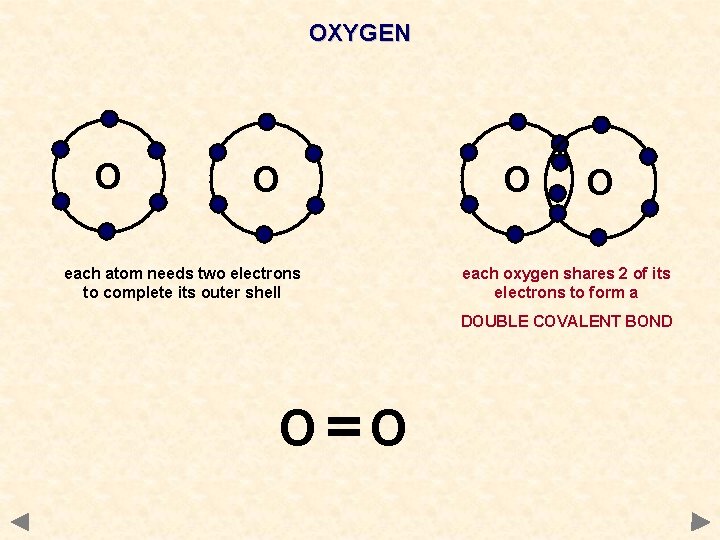
OXYGEN O O O each atom needs two electrons to complete its outer shell O each oxygen shares 2 of its electrons to form a DOUBLE COVALENT BOND O O
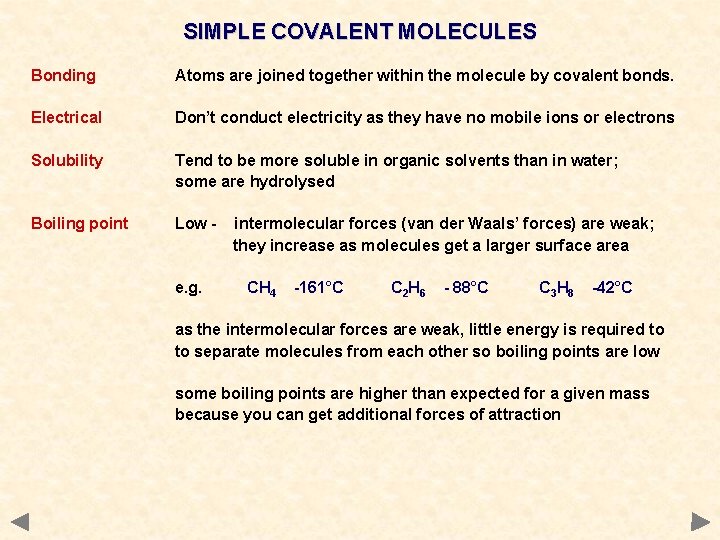
SIMPLE COVALENT MOLECULES Bonding Atoms are joined together within the molecule by covalent bonds. Electrical Don’t conduct electricity as they have no mobile ions or electrons Solubility Tend to be more soluble in organic solvents than in water; some are hydrolysed Boiling point Low - e. g. intermolecular forces (van der Waals’ forces) are weak; they increase as molecules get a larger surface area CH 4 -161°C C 2 H 6 - 88°C C 3 H 8 -42°C as the intermolecular forces are weak, little energy is required to to separate molecules from each other so boiling points are low some boiling points are higher than expected for a given mass because you can get additional forces of attraction
- Slides: 17