
Covalent Bonding Results from the sharing of electron
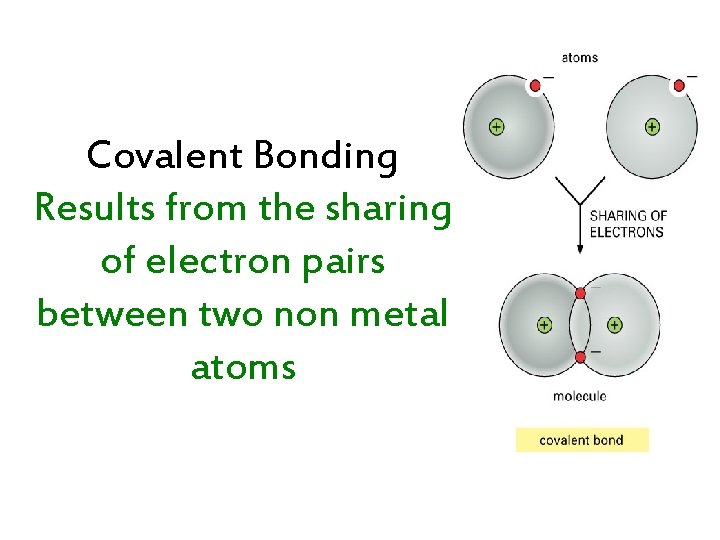
Covalent Bonding Results from the sharing of electron pairs between two non metal atoms
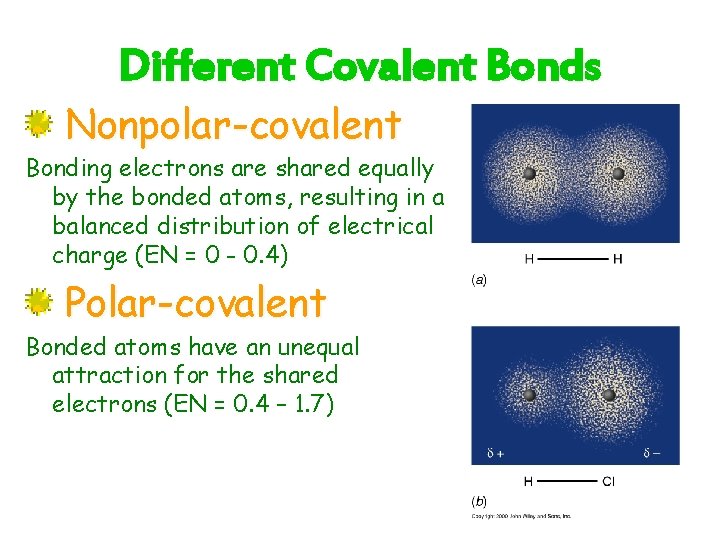
Different Covalent Bonds Nonpolar-covalent Bonding electrons are shared equally by the bonded atoms, resulting in a balanced distribution of electrical charge (EN = 0 - 0. 4) Polar-covalent Bonded atoms have an unequal attraction for the shared electrons (EN = 0. 4 – 1. 7)
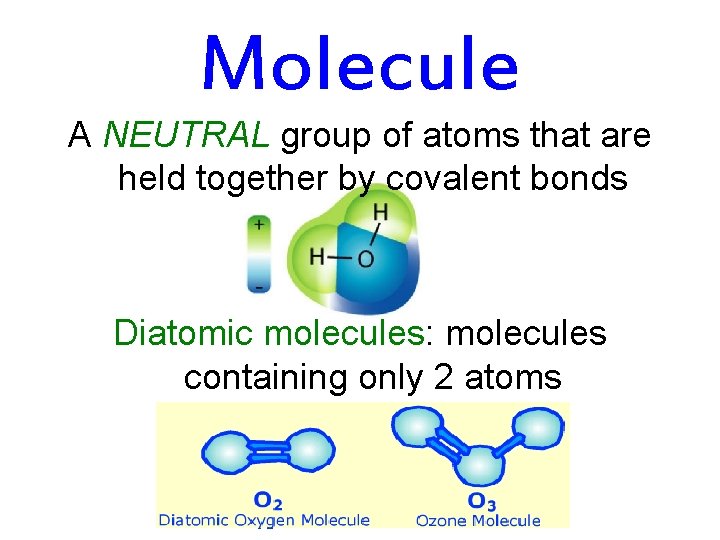
Molecule A NEUTRAL group of atoms that are held together by covalent bonds Diatomic molecules: molecules containing only 2 atoms
Characteristics of a Covalent Bond • Bond length: The distance between two bonded atoms (average distance between bonded atoms) • Bond energy: The energy required to break a chemical bond and form neutral isolated atoms • Happens between nonmetals (nonmetallic)
The Octet Rule Chemical compounds tend to form so that each atom, by gaining, losing, or sharing electrons, has an octet of electrons in its highest occupied energy level Octet = 8 = s 2 + p 6

Orbitals Overlap
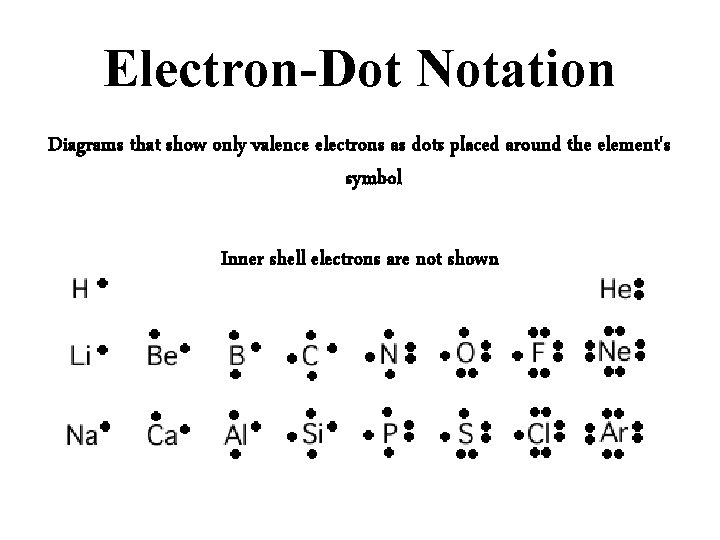
Electron-Dot Notation Diagrams that show only valence electrons as dots placed around the element's symbol Inner shell electrons are not shown
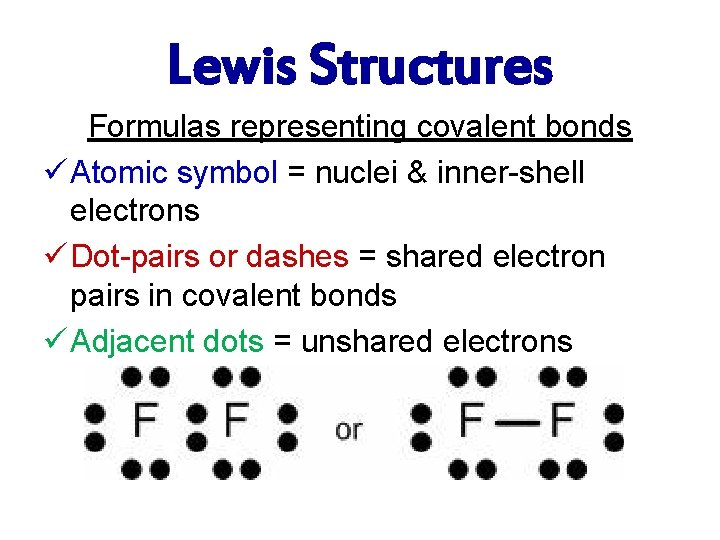
Lewis Structures Formulas representing covalent bonds ü Atomic symbol = nuclei & inner-shell electrons ü Dot-pairs or dashes = shared electron pairs in covalent bonds ü Adjacent dots = unshared electrons
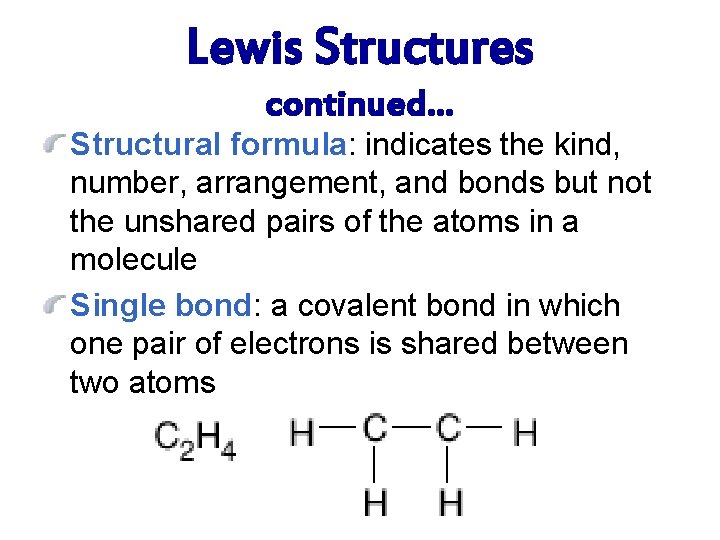
Lewis Structures continued… Structural formula: indicates the kind, number, arrangement, and bonds but not the unshared pairs of the atoms in a molecule Single bond: a covalent bond in which one pair of electrons is shared between two atoms
How to Write Single-bond Lewis Structures 1. Determine the type and # of atoms in the molecule 2. Write the electron-dot notation for each type of atom in the molecule 3. Determine the total number of valence electrons available in the atom to be combined 4. Arrange the atoms to form a skeleton structure for the molecule. (When carbon present always the central atom, Hydrogen is never central, least-electronegative center when no carbon) 5. Add unshared pairs of electrons to each nonmetal atom (except H) such that each is surrounded by 8 e 6. Count the e- in the structure to be sure the # of valence eused equals the # available *See handout and do some practice……
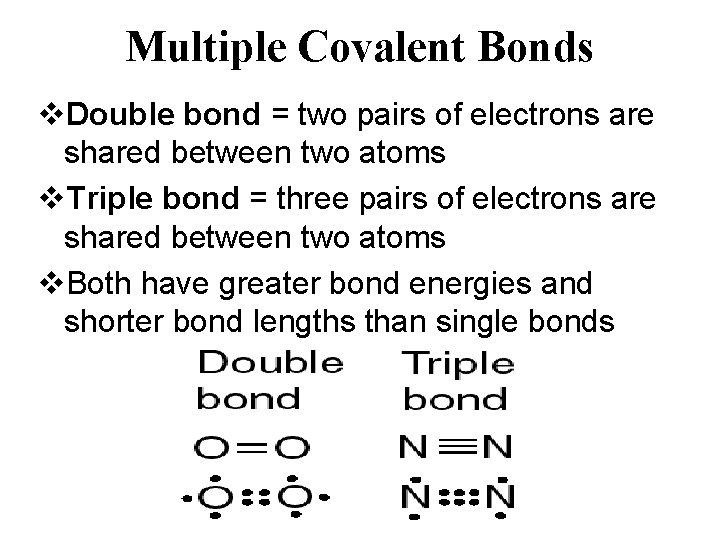
Multiple Covalent Bonds v. Double bond = two pairs of electrons are shared between two atoms v. Triple bond = three pairs of electrons are shared between two atoms v. Both have greater bond energies and shorter bond lengths than single bonds
How to Write Multiple Bond Lewis Structures 1. Follow steps 1 -3 from single-bond directions 2. Arrange the atoms to form a skeleton structure for the molecule and connect to atoms by e- pair bonds 3. Add unshared pairs of electrons to each nonmetal atom (except hydrogen) such that each is surrounded by eight electrons 4. Count the electrons in the Lewis structure to be sure that the # of valence electrons used equals the # available 5. If too many electrons have been used, subtract one or more lone pairs until the total number of valence e- is correct. Then move one or more lone e- pairs to existing bonds between non-hydrogen atoms until the outer shells of all atoms are completely filled
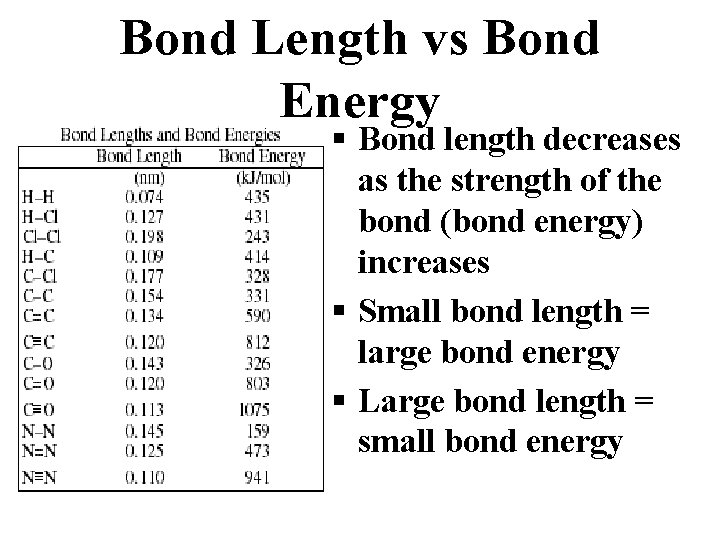
Bond Length vs Bond Energy § Bond length decreases as the strength of the bond (bond energy) increases § Small bond length = large bond energy § Large bond length = small bond energy
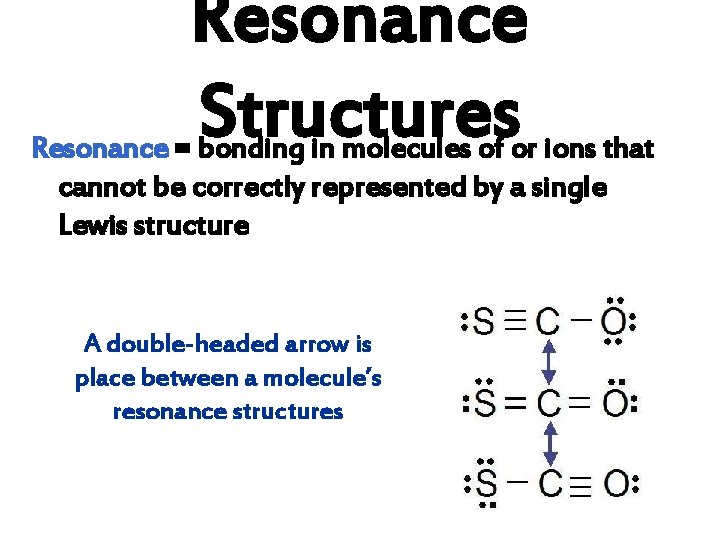
Resonance Structures Resonance = bonding in molecules of or ions that cannot be correctly represented by a single Lewis structure A double-headed arrow is place between a molecule’s resonance structures
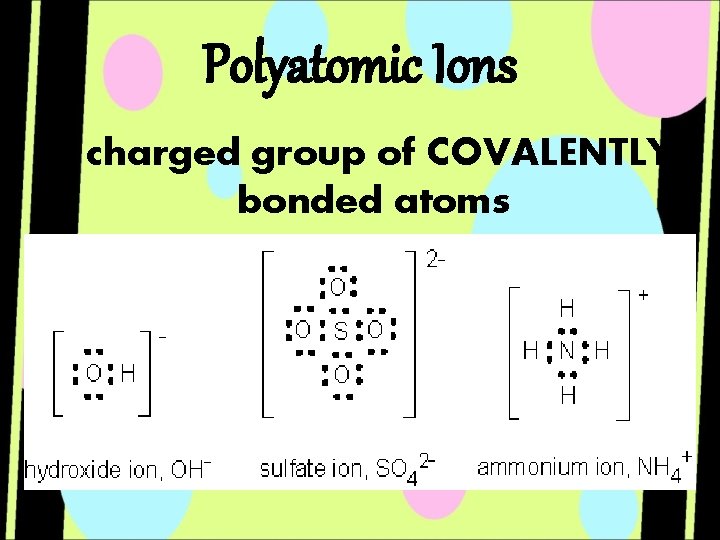
Polyatomic Ions A charged group of COVALENTLY bonded atoms
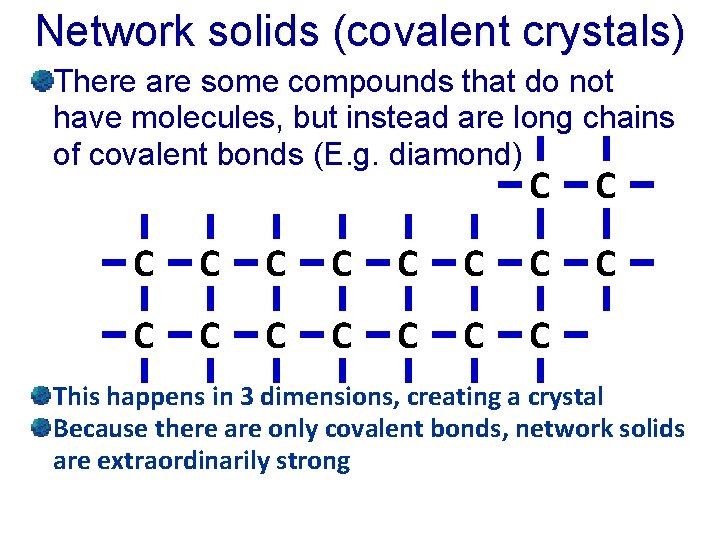
Network solids (covalent crystals) There are some compounds that do not have molecules, but instead are long chains of covalent bonds (E. g. diamond) C C C C C This happens in 3 dimensions, creating a crystal Because there are only covalent bonds, network solids are extraordinarily strong
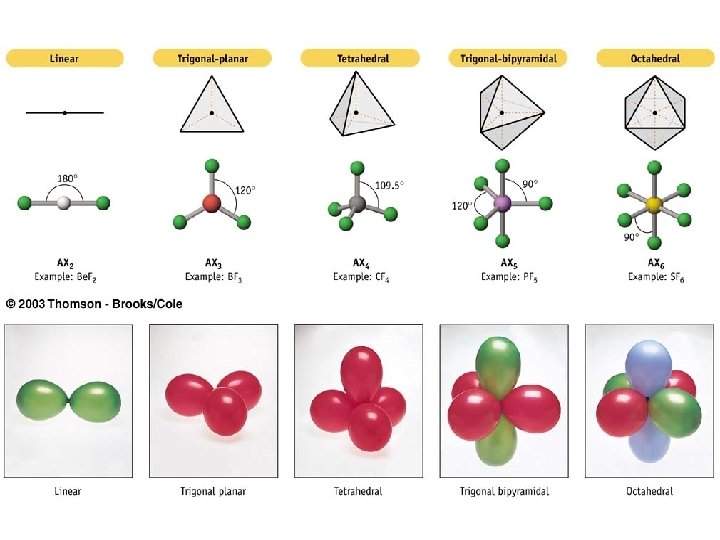
r a l cu e l o M Geom etry 3 -dimensional arrangement of a molecule’s atoms in space
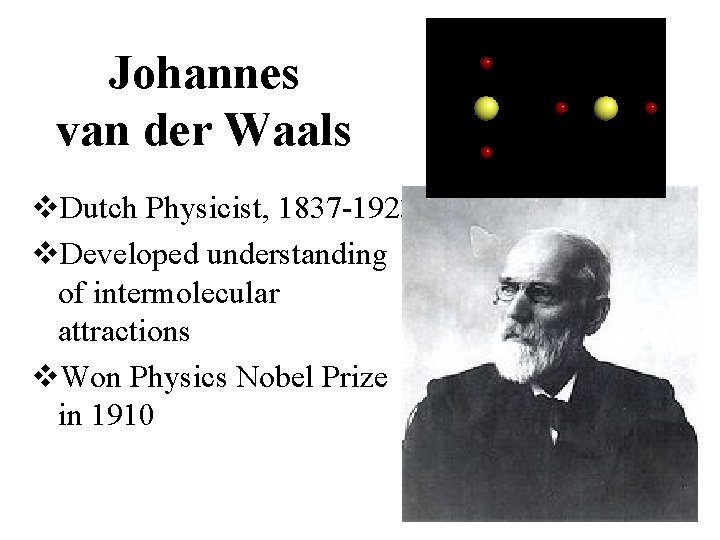
Johannes van der Waals v. Dutch Physicist, 1837 -1923 v. Developed understanding of intermolecular attractions v. Won Physics Nobel Prize in 1910
VSEPR Theory Valence-shell, Electron-pair, Repulsion Electron Pairs Repel Take positions to maximize separation. . . minimize repulsions Explains shape but not how orbitals change when bonding occurs
Hybridization Mixing of 2 or more atomic orbitals to produce new hybrid (changed) atomic orbitals Hybrid orbitals are named for the atomic orbitals that the electrons used to occupy Old orbitals energy = New hybrid orbitals energy
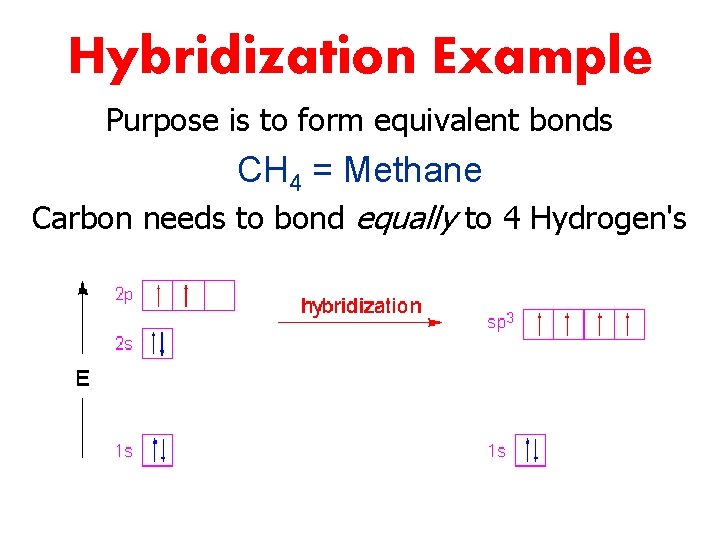
Hybridization Example Purpose is to form equivalent bonds CH 4 = Methane Carbon needs to bond equally to 4 Hydrogen's
Intermolecular Forces The force of attraction between molecules 1. Dipole-Dipole Forces 2. Hydrogen Bonding 3. London Dispersion Forces
Dipole-Dipole • Dipole = opposite charges that are equal and separated by a short distance (polar molecules exhibit dipoles) • Dipole-Dipole Forces occur between the molecules • Dipoles can induce polarity in a nonpolar molecule
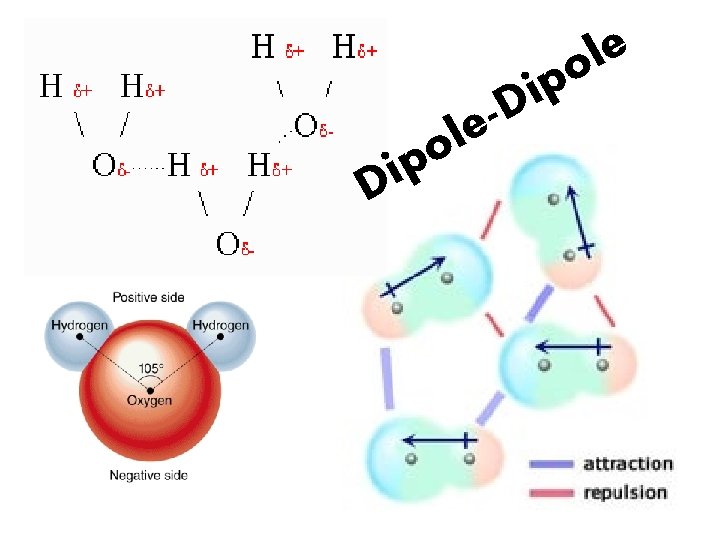
e l o p i -D p i D e l o
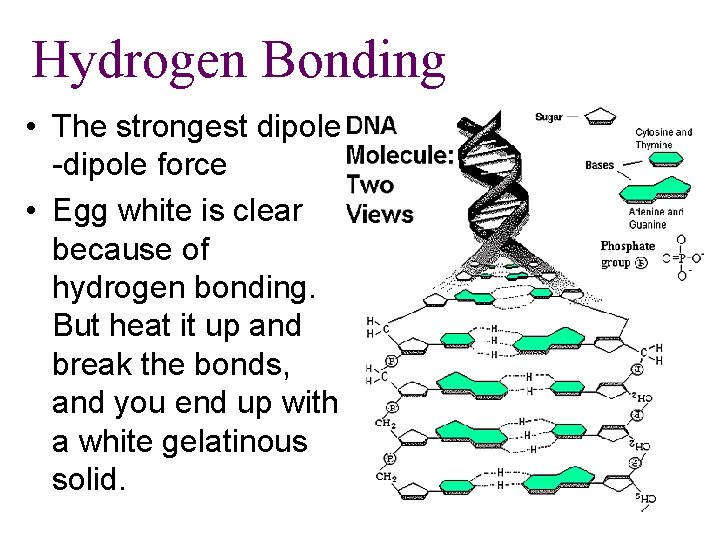
Hydrogen Bonding • The strongest dipole -dipole force • Egg white is clear because of hydrogen bonding. But heat it up and break the bonds, and you end up with a white gelatinous solid.
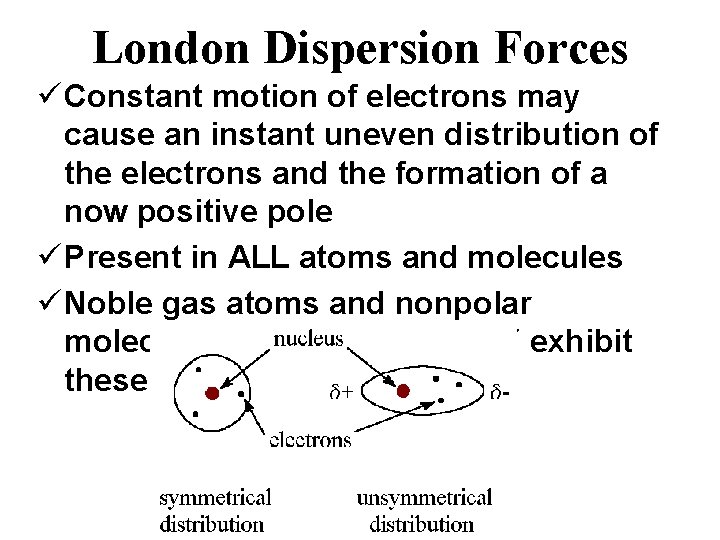
London Dispersion Forces ü Constant motion of electrons may cause an instant uneven distribution of the electrons and the formation of a now positive pole ü Present in ALL atoms and molecules ü Noble gas atoms and nonpolar molecules however can ONLY exhibit these forces
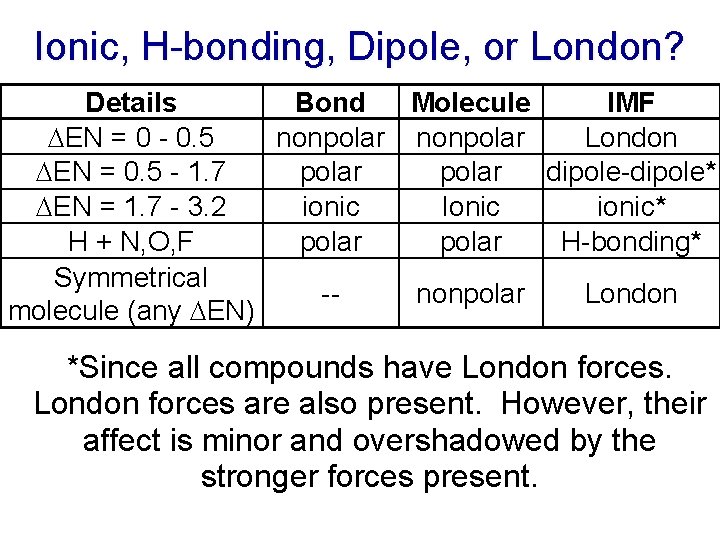
Ionic, H-bonding, Dipole, or London? Details Bond Molecule IMF EN = 0 - 0. 5 nonpolar London EN = 0. 5 - 1. 7 polar dipole-dipole* EN = 1. 7 - 3. 2 ionic Ionic ionic* H + N, O, F polar H-bonding* Symmetrical -nonpolar London molecule (any EN) *Since all compounds have London forces are also present. However, their affect is minor and overshadowed by the stronger forces present.
- Slides: 28