
Covalent bonding molecules Hydrogen H 2 g Chlorine
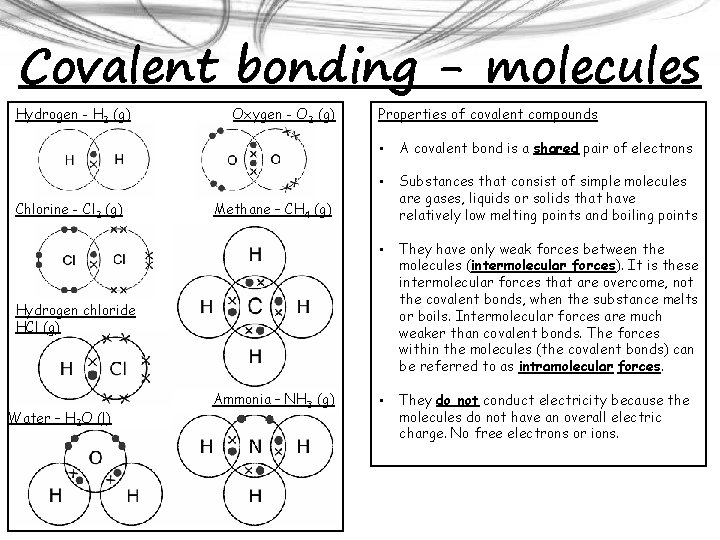
Covalent bonding - molecules Hydrogen - H 2 (g) Chlorine - Cl 2 (g) Oxygen - O 2 (g) Properties of covalent compounds • A covalent bond is a shared pair of electrons • Substances that consist of simple molecules are gases, liquids or solids that have relatively low melting points and boiling points • They have only weak forces between the molecules (intermolecular forces). It is these intermolecular forces that are overcome, not the covalent bonds, when the substance melts or boils. Intermolecular forces are much weaker than covalent bonds. The forces within the molecules (the covalent bonds) can be referred to as intramolecular forces. • They do not conduct electricity because the molecules do not have an overall electric charge. No free electrons or ions. Methane – CH 4 (g) Hydrogen chloride HCl (g) Water – H 2 O (l) Ammonia – NH 3 (g)
1. 2. 10 Questions Do covalent bonds transfer or share electrons? covalent bonds exist between. . (a) Metals and Non-metals, (b) Non metals and Non-metals (c) Metals and Metals 3. Elements in group 7 form covalent compounds with how many bonds? 4. Elements in group __ form covalent compounds with 3 bonds? 5. Why do covalent compounds NOT conduct electricity? 6. Are covalent bonds strong or weak? 7. Draw a diagram to show the electron arrangement in a carbon atom. 8. Draw a dot-cross diagram to show the bonding between 2 fluorine atoms 9. Draw a dot-cross diagram to show the bonding present in CH 4? 10. How many bonds does carbon form in CO 2? Covalent bonding - molecules
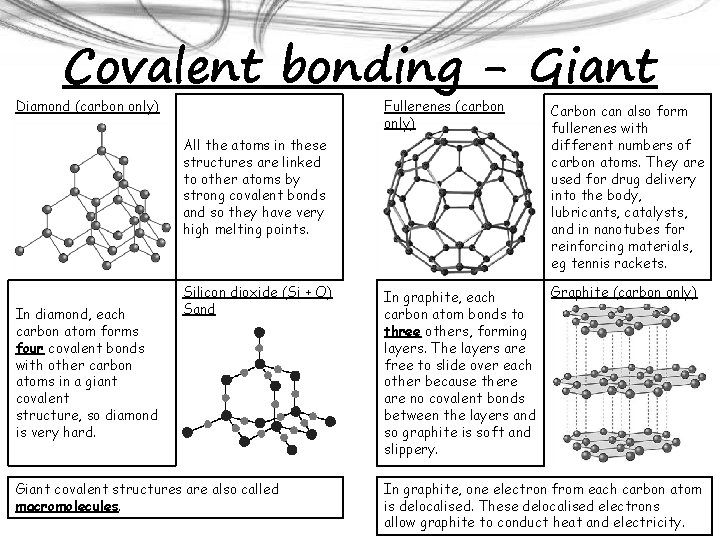
Covalent bonding - Giant Diamond (carbon only) Fullerenes (carbon only) Carbon can also form fullerenes with different numbers of carbon atoms. They are used for drug delivery into the body, lubricants, catalysts, and in nanotubes for reinforcing materials, eg tennis rackets. In graphite, each carbon atom bonds to three others, forming layers. The layers are free to slide over each other because there are no covalent bonds between the layers and so graphite is soft and slippery. Graphite (carbon only) All the atoms in these structures are linked to other atoms by strong covalent bonds and so they have very high melting points. In diamond, each carbon atom forms four covalent bonds with other carbon atoms in a giant covalent structure, so diamond is very hard. Silicon dioxide (Si + O) Sand Giant covalent structures are also called macromolecules. In graphite, one electron from each carbon atom is delocalised. These delocalised electrons allow graphite to conduct heat and electricity.
1. 2. 3. 4. 5. 6. 7. 8. 10 Questions How many bonds do carbon atoms form in diamond? How many bonds do carbon atoms form in graphite? Why is graphite soft and slippery? Why can graphite conduct electricity? What can diamond not conduct electricity? What is the chemical name for sand? Giant covalent structures are also called _____? Do giant covalent structures have high or low melting points? 9. Explain your answer to question 8. HT only 10. Give a use for fullerenes. Covalent bonding - Giant
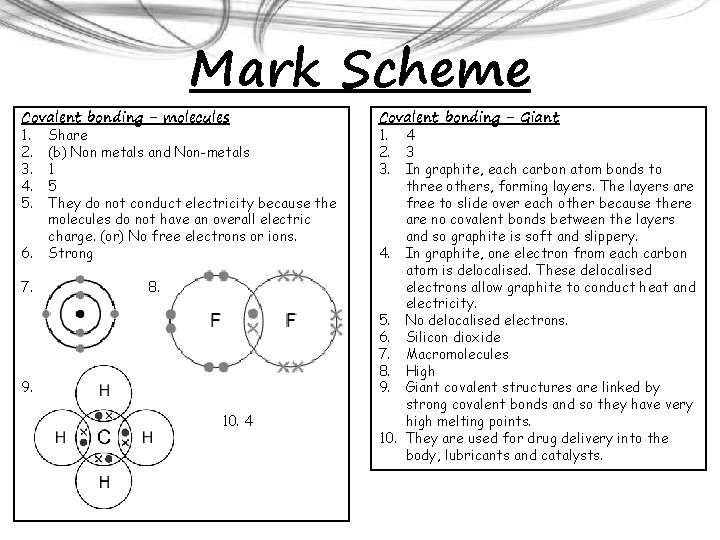
Mark Scheme Covalent bonding - molecules 1. Share 2. (b) Non metals and Non-metals 3. 1 4. 5 5. They do not conduct electricity because the molecules do not have an overall electric charge. (or) No free electrons or ions. 6. Strong 7. 8. 9. 10. 4 Covalent bonding - Giant 1. 4 2. 3 3. In graphite, each carbon atom bonds to three others, forming layers. The layers are free to slide over each other because there are no covalent bonds between the layers and so graphite is soft and slippery. 4. In graphite, one electron from each carbon atom is delocalised. These delocalised electrons allow graphite to conduct heat and electricity. 5. No delocalised electrons. 6. Silicon dioxide 7. Macromolecules 8. High 9. Giant covalent structures are linked by strong covalent bonds and so they have very high melting points. 10. They are used for drug delivery into the body, lubricants and catalysts.
- Slides: 5