
Covalent Bonding Ballandstick model 1 Bonds are Forces
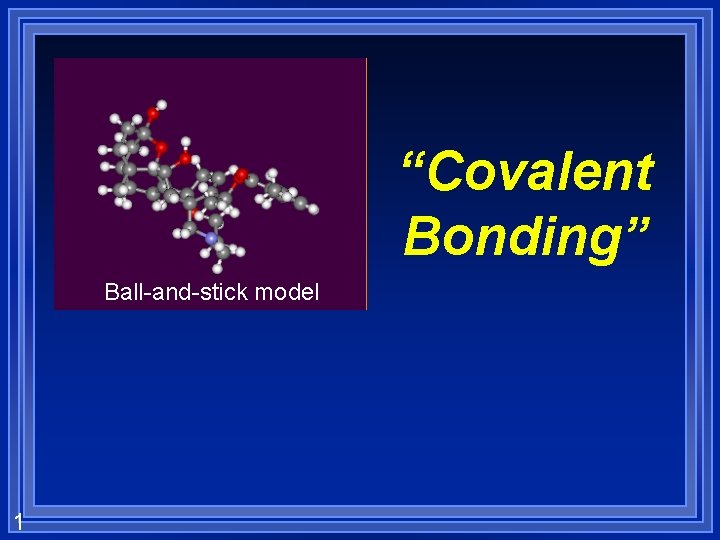
“Covalent Bonding” Ball-and-stick model 1
Bonds are… ü Forces that hold groups of atoms together and make them function as a unit. Two types: 1) Ionic bonds – transfer of electrons (gained or lost; makes formula unit) 2) Covalent bonds – sharing of electrons. The resulting particle is called a “molecule” 2
Covalent Bonds l The word covalent is a combination of the prefix co- (from Latin com, meaning “with” or together”), and the verb valere, meaning “to be strong”. “ l Two electrons shared together have the strength to hold two atoms together in a bond. 3
Molecules § Many elements found in nature are in the form of molecules: § a neutral group of atoms joined together by covalent bonds. § For example, air contains oxygen molecules, consisting of two oxygen atoms joined covalently § Called a “diatomic molecule” (O 2) 4

Covalent bonding l Fluorine has seven valence electrons (but would like to have 8) F 5

Covalent bonding l Fluorine has seven valence electrons l A second atom also has seven F 6 F
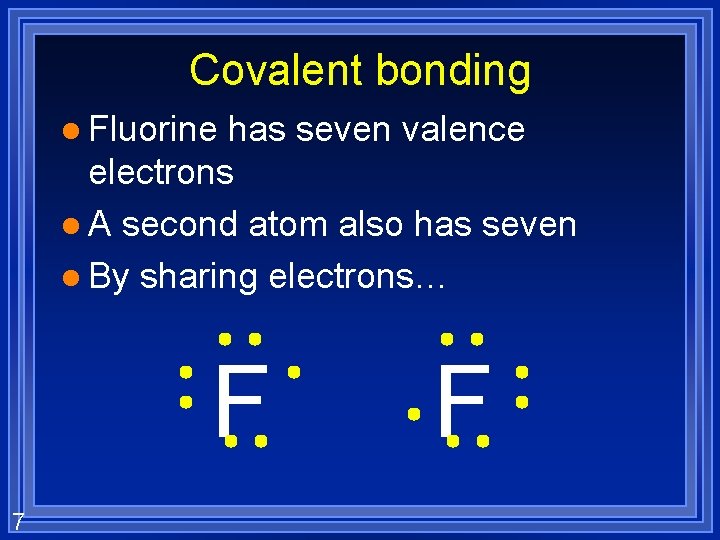
Covalent bonding l Fluorine has seven valence electrons l A second atom also has seven l By sharing electrons… F 7 F
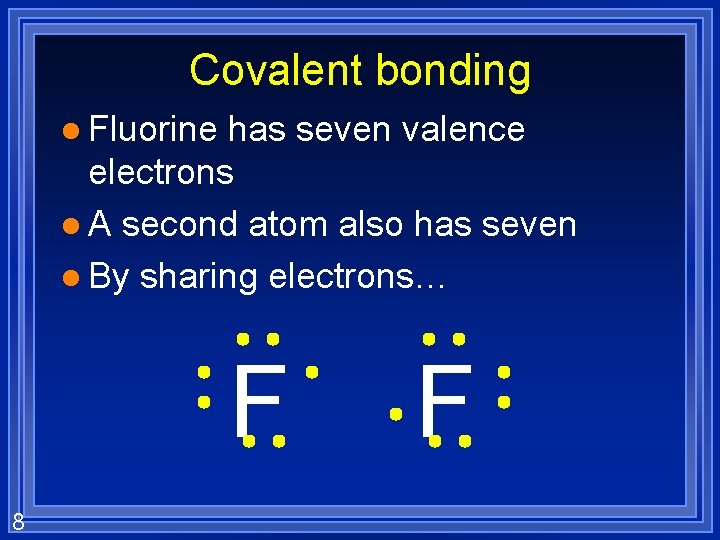
Covalent bonding l Fluorine has seven valence electrons l A second atom also has seven l By sharing electrons… F 8 F
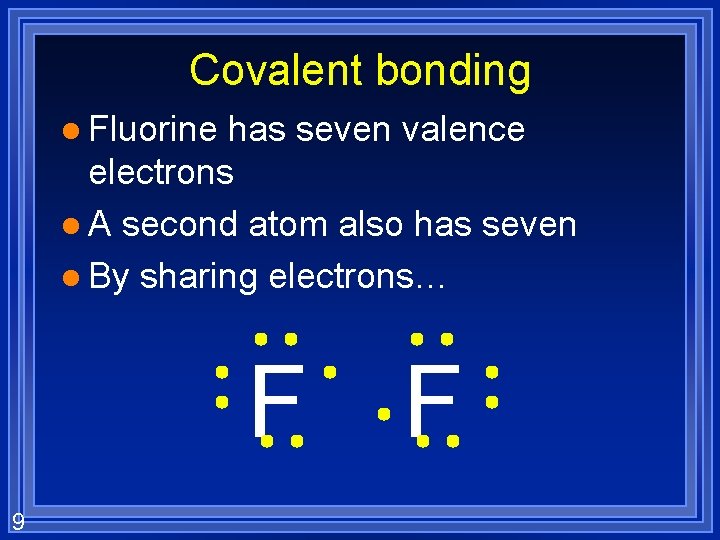
Covalent bonding l Fluorine has seven valence electrons l A second atom also has seven l By sharing electrons… F F 9
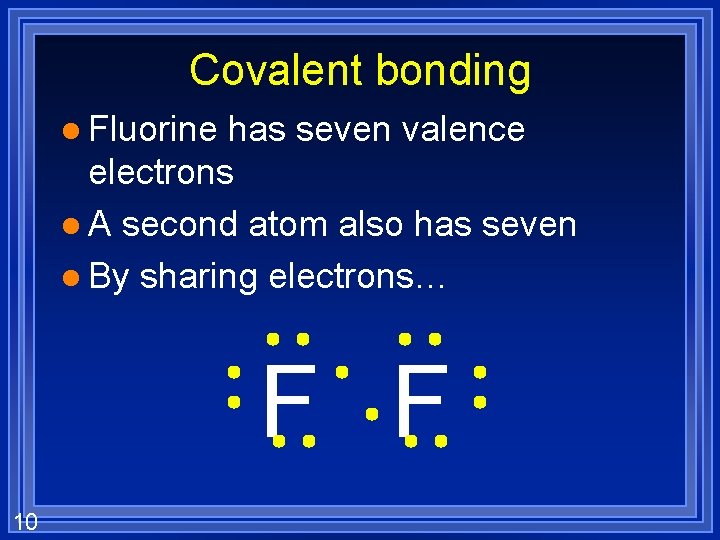
Covalent bonding l Fluorine has seven valence electrons l A second atom also has seven l By sharing electrons… F F 10
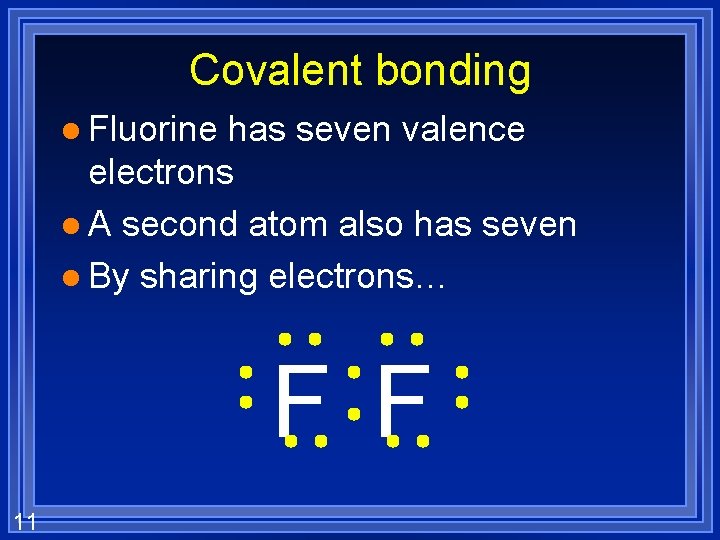
Covalent bonding l Fluorine has seven valence electrons l A second atom also has seven l By sharing electrons… F F 11
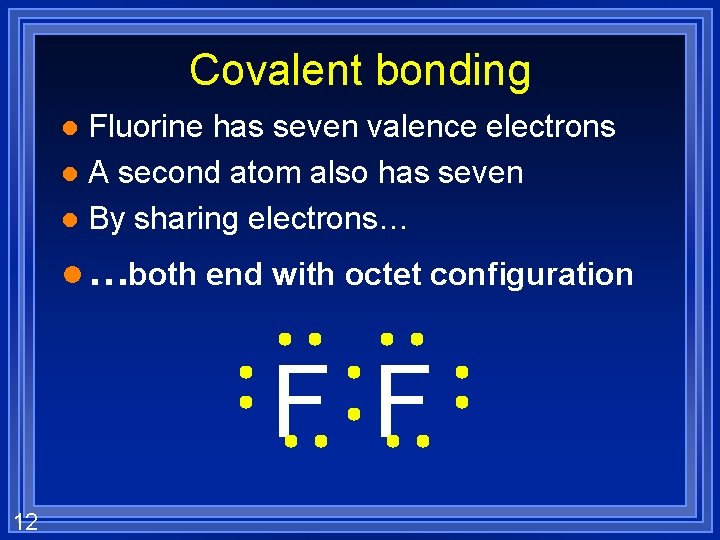
Covalent bonding Fluorine has seven valence electrons l A second atom also has seven l By sharing electrons… l l …both end with octet configuration F F 12

Covalent bonding Fluorine has seven valence electrons l A second atom also has seven l By sharing electrons… l …both end with full orbitals l F F 13 8 Valence electrons

Covalent bonding Fluorine has seven valence electrons l A second atom also has seven l By sharing electrons… l …both end with full orbitals l 8 Valence electrons 14 F F
Molecular Compounds l Compounds that are bonded covalently (like in water, or carbon dioxide) are called molecular compounds 15

A Single Covalent Bond is. . . l. A sharing of two valence electrons. l Only nonmetals and hydrogen. l Form molecules l Two atoms are joined together 16
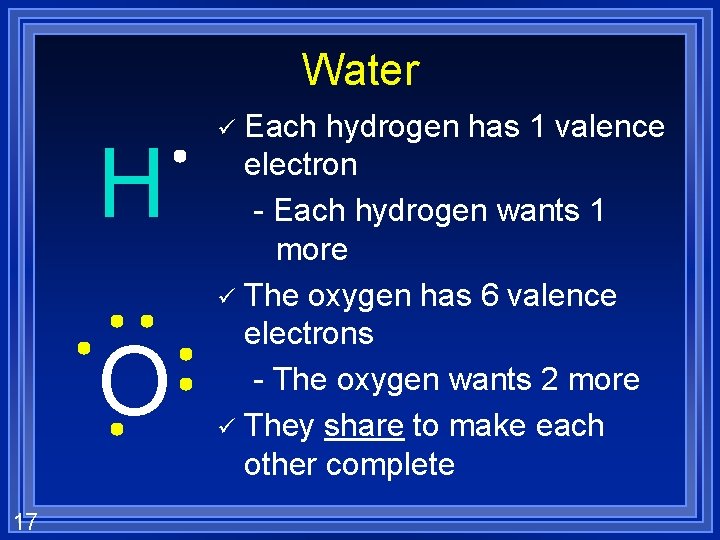
Water H O 17 Each hydrogen has 1 valence electron - Each hydrogen wants 1 more ü The oxygen has 6 valence electrons - The oxygen wants 2 more ü They share to make each other complete ü
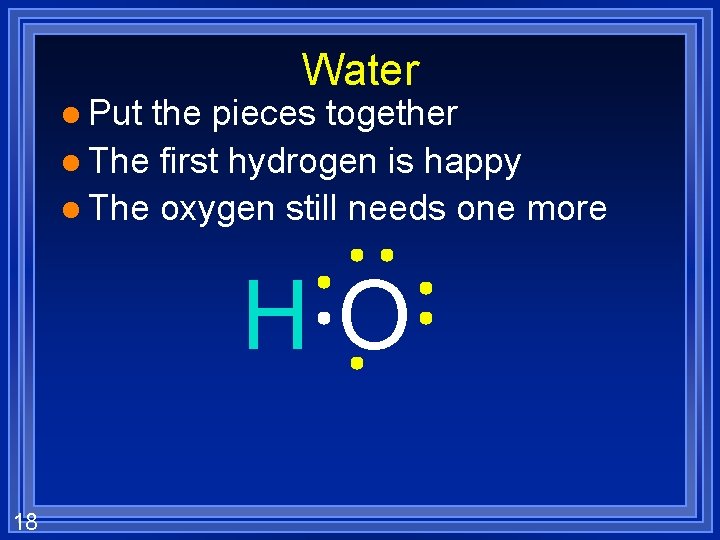
l Put Water the pieces together l The first hydrogen is happy l The oxygen still needs one more HO 18
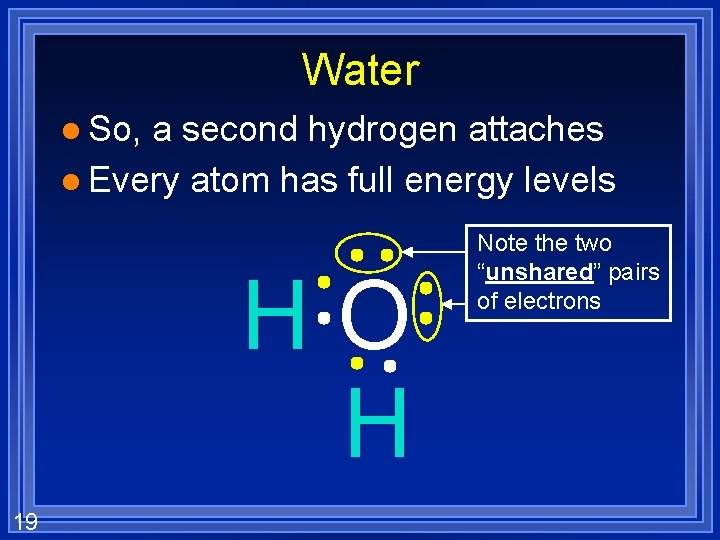
Water l So, a second hydrogen attaches l Every atom has full energy levels HO H 19 Note the two “unshared” pairs of electrons
Multiple Bonds l Sometimes atoms share more than one pair of valence electrons. l A double bond is when atoms share two pairs of electrons (4 total) l A triple bond is when atoms share three pairs of electrons (6 total) l These 7 elements as diatomic: Br 2 I 2 N 2 Cl 2 H 2 O 2 F 2 20
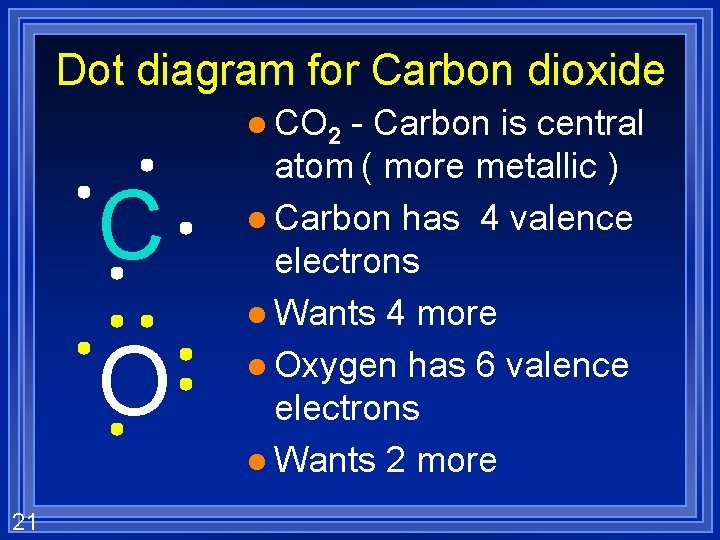
Dot diagram for Carbon dioxide l CO 2 C O 21 - Carbon is central atom ( more metallic ) l Carbon has 4 valence electrons l Wants 4 more l Oxygen has 6 valence electrons l Wants 2 more
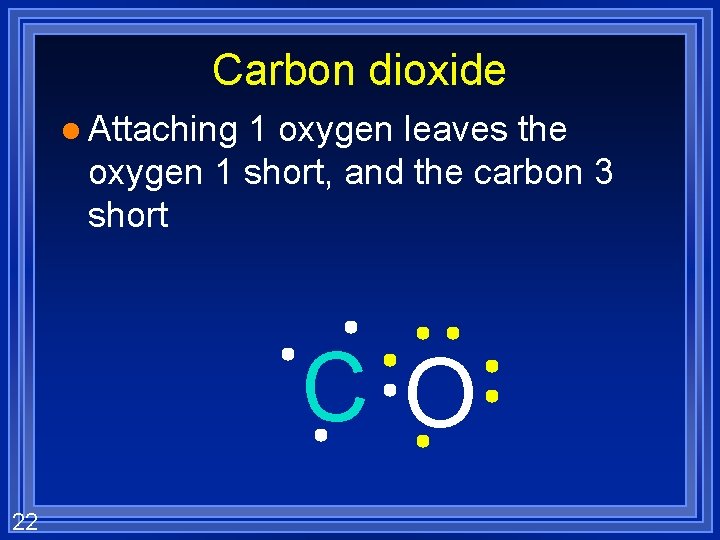
Carbon dioxide l Attaching 1 oxygen leaves the oxygen 1 short, and the carbon 3 short CO 22
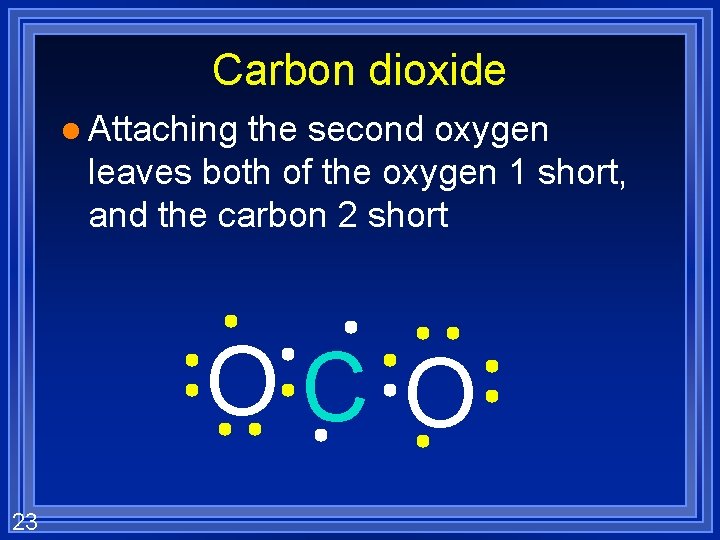
Carbon dioxide l Attaching the second oxygen leaves both of the oxygen 1 short, and the carbon 2 short OC O 23
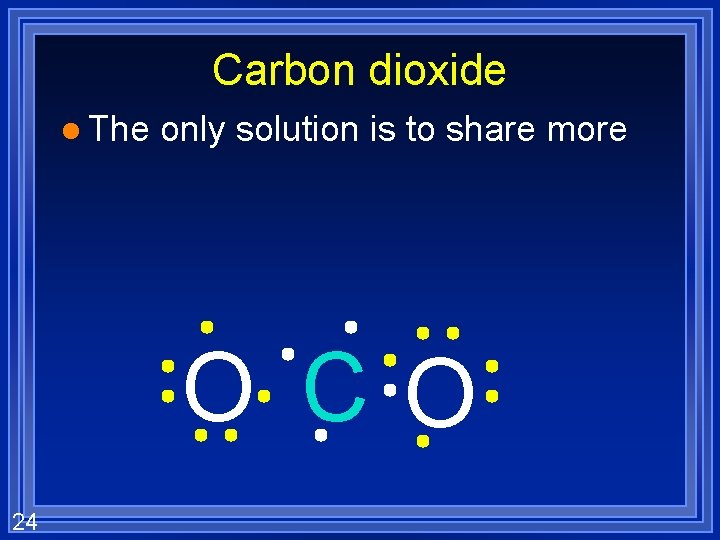
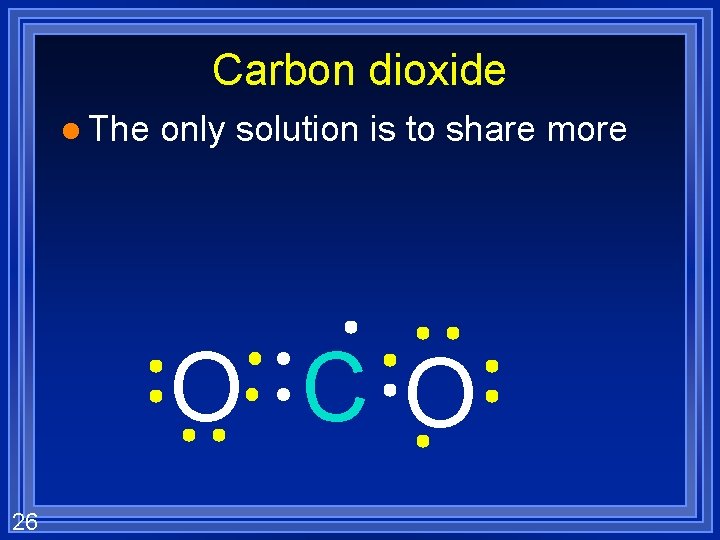
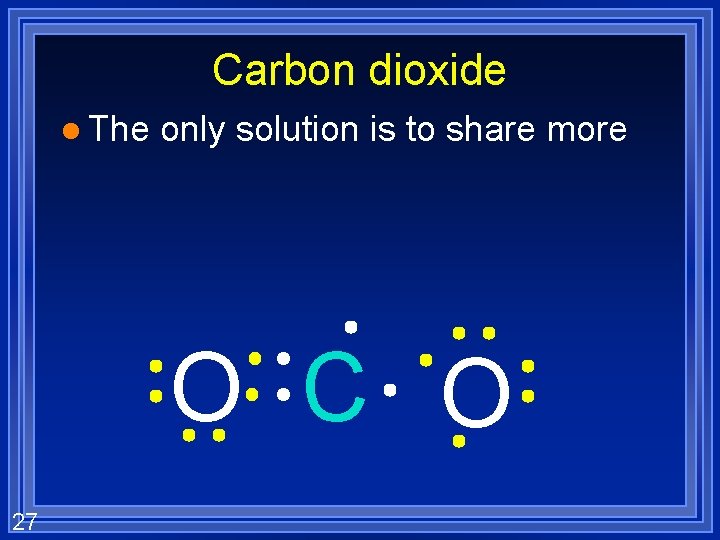
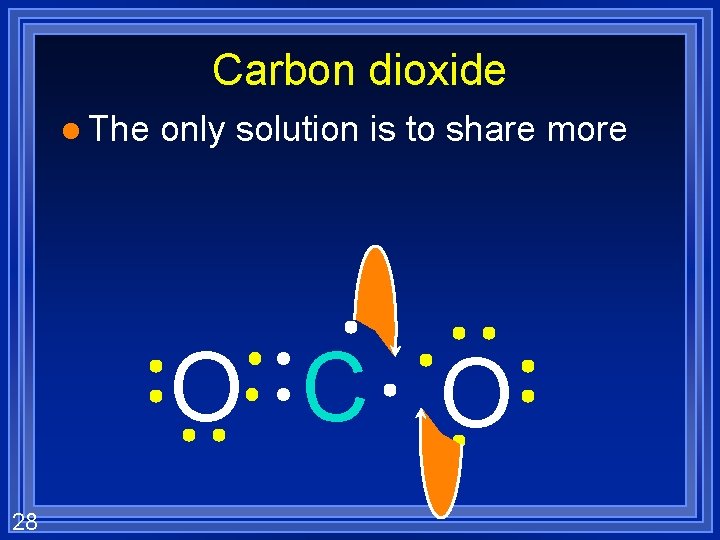
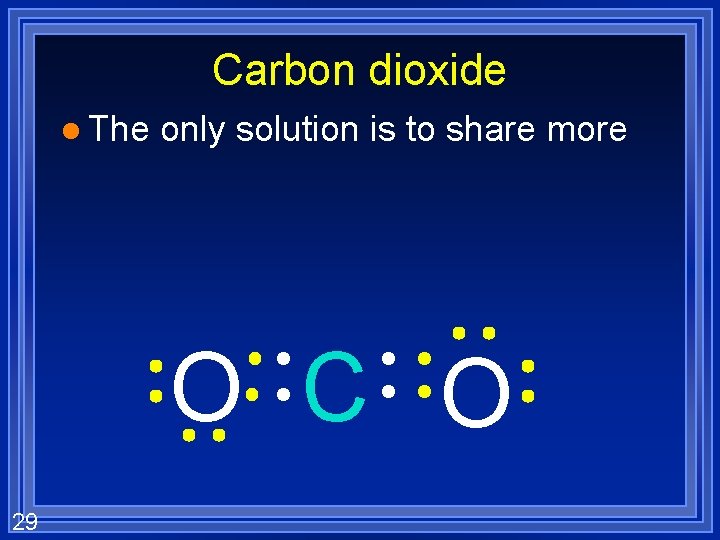
Carbon dioxide l The only solution is to share more O CO 24
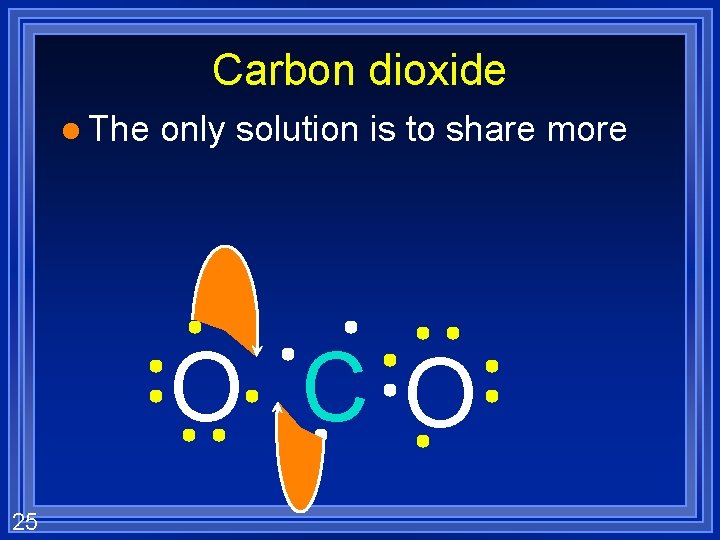
Carbon dioxide l The only solution is to share more O CO 25
Carbon dioxide l The only solution is to share more O CO 26
Carbon dioxide l The only solution is to share more O C O 27
Carbon dioxide l The only solution is to share more O C O 28
Carbon dioxide l The only solution is to share more O C O 29
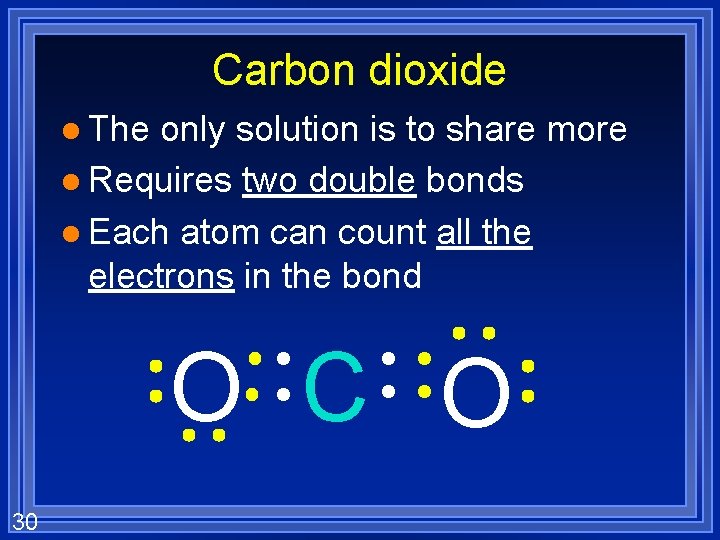
Carbon dioxide l The only solution is to share more l Requires two double bonds l Each atom can count all the electrons in the bond O C O 30
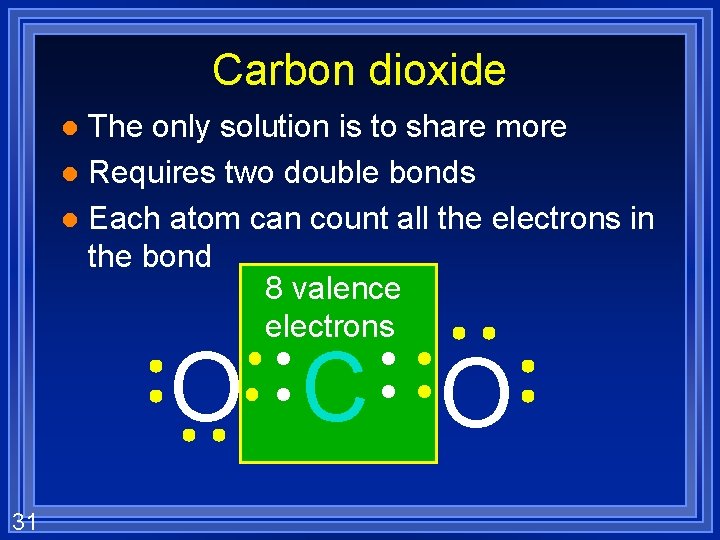
Carbon dioxide The only solution is to share more l Requires two double bonds l Each atom can count all the electrons in the bond 8 valence electrons l O C O 31
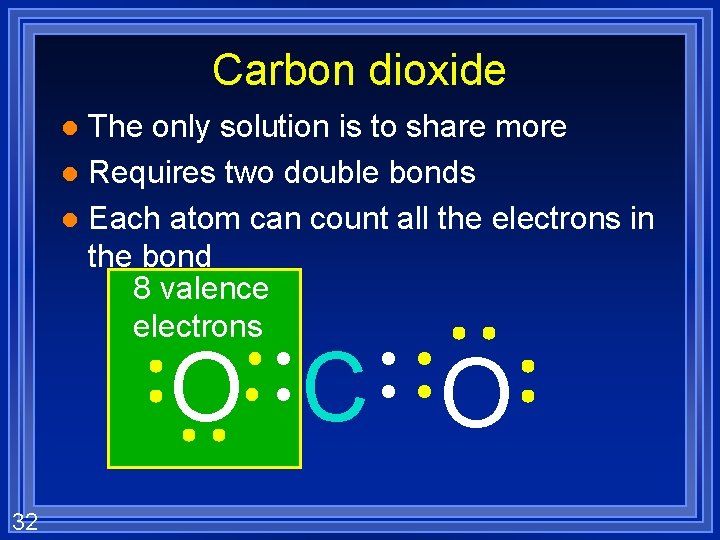
Carbon dioxide The only solution is to share more l Requires two double bonds l Each atom can count all the electrons in the bond 8 valence electrons l O C O 32
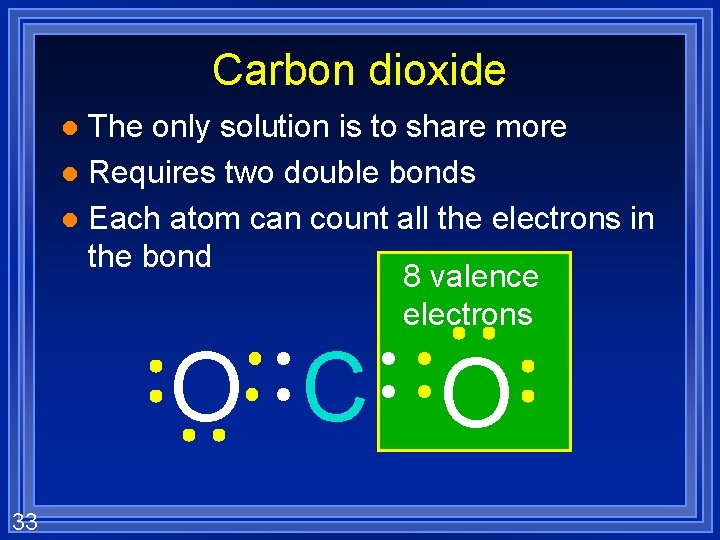
Carbon dioxide The only solution is to share more l Requires two double bonds l Each atom can count all the electrons in the bond 8 valence electrons l O C O 33
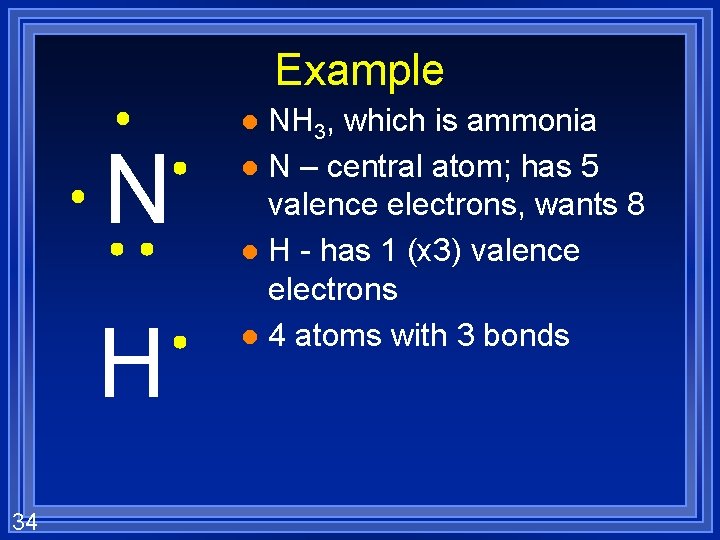
Example NH 3, which is ammonia l N – central atom; has 5 valence electrons, wants 8 l H - has 1 (x 3) valence electrons l 4 atoms with 3 bonds l N H 34
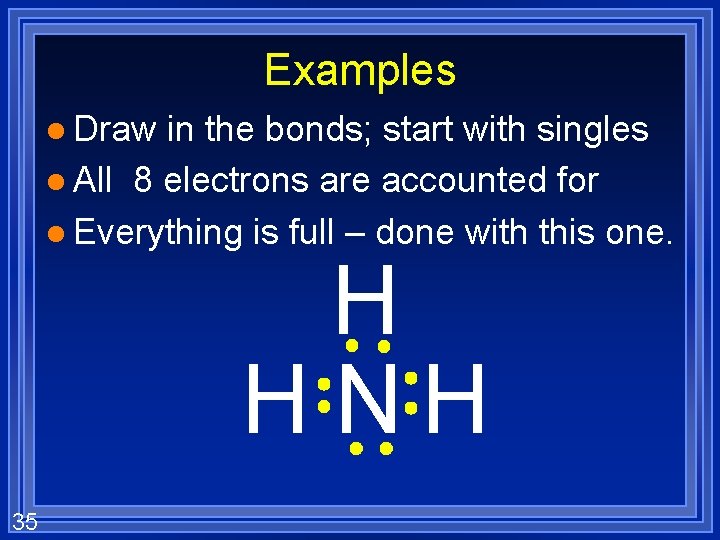
Examples l Draw in the bonds; start with singles l All 8 electrons are accounted for l Everything is full – done with this one. H H NH 35
Example: HCN: C is central atom l N - has 5 valence electrons, wants 8 l C - has 4 valence electrons, wants 8 l H - has 1 valence electron, wants 2 l 3 atoms with 4 bonds – this will require multiple bonds l 36
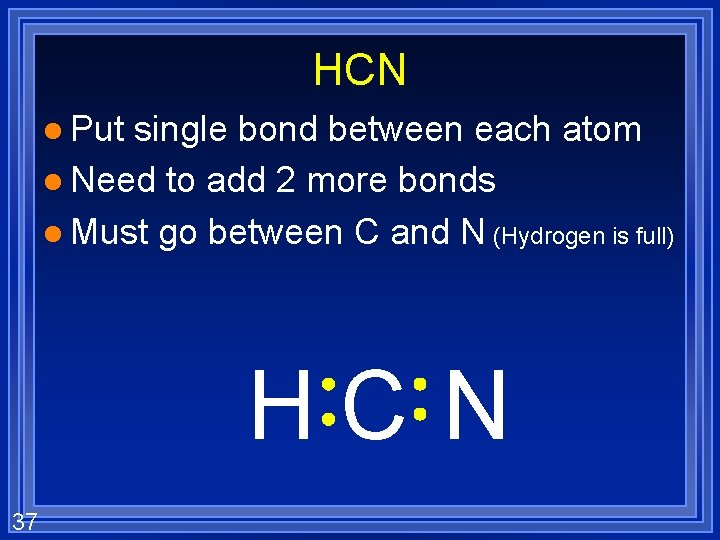
HCN l Put single bond between each atom l Need to add 2 more bonds l Must go between C and N (Hydrogen is full) HC N 37
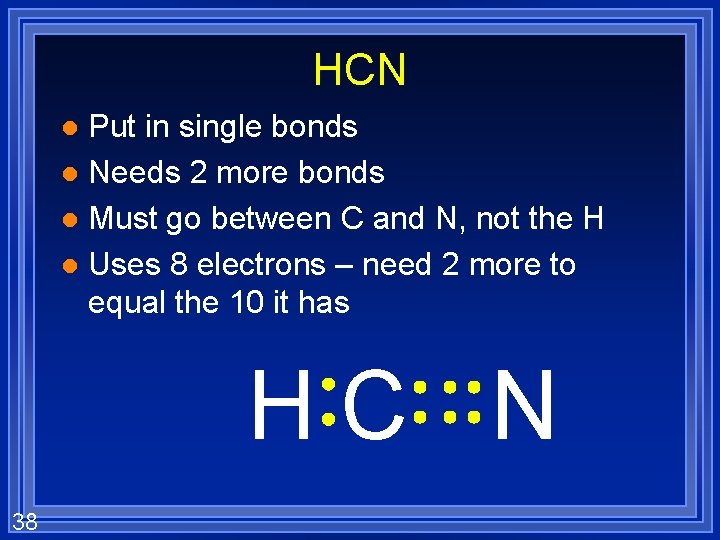
HCN Put in single bonds l Needs 2 more bonds l Must go between C and N, not the H l Uses 8 electrons – need 2 more to equal the 10 it has l HC N 38
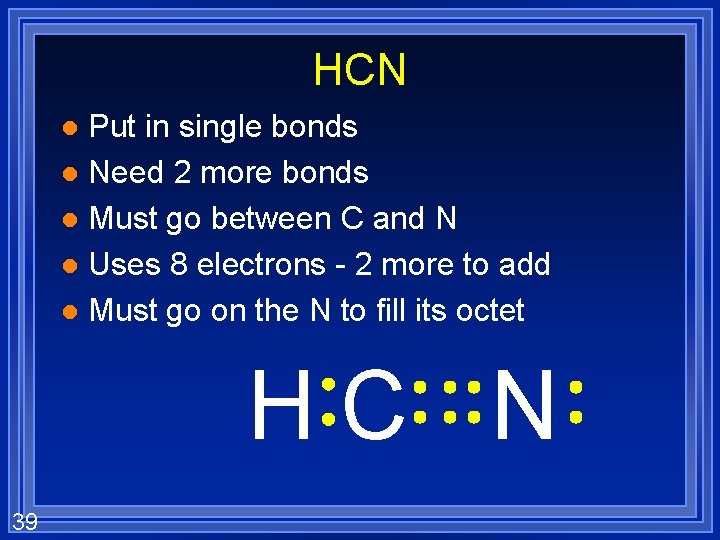
HCN Put in single bonds l Need 2 more bonds l Must go between C and N l Uses 8 electrons - 2 more to add l Must go on the N to fill its octet l HC N 39
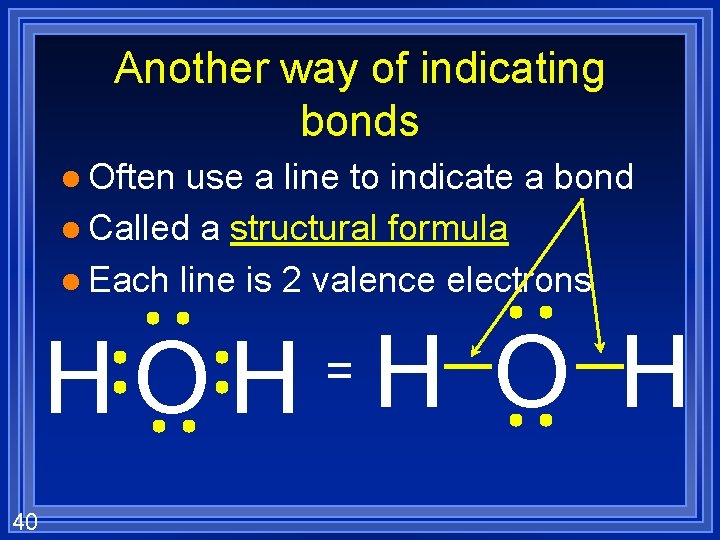
Another way of indicating bonds l Often use a line to indicate a bond l Called a structural formula l Each line is 2 valence electrons HOH H O H = 40
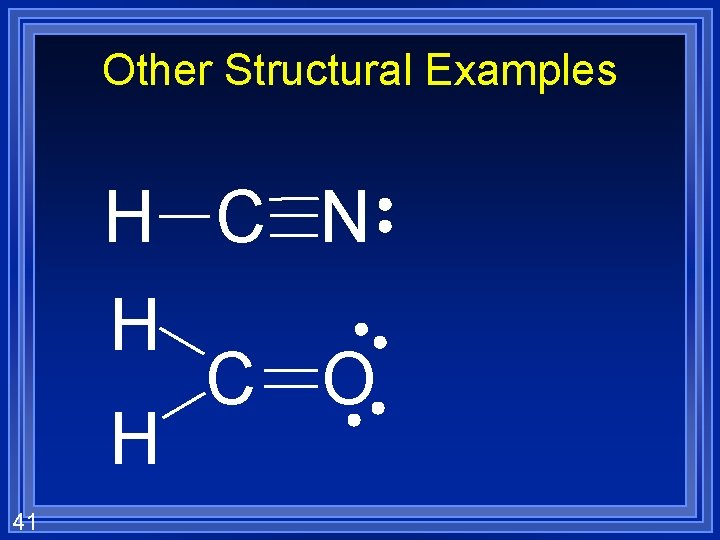
Other Structural Examples H C N H C O H 41
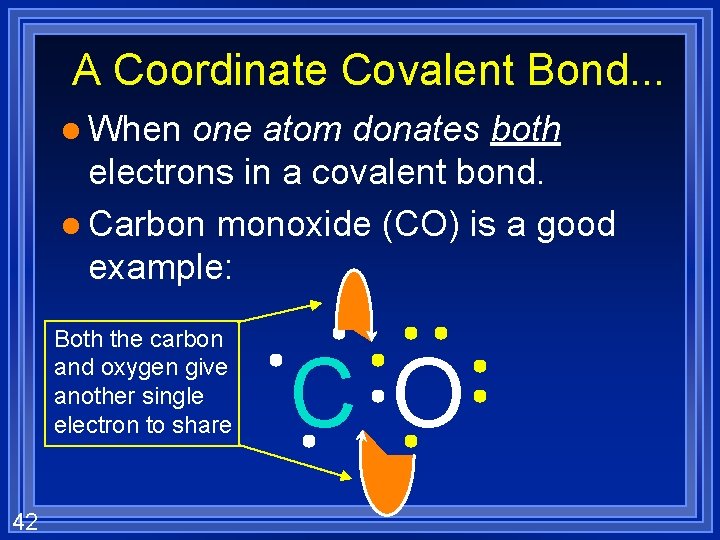
A Coordinate Covalent Bond. . . l When one atom donates both electrons in a covalent bond. l Carbon monoxide (CO) is a good example: Both the carbon and oxygen give another single electron to share 42 CO
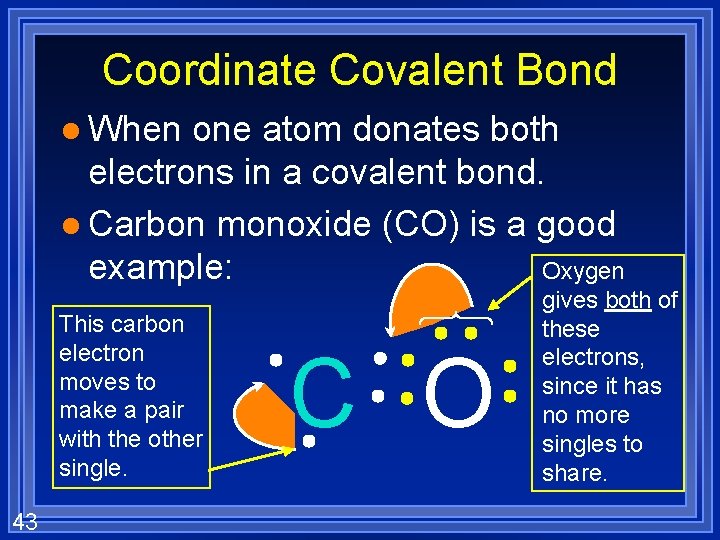
Coordinate Covalent Bond l When one atom donates both electrons in a covalent bond. l Carbon monoxide (CO) is a good example: Oxygen This carbon electron moves to make a pair with the other single. 43 C O gives both of these electrons, since it has no more singles to share.
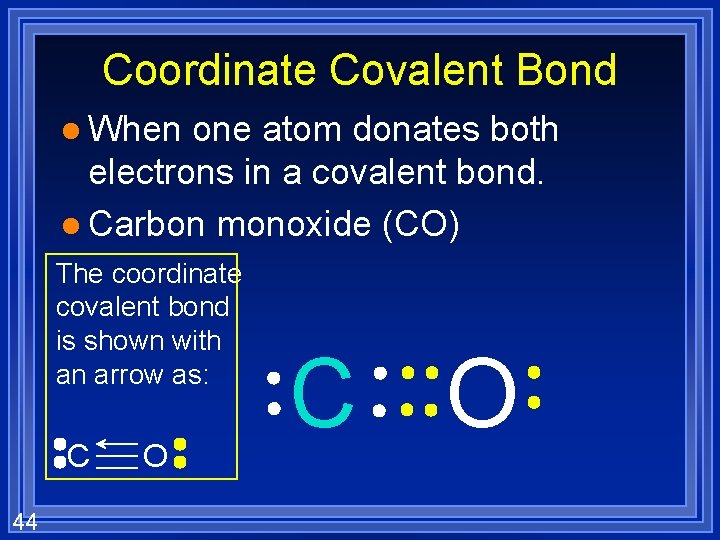
Coordinate Covalent Bond l When one atom donates both electrons in a covalent bond. l Carbon monoxide (CO) The coordinate covalent bond is shown with an arrow as: C 44 O C O

Covalent Network Compounds Some covalently bonded substances DO NOT form discrete molecules. Diamond, a network of covalently bonded carbon atoms 45 Graphite, a network of covalently bonded carbon atoms

46
- Slides: 46